biosecurity built on science
Disinfestation for market access
Lisa Jamieson
Scientist, Applied Entomology
Plant & Food Research
Plant Biosecurity Cooperative Research Centre
biosecurity built on science
Problem being addressed
 Quarantine pests causing disruption to the
trade of Australian and New Zealand
horticulture commodities
 Commodities that are hosts to quarantine
pests need protocols to access export
markets with quarantine barriers
 Develop treatments:
- effective against the pest
- maintain product quality
- fit in to transport and handling systems
(air-freight/sea-freight)
- cost effective
 Significant disinfestation R&D over the last
40 years
 Many protocols developed, some used
extensively, some not used at all
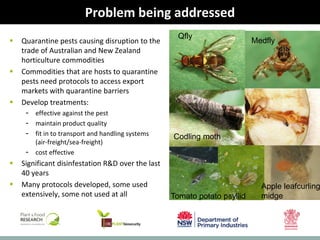
Qfly
Medfly
Codling moth
Tomato potato psyllid
Apple leafcurling
midge
biosecurity built on science
What are we doing about it?
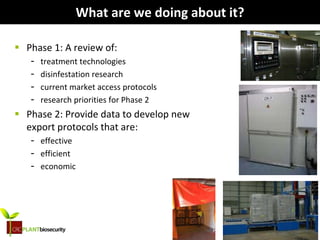
 Phase 1: A review of:
- treatment technologies
- disinfestation research
- current market access protocols
- research priorities for Phase 2
 Phase 2: Provide data to develop new
export protocols that are:
- effective
- efficient
- economic
biosecurity built on science
What are we doing about it?
 Need to review all the published and unpublished phytosanitary research
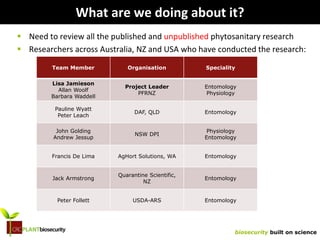
 Researchers across Australia, NZ and USA who have conducted the research:
Team Member Organisation Speciality
Lisa Jamieson
Allan Woolf
Barbara Waddell
Project Leader
PFRNZ
Entomology
Physiology
Pauline Wyatt
Peter Leach
DAF, QLD Entomology
John Golding
Andrew Jessup
NSW DPI
Physiology
Entomology
Francis De Lima AgHort Solutions, WA Entomology
Jack Armstrong
Quarantine Scientific,
NZ
Entomology
Peter Follett USDA-ARS Entomology
biosecurity built on science
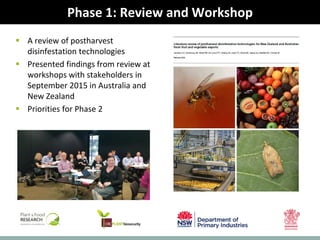
Phase 1: Review and Workshop
 A review of postharvest
disinfestation technologies
 Presented findings from review at
workshops with stakeholders in
September 2015 in Australia and
New Zealand
 Priorities for Phase 2
biosecurity built on science
Review of disinfestation technologies
 Fumigants
- 15 major, 18 minor fumigants, methyl bromide
 Energy treatments
- irradiation, electrical, microwave, radio frequency,
pulsed electrical field, infrared, cold plasma
 Controlled atmosphere (CA)
- CA plus heat, CA plus cold, CA plus high pressure
 Physical
- heat, cold, pressure, vacuum, brushing, high pressure
washing
 Systems approaches
biosecurity built on science
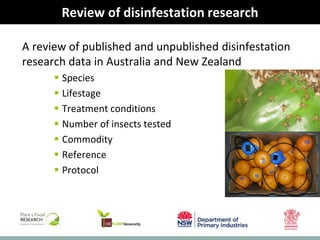
Review of disinfestation research
A review of published and unpublished disinfestation
research data in Australia and New Zealand
 Species
 Lifestage
 Treatment conditions
 Number of insects tested
 Commodity
 Reference
 Protocol
biosecurity built on science
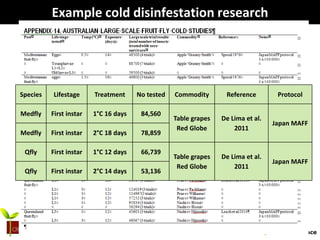
Example cold disinfestation research
Species Lifestage Treatment No tested Commodity Reference Protocol
Medfly First instar 1°C 16 days 84,560
Table grapes
Red Globe
De Lima et al.
2011
Japan MAFF
Medfly First instar 2°C 18 days 78,859
Qfly First instar 1°C 12 days 66,739
Table grapes
Red Globe
De Lima et al.
2011
Japan MAFF
Qfly First instar 2°C 14 days 53,136
biosecurity built on science
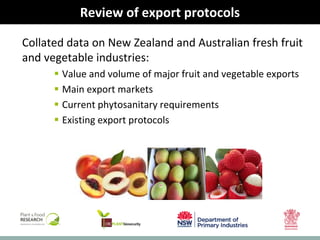
Review of export protocols
Collated data on New Zealand and Australian fresh fruit
and vegetable industries:
 Value and volume of major fruit and vegetable exports
 Main export markets
 Current phytosanitary requirements
 Existing export protocols
biosecurity built on science
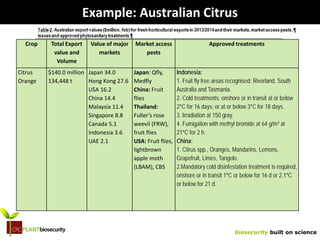
Example: Australian Citrus
Crop Total Export
value and
Volume
Value of major
markets
Market access
pests
Approved treatments
Citrus
Orange
$140.0 million
134,448 t
Japan 34.0
Hong Kong 27.6
USA 16.2
China 14.4
Malaysia 11.4
Singapore 8.8
Canada 5.1
Indonesia 3.6
UAE 2.1
Japan: Qfly,
Medfly
China: Fruit
flies
Thailand:
Fuller’s rose
weevil (FRW),
fruit flies
USA: Fruit flies,
lightbrown
apple moth
(LBAM), CBS
Indonesia:
1. Fruit fly free areas recognised: Riverland, South
Australia and Tasmania.
2. Cold treatments: onshore or in transit at or below
2°C for 16 days; or at or below 3°C for 18 days.
3. Irradiation at 150 gray.
4. Fumigation with methyl bromide at 64 g/m3 at
21°C for 2 h.
China:
1. Citrus spp., Oranges, Mandarins, Lemons,
Grapefruit, Limes, Tangelo.
2.Mandatory cold disinfestation treatment is required,
onshore or in transit 1°C or below for 16 d or 2.1°C
or below for 21 d.
biosecurity built on science
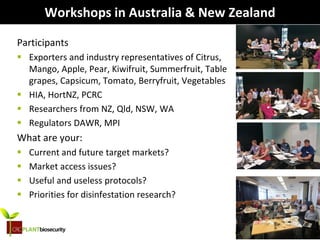
Workshops in Australia & New Zealand
Participants
 Exporters and industry representatives of Citrus,
Mango, Apple, Pear, Kiwifruit, Summerfruit, Table
grapes, Capsicum, Tomato, Berryfruit, Vegetables
 HIA, HortNZ, PCRC
 Researchers from NZ, Qld, NSW, WA
 Regulators DAWR, MPI
What are your:
 Current and future target markets?
 Market access issues?
 Useful and useless protocols?
 Priorities for disinfestation research?
biosecurity built on science
Stakeholder meetings in Australia & New Zealand
Several cross-industry priorities
 Fruit flies remain primary pests of
concern (Australia & New Zealand)
- Other pests: FRW, MSW, thrips,
mealybugs, scale insects, mites,
lightbrown apple moth, codling moth
 Development of postharvest
disinfestation treatments to enable
market access by air-freight
- Shorter cold treatments, irradiation, low-
dose methyl bromide
 Consistent cold treatments between
markets
 NZ fruit fly preparedness: collection of
efficacy data on 4 major fruit fly species
- Qfly, Medfly, Oriental fruit fly, Melon fruit fly
biosecurity built on science
Priorities for Phase 2
Compare cold mortality response data for Qfly, Medfly, Oriental
fruit fly and melon fruit fly across commodities and countries
• Collate mortality response data and conduct additional cold
studies
• Protocols developed and approved for fruit flies before they
establish in New Zealand and Australia
• Standardisation of cold treatments across markets
Develop new disinfestation protocols appropriate for air-freight
- Short cold treatments – combine with CA or low toxicity
compound (PBCRC)
- Linking with development of new disinfestation protocols for
irradiation and low-dose methyl bromide (HIA projects)
biosecurity built on science
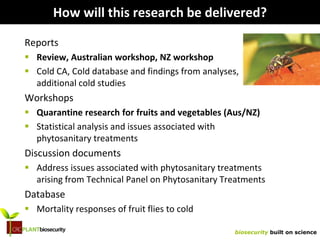
How will this research be delivered?
Reports
 Review, Australian workshop, NZ workshop
 Cold CA, Cold database and findings from analyses,
additional cold studies
Workshops
 Quarantine research for fruits and vegetables (Aus/NZ)
 Statistical analysis and issues associated with
phytosanitary treatments
Discussion documents
 Address issues associated with phytosanitary treatments
arising from Technical Panel on Phytosanitary Treatments
Database
 Mortality responses of fruit flies to cold
biosecurity built on science
Who will benefit from this research?
 Fruit and vegetable exporters and associated
businesses
 Producers of fruits and vegetables
 Product groups and horticultural industry
representative groups e.g. HIAL, HortNZ, PMAC,
PMA
 Regulators and risk assessors/managers, e.g. MPI,
DAFWA
 Researchers – better collaboration
biosecurity built on science
Benefit for our horticultural industries
Short term:
 Review and summary of disinfestation research that is
relevant to Australian and NZ horticultural industries
 Research priorities for the development of new effective
disinfestation treatments to safeguard Australian and NZ
horticulture
 Provision of data and recommendations for
implementing new effective postharvest treatments
 Maintaining and expanding capability in developing
phytosanitary treatments
Long term:
- New quarantine protocols developed
- Increased export trade of horticultural products
biosecurity built on science
End-User Advocate Perspective
 A high quality evaluation of postharvest market access
treatments
 Industry may have to rely less on true fumigants and
more on alternate methods of pest control in the
future
 Now a good opportunity to develop new export
protocol for key pests of quarantine concern as the 2nd
phase of the project
 New export protocol will need to be cost effective,
safe to use, and acceptable to our trading partners
biosecurity built on science
Future
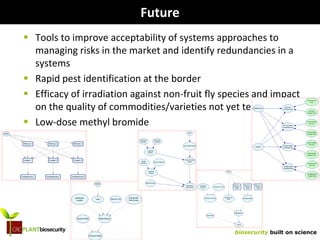
 Tools to improve acceptability of systems approaches to
managing risks in the market and identify redundancies in a
systems
 Rapid pest identification at the border
 Efficacy of irradiation against non-fruit fly species and impact
on the quality of commodities/varieties not yet tested
 Low-dose methyl bromide
biosecurity built on science
Thank you
For more information, please email
 Lisa.Jamieson@plantandfood.co.nz
Project team members:
 Pauline Wyatt, Peter Leach, DAF QLD
 John Golding, NSW DPI
 Frances De Lima, AgHort Solutions, WA
 Jack Armstrong, Quarantine Scientific, NZ
 Peter Follett, USDA-ARS, Hawaii
 Allan Woolf, Barbara Waddell, PFR NZ
PBCRC is established and supported under
the Australian Government Cooperative
Research Centres Programme

Disinfestation for market access

  • 1.
    biosecurity built onscience Disinfestation for market access Lisa Jamieson Scientist, Applied Entomology Plant & Food Research Plant Biosecurity Cooperative Research Centre
  • 2.
    biosecurity built onscience Problem being addressed  Quarantine pests causing disruption to the trade of Australian and New Zealand horticulture commodities  Commodities that are hosts to quarantine pests need protocols to access export markets with quarantine barriers  Develop treatments: - effective against the pest - maintain product quality - fit in to transport and handling systems (air-freight/sea-freight) - cost effective  Significant disinfestation R&D over the last 40 years  Many protocols developed, some used extensively, some not used at all Qfly Medfly Codling moth Tomato potato psyllid Apple leafcurling midge
  • 3.
    biosecurity built onscience What are we doing about it?  Phase 1: A review of: - treatment technologies - disinfestation research - current market access protocols - research priorities for Phase 2  Phase 2: Provide data to develop new export protocols that are: - effective - efficient - economic
  • 4.
    biosecurity built onscience What are we doing about it?  Need to review all the published and unpublished phytosanitary research  Researchers across Australia, NZ and USA who have conducted the research: Team Member Organisation Speciality Lisa Jamieson Allan Woolf Barbara Waddell Project Leader PFRNZ Entomology Physiology Pauline Wyatt Peter Leach DAF, QLD Entomology John Golding Andrew Jessup NSW DPI Physiology Entomology Francis De Lima AgHort Solutions, WA Entomology Jack Armstrong Quarantine Scientific, NZ Entomology Peter Follett USDA-ARS Entomology
  • 5.
    biosecurity built onscience Phase 1: Review and Workshop  A review of postharvest disinfestation technologies  Presented findings from review at workshops with stakeholders in September 2015 in Australia and New Zealand  Priorities for Phase 2
  • 6.
    biosecurity built onscience Review of disinfestation technologies  Fumigants - 15 major, 18 minor fumigants, methyl bromide  Energy treatments - irradiation, electrical, microwave, radio frequency, pulsed electrical field, infrared, cold plasma  Controlled atmosphere (CA) - CA plus heat, CA plus cold, CA plus high pressure  Physical - heat, cold, pressure, vacuum, brushing, high pressure washing  Systems approaches
  • 7.
    biosecurity built onscience Review of disinfestation research A review of published and unpublished disinfestation research data in Australia and New Zealand  Species  Lifestage  Treatment conditions  Number of insects tested  Commodity  Reference  Protocol
  • 8.
    biosecurity built onscience Example cold disinfestation research Species Lifestage Treatment No tested Commodity Reference Protocol Medfly First instar 1°C 16 days 84,560 Table grapes Red Globe De Lima et al. 2011 Japan MAFF Medfly First instar 2°C 18 days 78,859 Qfly First instar 1°C 12 days 66,739 Table grapes Red Globe De Lima et al. 2011 Japan MAFF Qfly First instar 2°C 14 days 53,136
  • 9.
    biosecurity built onscience Review of export protocols Collated data on New Zealand and Australian fresh fruit and vegetable industries:  Value and volume of major fruit and vegetable exports  Main export markets  Current phytosanitary requirements  Existing export protocols
  • 10.
    biosecurity built onscience Example: Australian Citrus Crop Total Export value and Volume Value of major markets Market access pests Approved treatments Citrus Orange $140.0 million 134,448 t Japan 34.0 Hong Kong 27.6 USA 16.2 China 14.4 Malaysia 11.4 Singapore 8.8 Canada 5.1 Indonesia 3.6 UAE 2.1 Japan: Qfly, Medfly China: Fruit flies Thailand: Fuller’s rose weevil (FRW), fruit flies USA: Fruit flies, lightbrown apple moth (LBAM), CBS Indonesia: 1. Fruit fly free areas recognised: Riverland, South Australia and Tasmania. 2. Cold treatments: onshore or in transit at or below 2°C for 16 days; or at or below 3°C for 18 days. 3. Irradiation at 150 gray. 4. Fumigation with methyl bromide at 64 g/m3 at 21°C for 2 h. China: 1. Citrus spp., Oranges, Mandarins, Lemons, Grapefruit, Limes, Tangelo. 2.Mandatory cold disinfestation treatment is required, onshore or in transit 1°C or below for 16 d or 2.1°C or below for 21 d.
  • 11.
    biosecurity built onscience Workshops in Australia & New Zealand Participants  Exporters and industry representatives of Citrus, Mango, Apple, Pear, Kiwifruit, Summerfruit, Table grapes, Capsicum, Tomato, Berryfruit, Vegetables  HIA, HortNZ, PCRC  Researchers from NZ, Qld, NSW, WA  Regulators DAWR, MPI What are your:  Current and future target markets?  Market access issues?  Useful and useless protocols?  Priorities for disinfestation research?
  • 12.
    biosecurity built onscience Stakeholder meetings in Australia & New Zealand Several cross-industry priorities  Fruit flies remain primary pests of concern (Australia & New Zealand) - Other pests: FRW, MSW, thrips, mealybugs, scale insects, mites, lightbrown apple moth, codling moth  Development of postharvest disinfestation treatments to enable market access by air-freight - Shorter cold treatments, irradiation, low- dose methyl bromide  Consistent cold treatments between markets  NZ fruit fly preparedness: collection of efficacy data on 4 major fruit fly species - Qfly, Medfly, Oriental fruit fly, Melon fruit fly
  • 13.
    biosecurity built onscience Priorities for Phase 2 Priorities for Phase 2 Compare cold mortality response data for Qfly, Medfly, Oriental fruit fly and melon fruit fly across commodities and countries • Collate mortality response data and conduct additional cold studies • Protocols developed and approved for fruit flies before they establish in New Zealand and Australia • Standardisation of cold treatments across markets Develop new disinfestation protocols appropriate for air-freight - Short cold treatments – combine with CA or low toxicity compound (PBCRC) - Linking with development of new disinfestation protocols for irradiation and low-dose methyl bromide (HIA projects)
  • 14.
    biosecurity built onscience How will this research be delivered? Reports  Review, Australian workshop, NZ workshop  Cold CA, Cold database and findings from analyses, additional cold studies Workshops  Quarantine research for fruits and vegetables (Aus/NZ)  Statistical analysis and issues associated with phytosanitary treatments Discussion documents  Address issues associated with phytosanitary treatments arising from Technical Panel on Phytosanitary Treatments Database  Mortality responses of fruit flies to cold
  • 15.
    biosecurity built onscience Who will benefit from this research?  Fruit and vegetable exporters and associated businesses  Producers of fruits and vegetables  Product groups and horticultural industry representative groups e.g. HIAL, HortNZ, PMAC, PMA  Regulators and risk assessors/managers, e.g. MPI, DAFWA  Researchers – better collaboration
  • 16.
    biosecurity built onscience Benefit for our horticultural industries Short term:  Review and summary of disinfestation research that is relevant to Australian and NZ horticultural industries  Research priorities for the development of new effective disinfestation treatments to safeguard Australian and NZ horticulture  Provision of data and recommendations for implementing new effective postharvest treatments  Maintaining and expanding capability in developing phytosanitary treatments Long term: - New quarantine protocols developed - Increased export trade of horticultural products
  • 17.
    biosecurity built onscience End-User Advocate Perspective  A high quality evaluation of postharvest market access treatments  Industry may have to rely less on true fumigants and more on alternate methods of pest control in the future  Now a good opportunity to develop new export protocol for key pests of quarantine concern as the 2nd phase of the project  New export protocol will need to be cost effective, safe to use, and acceptable to our trading partners
  • 18.
    biosecurity built onscience Future  Tools to improve acceptability of systems approaches to managing risks in the market and identify redundancies in a systems  Rapid pest identification at the border  Efficacy of irradiation against non-fruit fly species and impact on the quality of commodities/varieties not yet tested  Low-dose methyl bromide
  • 19.
    biosecurity built onscience Thank you For more information, please email  Lisa.Jamieson@plantandfood.co.nz Project team members:  Pauline Wyatt, Peter Leach, DAF QLD  John Golding, NSW DPI  Frances De Lima, AgHort Solutions, WA  Jack Armstrong, Quarantine Scientific, NZ  Peter Follett, USDA-ARS, Hawaii  Allan Woolf, Barbara Waddell, PFR NZ PBCRC is established and supported under the Australian Government Cooperative Research Centres Programme