biosecurity built on science
Plant Biosecurity Cooperative Research Centre
Project 2014
Part A: New tools for field grains surveillance
Jenny Davidson: Senior Plant Pathologist (SARDI)
Rohan Kimber: Plant Pathologist (SARDI)
Greg Baker: Entomologist (SARDI)
Helen De Graaf: Entomologist (SARDI)
Les Zeller: Engineer (USQ)
Paul Kamel: Engineer (USQ)
biosecurity built on science
New opportunities for pest & disease surveillance using new technologies & sensing systems
 Broad scale surveillance (coordinated network)
Detect & report endemic or exotic incursions of fungal spores / insects in the field to the decision
maker or grower community
 Local (on farm) outbreaks
 Regional threats (e.g. rusts)
 National interests (biosecurity)
Project 2014 – New tools for field grains surveillance and diagnostics of high priority exotic pests
New technology & opportunities
biosecurity built on science
New technology & opportunitiesTechnologies implemented
• Species specific detection – qPCR, Pheromone lures (stacking)
• Sensors - optical, impact & digital to confirm target
• Smart capture – GPS, environment or diurnal triggers
• Wireless / telemetry networked grid & transmission
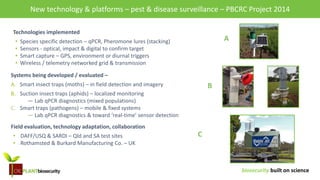
Systems being developed / evaluated –
A. Smart insect traps (moths) – in field detection and imagery
B. Suction insect traps (aphids) – localized monitoring
― Lab qPCR diagnostics (mixed populations)
C. Smart traps (pathogens) – mobile & fixed systems
— Lab qPCR diagnostics & toward ‘real-time’ sensor detection
Field evaluation, technology adaptation, collaboration
• DAFF/USQ & SARDI – Qld and SA test sites
• Rothamsted & Burkard Manufacturing Co. – UK
Research & opportunities – Surveillance and New technologiesNew technology & platforms – pest & disease surveillance – PBCRC Project 2014
B
C
A
biosecurity built on science
Research & opportunities – Surveillance and New technologies
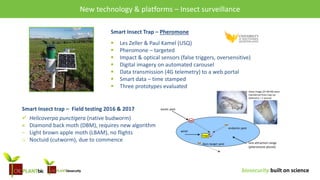
Smart Insect Trap – Pheromone
 Les Zeller & Paul Kamel (USQ)
 Pheromone – targeted
 Impact & optical sensors (false triggers, oversensitive)
 Digital imagery on automated carousel
 Data transmission (4G telemetry) to a web portal
 Smart data – time stamped
 Three prototypes evaluated
these image (25-80 KB) were
transferred from trap via
telemetry < 1 second
trap
wind
lure attraction range
(pheromone plume)
exotic pest
endemic pest
Non-target pest
Smart Insect trap – Field testing 2016 & 2017
 Helicoverpa punctigera (native budworm)
× Diamond back moth (DBM), requires new algorithm
− Light brown apple moth (LBAM), no flights
o Noctuid (cutworm), due to commence
New technology & platforms – Insect surveillance
biosecurity built on science
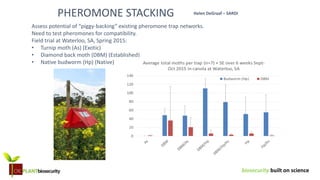
PHEROMONE STACKING
Assess potential of “piggy-backing” existing pheromone trap networks.
Need to test pheromones for compatibility.
Field trial at Waterloo, SA, Spring 2015:
• Turnip moth (As) (Exotic)
• Diamond back moth (DBM) (Established)
• Native budworm (Hp) (Native)
Helen DeGraaf – SARDI
biosecurity built on science
Research & opportunities – Surveillance and New technologiesNew technology & platforms – Insect surveillance
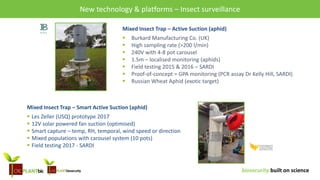
Mixed Insect Trap – Active Suction (aphid)
 Burkard Manufacturing Co. (UK)
 High sampling rate (>200 l/min)
 240V with 4-8 pot carousel
 1.5m – localised monitoring (aphids)
 Field testing 2015 & 2016 – SARDI
 Proof-of-concept = GPA monitoring (PCR assay Dr Kelly Hill, SARDI)
 Russian Wheat Aphid (exotic target)
Burkard
Mixed Insect Trap – Smart Active Suction (aphid)
 Les Zeller (USQ) prototype 2017
 12V solar powered fan suction (optimised)
 Smart capture – temp, RH, temporal, wind speed or direction
 Mixed populations with carousel system (10 pots)
 Field testing 2017 - SARDI
biosecurity built on science
Research & opportunities – Surveillance and New technologiesNew technology & platforms – Insect surveillance
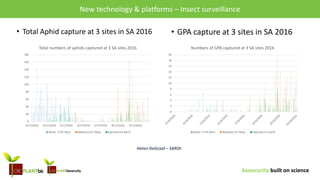
• Total Aphid capture at 3 sites in SA 2016
0
20
40
60
80
100
120
140
160
180
3/17/2016 4/17/2016 5/17/2016 6/17/2016 7/17/2016 8/17/2016 9/17/2016
Total numbers of aphids captured at 3 SA sites 2016
Waite (17th Mar) Balaklava (27 May) Kapunda (14 April)
• GPA capture at 3 sites in SA 2016
0
2
4
6
8
10
12
14
16
18
20
Numbers of GPA captured at 3 SA sites 2016
Waite (17th Mar) Balaklava (27 May) Kapunda (14 April)
Helen DeGraaf – SARDI
biosecurity built on science
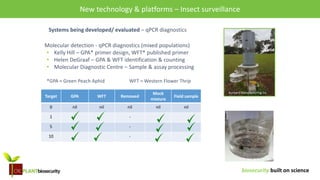
Systems being developed/ evaluated – qPCR diagnostics
C
Burkard Manufacturing Co.
Molecular detection - qPCR diagnostics (mixed populations)
• Kelly Hill – GPA* primer design, WFT* published primer
• Helen DeGraaf – GPA & WFT identification & counting
• Molecular Diagnostic Centre – Sample & assay processing
*GPA = Green Peach Aphid WFT = Western Flower Thrip
Target GPA WFT Removed
Mock
mixture
Field sample
0 nil nil nil nil nil
1 -
5 -
10 -
New technology & platforms – Insect surveillance
biosecurity built on science
• Russian Wheat Aphid (RWA) capture at 3 sites - originally the exotic species target
Helen DeGraaf – SARDI
Research & opportunities – Surveillance and New technologiesNew technology & platforms – Insect surveillance
0
1
2
3
4
5
6
5/4/2016 6/4/2016 7/4/2016 8/4/2016 9/4/2016 10/4/2016
Number of RWA captured at 2 SA sites2016
Balaklava (27 May) Kapunda (14 April)
Diuraphis noxia, alate
Start trap End trap Days trapping Sum of 4 YPTs Kapunda ST Balaklava ST
24/08/2016 1/09/2016 8 0 0 0
1/09/2016 15/09/2016 14 3 2 11
15/09/2016 5/10/2016 20 2 0 16
5/10/2016 19/10/2016 14 2 5 3
Total RWA trapped by yellow pan traps at 4 sites in Tarlee and suction traps at Kapunda and Balaklava (suction trap data [24-48hr] pooled to match YPT trap periods)
Maarten van Helden – SARDI
Yellow Pan Trap – YPTsSuction Trap – ST
biosecurity built on science
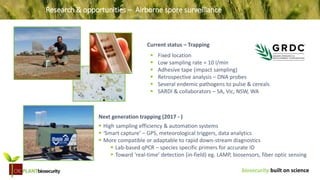
Next generation trapping (2017 - )
 High sampling efficiency & automation systems
 ‘Smart capture’ – GPS, meteorological triggers, data analytics
 More compatible or adaptable to rapid down-stream diagnostics
 Lab-based qPCR – species specific primers for accurate ID
 Toward ‘real-time’ detection (in-field) eg. LAMP, biosensors, fiber optic sensing
 Fixed location
 Low sampling rate = 10 l/min
 Adhesive tape (impact sampling)
 Retrospective analysis – DNA probes
 Several endemic pathogens to pulse & cereals
 SARDI & collaborators – SA, Vic, NSW, WA
Current status – Trapping
Research & opportunities – Airborne spore surveillance
biosecurity built on science
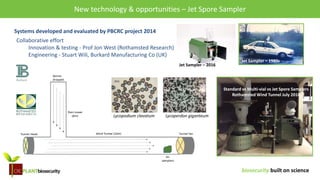
New technology & opportunities – Jet Spore Sampler
Standard vs Multi-vial vs Jet Spore Samplers
Rothamsted Wind Tunnel July 2016
Lycopodium clavatum Lycoperdon giganteum
Burkard
Systems developed and evaluated by PBCRC project 2014
Collaborative effort
Innovation & testing - Prof Jon West (Rothamsted Research)
Engineering - Stuart Wili, Burkard Manufacturing Co (UK)
Jet Sampler – 1980s
Jet Sampler – 2016
biosecurity built on science
New technology & opportunities – Mobile Jet Spore Sampler
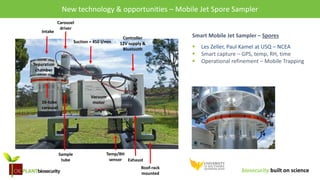
Smart Mobile Jet Sampler – Spores
 Les Zeller, Paul Kamel at USQ – NCEA
 Smart capture – GPS, temp, RH, time
 Operational refinement – Mobile Trapping
Intake
Carousel
driver
Suction = 450 l/min
Vacuum
motor16-tube
carousel
Sample
tube
Temp/RH
sensor
Controller
12V supply &
Bluetooth
Roof-rack
mounted
Separation
chamber
Exhaust
biosecurity built on scienceBurkard
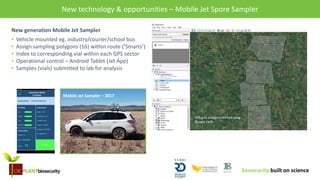
New generation Mobile Jet Sampler
• Vehicle mounted eg. industry/courier/school bus
• Assign sampling polygons (16) within route (‘Smarts’)
• Index to corresponding vial within each GPS sector
• Operational control – Android Tablet (Jet App)
• Samples (vials) submitted to lab for analysis
New technology & opportunities – Mobile Jet Spore Sampler
Mobile Jet Sampler – 2017
GPS grid polygons defined using
Google Earth
biosecurity built on science
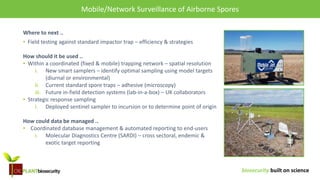
Mobile/Network surveillance of air-borne spores
Where to next ..
• Field testing against standard impactor trap – efficiency & strategies
How should it be used ..
• Within a coordinated (fixed & mobile) trapping network – spatial resolution
i. New smart samplers – identify optimal sampling using model targets
(diurnal or environmental)
ii. Current standard spore traps – adhesive (microscopy)
iii. Future in-field detection systems (lab-in-a-box) – UK collaborators
• Strategic response sampling
i. Deployed sentinel sampler to incursion or to determine point of origin
How could data be managed ..
• Coordinated database management & automated reporting to end-users
i. Molecular Diagnostics Centre (SARDI) – cross sectoral, endemic &
exotic target reporting
Mobile/Network Surveillance of Airborne Spores
biosecurity built on science
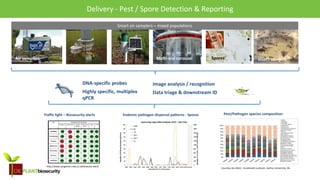
Air samplers
DNA-specific probes
Highly specific, multiplex
qPCR
Smart air samplers – mixed populations
Insect samplesMulti-vial carousel
Traffic light – Biosecurity alerts
Delivery - Pest / Spore Detection & Reporting
http://www.syngenta-crop.co.uk/brassica-alert/
Image analysis / recognition
Data triage & downstream ID
Spores
Pest/Pathogen species composition
Courtesy Jon West - Annemarie Justesen, Aarhus University, Dk
Endemic pathogen dispersal patterns - Spores
biosecurity built on science
Thank you
Burkard
 Jon West (Rothamsted Research)
 Stuart Wili (Burkard Manufacturing Co.)
 Helen DeGraaf (SARDI – Entomology)
 Greg Baker (SARDI – Entomology)
 Kelly Hill (SARDI)
 Les Zeller (USQ - NCEA)
 Paul Kamel (USQ - NCEA)
 Molecular Diagnostics Centre (SARDI)
 John Weiss (Vic DEDJTR)
 Jamus Stonar (SARDI)
 Tracey Brookes (MEA)
 Sarah Noack (Hart Field Site)
 Matt Tscharke – USQ
 Maarten van Helden - SARDI

New tools for field grains surveillance

  • 1.
    biosecurity built onscience Plant Biosecurity Cooperative Research Centre Project 2014 Part A: New tools for field grains surveillance Jenny Davidson: Senior Plant Pathologist (SARDI) Rohan Kimber: Plant Pathologist (SARDI) Greg Baker: Entomologist (SARDI) Helen De Graaf: Entomologist (SARDI) Les Zeller: Engineer (USQ) Paul Kamel: Engineer (USQ)
  • 2.
    biosecurity built onscience New opportunities for pest & disease surveillance using new technologies & sensing systems  Broad scale surveillance (coordinated network) Detect & report endemic or exotic incursions of fungal spores / insects in the field to the decision maker or grower community  Local (on farm) outbreaks  Regional threats (e.g. rusts)  National interests (biosecurity) Project 2014 – New tools for field grains surveillance and diagnostics of high priority exotic pests New technology & opportunities
  • 3.
    biosecurity built onscience New technology & opportunitiesTechnologies implemented • Species specific detection – qPCR, Pheromone lures (stacking) • Sensors - optical, impact & digital to confirm target • Smart capture – GPS, environment or diurnal triggers • Wireless / telemetry networked grid & transmission Systems being developed / evaluated – A. Smart insect traps (moths) – in field detection and imagery B. Suction insect traps (aphids) – localized monitoring ― Lab qPCR diagnostics (mixed populations) C. Smart traps (pathogens) – mobile & fixed systems — Lab qPCR diagnostics & toward ‘real-time’ sensor detection Field evaluation, technology adaptation, collaboration • DAFF/USQ & SARDI – Qld and SA test sites • Rothamsted & Burkard Manufacturing Co. – UK Research & opportunities – Surveillance and New technologiesNew technology & platforms – pest & disease surveillance – PBCRC Project 2014 B C A
  • 4.
    biosecurity built onscience Research & opportunities – Surveillance and New technologies Smart Insect Trap – Pheromone  Les Zeller & Paul Kamel (USQ)  Pheromone – targeted  Impact & optical sensors (false triggers, oversensitive)  Digital imagery on automated carousel  Data transmission (4G telemetry) to a web portal  Smart data – time stamped  Three prototypes evaluated these image (25-80 KB) were transferred from trap via telemetry < 1 second trap wind lure attraction range (pheromone plume) exotic pest endemic pest Non-target pest Smart Insect trap – Field testing 2016 & 2017  Helicoverpa punctigera (native budworm) × Diamond back moth (DBM), requires new algorithm − Light brown apple moth (LBAM), no flights o Noctuid (cutworm), due to commence New technology & platforms – Insect surveillance
  • 5.
    biosecurity built onscience PHEROMONE STACKING Assess potential of “piggy-backing” existing pheromone trap networks. Need to test pheromones for compatibility. Field trial at Waterloo, SA, Spring 2015: • Turnip moth (As) (Exotic) • Diamond back moth (DBM) (Established) • Native budworm (Hp) (Native) Helen DeGraaf – SARDI
  • 6.
    biosecurity built onscience Research & opportunities – Surveillance and New technologiesNew technology & platforms – Insect surveillance Mixed Insect Trap – Active Suction (aphid)  Burkard Manufacturing Co. (UK)  High sampling rate (>200 l/min)  240V with 4-8 pot carousel  1.5m – localised monitoring (aphids)  Field testing 2015 & 2016 – SARDI  Proof-of-concept = GPA monitoring (PCR assay Dr Kelly Hill, SARDI)  Russian Wheat Aphid (exotic target) Burkard Mixed Insect Trap – Smart Active Suction (aphid)  Les Zeller (USQ) prototype 2017  12V solar powered fan suction (optimised)  Smart capture – temp, RH, temporal, wind speed or direction  Mixed populations with carousel system (10 pots)  Field testing 2017 - SARDI
  • 7.
    biosecurity built onscience Research & opportunities – Surveillance and New technologiesNew technology & platforms – Insect surveillance • Total Aphid capture at 3 sites in SA 2016 0 20 40 60 80 100 120 140 160 180 3/17/2016 4/17/2016 5/17/2016 6/17/2016 7/17/2016 8/17/2016 9/17/2016 Total numbers of aphids captured at 3 SA sites 2016 Waite (17th Mar) Balaklava (27 May) Kapunda (14 April) • GPA capture at 3 sites in SA 2016 0 2 4 6 8 10 12 14 16 18 20 Numbers of GPA captured at 3 SA sites 2016 Waite (17th Mar) Balaklava (27 May) Kapunda (14 April) Helen DeGraaf – SARDI
  • 8.
    biosecurity built onscience Systems being developed/ evaluated – qPCR diagnostics C Burkard Manufacturing Co. Molecular detection - qPCR diagnostics (mixed populations) • Kelly Hill – GPA* primer design, WFT* published primer • Helen DeGraaf – GPA & WFT identification & counting • Molecular Diagnostic Centre – Sample & assay processing *GPA = Green Peach Aphid WFT = Western Flower Thrip Target GPA WFT Removed Mock mixture Field sample 0 nil nil nil nil nil 1 - 5 - 10 - New technology & platforms – Insect surveillance
  • 9.
    biosecurity built onscience • Russian Wheat Aphid (RWA) capture at 3 sites - originally the exotic species target Helen DeGraaf – SARDI Research & opportunities – Surveillance and New technologiesNew technology & platforms – Insect surveillance 0 1 2 3 4 5 6 5/4/2016 6/4/2016 7/4/2016 8/4/2016 9/4/2016 10/4/2016 Number of RWA captured at 2 SA sites2016 Balaklava (27 May) Kapunda (14 April) Diuraphis noxia, alate Start trap End trap Days trapping Sum of 4 YPTs Kapunda ST Balaklava ST 24/08/2016 1/09/2016 8 0 0 0 1/09/2016 15/09/2016 14 3 2 11 15/09/2016 5/10/2016 20 2 0 16 5/10/2016 19/10/2016 14 2 5 3 Total RWA trapped by yellow pan traps at 4 sites in Tarlee and suction traps at Kapunda and Balaklava (suction trap data [24-48hr] pooled to match YPT trap periods) Maarten van Helden – SARDI Yellow Pan Trap – YPTsSuction Trap – ST
  • 10.
    biosecurity built onscience Next generation trapping (2017 - )  High sampling efficiency & automation systems  ‘Smart capture’ – GPS, meteorological triggers, data analytics  More compatible or adaptable to rapid down-stream diagnostics  Lab-based qPCR – species specific primers for accurate ID  Toward ‘real-time’ detection (in-field) eg. LAMP, biosensors, fiber optic sensing  Fixed location  Low sampling rate = 10 l/min  Adhesive tape (impact sampling)  Retrospective analysis – DNA probes  Several endemic pathogens to pulse & cereals  SARDI & collaborators – SA, Vic, NSW, WA Current status – Trapping Research & opportunities – Airborne spore surveillance
  • 11.
    biosecurity built onscience New technology & opportunities – Jet Spore Sampler Standard vs Multi-vial vs Jet Spore Samplers Rothamsted Wind Tunnel July 2016 Lycopodium clavatum Lycoperdon giganteum Burkard Systems developed and evaluated by PBCRC project 2014 Collaborative effort Innovation & testing - Prof Jon West (Rothamsted Research) Engineering - Stuart Wili, Burkard Manufacturing Co (UK) Jet Sampler – 1980s Jet Sampler – 2016
  • 12.
    biosecurity built onscience New technology & opportunities – Mobile Jet Spore Sampler Smart Mobile Jet Sampler – Spores  Les Zeller, Paul Kamel at USQ – NCEA  Smart capture – GPS, temp, RH, time  Operational refinement – Mobile Trapping Intake Carousel driver Suction = 450 l/min Vacuum motor16-tube carousel Sample tube Temp/RH sensor Controller 12V supply & Bluetooth Roof-rack mounted Separation chamber Exhaust
  • 13.
    biosecurity built onscienceBurkard New generation Mobile Jet Sampler • Vehicle mounted eg. industry/courier/school bus • Assign sampling polygons (16) within route (‘Smarts’) • Index to corresponding vial within each GPS sector • Operational control – Android Tablet (Jet App) • Samples (vials) submitted to lab for analysis New technology & opportunities – Mobile Jet Spore Sampler Mobile Jet Sampler – 2017 GPS grid polygons defined using Google Earth
  • 14.
    biosecurity built onscience Mobile/Network surveillance of air-borne spores Where to next .. • Field testing against standard impactor trap – efficiency & strategies How should it be used .. • Within a coordinated (fixed & mobile) trapping network – spatial resolution i. New smart samplers – identify optimal sampling using model targets (diurnal or environmental) ii. Current standard spore traps – adhesive (microscopy) iii. Future in-field detection systems (lab-in-a-box) – UK collaborators • Strategic response sampling i. Deployed sentinel sampler to incursion or to determine point of origin How could data be managed .. • Coordinated database management & automated reporting to end-users i. Molecular Diagnostics Centre (SARDI) – cross sectoral, endemic & exotic target reporting Mobile/Network Surveillance of Airborne Spores
  • 15.
    biosecurity built onscience Air samplers DNA-specific probes Highly specific, multiplex qPCR Smart air samplers – mixed populations Insect samplesMulti-vial carousel Traffic light – Biosecurity alerts Delivery - Pest / Spore Detection & Reporting http://www.syngenta-crop.co.uk/brassica-alert/ Image analysis / recognition Data triage & downstream ID Spores Pest/Pathogen species composition Courtesy Jon West - Annemarie Justesen, Aarhus University, Dk Endemic pathogen dispersal patterns - Spores
  • 16.
    biosecurity built onscience Thank you Burkard  Jon West (Rothamsted Research)  Stuart Wili (Burkard Manufacturing Co.)  Helen DeGraaf (SARDI – Entomology)  Greg Baker (SARDI – Entomology)  Kelly Hill (SARDI)  Les Zeller (USQ - NCEA)  Paul Kamel (USQ - NCEA)  Molecular Diagnostics Centre (SARDI)  John Weiss (Vic DEDJTR)  Jamus Stonar (SARDI)  Tracey Brookes (MEA)  Sarah Noack (Hart Field Site)  Matt Tscharke – USQ  Maarten van Helden - SARDI