
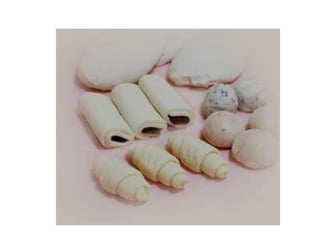
Frozen dough from the broad sense refers all semi-finished
products with flour as the main raw material, which are
kneaded and processed by machine and frozen, and later are
reprocessed
What is frozen dough ?
. Frozen dough from the narrow sense specifically refers
to semi-finished products in baking industry, with yeast
fermentation bread production technology applied and
frozen dough conditioner added in the production
process, after instant freezer is used to make dough
temperature soon more than crystal point (about -7℃),
and then stored in the condition of -18℃. The semi-
finished products can be made into delicious breads after
sequent processing, such as unfreezing, fermentation,
baking, etc.
Preservation of frozen dough:
Frozen bread dough needs stricter storage management
than other general frozen foods. If it is kept at the stable
temperature of -18℃ and baked within 3 months, the
product quality can be ensured. Temperature change,
dough leavening failure or piriformis during transportation
and storage are called freezing obstacle.
Just as ice cream, frozen dough cannot become so called
commodity any more if it has been unfrozen once.
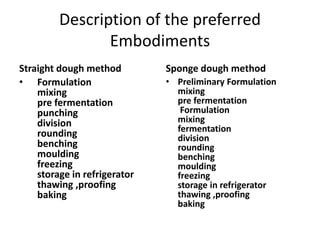
Description of the preferred
Embodiments
Straight dough method
• Formulation
mixing
pre fermentation
punching
division
rounding
benching
moulding
freezing
storage in refrigerator
thawing ,proofing
baking
Sponge dough method
• Preliminary Formulation
mixing
pre fermentation
Formulation
mixing
fermentation
division
rounding
benching
moulding
freezing
storage in refrigerator
thawing ,proofing
baking
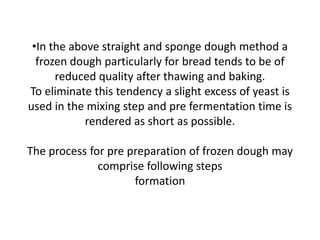
•In the above straight and sponge dough method a
frozen dough particularly for bread tends to be of
reduced quality after thawing and baking.
To eliminate this tendency a slight excess of yeast is
used in the mixing step and pre fermentation time is
rendered as short as possible.
The process for pre preparation of frozen dough may
comprise following steps
formation
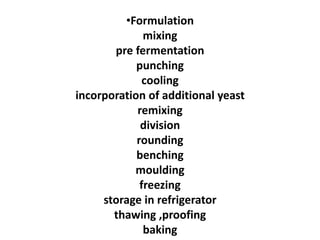
•Formulation
mixing
pre fermentation
punching
cooling
incorporation of additional yeast
remixing
division
rounding
benching
moulding
freezing
storage in refrigerator
thawing ,proofing
baking
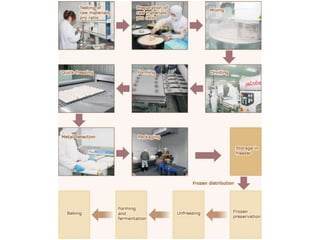
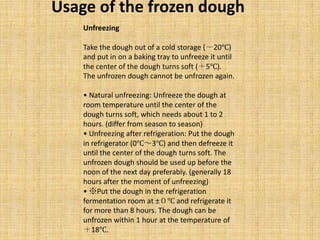
Unfreezing
Take the dough out of a cold storage (-20℃)
and put in on a baking tray to unfreeze it until
the center of the dough turns soft (+5℃).
The unfrozen dough cannot be unfrozen again.
• Natural unfreezing: Unfreeze the dough at
room temperature until the center of the
dough turns soft, which needs about 1 to 2
hours. (differ from season to season)
• Unfreezing after refrigeration: Put the dough
in refrigerator (0℃~3℃) and then defreeze it
until the center of the dough turns soft. The
unfrozen dough should be used up before the
noon of the next day preferably. (generally 18
hours after the moment of unfreezing)
• ※Put the dough in the refrigeration
fermentation room at ±0℃ and refrigerate it
for more than 8 hours. The dough can be
unfrozen within 1 hour at the temperature of
+18℃.
Usage of the frozen dough
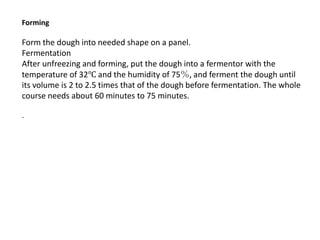
Forming
Form the dough into needed shape on a panel.
Fermentation
After unfreezing and forming, put the dough into a fermentor with the
temperature of 32℃ and the humidity of 75%, and ferment the dough until
its volume is 2 to 2.5 times that of the dough before fermentation. The whole
course needs about 60 minutes to 75 minutes.
.
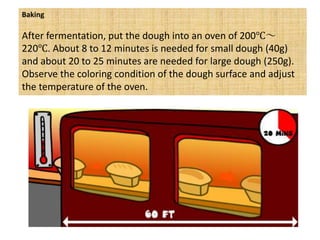
Baking
After fermentation, put the dough into an oven of 200℃~
220℃. About 8 to 12 minutes is needed for small dough (40g)
and about 20 to 25 minutes are needed for large dough (250g).
Observe the coloring condition of the dough surface and adjust
the temperature of the oven.
Frozen dough
Frozen dough

Frozen dough

  • 1.
    Frozen dough fromthe broad sense refers all semi-finished products with flour as the main raw material, which are kneaded and processed by machine and frozen, and later are reprocessed What is frozen dough ? . Frozen dough from the narrow sense specifically refers to semi-finished products in baking industry, with yeast fermentation bread production technology applied and frozen dough conditioner added in the production process, after instant freezer is used to make dough temperature soon more than crystal point (about -7℃), and then stored in the condition of -18℃. The semi- finished products can be made into delicious breads after sequent processing, such as unfreezing, fermentation, baking, etc.
  • 2.
    Preservation of frozendough: Frozen bread dough needs stricter storage management than other general frozen foods. If it is kept at the stable temperature of -18℃ and baked within 3 months, the product quality can be ensured. Temperature change, dough leavening failure or piriformis during transportation and storage are called freezing obstacle. Just as ice cream, frozen dough cannot become so called commodity any more if it has been unfrozen once.
  • 4.
    Description of thepreferred Embodiments Straight dough method • Formulation mixing pre fermentation punching division rounding benching moulding freezing storage in refrigerator thawing ,proofing baking Sponge dough method • Preliminary Formulation mixing pre fermentation Formulation mixing fermentation division rounding benching moulding freezing storage in refrigerator thawing ,proofing baking
  • 5.
    •In the abovestraight and sponge dough method a frozen dough particularly for bread tends to be of reduced quality after thawing and baking. To eliminate this tendency a slight excess of yeast is used in the mixing step and pre fermentation time is rendered as short as possible. The process for pre preparation of frozen dough may comprise following steps formation
  • 6.
    •Formulation mixing pre fermentation punching cooling incorporation ofadditional yeast remixing division rounding benching moulding freezing storage in refrigerator thawing ,proofing baking
  • 7.
    Unfreezing Take the doughout of a cold storage (-20℃) and put in on a baking tray to unfreeze it until the center of the dough turns soft (+5℃). The unfrozen dough cannot be unfrozen again. • Natural unfreezing: Unfreeze the dough at room temperature until the center of the dough turns soft, which needs about 1 to 2 hours. (differ from season to season) • Unfreezing after refrigeration: Put the dough in refrigerator (0℃~3℃) and then defreeze it until the center of the dough turns soft. The unfrozen dough should be used up before the noon of the next day preferably. (generally 18 hours after the moment of unfreezing) • ※Put the dough in the refrigeration fermentation room at ±0℃ and refrigerate it for more than 8 hours. The dough can be unfrozen within 1 hour at the temperature of +18℃. Usage of the frozen dough
  • 8.
    Forming Form the doughinto needed shape on a panel. Fermentation After unfreezing and forming, put the dough into a fermentor with the temperature of 32℃ and the humidity of 75%, and ferment the dough until its volume is 2 to 2.5 times that of the dough before fermentation. The whole course needs about 60 minutes to 75 minutes. .
  • 9.
    Baking After fermentation, putthe dough into an oven of 200℃~ 220℃. About 8 to 12 minutes is needed for small dough (40g) and about 20 to 25 minutes are needed for large dough (250g). Observe the coloring condition of the dough surface and adjust the temperature of the oven.