

Production of Rusk
Presented by
Mrinal Kanti Debnath
ROLL No: 171712
Abdullah Al Numan
ROLL No: 171713
Department of Agro Product
Processing Technology.
Jashore University Of Science and
Technology.
Presented To
Farzana Yeasmin
Assistant Professor.
Department of Agro Product Processing
Technology.
Jashore University Of Science and
Technology.
Rusk
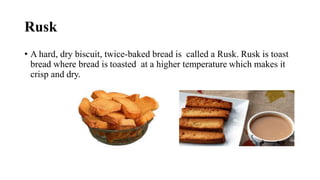
• A hard, dry biscuit, twice-baked bread is called a Rusk. Rusk is toast
bread where bread is toasted at a higher temperature which makes it
crisp and dry.
Principles of Rusk making.
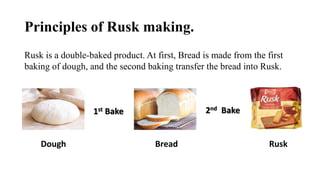
Rusk is a double-baked product. At first, Bread is made from the first
baking of dough, and the second baking transfer the bread into Rusk.
Dough Bread Rusk
1st Bake 2nd Bake
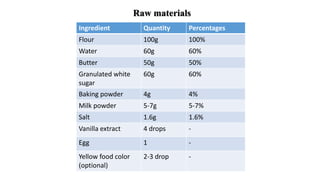
Raw materials
Ingredient Quantity Percentages
Flour 100g 100%
Water 60g 60%
Butter 50g 50%
Granulated white
sugar
60g 60%
Baking powder 4g 4%
Milk powder 5-7g 5-7%
Salt 1.6g 1.6%
Vanilla extract 4 drops -
Egg 1 -
Yellow food color
(optional)
2-3 drop -
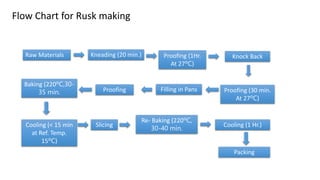
Flow Chart for Rusk making
Raw Materials Kneading (20 min.) Proofing (1Hr.
At 27ºC)
Knock Back
Proofing (30 min.
At 27ºC)
Filling in Pans
Proofing
Baking (220ºC,30-
35 min.
Cooling (< 15 min
at Ref. Temp.
15ºC)
Slicing
Re- Baking (220ºC,
30-40 min.
Cooling (1 Hr.)
Packing
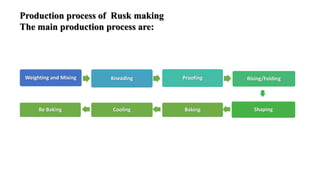
Production process of Rusk making
The main production process are:
Weighting and Mixing Kneading Proofing Rising/Folding
Shaping
Baking
Cooling
Re Baking
Weighing and mixing
The production of rusk begins with mixing of the ingredients. For this
purpose, Accurate amounts of ingredients are combined.
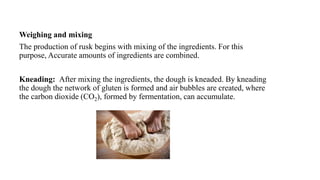
Kneading: After mixing the ingredients, the dough is kneaded. By kneading
the dough the network of gluten is formed and air bubbles are created, where
the carbon dioxide (CO2), formed by fermentation, can accumulate.
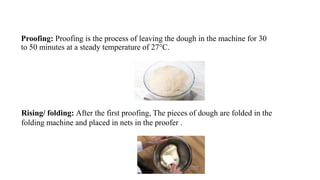
Proofing: Proofing is the process of leaving the dough in the machine for 30
to 50 minutes at a steady temperature of 27°C.
Rising/ folding: After the first proofing, The pieces of dough are folded in the
folding machine and placed in nets in the proofer .
Shaping : After the folding, the dough is shaped for use in a baking tin. The
forming of the dough into a long roll is called shaping. During the shaping process
the dough ball is rolled into a slab.
Baking : After the final proofing the dough has risen sufficiently and
is ready to be baked. Baking the bread takes up 30 to 40 minutes at a
temperature of 200 to 220°C.
Cooling and Slicing : After the baking, The loaf will very hot. So it is necessary
to cool down. After cooling a slicer will slice the loaf.
Re-Baking : After the slicing the sliced bread is ready to be baked
again. Baking the bread takes up 30 to 40 minutes at a temperature of
200 to 220°C.
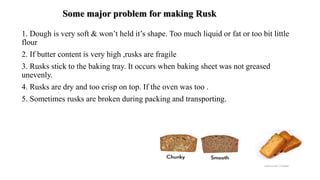
Some major problem for making Rusk
1. Dough is very soft & won’t held it’s shape. Too much liquid or fat or too bit little
flour
2. If butter content is very high ,rusks are fragile
3. Rusks stick to the baking tray. It occurs when baking sheet was not greased
unevenly.
4. Rusks are dry and too crisp on top. If the oven was too .
5. Sometimes rusks are broken during packing and transporting.
Equipment’s for Rusk production line
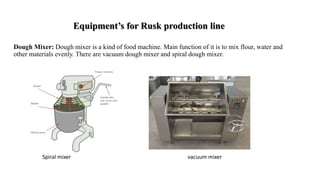
Dough Mixer: Dough mixer is a kind of food machine. Main function of it is to mix flour, water and
other materials evenly. There are vacuum dough mixer and spiral dough mixer.
Spiral mixer vacuum mixer
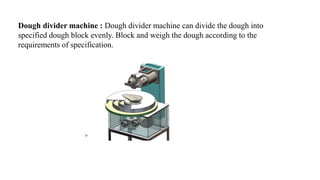
Dough divider machine : Dough divider machine can divide the dough into
specified dough block evenly. Block and weigh the dough according to the
requirements of specification.
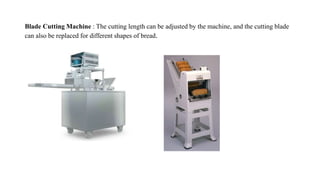
Blade Cutting Machine : The cutting length can be adjusted by the machine, and the cutting blade
can also be replaced for different shapes of bread.
Safety precaution of Rusk making
•Use hot pads when handle something hot.
•Don't crowd the cooking area around the range with unnecessary
personnel or equipment.
•Never stand in front of the range cabinet or oven doors when you
open them. Always stand to the side.
•Close the range cabinet door the right way. Don't slam it.
•Do not fill your cooking utensils too fulfill only to a safe handling
level.
•Avoid "horseplay."
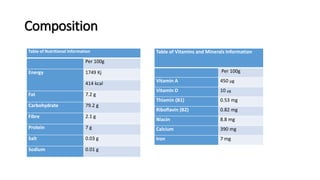
Composition
Table of Nutritional Information
Per 100g
Energy 1749 Kj
414 kcal
Fat 7.2 g
Carbohydrate 79.2 g
Fibre 2.1 g
Protein 7 g
Salt 0.03 g
Sodium 0.01 g
Table of Vitamins and Minerals Information
Per 100g
Vitamin A 450 µg
Vitamin D 10 µg
Thiamin (B1) 0.53 mg
Riboflavin (B2) 0.82 mg
Niacin 8.8 mg
Calcium 390 mg
Iron 7 mg
https://www.youtube.com/watch?v=f4NDy3pSzNs
Video
Thank YOU
Any Question?

Rusk production processing/Technology of Bangladesh and India

  • 1.
    Production of Rusk Presentedby Mrinal Kanti Debnath ROLL No: 171712 Abdullah Al Numan ROLL No: 171713 Department of Agro Product Processing Technology. Jashore University Of Science and Technology. Presented To Farzana Yeasmin Assistant Professor. Department of Agro Product Processing Technology. Jashore University Of Science and Technology.
  • 2.
    Rusk • A hard,dry biscuit, twice-baked bread is called a Rusk. Rusk is toast bread where bread is toasted at a higher temperature which makes it crisp and dry.
  • 3.
    Principles of Ruskmaking. Rusk is a double-baked product. At first, Bread is made from the first baking of dough, and the second baking transfer the bread into Rusk. Dough Bread Rusk 1st Bake 2nd Bake
  • 4.
    Raw materials Ingredient QuantityPercentages Flour 100g 100% Water 60g 60% Butter 50g 50% Granulated white sugar 60g 60% Baking powder 4g 4% Milk powder 5-7g 5-7% Salt 1.6g 1.6% Vanilla extract 4 drops - Egg 1 - Yellow food color (optional) 2-3 drop -
  • 5.
    Flow Chart forRusk making Raw Materials Kneading (20 min.) Proofing (1Hr. At 27ºC) Knock Back Proofing (30 min. At 27ºC) Filling in Pans Proofing Baking (220ºC,30- 35 min. Cooling (< 15 min at Ref. Temp. 15ºC) Slicing Re- Baking (220ºC, 30-40 min. Cooling (1 Hr.) Packing
  • 6.
    Production process ofRusk making The main production process are: Weighting and Mixing Kneading Proofing Rising/Folding Shaping Baking Cooling Re Baking
  • 7.
    Weighing and mixing Theproduction of rusk begins with mixing of the ingredients. For this purpose, Accurate amounts of ingredients are combined. Kneading: After mixing the ingredients, the dough is kneaded. By kneading the dough the network of gluten is formed and air bubbles are created, where the carbon dioxide (CO2), formed by fermentation, can accumulate.
  • 8.
    Proofing: Proofing isthe process of leaving the dough in the machine for 30 to 50 minutes at a steady temperature of 27°C. Rising/ folding: After the first proofing, The pieces of dough are folded in the folding machine and placed in nets in the proofer .
  • 9.
    Shaping : Afterthe folding, the dough is shaped for use in a baking tin. The forming of the dough into a long roll is called shaping. During the shaping process the dough ball is rolled into a slab. Baking : After the final proofing the dough has risen sufficiently and is ready to be baked. Baking the bread takes up 30 to 40 minutes at a temperature of 200 to 220°C.
  • 10.
    Cooling and Slicing: After the baking, The loaf will very hot. So it is necessary to cool down. After cooling a slicer will slice the loaf. Re-Baking : After the slicing the sliced bread is ready to be baked again. Baking the bread takes up 30 to 40 minutes at a temperature of 200 to 220°C.
  • 11.
    Some major problemfor making Rusk 1. Dough is very soft & won’t held it’s shape. Too much liquid or fat or too bit little flour 2. If butter content is very high ,rusks are fragile 3. Rusks stick to the baking tray. It occurs when baking sheet was not greased unevenly. 4. Rusks are dry and too crisp on top. If the oven was too . 5. Sometimes rusks are broken during packing and transporting.
  • 12.
    Equipment’s for Ruskproduction line Dough Mixer: Dough mixer is a kind of food machine. Main function of it is to mix flour, water and other materials evenly. There are vacuum dough mixer and spiral dough mixer. Spiral mixer vacuum mixer
  • 13.
    Dough divider machine: Dough divider machine can divide the dough into specified dough block evenly. Block and weigh the dough according to the requirements of specification.
  • 14.
    Blade Cutting Machine: The cutting length can be adjusted by the machine, and the cutting blade can also be replaced for different shapes of bread.
  • 15.
    Safety precaution ofRusk making •Use hot pads when handle something hot. •Don't crowd the cooking area around the range with unnecessary personnel or equipment. •Never stand in front of the range cabinet or oven doors when you open them. Always stand to the side. •Close the range cabinet door the right way. Don't slam it. •Do not fill your cooking utensils too fulfill only to a safe handling level. •Avoid "horseplay."
  • 16.
    Composition Table of NutritionalInformation Per 100g Energy 1749 Kj 414 kcal Fat 7.2 g Carbohydrate 79.2 g Fibre 2.1 g Protein 7 g Salt 0.03 g Sodium 0.01 g Table of Vitamins and Minerals Information Per 100g Vitamin A 450 µg Vitamin D 10 µg Thiamin (B1) 0.53 mg Riboflavin (B2) 0.82 mg Niacin 8.8 mg Calcium 390 mg Iron 7 mg
  • 17.
  • 18.