A Presentation on
Doughnuts
Baking and Confectionary Technology
Presented by: Md. Al Zuber
Roll: 161723
Dept. of APPT
Date: 12 October, 2019
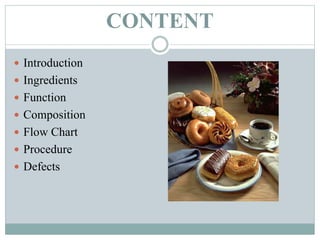
CONTENT
 Introduction
 Ingredients
 Function
 Composition
 Flow Chart
 Procedure
 Defects
INTRODUCTION
A doughnut or donut is a type of fried dough confection or
dessert food.
The doughnut is popular in many countries and is prepared
in various forms as a sweet snack that can be homemade
or purchased in bakeries, supermarkets, food stalls, and
franchised specialty vendors.
Which is correct donuts or Doughnuts?
Doughnut is the original, generally preferred
spelling of the word. It is more common in the
United States and vastly more common
internationally. Donut is an Americanized,
shortened version of donut that isn't incorrect,
but it is much less common.
How are Doughnuts made?
This type of doughnut uses baking powder in
the batter to leaven the dough. Yeast-leavened
doughnuts are made with ingredients that
include flour, shortening, milk, sugar, salt, water,
yeast, eggs or egg whites, and flavorings. ...
Doughnuts also require oil (usually vegetable
oil) for frying.
Natural Resources
 Enriched Wheat Flour
 Water
 Dextrose
 Palm Oil
 Sugar
 Milk
What's the most popular donut?
Here are what we have found to be the most
popular kinds of donuts.
 Glazed. The original glazed donut has remained the
favorite throughout history. ...
 Chocolate Frosted With Sprinkles. Sprinkles aren't
the only favorite on ice cream. ...
 Double Chocolate. ...
 Cinnamon. ...
 Boston Cream. ...
 Apple-Cinnamon
Classification of Doughnuts
Types of Doughnut
1. Cinnamon Twist Doughnut
2. Cruller
3. Strawberry Frosted Doughnut
4. Old-fashioned Doughnut
5. Jelly Doughnut
6. Chocolate Frosted Doughnut
7. Blueberry Doughnut
Types of Doughnuts
8. Glazed Doughnut
9. Cream-Filled Doughnut
10. Boston Kreme Pie Doughnut
11. Sour Cream Doughnut
12. Apple-Crumb Doughnut
13. Doughnut Holes
14. Chocolate Cake Doughnut
Ingredients
 Wheat Flour
 Eggs
 Peanuts
 Water
 Sugar
 Palm Oil
 Shortening
 Emulsifier
 Vanilla
Ingredients
 Milk Solids
 Soy Flour
 Salt
 Oat Fibre
 Spices
 Vanilla
 Eggs
 Peanuts
Function of Ingredients
 Flour:- Provides the Recipe Foundation.
 Fat:- Holds it All Together.
 Sugar:- Is Sweet and Helps Tenderize and
makes crust colour
 Eggs:- Add Texture.
 Liquids:- Add Leavening and Tenderness.
 Salt:- Adds Flavor and Weight.
 Leavening Agents:- Baking Soda and Baking
Powder.
Composition
Flow Chart
Manufacturing Process
This process will describe the manufacture of
doughnuts in a mechanized doughnut bakery that
makes only yeast-raised doughnuts. Because yeast
requires time for kneading, time to rest and
additional time to rise or proof, it takes at least an
hour to take dry pre-packaged mix to completed
product.
Manufacturing Procedures
 Acquiring the ingredients
 Measuring the ingredients
 Mixing and kneading
 Resting the yeast
 Shaping the doughnuts
 Proofing
 Frying
 Glazing and drying
 Further finishing and sale
Acquiring the ingredients
• Collect the ingredients
• Collect the bags
• Mixes the bags
• Storing them
Measuring the ingredients
• Weighing the ingredients
• Putting into the
• Precise amount measuring
Mixing and kneading
 flour mixture is poured into a large mixing bowl
 wet ingredients are added
 wet yeast slurry (for leavening) is mixed separately and carefully added to the
flour-water mixture
 dough mixer then begins its work
 dough hook mixes
 human kneading process
 pulling and
 Stretching
 Forming the basic structure of the doughnut
 Kneeded for 13 minutes.
Resting the yeast
• Rests for about 10 minutes
• Yeast growing
• Fermentation
• yeast reacts with sugar
• good-quality dough is spongy and soft.
Shaping the doughnuts
• Dough is hoisted by hand and
• Loaded into extruder
• flour mixture is mixed with wet ingredients
• Wet yeast slurry is mixed separately and
carefully added to the flour-water mixture.
Proofing
The extruder is attached directly to the proofing box (a warm, oven
like machine), which is a hot-air, temperature-controlled warm box set
to approximately 125° F (51.6° C).
• Doughnuts are slowly allowed to rise or proof as the yeast ferments under
controlled conditions
• Proofing renders the doughnuts light and airy. (Yeast doughs must be
allowed to rise slowly and at just the right temperature. )
• If the proofing box is too hot, the yeast bacteria will be killed and the
doughnuts will not rise.
• If too cold, the yeast remains inactive and cannot ferment thus preventing
leavening.
• This process done
• for about 30 minutes.
Frying
• Raw doughnuts fall automatically
• It is important to drop just a certain amount of raw doughnuts into
the grease at a time.
• If too many are placed in the fryer at one time, the oil temperature is
drastically lowered, fry time is longer, and the doughnuts absorb too
much oil. The frying oil is the most expensive ingredient in the
production process, and if the doughnuts absorb too much oil, it
reduces the profit margin on the batch. As the doughnuts move
through the fryer, they are flipped over by a mechanism. After two
minutes, the doughnuts have moved completely through the fryer and
are forced into the mechanism that applies glaze.
Glazing and drying
As the doughnuts leave the fryer, they move
under a shower of glaze. Here, glaze is forced
through holes from a bridge running several inches
above the hot doughnuts. The glaze coats the top,
sides, and part of the bottom of the doughnuts. The
doughnuts are conveyored out of the production
area to dry and cool.
Further finishing and sale
Once conveyored to a finishing station, the
doughnuts may be sprinkled with candies or nuts
or are given a thicker frosting. The disk-like
doughnuts (those with no hole) are forced onto a
machine that injects two doughnuts at a time
with the desired, pre-measured filling. The
completed doughnuts are placed on trays for
movement to the counter or packed into boxes for
custom orders.
Advantages
It is easy to form and change the values can be varied
and inserted the chart can have different colours and
shapes the readings are easy to understand
 It is arranged systematically
 Easy to access
 Informal collector
 Easy and better planning
 Incredible management
Disadvantages
 Maintenance is not easy
 creation lacks
 priorities neglected
 basis not developed
 lack of placement
 it can be a little difficult to insert
Defects
 PLATE/CYLINDER SWELLING
 PRINTING PRESSURE
 PRINT-TO-WEB SPEED CONFORMITY
 INK TRANSFER
THANK YOU

Doughnut presentation

  • 1.
    A Presentation on Doughnuts Bakingand Confectionary Technology Presented by: Md. Al Zuber Roll: 161723 Dept. of APPT Date: 12 October, 2019
  • 2.
    CONTENT  Introduction  Ingredients Function  Composition  Flow Chart  Procedure  Defects
  • 3.
    INTRODUCTION A doughnut ordonut is a type of fried dough confection or dessert food. The doughnut is popular in many countries and is prepared in various forms as a sweet snack that can be homemade or purchased in bakeries, supermarkets, food stalls, and franchised specialty vendors.
  • 4.
    Which is correctdonuts or Doughnuts? Doughnut is the original, generally preferred spelling of the word. It is more common in the United States and vastly more common internationally. Donut is an Americanized, shortened version of donut that isn't incorrect, but it is much less common.
  • 5.
    How are Doughnutsmade? This type of doughnut uses baking powder in the batter to leaven the dough. Yeast-leavened doughnuts are made with ingredients that include flour, shortening, milk, sugar, salt, water, yeast, eggs or egg whites, and flavorings. ... Doughnuts also require oil (usually vegetable oil) for frying.
  • 6.
    Natural Resources  EnrichedWheat Flour  Water  Dextrose  Palm Oil  Sugar  Milk
  • 7.
    What's the mostpopular donut? Here are what we have found to be the most popular kinds of donuts.  Glazed. The original glazed donut has remained the favorite throughout history. ...  Chocolate Frosted With Sprinkles. Sprinkles aren't the only favorite on ice cream. ...  Double Chocolate. ...  Cinnamon. ...  Boston Cream. ...  Apple-Cinnamon
  • 8.
  • 9.
    Types of Doughnut 1.Cinnamon Twist Doughnut 2. Cruller 3. Strawberry Frosted Doughnut 4. Old-fashioned Doughnut 5. Jelly Doughnut 6. Chocolate Frosted Doughnut 7. Blueberry Doughnut
  • 10.
    Types of Doughnuts 8.Glazed Doughnut 9. Cream-Filled Doughnut 10. Boston Kreme Pie Doughnut 11. Sour Cream Doughnut 12. Apple-Crumb Doughnut 13. Doughnut Holes 14. Chocolate Cake Doughnut
  • 11.
    Ingredients  Wheat Flour Eggs  Peanuts  Water  Sugar  Palm Oil  Shortening  Emulsifier  Vanilla
  • 12.
    Ingredients  Milk Solids Soy Flour  Salt  Oat Fibre  Spices  Vanilla  Eggs  Peanuts
  • 13.
    Function of Ingredients Flour:- Provides the Recipe Foundation.  Fat:- Holds it All Together.  Sugar:- Is Sweet and Helps Tenderize and makes crust colour  Eggs:- Add Texture.  Liquids:- Add Leavening and Tenderness.  Salt:- Adds Flavor and Weight.  Leavening Agents:- Baking Soda and Baking Powder.
  • 14.
  • 15.
  • 16.
    Manufacturing Process This processwill describe the manufacture of doughnuts in a mechanized doughnut bakery that makes only yeast-raised doughnuts. Because yeast requires time for kneading, time to rest and additional time to rise or proof, it takes at least an hour to take dry pre-packaged mix to completed product.
  • 17.
    Manufacturing Procedures  Acquiringthe ingredients  Measuring the ingredients  Mixing and kneading  Resting the yeast  Shaping the doughnuts  Proofing  Frying  Glazing and drying  Further finishing and sale
  • 18.
    Acquiring the ingredients •Collect the ingredients • Collect the bags • Mixes the bags • Storing them
  • 19.
    Measuring the ingredients •Weighing the ingredients • Putting into the • Precise amount measuring
  • 20.
    Mixing and kneading flour mixture is poured into a large mixing bowl  wet ingredients are added  wet yeast slurry (for leavening) is mixed separately and carefully added to the flour-water mixture  dough mixer then begins its work  dough hook mixes  human kneading process  pulling and  Stretching  Forming the basic structure of the doughnut  Kneeded for 13 minutes.
  • 21.
    Resting the yeast •Rests for about 10 minutes • Yeast growing • Fermentation • yeast reacts with sugar • good-quality dough is spongy and soft.
  • 22.
    Shaping the doughnuts •Dough is hoisted by hand and • Loaded into extruder • flour mixture is mixed with wet ingredients • Wet yeast slurry is mixed separately and carefully added to the flour-water mixture.
  • 23.
    Proofing The extruder isattached directly to the proofing box (a warm, oven like machine), which is a hot-air, temperature-controlled warm box set to approximately 125° F (51.6° C). • Doughnuts are slowly allowed to rise or proof as the yeast ferments under controlled conditions • Proofing renders the doughnuts light and airy. (Yeast doughs must be allowed to rise slowly and at just the right temperature. ) • If the proofing box is too hot, the yeast bacteria will be killed and the doughnuts will not rise. • If too cold, the yeast remains inactive and cannot ferment thus preventing leavening. • This process done • for about 30 minutes.
  • 24.
    Frying • Raw doughnutsfall automatically • It is important to drop just a certain amount of raw doughnuts into the grease at a time. • If too many are placed in the fryer at one time, the oil temperature is drastically lowered, fry time is longer, and the doughnuts absorb too much oil. The frying oil is the most expensive ingredient in the production process, and if the doughnuts absorb too much oil, it reduces the profit margin on the batch. As the doughnuts move through the fryer, they are flipped over by a mechanism. After two minutes, the doughnuts have moved completely through the fryer and are forced into the mechanism that applies glaze.
  • 25.
    Glazing and drying Asthe doughnuts leave the fryer, they move under a shower of glaze. Here, glaze is forced through holes from a bridge running several inches above the hot doughnuts. The glaze coats the top, sides, and part of the bottom of the doughnuts. The doughnuts are conveyored out of the production area to dry and cool.
  • 26.
    Further finishing andsale Once conveyored to a finishing station, the doughnuts may be sprinkled with candies or nuts or are given a thicker frosting. The disk-like doughnuts (those with no hole) are forced onto a machine that injects two doughnuts at a time with the desired, pre-measured filling. The completed doughnuts are placed on trays for movement to the counter or packed into boxes for custom orders.
  • 27.
    Advantages It is easyto form and change the values can be varied and inserted the chart can have different colours and shapes the readings are easy to understand  It is arranged systematically  Easy to access  Informal collector  Easy and better planning  Incredible management
  • 28.
    Disadvantages  Maintenance isnot easy  creation lacks  priorities neglected  basis not developed  lack of placement  it can be a little difficult to insert
  • 29.
    Defects  PLATE/CYLINDER SWELLING PRINTING PRESSURE  PRINT-TO-WEB SPEED CONFORMITY  INK TRANSFER
  • 30.