SOME INTELLECTUALS &
THEIR REVOLUTIONARY
IDEAS
‘SIGMUND
FREUD’
1
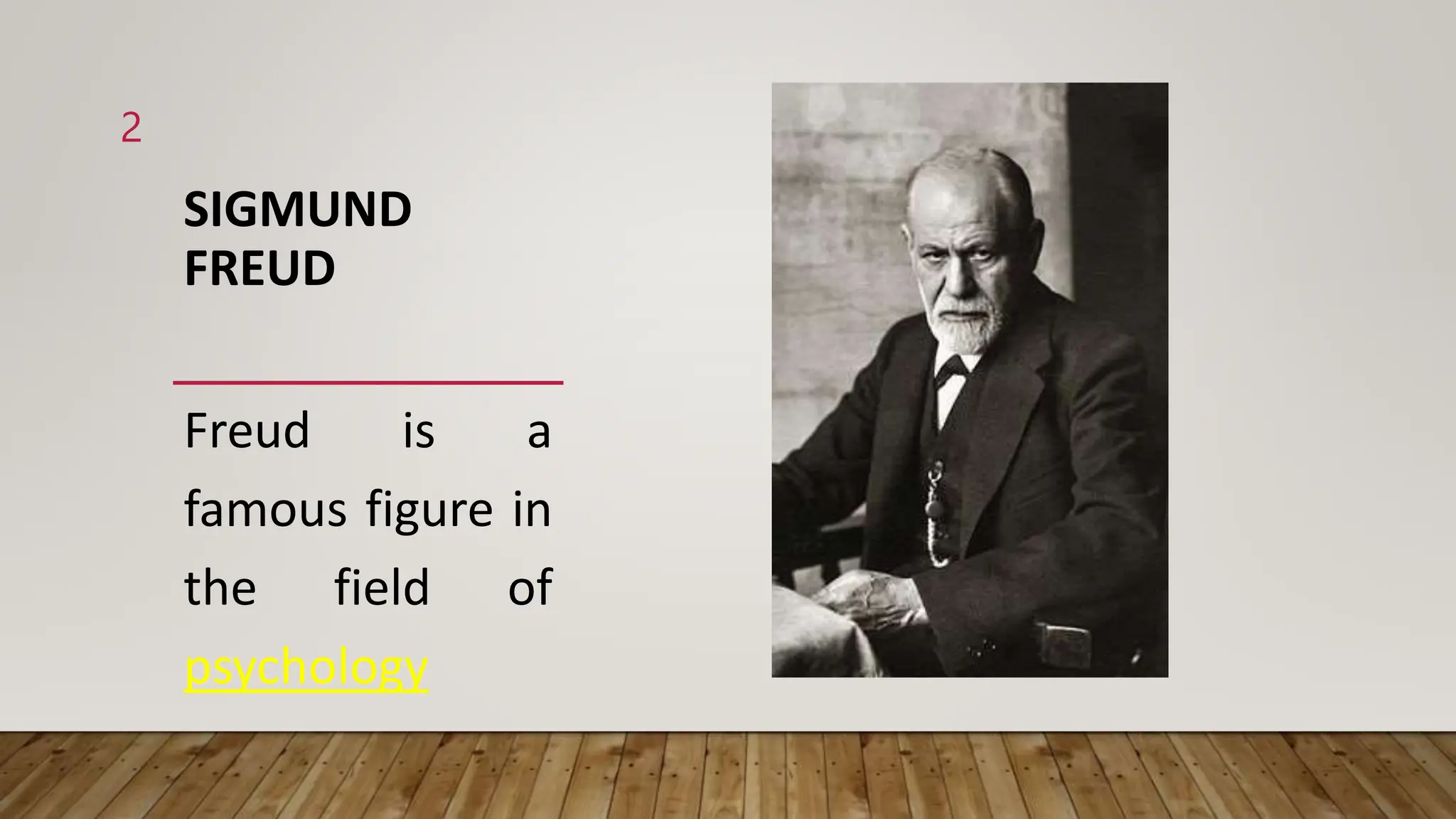
SIGMUND
FREUD
Freud is a
famous figure in
the field of
psychology
2
•Freud also made a significant
contribution in the scientific world
through the development of an
important observational method to
gather reliable data to study human’s
inner life.
3
PSYCHOANALYTIC THEORY OF PERSONALITY
•Freud believed that personality has three
structures:
•The id
•The ego
•The superego
4
“ID”
•The id is the Freudian structure of personality
that consists of instincts, which are the
individual’s reservoir of psychic energy.
•The pleasure principle is the Freudian
concept that the id always seeks pleasure &
avoids pain.
5
EGO
• The ego is the Freudian
structure of personality that
deals with the demands of
reality
• The ego abides by the reality
principle: it tries to bring the
individual pleasure within the
norms of society.
SUPEREGO
• The superego is the moral
branch of personality.
• It is often referred to as our
“conscience”
6
•His method of psychoanalysis was
proven to be effective in understanding
some neurological conditions that were
not understood by medicine at that
time.
7
•It is no doubt that amidst all questions on
his works that led to some sort of academic
controversy, his method of psychoanalysis
had great impact on the scientific way of
understanding human nature.
8
•His method was unorthodox – focusing on
human sexuality & the evil nature of man.
•To some, they found his ideas not easy
especially in his explanations of human
sexuality.
9
HUMAN SEXUALITY
10
FREUD'S PSYCHOSEXUAL STAGES OF DEVELOPMENT
1. Oral
2. Anal
3. Phallic
4. Latency
5. genital
11
THE ORAL
STAGE
Age Range: Birth to 1 Year
Erogenous Zone: Mouth
Gratifying activities: Nursing – eating, as
well as mouth movement, including
sucking, gumming, biting & swallowing.
12
INTERACTIONS WITH THE ENVIRONMENT
• To the infant, the mother’s breast is not only the
source of food & drink, but also represents her
love. Because the child’s personality is controlled
by the id & therefore demands immediate
gratification, responsive nurturing is the key. Both
insufficient & forceful feeding can result in fixation
in this stage.
13
SYMPTOMS OF ORAL FIXATION
• Smoking
• Constant chewing on gum, pens, pencils, etc.
• Nail biting
• Overeating
• Drinking
14
THE ANAL STAGE
Age Range: 1 to 3 years
Erogenous Zone: Bowel and Bladder Control
Gratifying activities: bowel movement & the
withholding of such movement
15
INTERACTIONS WITH THE ENVIRONMENT
• The major event at this stage is toilet training, a process
through which children are taught when, where & how
excretion is deemed appropriate by society. Children at
this stage, start to notice the pleasure & displeasure
associated with bowel movements. Through toilet training.
They also discover their own ability to control such
movements.
16
•Along with it comes the realization that this
ability gives them power over their parents.
That is by exercising control over the
retention & expulsion of feces, a child can
choose to either grant or resist parents’
wishes.
17
ANAL FIXATION
•Anal – expulsive personality
•Anal – retentive personality
18
ANAL – EXPULSIVE PERSONALITY
• If the parents are too lenient & fail to instill the
society’s rules about bowel movement control, the
child will derive pleasure & success from the
expulsion. Individuals with a fixation on this mode
of gratification are excessively sloppy,
disorganized, reckless, careless & defiant.
19
ANAL – RETENTIVE PERSONALITY
• If a child receives excessive pressure & punishment from
parents during toilet training, he will experience anxiety
over bowel movements & take pleasure in being able to
withhold such functions. Individuals who fail to progress
pass this stage are obsessively clean & orderly &
intolerant of those who aren’t. they may also be very
careful, stingy, withholding, obstinate, meticulous,
conforming & passive - aggressive.
20
THE PHALLIC STAGE
Age Range: 3 to 6 Years
Erogenous Zone: Genitals
Gratifying activities: Masturbation &
genital fondling
21
INTERACTIONS WITH THE ENVIRONMENT
• This is probably the most challenging stage in a person’s
psychosexual development. They key event at this stage, according
to freud, is the child’s feeling of attraction toward the parent of the
opposite sex, together with envy & fear of the same-sex parent. In
boys, this situation is called the “Oedipus Complex” (aka the oedipal
complex), named after the young man in Greek myth who killed his
father & married his mother. In girls, it is called the “electra
complex”.
22
• Boys, in the midst of their Oedipus complex, often experience
intense “castration anxiety” w/c comes from the fear of punishment
from the fathers for their desire for the mothers.
• Girls electra complex involves “penis envy”. That is, according freud,
the girl believes that she once had a penis but that it was removed.
• In order to compensate for its loss, the girl wants to have a child by
her father.
23
• Success or failure in the Oedipus conflict is at the core of
either normal psychological development or disorder.
• If a child is able to successfully resolve the conflict, he or
she will have learnt to control their envy & hostility &
begin to identify with & model after the parent of their
own sex & are ready to move on to the next
developmental stage.
24
PHALLIC FIXATION
•For men: anxiety &
guilty feelings about
sex, fear of
castration &
narcissistic
personality
• For women: it is implied that women
never progress past this stage fully &
will always maintain a sense of envy
& inferiority, although freud asserted
no certainty regarding women’s
possible fixations resulting from this
stage. Similarly, freud admitted
uncertainty on the females situation
when he constructed the “Penis envy”
theory in the first place.
25
THE LATENT PERIOD
Age Range: 6 to Puberty
Erogenous Zone: NONE
26
INTERACTIONS WITH THE ENVIRONMENT
• This is a period during which sexual feelings are
suppressed to allow children to focus their energy on
other aspects of life. This is a time of learning, adjusting to
the social environment outside of home, absorbing the
culture, forming beliefs & values, developing same-sex
friendships, engaging in sports, etc. this period of sexual
latency lasts 5 – 6 years, until puberty, upon which
children become capable of reproduction & their sexuality
is re-awakened.
27
THE GENITAL STAGE
Age Range: from Puberty onwards
Erogenous Zone: genital
Gratifying activities: masturbation &
heterosexual relationships
28
INTERACTIONS WITH THE ENVIRONMENT
•This stage is marked by a
renewed sexual interest &
desire & the pursuit of
relationships.
29
FIXATIONS
• This stage does not cause any fixation. According to freud, if people
experience difficulties at this stage & many people do, the damage
was done in earlier oral, anal & phallic stages. These people come
into this last stage of development with fixations from earlier
stages. For example, attractions to the opposite sex can be a source
of anxiety at this stage if the person has not successfully resolved
the oedipal (or electra) conflict at the phallic stage.
30
• SOME PEOPLE FIND FREUD’S PSYCHOSEXUAL DEVELOPMENT
THEORY INTRIGUING BUT DIFFICULT TO VERIFY IN REAL LIFE.
• OTHERS FEEL THAT IT WAS BUILT ON SHAKY GROUNDS
BECAUSE, ALTHOUGH THE ENTIRE THEORY FOCUSES ON EARLY
CHILDHOOD EXPERIENCE, IT IS NOT BASED ON STUDIES OF
CHILDREN, BUT MEMORIES & DREAMS OF FREUD’S ADULT
PATIENTS.
31
•SOME PEOPLE REJECT FREUD’S THEORY FOR
OTHER REASONS, SUCH AS THE IDEA THAT
SEXUAL DESIRES ARE THE PRIMARY MOTIVATION
OF ALL OUR ACTIONS & PSYCHOLOGICAL
DEVELOPMENT & ITS CONDESCENDING NOTIONS
ABOUT WOMEN.
32
33

Sigmund-Freud and his theory in psychoanalysis

  • 1.
    SOME INTELLECTUALS & THEIRREVOLUTIONARY IDEAS ‘SIGMUND FREUD’ 1
  • 2.
    SIGMUND FREUD Freud is a famousfigure in the field of psychology 2
  • 3.
    •Freud also madea significant contribution in the scientific world through the development of an important observational method to gather reliable data to study human’s inner life. 3
  • 4.
    PSYCHOANALYTIC THEORY OFPERSONALITY •Freud believed that personality has three structures: •The id •The ego •The superego 4
  • 5.
    “ID” •The id isthe Freudian structure of personality that consists of instincts, which are the individual’s reservoir of psychic energy. •The pleasure principle is the Freudian concept that the id always seeks pleasure & avoids pain. 5
  • 6.
    EGO • The egois the Freudian structure of personality that deals with the demands of reality • The ego abides by the reality principle: it tries to bring the individual pleasure within the norms of society. SUPEREGO • The superego is the moral branch of personality. • It is often referred to as our “conscience” 6
  • 7.
    •His method ofpsychoanalysis was proven to be effective in understanding some neurological conditions that were not understood by medicine at that time. 7
  • 8.
    •It is nodoubt that amidst all questions on his works that led to some sort of academic controversy, his method of psychoanalysis had great impact on the scientific way of understanding human nature. 8
  • 9.
    •His method wasunorthodox – focusing on human sexuality & the evil nature of man. •To some, they found his ideas not easy especially in his explanations of human sexuality. 9
  • 10.
  • 11.
    FREUD'S PSYCHOSEXUAL STAGESOF DEVELOPMENT 1. Oral 2. Anal 3. Phallic 4. Latency 5. genital 11
  • 12.
    THE ORAL STAGE Age Range:Birth to 1 Year Erogenous Zone: Mouth Gratifying activities: Nursing – eating, as well as mouth movement, including sucking, gumming, biting & swallowing. 12
  • 13.
    INTERACTIONS WITH THEENVIRONMENT • To the infant, the mother’s breast is not only the source of food & drink, but also represents her love. Because the child’s personality is controlled by the id & therefore demands immediate gratification, responsive nurturing is the key. Both insufficient & forceful feeding can result in fixation in this stage. 13
  • 14.
    SYMPTOMS OF ORALFIXATION • Smoking • Constant chewing on gum, pens, pencils, etc. • Nail biting • Overeating • Drinking 14
  • 15.
    THE ANAL STAGE AgeRange: 1 to 3 years Erogenous Zone: Bowel and Bladder Control Gratifying activities: bowel movement & the withholding of such movement 15
  • 16.
    INTERACTIONS WITH THEENVIRONMENT • The major event at this stage is toilet training, a process through which children are taught when, where & how excretion is deemed appropriate by society. Children at this stage, start to notice the pleasure & displeasure associated with bowel movements. Through toilet training. They also discover their own ability to control such movements. 16
  • 17.
    •Along with itcomes the realization that this ability gives them power over their parents. That is by exercising control over the retention & expulsion of feces, a child can choose to either grant or resist parents’ wishes. 17
  • 18.
    ANAL FIXATION •Anal –expulsive personality •Anal – retentive personality 18
  • 19.
    ANAL – EXPULSIVEPERSONALITY • If the parents are too lenient & fail to instill the society’s rules about bowel movement control, the child will derive pleasure & success from the expulsion. Individuals with a fixation on this mode of gratification are excessively sloppy, disorganized, reckless, careless & defiant. 19
  • 20.
    ANAL – RETENTIVEPERSONALITY • If a child receives excessive pressure & punishment from parents during toilet training, he will experience anxiety over bowel movements & take pleasure in being able to withhold such functions. Individuals who fail to progress pass this stage are obsessively clean & orderly & intolerant of those who aren’t. they may also be very careful, stingy, withholding, obstinate, meticulous, conforming & passive - aggressive. 20
  • 21.
    THE PHALLIC STAGE AgeRange: 3 to 6 Years Erogenous Zone: Genitals Gratifying activities: Masturbation & genital fondling 21
  • 22.
    INTERACTIONS WITH THEENVIRONMENT • This is probably the most challenging stage in a person’s psychosexual development. They key event at this stage, according to freud, is the child’s feeling of attraction toward the parent of the opposite sex, together with envy & fear of the same-sex parent. In boys, this situation is called the “Oedipus Complex” (aka the oedipal complex), named after the young man in Greek myth who killed his father & married his mother. In girls, it is called the “electra complex”. 22
  • 23.
    • Boys, inthe midst of their Oedipus complex, often experience intense “castration anxiety” w/c comes from the fear of punishment from the fathers for their desire for the mothers. • Girls electra complex involves “penis envy”. That is, according freud, the girl believes that she once had a penis but that it was removed. • In order to compensate for its loss, the girl wants to have a child by her father. 23
  • 24.
    • Success orfailure in the Oedipus conflict is at the core of either normal psychological development or disorder. • If a child is able to successfully resolve the conflict, he or she will have learnt to control their envy & hostility & begin to identify with & model after the parent of their own sex & are ready to move on to the next developmental stage. 24
  • 25.
    PHALLIC FIXATION •For men:anxiety & guilty feelings about sex, fear of castration & narcissistic personality • For women: it is implied that women never progress past this stage fully & will always maintain a sense of envy & inferiority, although freud asserted no certainty regarding women’s possible fixations resulting from this stage. Similarly, freud admitted uncertainty on the females situation when he constructed the “Penis envy” theory in the first place. 25
  • 26.
    THE LATENT PERIOD AgeRange: 6 to Puberty Erogenous Zone: NONE 26
  • 27.
    INTERACTIONS WITH THEENVIRONMENT • This is a period during which sexual feelings are suppressed to allow children to focus their energy on other aspects of life. This is a time of learning, adjusting to the social environment outside of home, absorbing the culture, forming beliefs & values, developing same-sex friendships, engaging in sports, etc. this period of sexual latency lasts 5 – 6 years, until puberty, upon which children become capable of reproduction & their sexuality is re-awakened. 27
  • 28.
    THE GENITAL STAGE AgeRange: from Puberty onwards Erogenous Zone: genital Gratifying activities: masturbation & heterosexual relationships 28
  • 29.
    INTERACTIONS WITH THEENVIRONMENT •This stage is marked by a renewed sexual interest & desire & the pursuit of relationships. 29
  • 30.
    FIXATIONS • This stagedoes not cause any fixation. According to freud, if people experience difficulties at this stage & many people do, the damage was done in earlier oral, anal & phallic stages. These people come into this last stage of development with fixations from earlier stages. For example, attractions to the opposite sex can be a source of anxiety at this stage if the person has not successfully resolved the oedipal (or electra) conflict at the phallic stage. 30
  • 31.
    • SOME PEOPLEFIND FREUD’S PSYCHOSEXUAL DEVELOPMENT THEORY INTRIGUING BUT DIFFICULT TO VERIFY IN REAL LIFE. • OTHERS FEEL THAT IT WAS BUILT ON SHAKY GROUNDS BECAUSE, ALTHOUGH THE ENTIRE THEORY FOCUSES ON EARLY CHILDHOOD EXPERIENCE, IT IS NOT BASED ON STUDIES OF CHILDREN, BUT MEMORIES & DREAMS OF FREUD’S ADULT PATIENTS. 31
  • 32.
    •SOME PEOPLE REJECTFREUD’S THEORY FOR OTHER REASONS, SUCH AS THE IDEA THAT SEXUAL DESIRES ARE THE PRIMARY MOTIVATION OF ALL OUR ACTIONS & PSYCHOLOGICAL DEVELOPMENT & ITS CONDESCENDING NOTIONS ABOUT WOMEN. 32
  • 33.

Editor's Notes

  • #11 ACCORDING TO FREUD, WHAT WE DO & WHY WE DO IT, WHO WE ARE & HOW WE BECAME THIS WAY ARE ALL RELATED TO OUR SEXUAL DRIVE. DIFFERENCES IN PERSONALITIES ORIGINATE IN DIFFERENCES IN CHILDHOOD SEXUAL EXPERIENCES. AT EACH STAGE, DIFFERENT AREAS OF THE CHILD’S BODY BECOME THE FOCUS OF HIS PLEASURE & THE DOMINAT SOURCE OF SEXUAL AROUSAL. DIFFERENCE IN SATISFYING THE SEXUAL URGES AT EACH STAGE WILL INEVITABLY LEAD TO DIFFERENCES IN ADULT PERONALITIES.