FM Modulation
Group Coordinators :Group Coordinators :
 Rubab Shafique
 Barira Nashal
 Rimsha Arshad
 Warda Shadab
Hoor Al Ayn
Topics to be discussed:
 Block Diagram of FM Receiver
 Single Tuned Slope Detector
Balance Slope Detector OR Dual Slope Detector
 FM Detector OR Demodulator
 Discriminator
 Ratio Detector
FM Receiver:
The devices that are able to receive FM signals (i.e. of bandwidth
ranging from 88MHz to 108MHz) is called FM receiver.
Application: used in Radio broadcasting
Difference Between a AM Receiver and FM Receiver:
 Frequencies are much higher
 Totally different methods of Demodulation is used
 different methods for obtaining AGC is used.
 Totally different methods of demodulation is used
 Need for limiting and de-emphasis in FM receiver
is used
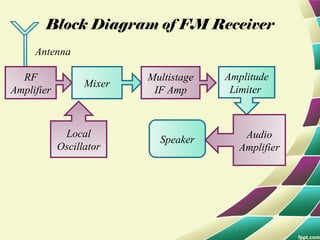
Block Diagram of FM Receiver
Speaker
RF
Amplifier
Mixer
Multistage
IF Amp
Local
Oscillator
Amplitude
Limiter
Audio
Amplifier
Antenna
Construction of FM Receiver:
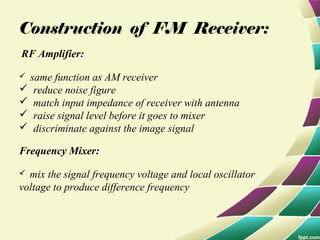
RF Amplifier:
 same function as AM receiver
 reduce noise figure
 match input impedance of receiver with antenna
 raise signal level before it goes to mixer
 discriminate against the image signal
Frequency Mixer:
 mix the signal frequency voltage and local oscillator
voltage to produce difference frequency
Local Oscillator:
 takes the usual form of frequencies that resembles VHF
operation
IF Amplifier:
 multistage RF Amplifier
 operate at intermediate frequency
 provides a large gain
 staggered tuned single tuned circuits produce more gain
bandwidth
Amplitude Limiter:
 stage not used in AM receiver
 a class A overdriven amplifier
 limits IF voltage to a certain level
 clips off amplitude variations in signal caused by noise

FM Demodulator:
 extracts original frequency from frequency
modulated carrier voltage
De-emphasis Circuit:
 Pre-emphasis_ boosting of high frequencies at transmitter
 It compensate high frequency at receiver
Audio Amplifier:
 able to accommodate a large bandwidth
Loudspeaker:
 capable of reproducing all high frequencies tones up to
15KHz
FM DETECTORSFM DETECTORS
OROR
DEMODULATORSDEMODULATORS
FM Detectors OR Demodulators:
“An FM detector or demodulator is a circuit used to convert
the FM signal after modulation back to its original form.” i.e. in
the form of modulation voltage.
 Various techniques can be used to demodulate the FM signal,
 Single tuned or slope detector
 Dual slope detector or Balanced slope detector
 Discriminator
 Ratio detector
SINGLE TUNEDSINGLE TUNED
OROR
SLOPE DETECTORSLOPE DETECTOR
Single Tuned OR Slope
Detector:
 It consists of a tuned circuit that tuned to a frequency slightly
offset of the carrier signal.
 It is used to convert frequency variation to amplitude
variation.
 As the frequency varies up and down according to its
modulation , so the signal of the slope moves up and down of the
tuned circuit . This causes the amplitude variation.
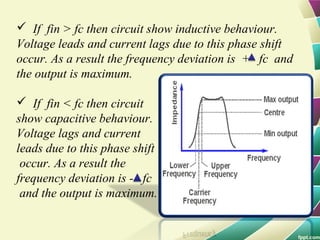
 If fin > fc then circuit show inductive behaviour.
Voltage leads and current lags due to this phase shift
occur. As a result the frequency deviation is + fc and
the output is maximum.
 If fin < fc then circuit
show capacitive behaviour.
Voltage lags and current
leads due to this phase shift
occur. As a result the
frequency deviation is - fc
and the output is maximum.
Slope Detector OR Single
Tuned Circuit:
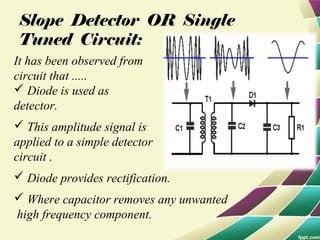
It has been observed from
circuit that .....
 Diode is used as
detector.
 This amplitude signal is
applied to a simple detector
circuit .
 Diode provides rectification.
 Where capacitor removes any unwanted
high frequency component.
Advantages:
 Simple - can be used to provide FM demodulation when only
an AM detector is present.
 Enables FM to be detected without any additional circuitry.
Disadvantages:
 Not linear as the output is dependent upon the curve of a filter.
Not linear as the output is dependent upon the curve of a filter.
Both frequency and amplitude variations are accepted and
therefore much higher levels of noise and interference
are experienced.
FM BALANCE SLOPEFM BALANCE SLOPE
DETECTORDETECTOR
OROR
DUAL SLOPEDUAL SLOPE
DETECTORDETECTOR
Introduction:
 A balanced slope detector is an improved version of slope
detector.
 It is used to over come the drawbacks of simple slope detector
, which is
a) Insufficient.
b) Improper linearity.
c) Difficult to arrange primary and secondary winding
tuned circuit.
These drawbacks are overcome by using balanced
slope detector.
Construction:
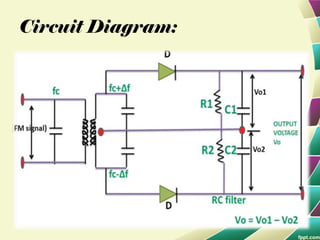
Three tuned circuits are used.
Two diodes are used.
Primary and secondary winding are center tapped with
output.
Two filters which are used to filter frequencies.
 R1 & C1
 R2 & C2
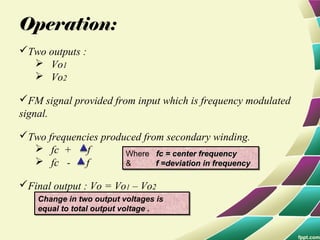
Operation:
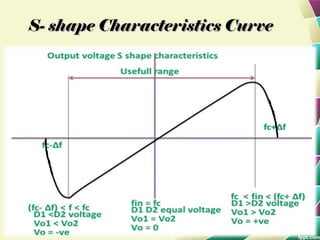
Two outputs :
 Vo1
 Vo2
FM signal provided from input which is frequency modulated
signal.
Two frequencies produced from secondary winding.
 fc + f
 fc - f
Final output : Vo = Vo1 – Vo2
Where fc = center frequencyfc = center frequency
& f =deviation in frequencyf =deviation in frequency
Where fc = center frequencyfc = center frequency
& f =deviation in frequencyf =deviation in frequency
Change in two output voltages is
equal to total output voltage .
Change in two output voltages is
equal to total output voltage .
Circuit Diagram:
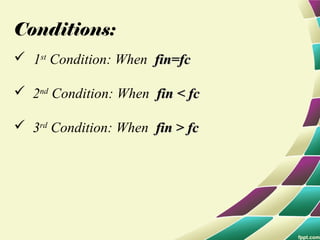
Conditions:
 1st
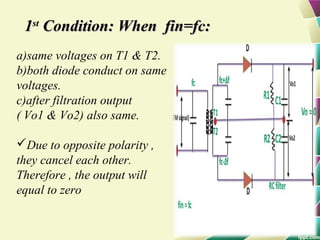
Condition: When fin=fcfin=fc
 2nd
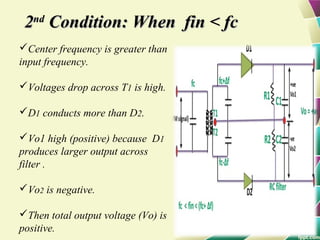
Condition: When fin < fcfin < fc
 3rd
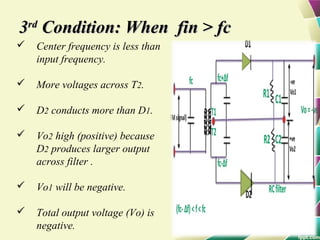
Condition: When fin > fcfin > fc
a)same voltages on T1 & T2.
b)both diode conduct on same
voltages.
c)after filtration output
( Vo1 & Vo2) also same.
Due to opposite polarity ,
they cancel each other.
Therefore , the output will
equal to zero
11stst
Condition: When fin=fc:Condition: When fin=fc:
Center frequency is greater than
input frequency.
Voltages drop across T1 is high.
D1 conducts more than D2.
Vo1 high (positive) because D1
produces larger output across
filter .
Vo2 is negative.
Then total output voltage (Vo) is
positive.
22ndnd
Condition: When fin < fcCondition: When fin < fc
33rdrd
Condition: When fin > fcCondition: When fin > fc
 Center frequency is less than
input frequency.
 More voltages across T2.
 D2 conducts more than D1.
 Vo2 high (positive) because
D2 produces larger output
across filter .
 Vo1 will be negative.
 Total output voltage (Vo) is
negative.
S- shape Characteristics CurveS- shape Characteristics Curve
Advantages:
More efficient than simple slope detector.
Better linearity than simple slope detector.
Drawbacks:
It is difficult to tuned because three tuned circuit used
at different frequency.
Amplitude limiting is not provided
FOSTERFOSTER
SEELEYSEELEY
DISCRIMINATORDISCRIMINATOR
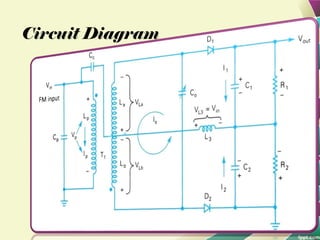
Foster Seeley Discriminator:
 Also called phase shift discriminator  operation very
similar to the balanced slope detector
 It uses a double-tuned RF transformer to convert frequency
variations in the received fm signal to amplitude variations.
 This type of circuit requires a transformer center tapped
secondary generally called the discriminator transformer, two
diodes and a no. of resistors and capacitors
 Because of the center-tap arrangement, the voltages at each
end of the secondary winding of T1 are 180 degrees out of phase
 The diodes conduct on opposite half cycles of the input
waveform and produce a RF ripple . This RF ripple is filtered
out by capacitors C3 and C4.
Circuit Diagram
Principle Circuit Operation:
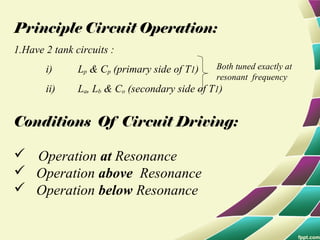
1.Have 2 tank circuits :
i) Lp & Cp (primary side of T1)
ii) La, Lb & Co (secondary side of T1)
Conditions Of Circuit Driving:
 Operation at Resonance
 Operation above Resonance
 Operation below Resonance
Both tuned exactly at
resonant frequency
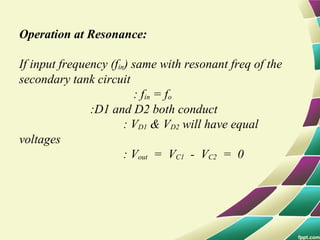
Operation at Resonance:
If input frequency (fin) same with resonant freq of the
secondary tank circuit
: fin = fo
:D1 and D2 both conduct
: VD1 & VD2 will have equal
voltages
: Vout = VC1 - VC2 = 0
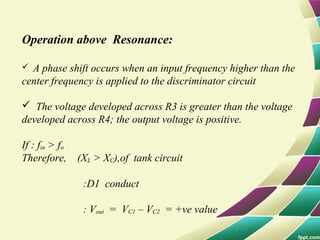
Operation above Resonance:
 A phase shift occurs when an input frequency higher than the
center frequency is applied to the discriminator circuit
 The voltage developed across R3 is greater than the voltage
developed across R4; the output voltage is positive.
If : fin > fo
Therefore, (XL > XC),of tank circuit
:D1 conduct
: Vout = VC1 – VC2 = +ve value
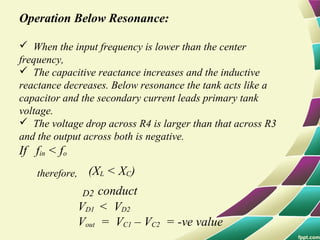
Operation Below Resonance:
 When the input frequency is lower than the center
frequency,
 The capacitive reactance increases and the inductive
reactance decreases. Below resonance the tank acts like a
capacitor and the secondary current leads primary tank
voltage.
 The voltage drop across R4 is larger than that across R3
and the output across both is negative.
If fin < fo
therefore, (XL < XC)
D2 conduct
VD1 < VD2
Vout = VC1 – VC2 = -ve value
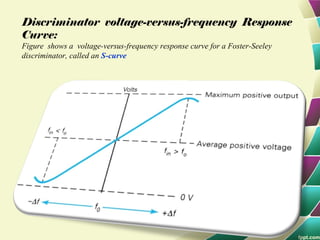
Discriminator voltage-versus-frequency Response
Curve:
Figure shows a voltage-versus-frequency response curve for a Foster-Seeley
discriminator, called an S-curve
Drawback of Phase Discriminator:
In the presence of noise and other amplitude variation the
demodulator output produce error.
Amplitude limiting is not provide.
Advantages:
It is easy to tuned then the balance slope detector.
It is better linearity.
RATIO
DETECTOR
Ratio Detector:
 Ratio detector is a modified form of discriminator.
 The difference between ratio detector and discriminator
are :
 Reverse diode polarity
 A large vale of capacitor is used
 Output is taken from different position
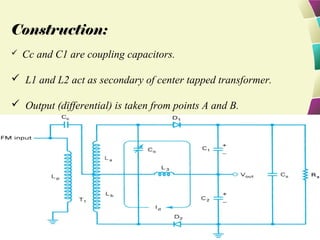
Construction:
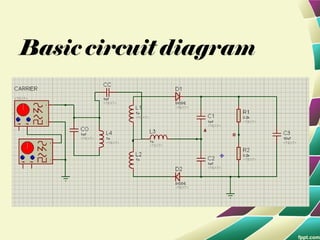
 Cc and C1 are coupling capacitors.
 L1 and L2 act as secondary of center tapped transformer.
 Output (differential) is taken from points A and B.
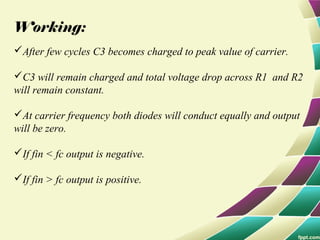
Working:
After few cycles C3 becomes charged to peak value of carrier.
C3 will remain charged and total voltage drop across R1 and R2
will remain constant.
At carrier frequency both diodes will conduct equally and output

will be zero.
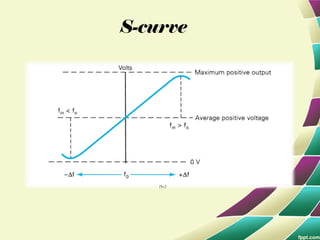
If fin < fc output is negative.
If fin > fc output is positive.
Basic circuit diagram
S-curve
Advantages:
 Limiter is not required
Comparatively less components used
Excellent noise free output
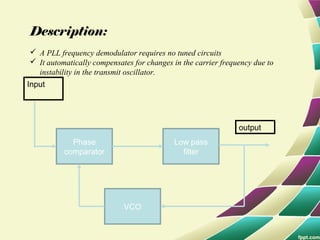
Phase Locked Loop
 Best frequency demodulator.
 Frequency or phase sensitive feedback control
circuit.
 Basic components :
1.Phase detector
2.Voltage control oscillator
3.Low pass filter
Phase
locked loop
(PPL)
Phase
comparator
VCO
Low pass
filter
Input
output
Description:
 A PLL frequency demodulator requires no tuned circuits
 It automatically compensates for changes in the carrier frequency due to
instability in the transmit oscillator.
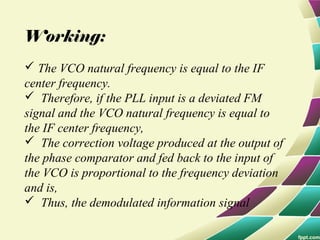
Working:
 The VCO natural frequency is equal to the IF
center frequency.
 Therefore, if the PLL input is a deviated FM
signal and the VCO natural frequency is equal to
the IF center frequency,
 The correction voltage produced at the output of
the phase comparator and fed back to the input of
the VCO is proportional to the frequency deviation
and is,
 Thus, the demodulated information signal
Thank
You

Frequency modulation and its circuits

  • 1.
    FM Modulation Group Coordinators:Group Coordinators :  Rubab Shafique  Barira Nashal  Rimsha Arshad  Warda Shadab Hoor Al Ayn
  • 2.
    Topics to bediscussed:  Block Diagram of FM Receiver  Single Tuned Slope Detector Balance Slope Detector OR Dual Slope Detector  FM Detector OR Demodulator  Discriminator  Ratio Detector
  • 3.
    FM Receiver: The devicesthat are able to receive FM signals (i.e. of bandwidth ranging from 88MHz to 108MHz) is called FM receiver. Application: used in Radio broadcasting Difference Between a AM Receiver and FM Receiver:  Frequencies are much higher  Totally different methods of Demodulation is used  different methods for obtaining AGC is used.  Totally different methods of demodulation is used  Need for limiting and de-emphasis in FM receiver is used
  • 4.
    Block Diagram ofFM Receiver Speaker RF Amplifier Mixer Multistage IF Amp Local Oscillator Amplitude Limiter Audio Amplifier Antenna
  • 5.
    Construction of FMReceiver: RF Amplifier:  same function as AM receiver  reduce noise figure  match input impedance of receiver with antenna  raise signal level before it goes to mixer  discriminate against the image signal Frequency Mixer:  mix the signal frequency voltage and local oscillator voltage to produce difference frequency
  • 6.
    Local Oscillator:  takesthe usual form of frequencies that resembles VHF operation IF Amplifier:  multistage RF Amplifier  operate at intermediate frequency  provides a large gain  staggered tuned single tuned circuits produce more gain bandwidth
  • 7.
    Amplitude Limiter:  stagenot used in AM receiver  a class A overdriven amplifier  limits IF voltage to a certain level  clips off amplitude variations in signal caused by noise  FM Demodulator:  extracts original frequency from frequency modulated carrier voltage
  • 8.
    De-emphasis Circuit:  Pre-emphasis_boosting of high frequencies at transmitter  It compensate high frequency at receiver Audio Amplifier:  able to accommodate a large bandwidth Loudspeaker:  capable of reproducing all high frequencies tones up to 15KHz
  • 9.
  • 10.
    FM Detectors ORDemodulators: “An FM detector or demodulator is a circuit used to convert the FM signal after modulation back to its original form.” i.e. in the form of modulation voltage.  Various techniques can be used to demodulate the FM signal,  Single tuned or slope detector  Dual slope detector or Balanced slope detector  Discriminator  Ratio detector
  • 11.
  • 12.
    Single Tuned ORSlope Detector:  It consists of a tuned circuit that tuned to a frequency slightly offset of the carrier signal.  It is used to convert frequency variation to amplitude variation.  As the frequency varies up and down according to its modulation , so the signal of the slope moves up and down of the tuned circuit . This causes the amplitude variation.
  • 13.
     If fin> fc then circuit show inductive behaviour. Voltage leads and current lags due to this phase shift occur. As a result the frequency deviation is + fc and the output is maximum.  If fin < fc then circuit show capacitive behaviour. Voltage lags and current leads due to this phase shift occur. As a result the frequency deviation is - fc and the output is maximum.
  • 14.
    Slope Detector ORSingle Tuned Circuit: It has been observed from circuit that .....  Diode is used as detector.  This amplitude signal is applied to a simple detector circuit .  Diode provides rectification.  Where capacitor removes any unwanted high frequency component.
  • 15.
    Advantages:  Simple -can be used to provide FM demodulation when only an AM detector is present.  Enables FM to be detected without any additional circuitry. Disadvantages:  Not linear as the output is dependent upon the curve of a filter. Not linear as the output is dependent upon the curve of a filter. Both frequency and amplitude variations are accepted and therefore much higher levels of noise and interference are experienced.
  • 16.
    FM BALANCE SLOPEFMBALANCE SLOPE DETECTORDETECTOR OROR DUAL SLOPEDUAL SLOPE DETECTORDETECTOR
  • 17.
    Introduction:  A balancedslope detector is an improved version of slope detector.  It is used to over come the drawbacks of simple slope detector , which is a) Insufficient. b) Improper linearity. c) Difficult to arrange primary and secondary winding tuned circuit. These drawbacks are overcome by using balanced slope detector.
  • 18.
    Construction: Three tuned circuitsare used. Two diodes are used. Primary and secondary winding are center tapped with output. Two filters which are used to filter frequencies.  R1 & C1  R2 & C2
  • 19.
    Operation: Two outputs : Vo1  Vo2 FM signal provided from input which is frequency modulated signal. Two frequencies produced from secondary winding.  fc + f  fc - f Final output : Vo = Vo1 – Vo2 Where fc = center frequencyfc = center frequency & f =deviation in frequencyf =deviation in frequency Where fc = center frequencyfc = center frequency & f =deviation in frequencyf =deviation in frequency Change in two output voltages is equal to total output voltage . Change in two output voltages is equal to total output voltage .
  • 20.
  • 21.
    Conditions:  1st Condition: Whenfin=fcfin=fc  2nd Condition: When fin < fcfin < fc  3rd Condition: When fin > fcfin > fc
  • 22.
    a)same voltages onT1 & T2. b)both diode conduct on same voltages. c)after filtration output ( Vo1 & Vo2) also same. Due to opposite polarity , they cancel each other. Therefore , the output will equal to zero 11stst Condition: When fin=fc:Condition: When fin=fc:
  • 23.
    Center frequency isgreater than input frequency. Voltages drop across T1 is high. D1 conducts more than D2. Vo1 high (positive) because D1 produces larger output across filter . Vo2 is negative. Then total output voltage (Vo) is positive. 22ndnd Condition: When fin < fcCondition: When fin < fc
  • 24.
    33rdrd Condition: When fin> fcCondition: When fin > fc  Center frequency is less than input frequency.  More voltages across T2.  D2 conducts more than D1.  Vo2 high (positive) because D2 produces larger output across filter .  Vo1 will be negative.  Total output voltage (Vo) is negative.
  • 25.
    S- shape CharacteristicsCurveS- shape Characteristics Curve
  • 26.
    Advantages: More efficient thansimple slope detector. Better linearity than simple slope detector. Drawbacks: It is difficult to tuned because three tuned circuit used at different frequency. Amplitude limiting is not provided
  • 27.
  • 28.
    Foster Seeley Discriminator: Also called phase shift discriminator  operation very similar to the balanced slope detector  It uses a double-tuned RF transformer to convert frequency variations in the received fm signal to amplitude variations.  This type of circuit requires a transformer center tapped secondary generally called the discriminator transformer, two diodes and a no. of resistors and capacitors
  • 29.
     Because ofthe center-tap arrangement, the voltages at each end of the secondary winding of T1 are 180 degrees out of phase  The diodes conduct on opposite half cycles of the input waveform and produce a RF ripple . This RF ripple is filtered out by capacitors C3 and C4.
  • 30.
  • 31.
    Principle Circuit Operation: 1.Have2 tank circuits : i) Lp & Cp (primary side of T1) ii) La, Lb & Co (secondary side of T1) Conditions Of Circuit Driving:  Operation at Resonance  Operation above Resonance  Operation below Resonance Both tuned exactly at resonant frequency
  • 32.
    Operation at Resonance: Ifinput frequency (fin) same with resonant freq of the secondary tank circuit : fin = fo :D1 and D2 both conduct : VD1 & VD2 will have equal voltages : Vout = VC1 - VC2 = 0
  • 33.
    Operation above Resonance: A phase shift occurs when an input frequency higher than the center frequency is applied to the discriminator circuit  The voltage developed across R3 is greater than the voltage developed across R4; the output voltage is positive. If : fin > fo Therefore, (XL > XC),of tank circuit :D1 conduct : Vout = VC1 – VC2 = +ve value
  • 34.
    Operation Below Resonance: When the input frequency is lower than the center frequency,  The capacitive reactance increases and the inductive reactance decreases. Below resonance the tank acts like a capacitor and the secondary current leads primary tank voltage.  The voltage drop across R4 is larger than that across R3 and the output across both is negative. If fin < fo therefore, (XL < XC) D2 conduct VD1 < VD2 Vout = VC1 – VC2 = -ve value
  • 35.
    Discriminator voltage-versus-frequency Response Curve: Figureshows a voltage-versus-frequency response curve for a Foster-Seeley discriminator, called an S-curve
  • 36.
    Drawback of PhaseDiscriminator: In the presence of noise and other amplitude variation the demodulator output produce error. Amplitude limiting is not provide. Advantages: It is easy to tuned then the balance slope detector. It is better linearity.
  • 37.
  • 38.
    Ratio Detector:  Ratiodetector is a modified form of discriminator.  The difference between ratio detector and discriminator are :  Reverse diode polarity  A large vale of capacitor is used  Output is taken from different position
  • 39.
    Construction:  Cc andC1 are coupling capacitors.  L1 and L2 act as secondary of center tapped transformer.  Output (differential) is taken from points A and B.
  • 40.
    Working: After few cyclesC3 becomes charged to peak value of carrier. C3 will remain charged and total voltage drop across R1 and R2 will remain constant. At carrier frequency both diodes will conduct equally and output will be zero. If fin < fc output is negative. If fin > fc output is positive.
  • 41.
  • 42.
  • 43.
    Advantages:  Limiter isnot required Comparatively less components used Excellent noise free output
  • 44.
    Phase Locked Loop Best frequency demodulator.  Frequency or phase sensitive feedback control circuit.  Basic components : 1.Phase detector 2.Voltage control oscillator 3.Low pass filter
  • 45.
  • 46.
    Phase comparator VCO Low pass filter Input output Description:  APLL frequency demodulator requires no tuned circuits  It automatically compensates for changes in the carrier frequency due to instability in the transmit oscillator.
  • 47.
    Working:  The VCOnatural frequency is equal to the IF center frequency.  Therefore, if the PLL input is a deviated FM signal and the VCO natural frequency is equal to the IF center frequency,  The correction voltage produced at the output of the phase comparator and fed back to the input of the VCO is proportional to the frequency deviation and is,  Thus, the demodulated information signal
  • 48.