URBAN DESIGN
M.ARCH SEM-1
PRESENTED BY-
Rajni Sharma
M.ARCH 1ST SEM
GUIDED BY-
Prof. Sunil Suplikar
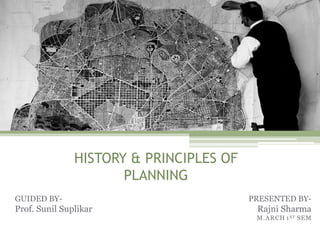
HISTORY & PRINCIPLES OF
PLANNING
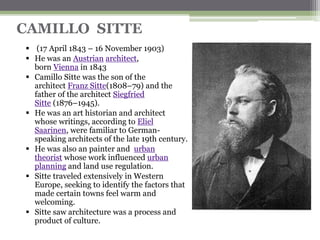
CAMILLO SITTE
▪ (17 April 1843 – 16 November 1903)
▪ He was an Austrian architect,
born Vienna in 1843
▪ Camillo Sitte was the son of the
architect Franz Sitte(1808–79) and the
father of the architect Siegfried
Sitte (1876–1945).
▪ He was an art historian and architect
whose writings, according to Eliel
Saarinen, were familiar to German-
speaking architects of the late 19th century.
▪ He was also an painter and urban
theorist whose work influenced urban
planning and land use regulation.
▪ Sitte traveled extensively in Western
Europe, seeking to identify the factors that
made certain towns feel warm and
welcoming.
▪ Sitte saw architecture was a process and
product of culture.
IDEOLOGY-
▪ His mainly focuses on details of public spaces,
grouping of buildings & streets that work
▪ The old plazas produce a collective harmonious
effect
▪ There are many advantages to an arrangement
of street openings in the form of turbine arms
▪ Two forms of square:
- Those that are deep
Deep plazas are better facing a church of slender
form
- Those that are wide
City halls require broader, more expansive ones
▪ Straight lines are unnatural, do not follow terrain
▪ Need both art and function to make cities
appealing
▪ Disruptions in symmetry are not unsightly
▪ ‘A city should be built to give its inhabitants
security and happiness.’
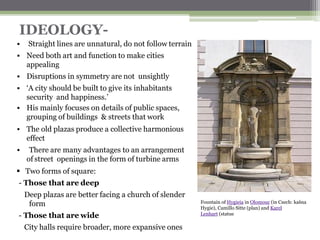
Fountain of Hygieia in Olomouc (in Czech: kašna
Hygie), Camillo Sitte (plan) and Karel
Lenhart (statue
City Planning According to Artistic
Principles (1889)
• In 1889, Sitte published City Planning
According to Artistic Principles (often
translated as The Art of Building Cities).
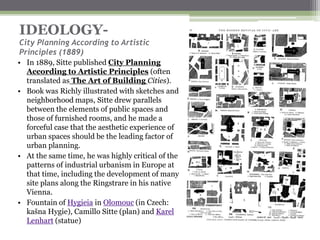
• Book was Richly illustrated with sketches and
neighborhood maps, Sitte drew parallels
between the elements of public spaces and
those of furnished rooms, and he made a
forceful case that the aesthetic experience of
urban spaces should be the leading factor of
urban planning.
• At the same time, he was highly critical of the
patterns of industrial urbanism in Europe at
that time, including the development of many
site plans along the Ringstrare in his native
Vienna.
• Fountain of Hygieia in Olomouc (in Czech:
kašna Hygie), Camillo Sitte (plan) and Karel
Lenhart (statue)
IDEOLOGY-
City Planning According to Artistic Principles (1889)
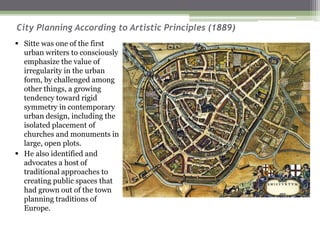
▪ Sitte was one of the first
urban writers to consciously
emphasize the value of
irregularity in the urban
form, by challenged among
other things, a growing
tendency toward rigid
symmetry in contemporary
urban design, including the
isolated placement of
churches and monuments in
large, open plots.
▪ He also identified and
advocates a host of
traditional approaches to
creating public spaces that
had grown out of the town
planning traditions of
Europe.
City Planning According to Artistic
Principles (1889)
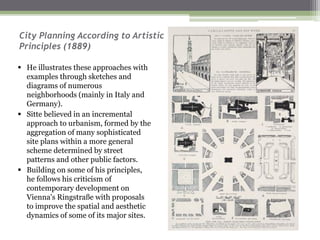
▪ He illustrates these approaches with
examples through sketches and
diagrams of numerous
neighborhoods (mainly in Italy and
Germany).
▪ Sitte believed in an incremental
approach to urbanism, formed by the
aggregation of many sophisticated
site plans within a more general
scheme determined by street
patterns and other public factors.
▪ Building on some of his principles,
he follows his criticism of
contemporary development on
Vienna's Ringstraße with proposals
to improve the spatial and aesthetic
dynamics of some of its major sites.
▪ Many of the old structural forms are simply out of the question for modern
builders
▪ Decorative construction without vital function is but temporary and of questionable
value
▪ Time makes inexorable changes in community life, and these changes alter the
original significance of architectural forms
▪ Intense human concentration has meant intense increase in land value
▪ Street after street has been cut through old districts, giving birth to more and more city
blocks
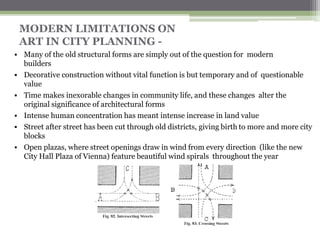
▪ Open plazas, where street openings draw in wind from every direction (like the new
City Hall Plaza of Vienna) feature beautiful wind spirals throughout the year
MODERN LIMITATIONS ON
ART IN CITY PLANNING -
BOOKS BY SITTE-
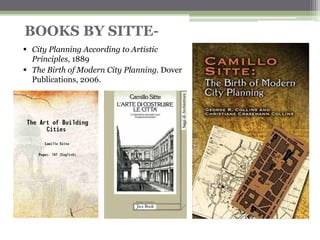
▪ City Planning According to Artistic
Principles, 1889
▪ The Birth of Modern City Planning. Dover
Publications, 2006.
REFERENCES-
▪ The Art Of Building Cities, English translation (1945). Internet Archive.
▪ https://en.wikipedia.org/wiki/Camillo_Sitte
▪ https://www.britannica.com/biography/Camillo-Sitte
▪ https://sheffieldurbandesignandplanning.wordpress.com/tag/theory/
▪ http://architecture-design-mannager.blogspot.com/2011/11/camillo-sitte-
city-building-according.html
“Thank you”

Camillo sitte - Urban designer

  • 1.
    URBAN DESIGN M.ARCH SEM-1 PRESENTEDBY- Rajni Sharma M.ARCH 1ST SEM GUIDED BY- Prof. Sunil Suplikar HISTORY & PRINCIPLES OF PLANNING
  • 2.
    CAMILLO SITTE ▪ (17April 1843 – 16 November 1903) ▪ He was an Austrian architect, born Vienna in 1843 ▪ Camillo Sitte was the son of the architect Franz Sitte(1808–79) and the father of the architect Siegfried Sitte (1876–1945). ▪ He was an art historian and architect whose writings, according to Eliel Saarinen, were familiar to German- speaking architects of the late 19th century. ▪ He was also an painter and urban theorist whose work influenced urban planning and land use regulation. ▪ Sitte traveled extensively in Western Europe, seeking to identify the factors that made certain towns feel warm and welcoming. ▪ Sitte saw architecture was a process and product of culture.
  • 3.
    IDEOLOGY- ▪ His mainlyfocuses on details of public spaces, grouping of buildings & streets that work ▪ The old plazas produce a collective harmonious effect ▪ There are many advantages to an arrangement of street openings in the form of turbine arms ▪ Two forms of square: - Those that are deep Deep plazas are better facing a church of slender form - Those that are wide City halls require broader, more expansive ones ▪ Straight lines are unnatural, do not follow terrain ▪ Need both art and function to make cities appealing ▪ Disruptions in symmetry are not unsightly ▪ ‘A city should be built to give its inhabitants security and happiness.’ Fountain of Hygieia in Olomouc (in Czech: kašna Hygie), Camillo Sitte (plan) and Karel Lenhart (statue
  • 4.
    City Planning Accordingto Artistic Principles (1889) • In 1889, Sitte published City Planning According to Artistic Principles (often translated as The Art of Building Cities). • Book was Richly illustrated with sketches and neighborhood maps, Sitte drew parallels between the elements of public spaces and those of furnished rooms, and he made a forceful case that the aesthetic experience of urban spaces should be the leading factor of urban planning. • At the same time, he was highly critical of the patterns of industrial urbanism in Europe at that time, including the development of many site plans along the Ringstrare in his native Vienna. • Fountain of Hygieia in Olomouc (in Czech: kašna Hygie), Camillo Sitte (plan) and Karel Lenhart (statue) IDEOLOGY-
  • 5.
    City Planning Accordingto Artistic Principles (1889) ▪ Sitte was one of the first urban writers to consciously emphasize the value of irregularity in the urban form, by challenged among other things, a growing tendency toward rigid symmetry in contemporary urban design, including the isolated placement of churches and monuments in large, open plots. ▪ He also identified and advocates a host of traditional approaches to creating public spaces that had grown out of the town planning traditions of Europe.
  • 6.
    City Planning Accordingto Artistic Principles (1889) ▪ He illustrates these approaches with examples through sketches and diagrams of numerous neighborhoods (mainly in Italy and Germany). ▪ Sitte believed in an incremental approach to urbanism, formed by the aggregation of many sophisticated site plans within a more general scheme determined by street patterns and other public factors. ▪ Building on some of his principles, he follows his criticism of contemporary development on Vienna's Ringstraße with proposals to improve the spatial and aesthetic dynamics of some of its major sites.
  • 7.
    ▪ Many ofthe old structural forms are simply out of the question for modern builders ▪ Decorative construction without vital function is but temporary and of questionable value ▪ Time makes inexorable changes in community life, and these changes alter the original significance of architectural forms ▪ Intense human concentration has meant intense increase in land value ▪ Street after street has been cut through old districts, giving birth to more and more city blocks ▪ Open plazas, where street openings draw in wind from every direction (like the new City Hall Plaza of Vienna) feature beautiful wind spirals throughout the year MODERN LIMITATIONS ON ART IN CITY PLANNING -
  • 8.
    BOOKS BY SITTE- ▪City Planning According to Artistic Principles, 1889 ▪ The Birth of Modern City Planning. Dover Publications, 2006.
  • 9.
    REFERENCES- ▪ The ArtOf Building Cities, English translation (1945). Internet Archive. ▪ https://en.wikipedia.org/wiki/Camillo_Sitte ▪ https://www.britannica.com/biography/Camillo-Sitte ▪ https://sheffieldurbandesignandplanning.wordpress.com/tag/theory/ ▪ http://architecture-design-mannager.blogspot.com/2011/11/camillo-sitte- city-building-according.html “Thank you”