RESEARCH METHODOLOGY
PART 2
Dr. NELSON C ELIAS, Ph.D.
Dr.NELSON C ELIAS,Ph.D.(Psy.)
Visit https://www.psyclinic.co.in/
OBJECTIVES
PART 2
DEFINE RESEARCH METHODOLOGY
ELEMENTS OF RESEARCH
METHODOLOGY
FRAMING A RESEARCH QUESTION
TURNING IT INTO A TITLE
DEFINITION
Research methodology is
the specific procedures
or techniques used to
identify, select, process,
and analyze information
about a topic.
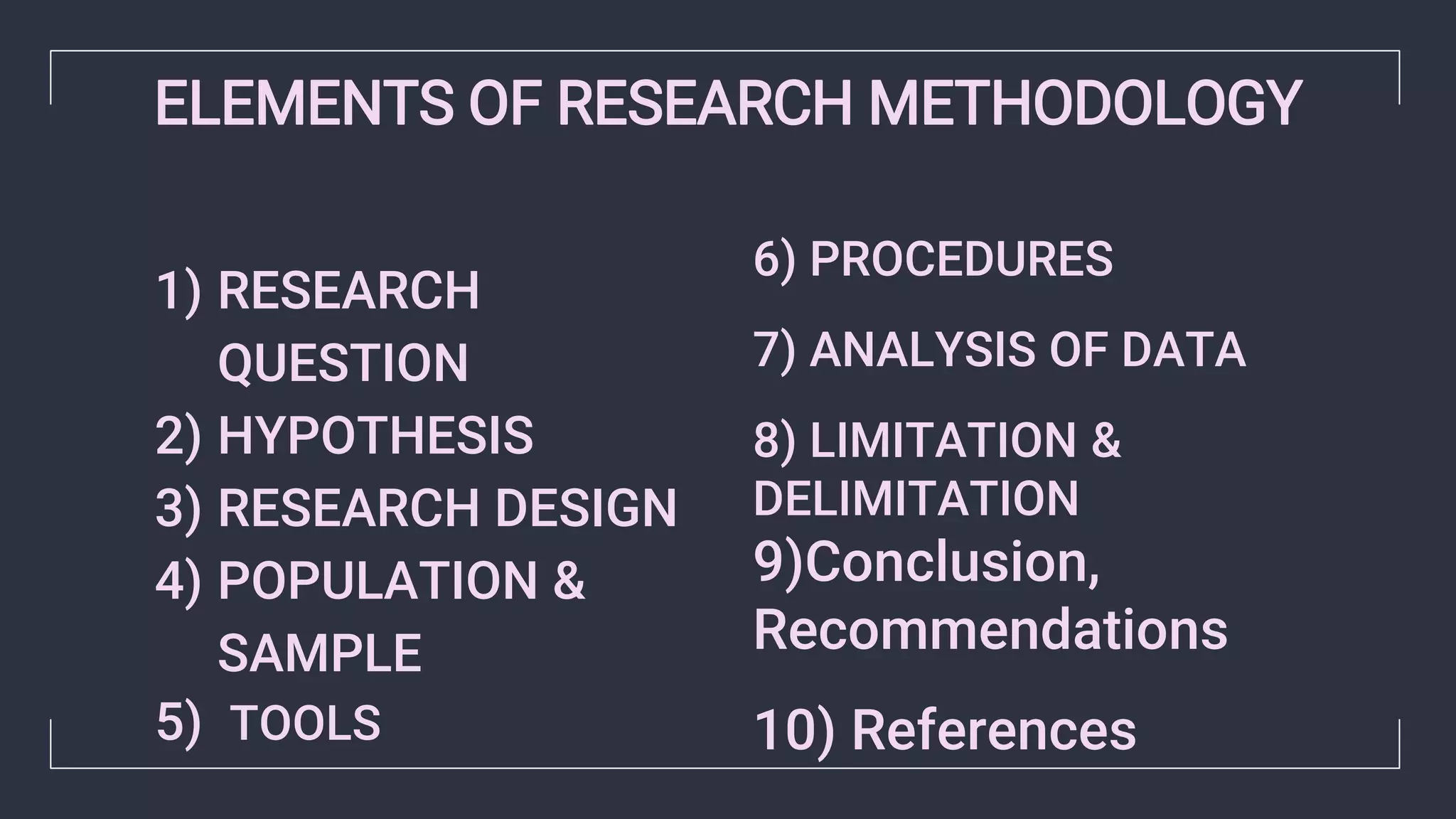
ELEMENTS OF RESEARCH METHODOLOGY
1) RESEARCH
QUESTION
2) HYPOTHESIS
3) RESEARCH DESIGN
4) POPULATION &
SAMPLE
5) TOOLS
6) PROCEDURES
7) ANALYSIS OF DATA
8) LIMITATION &
DELIMITATION
9)Conclusion,
Recommendations
10) References
FRAMING A RESEARCH QUESTION
A FEW TERMS
VARIABLES
a) Independent
b) dependent
CONTROL GROUP(Comparison
group)
EXPERIMENTAL GROUP(treatment
group)
The independent variable is the variable that
is controlled and manipulated by the
experimenter.
The dependent variable is the variable that is
measured by the experimenter.
The control group is composed of
participants who do not receive the
experimental treatment.
An experimental group, receives the
treatment whose effect researchers wish to
study
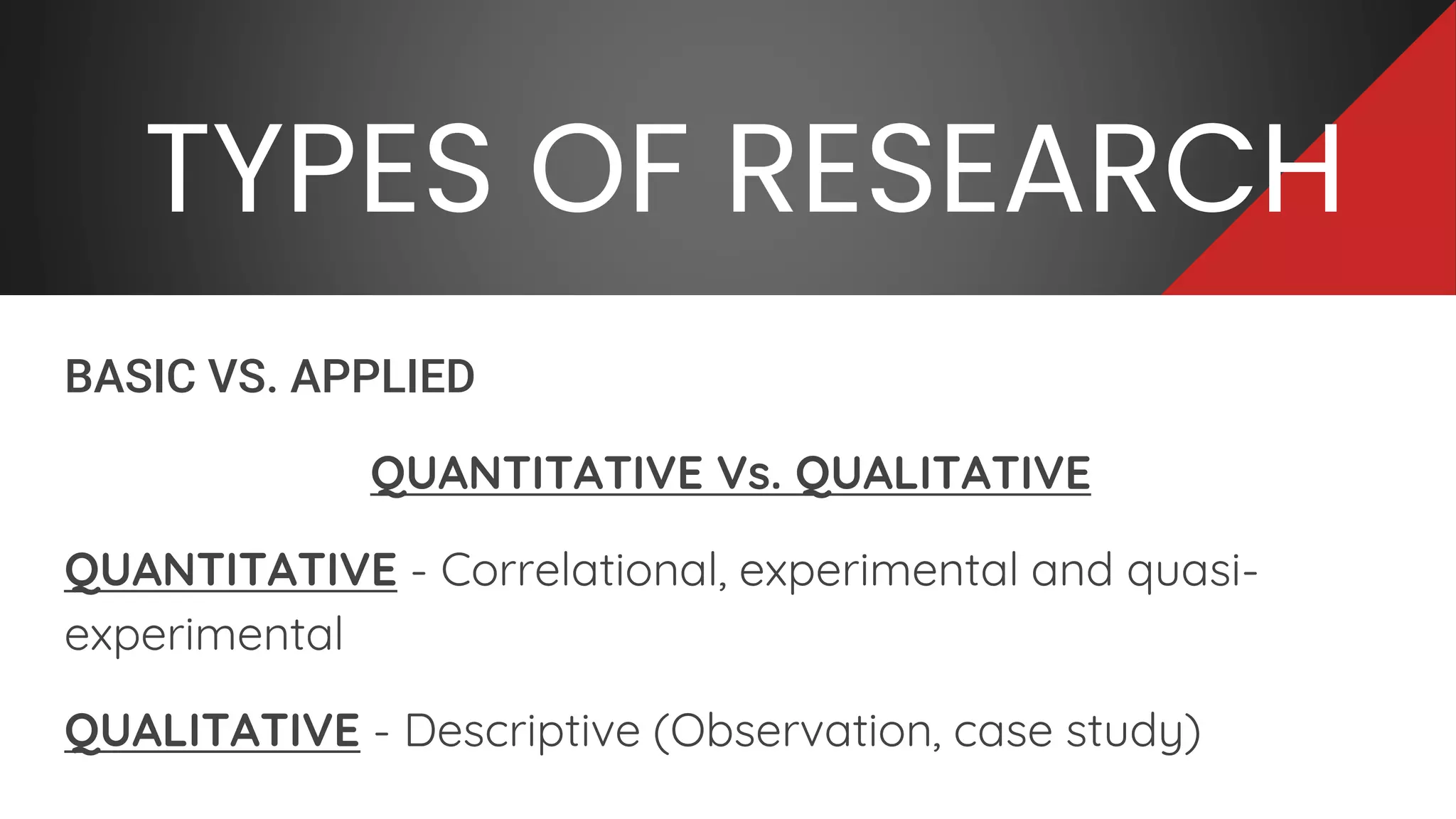
TYPES OF RESEARCH
BASIC VS. APPLIED
QUANTITATIVE Vs. QUALITATIVE
QUANTITATIVE - Correlational, experimental and quasi-
experimental
QUALITATIVE - Descriptive (Observation, case study)
QUANTITATIVE
CORRELATIONAL design which measures a relationship between two or more variables
without the researcher controlling them. It aims to find out whether there is a positive or
negative correlation. It does not imply causation.
EXPERIMENTAL - involves manipulating one variable to determine whether
changes in one variable cause changes in another variable. It relies on controlled
methods, random assignment and the manipulation of variables to test a
hypothesis.
QUASI-EXPERIMENTAL - without the random assignment of
participants to conditions or orders of conditions
TYPES OF RESEARCH QUESTIONS
OPEN ENDED QUESTIONS
Descriptive
Exploratory
CLOSE ENDED QUESTIONS
Relational (Correlational)
Causal (includes Experimental)
TYPES OF RESEARCH STUDIES
LONGITUDINAL STUDY
Makes comparison over
time. It involves repeated
observation of the same
sample and variables over a
short or long periods of
time. Same group
compared.
CROSS SECTIONAL STUDY
Makes comparison at a
single point in time. Examine
different samples of the
population at one time in
point. Different groups
compared. Easy.
FEASIBILITY OF THE
RESEARCH
QUESTION
POINTS TO CONSIDER
● RELEVANT
● POPULATION AND SAMPLE
(Ethical issues, existing rules
and regulations, availability,
payment etc.)
● INCLUSION OF
INTERVENTION -Its
feasibility)
● EQUIPMENT
● AVAILABILITY OF
VALID TOOLS
● TIME
● COST
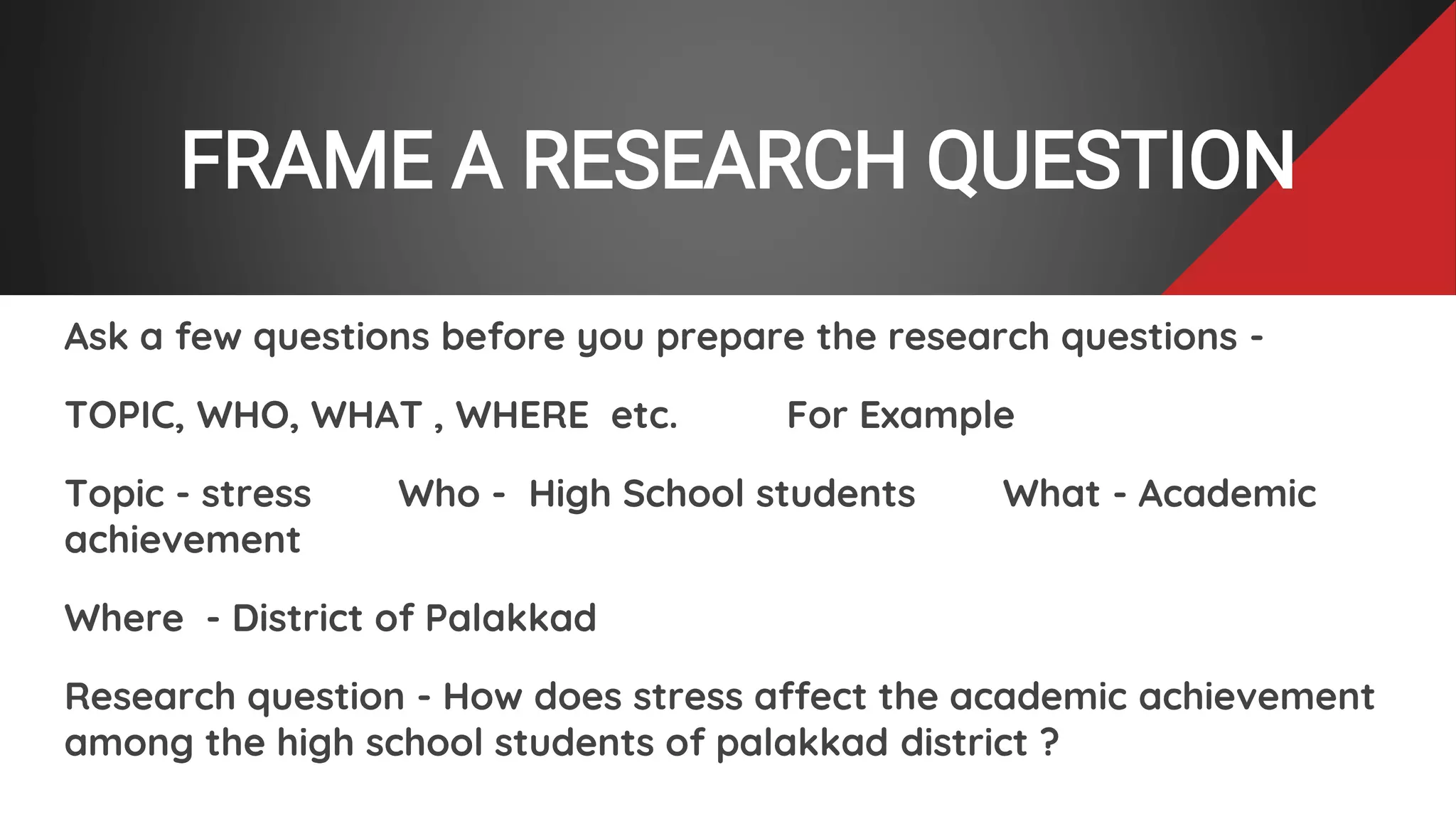
FRAME A RESEARCH QUESTION
Ask a few questions before you prepare the research questions -
TOPIC, WHO, WHAT , WHERE etc. For Example
Topic - stress Who - High School students What - Academic
achievement
Where - District of Palakkad
Research question - How does stress affect the academic achievement
among the high school students of palakkad district ?
Contd.
Ask a few more question yourself before proceeding
1) Are you planning for an interventional or relational study
2) Whether the sample will be available
3) Availability of valid tools
Besides it, think about the other points regarding the feasibility of the
research question.

A FEW EXAMPLES
● What is the role of social media on the
development of gender bias among adolescents in
India?
● What is the parenting styles among tribal primary
school children in the state of Madhya Pradesh?
● How does stress inoculation training influence the
emotional well being among working women ?
● What is the role of emotional intelligence on the
academic achievement among college students ?
CONVERTING A RESEARCH QUESTION
INTO A TITLE
TITLE
Avoid the use of articles (a,the). Eg. The impact of…..(avoid “The”)
Should not be more than 12 words in length
Should be self explanatory
Brief but should communicate the variables
It should communicate what the research paper is about.
Avoid using phrases like “A study on..”
A FEW TITLES
● Impact of social media on the development
of gender bias among adolescents.
● Parenting styles among tribal children in
Madhya Pradesh.
● Impact of stress inoculation training on
emotional well being among working
women.
● Emotional intelligence and academic
achievement among college students.
(Try to classify them - types of research)
Let us
recollect
Framing a
Research
question
SUBSCRIBE THE CHANNEL
TO WATCH THE FULL
SERIES.
Learn through psyclinic
Visit www.psyclinic.co.in
Dr. NELSON C ELIAS

Framing a research question

  • 1.
    RESEARCH METHODOLOGY PART 2 Dr.NELSON C ELIAS, Ph.D.
  • 2.
    Dr.NELSON C ELIAS,Ph.D.(Psy.) Visithttps://www.psyclinic.co.in/
  • 3.
    OBJECTIVES PART 2 DEFINE RESEARCHMETHODOLOGY ELEMENTS OF RESEARCH METHODOLOGY FRAMING A RESEARCH QUESTION TURNING IT INTO A TITLE
  • 4.
    DEFINITION Research methodology is thespecific procedures or techniques used to identify, select, process, and analyze information about a topic.
  • 5.
    ELEMENTS OF RESEARCHMETHODOLOGY 1) RESEARCH QUESTION 2) HYPOTHESIS 3) RESEARCH DESIGN 4) POPULATION & SAMPLE 5) TOOLS 6) PROCEDURES 7) ANALYSIS OF DATA 8) LIMITATION & DELIMITATION 9)Conclusion, Recommendations 10) References
  • 6.
  • 7.
    A FEW TERMS VARIABLES a)Independent b) dependent CONTROL GROUP(Comparison group) EXPERIMENTAL GROUP(treatment group) The independent variable is the variable that is controlled and manipulated by the experimenter. The dependent variable is the variable that is measured by the experimenter. The control group is composed of participants who do not receive the experimental treatment. An experimental group, receives the treatment whose effect researchers wish to study
  • 8.
    TYPES OF RESEARCH BASICVS. APPLIED QUANTITATIVE Vs. QUALITATIVE QUANTITATIVE - Correlational, experimental and quasi- experimental QUALITATIVE - Descriptive (Observation, case study)
  • 9.
    QUANTITATIVE CORRELATIONAL design whichmeasures a relationship between two or more variables without the researcher controlling them. It aims to find out whether there is a positive or negative correlation. It does not imply causation. EXPERIMENTAL - involves manipulating one variable to determine whether changes in one variable cause changes in another variable. It relies on controlled methods, random assignment and the manipulation of variables to test a hypothesis. QUASI-EXPERIMENTAL - without the random assignment of participants to conditions or orders of conditions
  • 10.
    TYPES OF RESEARCHQUESTIONS OPEN ENDED QUESTIONS Descriptive Exploratory CLOSE ENDED QUESTIONS Relational (Correlational) Causal (includes Experimental)
  • 11.
    TYPES OF RESEARCHSTUDIES LONGITUDINAL STUDY Makes comparison over time. It involves repeated observation of the same sample and variables over a short or long periods of time. Same group compared. CROSS SECTIONAL STUDY Makes comparison at a single point in time. Examine different samples of the population at one time in point. Different groups compared. Easy.
  • 12.
  • 13.
    POINTS TO CONSIDER ●RELEVANT ● POPULATION AND SAMPLE (Ethical issues, existing rules and regulations, availability, payment etc.) ● INCLUSION OF INTERVENTION -Its feasibility) ● EQUIPMENT ● AVAILABILITY OF VALID TOOLS ● TIME ● COST
  • 14.
    FRAME A RESEARCHQUESTION Ask a few questions before you prepare the research questions - TOPIC, WHO, WHAT , WHERE etc. For Example Topic - stress Who - High School students What - Academic achievement Where - District of Palakkad Research question - How does stress affect the academic achievement among the high school students of palakkad district ?
  • 15.
    Contd. Ask a fewmore question yourself before proceeding 1) Are you planning for an interventional or relational study 2) Whether the sample will be available 3) Availability of valid tools Besides it, think about the other points regarding the feasibility of the research question.
  • 16.
    A FEW EXAMPLES ●What is the role of social media on the development of gender bias among adolescents in India? ● What is the parenting styles among tribal primary school children in the state of Madhya Pradesh? ● How does stress inoculation training influence the emotional well being among working women ? ● What is the role of emotional intelligence on the academic achievement among college students ?
  • 17.
    CONVERTING A RESEARCHQUESTION INTO A TITLE
  • 18.
    TITLE Avoid the useof articles (a,the). Eg. The impact of…..(avoid “The”) Should not be more than 12 words in length Should be self explanatory Brief but should communicate the variables It should communicate what the research paper is about. Avoid using phrases like “A study on..”
  • 19.
    A FEW TITLES ●Impact of social media on the development of gender bias among adolescents. ● Parenting styles among tribal children in Madhya Pradesh. ● Impact of stress inoculation training on emotional well being among working women. ● Emotional intelligence and academic achievement among college students. (Try to classify them - types of research)
  • 20.
  • 21.
    SUBSCRIBE THE CHANNEL TOWATCH THE FULL SERIES. Learn through psyclinic Visit www.psyclinic.co.in Dr. NELSON C ELIAS

Editor's Notes

  • #8 Impact of emotional intelligence training on academic achievement
  • #9 Basic research tends to focus more on "big picture" topics, such as increasing the scientific knowledge base around a particular topic. Applied research tends to drill down more toward solving specific problems that affect people in the here and now..Study on cognition its elements. Applied- impact of stress on Academic achievement.. In quantitative research we quantify the variables, uses statistical analysis. Eg. impact of EI on AA. In qualitative we may use an interview to analyse the consumer behaviour.
  • #10 Correlational - We study the relation between height and weight. Does not reach into conclusion. Positive or negative correlation. Experimental- mostly interventional studies. Like impact Ei training on AA
  • #11 Descriptive - surveys, field studies, interviews etc. are used mostly here. Consumer behaviour in a supermarket.. Exploratory - to have a better understanding of the situation. For eg. A study on parenting styles among tribal children.
  • #12 Descriptive - surveys, field studies, interviews etc. are used mostly here. Consumer behaviour in a supermarket.. Exploratory - to have a better understanding of the situation. For eg. A study on parenting styles among tribal children.
  • #20 Qualitative but can use qualitative methods too 2) Exploratory 3)Experimental 4) correlational
  • #21 A few terms independent and dependent variables, types of research and research questions, type of studies ( cross sectional and longitudinal), feasibility of research question, points to consider, a few examples, changing it into a title.,