Lecture: Research Methodology
Lecturer: Abdulkadir Ahmed Moalin
CHAPTER ONE: INTRODUCTION TO
RESEARCH METHODOLOGY
Please VISIT daada Channel Official
INTRODUCTION TO RESEARCH
METHODOLOGY:
• Research means
• To re-search
• To re-examine
• To investigate
• To test
• To enquire
• Research: Is an investigative process of
finding reliable solution to a problem through
a Systematic?
Selection, Collection, analysis and
interpretation of data relating to the problem
in Order words Research is all Activities
that make us discover new knowledge about
things around us.
PROCESS OF RESEARCH:
• Identifying a problem
• Defining the problem in precise terms in
unambiguous terms
• Stating the problems in form of research
questions and research hypotheses
• Designing the research
• Collecting data
• Analyzing data
• Interpretation of data
• Drawing conclusion
• Making recommendations
PURPOSE OF RESEARCH
• To test what you already know
• To understand the other side of an issue
• To establish reliable guide
• To expand knowledge
• To predict, explain and interpret a behavior
• To provide solution to a problem
CLASSIFICATION OF RESEARCH
• Classification by purpose
• Classification by method.
• Classification based on type of evidences
required and method of analysis.
Classification by purpose:
• Basic (Pure) research
• Applied research.
• Action research
• Evaluation research
• and Development (R & D
Action Research:
• is a research that is directed towards solving
specific problem in a local setting .it is usually
taken by a teacher or group of teacher in school
to solving specific Problem so that the result can
be generalized.
• Evaluation Research
• The results of evaluation research help in
decision making.
• Research and Development:
• This is aimed at developing and testing product to
ensure Their effectiveness.
• Basic [Pure] Research:
• This is concern with the production of result and
finding which lead to development of theory.
• Applied Research:
• This is conducted for the purpose of applying or
testing theory and Evaluates its usefulness in
Solving Problems. It is concerned with the
usefulness of ideas or Theories or practical
situation.
Classification of Research by Method
• Historical
• Correlational
• Casual-comparative (ex-post-facto)
• Experimental
• Descriptive (survey
Historical Research:
• This type of research is based on oral evidence records
such as diaries,
• Case history, Autobiography, logbook; Books, Journals,
magazines etc are also useful Documents.
• Descriptive Research:
• It is also called a survey research. This type of research
is based on Information, interviews, Oral, written,
structured, unstructured etc), inventories, rating
Scales, self report, Observation etc. Descriptive
research is aim at fact finding of the present or current
• Correlative Research
• The correlation studies present a research approach
that seeks to Explain educational Phenomena rather
than mere stating the phenomena
• Experimental Research
• This type of research involves conducting experiment
for Research purpose. The experimental Method
involves investigating possible cause and effect
• Relationship by exposing one or more Experimental
groups to a treatment and one or more Control groups
• Causal-Comparative Research:
• Causal-comparative and experimental
research represent different methods,
however Both attempt to establish cause-
effect relationship, and both group
comparison
RESEARCH OBJECTIVES.
• The research objectives are stated after the
statement of the Problem.
• It helps to transform the research problem into a
testable form.
• Indicating clearly in Specific Terms what the
researcher intends to achieve.
• Languages use – to examine,
• to Determine,
• to Assess, to find, etc
RESEARCH QUESTIONS:
• Research questions are
interrogative statements or
Question that the researcher
seeks to answer.
Characteristics of a research question
are:
• It must be clearly stated i.e. it must not make
different meaning to different people.
• It should determine the type of data to be
collected how and were to collect the data
from
• It should provide focus and direction to the
major issues in the study.
• The question should be large enough to cover
all the major variables in the study.
• EXAMPLE:
• Effect of information utilization on the academic
performance of university students.
• How does information utilization affect the academic
performance of the university students?
• Will information utilization affect the academic
performance of male and female university Students?
Or
• Will there be any significance difference in how
information utilization affect the academic
Performance of male and female university students?
RESEARCH HYPOTHESES:
• Research hypothesis is a formal affirmative
statement predicting a single research
outcome.
• It predicts the likely relationship between
independent variable and dependent variable.
• Also suggest or guess answers to the research
questions before the study is embarked upon
• Hypothesis can be formulated in 2 forms: Null
and alternative.
• Null hypothesis is stated in a negative form. Ho is
use to represent null hypothesis.
• It is a non-directional hypothesis. It is non-
directional because it does not indicate a
Favorable or negative expectation of the findings.
• Alternative hypothesis stated in positive form.
• This is a directional hypothesis and H1 is use to
represent alternative hypothesis.
• It specifies the relationship between variables.
SCOPE OF STUDY
• SCOPE OF STUDY basically means all those things
that will be covered in research project.
• Time scope refers to the amount of time
available to complete a project
• Geographical scope set of places with which a
web research associated
• Content of scope: content should provide general
overview of the subjects covered, & highlight
significant individuals, organizations or events
representation in the collection.
OPERATIONAL DEFINITION OF TERMS
• All key terms used the proposed research
should be defined in the manner to be used in
the study, including the two variables and
related key terms.
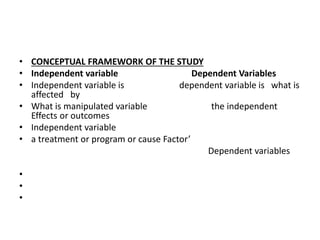
• CONCEPTUAL FRAMEWORK OF THE STUDY
• Independent variable Dependent Variables
• Independent variable is dependent variable is what is
affected by
• What is manipulated variable the independent
Effects or outcomes
• Independent variable
• a treatment or program or cause Factor’
Dependent variables
•
•
•
Conceptual framework
IV DV
SOLUTION

Chapter one research Methadology

  • 1.
    Lecture: Research Methodology Lecturer:Abdulkadir Ahmed Moalin CHAPTER ONE: INTRODUCTION TO RESEARCH METHODOLOGY Please VISIT daada Channel Official
  • 2.
    INTRODUCTION TO RESEARCH METHODOLOGY: •Research means • To re-search • To re-examine • To investigate • To test • To enquire
  • 3.
    • Research: Isan investigative process of finding reliable solution to a problem through a Systematic? Selection, Collection, analysis and interpretation of data relating to the problem in Order words Research is all Activities that make us discover new knowledge about things around us.
  • 5.
    PROCESS OF RESEARCH: •Identifying a problem • Defining the problem in precise terms in unambiguous terms • Stating the problems in form of research questions and research hypotheses • Designing the research
  • 6.
    • Collecting data •Analyzing data • Interpretation of data • Drawing conclusion • Making recommendations
  • 7.
    PURPOSE OF RESEARCH •To test what you already know • To understand the other side of an issue • To establish reliable guide • To expand knowledge • To predict, explain and interpret a behavior • To provide solution to a problem
  • 8.
    CLASSIFICATION OF RESEARCH •Classification by purpose • Classification by method. • Classification based on type of evidences required and method of analysis.
  • 9.
    Classification by purpose: •Basic (Pure) research • Applied research. • Action research • Evaluation research • and Development (R & D
  • 10.
    Action Research: • isa research that is directed towards solving specific problem in a local setting .it is usually taken by a teacher or group of teacher in school to solving specific Problem so that the result can be generalized. • Evaluation Research • The results of evaluation research help in decision making. • Research and Development: • This is aimed at developing and testing product to ensure Their effectiveness.
  • 11.
    • Basic [Pure]Research: • This is concern with the production of result and finding which lead to development of theory. • Applied Research: • This is conducted for the purpose of applying or testing theory and Evaluates its usefulness in Solving Problems. It is concerned with the usefulness of ideas or Theories or practical situation.
  • 12.
    Classification of Researchby Method • Historical • Correlational • Casual-comparative (ex-post-facto) • Experimental • Descriptive (survey
  • 13.
    Historical Research: • Thistype of research is based on oral evidence records such as diaries, • Case history, Autobiography, logbook; Books, Journals, magazines etc are also useful Documents. • Descriptive Research: • It is also called a survey research. This type of research is based on Information, interviews, Oral, written, structured, unstructured etc), inventories, rating Scales, self report, Observation etc. Descriptive research is aim at fact finding of the present or current
  • 14.
    • Correlative Research •The correlation studies present a research approach that seeks to Explain educational Phenomena rather than mere stating the phenomena • Experimental Research • This type of research involves conducting experiment for Research purpose. The experimental Method involves investigating possible cause and effect • Relationship by exposing one or more Experimental groups to a treatment and one or more Control groups
  • 15.
    • Causal-Comparative Research: •Causal-comparative and experimental research represent different methods, however Both attempt to establish cause- effect relationship, and both group comparison
  • 16.
    RESEARCH OBJECTIVES. • Theresearch objectives are stated after the statement of the Problem. • It helps to transform the research problem into a testable form. • Indicating clearly in Specific Terms what the researcher intends to achieve. • Languages use – to examine, • to Determine, • to Assess, to find, etc
  • 17.
    RESEARCH QUESTIONS: • Researchquestions are interrogative statements or Question that the researcher seeks to answer.
  • 18.
    Characteristics of aresearch question are: • It must be clearly stated i.e. it must not make different meaning to different people. • It should determine the type of data to be collected how and were to collect the data from • It should provide focus and direction to the major issues in the study. • The question should be large enough to cover all the major variables in the study.
  • 19.
    • EXAMPLE: • Effectof information utilization on the academic performance of university students. • How does information utilization affect the academic performance of the university students? • Will information utilization affect the academic performance of male and female university Students? Or • Will there be any significance difference in how information utilization affect the academic Performance of male and female university students?
  • 20.
    RESEARCH HYPOTHESES: • Researchhypothesis is a formal affirmative statement predicting a single research outcome. • It predicts the likely relationship between independent variable and dependent variable. • Also suggest or guess answers to the research questions before the study is embarked upon • Hypothesis can be formulated in 2 forms: Null and alternative.
  • 21.
    • Null hypothesisis stated in a negative form. Ho is use to represent null hypothesis. • It is a non-directional hypothesis. It is non- directional because it does not indicate a Favorable or negative expectation of the findings. • Alternative hypothesis stated in positive form. • This is a directional hypothesis and H1 is use to represent alternative hypothesis. • It specifies the relationship between variables.
  • 22.
    SCOPE OF STUDY •SCOPE OF STUDY basically means all those things that will be covered in research project. • Time scope refers to the amount of time available to complete a project • Geographical scope set of places with which a web research associated • Content of scope: content should provide general overview of the subjects covered, & highlight significant individuals, organizations or events representation in the collection.
  • 23.
    OPERATIONAL DEFINITION OFTERMS • All key terms used the proposed research should be defined in the manner to be used in the study, including the two variables and related key terms.
  • 24.
    • CONCEPTUAL FRAMEWORKOF THE STUDY • Independent variable Dependent Variables • Independent variable is dependent variable is what is affected by • What is manipulated variable the independent Effects or outcomes • Independent variable • a treatment or program or cause Factor’ Dependent variables • • •
  • 25.