Role Theory in Organizational Volunteering 1
RUNNING HEAD: Role Theory in Organizational Volunteering
Utilizing Role Theory to assess Goodness of Fit
Between Volunteers and the Organization
OSF St. Joseph Medical Center
Julie Boyd
Illinois State University
September 29, 2009
Role Theory in Organizational Volunteering 2
Introduction
This paper will illustrate the utility of Role Theory (Rommetveit, 1954) and its usefulness
in assessing goodness of fit between the volunteer and the organization. To begin, an explanation
of the theory and its many unique components will be discussed. Additionally, an assessment of
goodness of fit will also be presented in accordance with the implications of Role Theory. Next,
a brief summary of what kind of organization OSF St. Joseph Medical Center is and how they
utilize the role of the volunteer will be addressed. Finally, recommendations will be established
to provide OSF St. Joseph Medical Center the ability to assess goodness of fit between the
volunteer and the organization.
Explanation of Theory
Role Theory (Rommetveit, 1954) developed and emerged into the field of
communication via implications from both the fields of psychology and sociology. However,
Role Theory today is not in fact one solid theory. Rather, it is a set of similar concepts and
interrelated theories that are arguably at the foundation of social science in general, and the study
of individual behavior in particular. Roles are the building blocks of social organizations and
social structures. In fact, Role Theory posits that human behavior is guided by expectations held
both by the individual and by other people. In short, individuals generally have and manage
many roles. Roles specify what goals should be pursued, what tasks must be accomplished, and
what performances are required in a given scenario or situation. Role Theory is, in fact,
predictive. It implies that if one has information about the role expectations for a specified
position (e.g., administrator, co-worker, volunteer), a significant portion of the behavior of the
person occupying that position can be predicted (Lopata, 1991).
Role Theory in Organizational Volunteering 3
Theoretical Components
According to the modern sociologist Bruce Biddle (1986), after his adaption and
alterations to the original theory in 1986, the five major models of role theory include:
 Functional Role Theory, which examines role development as shared social norms for a
given social position
 Symbolic Interactionist Role Theory, which examines role development as the outcome of
individual interpretation of responses to behavior
 Structural Role Theory, which emphasizes the influence of society rather than the
individual in roles and utilizes mathematical models
 Organizational Role Theory, which examines role development in individual
organizational settings
 Cognitive Role Theory, which predicts the relationship between expectations and
behaviors
For the purposes and intents of this paper however, the only model that will be focused on relates
to the Organizational Role Theory model. The additional models will not be addressed.
Consequently, since the implications of Role Theory are so vast and excessive, only the
components directly related to the Organizational Role Theory model will be acknowledged and
analyzed.
Organizational Role Theory Model
From the organizational perspective, roles are the culturally defined norms—rights,
duties, expectations, and standards for behavior—associated with a given social position (Linton,
1945). In other words, one's social position is seen as influencing one's behaviors. In addition,
statuses such as gender, ethnicity, sexual orientation, and social class also shape roles in the
Role Theory in Organizational Volunteering 4
organizational setting (Lopata, 1991). Indeed, there is pressure to conform successfully to roles.
The social pressure to conform to roles can be negative for individuals in some cases. Role
captivity refers to the unwanted participation in a particular role (Pearlin, 1983). Despite
sanctions, roles do not remain static, but change and evolve over time. Similarly, as roles change
and evolve over time, the organization also changes. Thus, organizations manage the change to
keep the organizational balance; this is called dynamic homeostasis (Long, 2003).
Stages of Roles. Individuals accumulate different roles at any given stage within the life
course. Throughout life, individuals transfer into and out of different roles, keeping some,
leaving others behind, and beginning new roles (Burr, 1972). These role transitions accompany
transitions through organizational stages and can be easy or difficult, depending on the timing
and social context (Rodgers & White, 1993). In addition, the transition into one role can affect
the transition into another.
Consequences of Roles. Multiple roles can be associated with both positive and negative
consequences. Role overload and role conflict are two of the most well-known role theory
concepts. Role overload refers to the experience of lacking the resources, including time and
energy, needed to meet the demands of all roles. Role conflict describes an incongruity between
the expectations of one role and those of another. Role overload and conflict often lead to
difficulties with meeting role expectations, known as role strain (Goode, 1960). Various
negative psychological and physical problems can follow from role strain and ultimately have
negative implications to the bottom line of an organization.
Multiple Role Implications. With regard to the above consequences of having too many
roles, there are positive implications as well. In the theory of role balance, Stephen Marks and
Shelley MacDermid (1996) found that people who are able to fully participate in and perform a
Role Theory in Organizational Volunteering 5
number of different roles experience not only less role strain but also lower rates of depression
and higher self-esteem and innovation. Thus, multiple roles are important for the development of
personality and intellect. Role sharing is likely a means through which the positive aspects of
multiple roles can outweigh potential negative consequences. Individuals with different social
statuses and social positions, or even across social institutions, can share the same role.
Propositions of Role Theory. Many role theorists see Role Theory as one of the most
compelling theories bridging individual behavior and the social structure of an organization.
Roles, which are in part dictated by social structure and in part by social interactions, guide the
behavior of the individual. The individual, in turn, influences the norms, expectations, and
behaviors associated with roles within the organization. The understanding is reciprocal and
didactic. Therefore, Role Theory includes the following propositions:
 People spend much of their lives participating as members of groups and organizations.
 Within these groups, people occupy distinct positions.
 Each of these positions entails a role, which is a set of functions performed by the person
for the group.
 Groups often formalize role expectations as norms or even codified rules, which include
what rewards will result when roles are successfully performed and what punishments
will result when roles are not successfully performed.
 Individuals usually carry out their roles and perform in accordance with prevailing
norms; in other words, role theory assumes that people are primarily conformists who try
to live up to the norms that accompany their roles.
Role Theory in Organizational Volunteering 6
 Group members check each individual's performance to determine whether it conforms
with the norms; the anticipation that others will apply sanctions ensures role
performance.
Goodness of Fit within an Organization
Similarly, goodness of fit goes hand in hand with the notion of Role Theory and is
applicable and essential in understanding the role of the volunteer in an organization. On the
basic level, an organization’s culture will imitate goals and values that characterize the society in
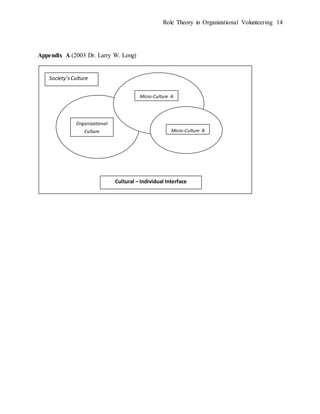
which it functions (Long, 2003). Organizational culture is however, separate from the societal
culture (see appendix A). But, there is a consensus among these two cultures that can encourage
modifications in both beliefs and values. Similarly, volunteers with different psychological
characteristics may be members of overlapping groups, called micro-cultures. For example, a
volunteer may volunteer their time and talents at OSF St. Joseph Medical Center, but they also
might attend the same Catholic Church down the street as some of their co-volunteers. These
micro-cultures can be comprised of almost any characteristics such as status, age, profession,
educational status, religious preference, wealth, etc. (Long, 2003).
According to Long (2003), an assessment of goodness of fit begins with the recognition
of the culture, both social and organizational. The social and organizational requirements define
roles while personal needs and characteristics influence how the roles are therefore enacted.
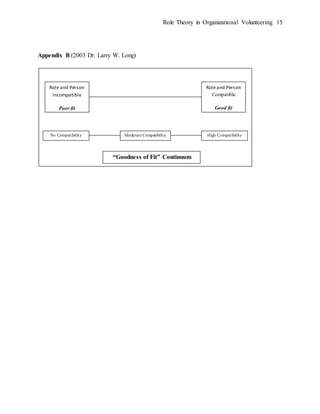
When a match exists between organizational roles and personal roles, the fit between the
volunteer and the role is good. When there is incompatibility, the fit is poor (see appendix B).
Quite obviously, it is most desirable for the volunteer to fall in the direction of “good” between
the role and the individual. If the goodness of fit isn’t perfect, the role can be changed by either
changing the role itself or by changing the individual to fit the role (Long, 2003).
Role Theory in Organizational Volunteering 7
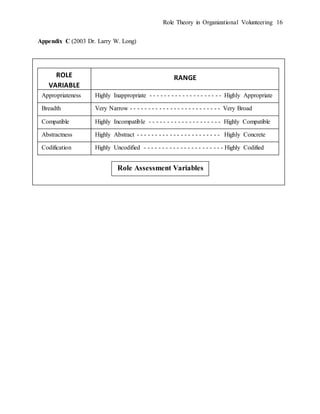
Role Characteristics. When accessing the goodness of it between a volunteer and the
organizational role, there are five role components that can be used (see appendix C). These are:
appropriateness, breadth, compatibility, abstractness level, and codification (Long, 2003).
 Appropriateness, is concerned with the necessity of the role in order for the organization
to accomplish its mission
 Breadth, is concerned with the scope of activities contained in a role
 Compatibility, simply refers to the volunteer and how compatible they are to the position
and/or role
 Abstractness, refers to the notion that roles should be described as concretely as possible,
so as to determine a good fit between the role and the volunteer
 Codification, is concerned with the extent to which a role description is written and a part
of standard operation procedures
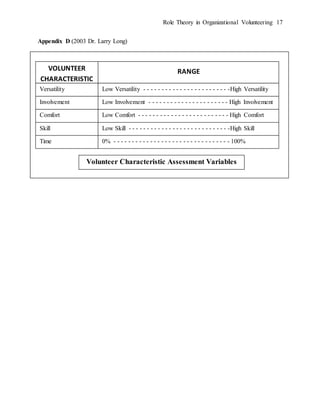
Volunteer Characteristics. On the opposite side, there are also five conceptual volunteer
characteristics that may help to determine and compare whether a volunteer is a good fit for the
role they currently hold (see Appendix D). These characteristics are: versatility, involvement,
comfort, skill and time (Long, 2003).
 Versatility, is an assessment of the number of different activities a person can perform or
the number of different roles an individual can enact
 Involvement, is the intensity with which an individual enacts a role
 Comfort, is an index of the level of apprehension or anxiety associated with behaviors
 Skill, is an assessment of both cognitive and behavior components
 Time, determines if a volunteer is using 100% of their available time to perform the role
effectively.
Role Theory in Organizational Volunteering 8
After evaluating both role characteristics and volunteer characteristics, goodness of fit can be
determined and accessed effectively (Long, 2003).
OSF St. Joseph Medical Center
OSF St. Joseph Medical Center is a small not-for-profit hospital in Bloomington, Illinois.
As the smaller of the two hospitals in town, it is a challenge for the medical center to operate
effectively while in competition with BroMenn, a for-profit hospital in Normal, Illinois. As a
not-for-profit, OSF faces many challenges daily. However, like most not-for-profits
organizations, it struggles with achieving financial stability. Thus, the survival of OSF St. Joseph
Medical Center relies heavily on its volunteer force. OSF currently holds over 250 volunteers
who donate their time and talents to the medical center, with no expectation for financial
compensation. A nonprofit organization cannot succeed without a strong core of volunteers.
Thus volunteering in a not-for-for profit organization is often viewed as a cornerstone on which
the rest of the organization is built.
Importance of the Volunteer to OSF
The mission of OSF St. Joseph Medical Center is to “serve people with the greatest care
and love in a community that celebrates the gift of life.” In order to live up to its mission, OSF
provides healthcare to any individual, regardless of their ability to pay. With this altruistic
tradition, it provides a challenge to keep the medical center financially stable. Thus, the
importance of the volunteer is not only their symbolic and community presence, but their
performance of tasks without financial compensation. For example, in the past year at OSF,
volunteers have donated close to 40,000 hours of their time and skills. This is nearly equivalent
to 12 full time staff members. As the medical center employs approximately 400 individuals, this
is a small, but meaningful way of exemplifying the importance of the volunteer and the
Role Theory in Organizational Volunteering 9
contributions that they provide. Volunteers serve OSF St. Joseph Medical Center willingly,
preferring to donate their time and talents without expecting anything in return.
Application of Theory to OSF St. Joseph Medical Center
As indicated above, it is important to understand and apply the principles related to Role
Theory in an organizational setting. More specifically, it is important to assess individual
volunteer roles with individual volunteers to determine if the goodness of fit between the two is
appropriate. Role Theory appears to be an adequate choice in attempting to determine the
goodness of fit between the volunteer and the role they perform. This theory has grown in recent
years to predict a wide range of goodness of fit. For example, despite its usual implications
determining goodness of fit between employees and the role they perform, it is also useful in
determining if volunteers are comfortable and/or happy in the position they currently serve.
Using Role Theory to Assess Goodness of Fit
Role Theory can be used effectively to understand and assess the goodness of fit between
the organizational role and the individual volunteer. By examining each of the theoretical
components associated with the theory and comparing it to the various ways of assessing
goodness of fit, OSF St. Joseph Medical Center can determine if the volunteers they currently
have are a good match to the current volunteer positions they hold.
Stages of Roles. Throughout the career of a volunteer in a particular organization,
individuals transfer in and out of different roles, keeping some, leaving others behind, and
beginning new roles. These implications are an important factor to consider when assessing
goodness of fit. For example, some volunteers at OSF St. Joseph Medical Center have been in
the same position for over 30 years! In fact, some of the current volunteers are actual former
employees of the medical center. Thus, they have transformed their role of employee (i.e. nurse)
Role Theory in Organizational Volunteering 10
to a volunteer (i.e. receptionist). The transformation of roles is an important and key aspect to
consider when assessing goodness of fit. Additionally, it is important to recognize that volunteers
such as this have a wide variety of experience within the medical center and therefore have more
knowledge than some of the current employees. These volunteers play an important role in that
they may hold knowledge that impacts the bottom line.
Consequences of Roles. Multiple roles can be associated with both positive and negative
consequences. However, when assessing goodness of fit it is more important to focus on the
negative consequences involved in volunteer roles. Volunteers can experience role overload (the
experience of lacking the resources, including time and energy, needed to meet the demands of
all roles) and role conflict (an incongruity between the expectations of one role and those of
another). Role overload and role conflict can lead to role strain (difficulties with meeting role
expectations). As emphasized above, volunteers are an essential core to the not-for-profit
organization. If too many volunteers begin to experience role overload, role conflict, or role
strain, it may lead to volunteers exiting the organization. As such, the implications of many
volunteers leaving may be vast and will have an ominous impact on the overall organization.
Therefore, it is important to not only keep the volunteers happy in the roles they perform, but it is
also important to monitor their various roles and tasks to determine if they are a good fit for their
current role.
Multiple Role Implications. Multiple roles are important for the development of
personality and intellect. However, having multiple roles may have a large impact on the role of
the volunteer. Similar to the above scenario, if volunteers begin to suffer from role conflict,
overload, or strain, it is likely a consequence of having too many roles and responsibilities. For
example, many volunteers at OSF enjoy performing multiple roles on various days to keep their
Role Theory in Organizational Volunteering 11
routines at a consistent change of pace. However, if a volunteer becomes “stretched too thin” in
their role performance, it is likely to have a negative impact on the organization as a whole,
because, as suggested, a volunteer role is a dominant and necessary position in a not-for-profit
organization.
Determining Goodness of Fit
Overall, Role Theory is an essential and useful tool in establishing and determining
goodness of fit between the role of the volunteer and the individual. As described above, it is
essential to the not-for-profit organization that volunteers are happy in their position, are not
experiencing any sort of role strain, conflict, or overload, and are overall in a “good fit” for the
current position they hold. By using Role Theory as a baseline in determining these factors, it is
relatively simple to determine if goodness of fit is indeed at work in a particular organization
such as OSF St. Joseph Medical Center. The following section will consist of basic
recommendations for assessing goodness of fit between the organizational role and the individual
volunteer.
Recommendations for assessing Goodness of Fit
1.) Implement an assessment of sorts to determine if the current volunteers at the medical
center are happy in their positions. Attempt to determine if any individual is
experiencing role strain, role conflict, or role overload. If any indication is made,
make all attempts to limit their experience, as this may be a potential indicator of a
volunteer leaving the organization, which in turn could have drastic implications to
the overall organization.
2.) Communicate to the volunteers how important and essential their involvement in the
medical center is. Explain the implications of serving in a not-for-profit medical
Role Theory in Organizational Volunteering 12
center and how their time and talents contribute to the bottom line and overall mission
of the hospital.
3.) Insure that volunteers are not experiencing role captivity (unwanted participation in a
particular role). If a volunteer is experiencing such a role, it is likely that their
individual goodness of fit is poor, ultimately leading to the volunteer exiting the
organization, or having a negative impact on the bottom line at OSF St. Joseph
Medical Center.
Limitations
Although Role Theory is an important asset to analyze when looking at the goodness of
fit between a volunteer and the organization, it also has its limitations. Role Theory is typically
utilized when looking at the goodness of fit between the employee and the role they hold at an
organization; therefore, utilizing this theory for volunteers may have different effects that have
yet to be determined or tested. Additionally, Role Theory is very abstract. What can be
applicable to one volunteer may not be applicable to another, therefore causing confusion among
the goodness of fit and a volunteer within an organization. Finally, Role Theory may have
specific limitations to OSF St. Joseph Medical Center. For example, because OSF is a not-for-
profit hospital, it may have different implications to volunteers in this setting versus a for-profit
hospital.
Role Theory in Organizational Volunteering 13
References
Biddle, B. (1986). Recent developments in role theory. Annual Review of Sociology 12, 67-92.
Burr, W. R. (1972). Role transitions: A reformulation of theory. Journal of Marriage and the
Family 34, 407-416.
Cottrell, L. S. (1942). The adjustment of the individual to his age and sex roles. American
Sociological Review 7, 617-620.
Goode, W. (1960). Theory of role strain. American Sociological Review 25, 483-496.
Linton, R. (1945). The cultural background of personality. New York: Appleton-Century Crofts.
Long. L. W. (2003). An integrative approach to management: Combing communication and
organizational theory.
Lopata, H. Z. (1991). Role theory. Social rules and social institutions. ed. Blau, J. and
Goodman, N. Boulder, CO: Westview Press.
Marks, S. & MacDermid, S. (1996). Multiple roles and the self: A theory of role balance.
Journal of Marriage and the Family 58, 417-432.
Nye, F. I. (1974). Emerging and declining family roles. Journal of Marriage and the Family 36,
238-245.
Pearlin, L. (1983). Role strain and personal stress. Psychosocial Stress. ed. Kaplan, H. B. New
York: Academic Press.
Rodgers, R. H. & White, J. H. (1993). Family development theory. Sourcebook of Family
Theories and Methods, ed. Boss, P., Doherty, W., LaRossa, R., Shumm, W., &
Steinmetz, S. New York: Plenum Press.
Rommetveit, R. (1954) Social norms and roles. Universitesforlaget: Oslo.
Role Theory in Organizational Volunteering 14
Appendix A (2003 Dr. Larry W. Long)
Society’sCulture
Cultural – Individual Interface
Organizational
Culture
Micro-Culture A
Micro-Culture B
Role Theory in Organizational Volunteering 15
Appendix B (2003 Dr. Larry W. Long)
“Goodness of Fit” Continuum
Role and Person
Incompatible
Poor fit
Role and Person
Compatible
Good fit
No Compatibility Moderate Compatibility
CoCompatibility
High Compatibility
Role Theory in Organizational Volunteering 16
Appendix C (2003 Dr. Larry W. Long)
ROLE
VARIABLE
Appropriateness
Breadth
Compatible
Abstractness
Codification
RANGE
Highly Inappropriate - - - - - - - - - - - - - - - - - - - - Highly Appropriate
Very Narrow - - - - - - - - - - - - - - - - - - - - - - - - - Very Broad
Highly Incompatible - - - - - - - - - - - - - - - - - - - - Highly Compatible
Highly Abstract - - - - - - - - - - - - - - - - - - - - - - - Highly Concrete
Highly Uncodified - - - - - - - - - - - - - - - - - - - - - - Highly Codified
Role Assessment Variables
Role Theory in Organizational Volunteering 17
Appendix D (2003 Dr. Larry Long)
VOLUNTEER
CHARACTERISTIC
Versatility
Involvement
Comfort
Skill
Time
RANGE
Low Versatility - - - - - - - - - - - - - - - - - - - - - - - -High Versatility
Low Involvement - - - - - - - - - - - - - - - - - - - - - - High Involvement
Low Comfort - - - - - - - - - - - - - - - - - - - - - - - - - High Comfort
Low Skill - - - - - - - - - - - - - - - - - - - - - - - - - - - -High Skill
0% - - - - - - - - - - - - - - - - - - - - - - - - - - - - - - - - 100%
Volunteer Characteristic Assessment Variables

Role Theory, Volunteering

  • 1.
    Role Theory inOrganizational Volunteering 1 RUNNING HEAD: Role Theory in Organizational Volunteering Utilizing Role Theory to assess Goodness of Fit Between Volunteers and the Organization OSF St. Joseph Medical Center Julie Boyd Illinois State University September 29, 2009
  • 2.
    Role Theory inOrganizational Volunteering 2 Introduction This paper will illustrate the utility of Role Theory (Rommetveit, 1954) and its usefulness in assessing goodness of fit between the volunteer and the organization. To begin, an explanation of the theory and its many unique components will be discussed. Additionally, an assessment of goodness of fit will also be presented in accordance with the implications of Role Theory. Next, a brief summary of what kind of organization OSF St. Joseph Medical Center is and how they utilize the role of the volunteer will be addressed. Finally, recommendations will be established to provide OSF St. Joseph Medical Center the ability to assess goodness of fit between the volunteer and the organization. Explanation of Theory Role Theory (Rommetveit, 1954) developed and emerged into the field of communication via implications from both the fields of psychology and sociology. However, Role Theory today is not in fact one solid theory. Rather, it is a set of similar concepts and interrelated theories that are arguably at the foundation of social science in general, and the study of individual behavior in particular. Roles are the building blocks of social organizations and social structures. In fact, Role Theory posits that human behavior is guided by expectations held both by the individual and by other people. In short, individuals generally have and manage many roles. Roles specify what goals should be pursued, what tasks must be accomplished, and what performances are required in a given scenario or situation. Role Theory is, in fact, predictive. It implies that if one has information about the role expectations for a specified position (e.g., administrator, co-worker, volunteer), a significant portion of the behavior of the person occupying that position can be predicted (Lopata, 1991).
  • 3.
    Role Theory inOrganizational Volunteering 3 Theoretical Components According to the modern sociologist Bruce Biddle (1986), after his adaption and alterations to the original theory in 1986, the five major models of role theory include:  Functional Role Theory, which examines role development as shared social norms for a given social position  Symbolic Interactionist Role Theory, which examines role development as the outcome of individual interpretation of responses to behavior  Structural Role Theory, which emphasizes the influence of society rather than the individual in roles and utilizes mathematical models  Organizational Role Theory, which examines role development in individual organizational settings  Cognitive Role Theory, which predicts the relationship between expectations and behaviors For the purposes and intents of this paper however, the only model that will be focused on relates to the Organizational Role Theory model. The additional models will not be addressed. Consequently, since the implications of Role Theory are so vast and excessive, only the components directly related to the Organizational Role Theory model will be acknowledged and analyzed. Organizational Role Theory Model From the organizational perspective, roles are the culturally defined norms—rights, duties, expectations, and standards for behavior—associated with a given social position (Linton, 1945). In other words, one's social position is seen as influencing one's behaviors. In addition, statuses such as gender, ethnicity, sexual orientation, and social class also shape roles in the
  • 4.
    Role Theory inOrganizational Volunteering 4 organizational setting (Lopata, 1991). Indeed, there is pressure to conform successfully to roles. The social pressure to conform to roles can be negative for individuals in some cases. Role captivity refers to the unwanted participation in a particular role (Pearlin, 1983). Despite sanctions, roles do not remain static, but change and evolve over time. Similarly, as roles change and evolve over time, the organization also changes. Thus, organizations manage the change to keep the organizational balance; this is called dynamic homeostasis (Long, 2003). Stages of Roles. Individuals accumulate different roles at any given stage within the life course. Throughout life, individuals transfer into and out of different roles, keeping some, leaving others behind, and beginning new roles (Burr, 1972). These role transitions accompany transitions through organizational stages and can be easy or difficult, depending on the timing and social context (Rodgers & White, 1993). In addition, the transition into one role can affect the transition into another. Consequences of Roles. Multiple roles can be associated with both positive and negative consequences. Role overload and role conflict are two of the most well-known role theory concepts. Role overload refers to the experience of lacking the resources, including time and energy, needed to meet the demands of all roles. Role conflict describes an incongruity between the expectations of one role and those of another. Role overload and conflict often lead to difficulties with meeting role expectations, known as role strain (Goode, 1960). Various negative psychological and physical problems can follow from role strain and ultimately have negative implications to the bottom line of an organization. Multiple Role Implications. With regard to the above consequences of having too many roles, there are positive implications as well. In the theory of role balance, Stephen Marks and Shelley MacDermid (1996) found that people who are able to fully participate in and perform a
  • 5.
    Role Theory inOrganizational Volunteering 5 number of different roles experience not only less role strain but also lower rates of depression and higher self-esteem and innovation. Thus, multiple roles are important for the development of personality and intellect. Role sharing is likely a means through which the positive aspects of multiple roles can outweigh potential negative consequences. Individuals with different social statuses and social positions, or even across social institutions, can share the same role. Propositions of Role Theory. Many role theorists see Role Theory as one of the most compelling theories bridging individual behavior and the social structure of an organization. Roles, which are in part dictated by social structure and in part by social interactions, guide the behavior of the individual. The individual, in turn, influences the norms, expectations, and behaviors associated with roles within the organization. The understanding is reciprocal and didactic. Therefore, Role Theory includes the following propositions:  People spend much of their lives participating as members of groups and organizations.  Within these groups, people occupy distinct positions.  Each of these positions entails a role, which is a set of functions performed by the person for the group.  Groups often formalize role expectations as norms or even codified rules, which include what rewards will result when roles are successfully performed and what punishments will result when roles are not successfully performed.  Individuals usually carry out their roles and perform in accordance with prevailing norms; in other words, role theory assumes that people are primarily conformists who try to live up to the norms that accompany their roles.
  • 6.
    Role Theory inOrganizational Volunteering 6  Group members check each individual's performance to determine whether it conforms with the norms; the anticipation that others will apply sanctions ensures role performance. Goodness of Fit within an Organization Similarly, goodness of fit goes hand in hand with the notion of Role Theory and is applicable and essential in understanding the role of the volunteer in an organization. On the basic level, an organization’s culture will imitate goals and values that characterize the society in which it functions (Long, 2003). Organizational culture is however, separate from the societal culture (see appendix A). But, there is a consensus among these two cultures that can encourage modifications in both beliefs and values. Similarly, volunteers with different psychological characteristics may be members of overlapping groups, called micro-cultures. For example, a volunteer may volunteer their time and talents at OSF St. Joseph Medical Center, but they also might attend the same Catholic Church down the street as some of their co-volunteers. These micro-cultures can be comprised of almost any characteristics such as status, age, profession, educational status, religious preference, wealth, etc. (Long, 2003). According to Long (2003), an assessment of goodness of fit begins with the recognition of the culture, both social and organizational. The social and organizational requirements define roles while personal needs and characteristics influence how the roles are therefore enacted. When a match exists between organizational roles and personal roles, the fit between the volunteer and the role is good. When there is incompatibility, the fit is poor (see appendix B). Quite obviously, it is most desirable for the volunteer to fall in the direction of “good” between the role and the individual. If the goodness of fit isn’t perfect, the role can be changed by either changing the role itself or by changing the individual to fit the role (Long, 2003).
  • 7.
    Role Theory inOrganizational Volunteering 7 Role Characteristics. When accessing the goodness of it between a volunteer and the organizational role, there are five role components that can be used (see appendix C). These are: appropriateness, breadth, compatibility, abstractness level, and codification (Long, 2003).  Appropriateness, is concerned with the necessity of the role in order for the organization to accomplish its mission  Breadth, is concerned with the scope of activities contained in a role  Compatibility, simply refers to the volunteer and how compatible they are to the position and/or role  Abstractness, refers to the notion that roles should be described as concretely as possible, so as to determine a good fit between the role and the volunteer  Codification, is concerned with the extent to which a role description is written and a part of standard operation procedures Volunteer Characteristics. On the opposite side, there are also five conceptual volunteer characteristics that may help to determine and compare whether a volunteer is a good fit for the role they currently hold (see Appendix D). These characteristics are: versatility, involvement, comfort, skill and time (Long, 2003).  Versatility, is an assessment of the number of different activities a person can perform or the number of different roles an individual can enact  Involvement, is the intensity with which an individual enacts a role  Comfort, is an index of the level of apprehension or anxiety associated with behaviors  Skill, is an assessment of both cognitive and behavior components  Time, determines if a volunteer is using 100% of their available time to perform the role effectively.
  • 8.
    Role Theory inOrganizational Volunteering 8 After evaluating both role characteristics and volunteer characteristics, goodness of fit can be determined and accessed effectively (Long, 2003). OSF St. Joseph Medical Center OSF St. Joseph Medical Center is a small not-for-profit hospital in Bloomington, Illinois. As the smaller of the two hospitals in town, it is a challenge for the medical center to operate effectively while in competition with BroMenn, a for-profit hospital in Normal, Illinois. As a not-for-profit, OSF faces many challenges daily. However, like most not-for-profits organizations, it struggles with achieving financial stability. Thus, the survival of OSF St. Joseph Medical Center relies heavily on its volunteer force. OSF currently holds over 250 volunteers who donate their time and talents to the medical center, with no expectation for financial compensation. A nonprofit organization cannot succeed without a strong core of volunteers. Thus volunteering in a not-for-for profit organization is often viewed as a cornerstone on which the rest of the organization is built. Importance of the Volunteer to OSF The mission of OSF St. Joseph Medical Center is to “serve people with the greatest care and love in a community that celebrates the gift of life.” In order to live up to its mission, OSF provides healthcare to any individual, regardless of their ability to pay. With this altruistic tradition, it provides a challenge to keep the medical center financially stable. Thus, the importance of the volunteer is not only their symbolic and community presence, but their performance of tasks without financial compensation. For example, in the past year at OSF, volunteers have donated close to 40,000 hours of their time and skills. This is nearly equivalent to 12 full time staff members. As the medical center employs approximately 400 individuals, this is a small, but meaningful way of exemplifying the importance of the volunteer and the
  • 9.
    Role Theory inOrganizational Volunteering 9 contributions that they provide. Volunteers serve OSF St. Joseph Medical Center willingly, preferring to donate their time and talents without expecting anything in return. Application of Theory to OSF St. Joseph Medical Center As indicated above, it is important to understand and apply the principles related to Role Theory in an organizational setting. More specifically, it is important to assess individual volunteer roles with individual volunteers to determine if the goodness of fit between the two is appropriate. Role Theory appears to be an adequate choice in attempting to determine the goodness of fit between the volunteer and the role they perform. This theory has grown in recent years to predict a wide range of goodness of fit. For example, despite its usual implications determining goodness of fit between employees and the role they perform, it is also useful in determining if volunteers are comfortable and/or happy in the position they currently serve. Using Role Theory to Assess Goodness of Fit Role Theory can be used effectively to understand and assess the goodness of fit between the organizational role and the individual volunteer. By examining each of the theoretical components associated with the theory and comparing it to the various ways of assessing goodness of fit, OSF St. Joseph Medical Center can determine if the volunteers they currently have are a good match to the current volunteer positions they hold. Stages of Roles. Throughout the career of a volunteer in a particular organization, individuals transfer in and out of different roles, keeping some, leaving others behind, and beginning new roles. These implications are an important factor to consider when assessing goodness of fit. For example, some volunteers at OSF St. Joseph Medical Center have been in the same position for over 30 years! In fact, some of the current volunteers are actual former employees of the medical center. Thus, they have transformed their role of employee (i.e. nurse)
  • 10.
    Role Theory inOrganizational Volunteering 10 to a volunteer (i.e. receptionist). The transformation of roles is an important and key aspect to consider when assessing goodness of fit. Additionally, it is important to recognize that volunteers such as this have a wide variety of experience within the medical center and therefore have more knowledge than some of the current employees. These volunteers play an important role in that they may hold knowledge that impacts the bottom line. Consequences of Roles. Multiple roles can be associated with both positive and negative consequences. However, when assessing goodness of fit it is more important to focus on the negative consequences involved in volunteer roles. Volunteers can experience role overload (the experience of lacking the resources, including time and energy, needed to meet the demands of all roles) and role conflict (an incongruity between the expectations of one role and those of another). Role overload and role conflict can lead to role strain (difficulties with meeting role expectations). As emphasized above, volunteers are an essential core to the not-for-profit organization. If too many volunteers begin to experience role overload, role conflict, or role strain, it may lead to volunteers exiting the organization. As such, the implications of many volunteers leaving may be vast and will have an ominous impact on the overall organization. Therefore, it is important to not only keep the volunteers happy in the roles they perform, but it is also important to monitor their various roles and tasks to determine if they are a good fit for their current role. Multiple Role Implications. Multiple roles are important for the development of personality and intellect. However, having multiple roles may have a large impact on the role of the volunteer. Similar to the above scenario, if volunteers begin to suffer from role conflict, overload, or strain, it is likely a consequence of having too many roles and responsibilities. For example, many volunteers at OSF enjoy performing multiple roles on various days to keep their
  • 11.
    Role Theory inOrganizational Volunteering 11 routines at a consistent change of pace. However, if a volunteer becomes “stretched too thin” in their role performance, it is likely to have a negative impact on the organization as a whole, because, as suggested, a volunteer role is a dominant and necessary position in a not-for-profit organization. Determining Goodness of Fit Overall, Role Theory is an essential and useful tool in establishing and determining goodness of fit between the role of the volunteer and the individual. As described above, it is essential to the not-for-profit organization that volunteers are happy in their position, are not experiencing any sort of role strain, conflict, or overload, and are overall in a “good fit” for the current position they hold. By using Role Theory as a baseline in determining these factors, it is relatively simple to determine if goodness of fit is indeed at work in a particular organization such as OSF St. Joseph Medical Center. The following section will consist of basic recommendations for assessing goodness of fit between the organizational role and the individual volunteer. Recommendations for assessing Goodness of Fit 1.) Implement an assessment of sorts to determine if the current volunteers at the medical center are happy in their positions. Attempt to determine if any individual is experiencing role strain, role conflict, or role overload. If any indication is made, make all attempts to limit their experience, as this may be a potential indicator of a volunteer leaving the organization, which in turn could have drastic implications to the overall organization. 2.) Communicate to the volunteers how important and essential their involvement in the medical center is. Explain the implications of serving in a not-for-profit medical
  • 12.
    Role Theory inOrganizational Volunteering 12 center and how their time and talents contribute to the bottom line and overall mission of the hospital. 3.) Insure that volunteers are not experiencing role captivity (unwanted participation in a particular role). If a volunteer is experiencing such a role, it is likely that their individual goodness of fit is poor, ultimately leading to the volunteer exiting the organization, or having a negative impact on the bottom line at OSF St. Joseph Medical Center. Limitations Although Role Theory is an important asset to analyze when looking at the goodness of fit between a volunteer and the organization, it also has its limitations. Role Theory is typically utilized when looking at the goodness of fit between the employee and the role they hold at an organization; therefore, utilizing this theory for volunteers may have different effects that have yet to be determined or tested. Additionally, Role Theory is very abstract. What can be applicable to one volunteer may not be applicable to another, therefore causing confusion among the goodness of fit and a volunteer within an organization. Finally, Role Theory may have specific limitations to OSF St. Joseph Medical Center. For example, because OSF is a not-for- profit hospital, it may have different implications to volunteers in this setting versus a for-profit hospital.
  • 13.
    Role Theory inOrganizational Volunteering 13 References Biddle, B. (1986). Recent developments in role theory. Annual Review of Sociology 12, 67-92. Burr, W. R. (1972). Role transitions: A reformulation of theory. Journal of Marriage and the Family 34, 407-416. Cottrell, L. S. (1942). The adjustment of the individual to his age and sex roles. American Sociological Review 7, 617-620. Goode, W. (1960). Theory of role strain. American Sociological Review 25, 483-496. Linton, R. (1945). The cultural background of personality. New York: Appleton-Century Crofts. Long. L. W. (2003). An integrative approach to management: Combing communication and organizational theory. Lopata, H. Z. (1991). Role theory. Social rules and social institutions. ed. Blau, J. and Goodman, N. Boulder, CO: Westview Press. Marks, S. & MacDermid, S. (1996). Multiple roles and the self: A theory of role balance. Journal of Marriage and the Family 58, 417-432. Nye, F. I. (1974). Emerging and declining family roles. Journal of Marriage and the Family 36, 238-245. Pearlin, L. (1983). Role strain and personal stress. Psychosocial Stress. ed. Kaplan, H. B. New York: Academic Press. Rodgers, R. H. & White, J. H. (1993). Family development theory. Sourcebook of Family Theories and Methods, ed. Boss, P., Doherty, W., LaRossa, R., Shumm, W., & Steinmetz, S. New York: Plenum Press. Rommetveit, R. (1954) Social norms and roles. Universitesforlaget: Oslo.
  • 14.
    Role Theory inOrganizational Volunteering 14 Appendix A (2003 Dr. Larry W. Long) Society’sCulture Cultural – Individual Interface Organizational Culture Micro-Culture A Micro-Culture B
  • 15.
    Role Theory inOrganizational Volunteering 15 Appendix B (2003 Dr. Larry W. Long) “Goodness of Fit” Continuum Role and Person Incompatible Poor fit Role and Person Compatible Good fit No Compatibility Moderate Compatibility CoCompatibility High Compatibility
  • 16.
    Role Theory inOrganizational Volunteering 16 Appendix C (2003 Dr. Larry W. Long) ROLE VARIABLE Appropriateness Breadth Compatible Abstractness Codification RANGE Highly Inappropriate - - - - - - - - - - - - - - - - - - - - Highly Appropriate Very Narrow - - - - - - - - - - - - - - - - - - - - - - - - - Very Broad Highly Incompatible - - - - - - - - - - - - - - - - - - - - Highly Compatible Highly Abstract - - - - - - - - - - - - - - - - - - - - - - - Highly Concrete Highly Uncodified - - - - - - - - - - - - - - - - - - - - - - Highly Codified Role Assessment Variables
  • 17.
    Role Theory inOrganizational Volunteering 17 Appendix D (2003 Dr. Larry Long) VOLUNTEER CHARACTERISTIC Versatility Involvement Comfort Skill Time RANGE Low Versatility - - - - - - - - - - - - - - - - - - - - - - - -High Versatility Low Involvement - - - - - - - - - - - - - - - - - - - - - - High Involvement Low Comfort - - - - - - - - - - - - - - - - - - - - - - - - - High Comfort Low Skill - - - - - - - - - - - - - - - - - - - - - - - - - - - -High Skill 0% - - - - - - - - - - - - - - - - - - - - - - - - - - - - - - - - 100% Volunteer Characteristic Assessment Variables