Let’s Learn
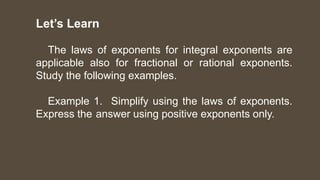
The laws of exponents for integral exponents are
applicable also for fractional or rational exponents.
Study the following examples.
Example 1. Simplify using the laws of exponents.
Express the answer using positive exponents only.
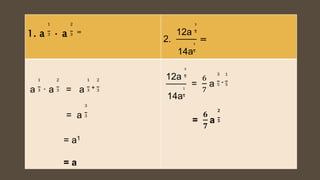
1. a
1
3 · a
2
3 =
2.
12a
3
5
14a
1
5
=
a
1
3 · a
2
3 = a
1
3 +
2
3
= a
3
3
= a1
= a
12a
3
5
14a
1
5
=
6
7
a
3
5 -
1
5
=
𝟔
𝟕
a
𝟐
𝟓
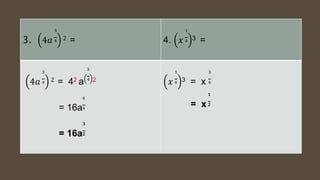
3. 4𝑎
3
4 2 = 4. 𝑥
1
6 3 =
4𝑎
3
4 2 = 42 a
3
4 2
= 16a
6
4
= 16a
𝟑
𝟐
𝑥
1
6 3 = x
3
6
= x
𝟏
𝟐
Example 2. Evaluate 27
2
3 .
Steps Solution
1. Express the base in
exponential form. (27 = 33)
27
2
3 = (33)
2
3
2. Use the power of a power
law of exponents.
= (33)
2
3 or 3
6
3 =
= 32
= 9
3. Simplify the result by
applying the laws of
exponents.
So, 27
2
3 = 9
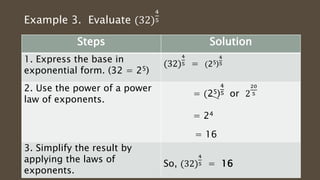
Example 3. Evaluate (32)
4
5
Steps Solution
1. Express the base in
exponential form. (32 = 25)
(32)
4
5 = (25)
4
5
2. Use the power of a power
law of exponents.
= (25)
4
5 or 2
20
5
= 24
= 16
3. Simplify the result by
applying the laws of
exponents.
So, (32)
4
5 = 16
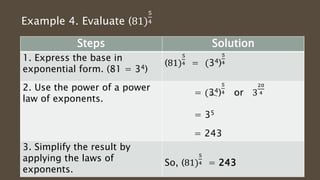
Example 4. Evaluate (81)
5
4
Steps Solution
1. Express the base in
exponential form. (81 = 34)
(81)
5
4 = (34)
5
4
2. Use the power of a power
law of exponents.
= (34)
5
4 or 3
20
4
= 35
= 243
3. Simplify the result by
applying the laws of
exponents.
So, (81)
5
4 = 243
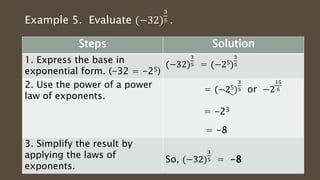
Example 5. Evaluate (−32)
3
5 .
Steps Solution
1. Express the base in
exponential form. (-32 = -25)
(−32)
3
5 = (−25)
3
5
2. Use the power of a power
law of exponents.
= (−25)
3
5 or −2
15
5
= -23
= -8
3. Simplify the result by
applying the laws of
exponents.
So, (−32)
3
5 = -8
Fractional exponents

Fractional exponents

  • 2.
    Let’s Learn The lawsof exponents for integral exponents are applicable also for fractional or rational exponents. Study the following examples. Example 1. Simplify using the laws of exponents. Express the answer using positive exponents only.
  • 3.
    1. a 1 3 ·a 2 3 = 2. 12a 3 5 14a 1 5 = a 1 3 · a 2 3 = a 1 3 + 2 3 = a 3 3 = a1 = a 12a 3 5 14a 1 5 = 6 7 a 3 5 - 1 5 = 𝟔 𝟕 a 𝟐 𝟓
  • 4.
    3. 4𝑎 3 4 2= 4. 𝑥 1 6 3 = 4𝑎 3 4 2 = 42 a 3 4 2 = 16a 6 4 = 16a 𝟑 𝟐 𝑥 1 6 3 = x 3 6 = x 𝟏 𝟐
  • 5.
    Example 2. Evaluate27 2 3 . Steps Solution 1. Express the base in exponential form. (27 = 33) 27 2 3 = (33) 2 3 2. Use the power of a power law of exponents. = (33) 2 3 or 3 6 3 = = 32 = 9 3. Simplify the result by applying the laws of exponents. So, 27 2 3 = 9
  • 6.
    Example 3. Evaluate(32) 4 5 Steps Solution 1. Express the base in exponential form. (32 = 25) (32) 4 5 = (25) 4 5 2. Use the power of a power law of exponents. = (25) 4 5 or 2 20 5 = 24 = 16 3. Simplify the result by applying the laws of exponents. So, (32) 4 5 = 16
  • 7.
    Example 4. Evaluate(81) 5 4 Steps Solution 1. Express the base in exponential form. (81 = 34) (81) 5 4 = (34) 5 4 2. Use the power of a power law of exponents. = (34) 5 4 or 3 20 4 = 35 = 243 3. Simplify the result by applying the laws of exponents. So, (81) 5 4 = 243
  • 8.
    Example 5. Evaluate(−32) 3 5 . Steps Solution 1. Express the base in exponential form. (-32 = -25) (−32) 3 5 = (−25) 3 5 2. Use the power of a power law of exponents. = (−25) 3 5 or −2 15 5 = -23 = -8 3. Simplify the result by applying the laws of exponents. So, (−32) 3 5 = -8