EXPONENTS
OBJECTIVES
At the end of the lesson, you are expected
to:
a. Enumerate the laws involving exponents;
b. Apply the laws involving integral
exponents; and
c. Show accuracy and perseverance in
applying the laws involving integral
exponents.
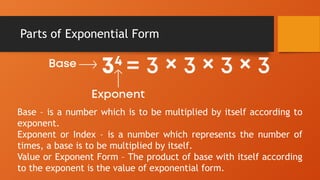
Parts of Exponential Form
Base – is a number which is to be multiplied by itself according to
exponent.
Exponent or Index – is a number which represents the number of
times, a base is to be multiplied by itself.
Value or Exponent Form – The product of base with itself according
to the exponent is the value of exponential form.
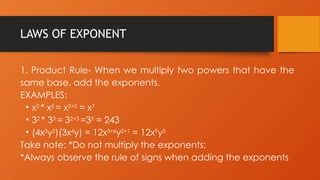
LAWS OF EXPONENT
1. Product Rule- When we multiply two powers that have the
same base, add the exponents.
EXAMPLES:
• x2
* x5
= x2+5
= x7
• 32
* 33
= 32+3
=35
= 243
• (4x3
y2
)(3x6
y) = 12x3+6
y2+1
= 12x9
y3
Take note: *Do not multiply the exponents;
*Always observe the rule of signs when adding the exponents
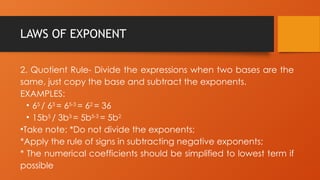
LAWS OF EXPONENT
2. Quotient Rule- Divide the expressions when two bases are the
same, just copy the base and subtract the exponents.
EXAMPLES:
• 65
/ 63
= 65-3
= 62
= 36
• 15b5
/ 3b3
= 5b5-3
= 5b2
•Take note: *Do not divide the exponents;
*Apply the rule of signs in subtracting negative exponents;
* The numerical coefficients should be simplified to lowest term if
possible
LAWS OF EXPONENT
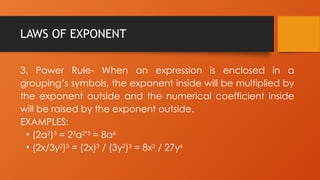
3. Power Rule- When an expression is enclosed in a
grouping’s symbols, the exponent inside will be multiplied by
the exponent outside and the numerical coefficient inside
will be raised by the exponent outside.
EXAMPLES:
• (2a2
)3
= 23
a2*3
= 8a6
• (2x/3y2
)3
= (2x)3
/ (3y2
)3
= 8x3
/ 27y6
LAWS OF EXPONENT
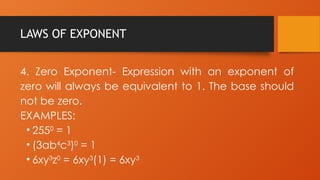
4. Zero Exponent- Expression with an exponent of
zero will always be equivalent to 1. The base should
not be zero.
EXAMPLES:
• 2550
= 1
• (3ab4
c3
)0
= 1
• 6xy3
z0
= 6xy3
(1) = 6xy3
LAWS OF EXPONENT
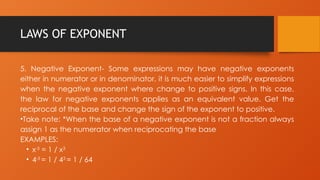
5. Negative Exponent- Some expressions may have negative exponents
either in numerator or in denominator, it is much easier to simplify expressions
when the negative exponent where change to positive signs. In this case,
the law for negative exponents applies as an equivalent value. Get the
reciprocal of the base and change the sign of the exponent to positive.
•Take note: *When the base of a negative exponent is not a fraction always
assign 1 as the numerator when reciprocating the base
EXAMPLES:
• x-3
= 1 / x3
• 4-3
= 1 / 43
= 1 / 64
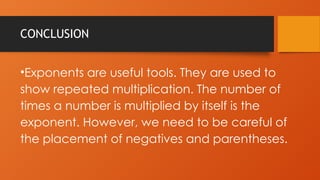
CONCLUSION
•Exponents are useful tools. They are used to
show repeated multiplication. The number of
times a number is multiplied by itself is the
exponent. However, we need to be careful of
the placement of negatives and parentheses.
ADDITIONAL
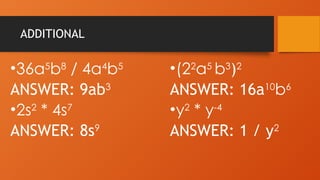
•36a5
b8
/ 4a4
b5
ANSWER: 9ab3
•2s2
* 4s7
ANSWER: 8s9
•(22
a5
b3
)2
ANSWER: 16a10
b6
•y2
* y-4
ANSWER: 1 / y2
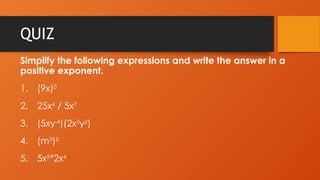
QUIZ
Simplify the following expressions and write the answer in a
positive exponent.
1. (9x)0
2. 25x4
/ 5x7
3. (5xy-4
)(2x3
y2
)
4. (m3
)5
5. 5x5
*2x4

Lesson 1. Exponents. Lesson 1. Exponents. Lesson 1. Exponents.ppt

  • 1.
  • 2.
    OBJECTIVES At the endof the lesson, you are expected to: a. Enumerate the laws involving exponents; b. Apply the laws involving integral exponents; and c. Show accuracy and perseverance in applying the laws involving integral exponents.
  • 3.
    Parts of ExponentialForm Base – is a number which is to be multiplied by itself according to exponent. Exponent or Index – is a number which represents the number of times, a base is to be multiplied by itself. Value or Exponent Form – The product of base with itself according to the exponent is the value of exponential form.
  • 4.
    LAWS OF EXPONENT 1.Product Rule- When we multiply two powers that have the same base, add the exponents. EXAMPLES: • x2 * x5 = x2+5 = x7 • 32 * 33 = 32+3 =35 = 243 • (4x3 y2 )(3x6 y) = 12x3+6 y2+1 = 12x9 y3 Take note: *Do not multiply the exponents; *Always observe the rule of signs when adding the exponents
  • 5.
    LAWS OF EXPONENT 2.Quotient Rule- Divide the expressions when two bases are the same, just copy the base and subtract the exponents. EXAMPLES: • 65 / 63 = 65-3 = 62 = 36 • 15b5 / 3b3 = 5b5-3 = 5b2 •Take note: *Do not divide the exponents; *Apply the rule of signs in subtracting negative exponents; * The numerical coefficients should be simplified to lowest term if possible
  • 6.
    LAWS OF EXPONENT 3.Power Rule- When an expression is enclosed in a grouping’s symbols, the exponent inside will be multiplied by the exponent outside and the numerical coefficient inside will be raised by the exponent outside. EXAMPLES: • (2a2 )3 = 23 a2*3 = 8a6 • (2x/3y2 )3 = (2x)3 / (3y2 )3 = 8x3 / 27y6
  • 7.
    LAWS OF EXPONENT 4.Zero Exponent- Expression with an exponent of zero will always be equivalent to 1. The base should not be zero. EXAMPLES: • 2550 = 1 • (3ab4 c3 )0 = 1 • 6xy3 z0 = 6xy3 (1) = 6xy3
  • 8.
    LAWS OF EXPONENT 5.Negative Exponent- Some expressions may have negative exponents either in numerator or in denominator, it is much easier to simplify expressions when the negative exponent where change to positive signs. In this case, the law for negative exponents applies as an equivalent value. Get the reciprocal of the base and change the sign of the exponent to positive. •Take note: *When the base of a negative exponent is not a fraction always assign 1 as the numerator when reciprocating the base EXAMPLES: • x-3 = 1 / x3 • 4-3 = 1 / 43 = 1 / 64
  • 9.
    CONCLUSION •Exponents are usefultools. They are used to show repeated multiplication. The number of times a number is multiplied by itself is the exponent. However, we need to be careful of the placement of negatives and parentheses.

  • 10.
    ADDITIONAL •36a5 b8 / 4a4 b5 ANSWER: 9ab3 •2s2 *4s7 ANSWER: 8s9 •(22 a5 b3 )2 ANSWER: 16a10 b6 •y2 * y-4 ANSWER: 1 / y2
  • 11.
    QUIZ Simplify the followingexpressions and write the answer in a positive exponent. 1. (9x)0 2. 25x4 / 5x7 3. (5xy-4 )(2x3 y2 ) 4. (m3 )5 5. 5x5 *2x4