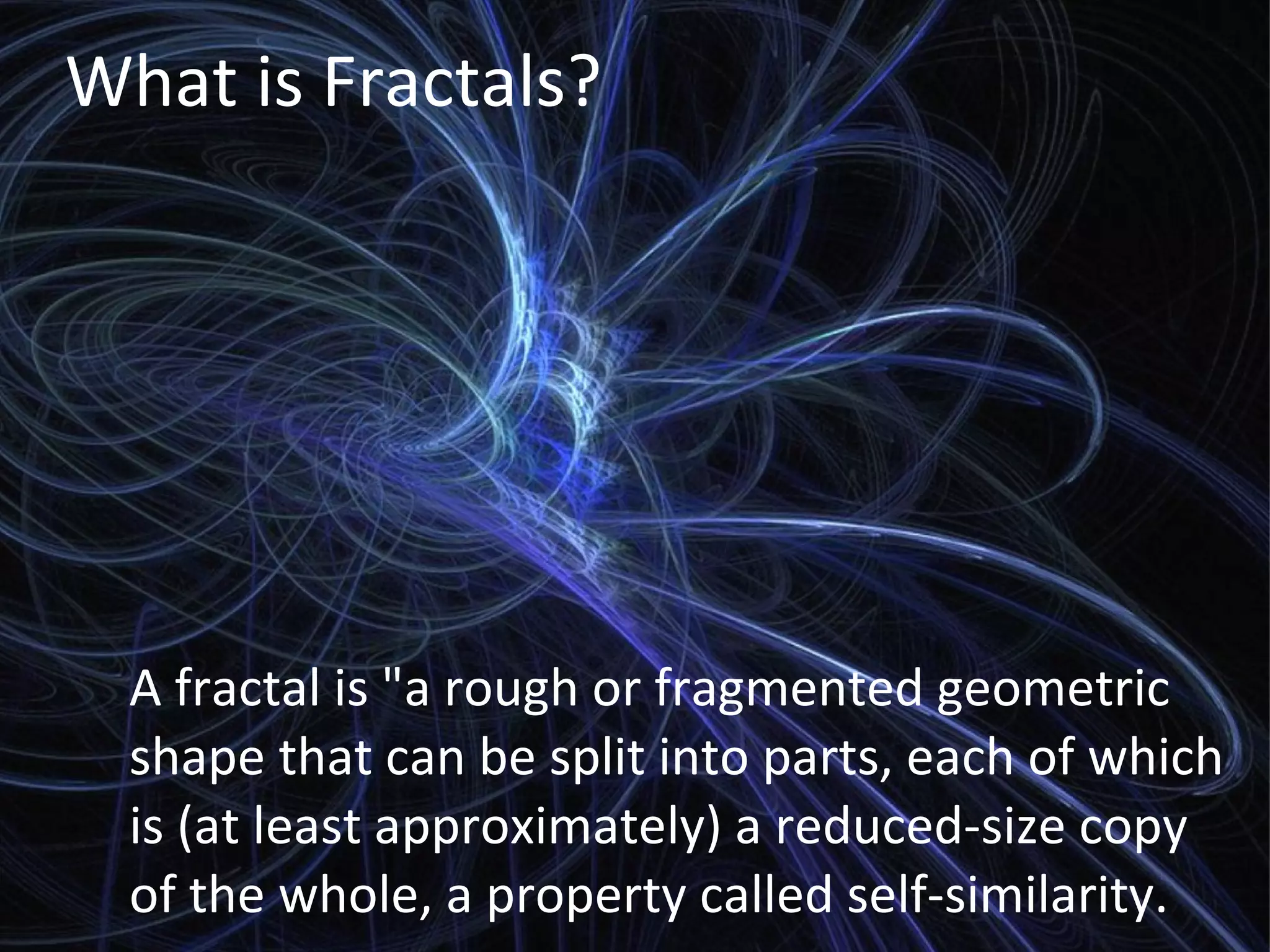
What is Fractals? A fractal is "a rough or fragmented geometric shape that can be split into parts, each of which is (at least approximately) a reduced-size copy of the whole, a property called self-similarity.
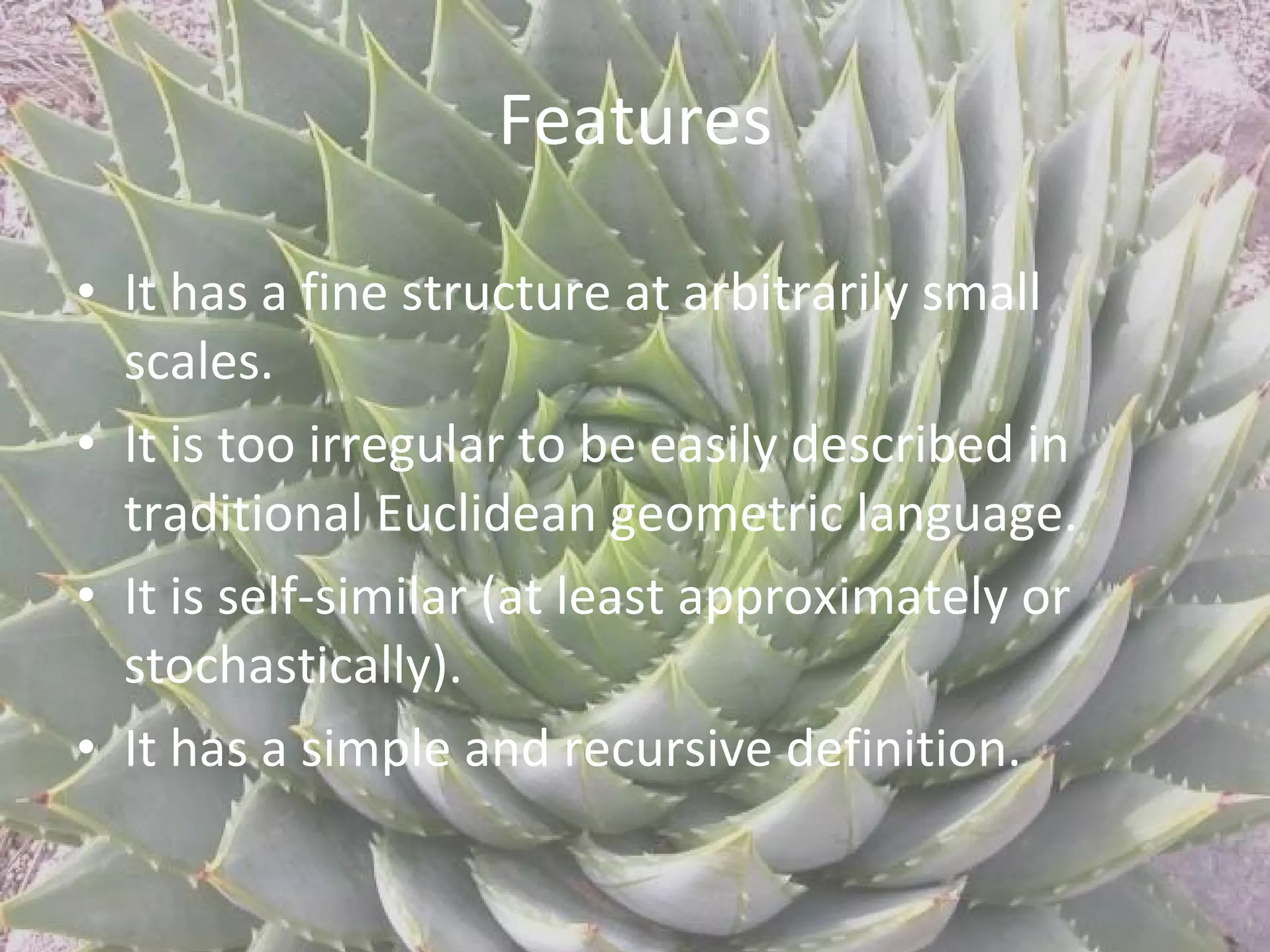
Features It has a fine structure at arbitrarily small scales. It is too irregular to be easily described in traditional Euclidean geometric language. It is self-similar (at least approximately or stochastically). It has a simple and recursive definition.
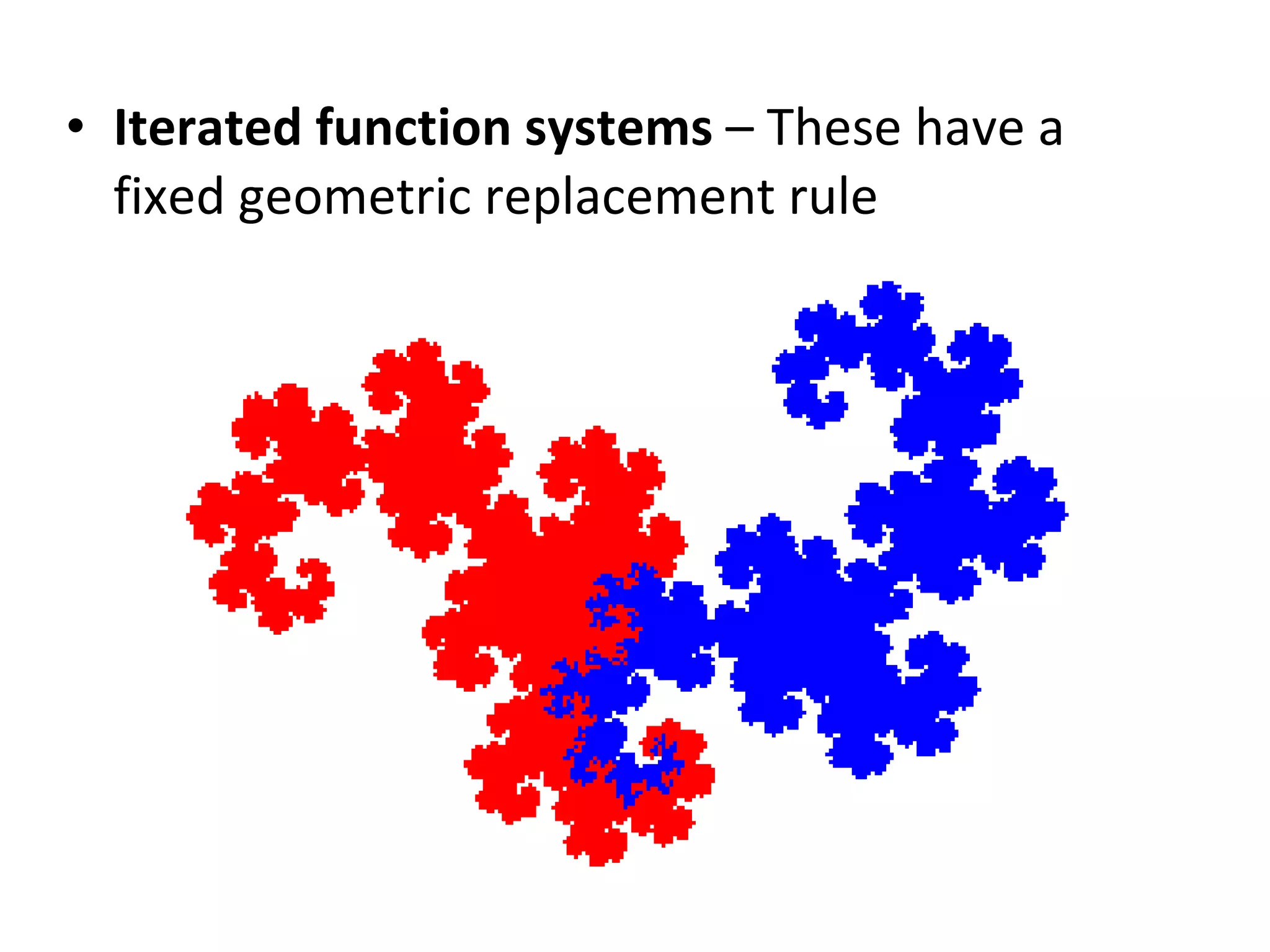
Iterated function systems  – These have a fixed geometric replacement rule
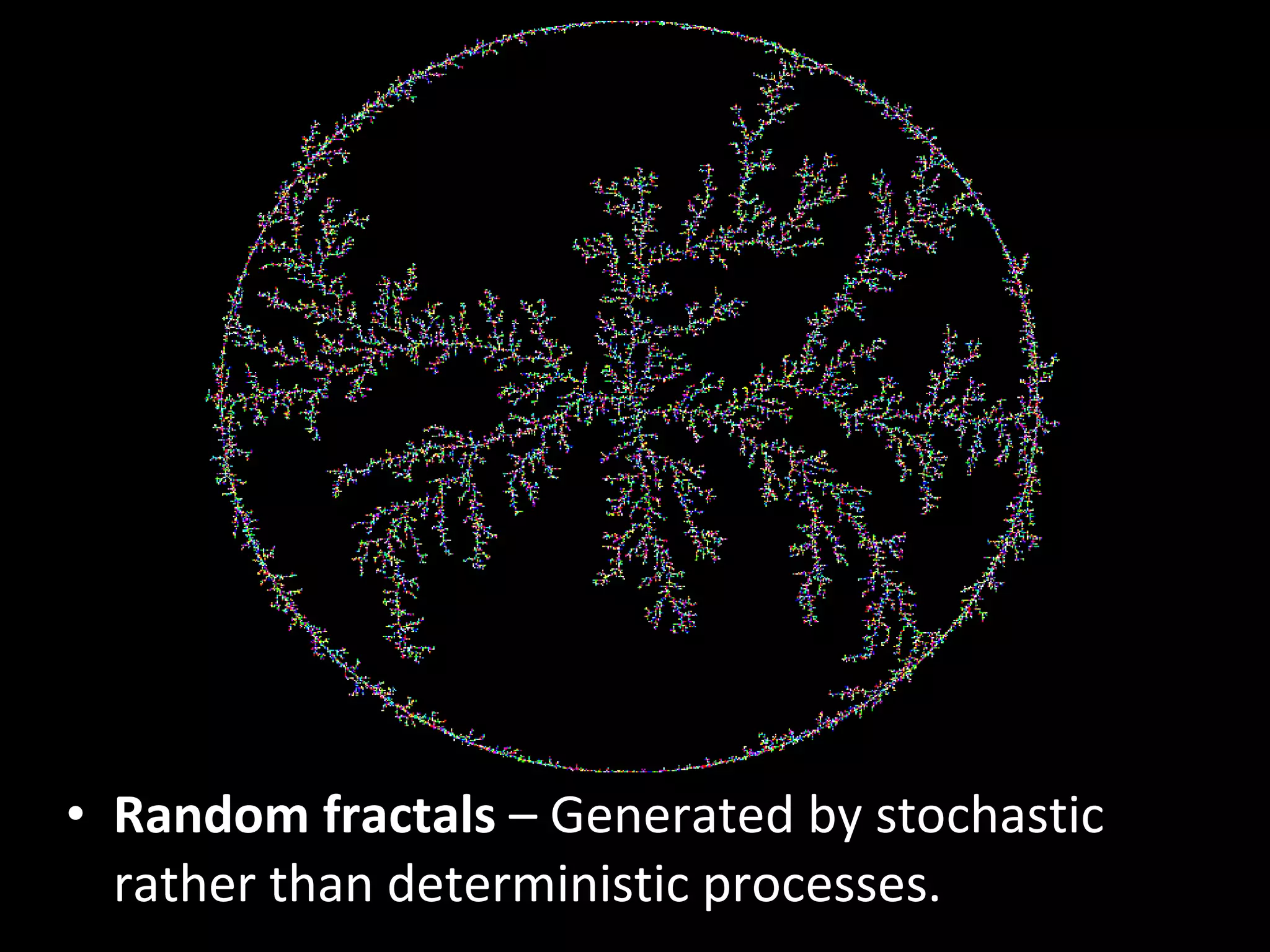
Random fractals  – Generated by stochastic rather than deterministic processes.
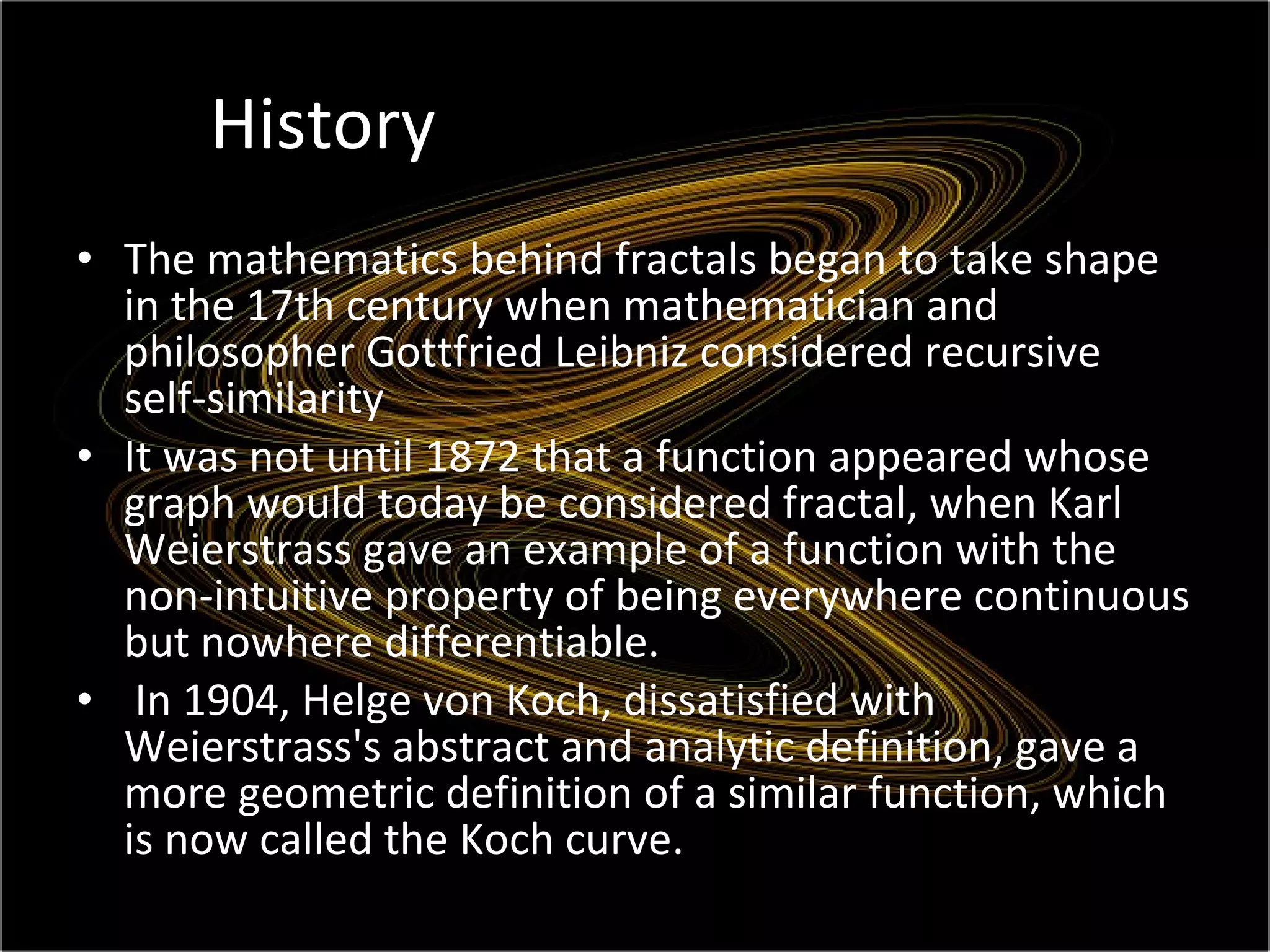
History The mathematics behind fractals began to take shape in the 17th century when mathematician and philosopher Gottfried Leibniz considered recursive self-similarity It was not until 1872 that a function appeared whose graph would today be considered fractal, when Karl Weierstrass gave an example of a function with the non-intuitive property of being everywhere continuous but nowhere differentiable. In 1904, Helge von Koch, dissatisfied with Weierstrass's abstract and analytic definition, gave a more geometric definition of a similar function, which is now called the Koch curve.
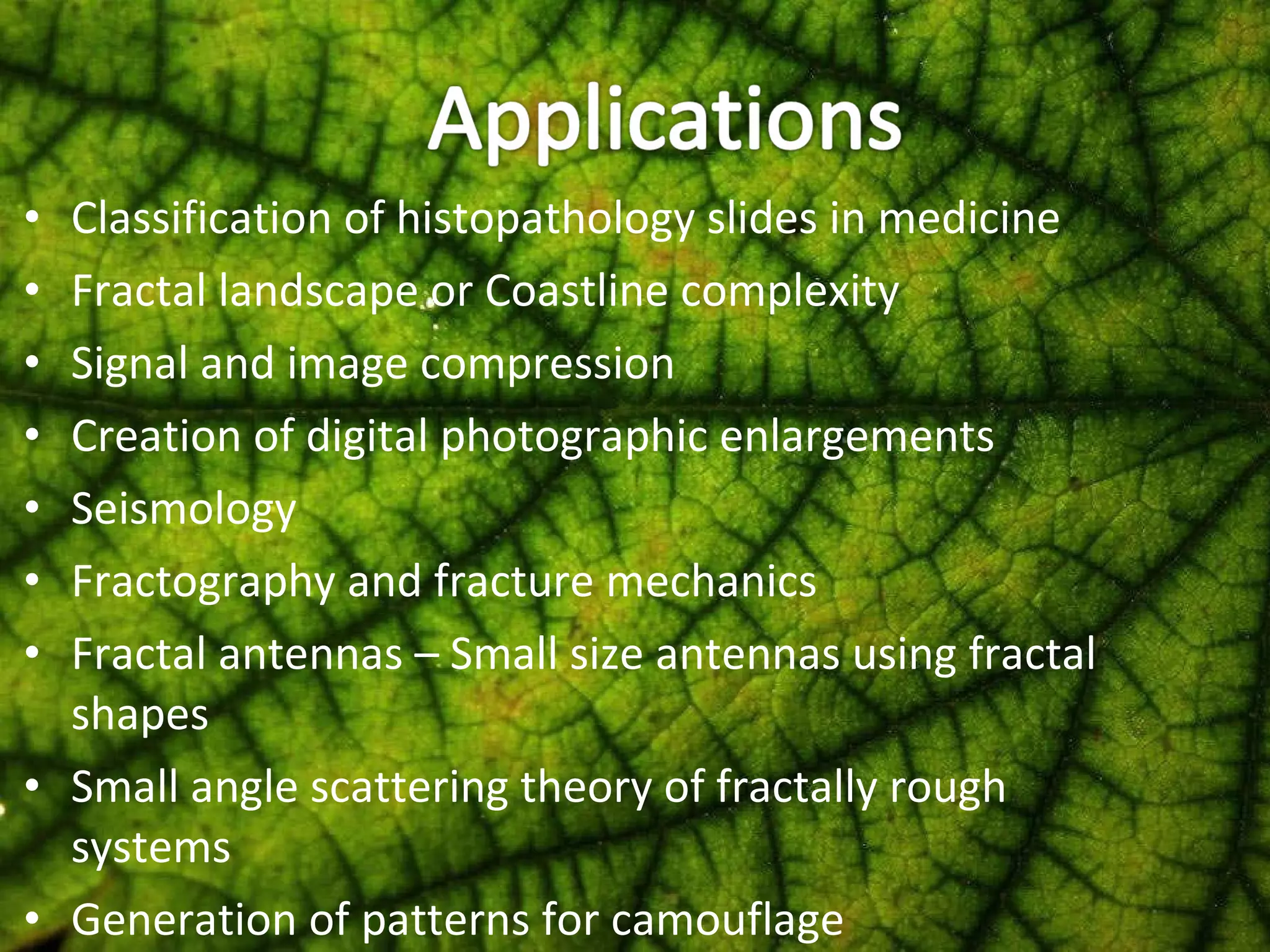
Classification of histopathology slides in medicine Fractal landscape or Coastline complexity Signal and image compression Creation of digital photographic enlargements Seismology Fractography and fracture mechanics Fractal antennas – Small size antennas using fractal shapes Small angle scattering theory of fractally rough systems Generation of patterns for camouflage
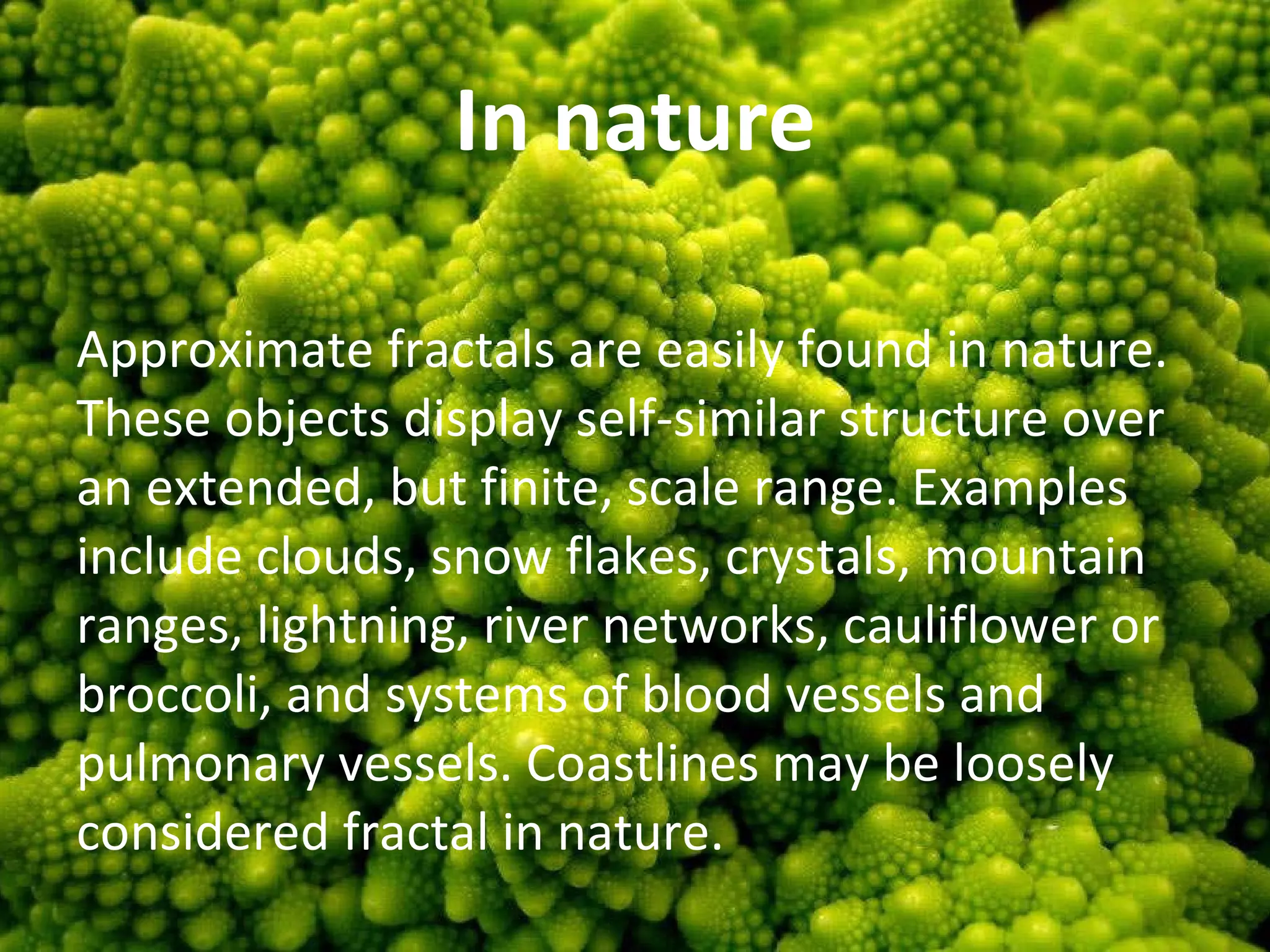
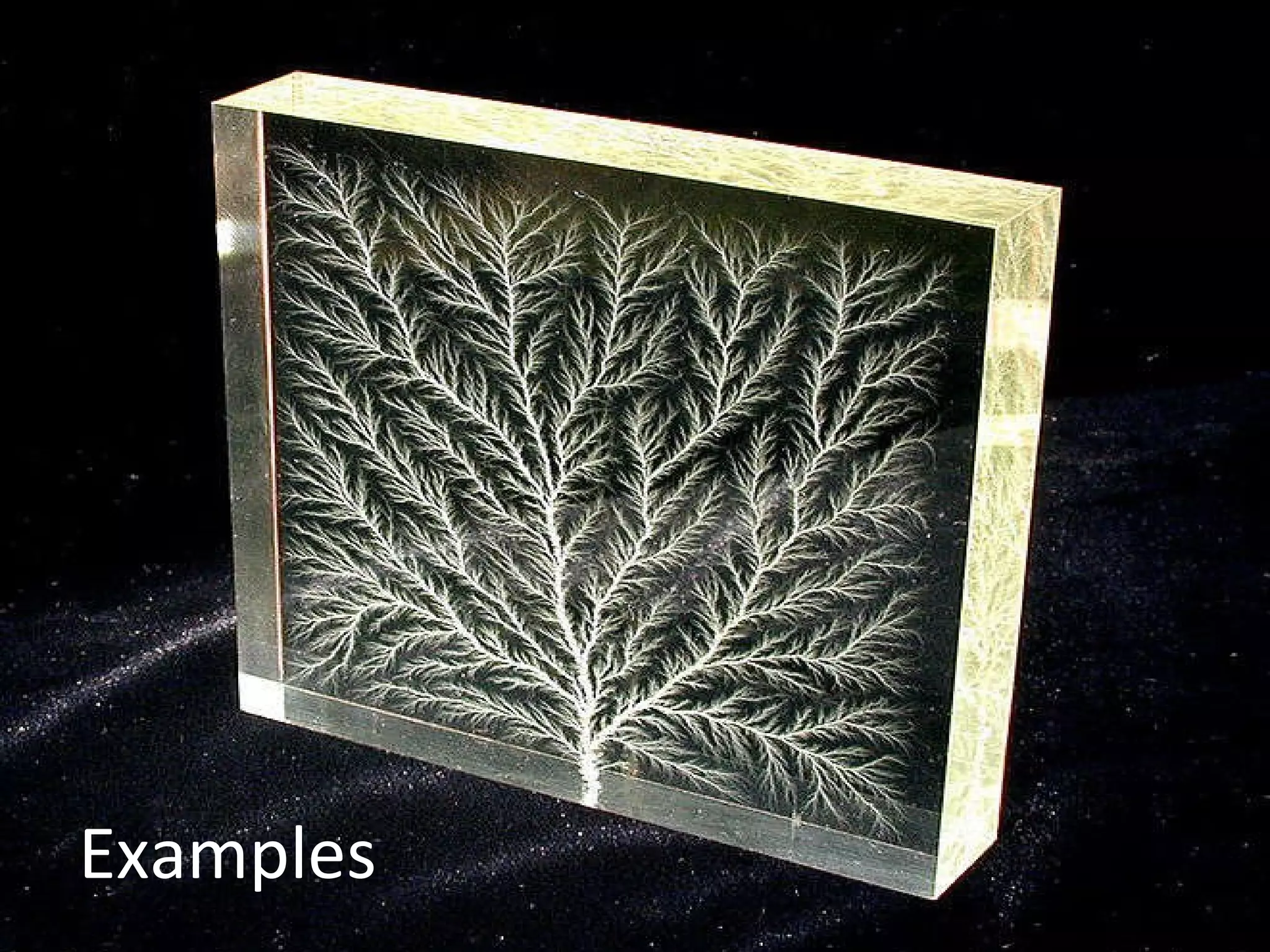
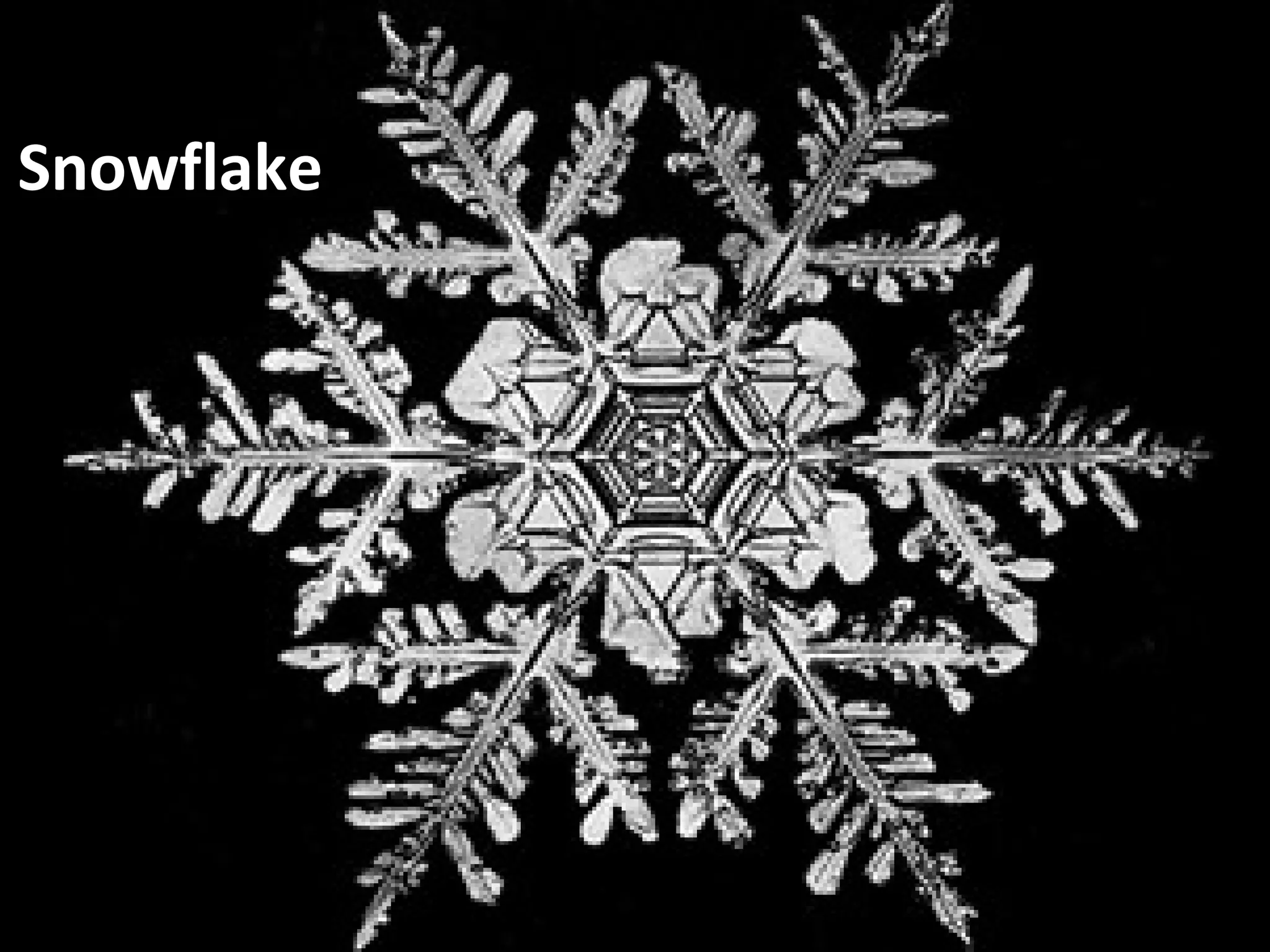
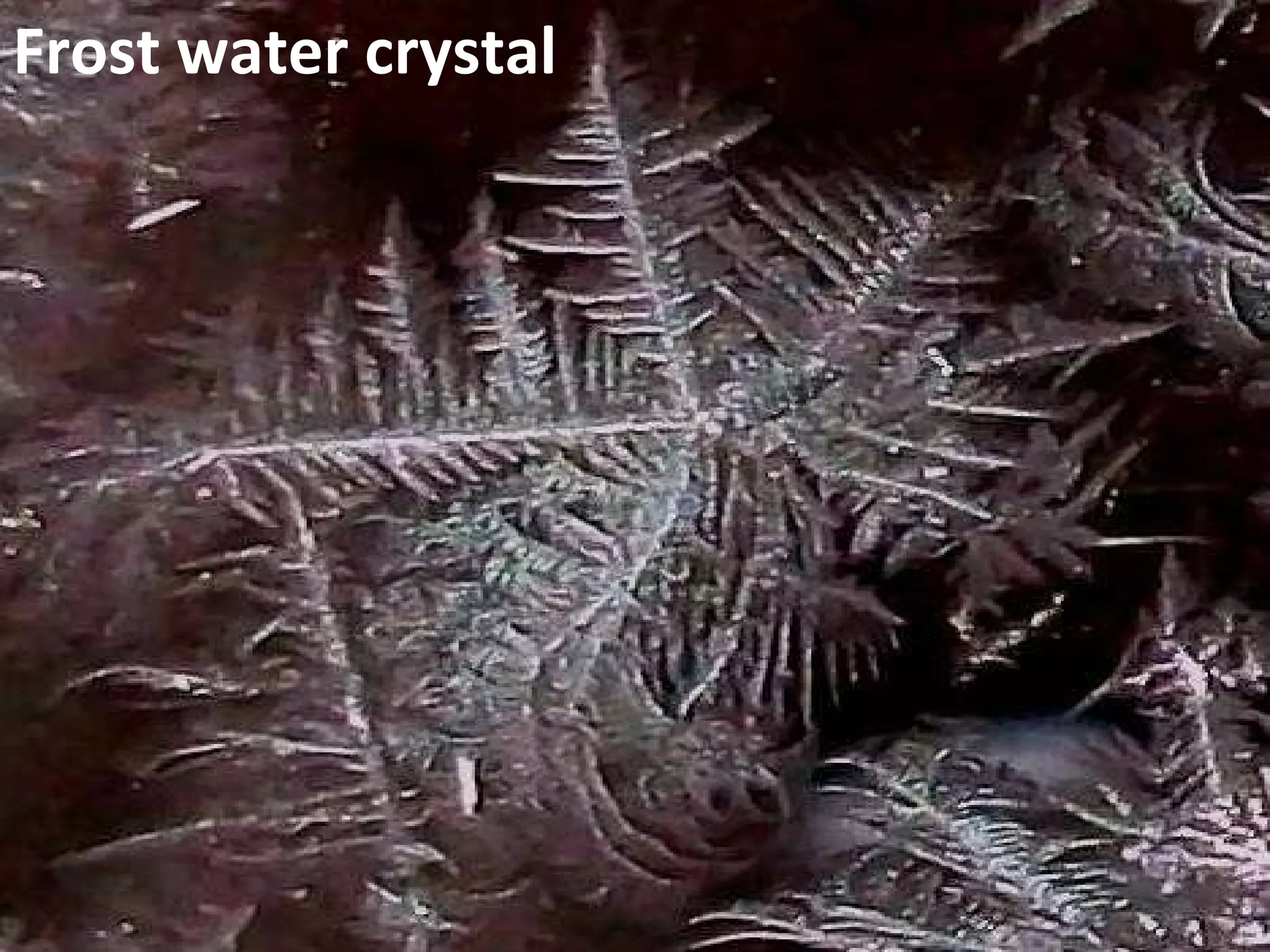
In nature Approximate fractals are easily found in nature. These objects display self-similar structure over an extended, but finite, scale range. Examples include clouds, snow flakes, crystals, mountain ranges, lightning, river networks, cauliflower or broccoli, and systems of blood vessels and pulmonary vessels. Coastlines may be loosely considered fractal in nature.
Examples
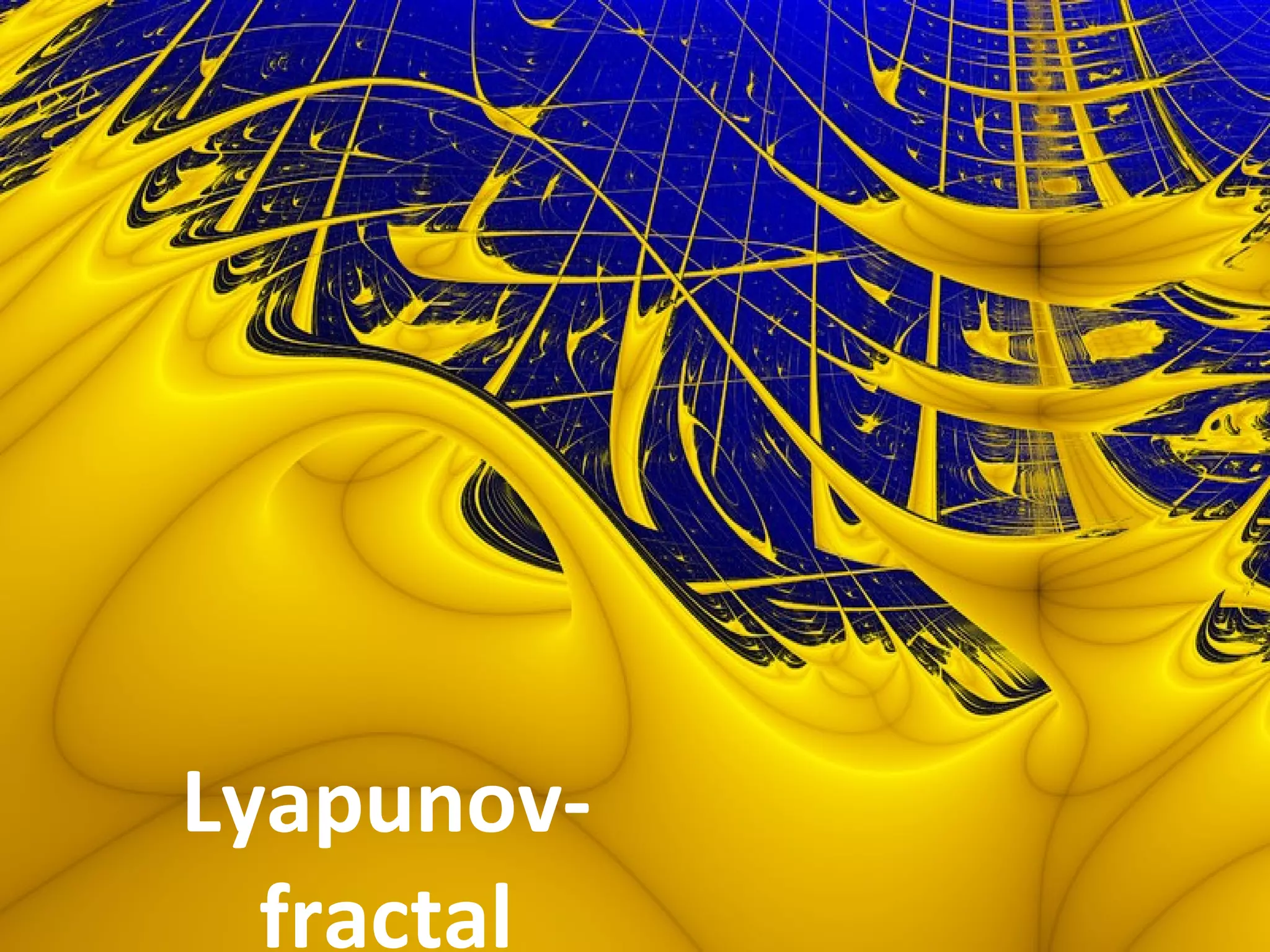
Lyapunov-fractal
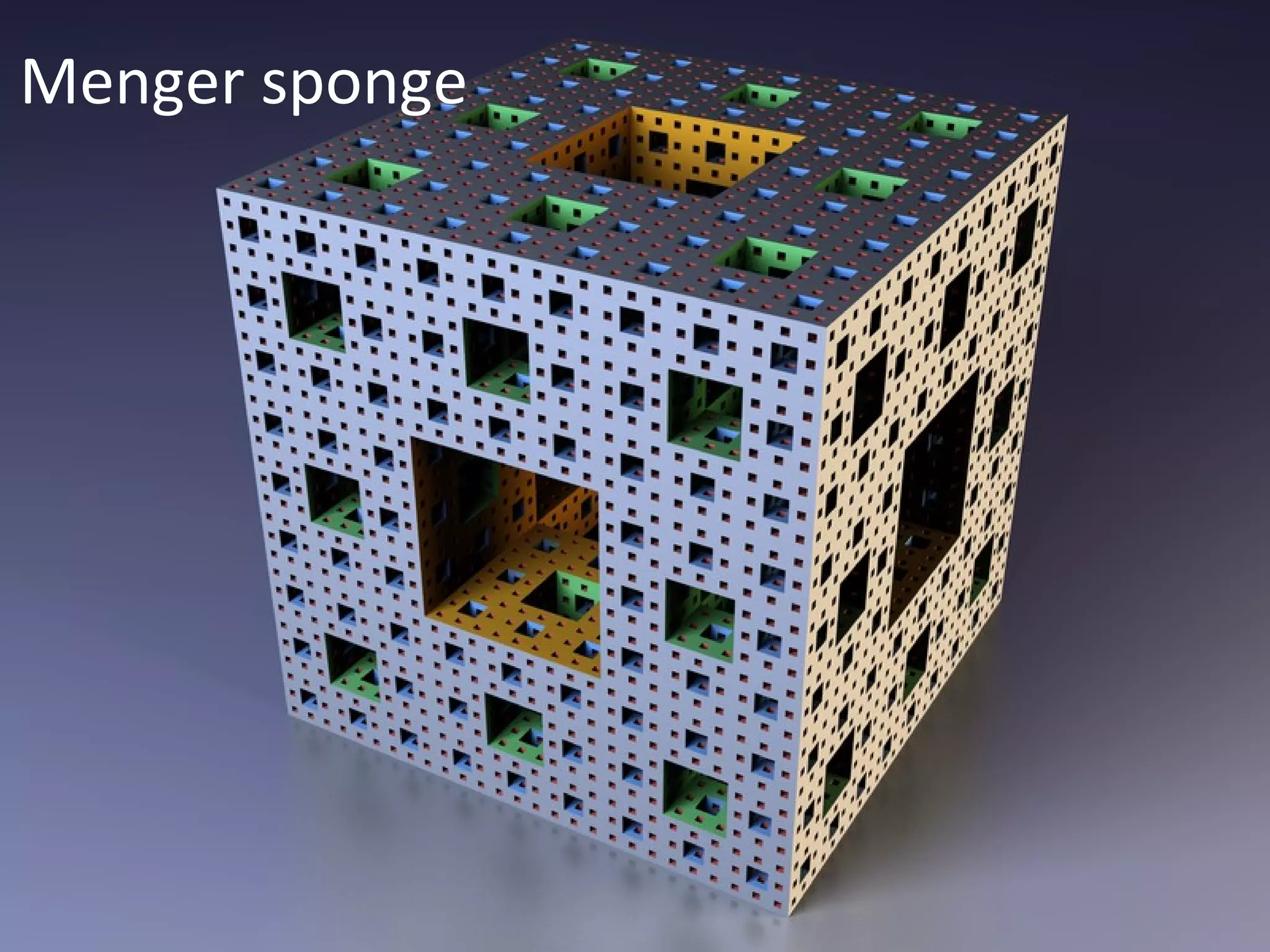
Menger sponge
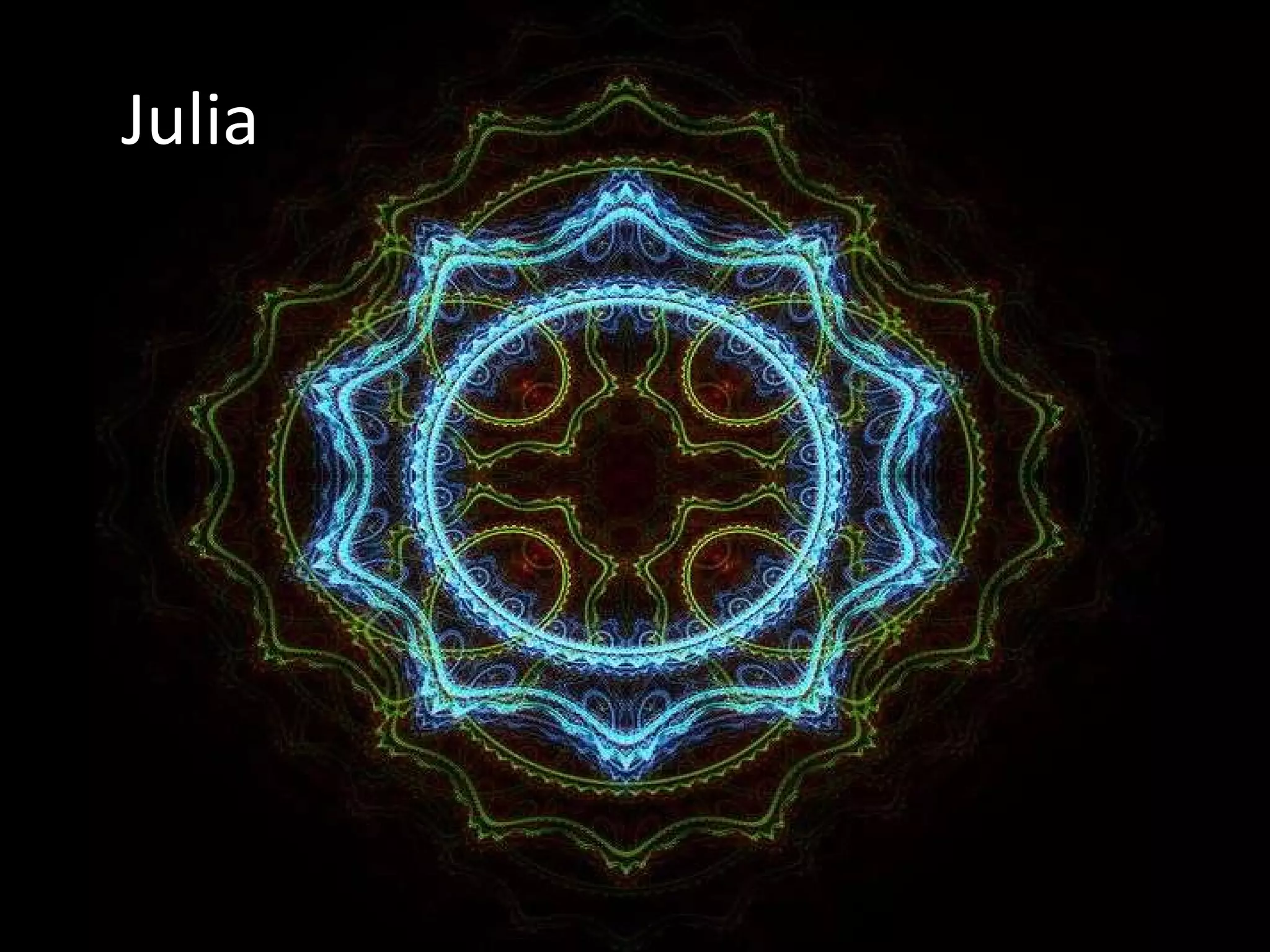
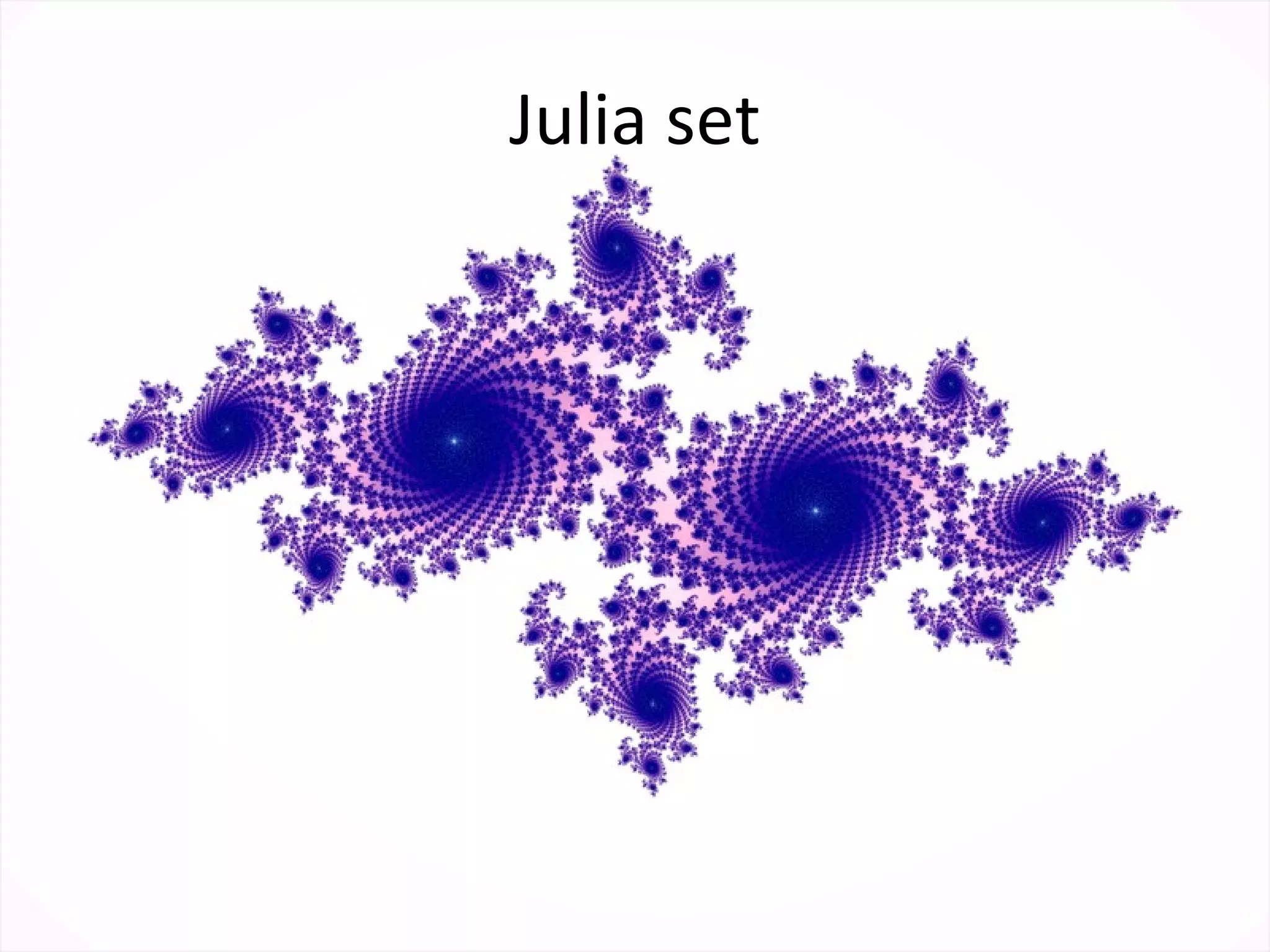
Julia
Snowflake
Frost water crystal
Julia set
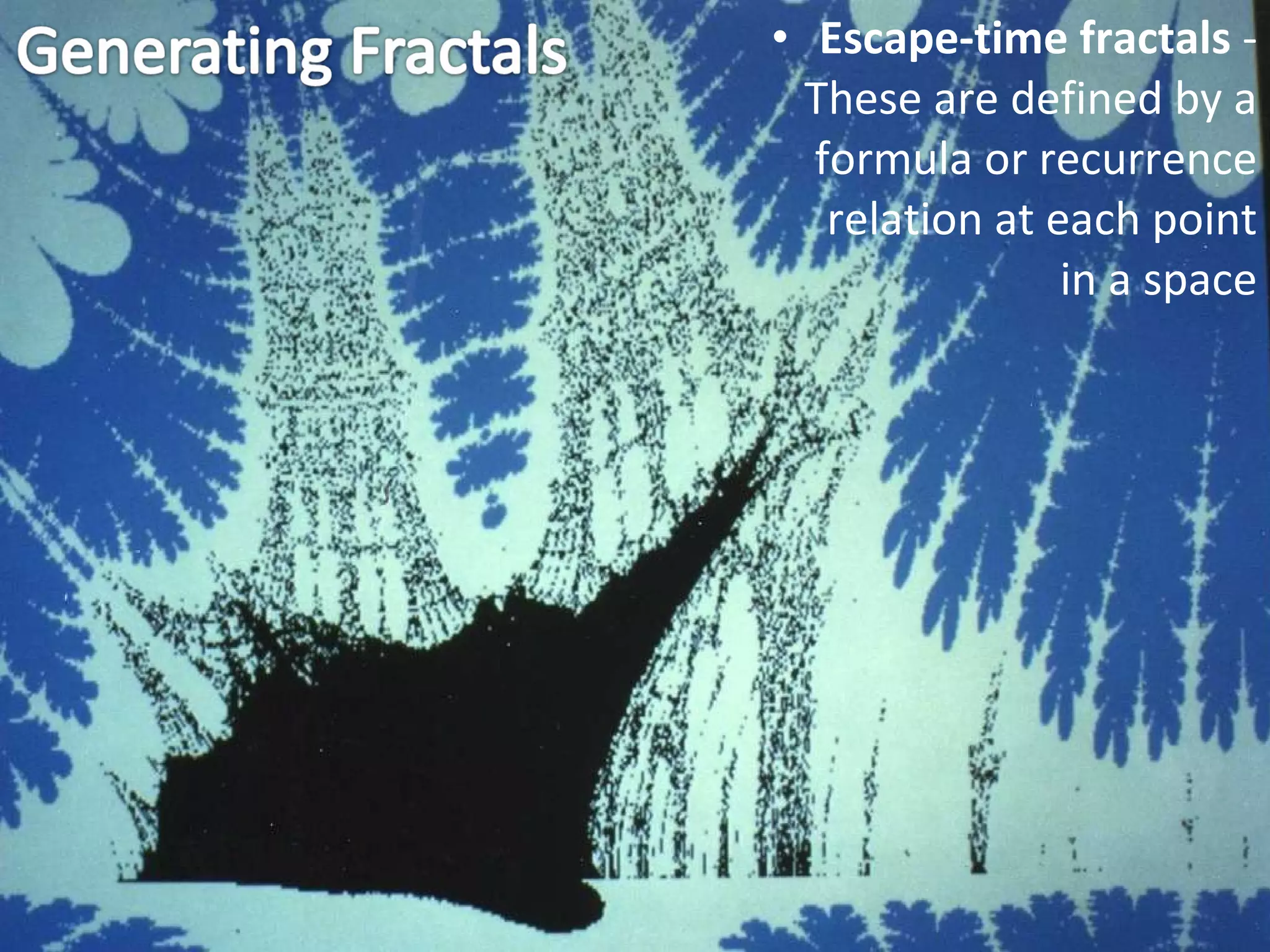
Escape-time fractals  - These are defined by a formula or recurrence relation at each point in a space
Classification Fractals can also be classified according to their self-similarity. There are three types of self-similarity found in fractals: Exact self-similarity  – This is the strongest type of self-similarity; the fractal appears identical at different scales. Fractals defined by iterated function systems often display exact self-similarity. For example, the Sierpinski triangle and Koch snowflake exhibit exact self-similarity. Quasi-self-similarity  – This is a looser form of self-similarity; the fractal appears approximately (but not exactly) identical at different scales. Quasi-self-similar fractals contain small copies of the entire fractal in distorted and degenerate forms. Fractals defined by recurrence relations are usually quasi-self-similar but not exactly self-similar. The Mandelbrot set is quasi-self-similar, as the satellites are approximations of the entire set, but not exact copies. Statistical self-similarity  – This is the weakest type of self-similarity; the fractal has numerical or statistical measures which are preserved across scales. Most reasonable definitions of "fractal" trivially imply some form of statistical self-similarity. Random fractals are examples of fractals which are statistically self-similar, but neither exactly nor quasi-self-similar. The coastline of Britain is another example; one cannot expect to find microscopic Britain's (even distorted ones) by looking at a small section of the coast with a magnifying glass.
Bibliography The Fractal Geometry of Nature  by  Mandelbrot, B.B. Fractals: The Patterns of Chaos by  Thames and Hudson www.wikipedia.com math.rice.edu/~lanius/frac/

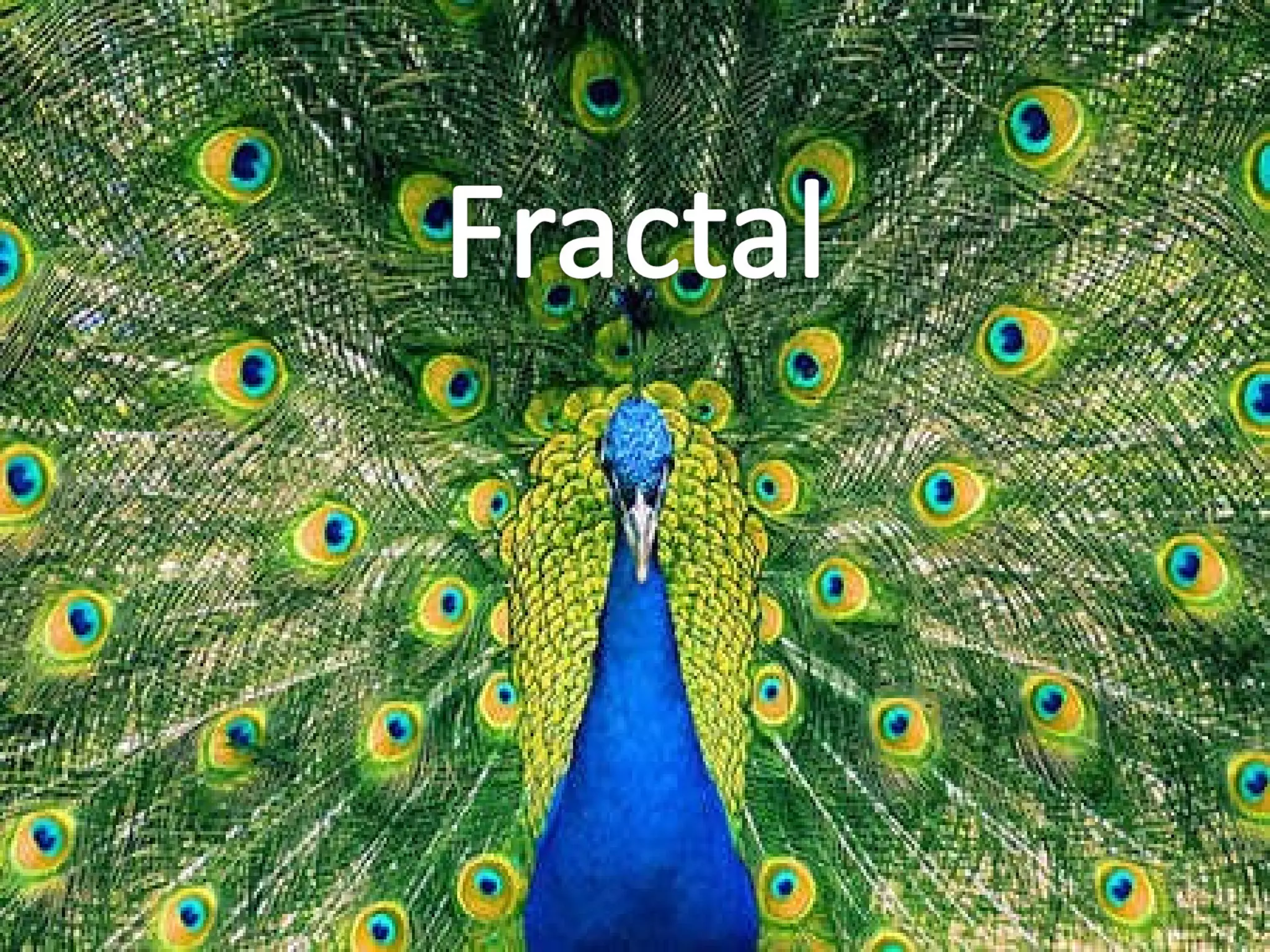
Fractal

  • 1.
  • 2.
    What is Fractals?A fractal is "a rough or fragmented geometric shape that can be split into parts, each of which is (at least approximately) a reduced-size copy of the whole, a property called self-similarity.
  • 3.
    Features It hasa fine structure at arbitrarily small scales. It is too irregular to be easily described in traditional Euclidean geometric language. It is self-similar (at least approximately or stochastically). It has a simple and recursive definition.
  • 4.
    Iterated function systems – These have a fixed geometric replacement rule
  • 5.
    Random fractals – Generated by stochastic rather than deterministic processes.
  • 6.
    History The mathematicsbehind fractals began to take shape in the 17th century when mathematician and philosopher Gottfried Leibniz considered recursive self-similarity It was not until 1872 that a function appeared whose graph would today be considered fractal, when Karl Weierstrass gave an example of a function with the non-intuitive property of being everywhere continuous but nowhere differentiable. In 1904, Helge von Koch, dissatisfied with Weierstrass's abstract and analytic definition, gave a more geometric definition of a similar function, which is now called the Koch curve.
  • 7.
    Classification of histopathologyslides in medicine Fractal landscape or Coastline complexity Signal and image compression Creation of digital photographic enlargements Seismology Fractography and fracture mechanics Fractal antennas – Small size antennas using fractal shapes Small angle scattering theory of fractally rough systems Generation of patterns for camouflage
  • 8.
    In nature Approximatefractals are easily found in nature. These objects display self-similar structure over an extended, but finite, scale range. Examples include clouds, snow flakes, crystals, mountain ranges, lightning, river networks, cauliflower or broccoli, and systems of blood vessels and pulmonary vessels. Coastlines may be loosely considered fractal in nature.
  • 9.
  • 10.
  • 11.
  • 12.
  • 13.
  • 14.
  • 15.
  • 16.
    Escape-time fractals - These are defined by a formula or recurrence relation at each point in a space
  • 17.
    Classification Fractals canalso be classified according to their self-similarity. There are three types of self-similarity found in fractals: Exact self-similarity – This is the strongest type of self-similarity; the fractal appears identical at different scales. Fractals defined by iterated function systems often display exact self-similarity. For example, the Sierpinski triangle and Koch snowflake exhibit exact self-similarity. Quasi-self-similarity – This is a looser form of self-similarity; the fractal appears approximately (but not exactly) identical at different scales. Quasi-self-similar fractals contain small copies of the entire fractal in distorted and degenerate forms. Fractals defined by recurrence relations are usually quasi-self-similar but not exactly self-similar. The Mandelbrot set is quasi-self-similar, as the satellites are approximations of the entire set, but not exact copies. Statistical self-similarity – This is the weakest type of self-similarity; the fractal has numerical or statistical measures which are preserved across scales. Most reasonable definitions of "fractal" trivially imply some form of statistical self-similarity. Random fractals are examples of fractals which are statistically self-similar, but neither exactly nor quasi-self-similar. The coastline of Britain is another example; one cannot expect to find microscopic Britain's (even distorted ones) by looking at a small section of the coast with a magnifying glass.
  • 18.
    Bibliography The FractalGeometry of Nature by Mandelbrot, B.B. Fractals: The Patterns of Chaos by Thames and Hudson www.wikipedia.com math.rice.edu/~lanius/frac/