 TILING THE PLANE
 RECURSIVELY DEFINED CURVES
 KOCH CURVES
 C CURVES
 DRAGONS
 SPACE FILLING CURVES
 FRACTALS
 GRAMMAR BASED MODELS
 TURTLE GRAPHICS
 RAY TRACING
 Image is a visual representation of scene, it
represent selected properties of scene to
viewer with varying degree of realism.
 Use one or more geometric shapes
 Tessellation(without gaps) of flat surface
 Shape repeated
 Moving infinity
 Covering entire plane
 Used arts,mosaics,wall papers,tiled floor
 Monohedral tiling
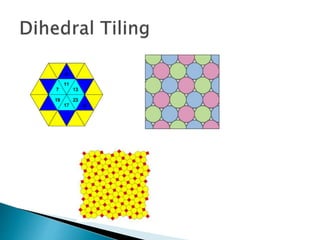
 Dihedral tiling
 Drawing tiling
 Reptiles
 Based on single polygon
 Types
1. Regular tiling
2. Patterns
3. Cario tiling
4. Polymino
5. Polyiamond
 Shifting the tessellation in particular direction
 Four pentagon fit together to form hexagon
 Used to tile the plane
 Many street in cairo,Egypt in this pattern
 Large window setup
 Tiles grouped together into single figure
 Single figure drawn again and again
 Non periodic figure include
 Small to large and large to small
 Non periodic tiling
 Based on square, equilateral triangle
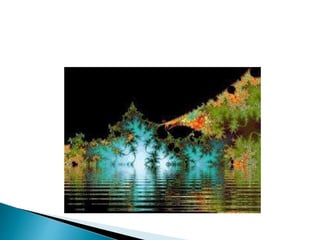
 A fractal is a never-ending pattern.
 Fractals are infinitely complex patterns that
are self-similar across different scales.
 They are created by repeating a simple
process over and over in an on-going
feedback loop.
 Self Similar fractals
 Self Affine fractals
 Invariant fractals
 Geometric figure is self similar
 Fractals appear identical at different scales
 Model trees,shrubs,plants
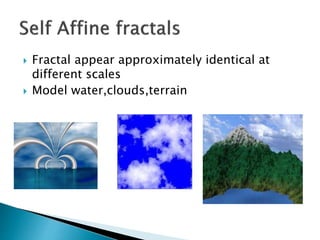
 Fractal appear approximately identical at
different scales
 Model water,clouds,terrain
 Non linear transformation
 Curves created by iterations
 Formulas repeated with slightly different
values over and over again
 Hilberts Curve
 Koch Curve
 Dragon Curve
 Space filling Curve/Piano Curve
 C Curve
 It was described by the German
mathematician David Hilbert in 1891.
 The Hilbert curve is a space filling curve.
 It visits every point in a square grid with a
size of 2×2, 4×4, 8×8, 16×16, or any other
power of 2.
1
2 3
4
3
21
4
1
6
3/
4
1/
4
2/
4
4/
40
4/16
3/16
2/16
1/16
16/16
1
0,0 0,0
1,1 1,1
1st iteration 2nd iteration 3rd iteration
6th iteration
 Developed by Helga von Koch in 1904
 Self similar fractals
 Described by Ernesto cesaro and Georg Faber
in the year 1910
 Self similar fractal curves
 Developed by Italian mathematician Guiseppe
peano in 1890
 Space filling curve
 Structure defined by language
 Languages described by a collection of
productions
 example, A->AA creates results of A, AA, AAAA,
 B->A[B] creates results of B, A[B], AA[B], etc.
 Grammar based models...
◦ [ ] for left branches
◦ ( ) for right branches
◦ A -> AA and B -> A[B]AA(B)
◦ create a 2nd generation of:
AA[A[B]AA(B)]AAAA(A[B]AA(B))
Advanced Modeling
Graftals
B B
B
B
B
B
B
A
A
A
A
A
A
A
A
A
A A
A
AA
Second GenerationFirst Generation
A
 Grammar based models...
◦ ...use biological productions to simulate plants
in development
◦ ...describe the topology of plants
◦ ...also describe the shape including the
directions of branches and the arrangement of
leaves
Advanced Modeling
Graftals
 To simulate the growth of plants using
languages include information on...
◦ ...the current age
◦ ...the growth rate of each segment
◦ ...the probabilities of death, dormancy, growth
◦ ...the shape (depending on type and age)
◦ ...the branch angles (depending on type and
age)
◦ ...the color and texture of each segment
Advanced Modeling
 Pseudo code simulates the growth of plants
using graftals:
◦ For (each moment in time)
 For (each bud that is still alive)
 Determine whether the bud dies, is dormant, or grow
 If (the bud does not die)
 If (the bud is not dormant)
 Create a portion of a stem, determining its
direction, position, color, texture;
Create a new bud;
Advanced Modeling
Graftals
 Particle systems...
◦ ...can be used to simulate fire, clouds, water, fog,
smoke, fireworks, trees, and grass
◦ ...are particularly useful for animating objects instead
of just simulating static objects
Advanced Modeling
Particle Systems
 Logo programming language
 Developed by feurzig & seymour papert in
1966
 Popular graphics language for kids
Computer graphics realism

Computer graphics realism

  • 2.
     TILING THEPLANE  RECURSIVELY DEFINED CURVES  KOCH CURVES  C CURVES  DRAGONS  SPACE FILLING CURVES  FRACTALS  GRAMMAR BASED MODELS  TURTLE GRAPHICS  RAY TRACING
  • 3.
     Image isa visual representation of scene, it represent selected properties of scene to viewer with varying degree of realism.
  • 4.
     Use oneor more geometric shapes  Tessellation(without gaps) of flat surface  Shape repeated  Moving infinity  Covering entire plane  Used arts,mosaics,wall papers,tiled floor
  • 8.
     Monohedral tiling Dihedral tiling  Drawing tiling  Reptiles
  • 9.
     Based onsingle polygon  Types 1. Regular tiling 2. Patterns 3. Cario tiling 4. Polymino 5. Polyiamond
  • 11.
     Shifting thetessellation in particular direction
  • 12.
     Four pentagonfit together to form hexagon  Used to tile the plane  Many street in cairo,Egypt in this pattern
  • 16.
     Large windowsetup  Tiles grouped together into single figure  Single figure drawn again and again  Non periodic figure include  Small to large and large to small
  • 17.
     Non periodictiling  Based on square, equilateral triangle
  • 19.
     A fractalis a never-ending pattern.  Fractals are infinitely complex patterns that are self-similar across different scales.  They are created by repeating a simple process over and over in an on-going feedback loop.
  • 20.
     Self Similarfractals  Self Affine fractals  Invariant fractals
  • 21.
     Geometric figureis self similar  Fractals appear identical at different scales
  • 28.
  • 29.
     Fractal appearapproximately identical at different scales  Model water,clouds,terrain
  • 30.
     Non lineartransformation
  • 31.
     Curves createdby iterations  Formulas repeated with slightly different values over and over again
  • 32.
     Hilberts Curve Koch Curve  Dragon Curve  Space filling Curve/Piano Curve  C Curve
  • 33.
     It wasdescribed by the German mathematician David Hilbert in 1891.  The Hilbert curve is a space filling curve.  It visits every point in a square grid with a size of 2×2, 4×4, 8×8, 16×16, or any other power of 2.
  • 34.
  • 35.
  • 37.
     Developed byHelga von Koch in 1904
  • 42.
     Self similarfractals  Described by Ernesto cesaro and Georg Faber in the year 1910
  • 45.
     Self similarfractal curves
  • 47.
     Developed byItalian mathematician Guiseppe peano in 1890  Space filling curve
  • 49.
     Structure definedby language  Languages described by a collection of productions  example, A->AA creates results of A, AA, AAAA,  B->A[B] creates results of B, A[B], AA[B], etc.
  • 50.
     Grammar basedmodels... ◦ [ ] for left branches ◦ ( ) for right branches ◦ A -> AA and B -> A[B]AA(B) ◦ create a 2nd generation of: AA[A[B]AA(B)]AAAA(A[B]AA(B)) Advanced Modeling Graftals B B B B B B B A A A A A A A A A A A A AA Second GenerationFirst Generation A
  • 51.
     Grammar basedmodels... ◦ ...use biological productions to simulate plants in development ◦ ...describe the topology of plants ◦ ...also describe the shape including the directions of branches and the arrangement of leaves Advanced Modeling Graftals
  • 52.
     To simulatethe growth of plants using languages include information on... ◦ ...the current age ◦ ...the growth rate of each segment ◦ ...the probabilities of death, dormancy, growth ◦ ...the shape (depending on type and age) ◦ ...the branch angles (depending on type and age) ◦ ...the color and texture of each segment Advanced Modeling
  • 53.
     Pseudo codesimulates the growth of plants using graftals: ◦ For (each moment in time)  For (each bud that is still alive)  Determine whether the bud dies, is dormant, or grow  If (the bud does not die)  If (the bud is not dormant)  Create a portion of a stem, determining its direction, position, color, texture; Create a new bud; Advanced Modeling Graftals
  • 54.
     Particle systems... ◦...can be used to simulate fire, clouds, water, fog, smoke, fireworks, trees, and grass ◦ ...are particularly useful for animating objects instead of just simulating static objects Advanced Modeling Particle Systems
  • 57.
     Logo programminglanguage  Developed by feurzig & seymour papert in 1966  Popular graphics language for kids

Editor's Notes

  • #51 Reference: Foley, van Dam, Feiner, Hughes, Computer Graphics Principles and Practice, 2nd Edition; Chapter 20 Notes: As you can see by this simple example, complex structures can be created by progressing down generations of productions. Some grammar based languages branch at angles that all have 45Þ angles; other languages allow varying angles to be chosen depending on the depth of the branch (as well as varying the thickness of the "branch" by its depth). This means that to create images that reflect natural effects, the age of the node must be kept; older nodes are generally transformed differently than younger nodes. This is primarily useful for accurately representing the actual biology of plants.
  • #52 Reference: Foley, van Dam, Feiner, Hughes, Computer Graphics Principles and Practice, 2nd Edition; Chapter 20 Notes: Grammar based models are primarily useful for simulating plant development. To do this, they describe both the topology and the shape of plants. They can be used to simulate the growth of plants by including information about each entities age, growth rate, probabilities of death, dormancy, or new growth, etc. An interesting point with graftals, is that the growth, shape, angles, etc. are all based on probabilities. By varying the values of probabilities can produce a wide variety of trees, for example. However, such values can be over-used and can even generate plants the have no resemblance at all to anything that is real!
  • #53 Reference: Foley, van Dam, Feiner, Hughes, Computer Graphics Principles and Practice, 2nd Edition; Chapter 20 Notes: Grammar based models are primarily useful for simulating plant development. To do this, they describe both the topology and the shape of plants. They can be used to simulate the growth of plants by including information about each entities age, growth rate, probabilities of death, dormancy, or new growth, etc. An interesting point with graftals, is that the growth, shape, angles, etc. are all based on probabilities. By varying the values of probabilities can produce a wide variety of trees, for example. However, such values can be over-used and can even generate plants the have no resemblance at all to anything that is real!
  • #54 Reference: Foley, van Dam, Feiner, Hughes, Computer Graphics Principles and Practice, 2nd Edition; Chapter 20
  • #55 Reference: Foley, van Dam, Feiner, Hughes, Computer Graphics Principles and Practice, 2nd Edition; Chapter 20 Notes: Particle systems are used to simulate fire, clouds, water, etc. They are primarily useful for animation, but can also create static objects. They are most impressive when simulated over time. Objects using particle systems are represented as a cloud of particles; particles are born, evolve, and die all at different times. Each particle moves in three-dimensions and changes its color, transparency, and size as a function of time.