FPGA Design,
Architecture and
Applications.
*This presentation is the intellectual property of Logic Fruit Technologies . Any plagiarism or misuse is
punishable according to Indian Laws.
November 2022
FPGA Design
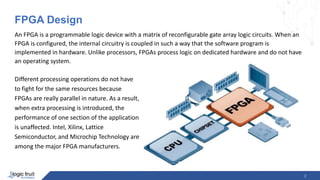
An FPGA is a programmable logic device with a matrix of reconfigurable gate array logic circuits. When an
FPGA is configured, the internal circuitry is coupled in such a way that the software program is
implemented in hardware. Unlike processors, FPGAs process logic on dedicated hardware and do not have
an operating system.
2
Different processing operations do not have
to fight for the same resources because
FPGAs are really parallel in nature. As a result,
when extra processing is introduced, the
performance of one section of the application
is unaffected. Intel, Xilinx, Lattice
Semiconductor, and Microchip Technology are
among the major FPGA manufacturers.
FPGA Architecture
Block RAMs, DSP Slices, PCI Express
compatibility, and programmable fabric
are all part of FPGAs’ heterogeneous
computation platforms. Because all of
these compute resources can be accessed
at the same time, they enable parallelism
and pipelining of applications throughout
the platform. An FPGA’s basic structure
consists of logic units, programmable
interconnects, and memory. The
placement of these blocks is unique to
each manufacturer.
3
Symmetrical arrays
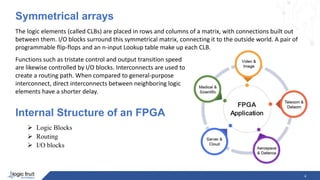
The logic elements (called CLBs) are placed in rows and columns of a matrix, with connections built out
between them. I/O blocks surround this symmetrical matrix, connecting it to the outside world. A pair of
programmable flip-flops and an n-input Lookup table make up each CLB.
4
Internal Structure of an FPGA
 Logic Blocks
 Routing
 I/O blocks
Functions such as tristate control and output transition speed
are likewise controlled by I/O blocks. Interconnects are used to
create a routing path. When compared to general-purpose
interconnect, direct interconnects between neighboring logic
elements have a shorter delay.
Row-based architecture
Alternating rows of logic modules and customizable connection tracks make up a row-based design. The
input-output blocks are located on the row’s periphery. Vertical interconnects can connect one row to
neighbouring rows.
Logic modules can be combined in a variety of ways. Combinatorial modules are made up entirely of
combinational parts. Sequential modules include both combinational and flip-flop features. Complex
combinatorial-sequential functions can be implemented with this sequential module. Anti-fuse
components are used to connect the smaller pieces of the routing rails.
To know more about FPGA Design, Architecture and Applications, see https://www.logic-
fruit.com/blog/fpga/fpga-design-architecture-and-applications/
5
Want to know more?
Click on the below button, to learn more
about the FPGA Design, Architecture
and Applications.
Learn More
TALK TO US TODAY
Sales@logic-fruit.com
www.logic-fruit.com

FPGA Design, Architecture and Applications

  • 1.
    FPGA Design, Architecture and Applications. *Thispresentation is the intellectual property of Logic Fruit Technologies . Any plagiarism or misuse is punishable according to Indian Laws. November 2022
  • 2.
    FPGA Design An FPGAis a programmable logic device with a matrix of reconfigurable gate array logic circuits. When an FPGA is configured, the internal circuitry is coupled in such a way that the software program is implemented in hardware. Unlike processors, FPGAs process logic on dedicated hardware and do not have an operating system. 2 Different processing operations do not have to fight for the same resources because FPGAs are really parallel in nature. As a result, when extra processing is introduced, the performance of one section of the application is unaffected. Intel, Xilinx, Lattice Semiconductor, and Microchip Technology are among the major FPGA manufacturers.
  • 3.
    FPGA Architecture Block RAMs,DSP Slices, PCI Express compatibility, and programmable fabric are all part of FPGAs’ heterogeneous computation platforms. Because all of these compute resources can be accessed at the same time, they enable parallelism and pipelining of applications throughout the platform. An FPGA’s basic structure consists of logic units, programmable interconnects, and memory. The placement of these blocks is unique to each manufacturer. 3
  • 4.
    Symmetrical arrays The logicelements (called CLBs) are placed in rows and columns of a matrix, with connections built out between them. I/O blocks surround this symmetrical matrix, connecting it to the outside world. A pair of programmable flip-flops and an n-input Lookup table make up each CLB. 4 Internal Structure of an FPGA  Logic Blocks  Routing  I/O blocks Functions such as tristate control and output transition speed are likewise controlled by I/O blocks. Interconnects are used to create a routing path. When compared to general-purpose interconnect, direct interconnects between neighboring logic elements have a shorter delay.
  • 5.
    Row-based architecture Alternating rowsof logic modules and customizable connection tracks make up a row-based design. The input-output blocks are located on the row’s periphery. Vertical interconnects can connect one row to neighbouring rows. Logic modules can be combined in a variety of ways. Combinatorial modules are made up entirely of combinational parts. Sequential modules include both combinational and flip-flop features. Complex combinatorial-sequential functions can be implemented with this sequential module. Anti-fuse components are used to connect the smaller pieces of the routing rails. To know more about FPGA Design, Architecture and Applications, see https://www.logic- fruit.com/blog/fpga/fpga-design-architecture-and-applications/ 5
  • 6.
    Want to knowmore? Click on the below button, to learn more about the FPGA Design, Architecture and Applications. Learn More TALK TO US TODAY Sales@logic-fruit.com www.logic-fruit.com