ARINC 818-2 standard:
overview and its
characteristics
*This presentation is the intellectual property of Logic Fruit Technologies . Any plagiarism or misuse is
punishable according to Indian Laws.
December 2022
ARINC 818-2 standard: In the aircraft, a growing amount of information is given in the form of
photographs, which passes through a complex video system before reaching the display in the
cockpit and crew.
2
Infrared and other wavelength sensors,
optical cameras, radars, flight recorders,
map/chart systems, synthetic sights,
image integration systems,
multifunctional head-up, and heads-
down displays, video concentrations, or
other subsystems are among the video
systems available.
ARINC 818 is the encoded 8B/10B point-
to-point protocol for video and data
serial transmission.
Bandwidth
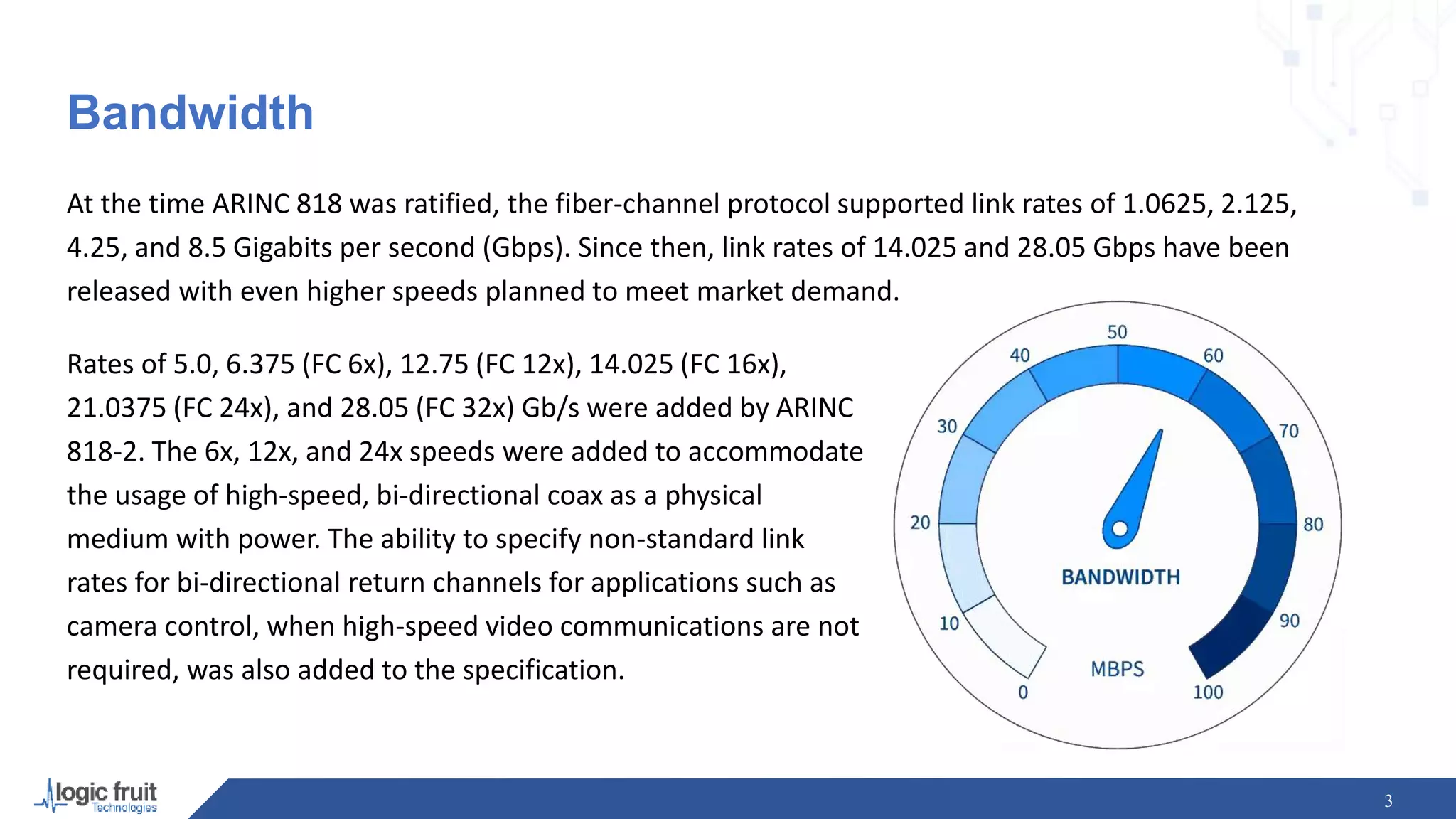
At the time ARINC 818 was ratified, the fiber-channel protocol supported link rates of 1.0625, 2.125,
4.25, and 8.5 Gigabits per second (Gbps). Since then, link rates of 14.025 and 28.05 Gbps have been
released with even higher speeds planned to meet market demand.
3
Rates of 5.0, 6.375 (FC 6x), 12.75 (FC 12x), 14.025 (FC 16x),
21.0375 (FC 24x), and 28.05 (FC 32x) Gb/s were added by ARINC
818-2. The 6x, 12x, and 24x speeds were added to accommodate
the usage of high-speed, bi-directional coax as a physical
medium with power. The ability to specify non-standard link
rates for bi-directional return channels for applications such as
camera control, when high-speed video communications are not
required, was also added to the specification.
ARINC 818-2 enables many parallel lines to circumvent the bandwidth restrictions of FPGAs.
The video frame is split into smaller chunks and sent via two or more channels. The ICD solves
latency and skew between the links, and each link must transmit a complete ADVB frame with
a header.
For example, as one of those described on Aviation Today, at 60 Hz, a WQXGA (2560 x 1600
pixels) image with 24-bit colour depth would take 737,280,000 B/s of bandwidth. This image
might be split and sent over two ARINC 818 4.25 Gbps lines using channel bonding. The
manner of re-splitting the video is determined by the ICD for that project.
4
Channel Bonding
5
Although ARINC 818 was designed for avionics, it is already being utilized in sensor fusion
applications, where many sensor outputs are multiplexed onto a single high-speed channel.
ARINC now supports approximately 15,000 airplanes, 300 airlines, 150 airports, and 200
train systems, as well as more than half of North America’s nuclear power facilities and other
critical infrastructure.
To know more about ARINC 818-2 standard: overview and its characteristics
https://www.logic-fruit.com/blog/arinc/arinc-818-2-standard/
Want to know more?
Click on the below button, to learn more
about the ARINC 818-2 standard:
overview and its characteristics.
Learn More
TALK TO US TODAY
Sales@logic-fruit.com
www.logic-fruit.com

ARINC 818-2 standard overview and its characteristics

  • 1.
    ARINC 818-2 standard: overviewand its characteristics *This presentation is the intellectual property of Logic Fruit Technologies . Any plagiarism or misuse is punishable according to Indian Laws. December 2022
  • 2.
    ARINC 818-2 standard:In the aircraft, a growing amount of information is given in the form of photographs, which passes through a complex video system before reaching the display in the cockpit and crew. 2 Infrared and other wavelength sensors, optical cameras, radars, flight recorders, map/chart systems, synthetic sights, image integration systems, multifunctional head-up, and heads- down displays, video concentrations, or other subsystems are among the video systems available. ARINC 818 is the encoded 8B/10B point- to-point protocol for video and data serial transmission.
  • 3.
    Bandwidth At the timeARINC 818 was ratified, the fiber-channel protocol supported link rates of 1.0625, 2.125, 4.25, and 8.5 Gigabits per second (Gbps). Since then, link rates of 14.025 and 28.05 Gbps have been released with even higher speeds planned to meet market demand. 3 Rates of 5.0, 6.375 (FC 6x), 12.75 (FC 12x), 14.025 (FC 16x), 21.0375 (FC 24x), and 28.05 (FC 32x) Gb/s were added by ARINC 818-2. The 6x, 12x, and 24x speeds were added to accommodate the usage of high-speed, bi-directional coax as a physical medium with power. The ability to specify non-standard link rates for bi-directional return channels for applications such as camera control, when high-speed video communications are not required, was also added to the specification.
  • 4.
    ARINC 818-2 enablesmany parallel lines to circumvent the bandwidth restrictions of FPGAs. The video frame is split into smaller chunks and sent via two or more channels. The ICD solves latency and skew between the links, and each link must transmit a complete ADVB frame with a header. For example, as one of those described on Aviation Today, at 60 Hz, a WQXGA (2560 x 1600 pixels) image with 24-bit colour depth would take 737,280,000 B/s of bandwidth. This image might be split and sent over two ARINC 818 4.25 Gbps lines using channel bonding. The manner of re-splitting the video is determined by the ICD for that project. 4 Channel Bonding
  • 5.
    5 Although ARINC 818was designed for avionics, it is already being utilized in sensor fusion applications, where many sensor outputs are multiplexed onto a single high-speed channel. ARINC now supports approximately 15,000 airplanes, 300 airlines, 150 airports, and 200 train systems, as well as more than half of North America’s nuclear power facilities and other critical infrastructure. To know more about ARINC 818-2 standard: overview and its characteristics https://www.logic-fruit.com/blog/arinc/arinc-818-2-standard/
  • 6.
    Want to knowmore? Click on the below button, to learn more about the ARINC 818-2 standard: overview and its characteristics. Learn More TALK TO US TODAY Sales@logic-fruit.com www.logic-fruit.com