IGNITION SYSTEMS IN SI ENGINES
Sreenidhi Institute of Science and Technology
Yamnampet, Ghatkesar, Hyderabad, Telangana 501301
The compression ratio of petrol engine is maintained
at lower level to avoid self-ignition of petrol during
the compression process.
FYI: The uncontrolled explosions of petrol vapour is
known as knocking.
Hence an ignition system is necessary for the petrol
engine.
Ignition Systems in SI Engines
A smooth and reliable functioning of an ignition
system is essential for reliable working of an engine.
The requirements of such an ignition system are:
1. It should provide a good spark between the
electrodes of the plugs at the correct timing.
2. should function efficiently over the entire range of
engine speed.
3. It should be light, effective and reliable in service.
4.It should be compact and easy to maintain.
5.It should be cheap and convenient to handle.
6.The interference from the high voltage source
should not affect the functioning of the radio and
television receivers inside all automobile.
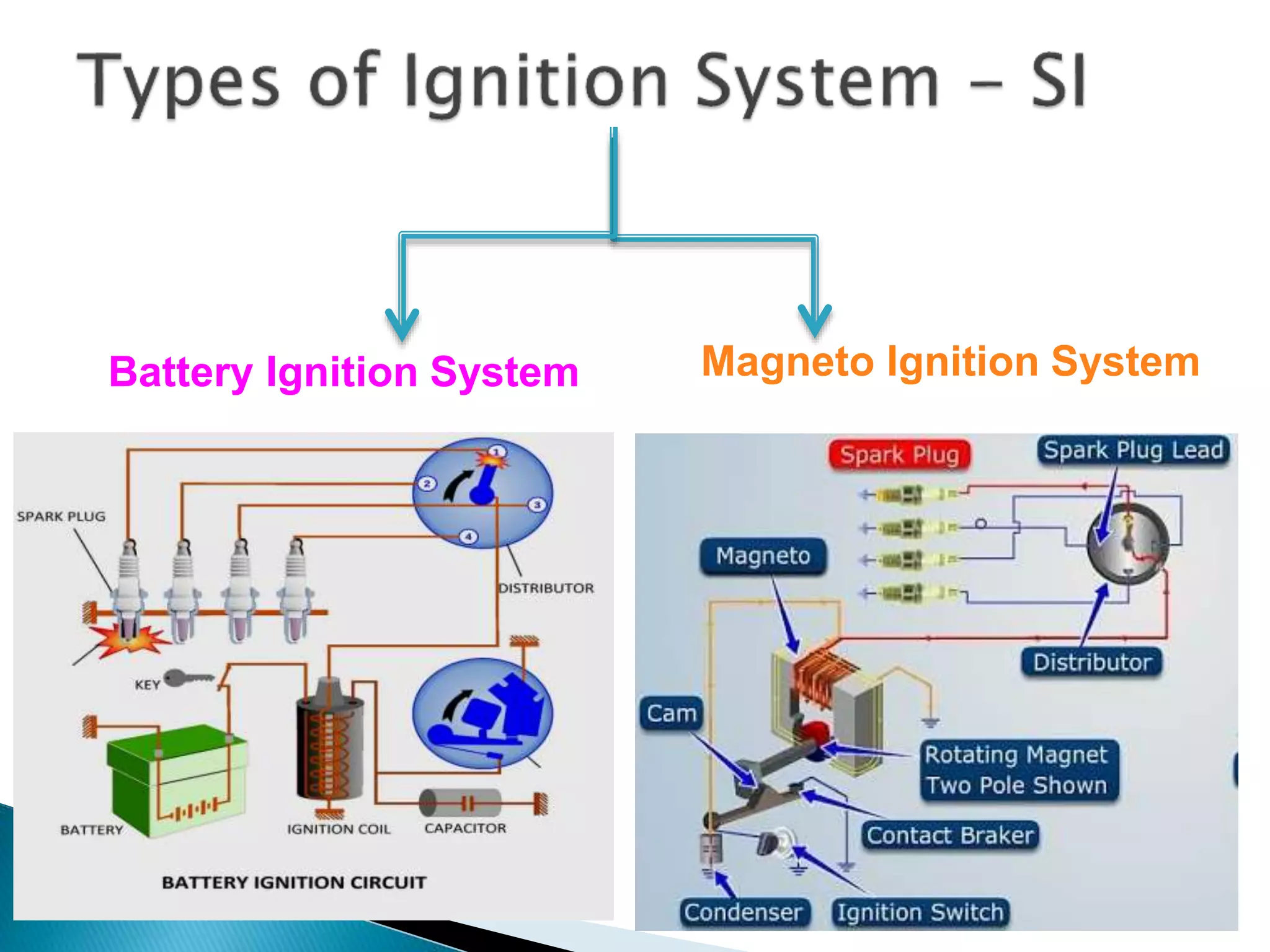
Battery Ignition System Magneto Ignition System
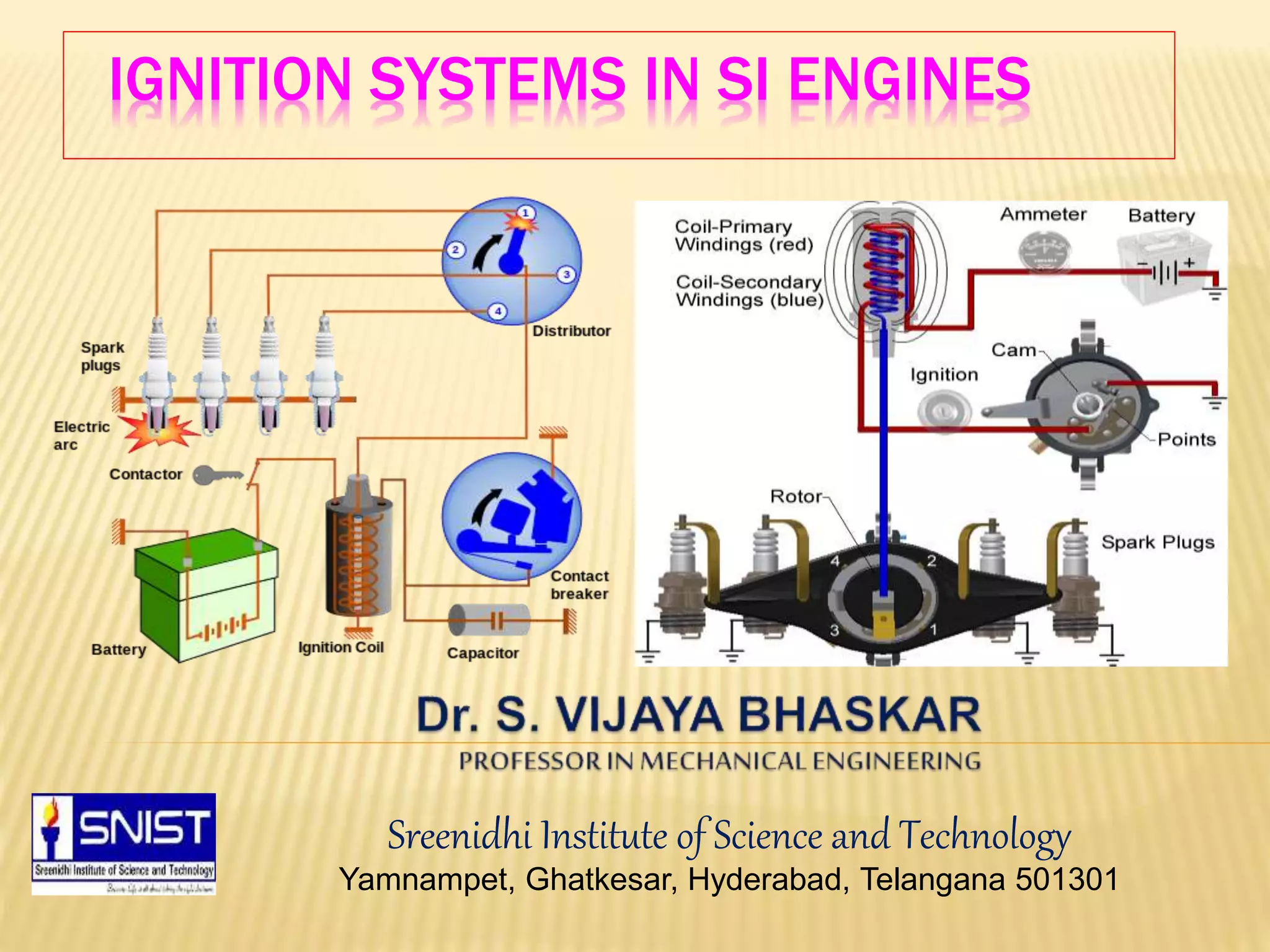
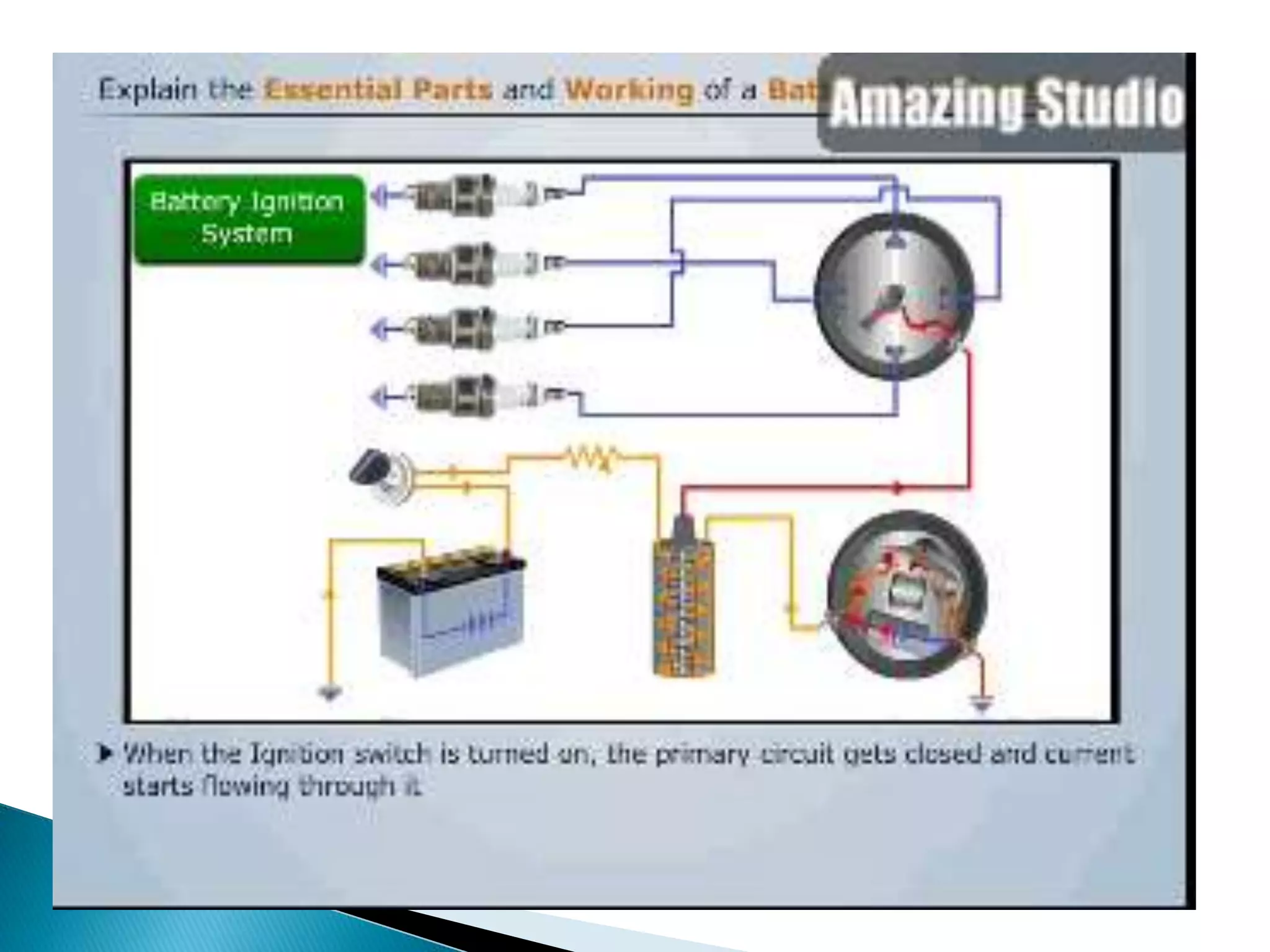
Battery Ignition System Components
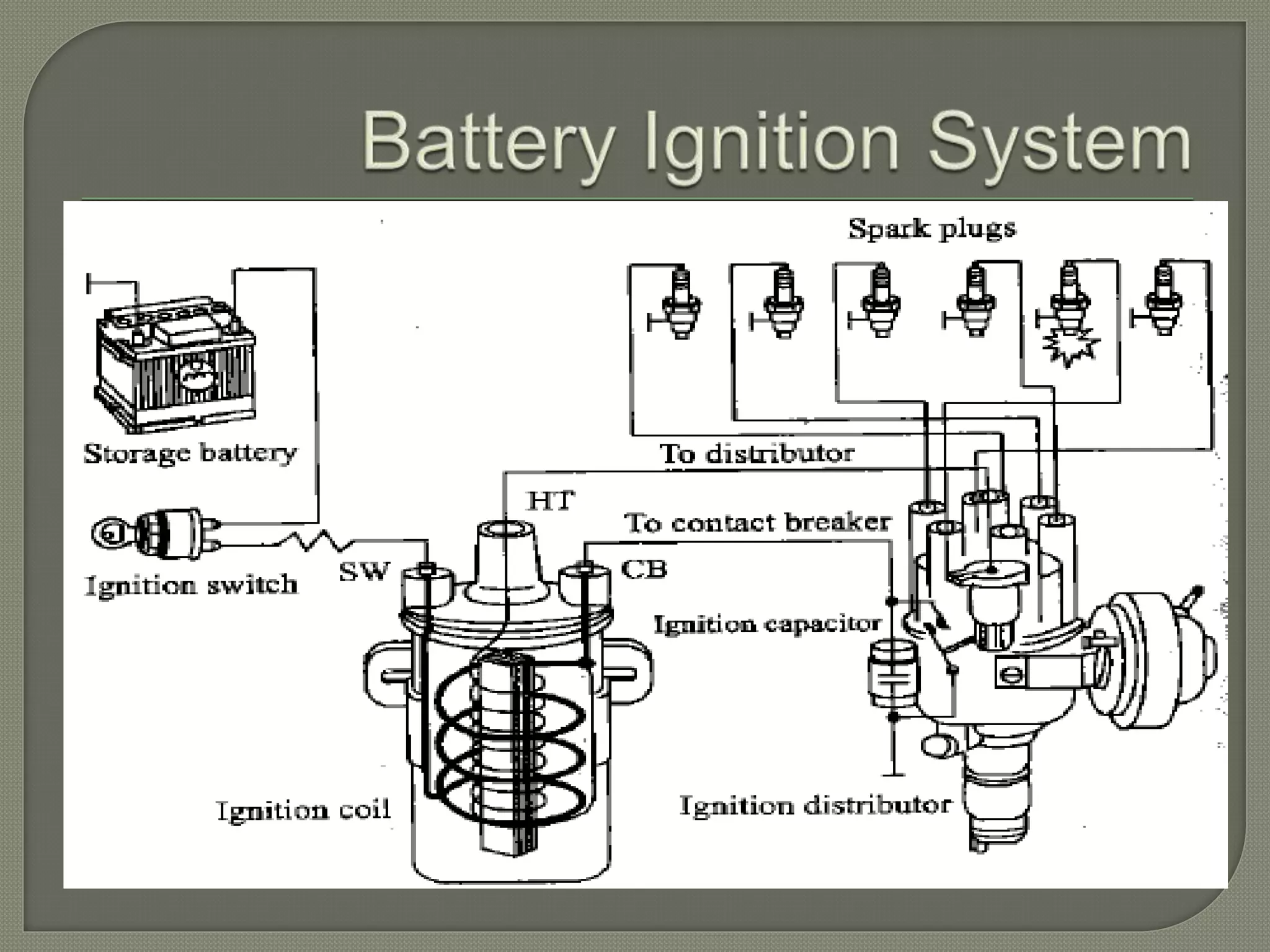
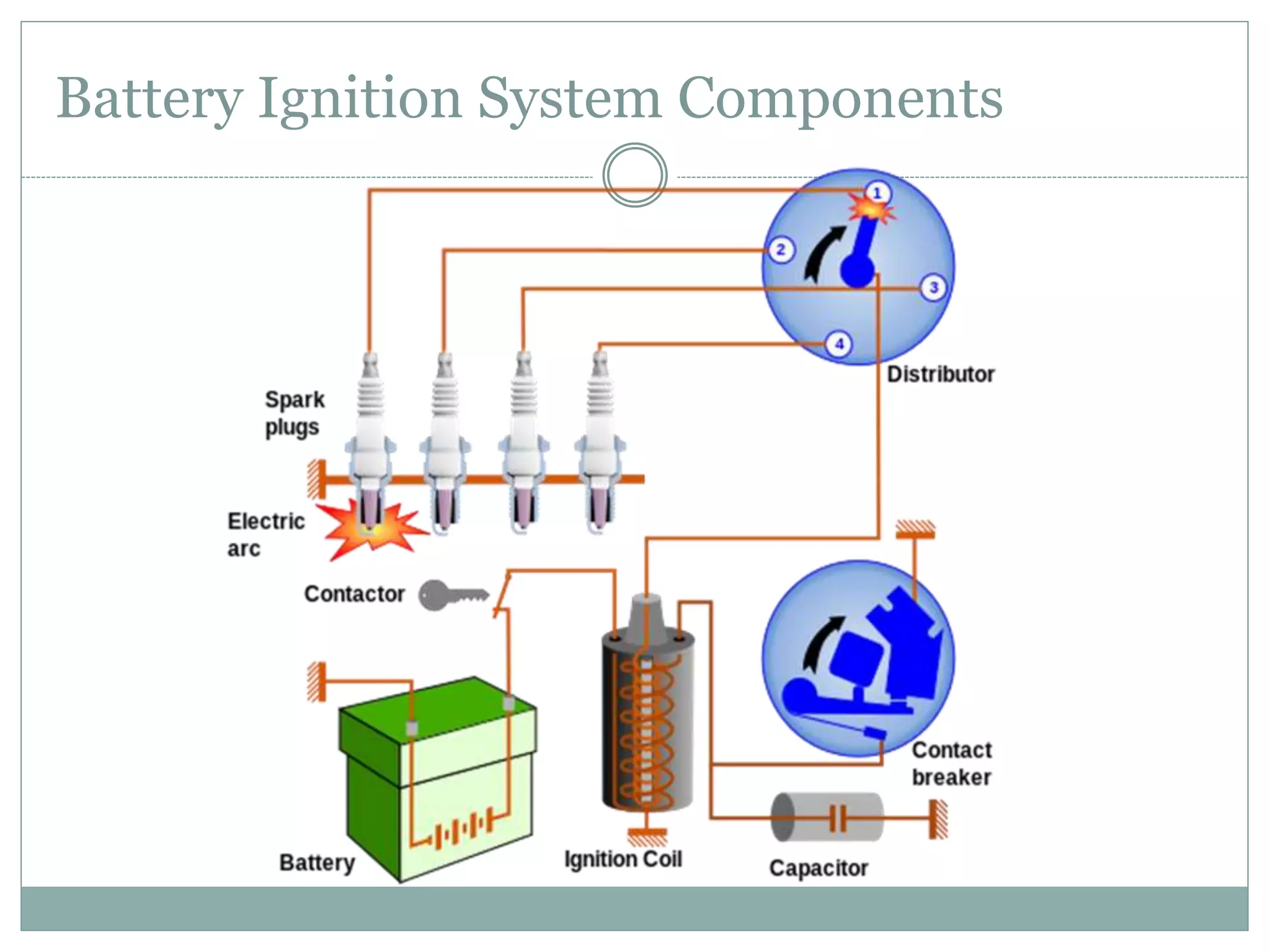
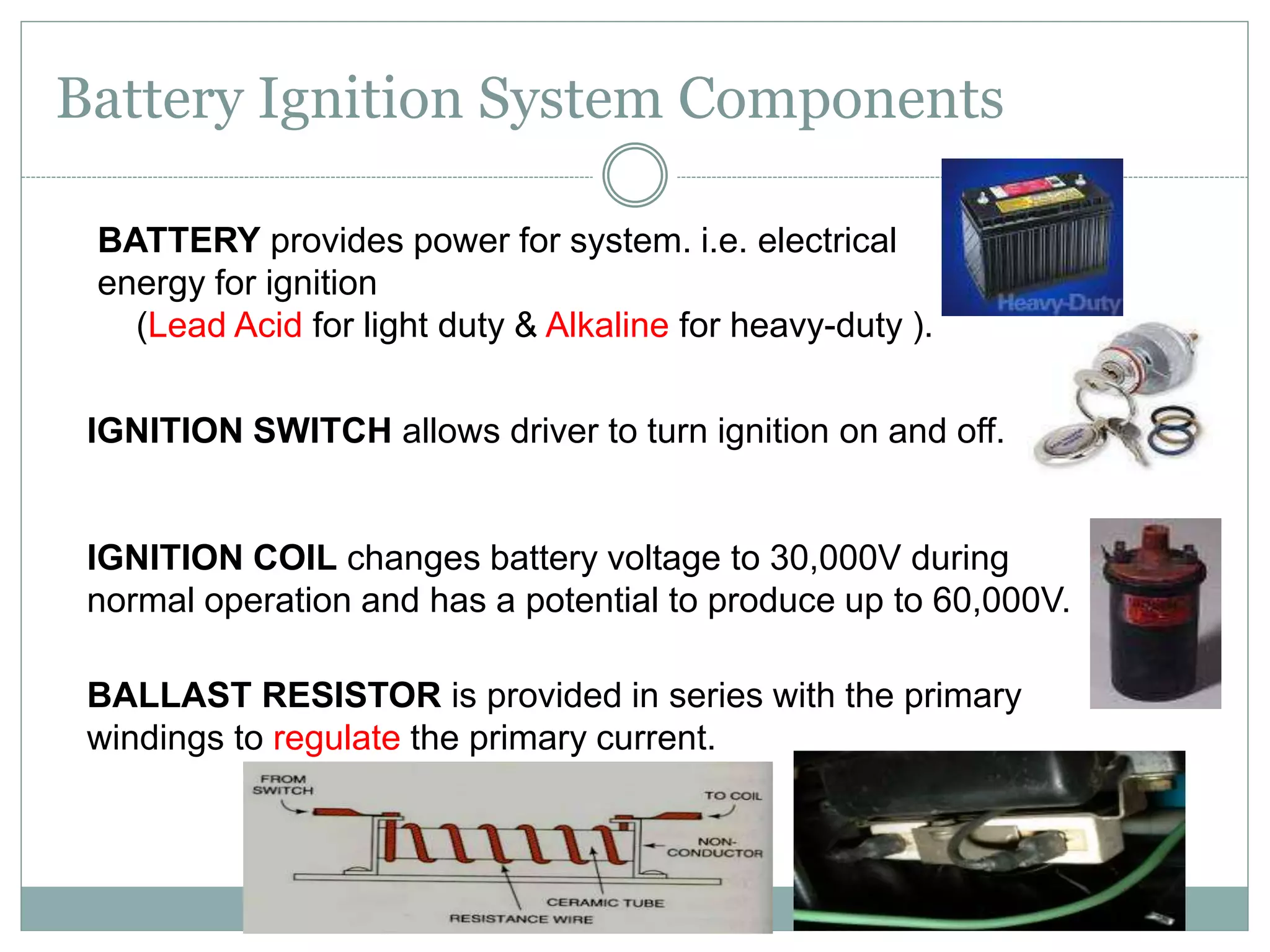
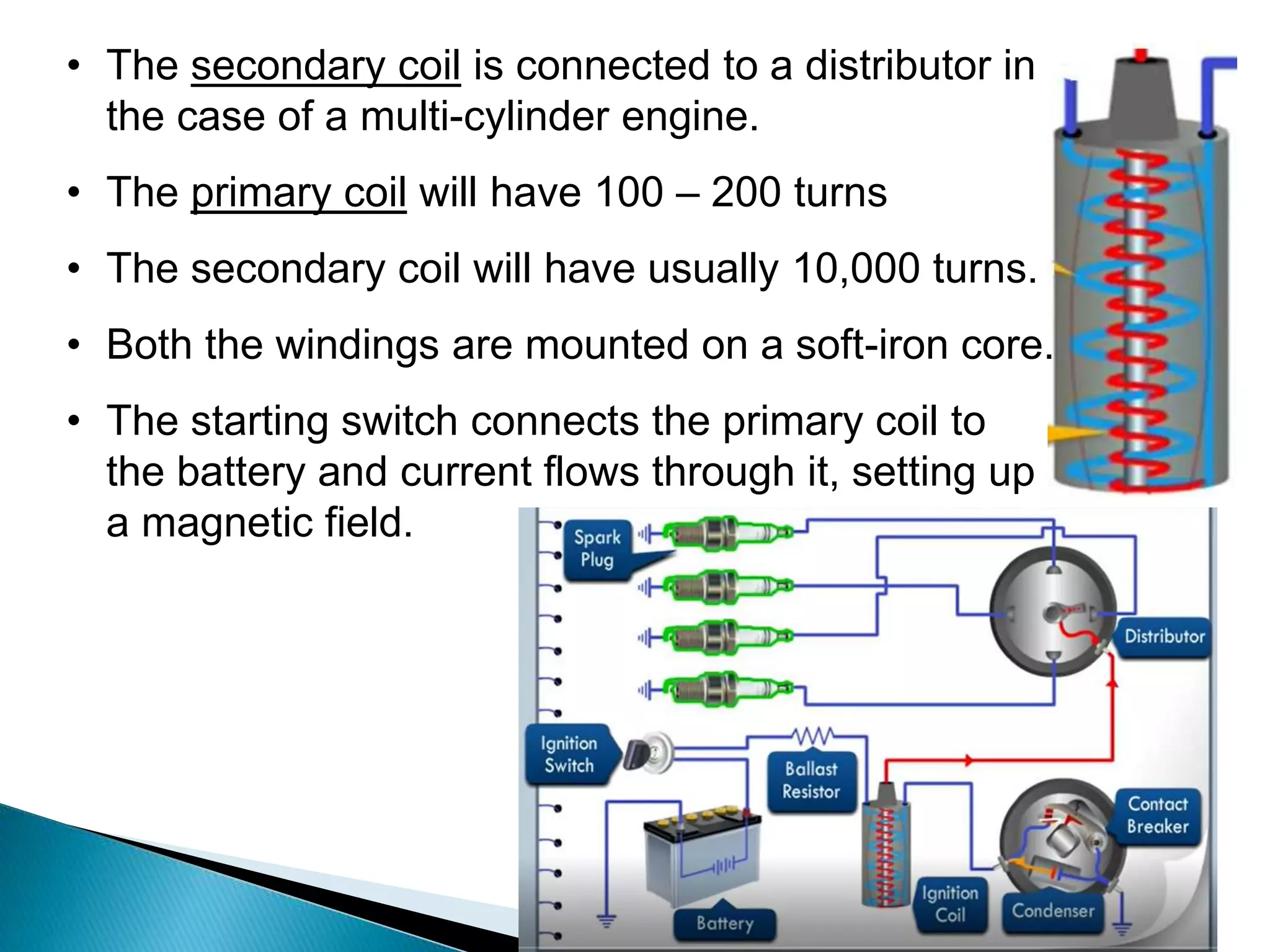
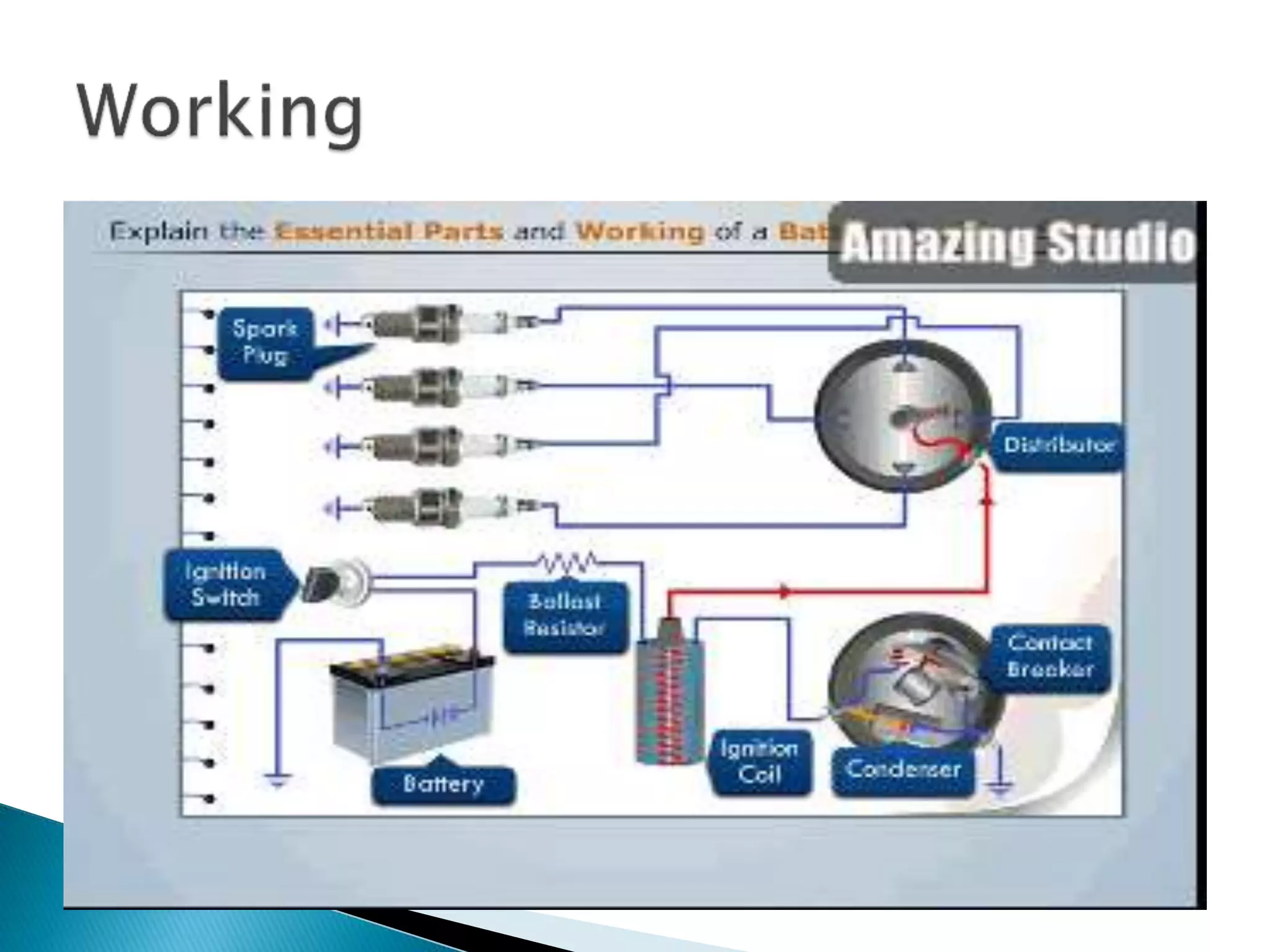
BATTERY provides power for system. i.e. electrical
energy for ignition
(Lead Acid for light duty & Alkaline for heavy-duty ).
IGNITION SWITCH allows driver to turn ignition on and off.
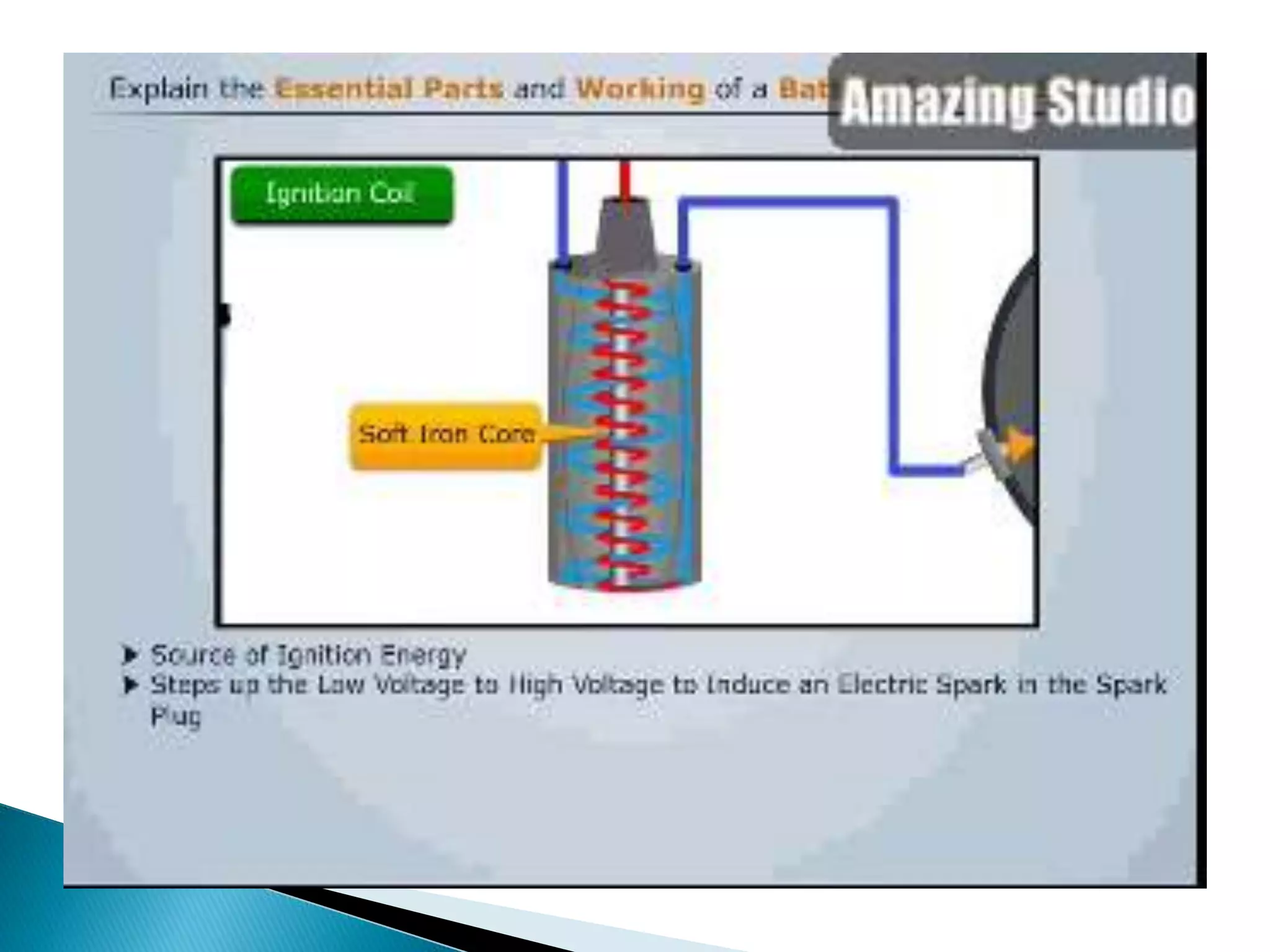
IGNITION COIL changes battery voltage to 30,000V during
normal operation and has a potential to produce up to 60,000V.
BALLAST RESISTOR is provided in series with the primary
windings to regulate the primary current.
Ignition Parts
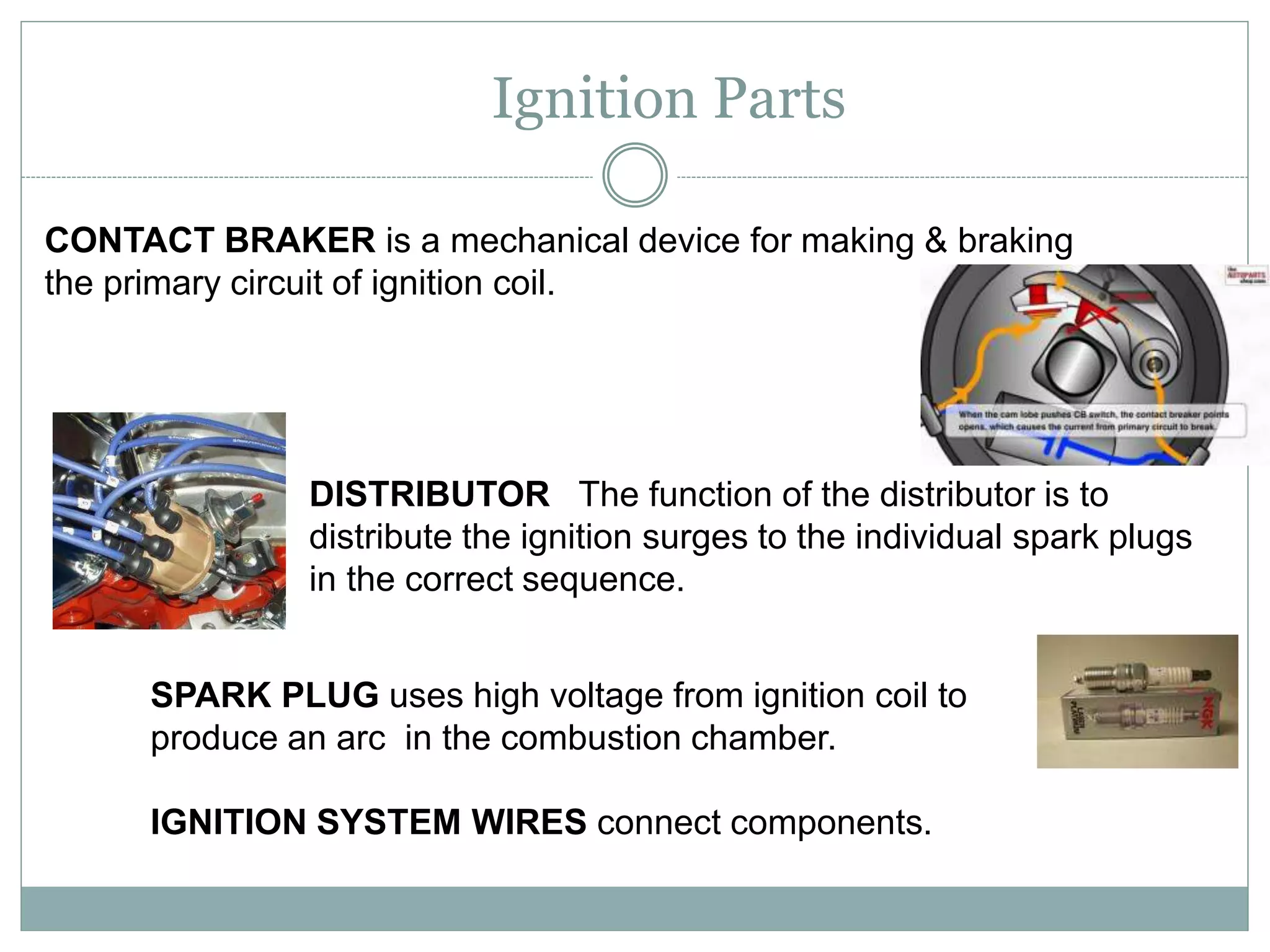
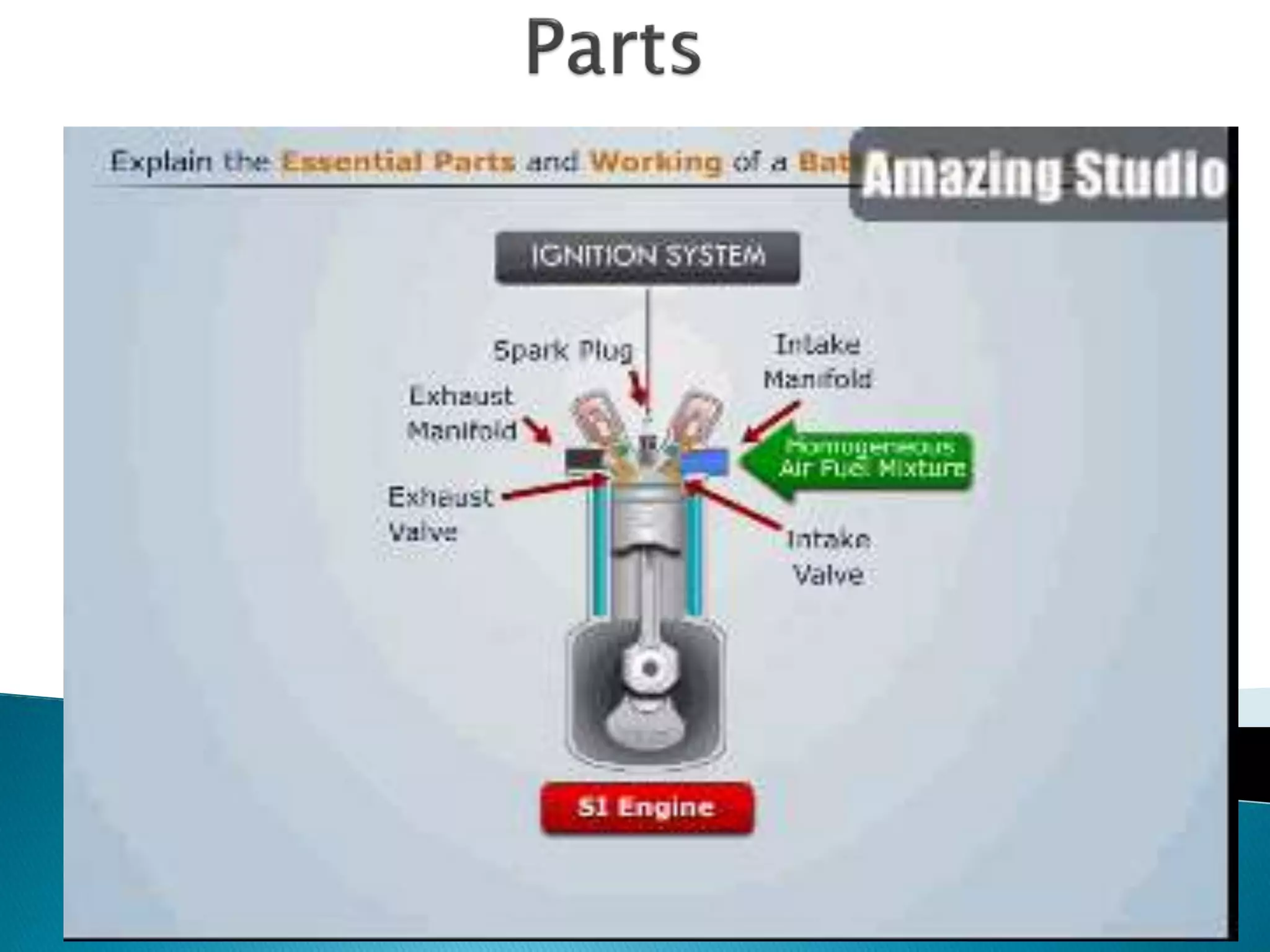
SPARK PLUG uses high voltage from ignition coil to
produce an arc in the combustion chamber.
IGNITION SYSTEM WIRES connect components.
DISTRIBUTOR The function of the distributor is to
distribute the ignition surges to the individual spark plugs
in the correct sequence.
CONTACT BRAKER is a mechanical device for making & braking
the primary circuit of ignition coil.
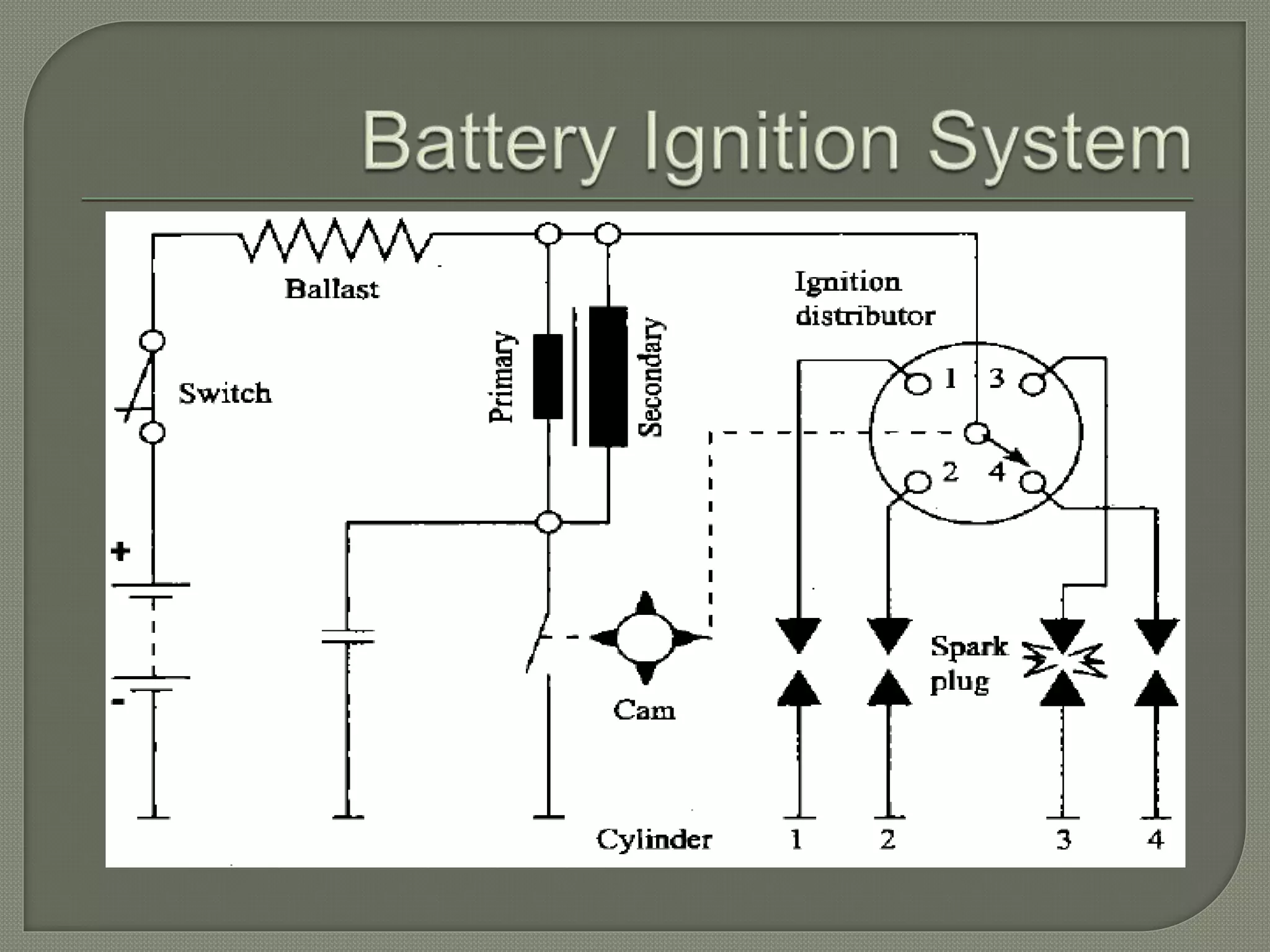
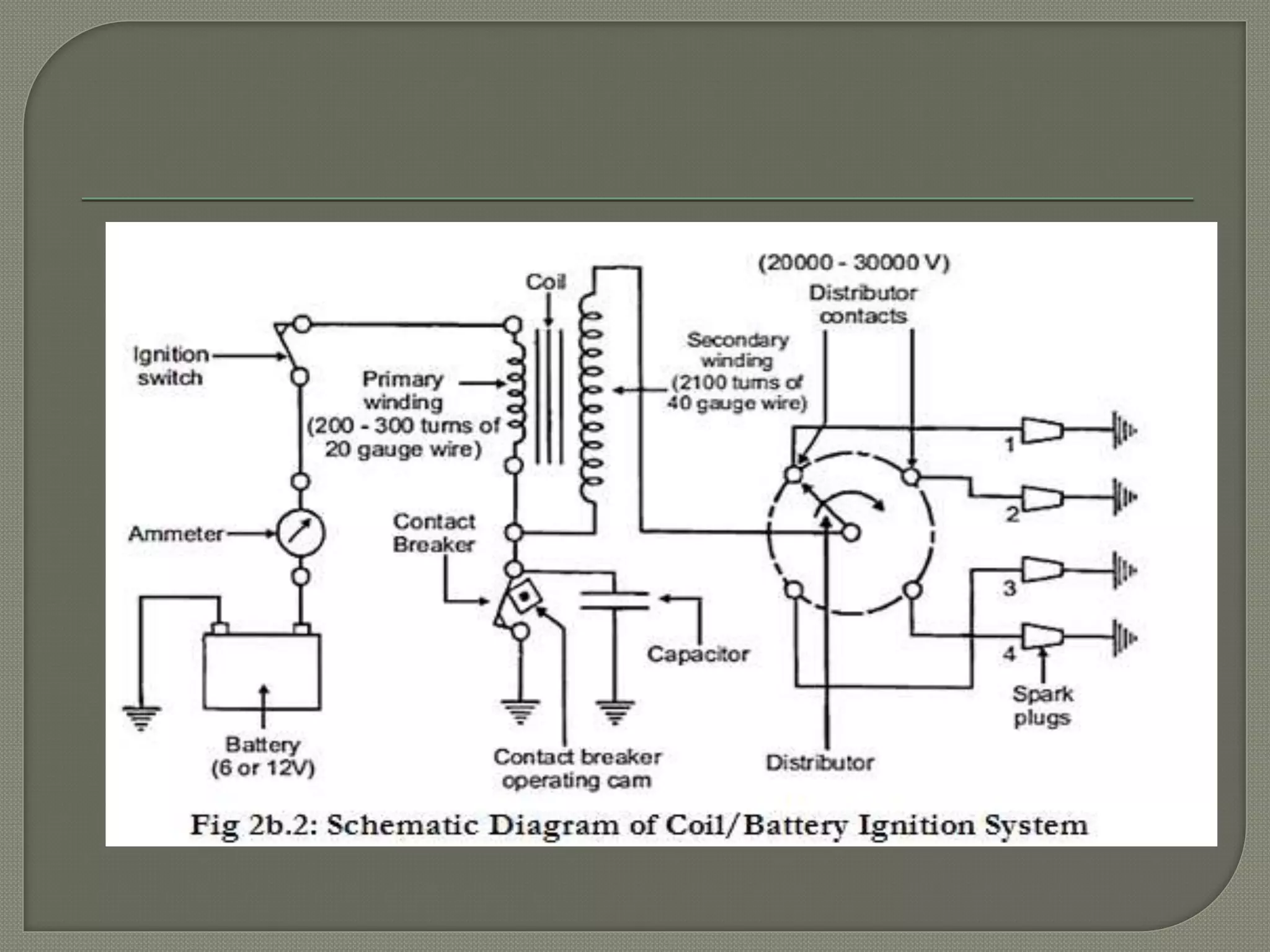
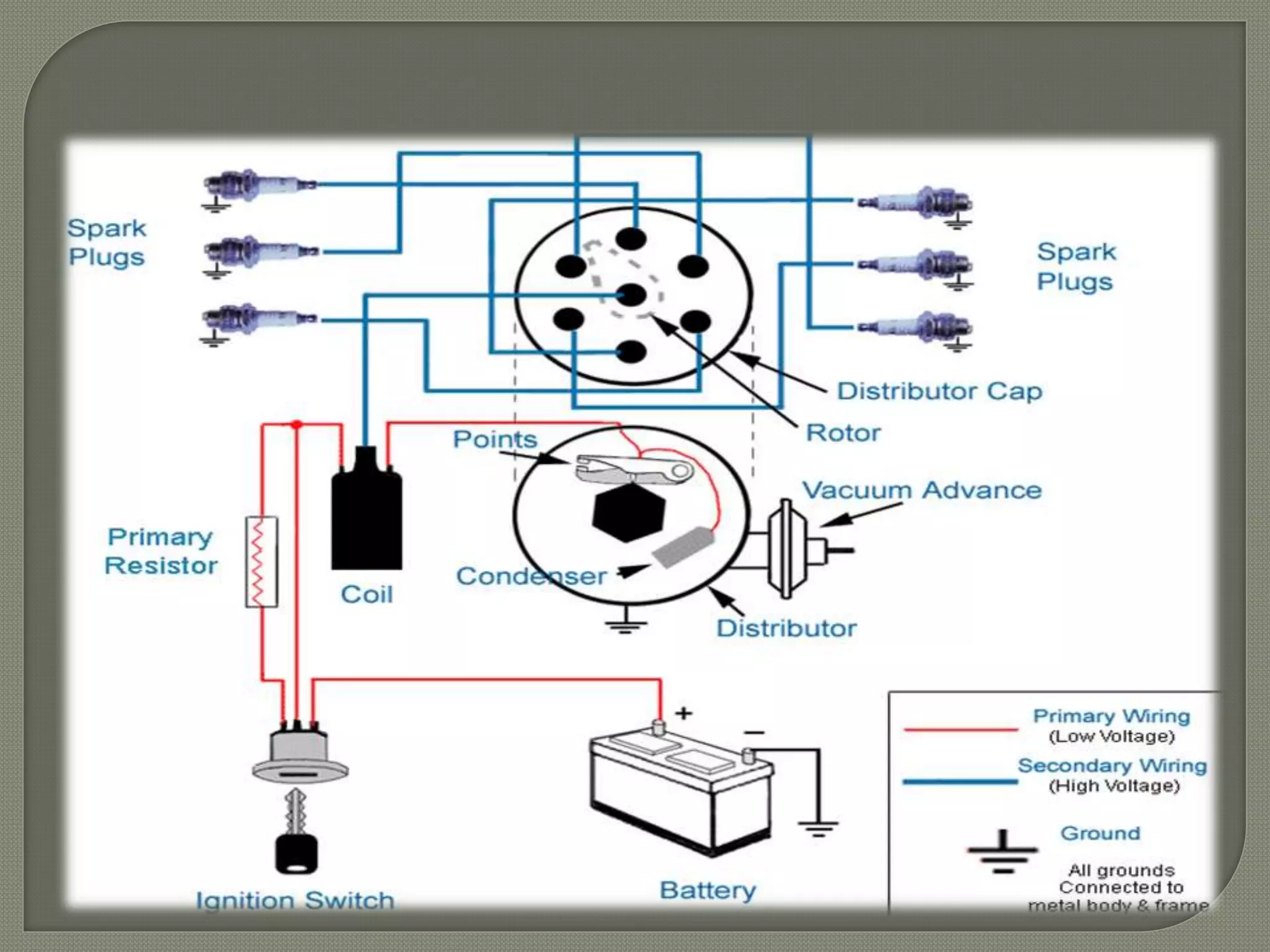
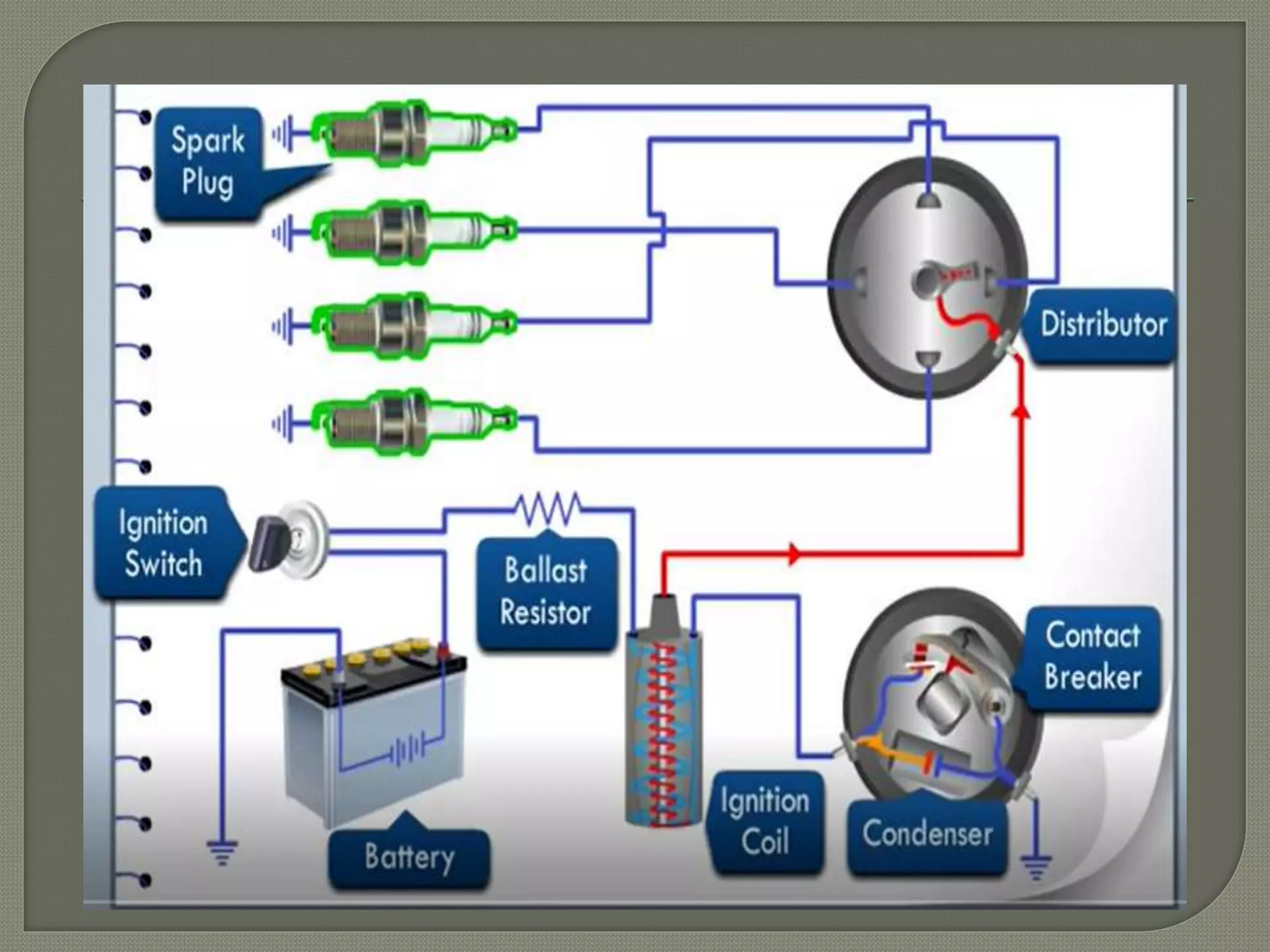
Battery Ignition System:
• The battery ignition system is commonly
employed system in spark ignition engines.
• Battery is the source of current and it is
connected to the primary coil through a
starting switch.
• The other end of the primary coil is
connected to a condenser and a contact
breaker.
Ignition Systems in SI Engines
• The secondary coil is connected to a distributor in
the case of a multi-cylinder engine.
• The primary coil will have 100 – 200 turns
• The secondary coil will have usually 10,000 turns.
• Both the windings are mounted on a soft-iron core.
• The starting switch connects the primary coil to
the battery and current flows through it, setting up
a magnetic field.
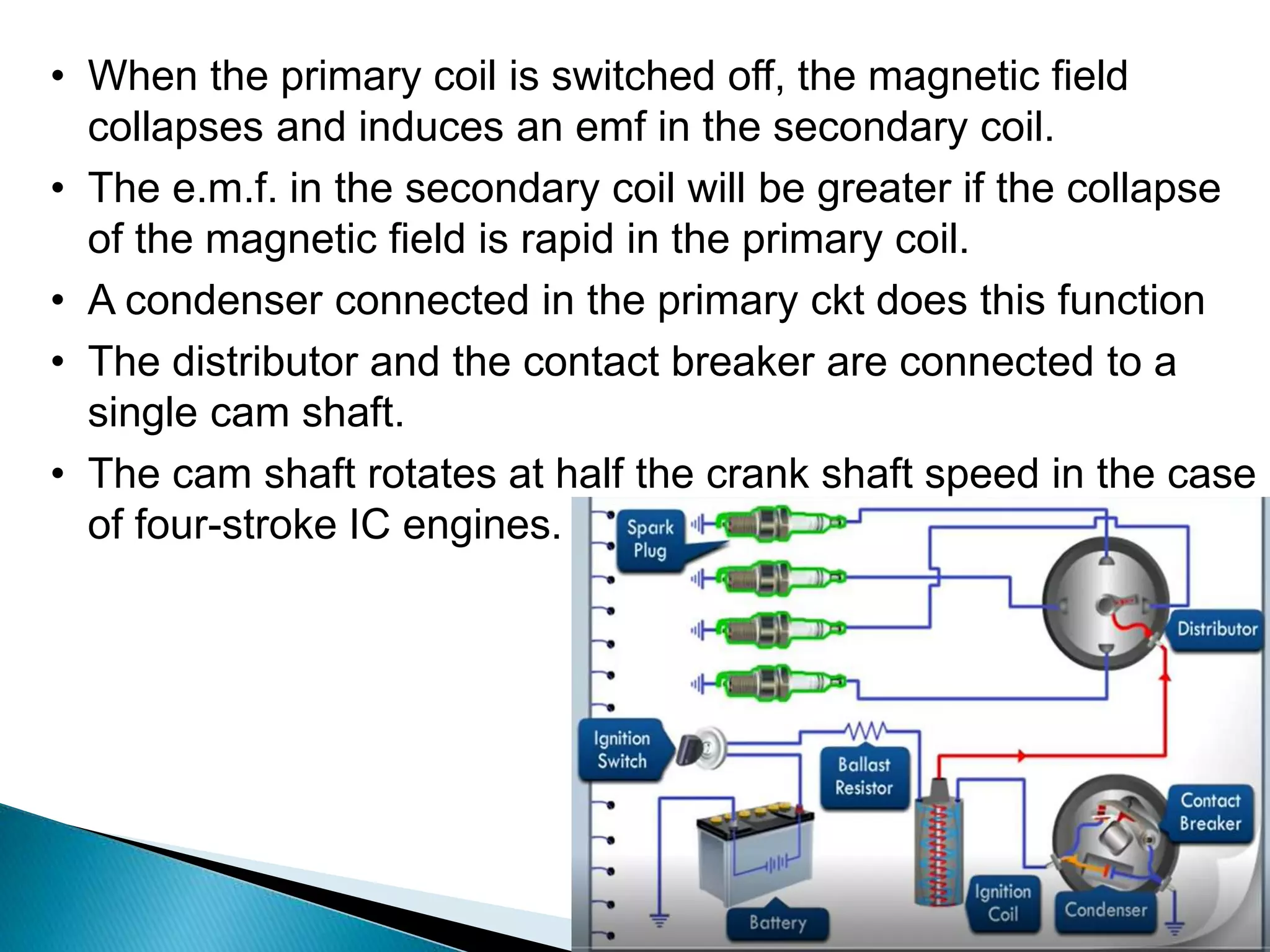
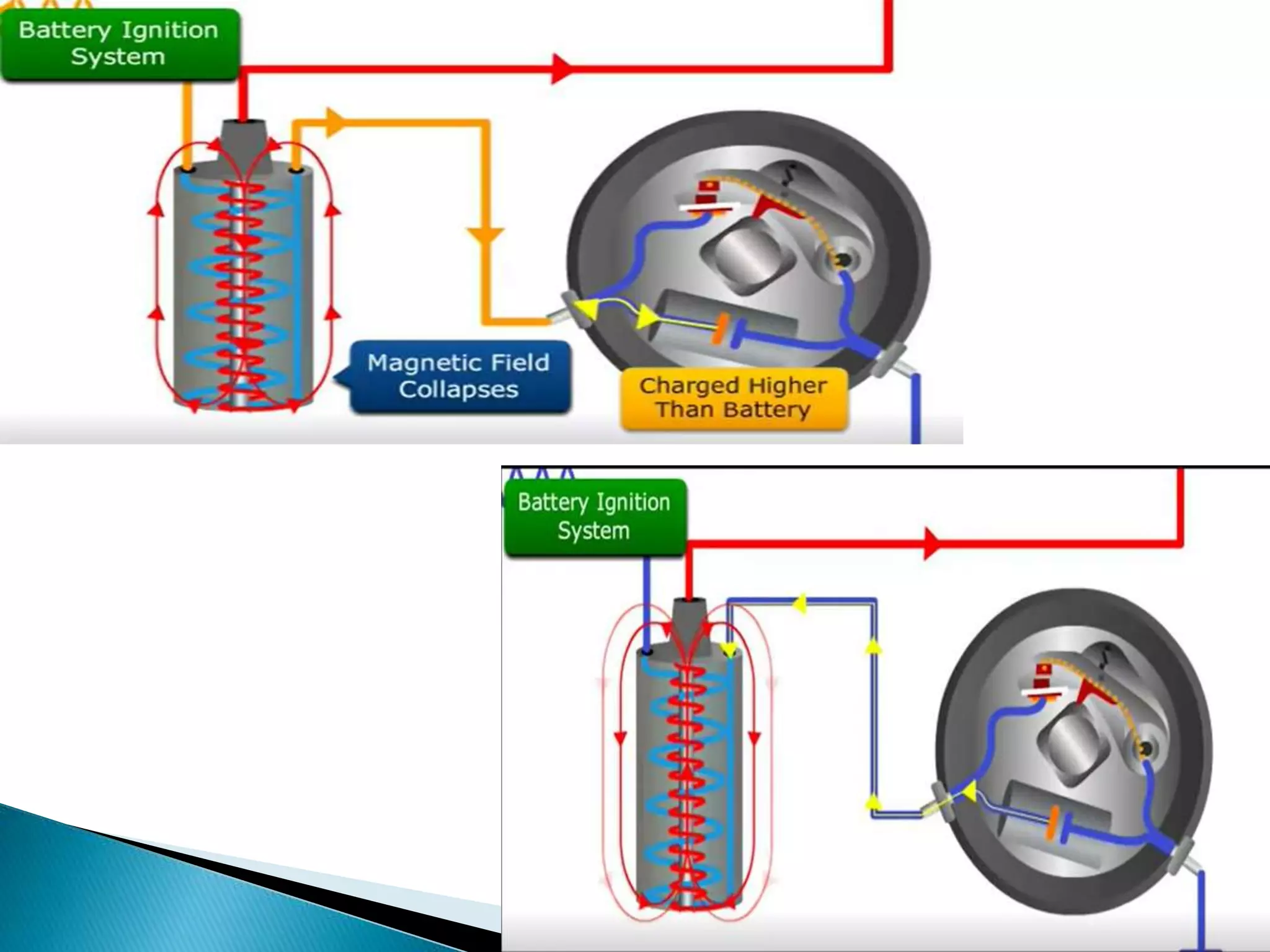
• When the primary coil is switched off, the magnetic field
collapses and induces an emf in the secondary coil.
• The e.m.f. in the secondary coil will be greater if the collapse
of the magnetic field is rapid in the primary coil.
• A condenser connected in the primary ckt does this function
• The distributor and the contact breaker are connected to a
single cam shaft.
• The cam shaft rotates at half the crank shaft speed in the case
of four-stroke IC engines.
Distributor: This connects the secondary to each
cylinder at the time of ignition in a multi-cylinder engine.
Contact-breaker: This also works simultaneously with
the distributor to disconnect the primary circuit at the
time when ignition is required.
Spark Plug: When a very high voltage is applied across
the electrodes of the spark plug, a spark is produced,
which induces the combustion process.
Ignition Systems in SI Engines
An Electronic circuit breaker is used in place of the
mechanical circuit breaker.
The remaining components are the same as in
battery ignition system.
B. Magneto Ignition System:
The magneto coil ignition system is shown in
Fig. 3.23
The functioning of Magneto ignition system is
similar to Battery ignition system.
The only difference is that the magneto coil
replaces a battery to produce the initial voltage
required by the system.
C. Electronic Ignition system:
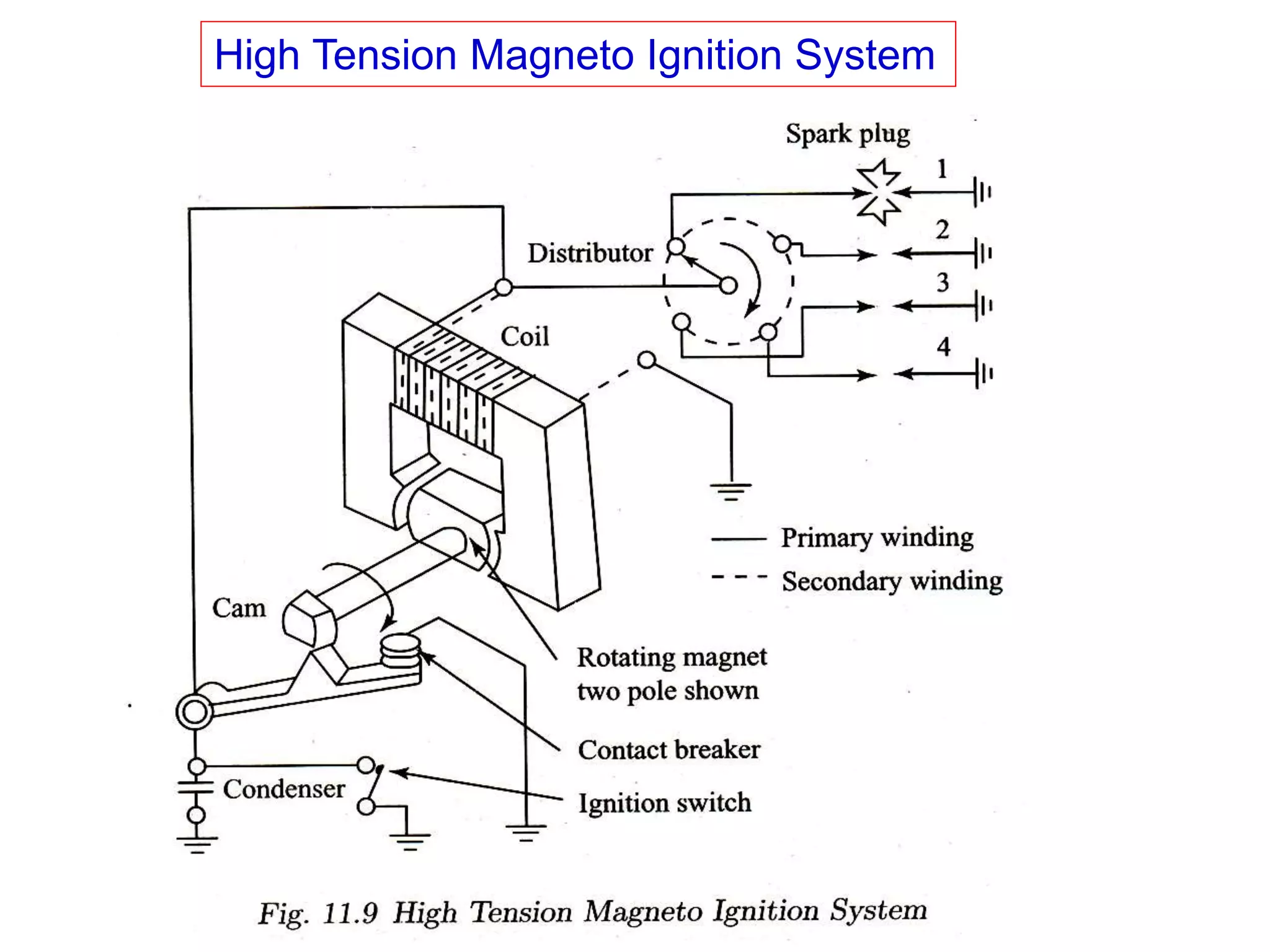
High Tension Magneto Ignition System
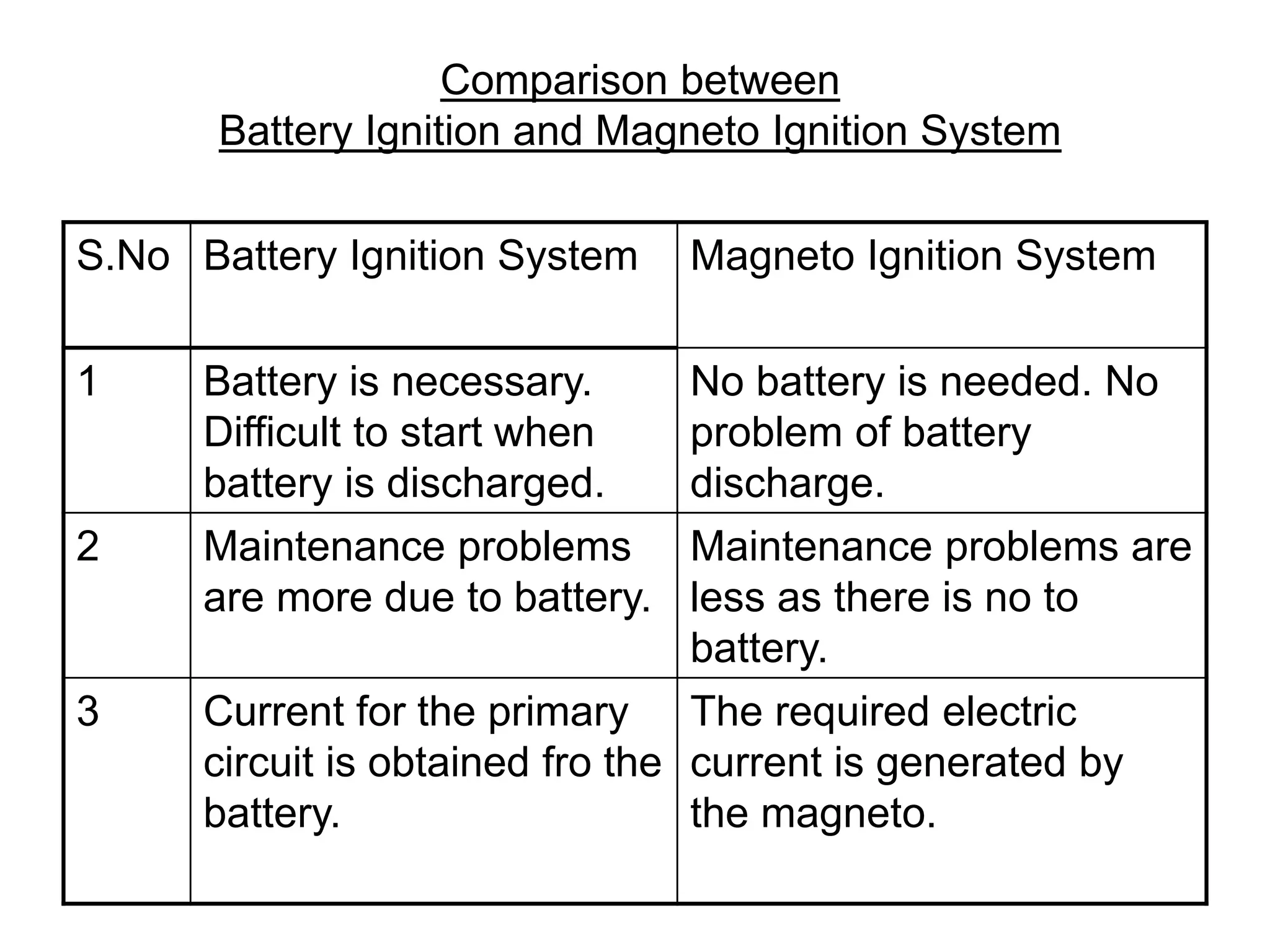
Comparison between
Battery Ignition and Magneto Ignition System
S.No Battery Ignition System Magneto Ignition System
1 Battery is necessary.
Difficult to start when
battery is discharged.
No battery is needed. No
problem of battery
discharge.
2 Maintenance problems
are more due to battery.
Maintenance problems are
less as there is no to
battery.
3 Current for the primary
circuit is obtained fro the
battery.
The required electric
current is generated by
the magneto.
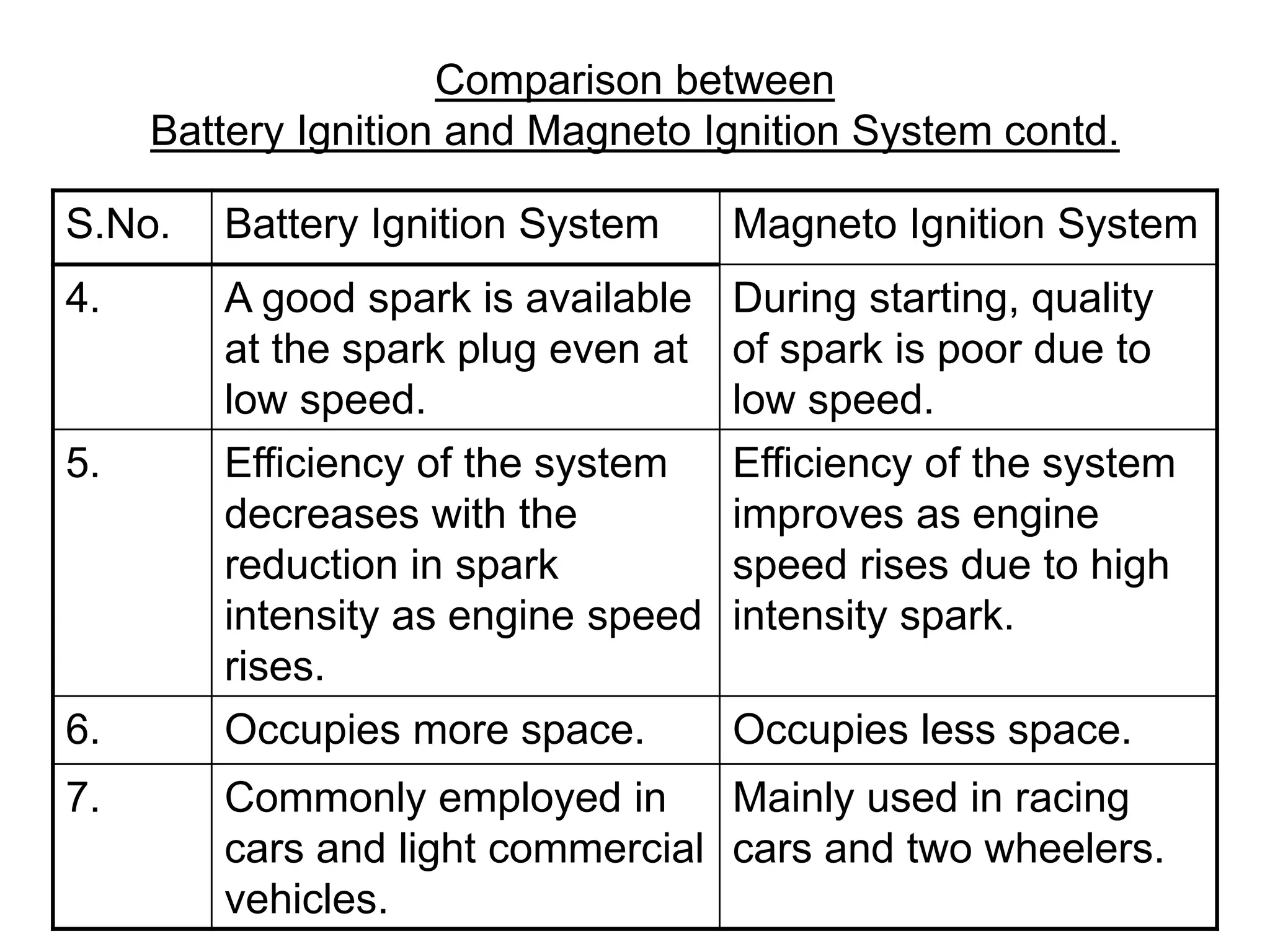
Comparison between
Battery Ignition and Magneto Ignition System contd.
S.No. Battery Ignition System Magneto Ignition System
4. A good spark is available
at the spark plug even at
low speed.
During starting, quality
of spark is poor due to
low speed.
5. Efficiency of the system
decreases with the
reduction in spark
intensity as engine speed
rises.
Efficiency of the system
improves as engine
speed rises due to high
intensity spark.
6. Occupies more space. Occupies less space.
7. Commonly employed in
cars and light commercial
vehicles.
Mainly used in racing
cars and two wheelers.

Ignition Systems in SI Engines

  • 1.
    IGNITION SYSTEMS INSI ENGINES Sreenidhi Institute of Science and Technology Yamnampet, Ghatkesar, Hyderabad, Telangana 501301
  • 2.
    The compression ratioof petrol engine is maintained at lower level to avoid self-ignition of petrol during the compression process. FYI: The uncontrolled explosions of petrol vapour is known as knocking. Hence an ignition system is necessary for the petrol engine. Ignition Systems in SI Engines
  • 3.
    A smooth andreliable functioning of an ignition system is essential for reliable working of an engine. The requirements of such an ignition system are: 1. It should provide a good spark between the electrodes of the plugs at the correct timing. 2. should function efficiently over the entire range of engine speed. 3. It should be light, effective and reliable in service. 4.It should be compact and easy to maintain. 5.It should be cheap and convenient to handle. 6.The interference from the high voltage source should not affect the functioning of the radio and television receivers inside all automobile.
  • 4.
    Battery Ignition SystemMagneto Ignition System
  • 8.
  • 11.
    Battery Ignition SystemComponents BATTERY provides power for system. i.e. electrical energy for ignition (Lead Acid for light duty & Alkaline for heavy-duty ). IGNITION SWITCH allows driver to turn ignition on and off. IGNITION COIL changes battery voltage to 30,000V during normal operation and has a potential to produce up to 60,000V. BALLAST RESISTOR is provided in series with the primary windings to regulate the primary current.
  • 12.
    Ignition Parts SPARK PLUGuses high voltage from ignition coil to produce an arc in the combustion chamber. IGNITION SYSTEM WIRES connect components. DISTRIBUTOR The function of the distributor is to distribute the ignition surges to the individual spark plugs in the correct sequence. CONTACT BRAKER is a mechanical device for making & braking the primary circuit of ignition coil.
  • 13.
    Battery Ignition System: •The battery ignition system is commonly employed system in spark ignition engines. • Battery is the source of current and it is connected to the primary coil through a starting switch. • The other end of the primary coil is connected to a condenser and a contact breaker. Ignition Systems in SI Engines
  • 14.
    • The secondarycoil is connected to a distributor in the case of a multi-cylinder engine. • The primary coil will have 100 – 200 turns • The secondary coil will have usually 10,000 turns. • Both the windings are mounted on a soft-iron core. • The starting switch connects the primary coil to the battery and current flows through it, setting up a magnetic field.
  • 15.
    • When theprimary coil is switched off, the magnetic field collapses and induces an emf in the secondary coil. • The e.m.f. in the secondary coil will be greater if the collapse of the magnetic field is rapid in the primary coil. • A condenser connected in the primary ckt does this function • The distributor and the contact breaker are connected to a single cam shaft. • The cam shaft rotates at half the crank shaft speed in the case of four-stroke IC engines.
  • 17.
    Distributor: This connectsthe secondary to each cylinder at the time of ignition in a multi-cylinder engine. Contact-breaker: This also works simultaneously with the distributor to disconnect the primary circuit at the time when ignition is required. Spark Plug: When a very high voltage is applied across the electrodes of the spark plug, a spark is produced, which induces the combustion process. Ignition Systems in SI Engines
  • 22.
    An Electronic circuitbreaker is used in place of the mechanical circuit breaker. The remaining components are the same as in battery ignition system. B. Magneto Ignition System: The magneto coil ignition system is shown in Fig. 3.23 The functioning of Magneto ignition system is similar to Battery ignition system. The only difference is that the magneto coil replaces a battery to produce the initial voltage required by the system. C. Electronic Ignition system:
  • 23.
    High Tension MagnetoIgnition System
  • 25.
    Comparison between Battery Ignitionand Magneto Ignition System S.No Battery Ignition System Magneto Ignition System 1 Battery is necessary. Difficult to start when battery is discharged. No battery is needed. No problem of battery discharge. 2 Maintenance problems are more due to battery. Maintenance problems are less as there is no to battery. 3 Current for the primary circuit is obtained fro the battery. The required electric current is generated by the magneto.
  • 26.
    Comparison between Battery Ignitionand Magneto Ignition System contd. S.No. Battery Ignition System Magneto Ignition System 4. A good spark is available at the spark plug even at low speed. During starting, quality of spark is poor due to low speed. 5. Efficiency of the system decreases with the reduction in spark intensity as engine speed rises. Efficiency of the system improves as engine speed rises due to high intensity spark. 6. Occupies more space. Occupies less space. 7. Commonly employed in cars and light commercial vehicles. Mainly used in racing cars and two wheelers.