{
EWRT 1C Class 22
back
short
watch
In each of these puzzles, a list of words is given. To solve the
puzzle, think of a single word that goes with each to form a
compound word (or word pair that functions as a compound
word). For example, if the given words are volley, field, and
bearing, then the answer would be ball, because the word ball can
be added to each of the other words to form volleyball, ball field,
and ball bearing.
blue
cake
cottage
stool
powder
ball
AGENDA
 New Teams
 Discussion:
 Trauma Theory
 Bloom
 Balaev
 Discussion: Rita Hayworth and
Shawshank Redemption
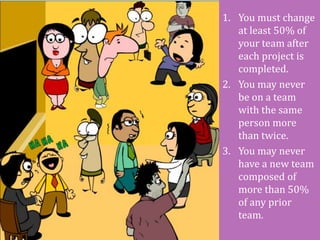
1. You must change
at least 50% of
your team after
each project is
completed.
2. You may never
be on a team
with the same
person more
than twice.
3. You may never
have a new team
composed of
more than 50%
of any prior
team.
Trauma Theory
What is it?
How did it come to be?
What are the effects?
Why do we apply it to
literature?
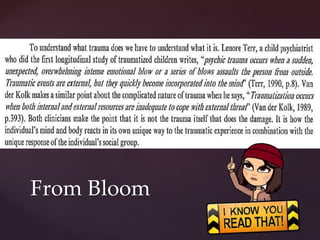
From Bloom
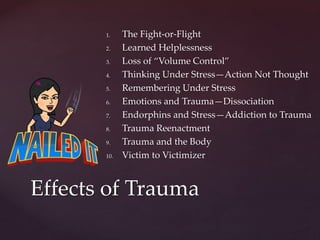
1. The Fight-or-Flight
2. Learned Helplessness
3. Loss of “Volume Control”
4. Thinking Under Stress—Action Not Thought
5. Remembering Under Stress
6. Emotions and Trauma—Dissociation
7. Endorphins and Stress—Addiction to Trauma
8. Trauma Reenactment
9. Trauma and the Body
10. Victim to Victimizer
Effects of Trauma
1. Q: Why in trauma theory does the captive try to bond with their abuser?
2. Q: Bloom points out that the evolution legacy has lead our species with an
innate sense of reciprocity, explaining our need for order, safety, and for
adequate protection. At what point do the fragmented traumatic experiences
perpetuate from one person to the other?
3. Q. How might learned helplessness prove to be more complex in humans
than in animals?
4. Q: What is the significance of verbal and emotional memory in “Trauma
theory?”
5. Q: Does trauma really hurt humans more than any animal because of
humans’ social interaction and intelligence?
6. Q: How does trauma tie in to the theory of the unconscious?
QHQ: Bloom
 “Trauma, in my analysis, refers to a person's emotional
response to an overwhelming event that disrupts previous
ideas of an individual's sense of self and the standards by
which one evaluates society. The term "trauma novel"
refers to a work of fiction that conveys profound loss or
intense fear on individual or collective levels. A defining
feature of the trauma novel is the transformation of the self
ignited by an external, often terrifying experience, which
illuminates the process of coming to terms with the
dynamics of memory that inform the new perceptions of
the self and world.”
From Balaev
 The trauma novel conveys a diversity of extreme emotional
states through an assortment of narrative innovations, such
as landscape imagery, temporal fissures, silence, or narrative
omission--the withholding of graphic, visceral traumatic
detail. Authors employ a nonlinear plot or disruptive
temporal sequences to emphasize mental confusion, chaos,
or contemplation as a response to the experience. The
narrative strategy of silence may create a "gap" in time or
feeling that allows the reader to imagine what might or
could have happened to the protagonist, thereby
broadening the meaning and effects of the experience.
From Balaev
1. QHQ : Why does trauma manage to stay with us? And in what
ways are we affected by trauma?
2. Q: Is trauma guaranteed to permanently become a part of us? Is the
“final” character of a person before they die simply a result of all
their traumatic experiences?
3. Q: Is trauma transferable? Does the claim that black citizens are still
suffering from past trauma take away from the very real,
contemporary trauma they suffer today?
QHQ: Balaev
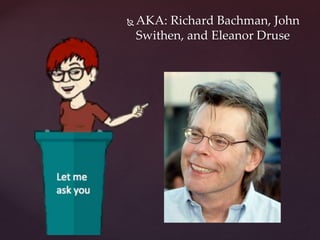
 AKA: Richard Bachman, John
Swithen, and Eleanor Druse
Group
Discussion:
ShawshankThe
Narrator
Point of
view
Reliable or
not?
Symbols
Themes/C
oncepts
Major
Characters
QHQs
Trauma and
Traumatic
incidents
{
Literary Style
 Who is the narrator?
 How did the first-person narrative affect the story?
 This first-person narrative has quite a few affects on the
story. It allows for doubt in the narration.
 Why does the author choose to tell the story through
Red’s eyes and not Andy’s?
 I like the perspective of the story through Red’s eyes instead of
Andy’s because it’s like we are trying to figure out Andy along
with Red.
 when Red shares some of the horrible things that
happened to Andy like the gang rape and constant
beatings I feel like Red adds a lot of details that come
from his own experiences
 Is he reliable? Why or why not?
 Our first impressions as a reader is the honesty that Red
gives us. He gains my trust by admitting his crime.
 Since the narration is from Red’s point of view, readers
can never be sure about the actual events that took place.
This makes Andy’s legend even more mystifying.
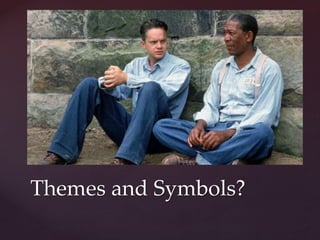
Themes and Symbols?
 Hope
 For Red it is hard to hold onto something as intangible as the idea of hope. After
Andy explains to Red about his false identity beyond the prison walls, Red begins
to dream of Andy’s paradise. “The whole idea seemed absurd, and that mental
image of blue water and white beaches seemed more cruel than foolish- it
dragged at my brain like a fishhook. I just couldn’t wear that invisible coat the
way Andy did.” (King 62) In this quote Red shares how hope is easily filtered out
in institutionalized mindsets; this thought of freedom is painful to Red because it
does not benefit him to dream of the outside world. Andy dreams of freedom and
has an “invisible coat” of hope that allows him to endure the years in confinement
while being an innocent man.
 Struggle
 An obvious struggle is one between freedom and imprisonment, which is
emphasized as more of a mental struggle than physical. When King talks about
freedom, it’s described as a dream, which got me thinking about imprisonment
and whether that’s a nightmare, and furthermore, if the terror of being
imprisoned is just a mental challenge to overcome.
 Imprisonment/Isolation
 One of the most obvious themes within Steven King’s “Rita Hayworth and
Shawshank Redemption” is the idea of imprisonment, isolation and the loss of
freedom. Not only is the location a prison ground, but within the prison grounds
is the outside (but enclosed) recreational area, fenced off.
Themes
{ {Symbols
 Rita Hayworth
 Q: Why is it significant that it is Rita Hayworth in those posters and
not someone else?
 Gem Stones
 Dufresne spends a great deal of time cleaning these worthless-looking
pieces of rock into an object that is often considered very beautiful. As
cliché as this sounds, King seems to be suggesting that these inmates
may seem worthless and not even worth a second glance, but some of
them are made of finer stuff, like the gemstones.
 Andy Dufresne
 What is Andy Dufresne is symbolic of and what does he represent to
Red and to the rest of the inmates at Shawshank?
 Warden Norton
 Warden Norton represents the faults of the prison system.
 The Bird
 What did Sherwood Bolton’s bird, Jake, represent? What did it
symbolize when the Red found it dead after it had been released?
Discuss trauma as it applies to any one character in “Rita Hayworth
and the Shawshank Redemption.” Use textual support to make a case
that the traumatic incident has long term ramifications.
His freedom was completely stripped
from him the moment he walked into
Shawshank, and his mind can’t even
fathom a life without the walls of prison
It isn’t until Andy Dufresne comes to
Shawshank and eventually escapes that
Red frees his institutionalized mind
from the imprisonment he has been
accustomed to.
Red has become accustomed to his life in prison, so much that he wouldn’t
feel comfortable anywhere else, not even outside as a free man. “I couldn’t
get along on the outside. I’m what they call an institutional man now” (79).
The correctional facility he does his prison time in has institutionalized him,
literally and symbolically, to become dependent on that system..
Well, listen: I knew this guy, Sherwood Bolton, his name was,
and he had this pigeon in his cell. From 1945 until 1953, when
they let him out, he had that pigeon. He wasn't any Birdman
of Alcatraz; he just had this pigeon. Jake, he called him. He set
Jake free a day before he, Sherwood, that is, was to walk, and
Jake flew away just as pretty as you could want. But about a
week after Sherwood Bolton left our happy little family, a
friend of mine called me over to the west corner of the
exercise yard, where Sherwood used to hang out. A bird was
lying there like a very small pile of dirty bed-linen. It looked
starved. My friend said: "Isn't that Jake, Red?" It was. That
pigeon was just as dead as a turd.
Trauma??
 Q: Why does Red say “He was a good nigger.”
(King, 77) when referring to Andy? Is there
any other racial tensions displayed in Rita
Hayworth and the Shawshank Redemption?
 Q: How does Andy remain a healthy
mentality most of his time at Shawshank?
 Q: Was Andy a kind man or a manipulator?
 Q: Why does King even mention the sisters?
 Q. Red recalls upon Andy that, “it was a kind
of inner light he carried around with him.”
What might this mean?
QHQs
Homework
Read Kafka’s The
Metamorphosis

Ewrt 1 c class 22 trauma

  • 1.
    { EWRT 1C Class22 back short watch In each of these puzzles, a list of words is given. To solve the puzzle, think of a single word that goes with each to form a compound word (or word pair that functions as a compound word). For example, if the given words are volley, field, and bearing, then the answer would be ball, because the word ball can be added to each of the other words to form volleyball, ball field, and ball bearing. blue cake cottage stool powder ball
  • 2.
    AGENDA  New Teams Discussion:  Trauma Theory  Bloom  Balaev  Discussion: Rita Hayworth and Shawshank Redemption
  • 3.
    1. You mustchange at least 50% of your team after each project is completed. 2. You may never be on a team with the same person more than twice. 3. You may never have a new team composed of more than 50% of any prior team.
  • 4.
    Trauma Theory What isit? How did it come to be? What are the effects? Why do we apply it to literature?
  • 5.
  • 6.
    1. The Fight-or-Flight 2.Learned Helplessness 3. Loss of “Volume Control” 4. Thinking Under Stress—Action Not Thought 5. Remembering Under Stress 6. Emotions and Trauma—Dissociation 7. Endorphins and Stress—Addiction to Trauma 8. Trauma Reenactment 9. Trauma and the Body 10. Victim to Victimizer Effects of Trauma
  • 7.
    1. Q: Whyin trauma theory does the captive try to bond with their abuser? 2. Q: Bloom points out that the evolution legacy has lead our species with an innate sense of reciprocity, explaining our need for order, safety, and for adequate protection. At what point do the fragmented traumatic experiences perpetuate from one person to the other? 3. Q. How might learned helplessness prove to be more complex in humans than in animals? 4. Q: What is the significance of verbal and emotional memory in “Trauma theory?” 5. Q: Does trauma really hurt humans more than any animal because of humans’ social interaction and intelligence? 6. Q: How does trauma tie in to the theory of the unconscious? QHQ: Bloom
  • 8.
     “Trauma, inmy analysis, refers to a person's emotional response to an overwhelming event that disrupts previous ideas of an individual's sense of self and the standards by which one evaluates society. The term "trauma novel" refers to a work of fiction that conveys profound loss or intense fear on individual or collective levels. A defining feature of the trauma novel is the transformation of the self ignited by an external, often terrifying experience, which illuminates the process of coming to terms with the dynamics of memory that inform the new perceptions of the self and world.” From Balaev
  • 9.
     The traumanovel conveys a diversity of extreme emotional states through an assortment of narrative innovations, such as landscape imagery, temporal fissures, silence, or narrative omission--the withholding of graphic, visceral traumatic detail. Authors employ a nonlinear plot or disruptive temporal sequences to emphasize mental confusion, chaos, or contemplation as a response to the experience. The narrative strategy of silence may create a "gap" in time or feeling that allows the reader to imagine what might or could have happened to the protagonist, thereby broadening the meaning and effects of the experience. From Balaev
  • 10.
    1. QHQ :Why does trauma manage to stay with us? And in what ways are we affected by trauma? 2. Q: Is trauma guaranteed to permanently become a part of us? Is the “final” character of a person before they die simply a result of all their traumatic experiences? 3. Q: Is trauma transferable? Does the claim that black citizens are still suffering from past trauma take away from the very real, contemporary trauma they suffer today? QHQ: Balaev
  • 11.
     AKA: RichardBachman, John Swithen, and Eleanor Druse
  • 12.
  • 13.
  • 14.
     Who isthe narrator?  How did the first-person narrative affect the story?  This first-person narrative has quite a few affects on the story. It allows for doubt in the narration.  Why does the author choose to tell the story through Red’s eyes and not Andy’s?  I like the perspective of the story through Red’s eyes instead of Andy’s because it’s like we are trying to figure out Andy along with Red.  when Red shares some of the horrible things that happened to Andy like the gang rape and constant beatings I feel like Red adds a lot of details that come from his own experiences  Is he reliable? Why or why not?  Our first impressions as a reader is the honesty that Red gives us. He gains my trust by admitting his crime.  Since the narration is from Red’s point of view, readers can never be sure about the actual events that took place. This makes Andy’s legend even more mystifying.
  • 15.
  • 16.
     Hope  ForRed it is hard to hold onto something as intangible as the idea of hope. After Andy explains to Red about his false identity beyond the prison walls, Red begins to dream of Andy’s paradise. “The whole idea seemed absurd, and that mental image of blue water and white beaches seemed more cruel than foolish- it dragged at my brain like a fishhook. I just couldn’t wear that invisible coat the way Andy did.” (King 62) In this quote Red shares how hope is easily filtered out in institutionalized mindsets; this thought of freedom is painful to Red because it does not benefit him to dream of the outside world. Andy dreams of freedom and has an “invisible coat” of hope that allows him to endure the years in confinement while being an innocent man.  Struggle  An obvious struggle is one between freedom and imprisonment, which is emphasized as more of a mental struggle than physical. When King talks about freedom, it’s described as a dream, which got me thinking about imprisonment and whether that’s a nightmare, and furthermore, if the terror of being imprisoned is just a mental challenge to overcome.  Imprisonment/Isolation  One of the most obvious themes within Steven King’s “Rita Hayworth and Shawshank Redemption” is the idea of imprisonment, isolation and the loss of freedom. Not only is the location a prison ground, but within the prison grounds is the outside (but enclosed) recreational area, fenced off. Themes
  • 17.
    { {Symbols  RitaHayworth  Q: Why is it significant that it is Rita Hayworth in those posters and not someone else?  Gem Stones  Dufresne spends a great deal of time cleaning these worthless-looking pieces of rock into an object that is often considered very beautiful. As cliché as this sounds, King seems to be suggesting that these inmates may seem worthless and not even worth a second glance, but some of them are made of finer stuff, like the gemstones.  Andy Dufresne  What is Andy Dufresne is symbolic of and what does he represent to Red and to the rest of the inmates at Shawshank?  Warden Norton  Warden Norton represents the faults of the prison system.  The Bird  What did Sherwood Bolton’s bird, Jake, represent? What did it symbolize when the Red found it dead after it had been released?
  • 18.
    Discuss trauma asit applies to any one character in “Rita Hayworth and the Shawshank Redemption.” Use textual support to make a case that the traumatic incident has long term ramifications. His freedom was completely stripped from him the moment he walked into Shawshank, and his mind can’t even fathom a life without the walls of prison It isn’t until Andy Dufresne comes to Shawshank and eventually escapes that Red frees his institutionalized mind from the imprisonment he has been accustomed to. Red has become accustomed to his life in prison, so much that he wouldn’t feel comfortable anywhere else, not even outside as a free man. “I couldn’t get along on the outside. I’m what they call an institutional man now” (79). The correctional facility he does his prison time in has institutionalized him, literally and symbolically, to become dependent on that system..
  • 19.
    Well, listen: Iknew this guy, Sherwood Bolton, his name was, and he had this pigeon in his cell. From 1945 until 1953, when they let him out, he had that pigeon. He wasn't any Birdman of Alcatraz; he just had this pigeon. Jake, he called him. He set Jake free a day before he, Sherwood, that is, was to walk, and Jake flew away just as pretty as you could want. But about a week after Sherwood Bolton left our happy little family, a friend of mine called me over to the west corner of the exercise yard, where Sherwood used to hang out. A bird was lying there like a very small pile of dirty bed-linen. It looked starved. My friend said: "Isn't that Jake, Red?" It was. That pigeon was just as dead as a turd. Trauma??
  • 20.
     Q: Whydoes Red say “He was a good nigger.” (King, 77) when referring to Andy? Is there any other racial tensions displayed in Rita Hayworth and the Shawshank Redemption?  Q: How does Andy remain a healthy mentality most of his time at Shawshank?  Q: Was Andy a kind man or a manipulator?  Q: Why does King even mention the sisters?  Q. Red recalls upon Andy that, “it was a kind of inner light he carried around with him.” What might this mean? QHQs
  • 21.