Determiners and pronouns
(Unit 9)
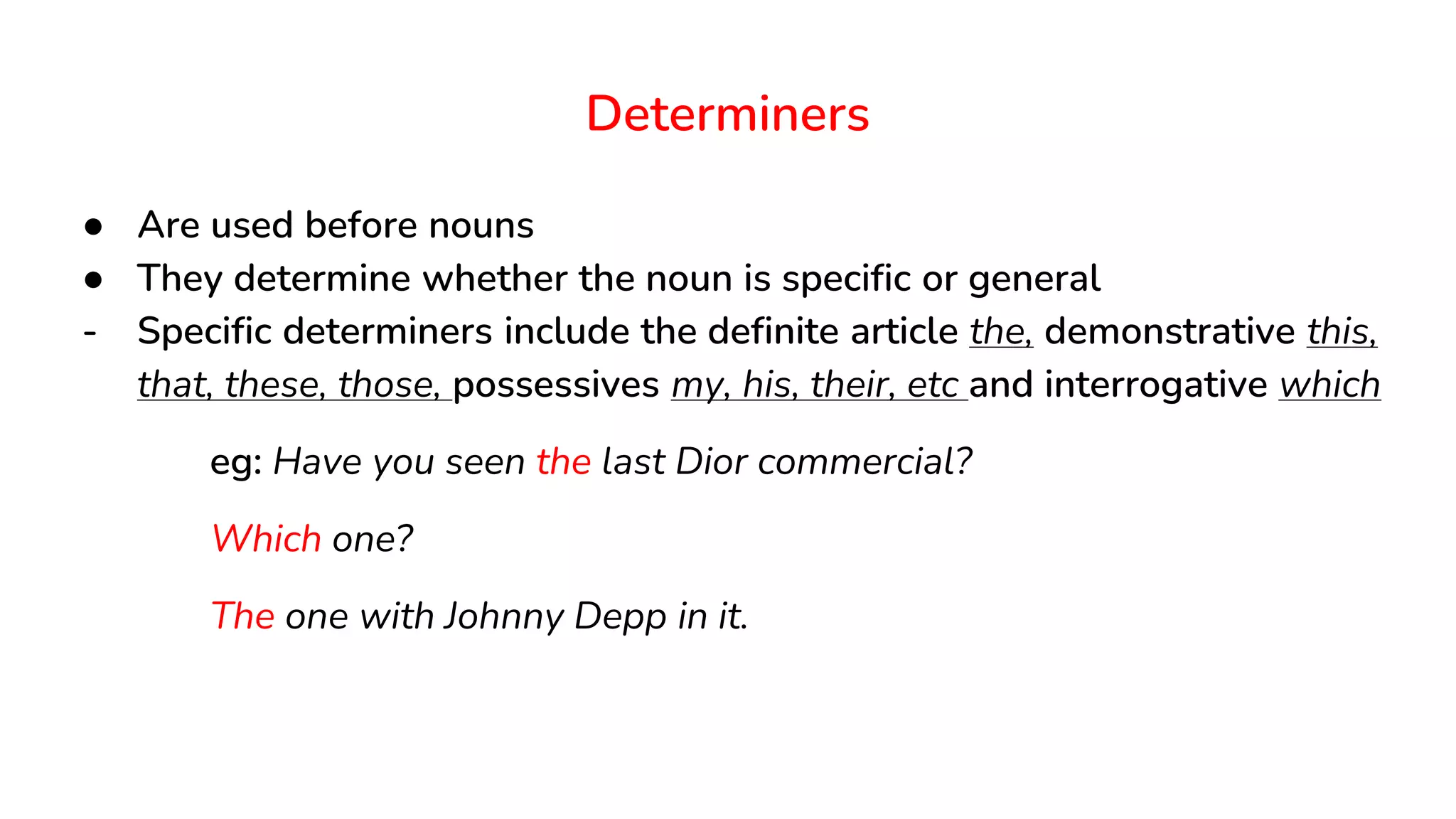
Determiners
● Are used before nouns
● They determine whether the noun is specific or general
- Specific determiners include the definite article the, demonstrative this,
that, these, those, possessives my, his, their, etc and interrogative which
eg: Have you seen the last Dior commercial?
Which one?
The one with Johnny Depp in it.
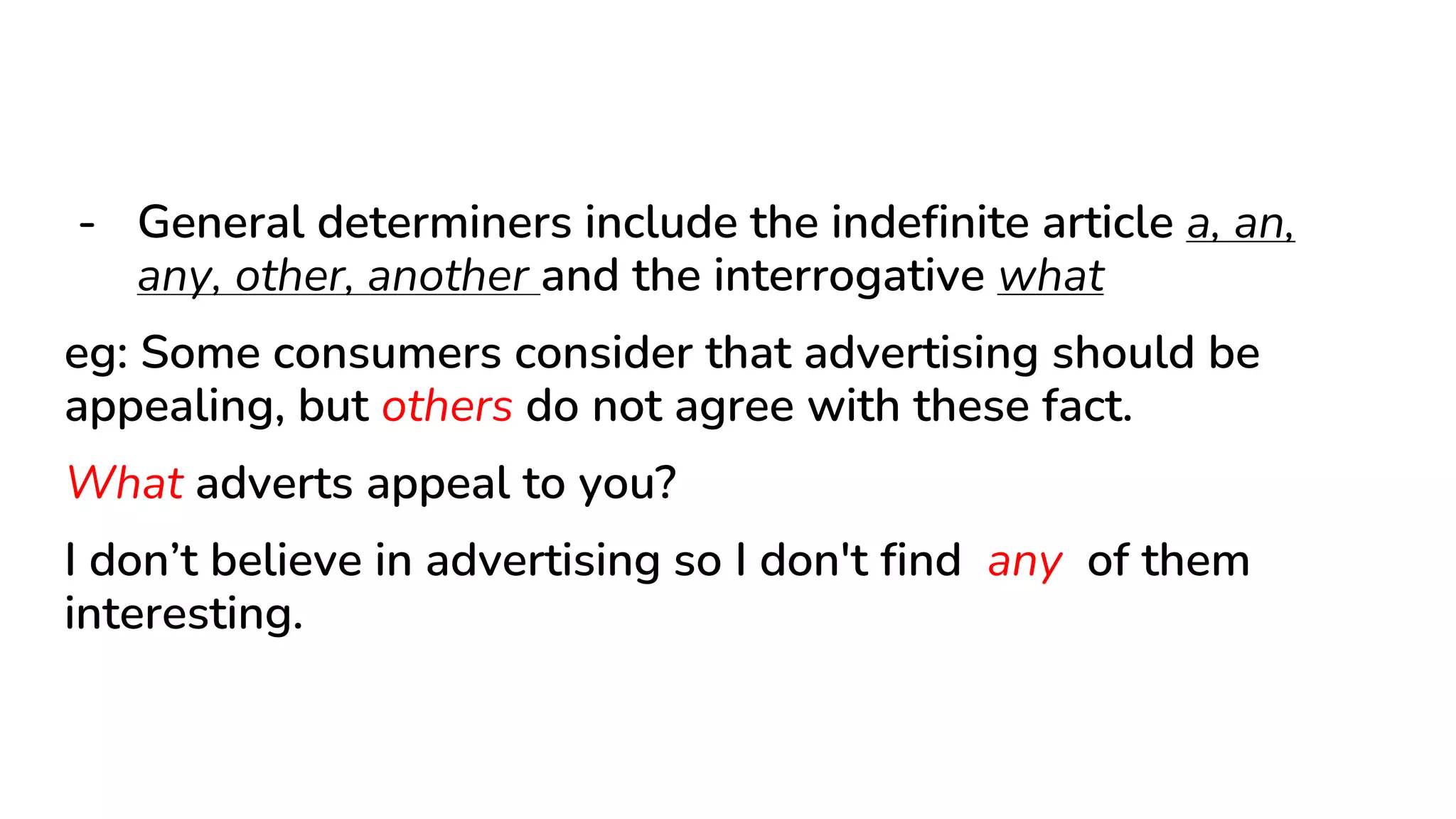
- General determiners include the indefinite article a, an,
any, other, another and the interrogative what
eg: Some consumers consider that advertising should be
appealing, but others do not agree with these fact.
What adverts appeal to you?
I don’t believe in advertising so I don't find any of them
interesting.
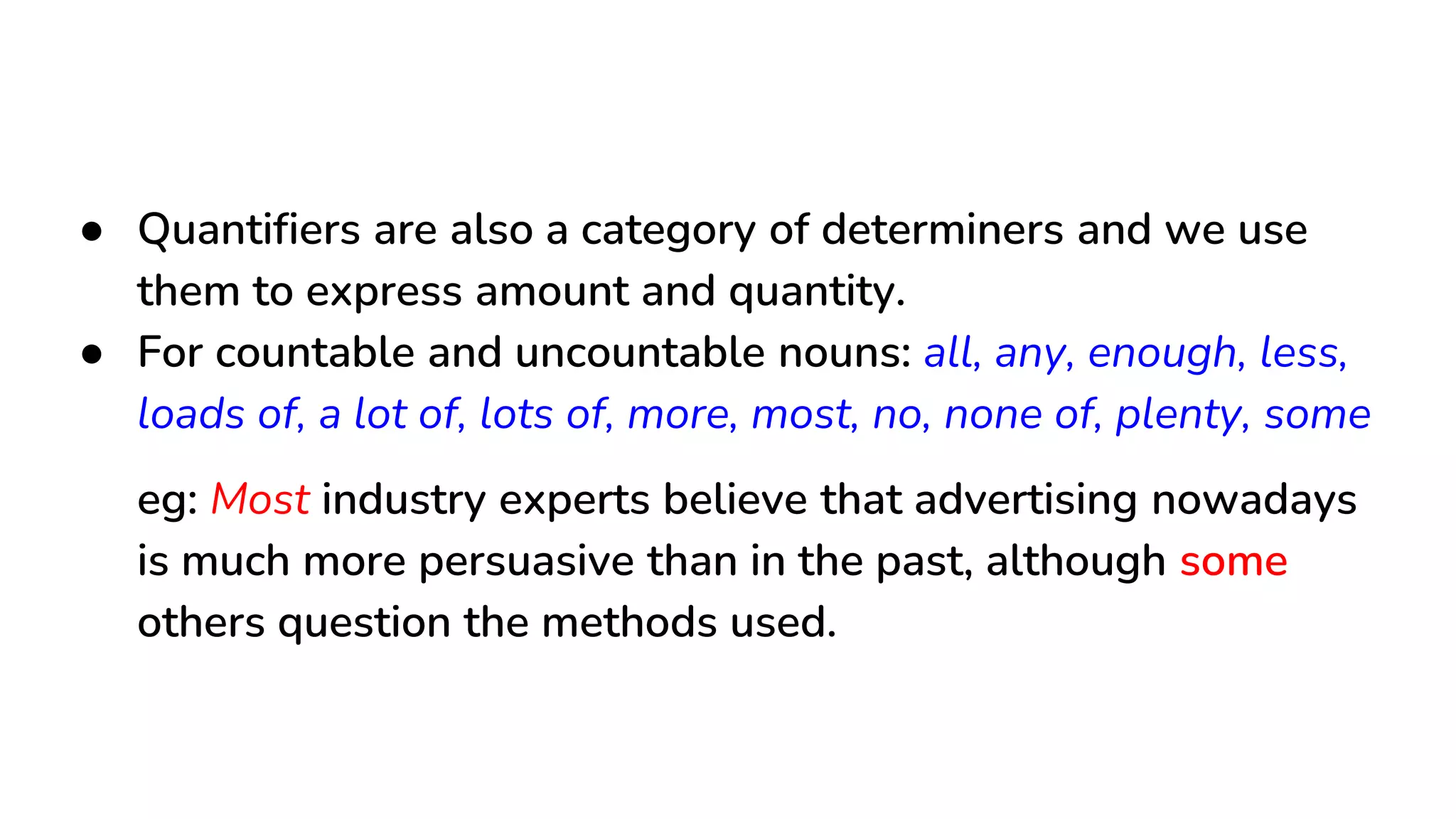
● Quantifiers are also a category of determiners and we use
them to express amount and quantity.
● For countable and uncountable nouns: all, any, enough, less,
loads of, a lot of, lots of, more, most, no, none of, plenty, some
eg: Most industry experts believe that advertising nowadays
is much more persuasive than in the past, although some
others question the methods used.
● Only with countable nouns: both, a couple of, each, (a) few,
fewer, hundreds of, several eg: Both experts agree that brands
can win back public support by advertising on social media
● Only with uncountable nouns: (a) little, (not) much, a bit of
● With uncountable abstract nouns such as time, money,and
trouble, we often use a good/great deal of eg: Dior has invested
a great deal of money
● Either/Neither are used to talk about two things and are followed
by singular nouns eg: Neither brand agreed to launch their
products online
● Each/Every are followed by a singular noun and mean all eg:
According to the last market research, each end-user was
satisfied with the new product.
● A few: some or more than expected eg: Quite a few people
turned up to the meeting
● Few: not as many as expected eg: Very few points of sales,
allow advertising of cigarettes.
Pronouns
● Are used to replace nouns
● can be used on their own: Have you got any money? Not much/
A lot
● as objects of verbs: Those two cannot stand each other. We
bought two products each
● after a determiner: Look at this one
● all and both also can be used after a noun, pronoun, modal or
auxiliary verb: You can keep the books, I’ve read them all.
Let’s practise
Do activities 1, 3, 4, and 5 from the student’s book page 88

Determiners and pronouns.pptx

  • 1.
  • 2.
    Determiners ● Are usedbefore nouns ● They determine whether the noun is specific or general - Specific determiners include the definite article the, demonstrative this, that, these, those, possessives my, his, their, etc and interrogative which eg: Have you seen the last Dior commercial? Which one? The one with Johnny Depp in it.
  • 3.
    - General determinersinclude the indefinite article a, an, any, other, another and the interrogative what eg: Some consumers consider that advertising should be appealing, but others do not agree with these fact. What adverts appeal to you? I don’t believe in advertising so I don't find any of them interesting.
  • 4.
    ● Quantifiers arealso a category of determiners and we use them to express amount and quantity. ● For countable and uncountable nouns: all, any, enough, less, loads of, a lot of, lots of, more, most, no, none of, plenty, some eg: Most industry experts believe that advertising nowadays is much more persuasive than in the past, although some others question the methods used.
  • 5.
    ● Only withcountable nouns: both, a couple of, each, (a) few, fewer, hundreds of, several eg: Both experts agree that brands can win back public support by advertising on social media ● Only with uncountable nouns: (a) little, (not) much, a bit of ● With uncountable abstract nouns such as time, money,and trouble, we often use a good/great deal of eg: Dior has invested a great deal of money ● Either/Neither are used to talk about two things and are followed by singular nouns eg: Neither brand agreed to launch their products online
  • 6.
    ● Each/Every arefollowed by a singular noun and mean all eg: According to the last market research, each end-user was satisfied with the new product. ● A few: some or more than expected eg: Quite a few people turned up to the meeting ● Few: not as many as expected eg: Very few points of sales, allow advertising of cigarettes.
  • 7.
    Pronouns ● Are usedto replace nouns ● can be used on their own: Have you got any money? Not much/ A lot ● as objects of verbs: Those two cannot stand each other. We bought two products each ● after a determiner: Look at this one ● all and both also can be used after a noun, pronoun, modal or auxiliary verb: You can keep the books, I’ve read them all.
  • 8.
    Let’s practise Do activities1, 3, 4, and 5 from the student’s book page 88