Noah Iliinsky
Center for Advanced Visualization, IBM
@noahi

Four Pillars of Visualization

© 2013 IBM Corporation
About the Speaker
§  Noah Iliinsky
§  Center for Advanced Visualization, IBM
§  Noah Iliinsky is the author of Designing
Data Visualizations and the technical editor
of, and a contributor to, Beautiful
Visualizations, both published by O’Reilly
Media.
§  He has spent the last several years
researching effective approaches to
creating diagrams and data visualization.
§  He has a master’s in Technical
Communication from the University of
Washington, and a bachelor’s in Physics
from Reed College

© 2013 IBM Corporation
Why Visualization?

© 2013 IBM Corporation
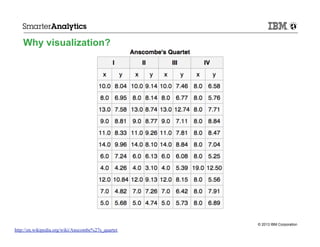
Why visualization?

© 2013 IBM Corporation

http://en.wikipedia.org/wiki/Anscombe%27s_quartet
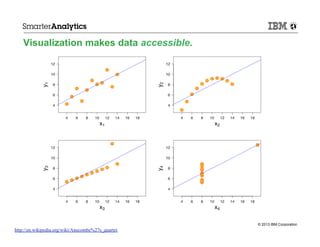
Visualization makes data accessible.

© 2013 IBM Corporation

http://en.wikipedia.org/wiki/Anscombe%27s_quartet
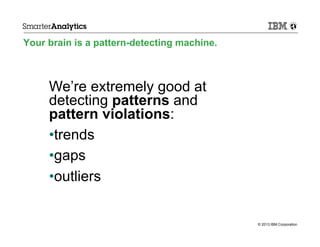
Your brain is a pattern-detecting machine.

We’re extremely good at
detecting patterns and
pattern violations:
• trends
• gaps
• outliers

© 2013 IBM Corporation
When are visualizations
successful?

© 2013 IBM Corporation
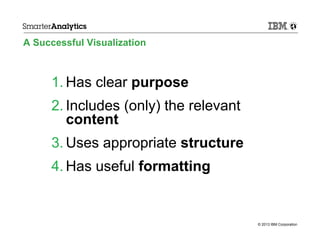
A Successful Visualization

1. Has clear purpose
2. Includes (only) the relevant
content
3. Uses appropriate structure
4. Has useful formatting

© 2013 IBM Corporation
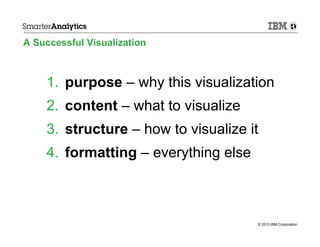
A Successful Visualization

1.  purpose – why this visualization
2.  content – what to visualize
3.  structure – how to visualize it
4.  formatting – everything else

© 2013 IBM Corporation
Purpose > Content > Structure > Formatting

For creators, do you know:
• Why am I creating this visualization?
• Who is it for?
• What do they need to understand?
• What actions do you need to enable?

© 2013 IBM Corporation
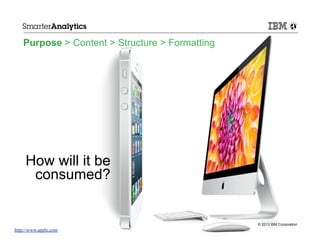
Purpose > Content > Structure > Formatting

How will it be
consumed?

© 2013 IBM Corporation

http://www.apple.com
Purpose > Content > Structure > Formatting

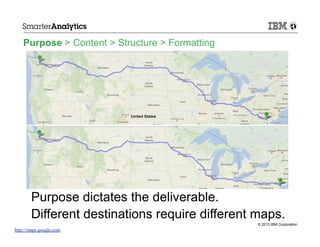
Purpose dictates the deliverable.
Different destinations require different maps.
© 2013 IBM Corporation

http://maps.google.com
Purpose > Content > Structure > Formatting

© 2013 IBM Corporation

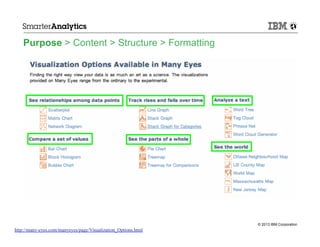
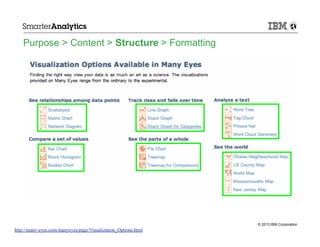
http://many-eyes.com/manyeyes/page/Visualization_Options.html
Purpose > Content > Structure > Formatting

• What data matters?
• What relationships matter?
• Informed by purpose!
• What’s excluded is as important as
what’s included.

© 2013 IBM Corporation
Purpose > Content > Structure > Formatting

© 2013 IBM Corporation

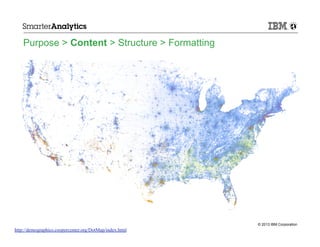
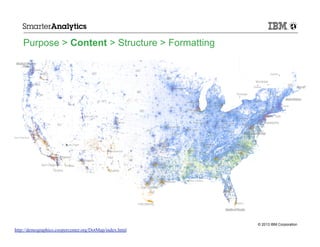
http://demographics.coopercenter.org/DotMap/index.html
Purpose > Content > Structure > Formatting

© 2013 IBM Corporation

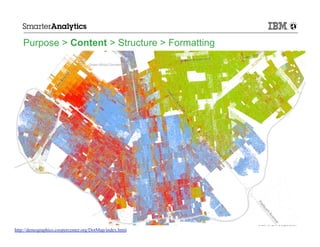
http://demographics.coopercenter.org/DotMap/index.html
Purpose > Content > Structure > Formatting

© 2013 IBM Corporation

http://demographics.coopercenter.org/DotMap/index.html
Purpose > Content > Structure > Formatting

© 2013 IBM Corporation

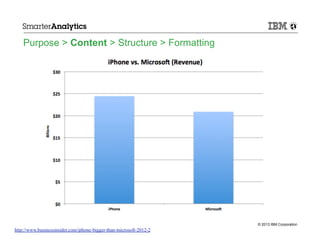
http://www.businessinsider.com/iphone-bigger-than-microsoft-2012-2
Purpose > Content > Structure > Formatting

• How do we best reveal the most
important data and relationships?
(Position!)
• Choose meaningful layout and axes!
• Use both axes! (Both, not three…)
• Informed by purpose and content!
© 2013 IBM Corporation
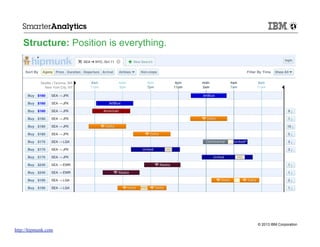
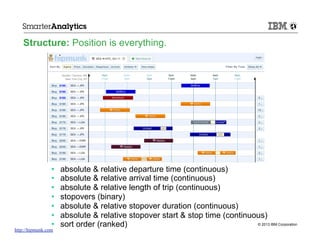
Structure: Position is everything.

© 2013 IBM Corporation

http://hipmunk.com
Structure: Position is everything.

• 
• 
• 
• 
• 
• 
• 

http://hipmunk.com

absolute & relative departure time (continuous)
absolute & relative arrival time (continuous)
absolute & relative length of trip (continuous)
stopovers (binary)
absolute & relative stopover duration (continuous)
absolute & relative stopover start & stop time (continuous)
© 2013 IBM Corporation
sort order (ranked)
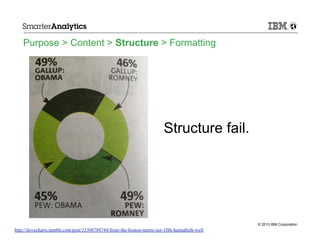
Purpose > Content > Structure > Formatting

Structure fail.

© 2013 IBM Corporation

http://ilovecharts.tumblr.com/post/33308788744/from-the-boston-metro-oct-10th-hannabeth-well
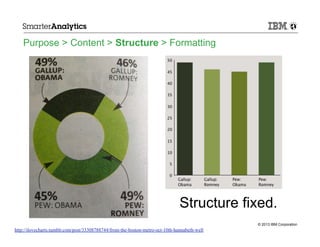
Purpose > Content > Structure > Formatting

Structure fixed.
© 2013 IBM Corporation

http://ilovecharts.tumblr.com/post/33308788744/from-the-boston-metro-oct-10th-hannabeth-well
Purpose > Content > Structure > Formatting

© 2013 IBM Corporation

http://many-eyes.com/manyeyes/page/Visualization_Options.html
Purpose > Content > Structure > Formatting

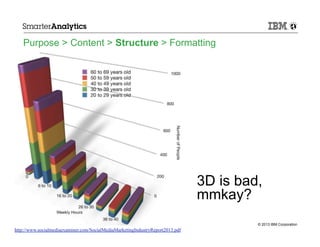
3D is bad,
mmkay?
© 2013 IBM Corporation

http://www.socialmediaexaminer.com/SocialMediaMarketingIndustryReport2013.pdf
Purpose > Content > Structure > Formatting

• How should it look and feel?
• How will it be consumed?
• Makes data and relationships
accessible.
• Makes importance visible.
• Informed by purpose, content, and
structure!
© 2013 IBM Corporation
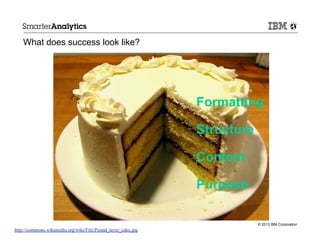
What does success look like?

Formatting
Structure
Content
Purpose
© 2013 IBM Corporation

http://commons.wikimedia.org/wiki/File:Pound_layer_cake.jpg
Purpose > Content > Structure > Formatting

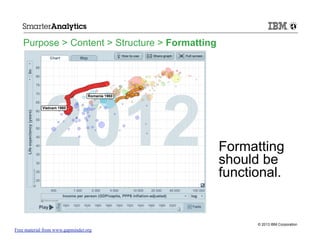
Formatting
should be
functional.

© 2013 IBM Corporation

Free material from www.gapminder.org
Purpose > Content > Structure > Formatting

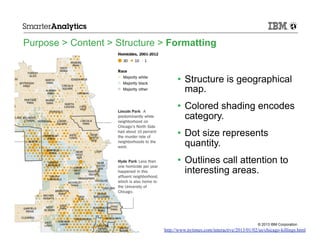
•  Structure is geographical
map.
•  Colored shading encodes
category.
•  Dot size represents
quantity.
•  Outlines call attention to
interesting areas.

© 2013 IBM Corporation

http://www.nytimes.com/interactive/2013/01/02/us/chicago-killings.html
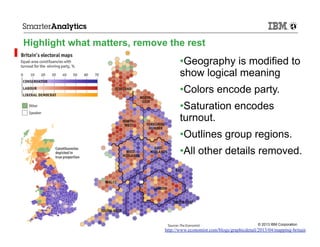
Highlight what matters, remove the rest

• Geography is modified to
show logical meaning
• Colors encode party.
• Saturation encodes
turnout.
• Outlines group regions.
• All other details removed.

© 2013 IBM Corporation

http://www.economist.com/blogs/graphicdetail/2013/04/mapping-britain
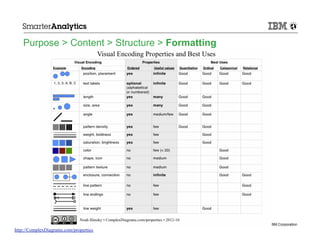
Purpose > Content > Structure > Formatting

© 2013 IBM Corporation

http://ComplexDiagrams.com/properties
Checklist

• Is the purpose well-defined?
• Does the content support the purpose?
• Does the structure reveal the content?
• Does the formatting facilitate
consumption?
• Iterate, iterate, iterate…
© 2013 IBM Corporation
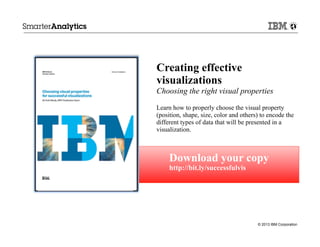
Creating effective
visualizations
Choosing the right visual properties
Learn how to properly choose the visual property
(position, shape, size, color and others) to encode the
different types of data that will be presented in a
visualization.

Download your copy
http://bit.ly/successfulvis

© 2013 IBM Corporation
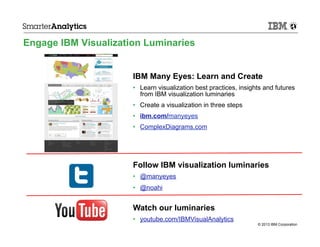
Engage IBM Visualization Luminaries
IBM Many Eyes: Learn and Create
•  Learn visualization best practices, insights and futures
from IBM visualization luminaries
•  Create a visualization in three steps
•  ibm.com/manyeyes
•  ComplexDiagrams.com

Follow IBM visualization luminaries
•  @manyeyes
•  @noahi

Watch our luminaries
•  youtube.com/IBMVisualAnalytics

© 2013 IBM Corporation

Four pillars of visualization - by Noah Iliinsky

  • 1.
    Noah Iliinsky Center forAdvanced Visualization, IBM @noahi Four Pillars of Visualization © 2013 IBM Corporation
  • 2.
    About the Speaker § Noah Iliinsky §  Center for Advanced Visualization, IBM §  Noah Iliinsky is the author of Designing Data Visualizations and the technical editor of, and a contributor to, Beautiful Visualizations, both published by O’Reilly Media. §  He has spent the last several years researching effective approaches to creating diagrams and data visualization. §  He has a master’s in Technical Communication from the University of Washington, and a bachelor’s in Physics from Reed College © 2013 IBM Corporation
  • 3.
  • 4.
    Why visualization? © 2013IBM Corporation http://en.wikipedia.org/wiki/Anscombe%27s_quartet
  • 5.
    Visualization makes dataaccessible. © 2013 IBM Corporation http://en.wikipedia.org/wiki/Anscombe%27s_quartet
  • 6.
    Your brain isa pattern-detecting machine. We’re extremely good at detecting patterns and pattern violations: • trends • gaps • outliers © 2013 IBM Corporation
  • 7.
  • 8.
    A Successful Visualization 1. Hasclear purpose 2. Includes (only) the relevant content 3. Uses appropriate structure 4. Has useful formatting © 2013 IBM Corporation
  • 9.
    A Successful Visualization 1. purpose – why this visualization 2.  content – what to visualize 3.  structure – how to visualize it 4.  formatting – everything else © 2013 IBM Corporation
  • 10.
    Purpose > Content> Structure > Formatting For creators, do you know: • Why am I creating this visualization? • Who is it for? • What do they need to understand? • What actions do you need to enable? © 2013 IBM Corporation
  • 11.
    Purpose > Content> Structure > Formatting How will it be consumed? © 2013 IBM Corporation http://www.apple.com
  • 12.
    Purpose > Content> Structure > Formatting Purpose dictates the deliverable. Different destinations require different maps. © 2013 IBM Corporation http://maps.google.com
  • 13.
    Purpose > Content> Structure > Formatting © 2013 IBM Corporation http://many-eyes.com/manyeyes/page/Visualization_Options.html
  • 14.
    Purpose > Content> Structure > Formatting • What data matters? • What relationships matter? • Informed by purpose! • What’s excluded is as important as what’s included. © 2013 IBM Corporation
  • 15.
    Purpose > Content> Structure > Formatting © 2013 IBM Corporation http://demographics.coopercenter.org/DotMap/index.html
  • 16.
    Purpose > Content> Structure > Formatting © 2013 IBM Corporation http://demographics.coopercenter.org/DotMap/index.html
  • 17.
    Purpose > Content> Structure > Formatting © 2013 IBM Corporation http://demographics.coopercenter.org/DotMap/index.html
  • 18.
    Purpose > Content> Structure > Formatting © 2013 IBM Corporation http://www.businessinsider.com/iphone-bigger-than-microsoft-2012-2
  • 19.
    Purpose > Content> Structure > Formatting • How do we best reveal the most important data and relationships? (Position!) • Choose meaningful layout and axes! • Use both axes! (Both, not three…) • Informed by purpose and content! © 2013 IBM Corporation
  • 20.
    Structure: Position iseverything. © 2013 IBM Corporation http://hipmunk.com
  • 21.
    Structure: Position iseverything. •  •  •  •  •  •  •  http://hipmunk.com absolute & relative departure time (continuous) absolute & relative arrival time (continuous) absolute & relative length of trip (continuous) stopovers (binary) absolute & relative stopover duration (continuous) absolute & relative stopover start & stop time (continuous) © 2013 IBM Corporation sort order (ranked)
  • 22.
    Purpose > Content> Structure > Formatting Structure fail. © 2013 IBM Corporation http://ilovecharts.tumblr.com/post/33308788744/from-the-boston-metro-oct-10th-hannabeth-well
  • 23.
    Purpose > Content> Structure > Formatting Structure fixed. © 2013 IBM Corporation http://ilovecharts.tumblr.com/post/33308788744/from-the-boston-metro-oct-10th-hannabeth-well
  • 24.
    Purpose > Content> Structure > Formatting © 2013 IBM Corporation http://many-eyes.com/manyeyes/page/Visualization_Options.html
  • 25.
    Purpose > Content> Structure > Formatting 3D is bad, mmkay? © 2013 IBM Corporation http://www.socialmediaexaminer.com/SocialMediaMarketingIndustryReport2013.pdf
  • 26.
    Purpose > Content> Structure > Formatting • How should it look and feel? • How will it be consumed? • Makes data and relationships accessible. • Makes importance visible. • Informed by purpose, content, and structure! © 2013 IBM Corporation
  • 27.
    What does successlook like? Formatting Structure Content Purpose © 2013 IBM Corporation http://commons.wikimedia.org/wiki/File:Pound_layer_cake.jpg
  • 28.
    Purpose > Content> Structure > Formatting Formatting should be functional. © 2013 IBM Corporation Free material from www.gapminder.org
  • 29.
    Purpose > Content> Structure > Formatting •  Structure is geographical map. •  Colored shading encodes category. •  Dot size represents quantity. •  Outlines call attention to interesting areas. © 2013 IBM Corporation http://www.nytimes.com/interactive/2013/01/02/us/chicago-killings.html
  • 30.
    Highlight what matters,remove the rest • Geography is modified to show logical meaning • Colors encode party. • Saturation encodes turnout. • Outlines group regions. • All other details removed. © 2013 IBM Corporation http://www.economist.com/blogs/graphicdetail/2013/04/mapping-britain
  • 31.
    Purpose > Content> Structure > Formatting © 2013 IBM Corporation http://ComplexDiagrams.com/properties
  • 32.
    Checklist • Is the purposewell-defined? • Does the content support the purpose? • Does the structure reveal the content? • Does the formatting facilitate consumption? • Iterate, iterate, iterate… © 2013 IBM Corporation
  • 33.
    Creating effective visualizations Choosing theright visual properties Learn how to properly choose the visual property (position, shape, size, color and others) to encode the different types of data that will be presented in a visualization. Download your copy http://bit.ly/successfulvis © 2013 IBM Corporation
  • 34.
    Engage IBM VisualizationLuminaries IBM Many Eyes: Learn and Create •  Learn visualization best practices, insights and futures from IBM visualization luminaries •  Create a visualization in three steps •  ibm.com/manyeyes •  ComplexDiagrams.com Follow IBM visualization luminaries •  @manyeyes •  @noahi Watch our luminaries •  youtube.com/IBMVisualAnalytics © 2013 IBM Corporation