Prepared by:
Nathaniel T. Sullano
BS Math – 3
is a science that deals with the principles
and criteria of validity of inference and
demonstration.
  is the formal systematic study of
the principles of valid inference and
correct reasoning.
  Logic is used in most intellectual
activities, but is studied primarily in the
disciplines
of philosophy, mathematics, semantics,
and computer science.
has became mathematized in the 19th century, in the
work of mostly British mathematicians such as George
Peacock (1791-1858), George Boole (1815-1864),
William Stanley Jevons (1835-1882), and Augustus de
Morgan, and a few Americans, notably Charles Sanders
Peirce.
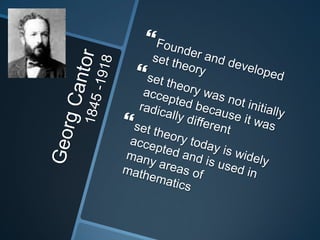
 was the creation of 19th-century analysts and geometers,
prominent among them is Georg Cantor (1845-1918),
whose inspiration came from geometry and analysis,
mostly the latter.
 mathematization of logic has a pre-history that goes
back to Leibniz.
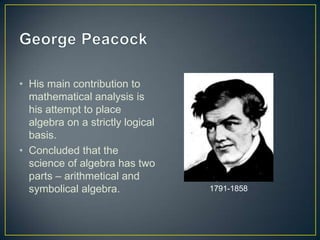
• His main contribution to
  mathematical analysis is
  his attempt to place
  algebra on a strictly logical
  basis.
• Concluded that the
  science of algebra has two
  parts – arithmetical and
  symbolical algebra.             1791-1858
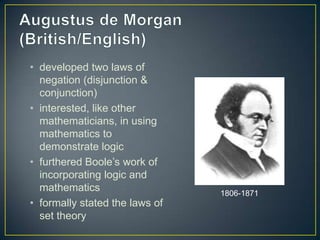
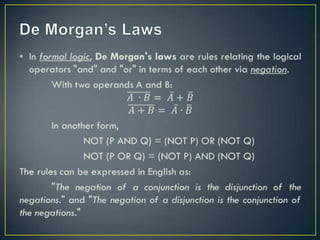
• developed two laws of
  negation (disjunction &
  conjunction)
• interested, like other
  mathematicians, in using
  mathematics to
  demonstrate logic
• furthered Boole‟s work of
  incorporating logic and
  mathematics                   1806-1871
• formally stated the laws of
  set theory
•
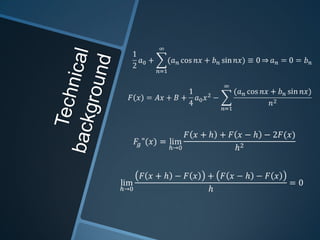
Lagrange‟s algebraic approach to analysis (Thinking of Taylor‟s
                           Theorem).


Where Df(x) = f’(x), and comparing with the Taylor‟s series of the
exponential function,


            Lagrange arrived at the formal equation


     Converse
     relation,
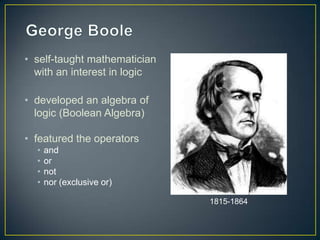
• self-taught mathematician
  with an interest in logic

• developed an algebra of
  logic (Boolean Algebra)

• featured the operators
  •   and
  •   or
  •   not
  •   nor (exclusive or)

                              1815-1864
Boole soon began to see the
                                           He wrote that,
possibilities for applying his
                                       “the validity of the
algebra to the solution of
                                   processes of analysis
logical problems. Boole's
                                  does not depend upon
1847 work, 'The
                                 the interpretation of the
Mathematical Analysis of
                                      symbols which are
Logic', not only expanded
                               employed but solely upon
on Gottfried Leibniz' earlier
                                         the laws of their
speculations on the
                                          combination…”
correlation between logic
and math, but argued that
logic was principally a
discipline of mathematics,
rather than philosophy.
• Boole denoted a generic member of a class by an
  uppercase „X’, and used the lowercase „x’.
• Then “xy” was to denote the class “whose members are
  both X‟s and Y‟s”
• This language rather blurs the distinction between a set,
  its members, and the properties that determine what the
  members are.
•
•
logic and set theory

logic and set theory

  • 1.
    Prepared by: Nathaniel T.Sullano BS Math – 3
  • 2.
    is a sciencethat deals with the principles and criteria of validity of inference and demonstration. is the formal systematic study of the principles of valid inference and correct reasoning. Logic is used in most intellectual activities, but is studied primarily in the disciplines of philosophy, mathematics, semantics, and computer science.
  • 3.
    has became mathematizedin the 19th century, in the work of mostly British mathematicians such as George Peacock (1791-1858), George Boole (1815-1864), William Stanley Jevons (1835-1882), and Augustus de Morgan, and a few Americans, notably Charles Sanders Peirce. was the creation of 19th-century analysts and geometers, prominent among them is Georg Cantor (1845-1918), whose inspiration came from geometry and analysis, mostly the latter. mathematization of logic has a pre-history that goes back to Leibniz.
  • 4.
    • His maincontribution to mathematical analysis is his attempt to place algebra on a strictly logical basis. • Concluded that the science of algebra has two parts – arithmetical and symbolical algebra. 1791-1858
  • 5.
    • developed twolaws of negation (disjunction & conjunction) • interested, like other mathematicians, in using mathematics to demonstrate logic • furthered Boole‟s work of incorporating logic and mathematics 1806-1871 • formally stated the laws of set theory
  • 6.
  • 7.
    Lagrange‟s algebraic approachto analysis (Thinking of Taylor‟s Theorem). Where Df(x) = f’(x), and comparing with the Taylor‟s series of the exponential function, Lagrange arrived at the formal equation Converse relation,
  • 8.
    • self-taught mathematician with an interest in logic • developed an algebra of logic (Boolean Algebra) • featured the operators • and • or • not • nor (exclusive or) 1815-1864
  • 9.
    Boole soon beganto see the He wrote that, possibilities for applying his “the validity of the algebra to the solution of processes of analysis logical problems. Boole's does not depend upon 1847 work, 'The the interpretation of the Mathematical Analysis of symbols which are Logic', not only expanded employed but solely upon on Gottfried Leibniz' earlier the laws of their speculations on the combination…” correlation between logic and math, but argued that logic was principally a discipline of mathematics, rather than philosophy.
  • 10.
    • Boole denoteda generic member of a class by an uppercase „X’, and used the lowercase „x’. • Then “xy” was to denote the class “whose members are both X‟s and Y‟s” • This language rather blurs the distinction between a set, its members, and the properties that determine what the members are.
  • 11.
  • 12.

Editor's Notes

  • #5 Peacock's main contribution to mathematical analysis is his attempt to place algebra on a strictly logical basis. He founded what has been called the philological or symbolical school of mathematicians; to which Gregory, De Morgan and Boole belonged. His answer to Maseres and Frend was that the science of algebra consisted of two parts—arithmetical algebra and symbolical algebra—and that they erred in restricting the science to the arithmetical part. His view of arithmetical algebra is as follows: "In arithmetical algebra we consider symbols as representing numbers, and the operations to which they are submitted as included in the same definitions as in common arithmetic; the signs + and − denote the operations of addition and subtraction in their ordinary meaning only, and those operations are considered as impossible in all cases where the symbols subjected to them possess values which would render them so in case they were replaced by digital numbers; thus in expressions such as a + b we must suppose a and b to be quantities of the same kind; in others, like a − b, we must suppose a greater than b and therefore homogeneous with it; in products and quotients, like ab and  we must suppose the multiplier and divisor to be abstract numbers; all results whatsoever, including negative quantities, which are not strictly deducible as legitimate conclusions from the definitions of the several operations must be rejected as impossible, or as foreign to the science."
  • #7 Negation-a logical proposition formed by asserting the falsity of a given proposition.
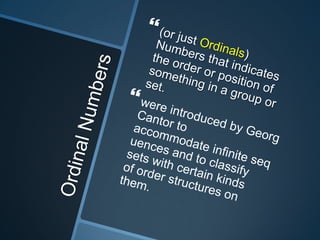
  • #25 In set theory, an ordinal number, or just ordinal, is the order type of a well-ordered set. They are usually identified with hereditarily transitive sets. Ordinals are an extension of the natural numbers different from integers and from cardinals. Like other kinds of numbers, ordinals can be added, multiplied, and exponentiated.
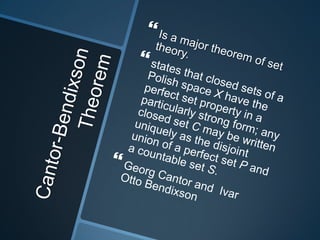
  • #27 A set  Pis called perfect if P=P’ , where P’ is the derived set of P.A Polish space is a second countable topological space that is metrizable with a complete metric. Equivalently, it is a complete separable metric space whose metric has been "forgotten". Examples include the real line R , the Baire space N , the Cantor space C, and the Hilbert cube I^n.