The Writing Journey Exploring Writing And Making Student Eager to Write Alay sa Bayan Program Magdalena & Majayjay, Laguna Department of Education, Region IV-A Calabarzon June 7-8, 2010
Seminar-Workshop Outline The Writing Process Reading and Writing Across the Curriculum * Text Structures and Organizations * Selecting Books for Teaching Evaluating Writing Output
How are you today? In a piece of paper, write the following: Name School  Subject  Grade Level Taught
Think about… Your favorite telenovela / TV Show The last book you have read The recent movie you saw Your most memorable teacher Something good that happened to you yesterday
Group Roles Assign roles in the group: Facilitator Scribe Reporter Time Keeper DA (Devil’s Advocate) Think of a group name and come up with a group cheer
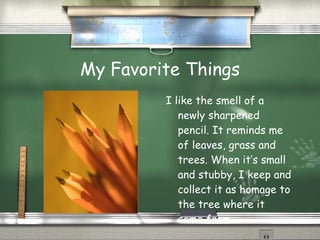
My Favorite Things I like the smell of a newly sharpened pencil. It reminds me of leaves, grass and trees. When it’s small and stubby, I keep and collect it as homage to the tree where it came from.
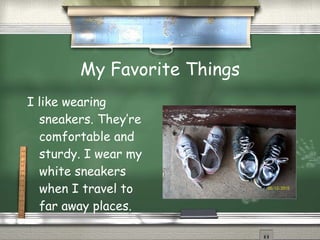
My Favorite Things I like wearing sneakers. They’re comfortable and sturdy. I wear my white sneakers when I travel to far away places.
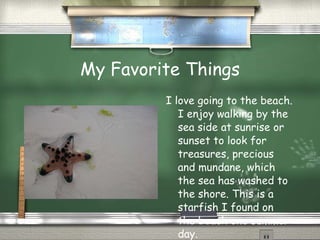
My Favorite Things I love going to the beach. I enjoy walking by the sea side at sunrise or sunset to look for treasures, precious and mundane, which the sea has washed to the shore. This is a starfish I found on the beach one summer day.
Raising Expectations  What do you ask the students to write? Why do you want the students to learn how to write them? Where are you having difficulty in?
How do children write? Children view writing as a requirement. Children get writing ideas from real life experiences. Children are capable of using their imagination to be able to write. Children could get lost and stumped before and during writing. Children mentally jump, skip, plod and turn during writing.
How do children write? Children must understand that writing is a process. Children need writing companions.
On Writing Writing helps in the construction of new meaning from old and fresh experiences. Writing is mind traveling; destination unknown.
The Writing Process Four steps in the writing process: Prewriting;  Writing the First Draft;  Revising;  Editing and Proofreading
Prewriting Find a meaningful idea to write about that meets the requirements and answers the instructions of the assignment. Develop your idea through the use of one or two prewriting strategies. Review the main idea and the sub-ideas that were generated from prewriting .
Prewriting If this leads you to a dead end, go back and retrace your steps. Focus and begin  writing .
When writing… Write as you would speak Know your subject Be honest Be personally involve with your writing (sincerity) Be at ease (relax)
Revising, Editing & Proofreading Commit yourself to improve your written output. Review and revise the content first. Review your writing, opening and closing paragraphs, style, words, sentences and paragraphs. Reread your revision. Have someone with “fresh eyes” to read your writing.
Revising On The Run Don’t add any new information Remove unnecessary facts and details Find the best possible information and go with it Put the pieces in the best possible order Do what little rewriting is necessary -- Peter Elbow
Prewriting Strategies Free Writing  – writing down thoughts in random on the topic or idea. Clustering – making a semantic web or concept map on the topic or idea. 5 Ws and 1 H  – identify basic information on the topic or idea by asking Who, What, Where, When and Why questions.
Prewriting Strategies Cubing  – Do a variation of free writing by writing the following instructions on a cube: Describe it – What do you see, hear, feel, smell, taste…? Compare it – What is it like? What is it different from? Associate it – What connections between this and something else come to mind?
Analyze it – What parts does it have? How do they work? Apply it – What can you do with it? How can you use it? Argue for or against it – may be serious or humorous
Prewriting Activities 1. Outlining  – identifying the main idea, topic sentences and supporting details following a structure (Introduction, Content, Conclusion) Topic Outline Sentence Outline
Offbeat Questions – craft questions about the topic or idea that is out of the box Person – What type of food and beverage is he/she like? Place – Where does this place go for advice? Object – What does this object look like when standing upside down? Issue or Event – What is inside its refrigerator?
Talking Points on Writing Learning to write and writing to learn It is a “virtuous” cycle (Walker, 1998). Involve students in reading and writing activities in the  content areas .
The Reading and Writing Love Team   Reading and writing are sparing partners. Good readers are good writers. To be very good at writing, one needs to ceaselessly read.
The Reading and Writing Love Team   Students benefit from reading and writing activities: develop skills and resources to understand content practice techniques that aid in retention write better
Reading and writing activities in the content areas foster student centered learning. Roles  between teacher and student undergo  transformation .
What will students read? Storybooks, works of fiction, literary genres Newspapers and magazines Menus, letters, invitations, announcements Recipes, handbooks, manuals Leaflets, brochures, directories Tickets, movie pass, reciepts Billboards, posters, signs
What will students write? Expressive Writing - diaries, journals, stories, poetry Product Writing - reports, essays, non-fiction and information materials
Text Structures & Organization Comparison and Contrast Cause and Effect Definition Explanation Description Narration / Sequence of Events
Students encounter different text structures and organizations when reading a variety of materials in the content areas. Different text structures and organizations require a reading ‘stance’. Different text structures and organizations call for different writing activities.
Assessing and Evaluating Writing A rubric is… an assessment tool a scoring guide a guide for students and teachers before an assignment begins
How to create a rubric? Determine concepts and learning objectives Choose the criteria to be evaluated Develop a grid where concepts, criteria and rating are included Discuss the rubric to students Use the rubric in evaluating the product, assignment or project
When writing is good Content that is interesting and important Craft - How content was rendered or presented organization and structure voice and style sentence fluency  writing conventions (spelling, punctuation, grammar

Teachwriting

  • 1.
    The Writing JourneyExploring Writing And Making Student Eager to Write Alay sa Bayan Program Magdalena & Majayjay, Laguna Department of Education, Region IV-A Calabarzon June 7-8, 2010
  • 2.
    Seminar-Workshop Outline TheWriting Process Reading and Writing Across the Curriculum * Text Structures and Organizations * Selecting Books for Teaching Evaluating Writing Output
  • 3.
    How are youtoday? In a piece of paper, write the following: Name School Subject Grade Level Taught
  • 4.
    Think about… Yourfavorite telenovela / TV Show The last book you have read The recent movie you saw Your most memorable teacher Something good that happened to you yesterday
  • 5.
    Group Roles Assignroles in the group: Facilitator Scribe Reporter Time Keeper DA (Devil’s Advocate) Think of a group name and come up with a group cheer
  • 6.
    My Favorite ThingsI like the smell of a newly sharpened pencil. It reminds me of leaves, grass and trees. When it’s small and stubby, I keep and collect it as homage to the tree where it came from.
  • 7.
    My Favorite ThingsI like wearing sneakers. They’re comfortable and sturdy. I wear my white sneakers when I travel to far away places.
  • 8.
    My Favorite ThingsI love going to the beach. I enjoy walking by the sea side at sunrise or sunset to look for treasures, precious and mundane, which the sea has washed to the shore. This is a starfish I found on the beach one summer day.
  • 9.
    Raising Expectations What do you ask the students to write? Why do you want the students to learn how to write them? Where are you having difficulty in?
  • 10.
    How do childrenwrite? Children view writing as a requirement. Children get writing ideas from real life experiences. Children are capable of using their imagination to be able to write. Children could get lost and stumped before and during writing. Children mentally jump, skip, plod and turn during writing.
  • 11.
    How do childrenwrite? Children must understand that writing is a process. Children need writing companions.
  • 12.
    On Writing Writinghelps in the construction of new meaning from old and fresh experiences. Writing is mind traveling; destination unknown.
  • 13.
    The Writing ProcessFour steps in the writing process: Prewriting; Writing the First Draft; Revising; Editing and Proofreading
  • 14.
    Prewriting Find ameaningful idea to write about that meets the requirements and answers the instructions of the assignment. Develop your idea through the use of one or two prewriting strategies. Review the main idea and the sub-ideas that were generated from prewriting .
  • 15.
    Prewriting If thisleads you to a dead end, go back and retrace your steps. Focus and begin writing .
  • 16.
    When writing… Writeas you would speak Know your subject Be honest Be personally involve with your writing (sincerity) Be at ease (relax)
  • 17.
    Revising, Editing &Proofreading Commit yourself to improve your written output. Review and revise the content first. Review your writing, opening and closing paragraphs, style, words, sentences and paragraphs. Reread your revision. Have someone with “fresh eyes” to read your writing.
  • 18.
    Revising On TheRun Don’t add any new information Remove unnecessary facts and details Find the best possible information and go with it Put the pieces in the best possible order Do what little rewriting is necessary -- Peter Elbow
  • 19.
    Prewriting Strategies FreeWriting – writing down thoughts in random on the topic or idea. Clustering – making a semantic web or concept map on the topic or idea. 5 Ws and 1 H – identify basic information on the topic or idea by asking Who, What, Where, When and Why questions.
  • 20.
    Prewriting Strategies Cubing – Do a variation of free writing by writing the following instructions on a cube: Describe it – What do you see, hear, feel, smell, taste…? Compare it – What is it like? What is it different from? Associate it – What connections between this and something else come to mind?
  • 21.
    Analyze it –What parts does it have? How do they work? Apply it – What can you do with it? How can you use it? Argue for or against it – may be serious or humorous
  • 22.
    Prewriting Activities 1.Outlining – identifying the main idea, topic sentences and supporting details following a structure (Introduction, Content, Conclusion) Topic Outline Sentence Outline
  • 23.
    Offbeat Questions –craft questions about the topic or idea that is out of the box Person – What type of food and beverage is he/she like? Place – Where does this place go for advice? Object – What does this object look like when standing upside down? Issue or Event – What is inside its refrigerator?
  • 24.
    Talking Points onWriting Learning to write and writing to learn It is a “virtuous” cycle (Walker, 1998). Involve students in reading and writing activities in the content areas .
  • 25.
    The Reading andWriting Love Team Reading and writing are sparing partners. Good readers are good writers. To be very good at writing, one needs to ceaselessly read.
  • 26.
    The Reading andWriting Love Team Students benefit from reading and writing activities: develop skills and resources to understand content practice techniques that aid in retention write better
  • 27.
    Reading and writingactivities in the content areas foster student centered learning. Roles between teacher and student undergo transformation .
  • 28.
    What will studentsread? Storybooks, works of fiction, literary genres Newspapers and magazines Menus, letters, invitations, announcements Recipes, handbooks, manuals Leaflets, brochures, directories Tickets, movie pass, reciepts Billboards, posters, signs
  • 29.
    What will studentswrite? Expressive Writing - diaries, journals, stories, poetry Product Writing - reports, essays, non-fiction and information materials
  • 30.
    Text Structures &Organization Comparison and Contrast Cause and Effect Definition Explanation Description Narration / Sequence of Events
  • 31.
    Students encounter differenttext structures and organizations when reading a variety of materials in the content areas. Different text structures and organizations require a reading ‘stance’. Different text structures and organizations call for different writing activities.
  • 32.
    Assessing and EvaluatingWriting A rubric is… an assessment tool a scoring guide a guide for students and teachers before an assignment begins
  • 33.
    How to createa rubric? Determine concepts and learning objectives Choose the criteria to be evaluated Develop a grid where concepts, criteria and rating are included Discuss the rubric to students Use the rubric in evaluating the product, assignment or project
  • 34.
    When writing isgood Content that is interesting and important Craft - How content was rendered or presented organization and structure voice and style sentence fluency writing conventions (spelling, punctuation, grammar