Polly Vaughan
Marla Robertson
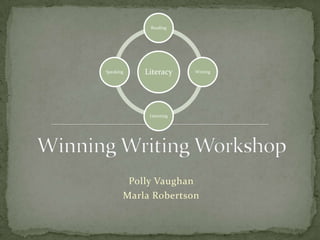
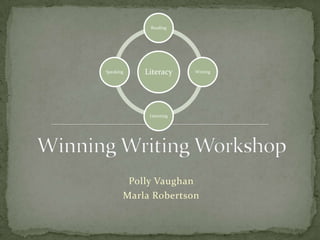
Literacy
Reading
Writing
Listening
Speaking
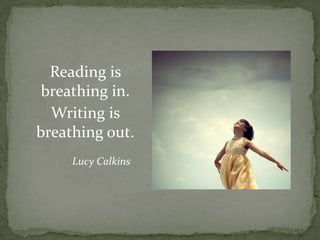
Reading is
breathing in.
Writing is
breathing out.
Lucy Calkins
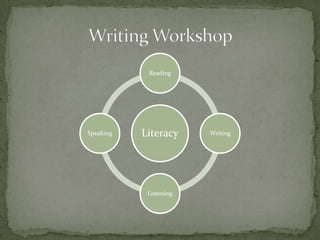
Literacy
Reading
Writing
Listening
Speaking
 Writer’s Workshop works because it is based on the idea that
students learn to write best when they write frequently, for
extended periods of time, on topics of their own choosing.
 Students write more
 Each student in the class is considered to be a working author
with the intent of perfecting their craft and publishing their
works.
 Students decide writing isn’t as difficult as they have been lead to
believe.
 The teacher is a writing professional and peer coach, guiding
authors as they explore their craft.
 Students begin to enjoy writing.
 Students gain a disposition to write and gain an understanding
of the mechanics of writing in such a way that is not mechanical.
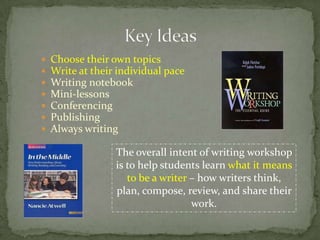
 Choose their own topics
 Write at their individual pace
 Writing notebook
 Mini-lessons
 Conferencing
 Publishing
 Always writing
The overall intent of writing workshop
is to help students learn what it means
to be a writer – how writers think,
plan, compose, review, and share their
work.
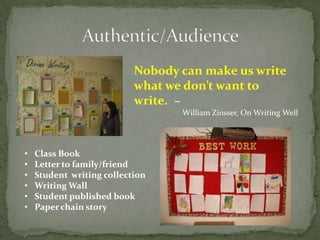
• Class Book
• Letter to family/friend
• Student writing collection
• Writing Wall
• Student published book
• Paper chain story
Nobody can make us write
what we don’t want to
write. ~
William Zinsser, On Writing Well
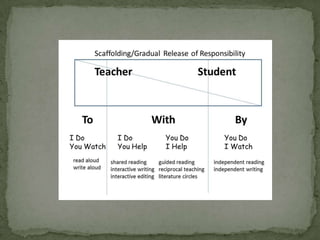
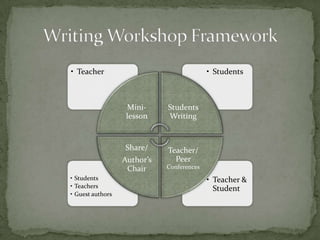
• Teacher &
Student
• Students
• Teachers
• Guest authors
• Students• Teacher
Mini-
lesson
Students
Writing
Teacher/
Peer
Conferences
Share/
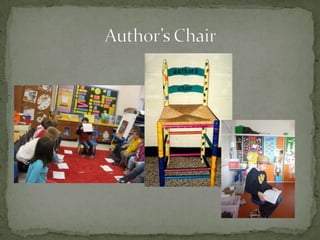
Author’s
Chair
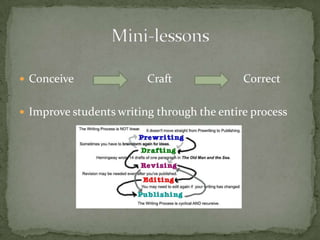
 Conceive Craft Correct
 Improve students writing through the entire process
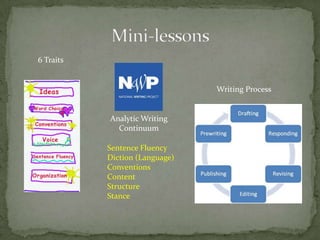
Writing Process
6 Traits
Analytic Writing
Continuum
Sentence Fluency
Diction (Language)
Conventions
Content
Structure
Stance
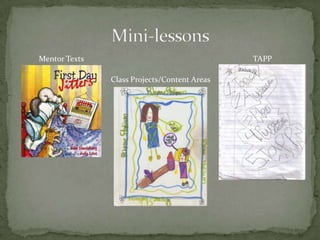
Mentor Texts
Class Projects/Content Areas
TAPP
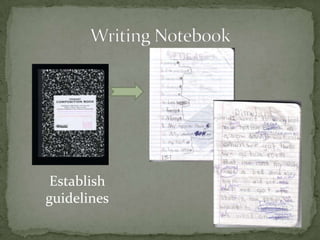
Establish
guidelines
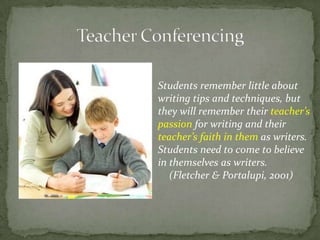
Students remember little about
writing tips and techniques, but
they will remember their teacher’s
passion for writing and their
teacher’s faith in them as writers.
Students need to come to believe
in themselves as writers.
(Fletcher & Portalupi, 2001)
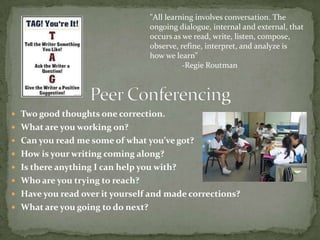
 Two good thoughts one correction.
 What are you working on?
 Can you read me some of what you’ve got?
 How is your writing coming along?
 Is there anything I can help you with?
 Who are you trying to reach?
 Have you read over it yourself and made corrections?
 What are you going to do next?
"All learning involves conversation. The
ongoing dialogue, internal and external, that
occurs as we read, write, listen, compose,
observe, refine, interpret, and analyze is
how we learn"
-Regie Routman
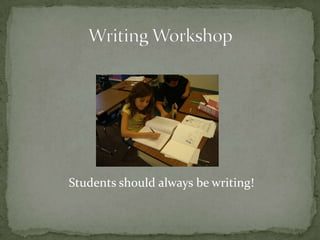
Students should always be writing!
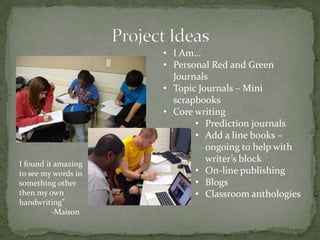
• I Am…
• Personal Red and Green
Journals
• Topic Journals – Mini
scrapbooks
• Core writing
• Prediction journals
• Add a line books –
ongoing to help with
writer’s block
• On-line publishing
• Blogs
• Classroom anthologies
I found it amazing
to see my words in
something other
then my own
handwriting”
-Maison
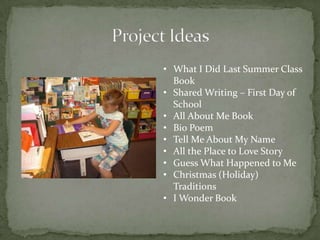
• What I Did Last Summer Class
Book
• Shared Writing – First Day of
School
• All About Me Book
• Bio Poem
• Tell Me About My Name
• All the Place to Love Story
• Guess What Happened to Me
• Christmas (Holiday)
Traditions
• I Wonder Book
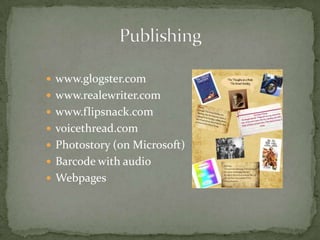
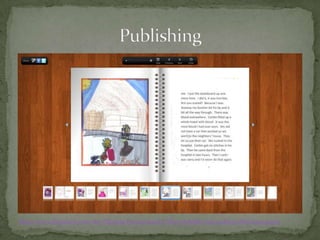
 www.glogster.com
 www.realewriter.com
 www.flipsnack.com
 voicethread.com
 Photostory (on Microsoft)
 Barcode with audio
 Webpages
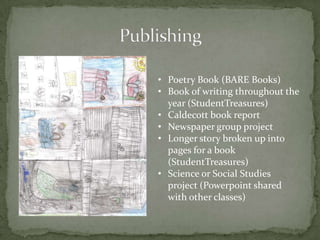
• Poetry Book (BARE Books)
• Book of writing throughout the
year (StudentTreasures)
• Caldecott book report
• Newspaper group project
• Longer story broken up into
pages for a book
(StudentTreasures)
• Science or Social Studies
project (Powerpoint shared
with other classes)
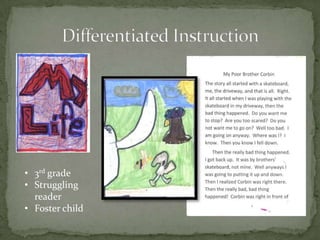
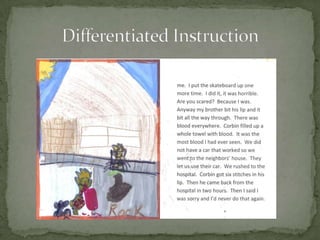
• 3rd grade
• Struggling
reader
• Foster child
http://www.flipsnack.com/my-flipping-books/details/?flip=3bf5dbc72d2342b84178bf0d4q442978
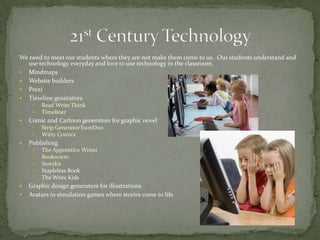
We need to meet our students where they are not make them come to us. Our students understand and
use technology everyday and love to use technology in the classroom.
 Mindmaps
 Website builders
 Prezi
 Timeline generators
 Read Write Think
 Timeliner
 Comic and Cartoon generators for graphic novel
 Strip GeneratorToonDoo
 Witty Comics
 Publishing
 The Apprentice Writer
 Bookworm
 Storykit
 Stapleless Book
 The Write Kids
 Graphic design generators for illustrations
 Avatars in simulation games where stories come to life
Polly Vaughan
Marla Robertson
Literacy
Reading
Writing
Listening
Speaking

Askew winning writers workshop 2012

  • 1.
  • 3.
    Reading is breathing in. Writingis breathing out. Lucy Calkins
  • 4.
  • 5.
     Writer’s Workshopworks because it is based on the idea that students learn to write best when they write frequently, for extended periods of time, on topics of their own choosing.  Students write more  Each student in the class is considered to be a working author with the intent of perfecting their craft and publishing their works.  Students decide writing isn’t as difficult as they have been lead to believe.  The teacher is a writing professional and peer coach, guiding authors as they explore their craft.  Students begin to enjoy writing.  Students gain a disposition to write and gain an understanding of the mechanics of writing in such a way that is not mechanical.
  • 7.
     Choose theirown topics  Write at their individual pace  Writing notebook  Mini-lessons  Conferencing  Publishing  Always writing The overall intent of writing workshop is to help students learn what it means to be a writer – how writers think, plan, compose, review, and share their work.
  • 8.
    • Class Book •Letter to family/friend • Student writing collection • Writing Wall • Student published book • Paper chain story Nobody can make us write what we don’t want to write. ~ William Zinsser, On Writing Well
  • 9.
    • Teacher & Student •Students • Teachers • Guest authors • Students• Teacher Mini- lesson Students Writing Teacher/ Peer Conferences Share/ Author’s Chair
  • 10.
     Conceive CraftCorrect  Improve students writing through the entire process
  • 11.
    Writing Process 6 Traits AnalyticWriting Continuum Sentence Fluency Diction (Language) Conventions Content Structure Stance
  • 12.
  • 13.
  • 14.
    Students remember littleabout writing tips and techniques, but they will remember their teacher’s passion for writing and their teacher’s faith in them as writers. Students need to come to believe in themselves as writers. (Fletcher & Portalupi, 2001)
  • 15.
     Two goodthoughts one correction.  What are you working on?  Can you read me some of what you’ve got?  How is your writing coming along?  Is there anything I can help you with?  Who are you trying to reach?  Have you read over it yourself and made corrections?  What are you going to do next? "All learning involves conversation. The ongoing dialogue, internal and external, that occurs as we read, write, listen, compose, observe, refine, interpret, and analyze is how we learn" -Regie Routman
  • 17.
  • 19.
    • I Am… •Personal Red and Green Journals • Topic Journals – Mini scrapbooks • Core writing • Prediction journals • Add a line books – ongoing to help with writer’s block • On-line publishing • Blogs • Classroom anthologies I found it amazing to see my words in something other then my own handwriting” -Maison
  • 20.
    • What IDid Last Summer Class Book • Shared Writing – First Day of School • All About Me Book • Bio Poem • Tell Me About My Name • All the Place to Love Story • Guess What Happened to Me • Christmas (Holiday) Traditions • I Wonder Book
  • 21.
     www.glogster.com  www.realewriter.com www.flipsnack.com  voicethread.com  Photostory (on Microsoft)  Barcode with audio  Webpages
  • 22.
    • Poetry Book(BARE Books) • Book of writing throughout the year (StudentTreasures) • Caldecott book report • Newspaper group project • Longer story broken up into pages for a book (StudentTreasures) • Science or Social Studies project (Powerpoint shared with other classes)
  • 24.
    • 3rd grade •Struggling reader • Foster child
  • 26.
  • 27.
    We need tomeet our students where they are not make them come to us. Our students understand and use technology everyday and love to use technology in the classroom.  Mindmaps  Website builders  Prezi  Timeline generators  Read Write Think  Timeliner  Comic and Cartoon generators for graphic novel  Strip GeneratorToonDoo  Witty Comics  Publishing  The Apprentice Writer  Bookworm  Storykit  Stapleless Book  The Write Kids  Graphic design generators for illustrations  Avatars in simulation games where stories come to life
  • 31.

Editor's Notes

  • #3 Both introduce ourselves – give a little bit of general background and then writing workshop background
  • #4 Polly - Importance of writing in the curriculum – more time – all across the day
  • #5 Marla - Perfect place in the day for all components of literacy
  • #6 Polly
  • #7 Marla
  • #8 Polly
  • #9 Marla
  • #10 Polly
  • #11 Marla? – I will work on this one
  • #12 Polly
  • #13 Marla – talk about conversations during mini-lessons – Teacher write-aloud – shared writing, etc.
  • #14 Polly – I moved the TAPP page to the screen before – you can add something in here or change this screen however you want
  • #15 Marla
  • #16 Polly – change the quote to something about peer conferencing – you can pick a different picture if you want – this was just an idea
  • #17 Marla
  • #18 Polly – never “I’m done”
  • #19 Marla – often will get personal – creates a safe environment - talk about Polly’s idea of red card/ green card
  • #20 Polly’s Page – things her classes have done
  • #21 Marla’s Page
  • #22 Polly’s Page – these are technology ideas
  • #23 Marla’s Page – more traditional avenues? - paper
  • #24 Polly to add student work – maybe Spec Ed students? – can add more screens if needed
  • #25 Marla student work
  • #26 Marla student work
  • #27 Marla student work
  • #28 Polly - Technology – ways to write as well as publish
  • #29 Marla Literacy Framework
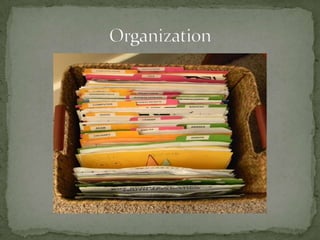
  • #30 Polly – organization – saving student work
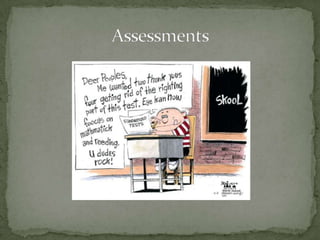
  • #31 Marla – writing assessments – STAAR – report card grades