Challenge Based
 Learning 101
      Cynthia Treichler
  Prince William County Schools
         Wilkes University
          @cbrown426
  cynthia.treichler@gmail.com
CBL in a Nutshell
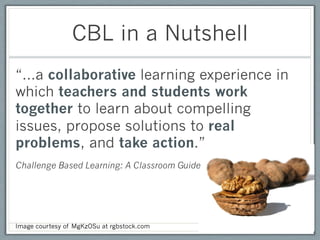
“…a collaborative learning experience in
which teachers and students work
together to learn about compelling
issues, propose solutions to real
problems, and take action.”
Challenge Based Learning: A Classroom Guide


Image courtesy of MgKzOSu at rgbstock.com
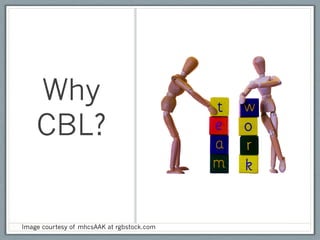
Why
    CBL?


Image courtesy of mhcsAAK at rgbstock.com
Challenges


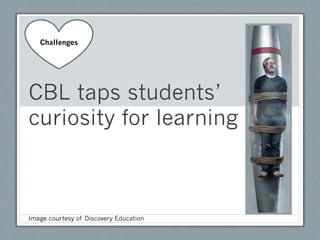
CBL taps students’
curiosity for learning


Image courtesy of Discovery Education
CBL Provides…
 •  A flexible framework with multiple entry points
    and varied solutions
 •  A focus on global challenges with local solutions
 •  An authentic connection to multiple disciplines
 •  An opportunity to work collaboratively and hone
    21st century skills and habits of mind


Johnson, Laurence F Smith, Rachel S.; Smythe, J. Troy; Varon, Rachel K. (2009).
                   .;
   Challenge-Based Learning: An Approach for Our Time. Austin, Texas: The New Media Consortium.
Image courtesy of ddpavumba at FreeDigitalPhotos.net
CBL Provides…
 •  The opportunity for students to guide learning and
    take action

 •  The documentation of the learning experience from
    challenge to solution

 •  24/7 access to up-to-date technology tools and
    resources so students can do their work

 •  The opportunity for the teacher to act as facilitator


Johnson, Laurence F Smith, Rachel S.; Smythe, J. Troy; Varon, Rachel K. (2009).
                   .;
   Challenge-Based Learning: An Approach for Our Time. Austin, Texas: The New Media Consortium.
Image courtesy of ddpavumba at FreeDigitalPhotos.net
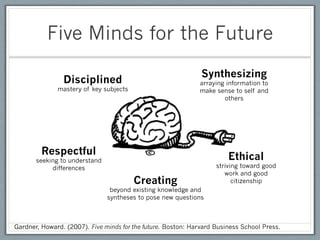
Five Minds for the Future
                                                               Synthesizing
                Disciplined                                   arraying information to
              mastery of key subjects                         make sense to self and
                                                                      others


         Respectful
       seeking to understand                                            Ethical
            differences                                             striving toward good
                                                                       work and good
                                        Creating                          citizenship
                                beyond existing knowledge and
                               syntheses to pose new questions


Gardner, Howard. (2007). Five minds for the future. Boston: Harvard Business School Press.
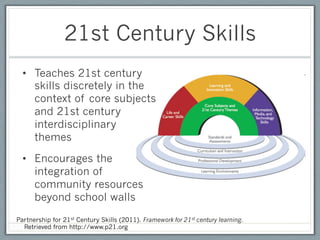
21st Century Skills
  •  Teaches 21st century
     skills discretely in the
     context of core subjects
     and 21st century
     interdisciplinary
     themes

  •  Encourages the
     integration of
     community resources
     beyond school walls
Partnership for 21st Century Skills (2011). Framework for 21st century learning.
  Retrieved from http://www.p21.org
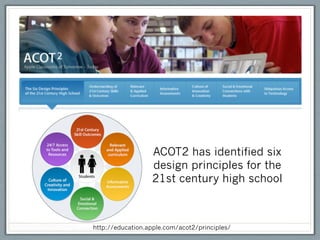
ACOT2 has identified six
                  design principles for the
                  21st century high school


http://education.apple.com/acot2/principles/
“Educators must become more than
information experts; they must also
be collaborators in learning…
seeking new knowledge alongside
students, and modeling positive
habits of mind and new ways of
thinking and learning.”
            Apple Classrooms of Tomorrow - Today
The Shift


                   Consuming                                Producing
                     Authority                            Transparency
                      Expert                                Facilitator
            Access to Information                      Access to People
                      Passive                              Passionate
                  Presentation                            Participation
               Formal Schooling                        Lifelong Learning

Hargadon, S. (2008, March 4). Web 2.0 is the future of education [Web log message].
   Retrieved from http://www.stevehargadon.com/2008/03/web-20-is-future-of-education.html
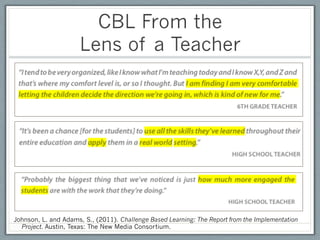
CBL From the
                      Lens of a Teacher


Johnson, L. and Adams, S., (2011). Challenge Based Learning: The Report from the Implementation
  Project. Austin, Texas: The New Media Consortium.	
  
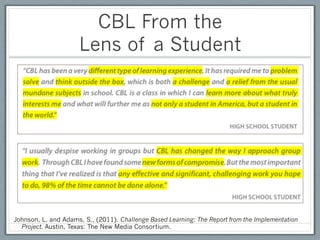
CBL From the
                     Lens of a Student


Johnson, L. and Adams, S., (2011). Challenge Based Learning: The Report from the Implementation
  Project. Austin, Texas: The New Media Consortium.	
  
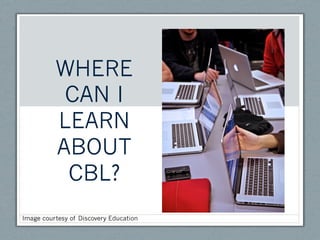
WHERE
           CAN I
          LEARN
          ABOUT
           CBL?
Image courtesy of Discovery Education
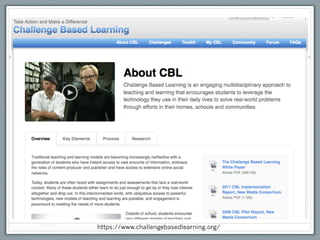
https://www.challengebasedlearning.org/
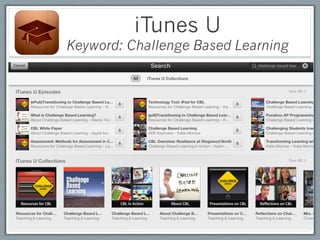
iTunes U
Keyword: Challenge Based Learning
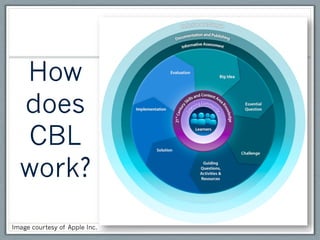
How
  does
  CBL
  work?
Image courtesy of Apple Inc.
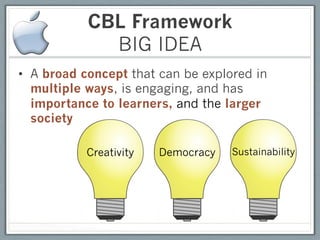
CBL Framework
             BIG IDEA
•  A broad concept that can be explored in
   multiple ways, is engaging, and has
   importance to learners, and the larger
   society

           Creativity   Democracy   Sustainability
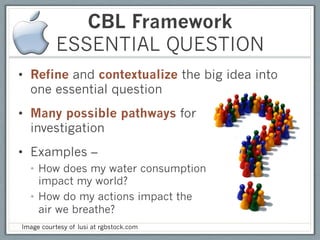
CBL Framework
           ESSENTIAL QUESTION
•  Refine and contextualize the big idea into
   one essential question
•  Many possible pathways for
   investigation
•  Examples –
  •  How does my water consumption
     impact my world?
  •  How do my actions impact the
     air we breathe?
Image courtesy of lusi at rgbstock.com
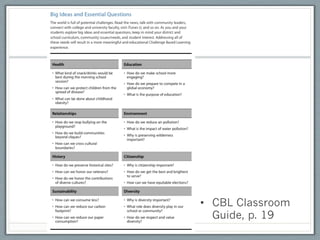
•  CBL Classroom
   Guide, p. 19
CBL Framework
           CHALLENGE

•  Asks learners to create a specific
   solution that can result in concrete,
   meaningful action.
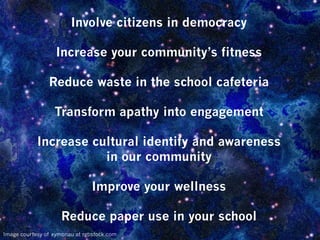
Involve citizens in democracy

                   Increase your community’s fitness

                Reduce waste in the school cafeteria

                  Transform apathy into engagement

            Increase cultural identify and awareness
                       in our community

                                Improve your wellness

                    Reduce paper use in your school
Image courtesy of xymonau at rgbstock.com
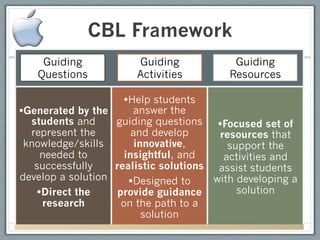
CBL Framework
    Guiding            Guiding             Guiding
   Questions           Activities         Resources

                     ŸHelp students
ŸGenerated by the       answer the
   students and    guiding questions ŸFocused set of
   represent the        and develop     resources that
  knowledge/skills       innovative,      support the
     needed to       insightful, and     activities and
    successfully   realistic solutions assist students
develop a solution     ŸDesigned to   with developing a
    ŸDirect the   provide guidance         solution
      research      on the path to a
                           solution
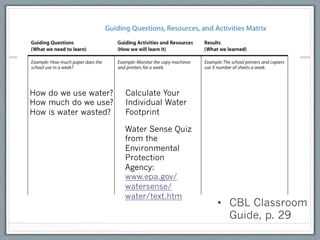
How do we use water?   Calculate Your
How much do we use?    Individual Water
How is water wasted?   Footprint

                       Water Sense Quiz
                       from the
                       Environmental
                       Protection
                       Agency:
                       www.epa.gov/
                       watersense/
                       water/text.htm
                                          •  CBL Classroom
                                             Guide, p. 29
CBL Framework
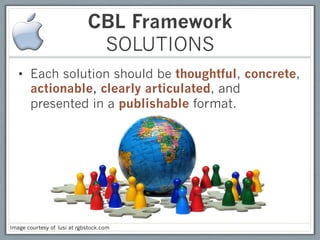
                              SOLUTIONS
   •  Each solution should be thoughtful, concrete,
      actionable, clearly articulated, and
      presented in a publishable format.


Image courtesy of lusi at rgbstock.com
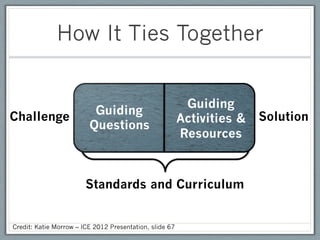
How It Ties Together


                                                          Guiding
Challenge                 Guiding                                       Solution
                                                         Activities &
                         Questions
                                                         Resources


                        Standards and Curriculum


Credit: Katie Morrow – ICE 2012 Presentation, slide 67
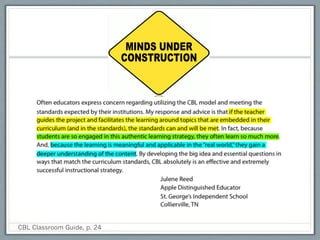
CBL Classroom Guide, p. 24
CBL Framework
               ASSESSMENT
•  How will the process be assessed?
  •  Assessing the individual and team process helps
     capture the development of 21st century skills

•  How will the solution be assessed?
  •  Assess solutions for: connection to the challenge;
     accuracy of the content; clarity of communication;
     applicability for implementation; and efficacy of the
     idea
CBL Framework
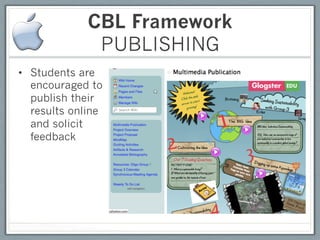
               PUBLISHING
•  Students are
   encouraged to
   publish their
   results online
   and solicit
   feedback
CBL Exemplar
         Big Idea: Democracy
•  Essential Question:
  •  How do we foster participation by
     all citizens in democracy?

•  The Challenge:
  •  Increase the involvement of all citizens in democracy.

•  Guiding Questions:
  •  What are the responsibilities of a citizen?
  •  What are the key elements of a democracy?
  •  What does it mean to be involved in democracy?
CBL Exemplar
            Big Idea: Democracy
•  Guiding Activities:
  •  Research the various definitions of citizenship
     throughout history.
  •  Develop a matrix of citizenship responsibilities.
  •  Interview local and state officials on their definitions of
     democracy.

•  Guiding Resources:
  •  Lynn University 2012 Debate iTunesU Curriculum
     (all grade levels targeted)
    •  http://www.challengebasedlearning.org/download-file/k-12-debate-curriculum.pdf/
       ffae6a41.pdf
CBL Exemplar
         Big Idea: Democracy
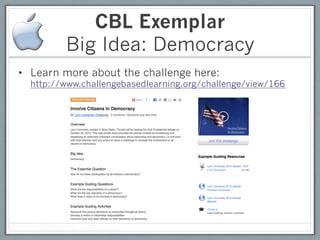
•  Learn more about the challenge here:
  http://www.challengebasedlearning.org/challenge/view/166
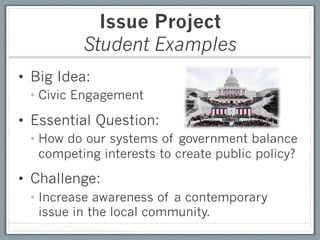
Issue Project
          Student Examples
•  Big Idea:
 •  Civic Engagement

•  Essential Question:
 •  How do our systems of government balance
    competing interests to create public policy?

•  Challenge:
 •  Increase awareness of a contemporary
    issue in the local community.
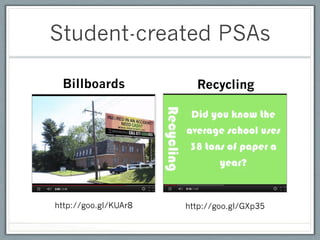
Student-created PSAs

 Billboards             Recycling


http://goo.gl/KUAr8   http://goo.gl/GXp35
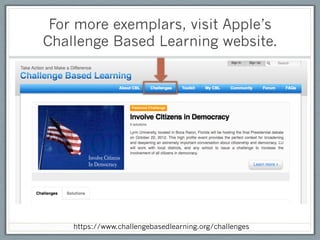
For more exemplars, visit Apple’s
Challenge Based Learning website.


    https://www.challengebasedlearning.org/challenges
•  Grade Levels:
  •  K – 5 | 6 – 8 | 9 – 12

•  Timeline:
  •  September 15, 2012 – March 5, 2013

•  Prizes Can Include: $5,000 school grants, assemblies
   with Discovery Channel talent, green prize packs, and
   more!

•  How to Enter: Register online and access free resources,
   lesson plans, videos, interactive labs and more.
   •  http://wecanchange.discoveryeducation.com/registration/
                        www.WeCanChange.com
There are multiple entry points within
 CBL, and this provides YOU with the
 flexibility to create a challenge that
  meets the needs of your students.
Share Your Ideas


              http://goo.gl/jV7lh
Image courtesy of rgbstock.com
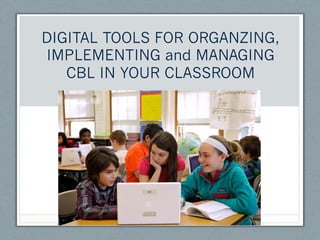
DIGITAL TOOLS FOR ORGANZING,
IMPLEMENTING and MANAGING
   CBL IN YOUR CLASSROOM
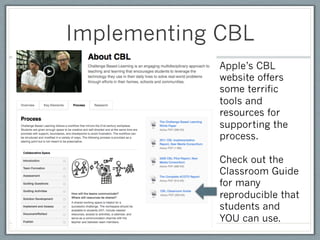
Implementing CBL
             Apple’s CBL
             website offers
             some terrific
             tools and
             resources for
             supporting the
             process.

             Check out the
             Classroom Guide
             for many
             reproducible that
             students and
             YOU can use.
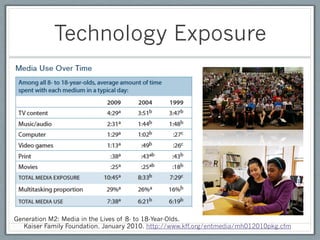
Technology Exposure


Generation M2: Media in the Lives of 8- to 18-Year-Olds.
   Kaiser Family Foundation. January 2010. http://www.kff.org/entmedia/mh012010pkg.cfm
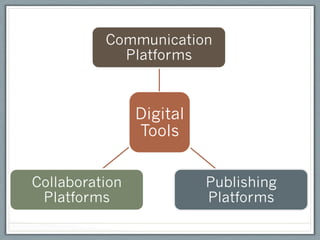
Communication
            Platforms


                Digital
                Tools


Collaboration             Publishing
 Platforms                Platforms
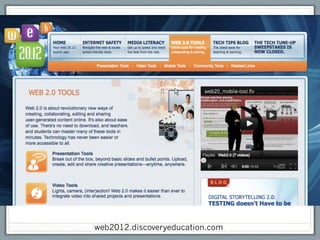
web2012.discoveryeducation.com
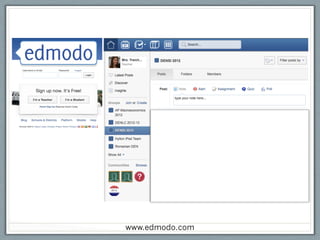
www.edmodo.com
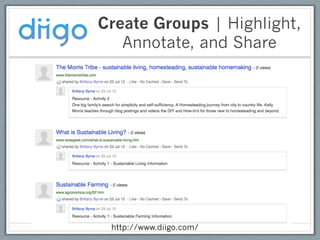
Create Groups | Highlight,
   Annotate, and Share


 http://www.diigo.com/
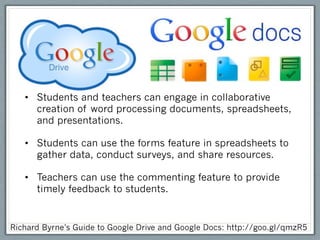
•  Students and teachers can engage in collaborative
      creation of word processing documents, spreadsheets,
      and presentations.

   •  Students can use the forms feature in spreadsheets to
      gather data, conduct surveys, and share resources.

   •  Teachers can use the commenting feature to provide
      timely feedback to students.


Richard Byrne’s Guide to Google Drive and Google Docs: http://goo.gl/qmzR5
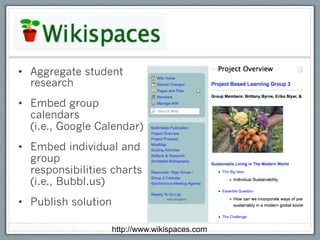
•  Aggregate student
   research
•  Embed group
   calendars
   (i.e., Google Calendar)
•  Embed individual and
   group
   responsibilities charts
   (i.e., Bubbl.us)
•  Publish solution

                      http://www.wikispaces.com
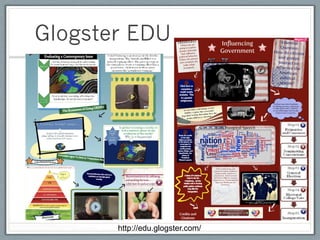
Glogster EDU


       http://edu.glogster.com/
I
CHALLENGE
   YOU
  TO ACT!
Cynthia Treichler
          @cbrown426
  cynthia.treichler@gmail.com

Resources | http://goo.gl/HYx9a
Credits
•  http://www.discoveryeducation.com

•  http://www.rgbstock.com/

•  http://www.freedigitalphotos.net/

•  https://www.challengebasedlearning.org/

•  http://education.apple.com/acot2/

•  http://teach42morrow.com/

•  http://jdorman.wikispaces.com/PBL

Challenge Based Learning

  • 1.
    Challenge Based Learning101 Cynthia Treichler Prince William County Schools Wilkes University @cbrown426 cynthia.treichler@gmail.com
  • 2.
    CBL in aNutshell “…a collaborative learning experience in which teachers and students work together to learn about compelling issues, propose solutions to real problems, and take action.” Challenge Based Learning: A Classroom Guide Image courtesy of MgKzOSu at rgbstock.com
  • 3.
    Why CBL? Image courtesy of mhcsAAK at rgbstock.com
  • 4.
    Challenges CBL taps students’ curiosityfor learning Image courtesy of Discovery Education
  • 5.
    CBL Provides… • A flexible framework with multiple entry points and varied solutions •  A focus on global challenges with local solutions •  An authentic connection to multiple disciplines •  An opportunity to work collaboratively and hone 21st century skills and habits of mind Johnson, Laurence F Smith, Rachel S.; Smythe, J. Troy; Varon, Rachel K. (2009). .; Challenge-Based Learning: An Approach for Our Time. Austin, Texas: The New Media Consortium. Image courtesy of ddpavumba at FreeDigitalPhotos.net
  • 6.
    CBL Provides… • The opportunity for students to guide learning and take action •  The documentation of the learning experience from challenge to solution •  24/7 access to up-to-date technology tools and resources so students can do their work •  The opportunity for the teacher to act as facilitator Johnson, Laurence F Smith, Rachel S.; Smythe, J. Troy; Varon, Rachel K. (2009). .; Challenge-Based Learning: An Approach for Our Time. Austin, Texas: The New Media Consortium. Image courtesy of ddpavumba at FreeDigitalPhotos.net
  • 7.
    Five Minds forthe Future Synthesizing Disciplined arraying information to mastery of key subjects make sense to self and others Respectful seeking to understand Ethical differences striving toward good work and good Creating citizenship beyond existing knowledge and syntheses to pose new questions Gardner, Howard. (2007). Five minds for the future. Boston: Harvard Business School Press.
  • 8.
    21st Century Skills •  Teaches 21st century skills discretely in the context of core subjects and 21st century interdisciplinary themes •  Encourages the integration of community resources beyond school walls Partnership for 21st Century Skills (2011). Framework for 21st century learning. Retrieved from http://www.p21.org
  • 9.
    ACOT2 has identifiedsix design principles for the 21st century high school http://education.apple.com/acot2/principles/
  • 10.
    “Educators must becomemore than information experts; they must also be collaborators in learning… seeking new knowledge alongside students, and modeling positive habits of mind and new ways of thinking and learning.” Apple Classrooms of Tomorrow - Today
  • 11.
    The Shift Consuming Producing Authority Transparency Expert Facilitator Access to Information Access to People Passive Passionate Presentation Participation Formal Schooling Lifelong Learning Hargadon, S. (2008, March 4). Web 2.0 is the future of education [Web log message]. Retrieved from http://www.stevehargadon.com/2008/03/web-20-is-future-of-education.html
  • 12.
    CBL From the Lens of a Teacher Johnson, L. and Adams, S., (2011). Challenge Based Learning: The Report from the Implementation Project. Austin, Texas: The New Media Consortium.  
  • 13.
    CBL From the Lens of a Student Johnson, L. and Adams, S., (2011). Challenge Based Learning: The Report from the Implementation Project. Austin, Texas: The New Media Consortium.  
  • 14.
    WHERE CAN I LEARN ABOUT CBL? Image courtesy of Discovery Education
  • 15.
  • 16.
  • 17.
    How does CBL work? Image courtesy of Apple Inc.
  • 18.
    CBL Framework BIG IDEA •  A broad concept that can be explored in multiple ways, is engaging, and has importance to learners, and the larger society Creativity Democracy Sustainability
  • 19.
    CBL Framework ESSENTIAL QUESTION •  Refine and contextualize the big idea into one essential question •  Many possible pathways for investigation •  Examples – •  How does my water consumption impact my world? •  How do my actions impact the air we breathe? Image courtesy of lusi at rgbstock.com
  • 20.
  • 21.
    CBL Framework CHALLENGE •  Asks learners to create a specific solution that can result in concrete, meaningful action.
  • 22.
    Involve citizens indemocracy Increase your community’s fitness Reduce waste in the school cafeteria Transform apathy into engagement Increase cultural identify and awareness in our community Improve your wellness Reduce paper use in your school Image courtesy of xymonau at rgbstock.com
  • 23.
    CBL Framework Guiding Guiding Guiding Questions Activities Resources ŸHelp students ŸGenerated by the answer the students and guiding questions ŸFocused set of represent the and develop resources that knowledge/skills innovative, support the needed to insightful, and activities and successfully realistic solutions assist students develop a solution ŸDesigned to with developing a ŸDirect the provide guidance solution research on the path to a solution
  • 24.
    How do weuse water? Calculate Your How much do we use? Individual Water How is water wasted? Footprint Water Sense Quiz from the Environmental Protection Agency: www.epa.gov/ watersense/ water/text.htm •  CBL Classroom Guide, p. 29
  • 25.
    CBL Framework SOLUTIONS •  Each solution should be thoughtful, concrete, actionable, clearly articulated, and presented in a publishable format. Image courtesy of lusi at rgbstock.com
  • 26.
    How It TiesTogether Guiding Challenge Guiding Solution Activities & Questions Resources Standards and Curriculum Credit: Katie Morrow – ICE 2012 Presentation, slide 67
  • 27.
  • 28.
    CBL Framework ASSESSMENT •  How will the process be assessed? •  Assessing the individual and team process helps capture the development of 21st century skills •  How will the solution be assessed? •  Assess solutions for: connection to the challenge; accuracy of the content; clarity of communication; applicability for implementation; and efficacy of the idea
  • 29.
    CBL Framework PUBLISHING •  Students are encouraged to publish their results online and solicit feedback
  • 30.
    CBL Exemplar Big Idea: Democracy •  Essential Question: •  How do we foster participation by all citizens in democracy? •  The Challenge: •  Increase the involvement of all citizens in democracy. •  Guiding Questions: •  What are the responsibilities of a citizen? •  What are the key elements of a democracy? •  What does it mean to be involved in democracy?
  • 31.
    CBL Exemplar Big Idea: Democracy •  Guiding Activities: •  Research the various definitions of citizenship throughout history. •  Develop a matrix of citizenship responsibilities. •  Interview local and state officials on their definitions of democracy. •  Guiding Resources: •  Lynn University 2012 Debate iTunesU Curriculum (all grade levels targeted) •  http://www.challengebasedlearning.org/download-file/k-12-debate-curriculum.pdf/ ffae6a41.pdf
  • 32.
    CBL Exemplar Big Idea: Democracy •  Learn more about the challenge here: http://www.challengebasedlearning.org/challenge/view/166
  • 33.
    Issue Project Student Examples •  Big Idea: •  Civic Engagement •  Essential Question: •  How do our systems of government balance competing interests to create public policy? •  Challenge: •  Increase awareness of a contemporary issue in the local community.
  • 34.
    Student-created PSAs Billboards Recycling http://goo.gl/KUAr8 http://goo.gl/GXp35
  • 35.
    For more exemplars,visit Apple’s Challenge Based Learning website. https://www.challengebasedlearning.org/challenges
  • 36.
    •  Grade Levels: •  K – 5 | 6 – 8 | 9 – 12 •  Timeline: •  September 15, 2012 – March 5, 2013 •  Prizes Can Include: $5,000 school grants, assemblies with Discovery Channel talent, green prize packs, and more! •  How to Enter: Register online and access free resources, lesson plans, videos, interactive labs and more. •  http://wecanchange.discoveryeducation.com/registration/ www.WeCanChange.com
  • 37.
    There are multipleentry points within CBL, and this provides YOU with the flexibility to create a challenge that meets the needs of your students.
  • 38.
    Share Your Ideas http://goo.gl/jV7lh Image courtesy of rgbstock.com
  • 39.
    DIGITAL TOOLS FORORGANZING, IMPLEMENTING and MANAGING CBL IN YOUR CLASSROOM
  • 40.
    Implementing CBL Apple’s CBL website offers some terrific tools and resources for supporting the process. Check out the Classroom Guide for many reproducible that students and YOU can use.
  • 41.
    Technology Exposure Generation M2:Media in the Lives of 8- to 18-Year-Olds. Kaiser Family Foundation. January 2010. http://www.kff.org/entmedia/mh012010pkg.cfm
  • 42.
    Communication Platforms Digital Tools Collaboration Publishing Platforms Platforms
  • 43.
  • 44.
  • 45.
    Create Groups |Highlight, Annotate, and Share http://www.diigo.com/
  • 46.
    •  Students andteachers can engage in collaborative creation of word processing documents, spreadsheets, and presentations. •  Students can use the forms feature in spreadsheets to gather data, conduct surveys, and share resources. •  Teachers can use the commenting feature to provide timely feedback to students. Richard Byrne’s Guide to Google Drive and Google Docs: http://goo.gl/qmzR5
  • 47.
    •  Aggregate student research •  Embed group calendars (i.e., Google Calendar) •  Embed individual and group responsibilities charts (i.e., Bubbl.us) •  Publish solution http://www.wikispaces.com
  • 48.
    Glogster EDU http://edu.glogster.com/
  • 49.
    I CHALLENGE YOU TO ACT!
  • 50.
    Cynthia Treichler @cbrown426 cynthia.treichler@gmail.com Resources | http://goo.gl/HYx9a
  • 51.
    Credits •  http://www.discoveryeducation.com •  http://www.rgbstock.com/ • http://www.freedigitalphotos.net/ •  https://www.challengebasedlearning.org/ •  http://education.apple.com/acot2/ •  http://teach42morrow.com/ •  http://jdorman.wikispaces.com/PBL