HISTORY
OF LIFE ON
EARTH
P R E P A R E D B Y :
M S . K I M B E R L Y J O Y C . A S T O R G A
S U B J E C T T E A C H E R
OBJECTIVES
• Identify the dates and sequence of the periods in the geologic time scale;
• Identify the major events in each major period;
• Describe the characteristics of the major groups of organisms’ presents
during a time period;
• Identify types of fossils; and
• Describe causes of mass extinctions.
Geologic Time Scale/
GTS
What does the time scale represent?
 The geologic time scale divides up the
history of the earth based on life-forms that
have existed during specific times since the
creation of the planet. These divisions are
called geochronologic units (geo: rock,
chronology: time).
Principles
Behind
Geological
Time Scale
STENO’S LAWS
 Nicholas Steno, a Danish physician (1638-1687), described how the
position of a rock layer could be used to show the relative age of the
layer.
 The Principle Of Superposition: The layer on the bottom was
deposited first and so is the oldest
 The Principle Of Horizontality: All rock layers were originally
deposited horizontally.
 The Principle Of Original Lateral Continuity: Originally deposited
layers of rock extend laterally in all directions until either thinning
out or being cut off by a different rock layer.
Relative Age Dating
• “Relative age” means the age of one object
compared to the age of another, not the exact age
of an object.
• Index Fossils are widespread, throughout their
geographic and geologic ranges, and are easily
recognized (unique).
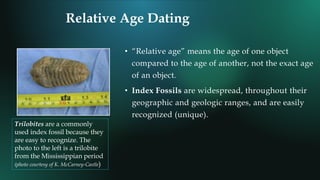
Trilobites are a commonly
used index fossil because they
are easy to recognize. The
photo to the left is a trilobite
from the Mississippian period
(photo courtesy of K. McCarney-Castle)
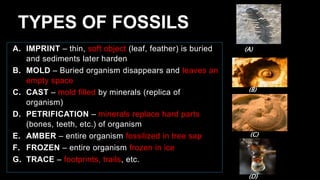
A. IMPRINT – thin, soft object (leaf, feather) is buried
and sediments later harden
B. MOLD – Buried organism disappears and leaves an
empty space
C. CAST – mold filled by minerals (replica of
organism)
D. PETRIFICATION – minerals replace hard parts
(bones, teeth, etc.) of organism
E. AMBER – entire organism fossilized in tree sap
F. FROZEN – entire organism frozen in ice
G. TRACE – footprints, trails, etc.
TYPES OF FOSSILS
(A)
(B)
(C)
(D)
Absolute Age Dating
• Absolute ages, or geochronometric ages, of rock can be
assigned to the geologic time scale on the basis of properties of
atoms that make up the minerals of a rock.
• Unlike relative dating, which relies on sequencing of rock
layers (i.e. younger vs. older), absolute dating can produce an
actual age in years.
Three Mechanisms:
 Radioactive Decay
 Radiocarbon Dating
 Uranium-Lead decay series (U-Pb series)
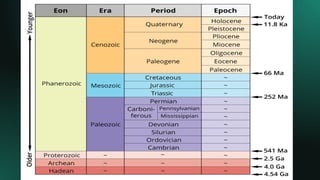
The Geologic Time Scale is divided by the following
divisions:
 EONS: Longest subdivision; based on the abundance of certain
fossils
 ERAS: Next to longest subdivision; marked by major changes
in the fossil record
 PERIODS: Based on types of life existing at the time
 EPOCHS: Shortest subdivision; marked by differences in
life forms and can vary from continent to continent.
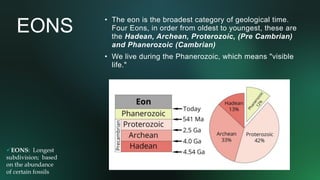
EONS
• The eon is the broadest category of geological time.
Four Eons, in order from oldest to youngest, these are
the Hadean, Archean, Proterozoic, (Pre Cambrian)
and Phanerozoic (Cambrian)
• We live during the Phanerozoic, which means "visible
life."
EONS: Longest
subdivision; based
on the abundance
of certain fossils
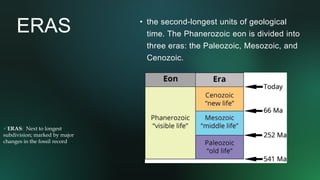
ERAS • the second-longest units of geological
time. The Phanerozoic eon is divided into
three eras: the Paleozoic, Mesozoic, and
Cenozoic.
ERAS: Next to longest
subdivision; marked by major
changes in the fossil record
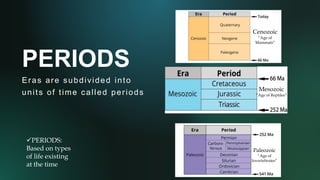
PERIODS
Eras are subdivided into
units of time called periods
PERIODS:
Based on types
of life existing
at the time
Paleozoic
“Age of
Invertebrates”
Mesozoic
“Age of Reptiles”
Cenozoic
“Age of
Mammals”
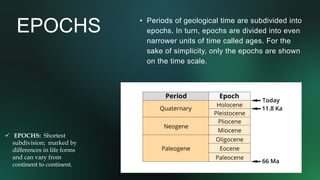
EPOCHS • Periods of geological time are subdivided into
epochs. In turn, epochs are divided into even
narrower units of time called ages. For the
sake of simplicity, only the epochs are shown
on the time scale.
 EPOCHS: Shortest
subdivision; marked by
differences in life forms
and can vary from
continent to continent.
Eons:
Precambrian: Earliest span of time
Phanerozoic: Everything since
Eras:
Paleozoic
Mesozoic
Cenozoic
Periods:
Cambrian
Ordovician
Silurian
Devonian
Carboniferous
(Missipp. & Pennsylvanian)
Permian
Triassic
Jurassic
Cretaceous
Paleogene
Neogene
Quaternary
Epochs:
Paleocene
Eocene
Oligocene
Miocene
Pliocene
Pleistocene
Holocene
We are living in the Phanerozoic Eon, Cenozoic Era,
Quaternary Period, Holocene Epoch……..BUT
Paleozoic
“Age of
Invertebrates”
Mesozoic
“Age of Reptiles”
Cenozoic
“Age of
Mammals”
17
ANTHROPOCENE EPOCH
A new concept has been gaining momentum since it’s
introduction by Paul Crutzen in 2000. He proposed that the
Holocene Epoch is over and a new geological epoch called the
Anthropocene has begun.
Mans’ impact on the Earth’s climate and ecosystems since the
Industrial Revolution is quite evident. Support for this theory
comes from data derived from glacial ice cores showing the
growth in greenhouse gases starting from the 1800’s.
Extinction
• Extinction is a part of life, and
animals and plants disappear all
the time. About 98% of all the
organisms that have ever existed
on our planet are now extinct.
• A mass extinction event is when
species vanish much faster than
they are replaced. This is usually
defined as about 75% of the
world's species being lost in a
'short' amount of geological time -
less than 2.8 million years.
How many mass
extinctions have there
been?
• The ORDOVICIAN-SILURIAN mass extinction
occurred 443 million years ago and wiped out
approximately 85% of all species. Scientists think
it was caused by temperatures plummeting and
huge glaciers forming, which caused sea levels to
drop dramatically. This was followed by a period
of rapid warming.
• The DEVONIAN mass extinction event took place
374 million years ago and killed about three-
quarters of the world's species, most of which
were marine invertebrates that lived at the bottom
of the sea. This was a period of many
environmental changes.
• The PERMIAN mass extinction, which happened 250 million
years ago, was the largest and most devastating event of the
five. Also known as the Great Dying, it eradicated more than
95% of all species, including most of the vertebrates which had
begun to evolve by this time. Some scientists think Earth was hit
by a large asteroid which filled the air with dust particles that
blocked out the Sun and caused acid rain.
• The TRIASSIC mass extinction event took place 200 million
years ago, eliminating about 80% of Earth's species, including
many types of dinosaurs. This was probably caused by colossal
geological activity that increased carbon dioxide levels and
global temperatures, as well as ocean acidification.
• The CRETACEOUS mass extinction event occurred 65 million
years ago, killing 78% of all species, including the remaining
non-avian dinosaurs. This was most likely caused by an asteroid
hitting the Earth in what is now Mexico, potentially compounded
by ongoing flood volcanism in what is now India
“No matter how our chapter ends up,
we get to be characters in a truly
amazing story.”
END.
Geological Time Scale.pptx

Geological Time Scale.pptx

  • 1.
    HISTORY OF LIFE ON EARTH PR E P A R E D B Y : M S . K I M B E R L Y J O Y C . A S T O R G A S U B J E C T T E A C H E R
  • 2.
    OBJECTIVES • Identify thedates and sequence of the periods in the geologic time scale; • Identify the major events in each major period; • Describe the characteristics of the major groups of organisms’ presents during a time period; • Identify types of fossils; and • Describe causes of mass extinctions.
  • 4.
    Geologic Time Scale/ GTS Whatdoes the time scale represent?  The geologic time scale divides up the history of the earth based on life-forms that have existed during specific times since the creation of the planet. These divisions are called geochronologic units (geo: rock, chronology: time).
  • 5.
  • 6.
    STENO’S LAWS  NicholasSteno, a Danish physician (1638-1687), described how the position of a rock layer could be used to show the relative age of the layer.  The Principle Of Superposition: The layer on the bottom was deposited first and so is the oldest  The Principle Of Horizontality: All rock layers were originally deposited horizontally.  The Principle Of Original Lateral Continuity: Originally deposited layers of rock extend laterally in all directions until either thinning out or being cut off by a different rock layer.
  • 7.
    Relative Age Dating •“Relative age” means the age of one object compared to the age of another, not the exact age of an object. • Index Fossils are widespread, throughout their geographic and geologic ranges, and are easily recognized (unique). Trilobites are a commonly used index fossil because they are easy to recognize. The photo to the left is a trilobite from the Mississippian period (photo courtesy of K. McCarney-Castle)
  • 8.
    A. IMPRINT –thin, soft object (leaf, feather) is buried and sediments later harden B. MOLD – Buried organism disappears and leaves an empty space C. CAST – mold filled by minerals (replica of organism) D. PETRIFICATION – minerals replace hard parts (bones, teeth, etc.) of organism E. AMBER – entire organism fossilized in tree sap F. FROZEN – entire organism frozen in ice G. TRACE – footprints, trails, etc. TYPES OF FOSSILS (A) (B) (C) (D)
  • 9.
    Absolute Age Dating •Absolute ages, or geochronometric ages, of rock can be assigned to the geologic time scale on the basis of properties of atoms that make up the minerals of a rock. • Unlike relative dating, which relies on sequencing of rock layers (i.e. younger vs. older), absolute dating can produce an actual age in years. Three Mechanisms:  Radioactive Decay  Radiocarbon Dating  Uranium-Lead decay series (U-Pb series)
  • 11.
    The Geologic TimeScale is divided by the following divisions:  EONS: Longest subdivision; based on the abundance of certain fossils  ERAS: Next to longest subdivision; marked by major changes in the fossil record  PERIODS: Based on types of life existing at the time  EPOCHS: Shortest subdivision; marked by differences in life forms and can vary from continent to continent.
  • 12.
    EONS • The eonis the broadest category of geological time. Four Eons, in order from oldest to youngest, these are the Hadean, Archean, Proterozoic, (Pre Cambrian) and Phanerozoic (Cambrian) • We live during the Phanerozoic, which means "visible life." EONS: Longest subdivision; based on the abundance of certain fossils
  • 13.
    ERAS • thesecond-longest units of geological time. The Phanerozoic eon is divided into three eras: the Paleozoic, Mesozoic, and Cenozoic. ERAS: Next to longest subdivision; marked by major changes in the fossil record
  • 14.
    PERIODS Eras are subdividedinto units of time called periods PERIODS: Based on types of life existing at the time Paleozoic “Age of Invertebrates” Mesozoic “Age of Reptiles” Cenozoic “Age of Mammals”
  • 15.
    EPOCHS • Periodsof geological time are subdivided into epochs. In turn, epochs are divided into even narrower units of time called ages. For the sake of simplicity, only the epochs are shown on the time scale.  EPOCHS: Shortest subdivision; marked by differences in life forms and can vary from continent to continent.
  • 16.
    Eons: Precambrian: Earliest spanof time Phanerozoic: Everything since Eras: Paleozoic Mesozoic Cenozoic Periods: Cambrian Ordovician Silurian Devonian Carboniferous (Missipp. & Pennsylvanian) Permian Triassic Jurassic Cretaceous Paleogene Neogene Quaternary Epochs: Paleocene Eocene Oligocene Miocene Pliocene Pleistocene Holocene We are living in the Phanerozoic Eon, Cenozoic Era, Quaternary Period, Holocene Epoch……..BUT Paleozoic “Age of Invertebrates” Mesozoic “Age of Reptiles” Cenozoic “Age of Mammals” 17
  • 17.
    ANTHROPOCENE EPOCH A newconcept has been gaining momentum since it’s introduction by Paul Crutzen in 2000. He proposed that the Holocene Epoch is over and a new geological epoch called the Anthropocene has begun. Mans’ impact on the Earth’s climate and ecosystems since the Industrial Revolution is quite evident. Support for this theory comes from data derived from glacial ice cores showing the growth in greenhouse gases starting from the 1800’s.
  • 18.
    Extinction • Extinction isa part of life, and animals and plants disappear all the time. About 98% of all the organisms that have ever existed on our planet are now extinct. • A mass extinction event is when species vanish much faster than they are replaced. This is usually defined as about 75% of the world's species being lost in a 'short' amount of geological time - less than 2.8 million years.
  • 19.
    How many mass extinctionshave there been? • The ORDOVICIAN-SILURIAN mass extinction occurred 443 million years ago and wiped out approximately 85% of all species. Scientists think it was caused by temperatures plummeting and huge glaciers forming, which caused sea levels to drop dramatically. This was followed by a period of rapid warming. • The DEVONIAN mass extinction event took place 374 million years ago and killed about three- quarters of the world's species, most of which were marine invertebrates that lived at the bottom of the sea. This was a period of many environmental changes.
  • 20.
    • The PERMIANmass extinction, which happened 250 million years ago, was the largest and most devastating event of the five. Also known as the Great Dying, it eradicated more than 95% of all species, including most of the vertebrates which had begun to evolve by this time. Some scientists think Earth was hit by a large asteroid which filled the air with dust particles that blocked out the Sun and caused acid rain. • The TRIASSIC mass extinction event took place 200 million years ago, eliminating about 80% of Earth's species, including many types of dinosaurs. This was probably caused by colossal geological activity that increased carbon dioxide levels and global temperatures, as well as ocean acidification. • The CRETACEOUS mass extinction event occurred 65 million years ago, killing 78% of all species, including the remaining non-avian dinosaurs. This was most likely caused by an asteroid hitting the Earth in what is now Mexico, potentially compounded by ongoing flood volcanism in what is now India
  • 22.
    “No matter howour chapter ends up, we get to be characters in a truly amazing story.”
  • 23.