FIELD SERVICE TECHNICIAN TRAINING - HUMAN FACTORY
FST
TRAINING
Human factory
WELCOME TO
FIELD SERVICE TECHNICIAN TRAINING - HUMAN FACTORY
Well CONTROL
2.6
FIELD SERVICE TECHNICIAN TRAINING - HUMAN FACTORY
3 factors govern the Success of Well Control:
1. Personnel
2. Equipment
3. Plans & Procedures
1. PERSONNEL
• ASK
• Communications
• Responsibility
2. EQUIPMENT
• Full Inventory with Spares
• MPT Full Specification
• Function & Pressure Tests
3. PLANS & PROCEDURES
• Well Plan & Consider All Aspects
• Back-up Plans & Procedures
• Procedures Tailored to Site
PHILOSOPHY
FIELD SERVICE TECHNICIAN TRAINING - HUMAN FACTORY
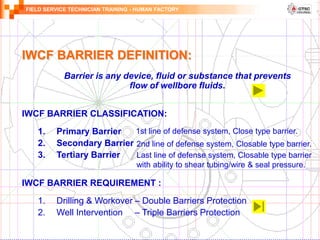
IWCF BARRIER DEFINITION:
Barrier is any device, fluid or substance that prevents
flow of wellbore fluids.
IWCF BARRIER CLASSIFICATION:
1. Primary Barrier
2. Secondary Barrier
3. Tertiary Barrier
IWCF BARRIER REQUIREMENT :
1. Drilling & Workover – Double Barriers Protection
2. Well Intervention – Triple Barriers Protection
1st line of defense system, Close type barrier.
2nd line of defense system, Closable type barrier.
Last line of defense system, Closable type barrier
with ability to shear tubing/wire & seal pressure.
FIELD SERVICE TECHNICIAN TRAINING - HUMAN FACTORY
1. Mechanical Barrier
1.1 Closed Type
1.2 Closeable Type
2. Hydrostatic Barrier
Must be “Tested From Direction of Flow”
Must be “Leak Tight”
API leakage criteria “400 cc/min or
900 scf/hr”
Must be diligently monitored for a
period of time to Ensure Thermal
Expansion & Contraction Effects
Have Ceased.
Hydrostatic Barrier Criteria:
• Liquids with circa 200 psi ▲ Pf
or ▼ Pff
• Must be observable from
surface.
BARRIER TYPE & BARRIER INTEGRITY
FIELD SERVICE TECHNICIAN TRAINING - HUMAN FACTORY
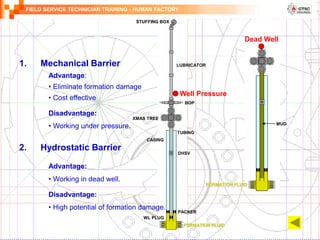
1. Mechanical Barrier
2. Hydrostatic Barrier
Advantage:
• Eliminate formation damage
• Cost effective
Disadvantage:
• Working under pressure.
WL PLUG
PACKER
DHSV
XMAS TREE
BOP
STUFFING BOX
FORMATION FLUID
MUD
Advantage:
• Working in dead well.
Disadvantage:
• High potential of formation damage.
LUBRICATOR
CASING
TUBING
Dead Well
Well Pressure
FORMATION FLUID
FIELD SERVICE TECHNICIAN TRAINING - HUMAN FACTORY
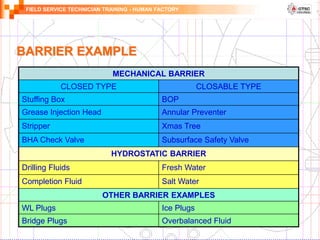
BARRIER EXAMPLE
MECHANICAL BARRIER
CLOSED TYPE CLOSABLE TYPE
Stuffing Box BOP
Grease Injection Head Annular Preventer
Stripper Xmas Tree
BHA Check Valve Subsurface Safety Valve
HYDROSTATIC BARRIER
Drilling Fluids Fresh Water
Completion Fluid Salt Water
OTHER BARRIER EXAMPLES
WL Plugs Ice Plugs
Bridge Plugs Overbalanced Fluid
FIELD SERVICE TECHNICIAN TRAINING - HUMAN FACTORY
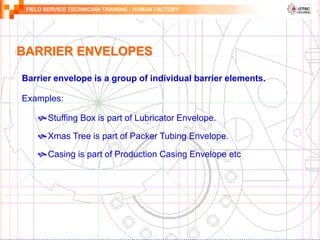
BARRIER ENVELOPES
Barrier envelope is a group of individual barrier elements.
Examples:
Stuffing Box is part of Lubricator Envelope.
Xmas Tree is part of Packer Tubing Envelope.
Casing is part of Production Casing Envelope etc
FIELD SERVICE TECHNICIAN TRAINING - HUMAN FACTORY
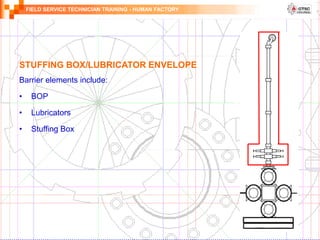
STUFFING BOX/LUBRICATOR ENVELOPE
Barrier elements include:
• BOP
• Lubricators
• Stuffing Box
FIELD SERVICE TECHNICIAN TRAINING - HUMAN FACTORY
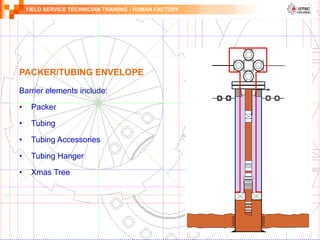
PACKER/TUBING ENVELOPE
Barrier elements include:
• Packer
• Tubing
• Tubing Accessories
• Tubing Hanger
• Xmas Tree
FIELD SERVICE TECHNICIAN TRAINING - HUMAN FACTORY
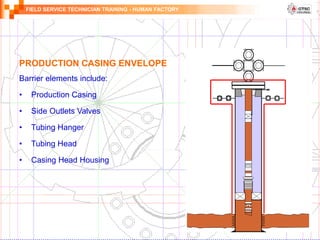
PRODUCTION CASING ENVELOPE
Barrier elements include:
• Production Casing
• Side Outlets Valves
• Tubing Hanger
• Tubing Head
• Casing Head Housing
FIELD SERVICE TECHNICIAN TRAINING - HUMAN FACTORY
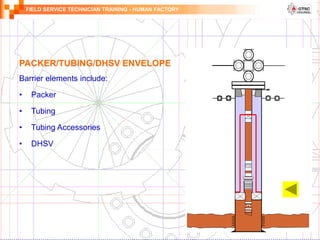
PACKER/TUBING/DHSV ENVELOPE
Barrier elements include:
• Packer
• Tubing
• Tubing Accessories
• DHSV
FIELD SERVICE TECHNICIAN TRAINING - HUMAN FACTORY
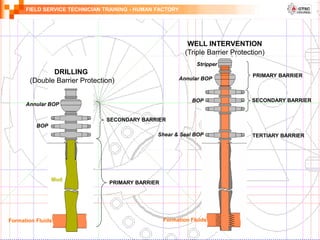
DRILLING
(Double Barrier Protection)
WELL INTERVENTION
(Triple Barrier Protection)
BOP
Mud
Formation Fluids
SECONDARY BARRIER
PRIMARY BARRIER
PRIMARY BARRIER
SECONDARY BARRIER
TERTIARY BARRIER
Stripper
Annular BOP
Annular BOP
BOP
Shear & Seal BOP
Formation Fluids
FIELD SERVICE TECHNICIAN TRAINING - HUMAN FACTORY
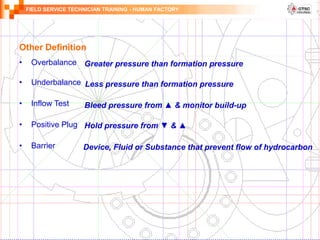
Other Definition
• Overbalance
• Underbalance
• Inflow Test
• Positive Plug
• Barrier
Hold pressure from ▼ & ▲
Bleed pressure from ▲ & monitor build-up
Less pressure than formation pressure
Greater pressure than formation pressure
Device, Fluid or Substance that prevent flow of hydrocarbon
FIELD SERVICE TECHNICIAN TRAINING - HUMAN FACTORY
FORMATION DAMAGE &
WELL KILLING
FIELD SERVICE TECHNICIAN TRAINING - HUMAN FACTORY
Well Intervention most notably formation damages are;
• Pore or perforations plugging by kill fluid solids, scale or debris.
• Permeability reduction by kill fluid filtrate invasion or insoluble
precipitates formed during acid stimulation with hydrofluoric acid.
• Sand face/cement breakdown due to acid stimulation effects.
• Clay swelling from incompatible brine or water contamination..
FORMATION DAMAGES
FIELD SERVICE TECHNICIAN TRAINING - HUMAN FACTORY
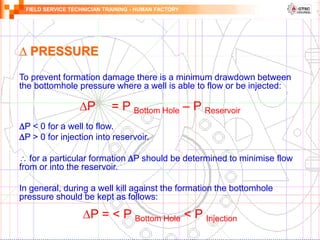
To prevent formation damage there is a minimum drawdown between
the bottomhole pressure where a well is able to flow or be injected:
∆P = P Bottom Hole – P Reservoir
P < 0 for a well to flow.
P > 0 for injection into reservoir.
 for a particular formation P should be determined to minimise flow
from or into the reservoir.
In general, during a well kill against the formation the bottomhole
pressure should be kept as follows:
∆P = < P Bottom Hole < P Injection
∆ PRESSURE
FIELD SERVICE TECHNICIAN TRAINING - HUMAN FACTORY
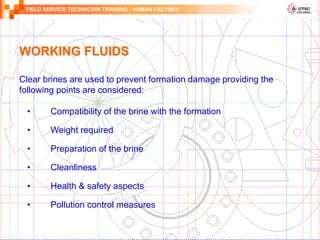
• Compatibility of the brine with the formation
• Weight required
• Preparation of the brine
• Cleanliness
• Health & safety aspects
• Pollution control measures
Clear brines are used to prevent formation damage providing the
following points are considered:
WORKING FLUIDS
FIELD SERVICE TECHNICIAN TRAINING - HUMAN FACTORY
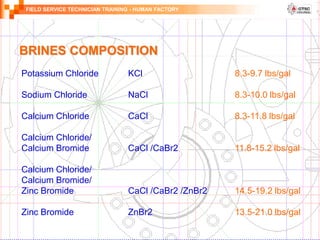
BRINES COMPOSITION
Potassium Chloride KCl 8.3-9.7 lbs/gal
Sodium Chloride NaCl 8.3-10.0 lbs/gal
Calcium Chloride CaCl 8.3-11.8 lbs/gal
Calcium Chloride/
Calcium Bromide CaCl /CaBr2 11.8-15.2 lbs/gal
Calcium Chloride/
Calcium Bromide/
Zinc Bromide CaCl /CaBr2 /ZnBr2 14.5-19.2 lbs/gal
Zinc Bromide ZnBr2 13.5-21.0 lbs/gal
FIELD SERVICE TECHNICIAN TRAINING - HUMAN FACTORY
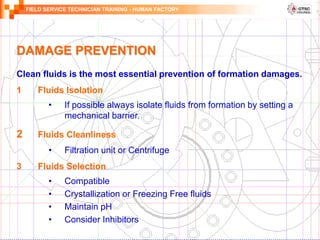
Clean fluids is the most essential prevention of formation damages.
1 Fluids Isolation
• If possible always isolate fluids from formation by setting a
mechanical barrier.
2 Fluids Cleanliness
• Filtration unit or Centrifuge
3 Fluids Selection
• Compatible
• Crystallization or Freezing Free fluids
• Maintain pH
• Consider Inhibitors
DAMAGE PREVENTION
FIELD SERVICE TECHNICIAN TRAINING - HUMAN FACTORY
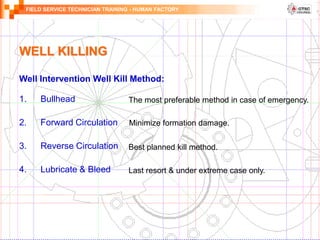
WELL KILLING
Well Intervention Well Kill Method:
1. Bullhead
2. Forward Circulation
3. Reverse Circulation
4. Lubricate & Bleed
The most preferable method in case of emergency.
Minimize formation damage.
Best planned kill method.
Last resort & under extreme case only.
FIELD SERVICE TECHNICIAN TRAINING - HUMAN FACTORY
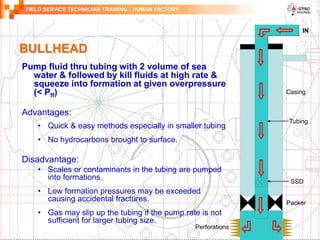
BULLHEAD
Pump fluid thru tubing with 2 volume of sea
water & followed by kill fluids at high rate &
squeeze into formation at given overpressure
(< Pff)
Advantages:
• Quick & easy methods especially in smaller tubing
• No hydrocarbons brought to surface.
Disadvantage:
• Scales or contaminants in the tubing are pumped
into formations.
• Low formation pressures may be exceeded
causing accidental fractures.
• Gas may slip up the tubing if the pump rate is not
sufficient for larger tubing size.
IN
SSD
Perforations
Tubing
Casing
Packer
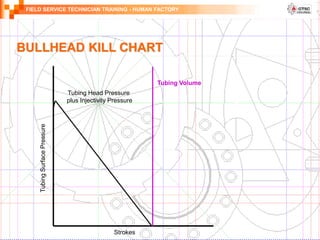
FIELD SERVICE TECHNICIAN TRAINING - HUMAN FACTORY
Strokes
Tubing
Surface
Pressure
Tubing Volume
Tubing Head Pressure
plus Injectivity Pressure
BULLHEAD KILL CHART
FIELD SERVICE TECHNICIAN TRAINING - HUMAN FACTORY
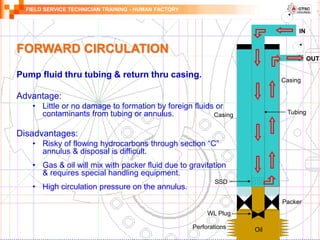
FORWARD CIRCULATION
Pump fluid thru tubing & return thru casing.
Advantage:
• Little or no damage to formation by foreign fluids or
contaminants from tubing or annulus.
Disadvantages:
• Risky of flowing hydrocarbons through section “C”
annulus & disposal is difficult.
• Gas & oil will mix with packer fluid due to gravitation
& requires special handling equipment.
• High circulation pressure on the annulus.
OUT
IN
SSD
Perforations
Casing
Tubing
WL Plug
Packer
Oil
Casing
FIELD SERVICE TECHNICIAN TRAINING - HUMAN FACTORY
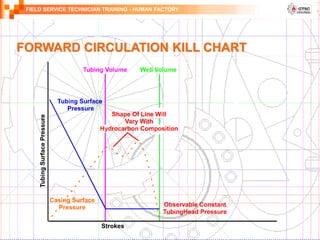
FORWARD CIRCULATION KILL CHART
FIELD SERVICE TECHNICIAN TRAINING - HUMAN FACTORY
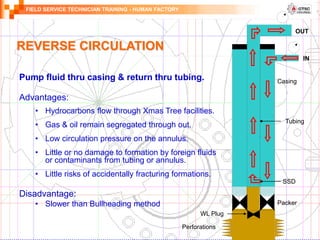
REVERSE CIRCULATION
Pump fluid thru casing & return thru tubing.
Advantages:
• Hydrocarbons flow through Xmas Tree facilities.
• Gas & oil remain segregated through out.
• Low circulation pressure on the annulus.
• Little or no damage to formation by foreign fluids
or contaminants from tubing or annulus.
• Little risks of accidentally fracturing formations.
Disadvantage:
• Slower than Bullheading method
OUT
IN
SSD
Perforations
Tubing
Casing
Packer
WL Plug
FIELD SERVICE TECHNICIAN TRAINING - HUMAN FACTORY
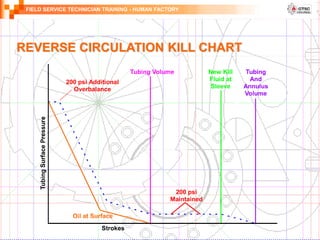
REVERSE CIRCULATION KILL CHART
FIELD SERVICE TECHNICIAN TRAINING - HUMAN FACTORY
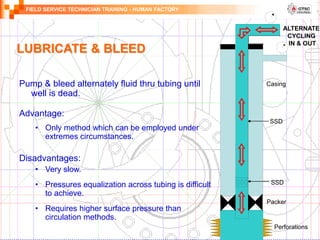
LUBRICATE & BLEED
Pump & bleed alternately fluid thru tubing until
well is dead.
Advantage:
• Only method which can be employed under
extremes circumstances.
Disadvantages:
• Very slow.
• Pressures equalization across tubing is difficult
to achieve.
• Requires higher surface pressure than
circulation methods.
ALTERNATE
CYCLING
IN & OUT
SSD
Perforations
SSD
Casing
Packer
FIELD SERVICE TECHNICIAN TRAINING - HUMAN FACTORY
Strokes
Tubing
Surface
Pressure
Minimum
Surface Pressure
to Prevent Influx
MASP
Tubing Volume
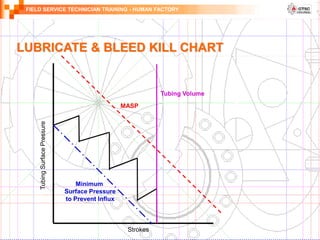
LUBRICATE & BLEED KILL CHART
FIELD SERVICE TECHNICIAN TRAINING - HUMAN FACTORY
PREPARATION FOR WELL KILL
1. Well must be closed in to stabilise bottomhole pressure.
2. Inspect & service Xmas tree.
3. Check whether SSSV needs to be locked open or pulled
(WRSV).
4. Isolate well from Production Control System & ESD if
necessary.
5. Ensure all Well Intervention Equipment has been organised
including pumping equipment.
FIELD SERVICE TECHNICIAN TRAINING - HUMAN FACTORY
INFORMATION REQUIRED
1. Fluid Levels In Tubing
2. Wellhead Pressure Rating
3. Formation Pressure
4. Formation Fracture Pressure
4. Casing & Tubing Sizes
5. Casing & Tubing Strengths
6. Injectivity Pressure
7. Maximum Allowable Surface Pressure (MASP)
FIELD SERVICE TECHNICIAN TRAINING - HUMAN FACTORY
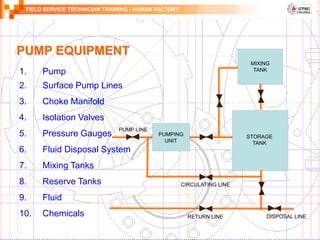
PUMP EQUIPMENT
1. Pump
2. Surface Pump Lines
3. Choke Manifold
4. Isolation Valves
5. Pressure Gauges
6. Fluid Disposal System
7. Mixing Tanks
8. Reserve Tanks
9. Fluid
10. Chemicals
MIXING
TANK
STORAGE
TANK
PUMPING
UNIT
PUMP LINE
CIRCULATING LINE
RETURN LINE DISPOSAL LINE
FIELD SERVICE TECHNICIAN TRAINING - HUMAN FACTORY
OPERATIONAL CHALLENGES
Well Intervention Common Challenges are:
1. Surge Pressure
2. Swab Pressure
3. Blockages
1. Surge Pressure
Piston Power arises from RIH:
• Small clearance (between CT OD / tubing ID) produces ▲pressures.
• Completion fluids produces ▲pressure than oil/gas).
• ▲speed produces ▲pressures.
• Longer OD tools produces ▲pressures.
• May activate pressure-activated equipment downhole.
Prevention:
4 Deviation
5 Hydrates
Slow down while RIH especially at downhole accessories.
FIELD SERVICE TECHNICIAN TRAINING - HUMAN FACTORY
OPERATIONAL CHALLENGES - continuation
2. Swab Pressure
Piston Effect occurs when downhole equipment is being POOH:
• Small clearance (between CT OD / tubing ID) produces ▲pressures.
• Completion fluids produces ▲pressure than oil/gas).
• ▲speed produces ▲pressures.
• Longer OD tools produces ▲pressures.
• Greater effect when downhole tools closer to reservoir & causes
hydrocarbon to be drawn out from reservoir.
Prevention:
Slow down while POOH especially at downhole accessories.
FIELD SERVICE TECHNICIAN TRAINING - HUMAN FACTORY
OPERATIONAL CHALLENGES - continuation
3. Blockages
• Sand Bridge
• Scale
• Paraffin
• Wax
• Hydrates Plug
• Collapsed casing, liners, tubing or jammed valves etc.
Removing Blockages
• Mechanical methods
• Chemical methods
FIELD SERVICE TECHNICIAN TRAINING - HUMAN FACTORY
OPERATIONAL CHALLENGES - continuation
4. Deviation
• Friction
• Colloidal effect
• Unable to reach desired depth
Solution
• Retry cautiously
• Roller subs
• Tractors or Locomotive
• Alternate well interventions method
FIELD SERVICE TECHNICIAN TRAINING - HUMAN FACTORY
OPERATIONAL CHALLENGES - continuation
5. Hydrates
Crystalline water structures filled with small molecules. These conditions
form hydrates;
• Presence of free water
• Presence of light gas molecules
• Relatively high pressure
• Relatively low temperature
Removing Hydrates
• Reduce pressure
(Risk: hydrate plug slips & gas above it, the plug may blow up).
• Raise temperature
• Use inhibitor (glycol, methanol or salt).
FIELD SERVICE TECHNICIAN TRAINING - HUMAN FACTORY
THE END
&
THANK YOU

12.6 Well Control.ppt

  • 1.
    FIELD SERVICE TECHNICIANTRAINING - HUMAN FACTORY FST TRAINING Human factory WELCOME TO
  • 2.
    FIELD SERVICE TECHNICIANTRAINING - HUMAN FACTORY Well CONTROL 2.6
  • 3.
    FIELD SERVICE TECHNICIANTRAINING - HUMAN FACTORY 3 factors govern the Success of Well Control: 1. Personnel 2. Equipment 3. Plans & Procedures 1. PERSONNEL • ASK • Communications • Responsibility 2. EQUIPMENT • Full Inventory with Spares • MPT Full Specification • Function & Pressure Tests 3. PLANS & PROCEDURES • Well Plan & Consider All Aspects • Back-up Plans & Procedures • Procedures Tailored to Site PHILOSOPHY
  • 4.
    FIELD SERVICE TECHNICIANTRAINING - HUMAN FACTORY IWCF BARRIER DEFINITION: Barrier is any device, fluid or substance that prevents flow of wellbore fluids. IWCF BARRIER CLASSIFICATION: 1. Primary Barrier 2. Secondary Barrier 3. Tertiary Barrier IWCF BARRIER REQUIREMENT : 1. Drilling & Workover – Double Barriers Protection 2. Well Intervention – Triple Barriers Protection 1st line of defense system, Close type barrier. 2nd line of defense system, Closable type barrier. Last line of defense system, Closable type barrier with ability to shear tubing/wire & seal pressure.
  • 5.
    FIELD SERVICE TECHNICIANTRAINING - HUMAN FACTORY 1. Mechanical Barrier 1.1 Closed Type 1.2 Closeable Type 2. Hydrostatic Barrier Must be “Tested From Direction of Flow” Must be “Leak Tight” API leakage criteria “400 cc/min or 900 scf/hr” Must be diligently monitored for a period of time to Ensure Thermal Expansion & Contraction Effects Have Ceased. Hydrostatic Barrier Criteria: • Liquids with circa 200 psi ▲ Pf or ▼ Pff • Must be observable from surface. BARRIER TYPE & BARRIER INTEGRITY
  • 6.
    FIELD SERVICE TECHNICIANTRAINING - HUMAN FACTORY 1. Mechanical Barrier 2. Hydrostatic Barrier Advantage: • Eliminate formation damage • Cost effective Disadvantage: • Working under pressure. WL PLUG PACKER DHSV XMAS TREE BOP STUFFING BOX FORMATION FLUID MUD Advantage: • Working in dead well. Disadvantage: • High potential of formation damage. LUBRICATOR CASING TUBING Dead Well Well Pressure FORMATION FLUID
  • 7.
    FIELD SERVICE TECHNICIANTRAINING - HUMAN FACTORY BARRIER EXAMPLE MECHANICAL BARRIER CLOSED TYPE CLOSABLE TYPE Stuffing Box BOP Grease Injection Head Annular Preventer Stripper Xmas Tree BHA Check Valve Subsurface Safety Valve HYDROSTATIC BARRIER Drilling Fluids Fresh Water Completion Fluid Salt Water OTHER BARRIER EXAMPLES WL Plugs Ice Plugs Bridge Plugs Overbalanced Fluid
  • 8.
    FIELD SERVICE TECHNICIANTRAINING - HUMAN FACTORY BARRIER ENVELOPES Barrier envelope is a group of individual barrier elements. Examples: Stuffing Box is part of Lubricator Envelope. Xmas Tree is part of Packer Tubing Envelope. Casing is part of Production Casing Envelope etc
  • 9.
    FIELD SERVICE TECHNICIANTRAINING - HUMAN FACTORY STUFFING BOX/LUBRICATOR ENVELOPE Barrier elements include: • BOP • Lubricators • Stuffing Box
  • 10.
    FIELD SERVICE TECHNICIANTRAINING - HUMAN FACTORY PACKER/TUBING ENVELOPE Barrier elements include: • Packer • Tubing • Tubing Accessories • Tubing Hanger • Xmas Tree
  • 11.
    FIELD SERVICE TECHNICIANTRAINING - HUMAN FACTORY PRODUCTION CASING ENVELOPE Barrier elements include: • Production Casing • Side Outlets Valves • Tubing Hanger • Tubing Head • Casing Head Housing
  • 12.
    FIELD SERVICE TECHNICIANTRAINING - HUMAN FACTORY PACKER/TUBING/DHSV ENVELOPE Barrier elements include: • Packer • Tubing • Tubing Accessories • DHSV
  • 13.
    FIELD SERVICE TECHNICIANTRAINING - HUMAN FACTORY DRILLING (Double Barrier Protection) WELL INTERVENTION (Triple Barrier Protection) BOP Mud Formation Fluids SECONDARY BARRIER PRIMARY BARRIER PRIMARY BARRIER SECONDARY BARRIER TERTIARY BARRIER Stripper Annular BOP Annular BOP BOP Shear & Seal BOP Formation Fluids
  • 14.
    FIELD SERVICE TECHNICIANTRAINING - HUMAN FACTORY Other Definition • Overbalance • Underbalance • Inflow Test • Positive Plug • Barrier Hold pressure from ▼ & ▲ Bleed pressure from ▲ & monitor build-up Less pressure than formation pressure Greater pressure than formation pressure Device, Fluid or Substance that prevent flow of hydrocarbon
  • 15.
    FIELD SERVICE TECHNICIANTRAINING - HUMAN FACTORY FORMATION DAMAGE & WELL KILLING
  • 16.
    FIELD SERVICE TECHNICIANTRAINING - HUMAN FACTORY Well Intervention most notably formation damages are; • Pore or perforations plugging by kill fluid solids, scale or debris. • Permeability reduction by kill fluid filtrate invasion or insoluble precipitates formed during acid stimulation with hydrofluoric acid. • Sand face/cement breakdown due to acid stimulation effects. • Clay swelling from incompatible brine or water contamination.. FORMATION DAMAGES
  • 17.
    FIELD SERVICE TECHNICIANTRAINING - HUMAN FACTORY To prevent formation damage there is a minimum drawdown between the bottomhole pressure where a well is able to flow or be injected: ∆P = P Bottom Hole – P Reservoir P < 0 for a well to flow. P > 0 for injection into reservoir.  for a particular formation P should be determined to minimise flow from or into the reservoir. In general, during a well kill against the formation the bottomhole pressure should be kept as follows: ∆P = < P Bottom Hole < P Injection ∆ PRESSURE
  • 18.
    FIELD SERVICE TECHNICIANTRAINING - HUMAN FACTORY • Compatibility of the brine with the formation • Weight required • Preparation of the brine • Cleanliness • Health & safety aspects • Pollution control measures Clear brines are used to prevent formation damage providing the following points are considered: WORKING FLUIDS
  • 19.
    FIELD SERVICE TECHNICIANTRAINING - HUMAN FACTORY BRINES COMPOSITION Potassium Chloride KCl 8.3-9.7 lbs/gal Sodium Chloride NaCl 8.3-10.0 lbs/gal Calcium Chloride CaCl 8.3-11.8 lbs/gal Calcium Chloride/ Calcium Bromide CaCl /CaBr2 11.8-15.2 lbs/gal Calcium Chloride/ Calcium Bromide/ Zinc Bromide CaCl /CaBr2 /ZnBr2 14.5-19.2 lbs/gal Zinc Bromide ZnBr2 13.5-21.0 lbs/gal
  • 20.
    FIELD SERVICE TECHNICIANTRAINING - HUMAN FACTORY Clean fluids is the most essential prevention of formation damages. 1 Fluids Isolation • If possible always isolate fluids from formation by setting a mechanical barrier. 2 Fluids Cleanliness • Filtration unit or Centrifuge 3 Fluids Selection • Compatible • Crystallization or Freezing Free fluids • Maintain pH • Consider Inhibitors DAMAGE PREVENTION
  • 21.
    FIELD SERVICE TECHNICIANTRAINING - HUMAN FACTORY WELL KILLING Well Intervention Well Kill Method: 1. Bullhead 2. Forward Circulation 3. Reverse Circulation 4. Lubricate & Bleed The most preferable method in case of emergency. Minimize formation damage. Best planned kill method. Last resort & under extreme case only.
  • 22.
    FIELD SERVICE TECHNICIANTRAINING - HUMAN FACTORY BULLHEAD Pump fluid thru tubing with 2 volume of sea water & followed by kill fluids at high rate & squeeze into formation at given overpressure (< Pff) Advantages: • Quick & easy methods especially in smaller tubing • No hydrocarbons brought to surface. Disadvantage: • Scales or contaminants in the tubing are pumped into formations. • Low formation pressures may be exceeded causing accidental fractures. • Gas may slip up the tubing if the pump rate is not sufficient for larger tubing size. IN SSD Perforations Tubing Casing Packer
  • 23.
    FIELD SERVICE TECHNICIANTRAINING - HUMAN FACTORY Strokes Tubing Surface Pressure Tubing Volume Tubing Head Pressure plus Injectivity Pressure BULLHEAD KILL CHART
  • 24.
    FIELD SERVICE TECHNICIANTRAINING - HUMAN FACTORY FORWARD CIRCULATION Pump fluid thru tubing & return thru casing. Advantage: • Little or no damage to formation by foreign fluids or contaminants from tubing or annulus. Disadvantages: • Risky of flowing hydrocarbons through section “C” annulus & disposal is difficult. • Gas & oil will mix with packer fluid due to gravitation & requires special handling equipment. • High circulation pressure on the annulus. OUT IN SSD Perforations Casing Tubing WL Plug Packer Oil Casing

  • 25.
    FIELD SERVICE TECHNICIANTRAINING - HUMAN FACTORY FORWARD CIRCULATION KILL CHART
  • 26.
    FIELD SERVICE TECHNICIANTRAINING - HUMAN FACTORY REVERSE CIRCULATION Pump fluid thru casing & return thru tubing. Advantages: • Hydrocarbons flow through Xmas Tree facilities. • Gas & oil remain segregated through out. • Low circulation pressure on the annulus. • Little or no damage to formation by foreign fluids or contaminants from tubing or annulus. • Little risks of accidentally fracturing formations. Disadvantage: • Slower than Bullheading method OUT IN SSD Perforations Tubing Casing Packer WL Plug
  • 27.
    FIELD SERVICE TECHNICIANTRAINING - HUMAN FACTORY REVERSE CIRCULATION KILL CHART
  • 28.
    FIELD SERVICE TECHNICIANTRAINING - HUMAN FACTORY LUBRICATE & BLEED Pump & bleed alternately fluid thru tubing until well is dead. Advantage: • Only method which can be employed under extremes circumstances. Disadvantages: • Very slow. • Pressures equalization across tubing is difficult to achieve. • Requires higher surface pressure than circulation methods. ALTERNATE CYCLING IN & OUT SSD Perforations SSD Casing Packer
  • 29.
    FIELD SERVICE TECHNICIANTRAINING - HUMAN FACTORY Strokes Tubing Surface Pressure Minimum Surface Pressure to Prevent Influx MASP Tubing Volume LUBRICATE & BLEED KILL CHART
  • 30.
    FIELD SERVICE TECHNICIANTRAINING - HUMAN FACTORY PREPARATION FOR WELL KILL 1. Well must be closed in to stabilise bottomhole pressure. 2. Inspect & service Xmas tree. 3. Check whether SSSV needs to be locked open or pulled (WRSV). 4. Isolate well from Production Control System & ESD if necessary. 5. Ensure all Well Intervention Equipment has been organised including pumping equipment.
  • 31.
    FIELD SERVICE TECHNICIANTRAINING - HUMAN FACTORY INFORMATION REQUIRED 1. Fluid Levels In Tubing 2. Wellhead Pressure Rating 3. Formation Pressure 4. Formation Fracture Pressure 4. Casing & Tubing Sizes 5. Casing & Tubing Strengths 6. Injectivity Pressure 7. Maximum Allowable Surface Pressure (MASP)
  • 32.
    FIELD SERVICE TECHNICIANTRAINING - HUMAN FACTORY PUMP EQUIPMENT 1. Pump 2. Surface Pump Lines 3. Choke Manifold 4. Isolation Valves 5. Pressure Gauges 6. Fluid Disposal System 7. Mixing Tanks 8. Reserve Tanks 9. Fluid 10. Chemicals MIXING TANK STORAGE TANK PUMPING UNIT PUMP LINE CIRCULATING LINE RETURN LINE DISPOSAL LINE
  • 33.
    FIELD SERVICE TECHNICIANTRAINING - HUMAN FACTORY OPERATIONAL CHALLENGES Well Intervention Common Challenges are: 1. Surge Pressure 2. Swab Pressure 3. Blockages 1. Surge Pressure Piston Power arises from RIH: • Small clearance (between CT OD / tubing ID) produces ▲pressures. • Completion fluids produces ▲pressure than oil/gas). • ▲speed produces ▲pressures. • Longer OD tools produces ▲pressures. • May activate pressure-activated equipment downhole. Prevention: 4 Deviation 5 Hydrates Slow down while RIH especially at downhole accessories.
  • 34.
    FIELD SERVICE TECHNICIANTRAINING - HUMAN FACTORY OPERATIONAL CHALLENGES - continuation 2. Swab Pressure Piston Effect occurs when downhole equipment is being POOH: • Small clearance (between CT OD / tubing ID) produces ▲pressures. • Completion fluids produces ▲pressure than oil/gas). • ▲speed produces ▲pressures. • Longer OD tools produces ▲pressures. • Greater effect when downhole tools closer to reservoir & causes hydrocarbon to be drawn out from reservoir. Prevention: Slow down while POOH especially at downhole accessories.
  • 35.
    FIELD SERVICE TECHNICIANTRAINING - HUMAN FACTORY OPERATIONAL CHALLENGES - continuation 3. Blockages • Sand Bridge • Scale • Paraffin • Wax • Hydrates Plug • Collapsed casing, liners, tubing or jammed valves etc. Removing Blockages • Mechanical methods • Chemical methods
  • 36.
    FIELD SERVICE TECHNICIANTRAINING - HUMAN FACTORY OPERATIONAL CHALLENGES - continuation 4. Deviation • Friction • Colloidal effect • Unable to reach desired depth Solution • Retry cautiously • Roller subs • Tractors or Locomotive • Alternate well interventions method
  • 37.
    FIELD SERVICE TECHNICIANTRAINING - HUMAN FACTORY OPERATIONAL CHALLENGES - continuation 5. Hydrates Crystalline water structures filled with small molecules. These conditions form hydrates; • Presence of free water • Presence of light gas molecules • Relatively high pressure • Relatively low temperature Removing Hydrates • Reduce pressure (Risk: hydrate plug slips & gas above it, the plug may blow up). • Raise temperature • Use inhibitor (glycol, methanol or salt).
  • 38.
    FIELD SERVICE TECHNICIANTRAINING - HUMAN FACTORY THE END & THANK YOU