Deep	Water	
GPU	Deep	Learning	for	H2O
Arno	Candel,	PhD	
Chief	Architect,	Physicist	&	Hacker,	H2O.ai	
@ArnoCandel


The	Open	Tour,	Dallas,	TX	
Oct	26	2016
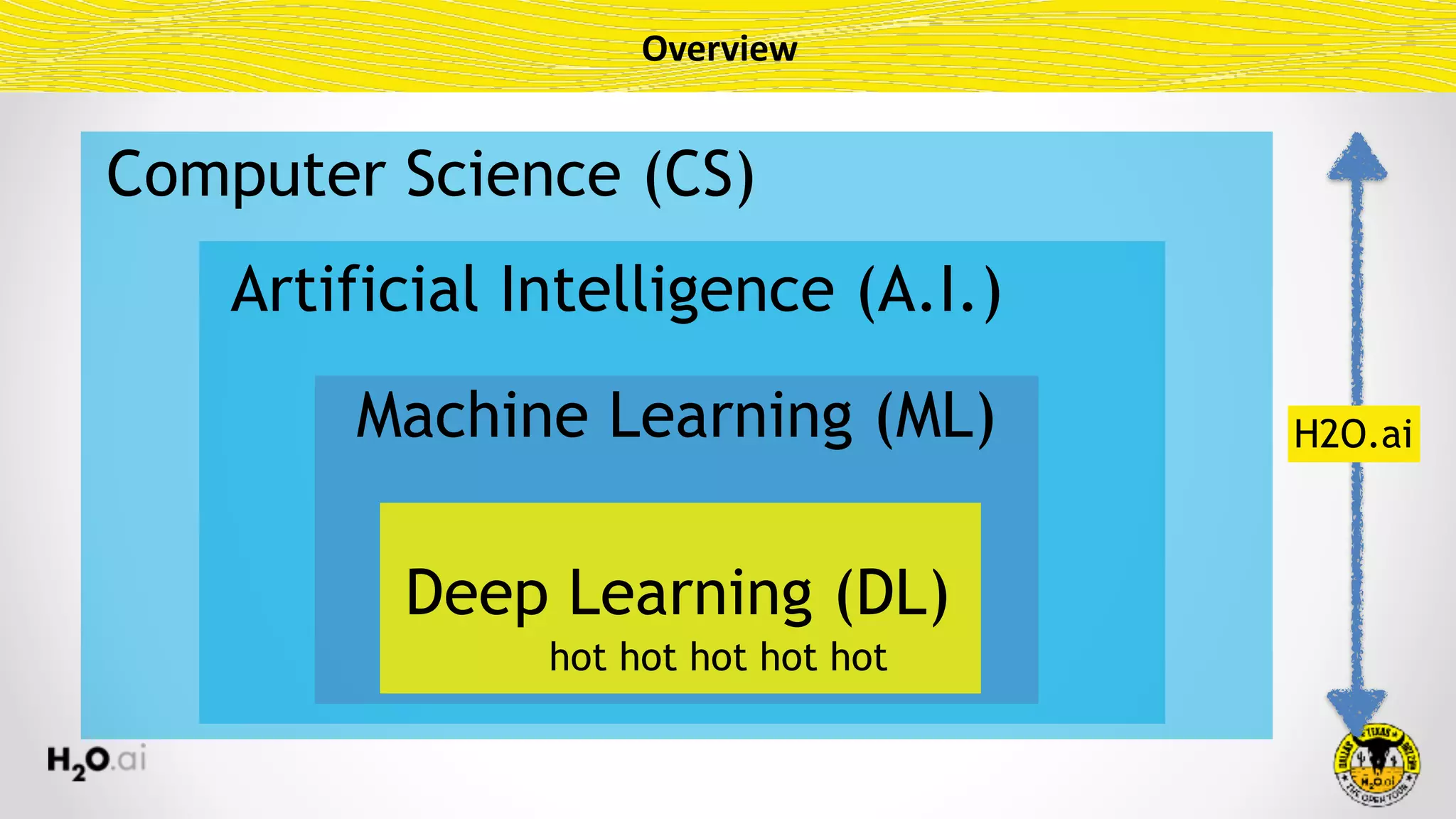
Overview
Machine Learning (ML)
Artificial Intelligence (A.I.)
Computer Science (CS)
H2O.ai
Deep Learning (DL)
hot hot hot hot hot
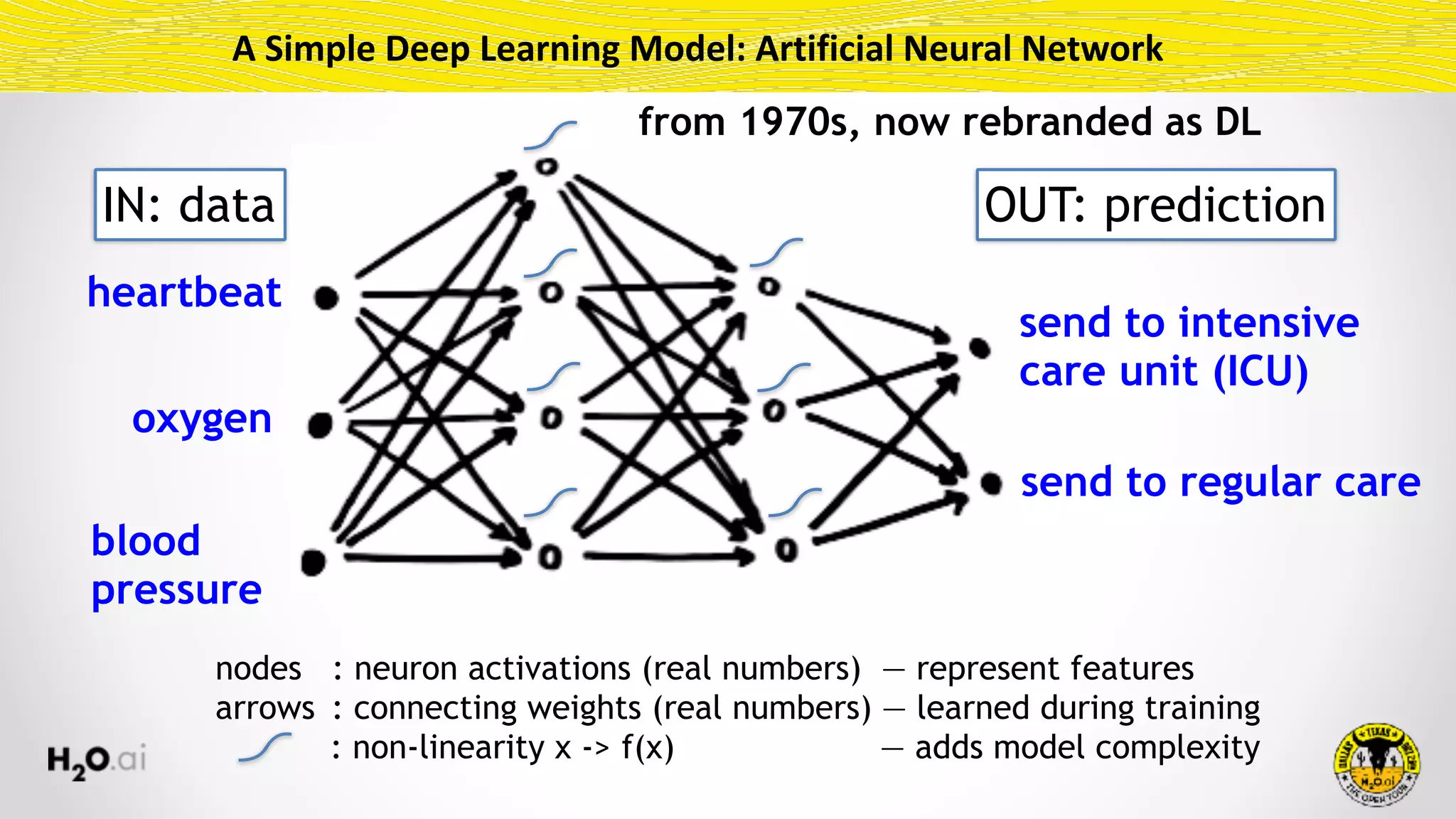
A	Simple	Deep	Learning	Model:	Artificial	Neural	Network
heartbeat
blood
pressure
oxygen
send to regular care
send to intensive

care unit (ICU)
IN: data OUT: prediction
nodes : neuron activations (real numbers) — represent features
arrows : connecting weights (real numbers) — learned during training
: non-linearity x -> f(x) — adds model complexity
from 1970s, now rebranded as DL
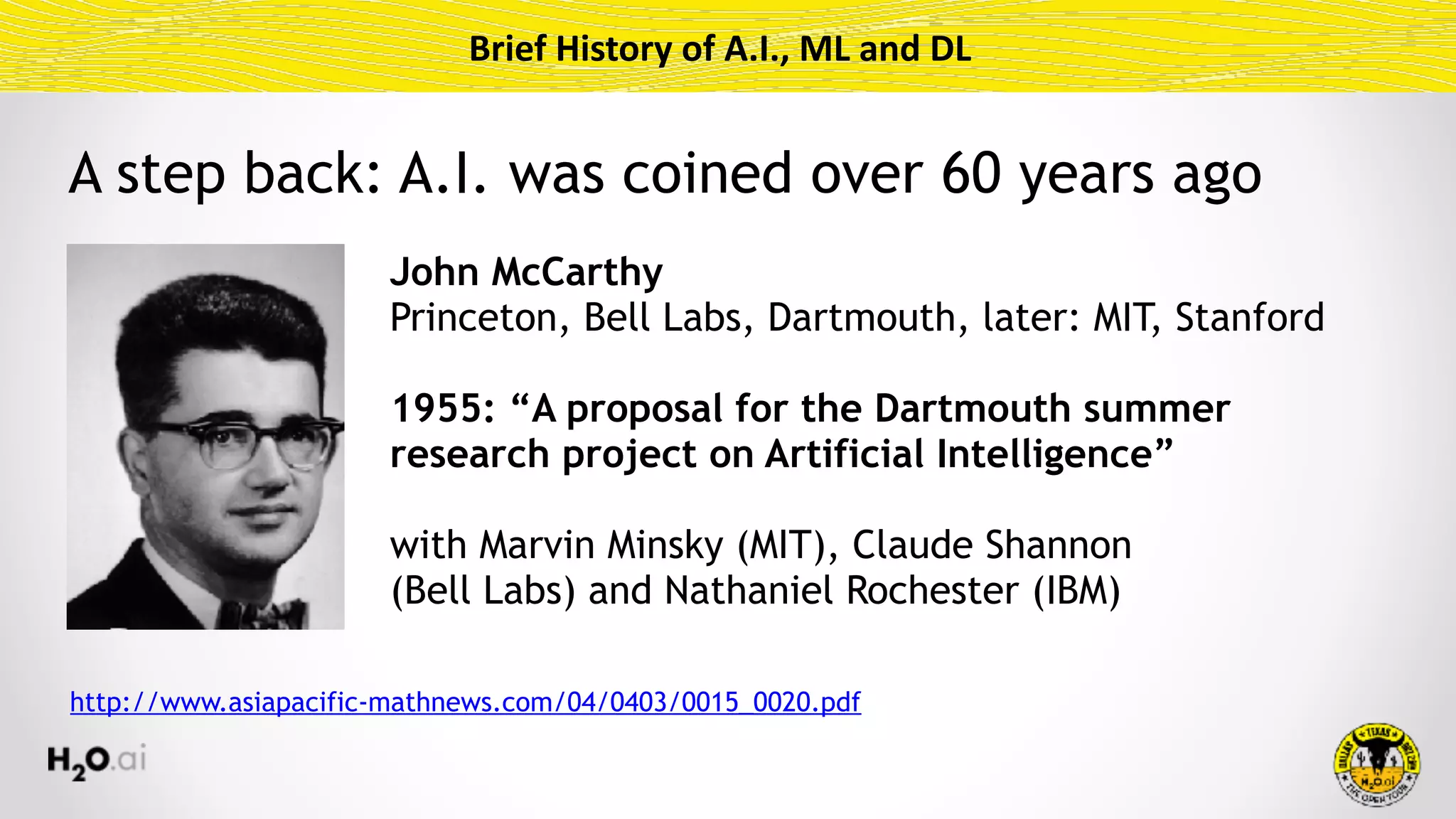
Brief	History	of	A.I.,	ML	and	DL
John McCarthy

Princeton, Bell Labs, Dartmouth, later: MIT, Stanford
1955: “A proposal for the Dartmouth summer
research project on Artificial Intelligence”
with Marvin Minsky (MIT), Claude Shannon 

(Bell Labs) and Nathaniel Rochester (IBM)
http://www.asiapacific-mathnews.com/04/0403/0015_0020.pdf
A step back: A.I. was coined over 60 years ago
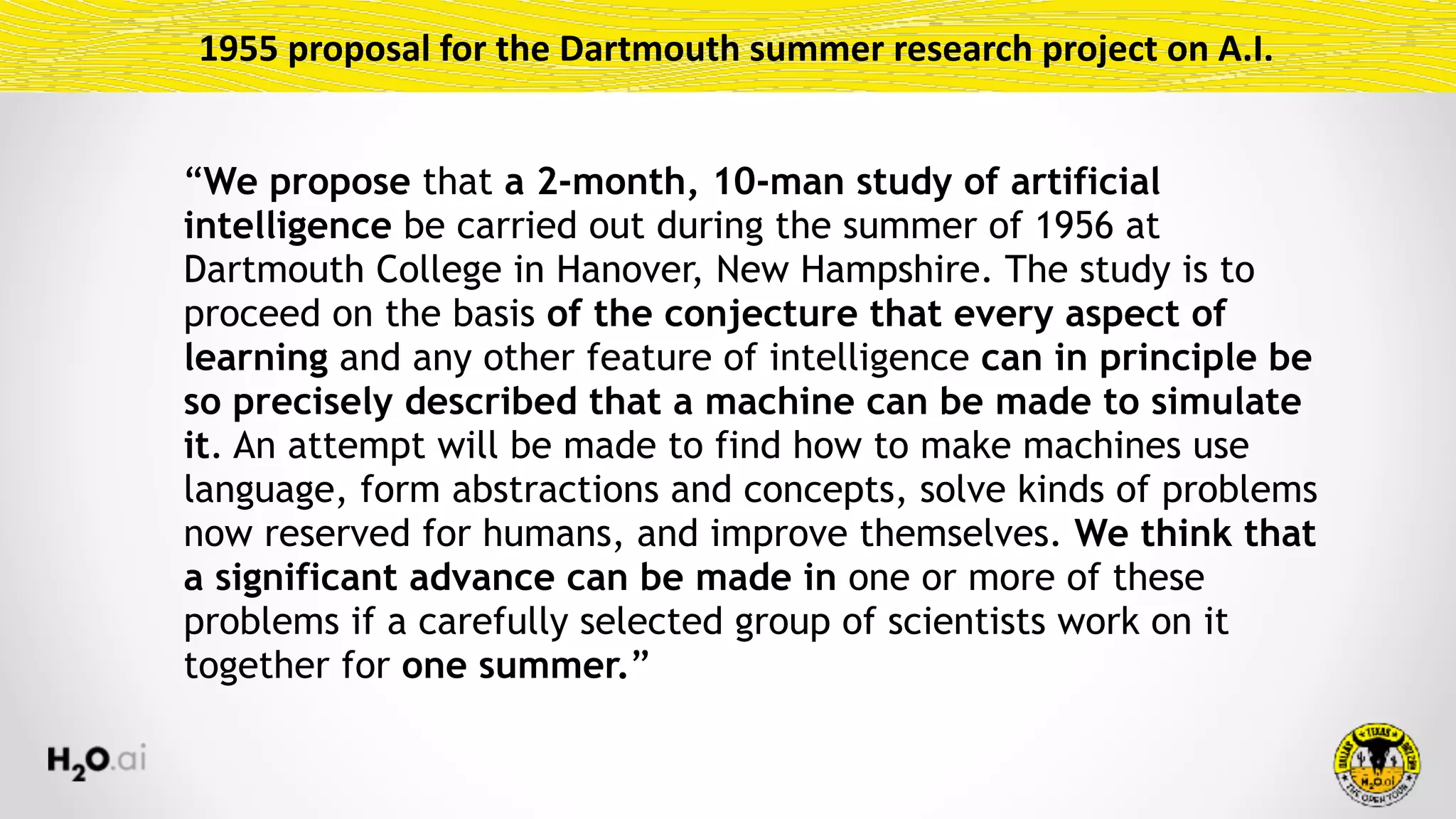
1955	proposal	for	the	Dartmouth	summer	research	project	on	A.I.
“We propose that a 2-month, 10-man study of artificial
intelligence be carried out during the summer of 1956 at
Dartmouth College in Hanover, New Hampshire. The study is to
proceed on the basis of the conjecture that every aspect of
learning and any other feature of intelligence can in principle be
so precisely described that a machine can be made to simulate
it. An attempt will be made to find how to make machines use
language, form abstractions and concepts, solve kinds of problems
now reserved for humans, and improve themselves. We think that
a significant advance can be made in one or more of these
problems if a carefully selected group of scientists work on it
together for one summer.”
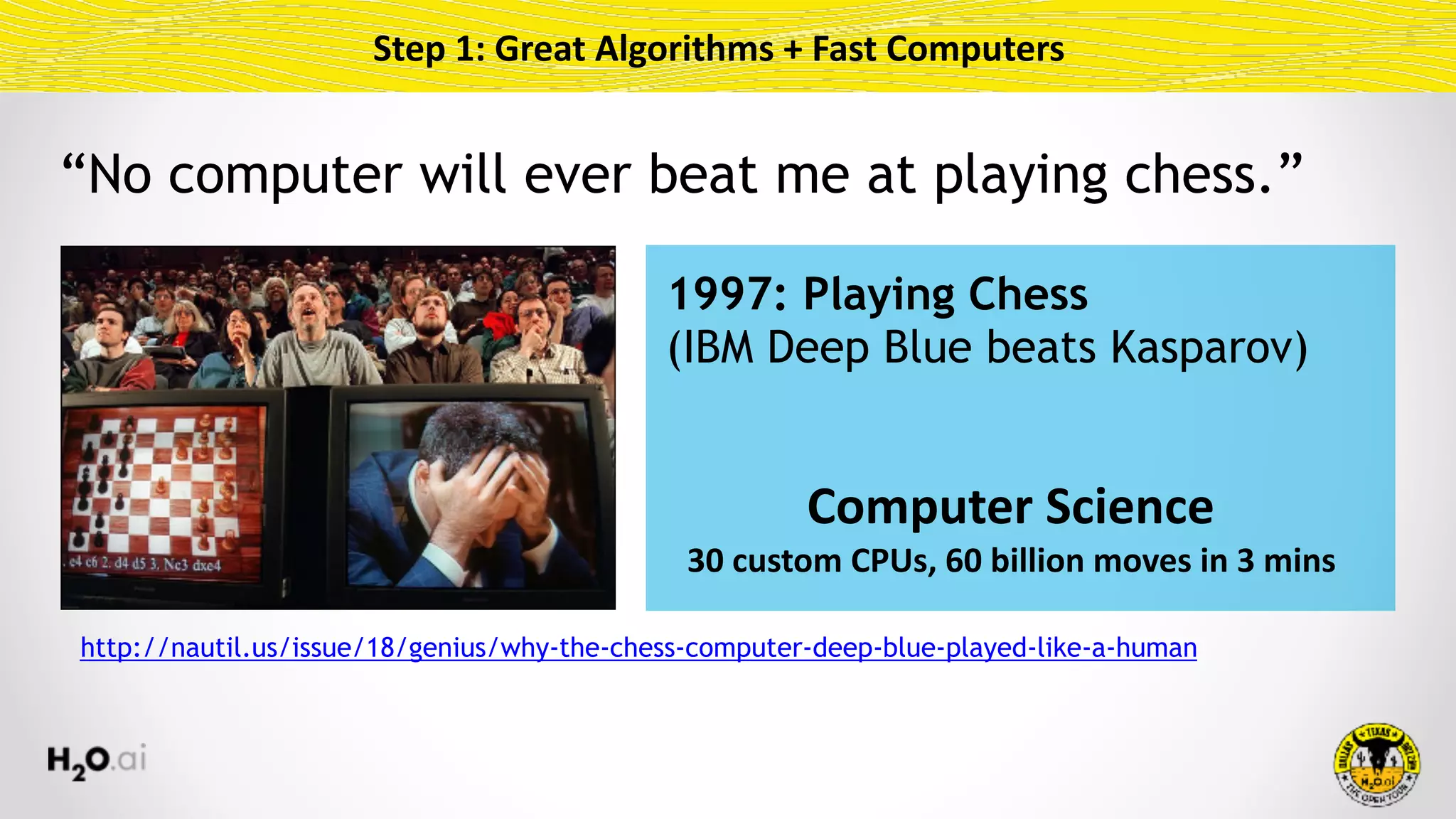
Step	1:	Great	Algorithms	+	Fast	Computers
http://nautil.us/issue/18/genius/why-the-chess-computer-deep-blue-played-like-a-human
1997: Playing Chess
(IBM Deep Blue beats Kasparov)
Computer	Science

30	custom	CPUs,	60	billion	moves	in	3	mins
“No computer will ever beat me at playing chess.”
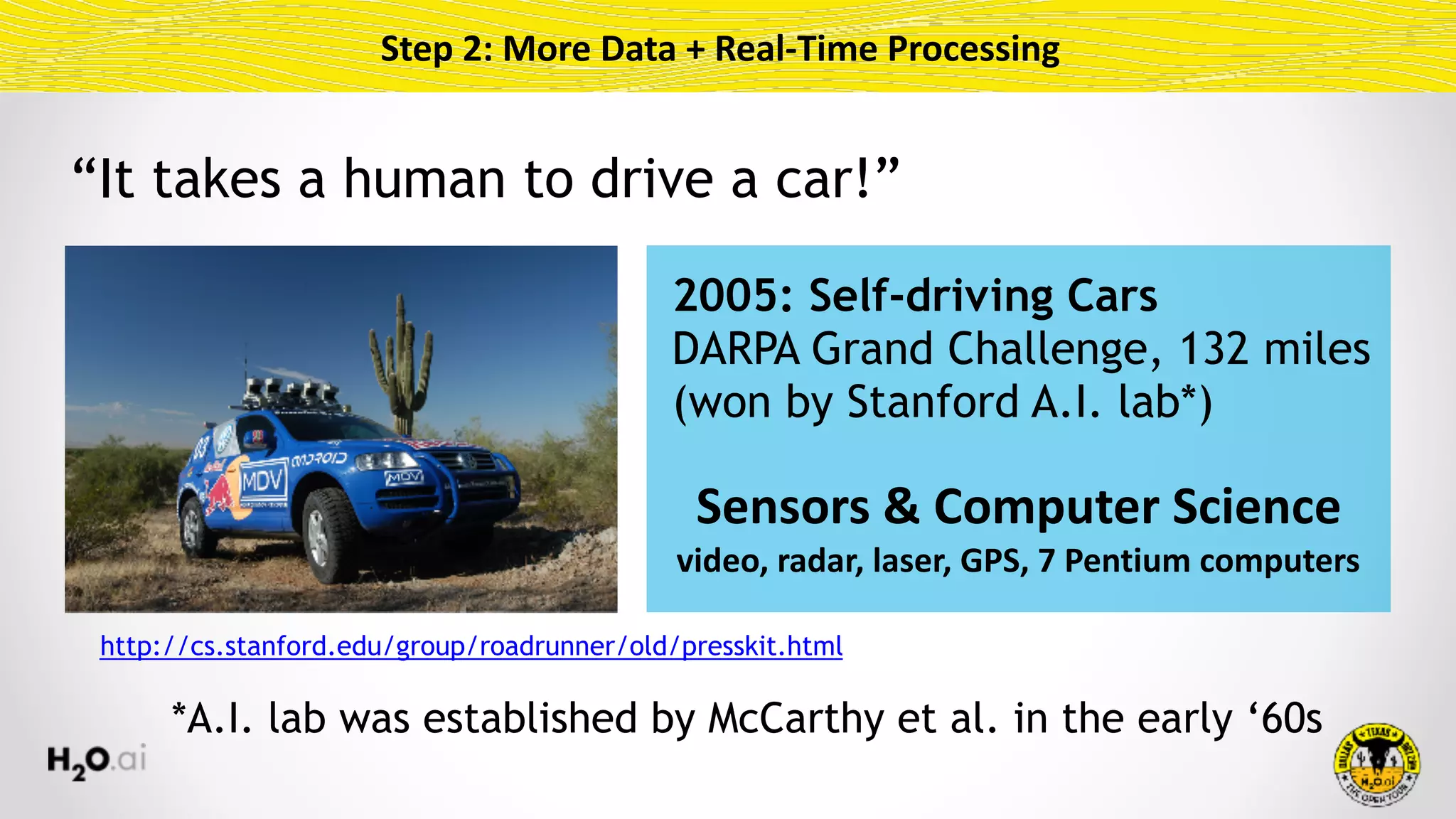
Step	2:	More	Data	+	Real-Time	Processing
http://cs.stanford.edu/group/roadrunner/old/presskit.html
2005: Self-driving Cars

DARPA Grand Challenge, 132 miles
(won by Stanford A.I. lab*)
Sensors	&	Computer	Science

video,	radar,	laser,	GPS,	7	Pentium	computers
“It takes a human to drive a car!”
*A.I. lab was established by McCarthy et al. in the early ‘60s
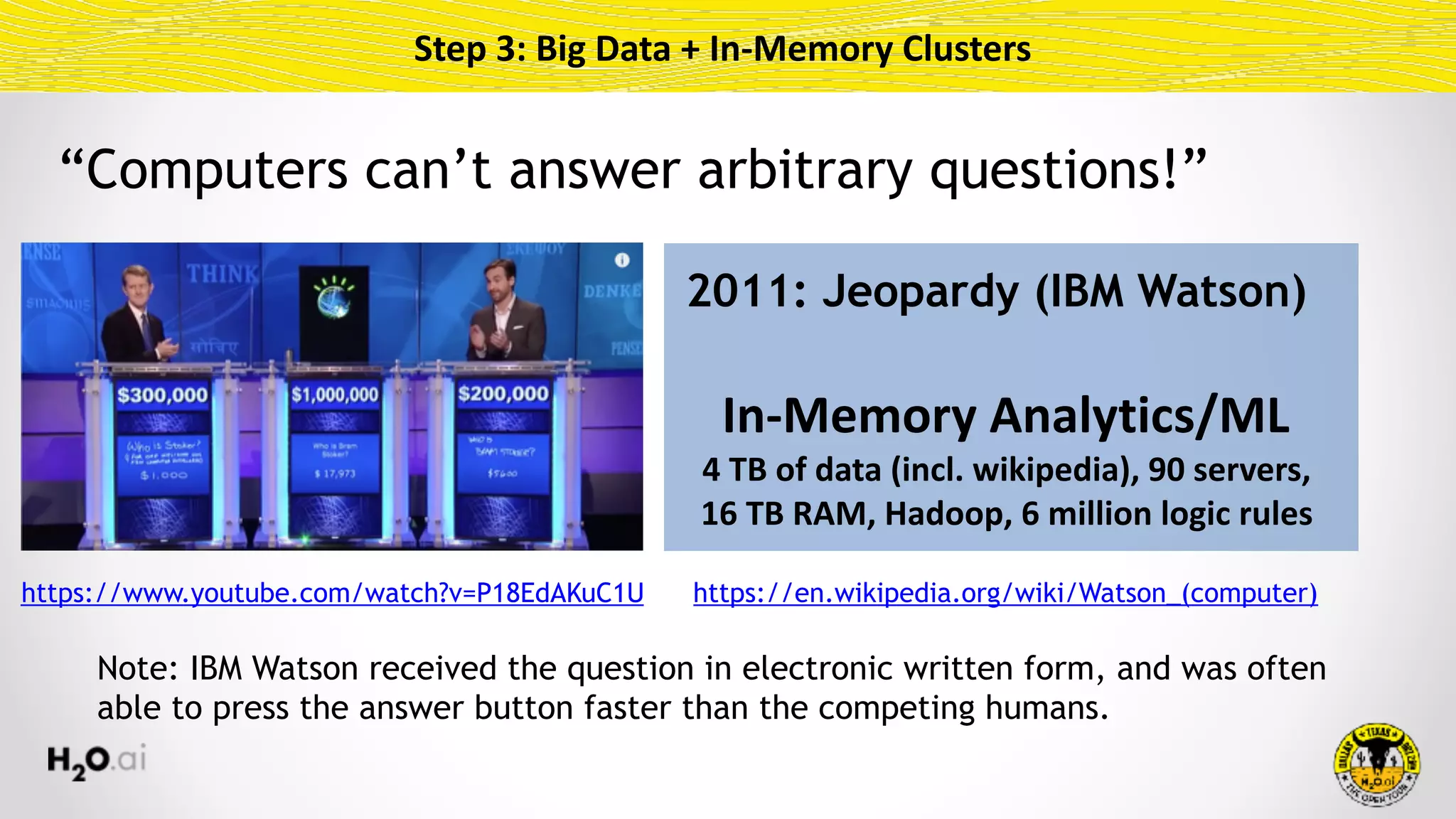
Step	3:	Big	Data	+	In-Memory	Clusters
2011: Jeopardy (IBM Watson)
In-Memory	Analytics/ML	
4	TB	of	data	(incl.	wikipedia),	90	servers,

16	TB	RAM,	Hadoop,	6	million	logic	rules
https://www.youtube.com/watch?v=P18EdAKuC1U https://en.wikipedia.org/wiki/Watson_(computer)
Note: IBM Watson received the question in electronic written form, and was often
able to press the answer button faster than the competing humans.
“Computers can’t answer arbitrary questions!”
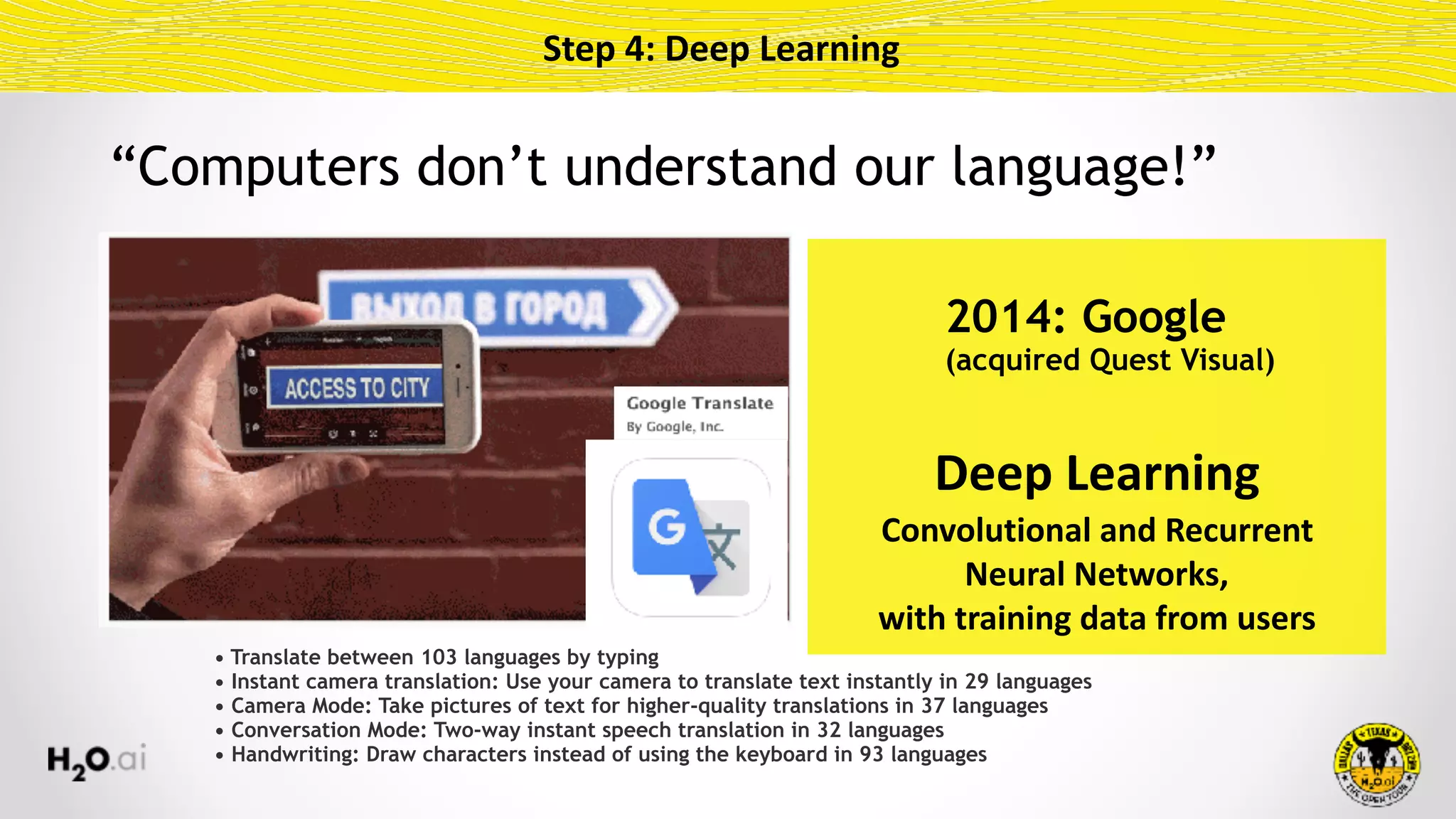
“Computers don’t understand our language!”
2014: Google

(acquired Quest Visual)
Deep	Learning

Convolutional	and	Recurrent	
Neural	Networks,	
with	training	data	from	users
Step	4:	Deep	Learning
• Translate between 103 languages by typing
• Instant camera translation: Use your camera to translate text instantly in 29 languages
• Camera Mode: Take pictures of text for higher-quality translations in 37 languages
• Conversation Mode: Two-way instant speech translation in 32 languages
• Handwriting: Draw characters instead of using the keyboard in 93 languages
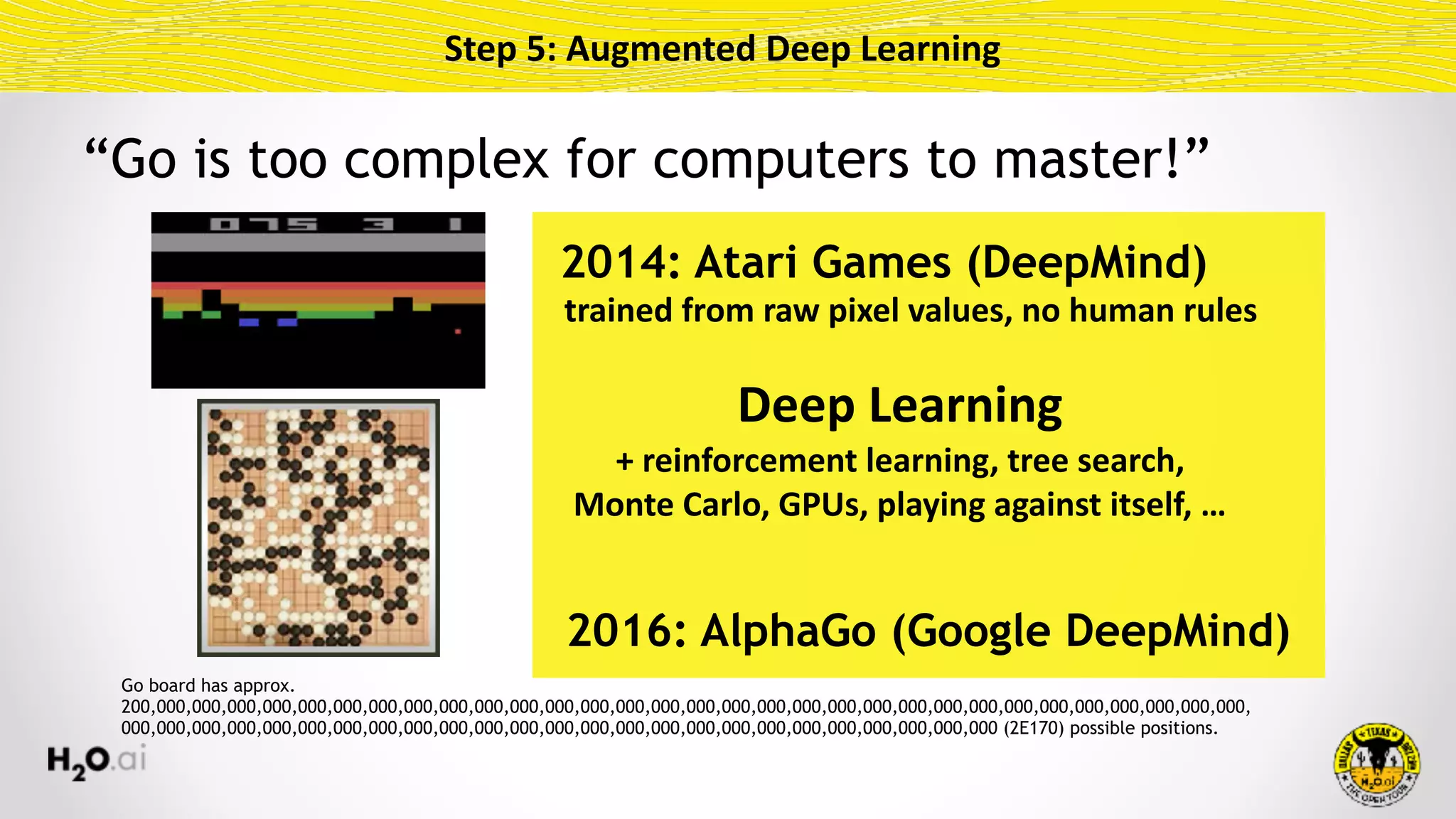
Step	5:	Augmented	Deep	Learning
2014: Atari Games (DeepMind)
2016: AlphaGo (Google DeepMind)
Deep	Learning

+	reinforcement	learning,	tree	search,

Monte	Carlo,	GPUs,	playing	against	itself,	…
Go board has approx.
200,000,000,000,000,000,000,000,000,000,000,000,000,000,000,000,000,000,000,000,000,000,000,000,000,000,000,000,000,000,000,000,
000,000,000,000,000,000,000,000,000,000,000,000,000,000,000,000,000,000,000,000,000,000,000,000,000 (2E170) possible positions.
trained	from	raw	pixel	values,	no	human	rules
“Go is too complex for computers to master!”
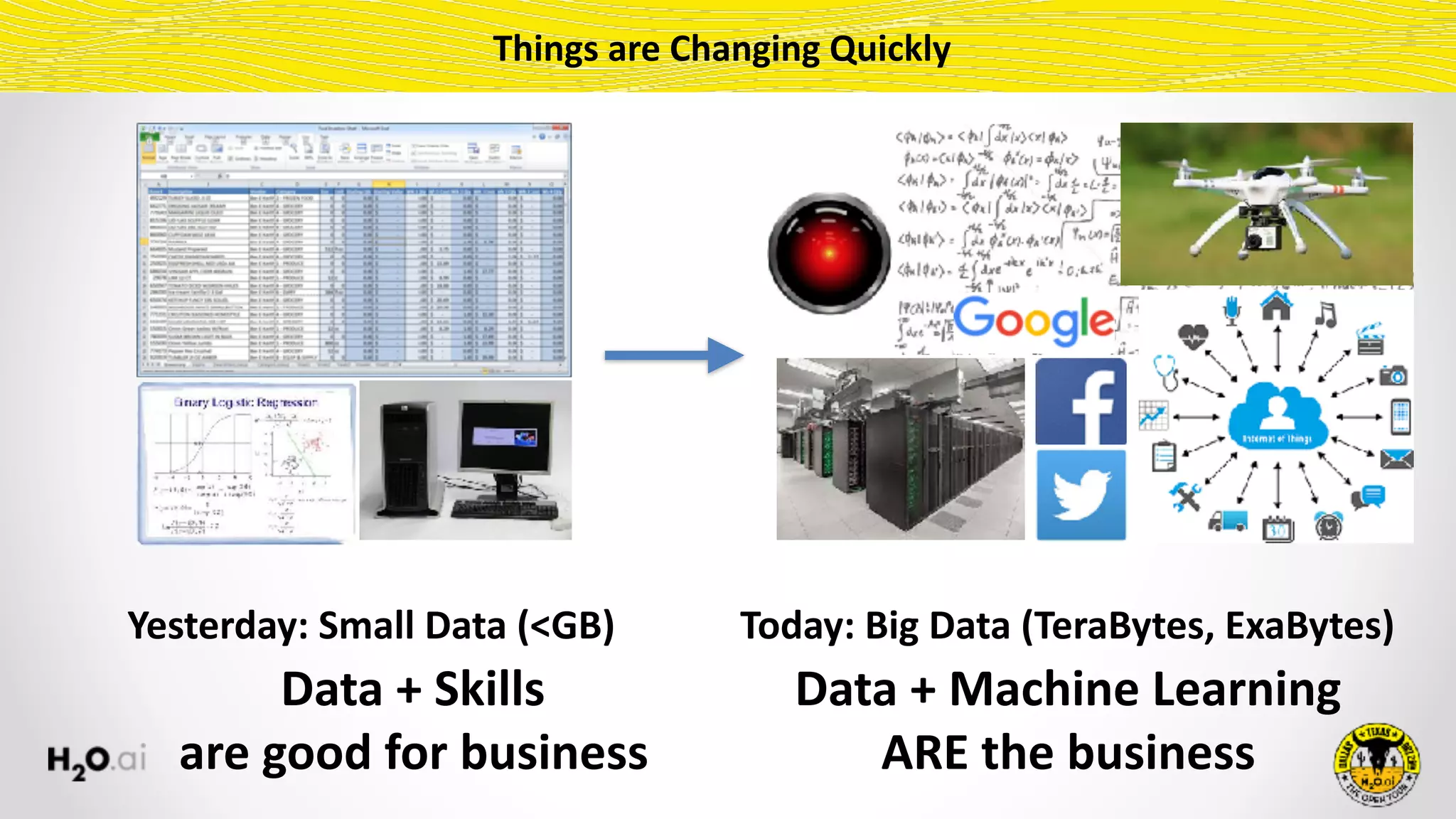
Things	are	Changing	Quickly
Yesterday:	Small	Data	(<GB) Today:	Big	Data	(TeraBytes,	ExaBytes)
Data	+	Skills

are	good	for	business
Data	+	Machine	Learning	
ARE	the	business
• conceptually	simple	
• solves	many	problems	
• benefits	from	big	data	
• super-human	results
Why	Deep	Learning?
Deep	Learning	is	in	the	Center	of	This	Revolution
Why	Deep	Learning?
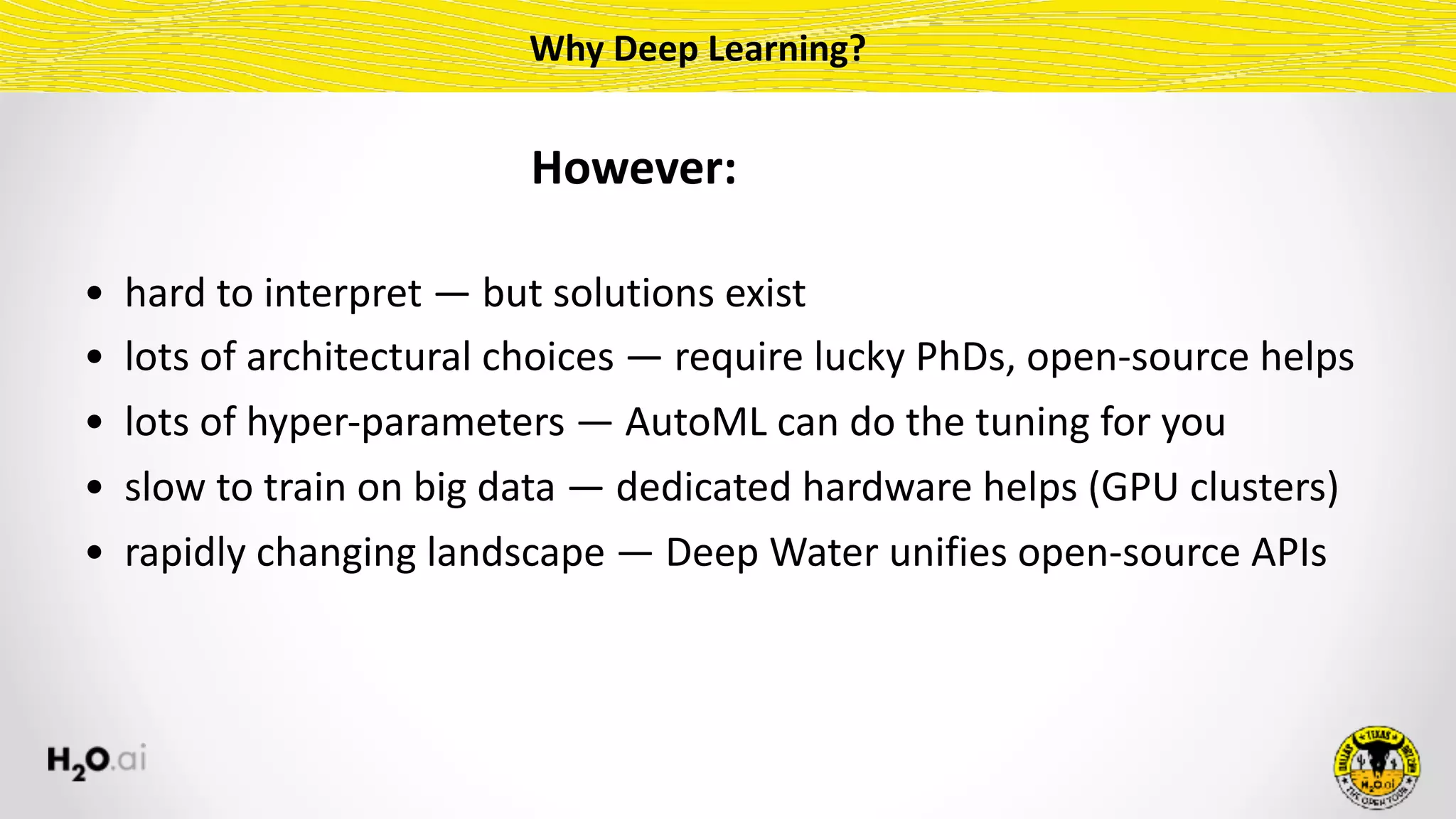
• hard	to	interpret	—	but	solutions	exist	
• lots	of	architectural	choices	—	require	lucky	PhDs,	open-source	helps	
• lots	of	hyper-parameters	—	AutoML	can	do	the	tuning	for	you	
• slow	to	train	on	big	data	—	dedicated	hardware	helps	(GPU	clusters)	
• rapidly	changing	landscape	—	Deep	Water	unifies	open-source	APIs
However:
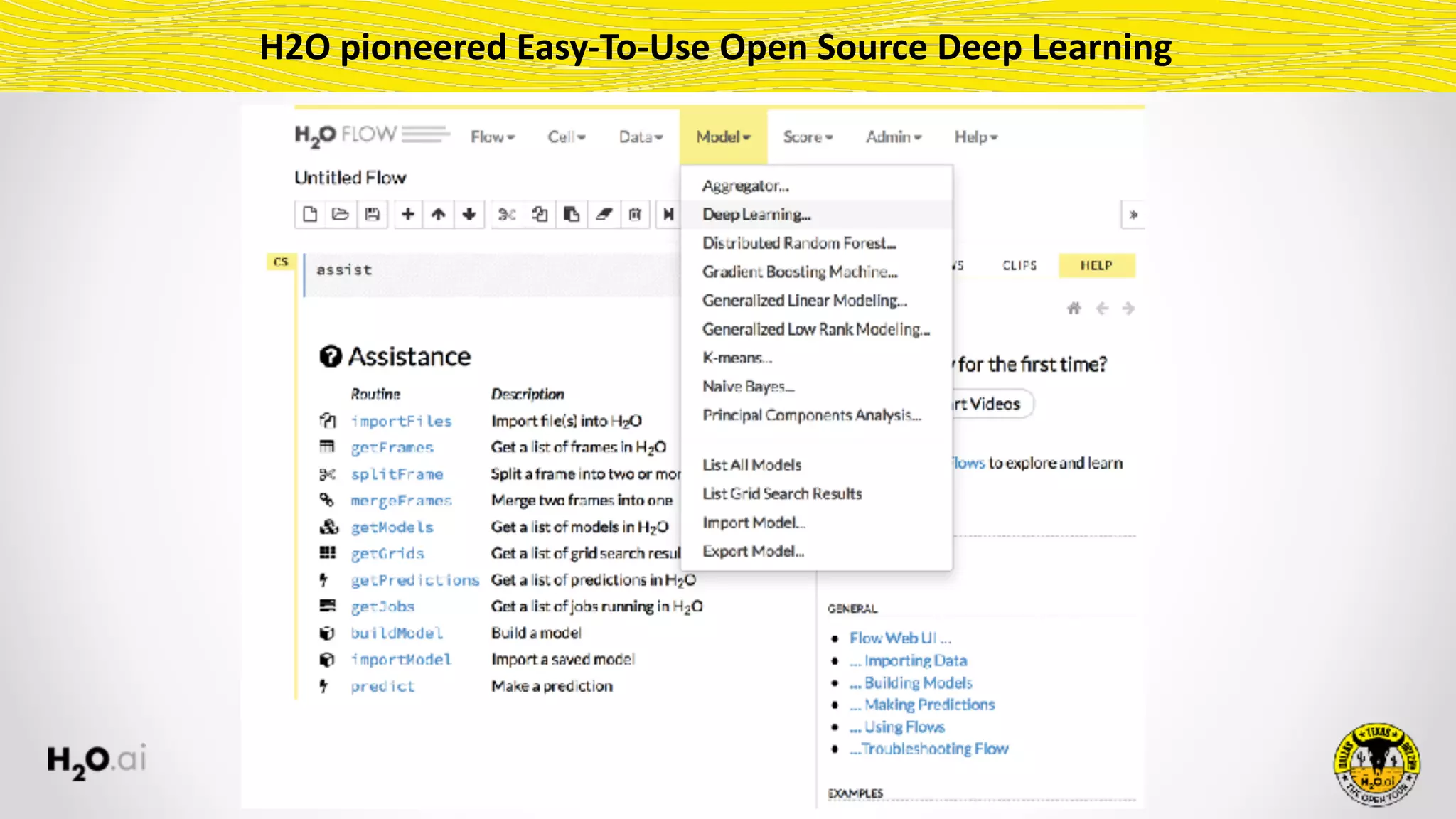
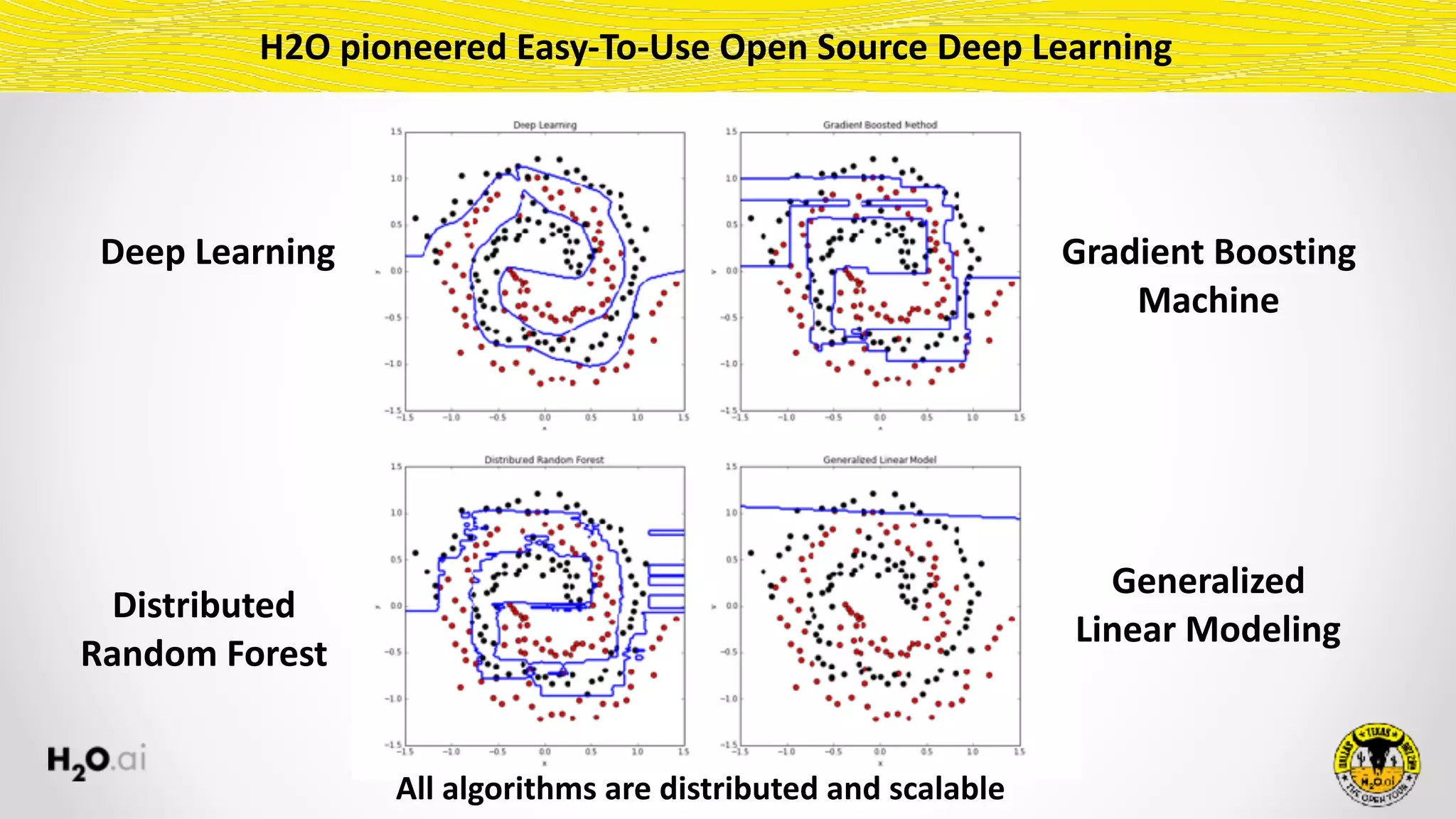
H2O	pioneered	Easy-To-Use	Open	Source	Deep	Learning
Gradient	Boosting

Machine
Generalized

Linear	Modeling
Deep	Learning
Distributed

Random	Forest
All	algorithms	are	distributed	and	scalable
H2O	pioneered	Easy-To-Use	Open	Source	Deep	Learning
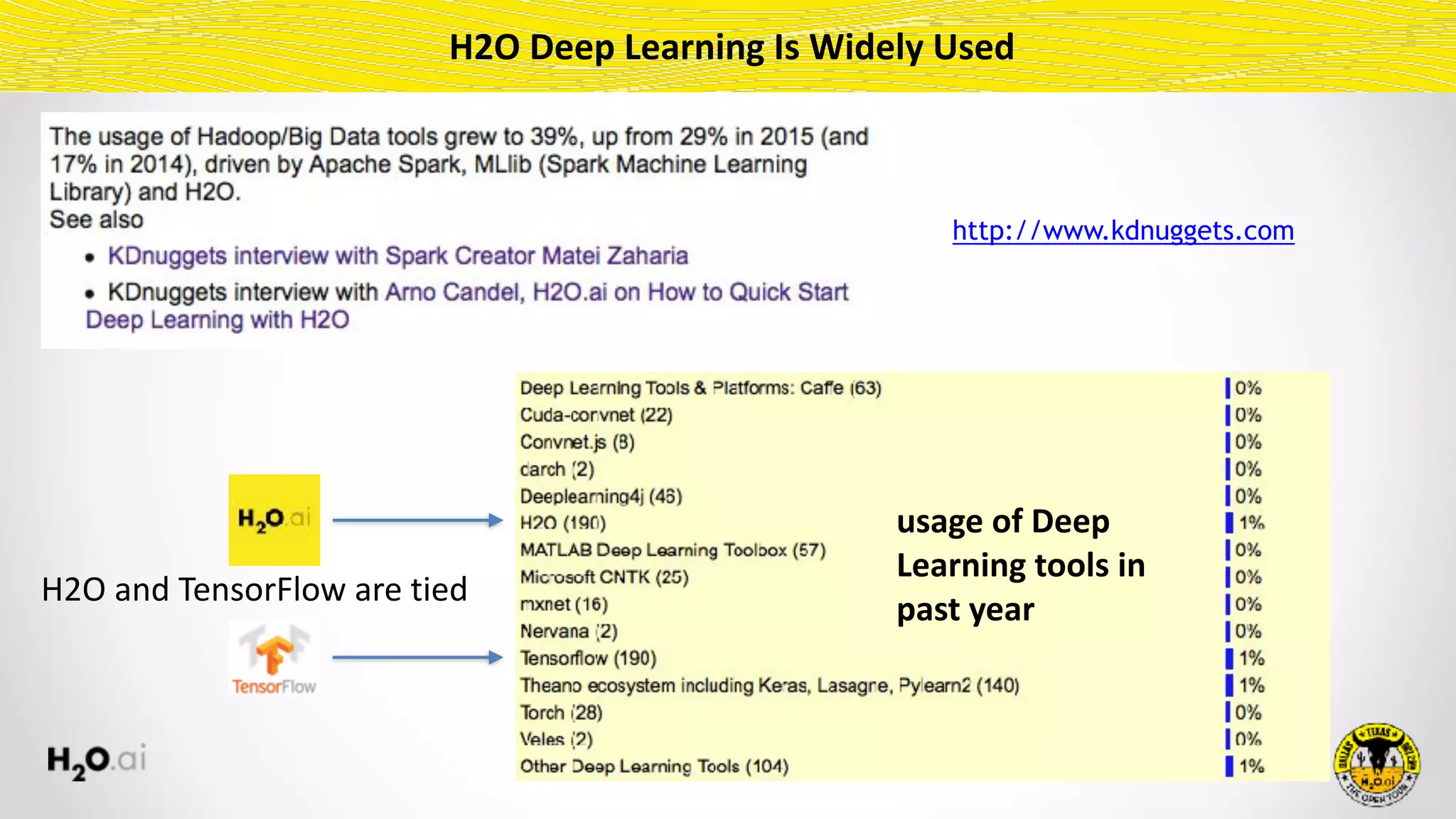
H2O	Deep	Learning	Is	Widely	Used
http://www.kdnuggets.com
H2O	and	TensorFlow	are	tied
usage	of	Deep	
Learning	tools	in	
past	year
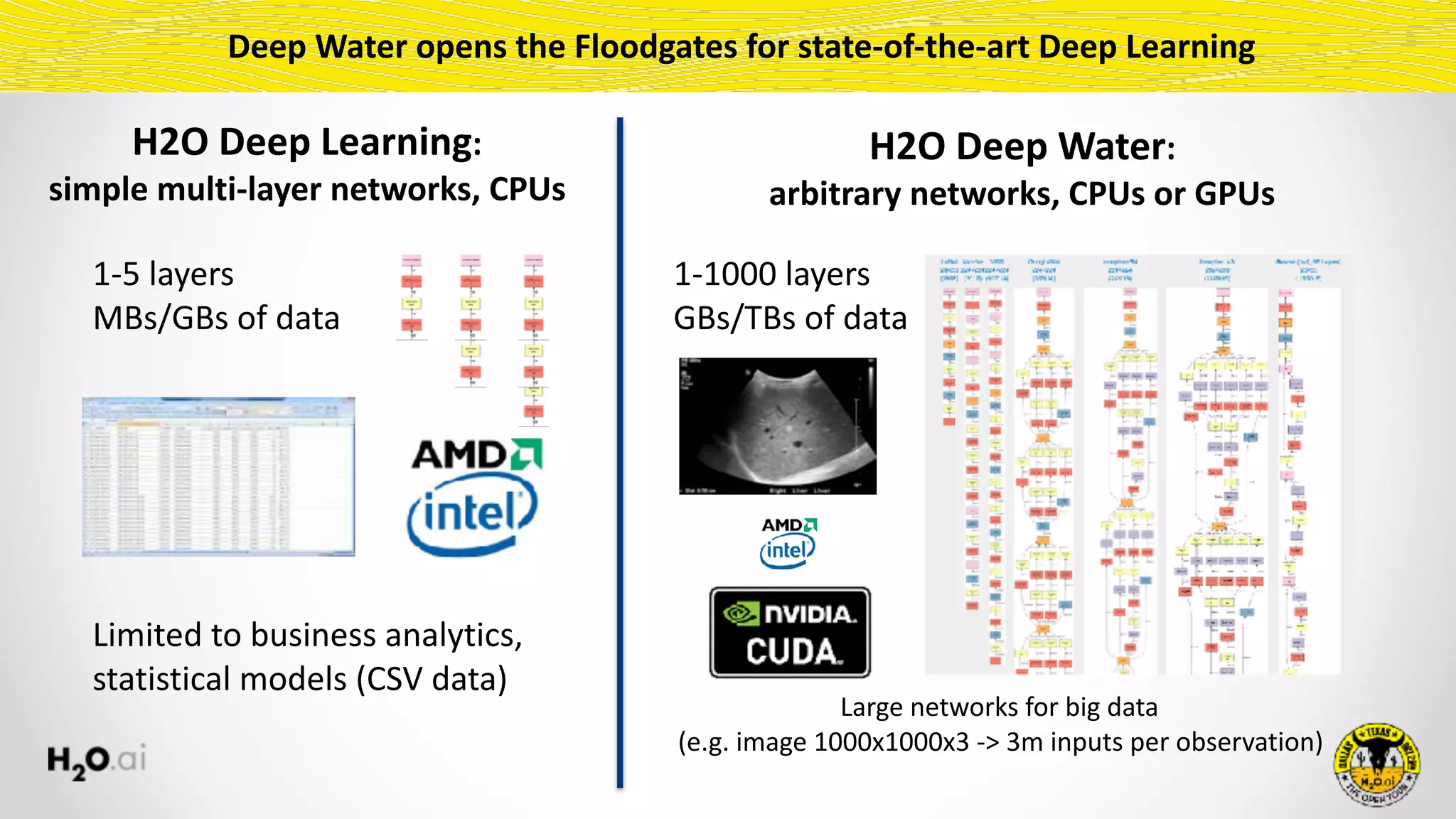
Deep	Water	opens	the	Floodgates	for	state-of-the-art	Deep	Learning
H2O	Deep	Learning:	
simple	multi-layer	networks,	CPUs
H2O	Deep	Water:

arbitrary	networks,	CPUs	or	GPUs
Limited	to	business	analytics,	
statistical	models	(CSV	data)
Large	networks	for	big	data	
(e.g.	image	1000x1000x3	->	3m	inputs	per	observation)
1-5	layers	
MBs/GBs	of	data
1-1000	layers	
GBs/TBs	of	data
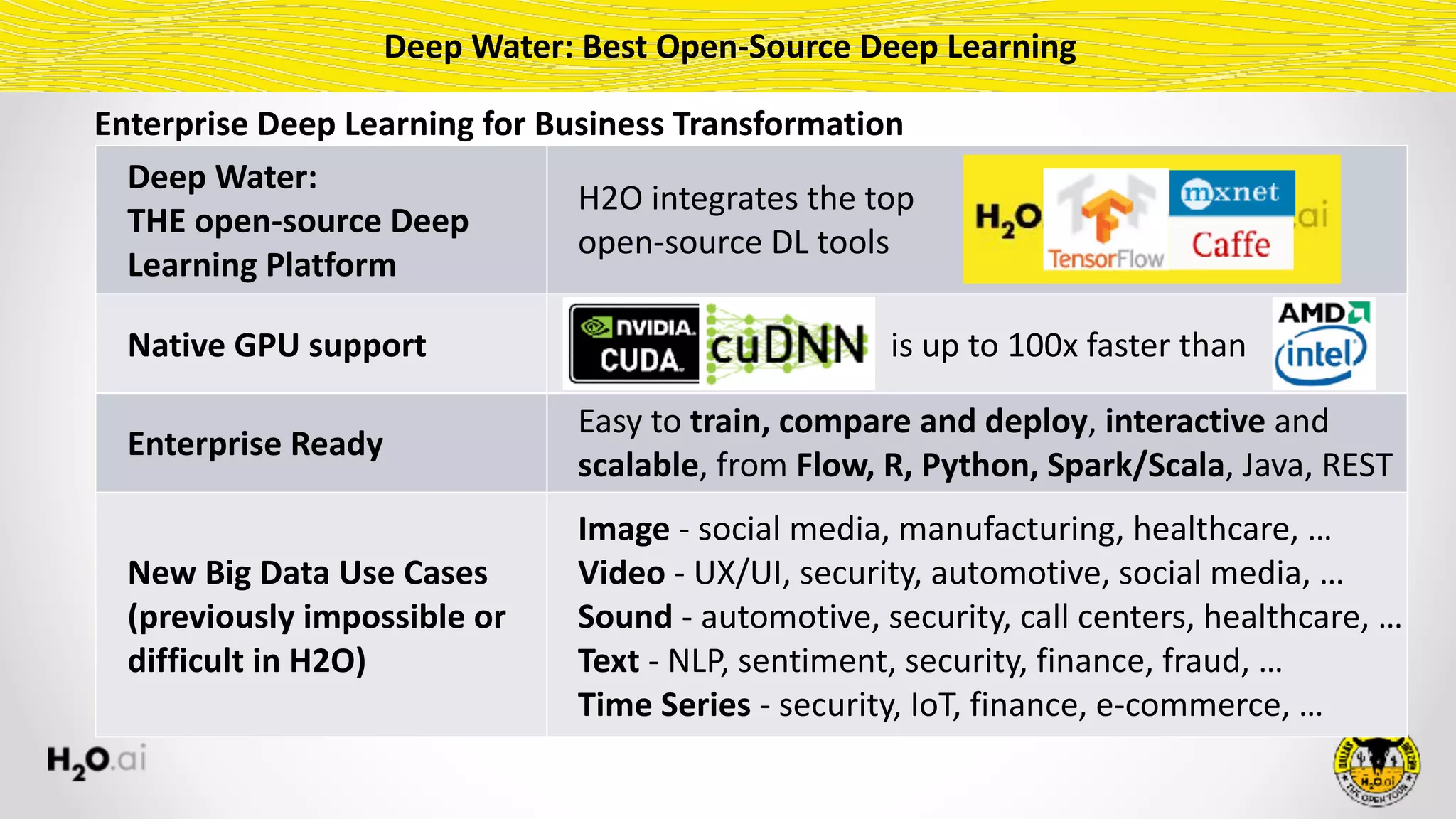
Deep	Water:

THE	open-source	Deep	
Learning	Platform
H2O	integrates	the	top

open-source	DL	tools
Native	GPU	support 																																						is	up	to	100x	faster	than
Enterprise	Ready
Easy	to	train,	compare	and	deploy,	interactive	and	
scalable,	from	Flow,	R,	Python,	Spark/Scala,	Java,	REST
New	Big	Data	Use	Cases	
(previously	impossible	or	
difficult	in	H2O)
Image	-	social	media,	manufacturing,	healthcare,	…	
Video	-	UX/UI,	security,	automotive,	social	media,	…	
Sound	-	automotive,	security,	call	centers,	healthcare,	…	
Text	-	NLP,	sentiment,	security,	finance,	fraud,	…	
Time	Series	-	security,	IoT,	finance,	e-commerce,	…
Deep	Water:	Best	Open-Source	Deep	Learning
Enterprise	Deep	Learning	for	Business	Transformation
Scala

Spark
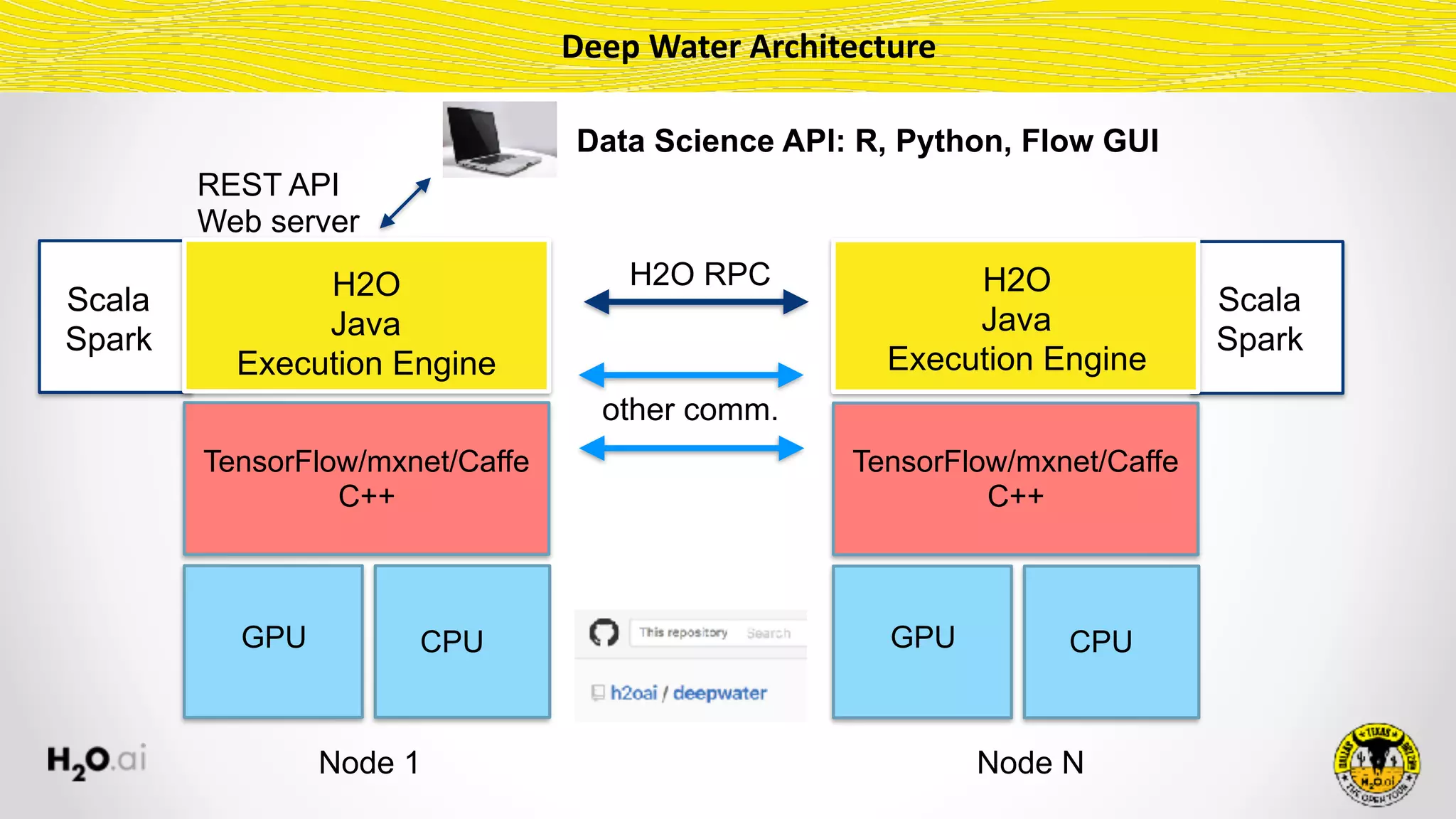
Deep	Water	Architecture
H2O

Java
Execution Engine
TensorFlow/mxnet/Caffe
C++
GPU CPU
TensorFlow/mxnet/Caffe
C++
GPU CPU
H2O RPC
Data Science API: R, Python, Flow GUI
REST API
Web server
H2O

Java
Execution Engine
other comm.
Node 1 Node N
Scala

Spark
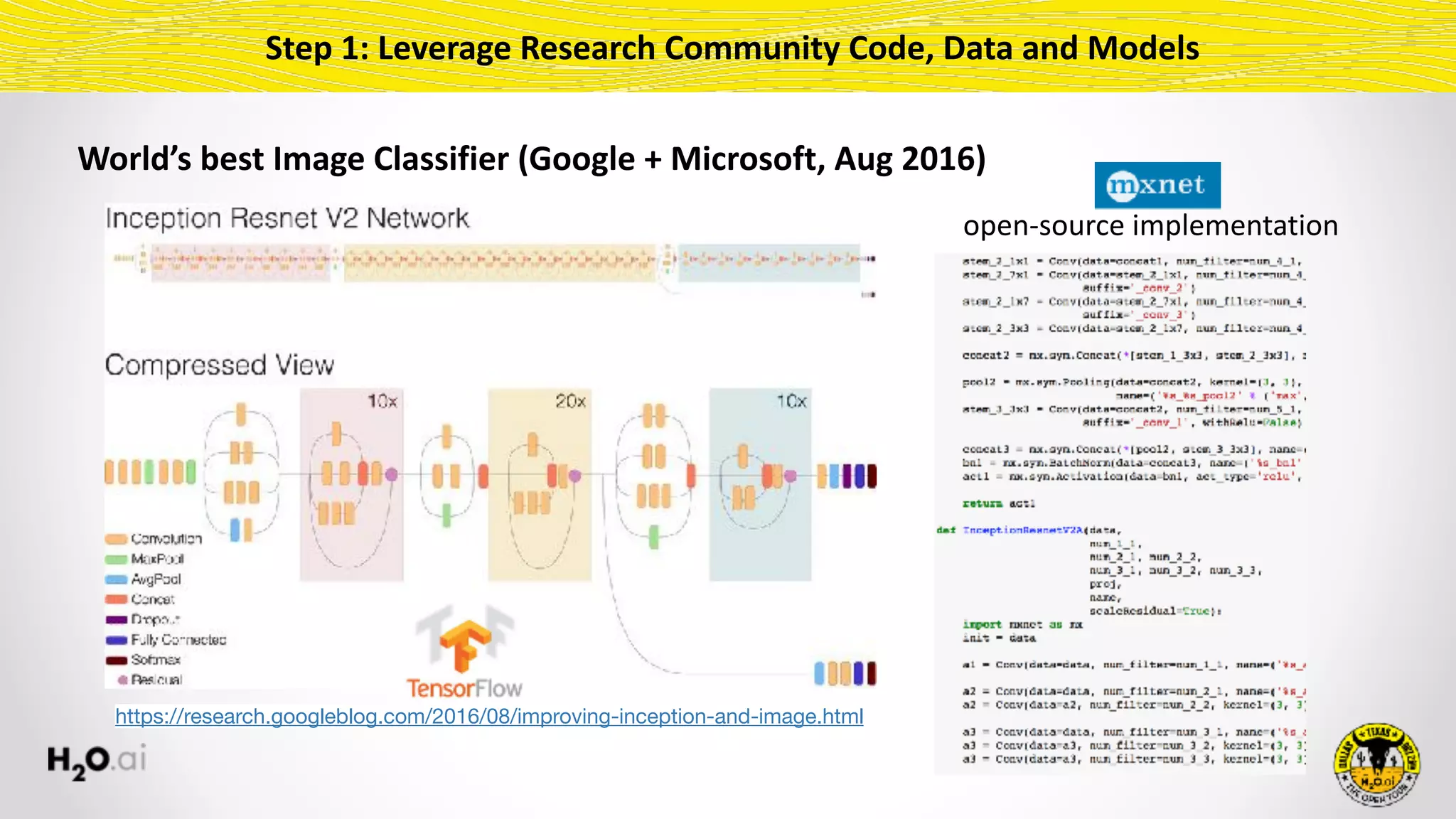
Step	1:	Leverage	Research	Community	Code,	Data	and	Models		
World’s	best	Image	Classifier	(Google	+	Microsoft,	Aug	2016)
https://research.googleblog.com/2016/08/improving-inception-and-image.html
open-source	implementation
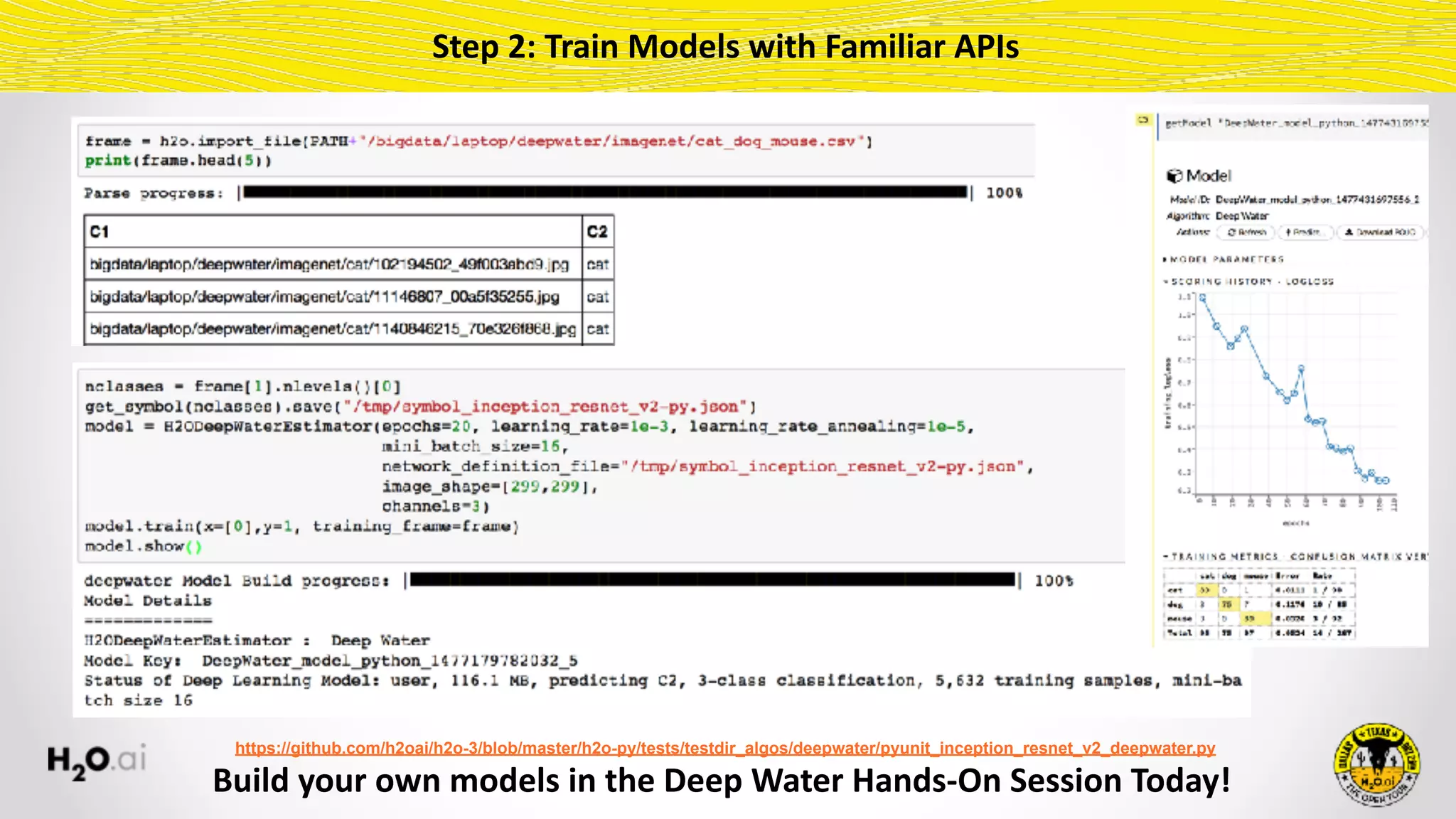
Build	your	own	models	in	the	Deep	Water	Hands-On	Session	Today!	
Step	2:	Train	Models	with	Familiar	APIs
https://github.com/h2oai/h2o-3/blob/master/h2o-py/tests/testdir_algos/deepwater/pyunit_inception_resnet_v2_deepwater.py
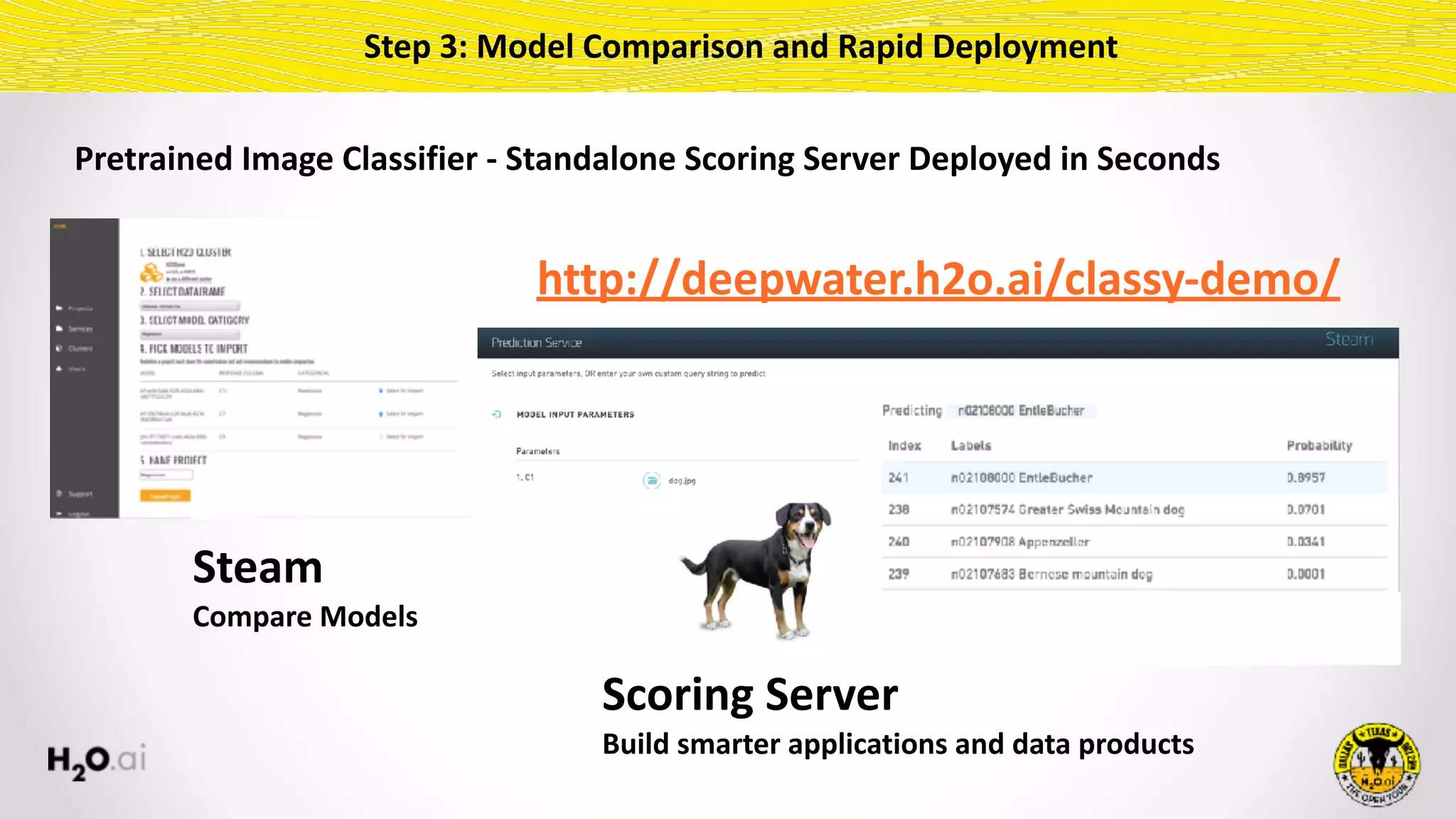
Pretrained	Image	Classifier	-	Standalone	Scoring	Server	Deployed	in	Seconds
http://deepwater.h2o.ai/classy-demo/
Step	3:	Model	Comparison	and	Rapid	Deployment
Steam	
Compare	Models
Scoring	Server	
Build	smarter	applications	and	data	products
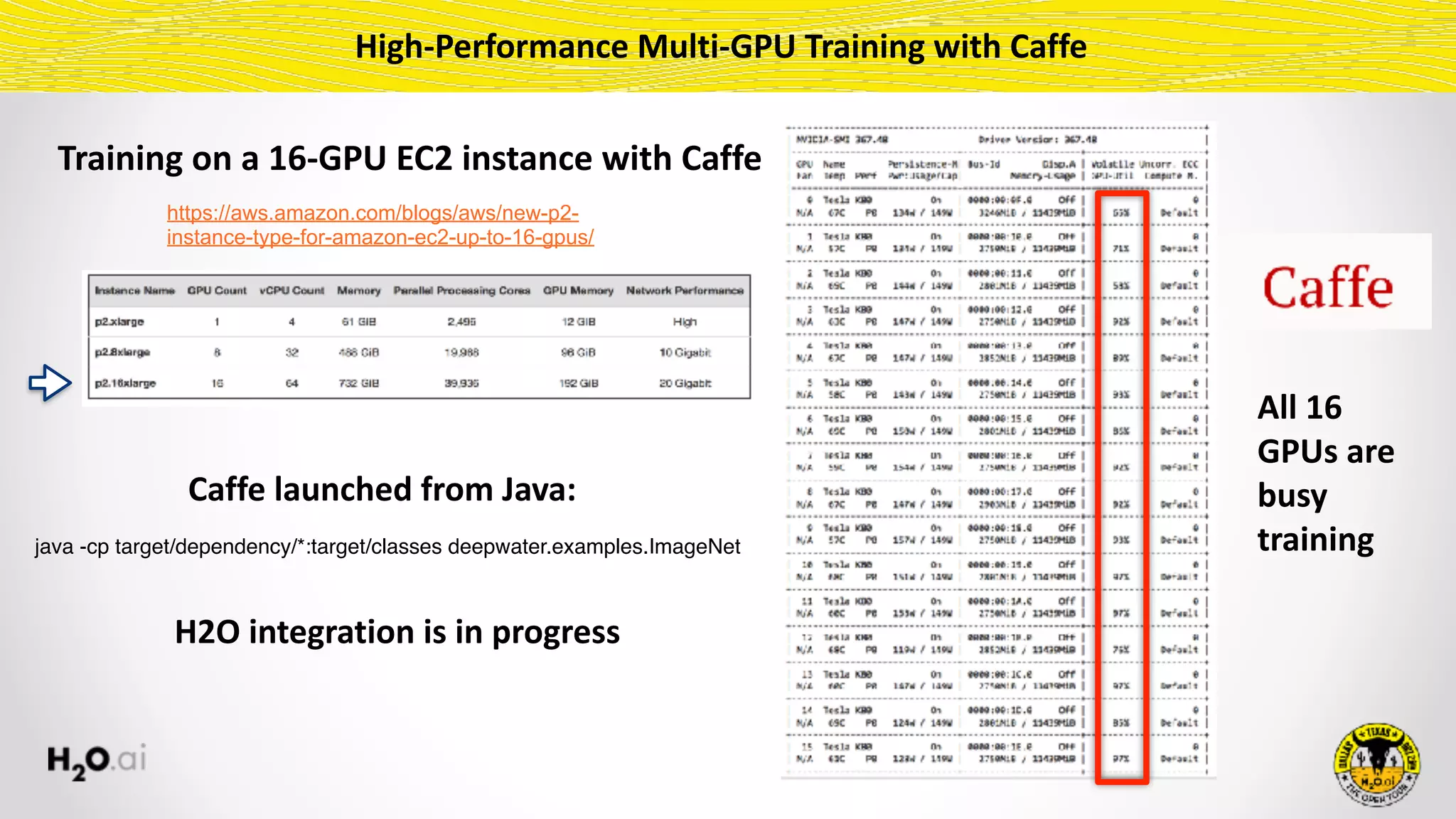
High-Performance	Multi-GPU	Training	with	Caffe
Training	on	a	16-GPU	EC2	instance	with	Caffe
java -cp target/dependency/*:target/classes deepwater.examples.ImageNet
Caffe	launched	from	Java:
https://aws.amazon.com/blogs/aws/new-p2-
instance-type-for-amazon-ec2-up-to-16-gpus/
All	16	
GPUs	are	
busy	
training
H2O	integration	is	in	progress
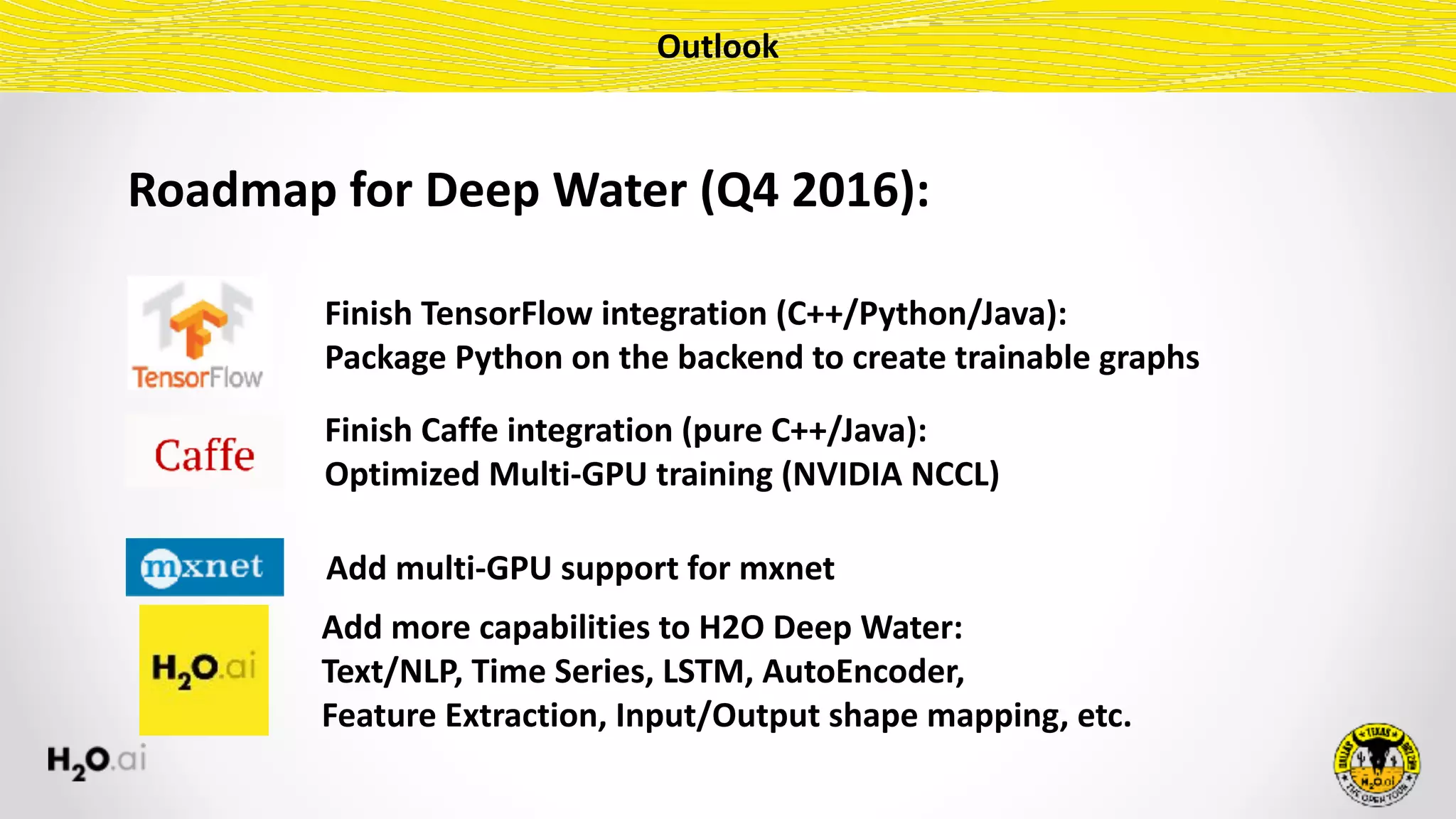
Outlook
Finish	TensorFlow	integration	(C++/Python/Java):	
Package	Python	on	the	backend	to	create	trainable	graphs
Roadmap	for	Deep	Water	(Q4	2016):
Finish	Caffe	integration	(pure	C++/Java):	
Optimized	Multi-GPU	training	(NVIDIA	NCCL)
Add	more	capabilities	to	H2O	Deep	Water:	
Text/NLP,	Time	Series,	LSTM,	AutoEncoder,	
Feature	Extraction,	Input/Output	shape	mapping,	etc.
Add	multi-GPU	support	for	mxnet
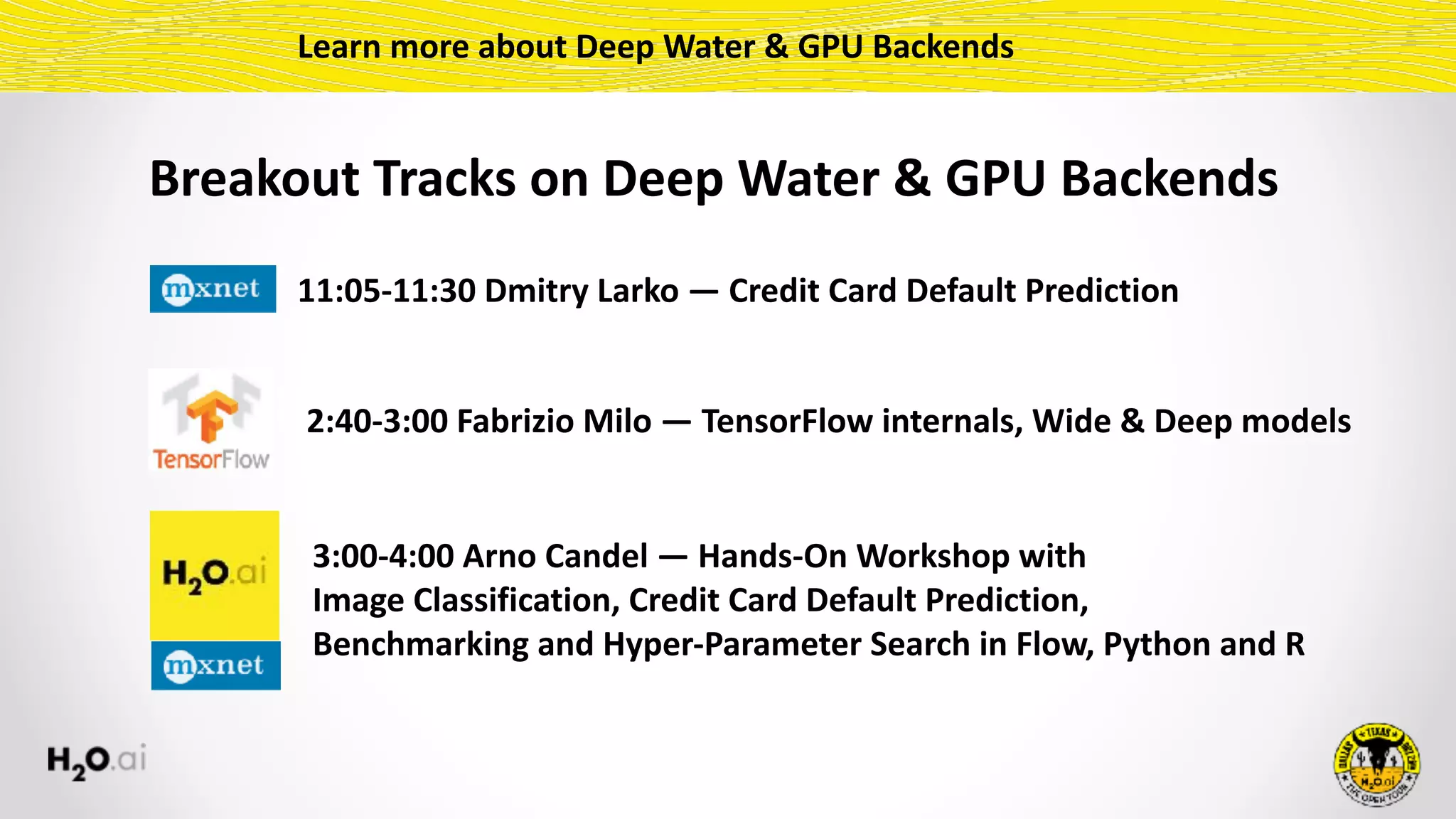
Learn	more	about	Deep	Water	&	GPU	Backends
11:05-11:30	Dmitry	Larko	—	Credit	Card	Default	Prediction
2:40-3:00	Fabrizio	Milo	—	TensorFlow	internals,	Wide	&	Deep	models
3:00-4:00	Arno	Candel	—	Hands-On	Workshop	with	
Image	Classification,	Credit	Card	Default	Prediction,

Benchmarking	and	Hyper-Parameter	Search	in	Flow,	Python	and	R
Breakout	Tracks	on	Deep	Water	&	GPU	Backends
Deep	Water	Live	Demo
Live	Demo

Deep Water - GPU Deep Learning for H2O - Arno Candel