#VoxxedVienna @ramtop
It’s All About
Morphisms
Uberto Barbini
#VoxxedVienna @ramtop
Map of this presentation
Category Monoid
Functor
Applicative
Monad
Natural Transformation
The Foundations of
Functional Programming
#VoxxedVienna @ramtop
This presentation will be a success if
most of you will not fall asleep
#VoxxedVienna @ramtop
This presentation will be a success if
most of you will not fall asleep
As a secondary goal, I hope
to encourage people using
Functional Programming and
studying Category Theory
It’s ok if you don’t
understand all the first time
#VoxxedVienna @ramtop
What is this Category thingy?
Invented in 1940s “with the goal of
understanding the processes that preserve
mathematical structure.”
“Category Theory is about relation
between things”
“General abstract nonsense”
#VoxxedVienna @ramtop
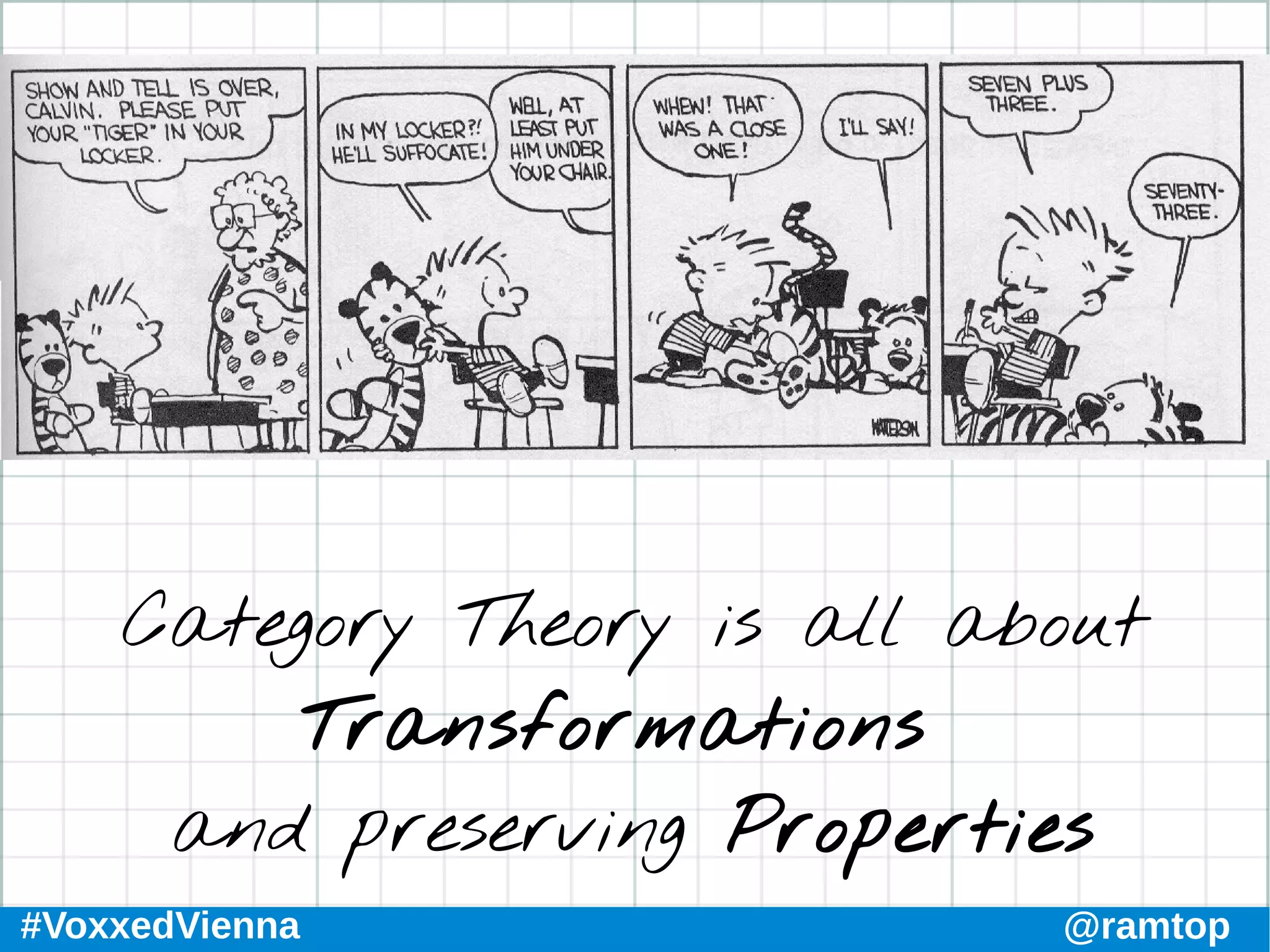
Category Theory is all about
Transformations
and preserving Properties
#VoxxedVienna @ramtop
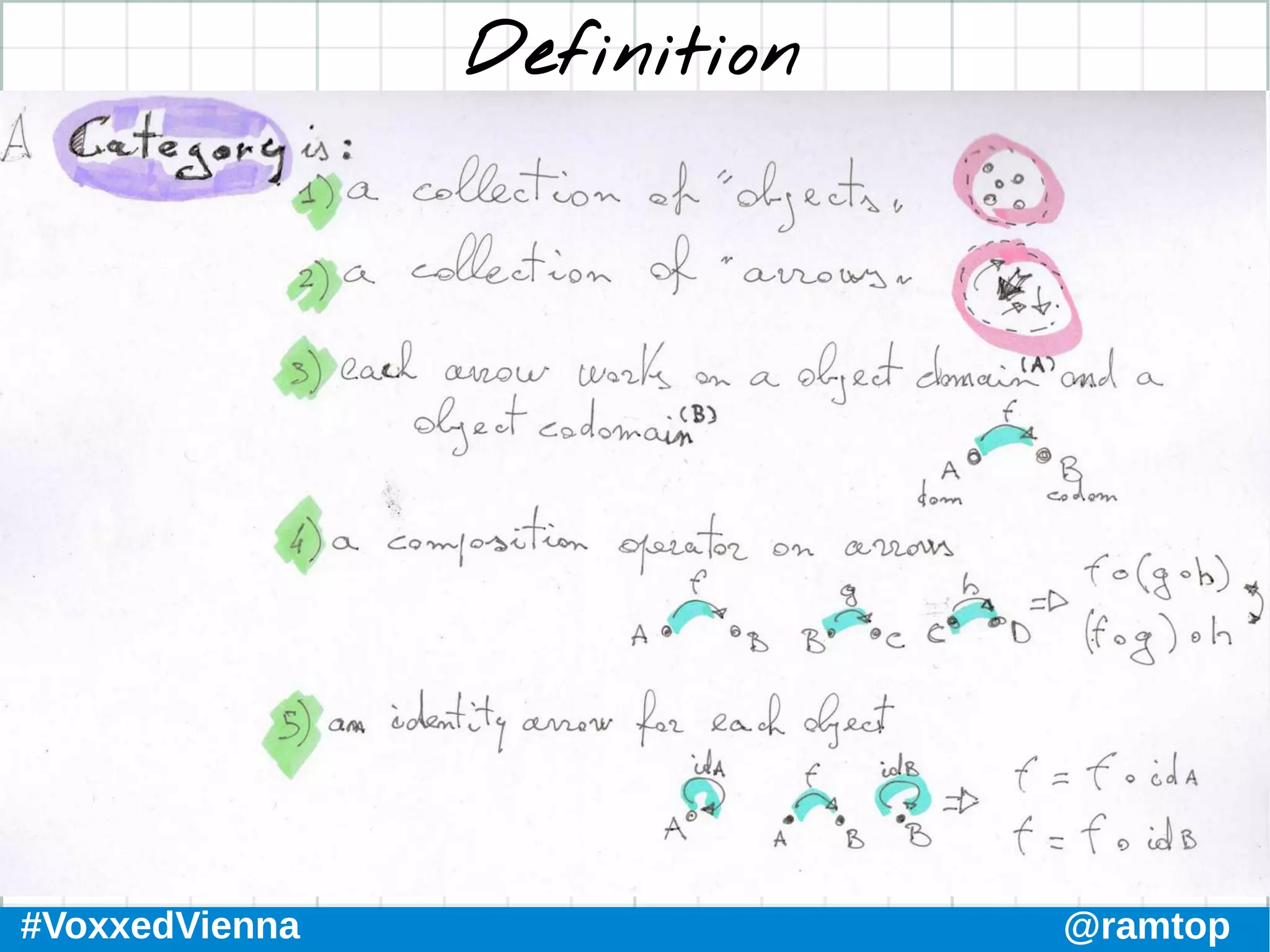
Definition
#VoxxedVienna @ramtop
A Category Example
Tube Map:
Objects stations→
Arrows travel routes→
Each Arrows connect 2 stations
Arrow composition is travelling along the line
Identity Arrow is staying in the same station
#VoxxedVienna @ramtop
London Tube Category
#VoxxedVienna @ramtop
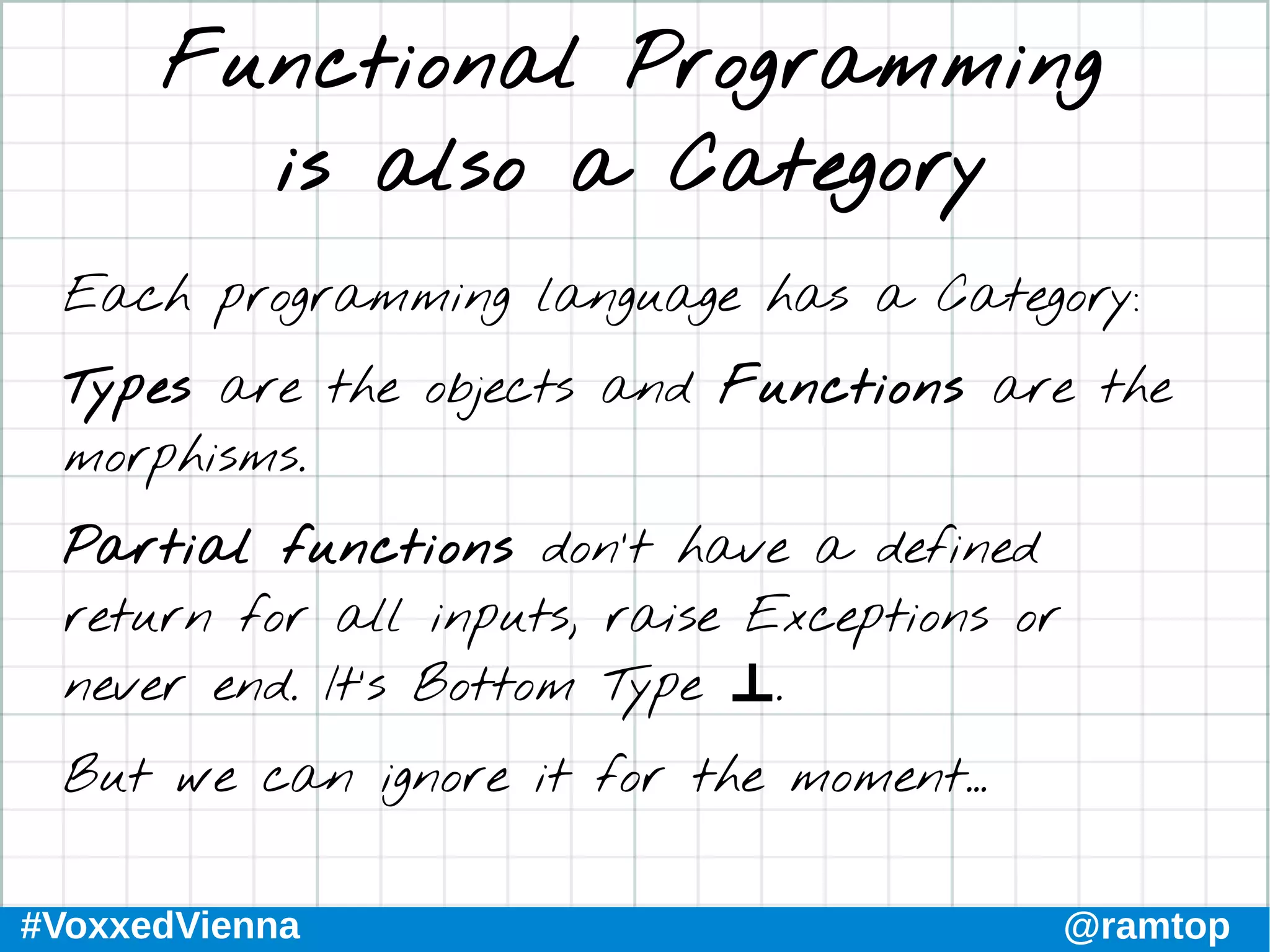
Functional Programming
is also a Category
Each programming language has a Category:
Types are the objects and Functions are the
morphisms.
Partial functions don’t have a defined
return for all inputs, raise Exceptions or
never end. It’s Bottom Type ⊥.
But we can ignore it for the moment...
#VoxxedVienna @ramtop
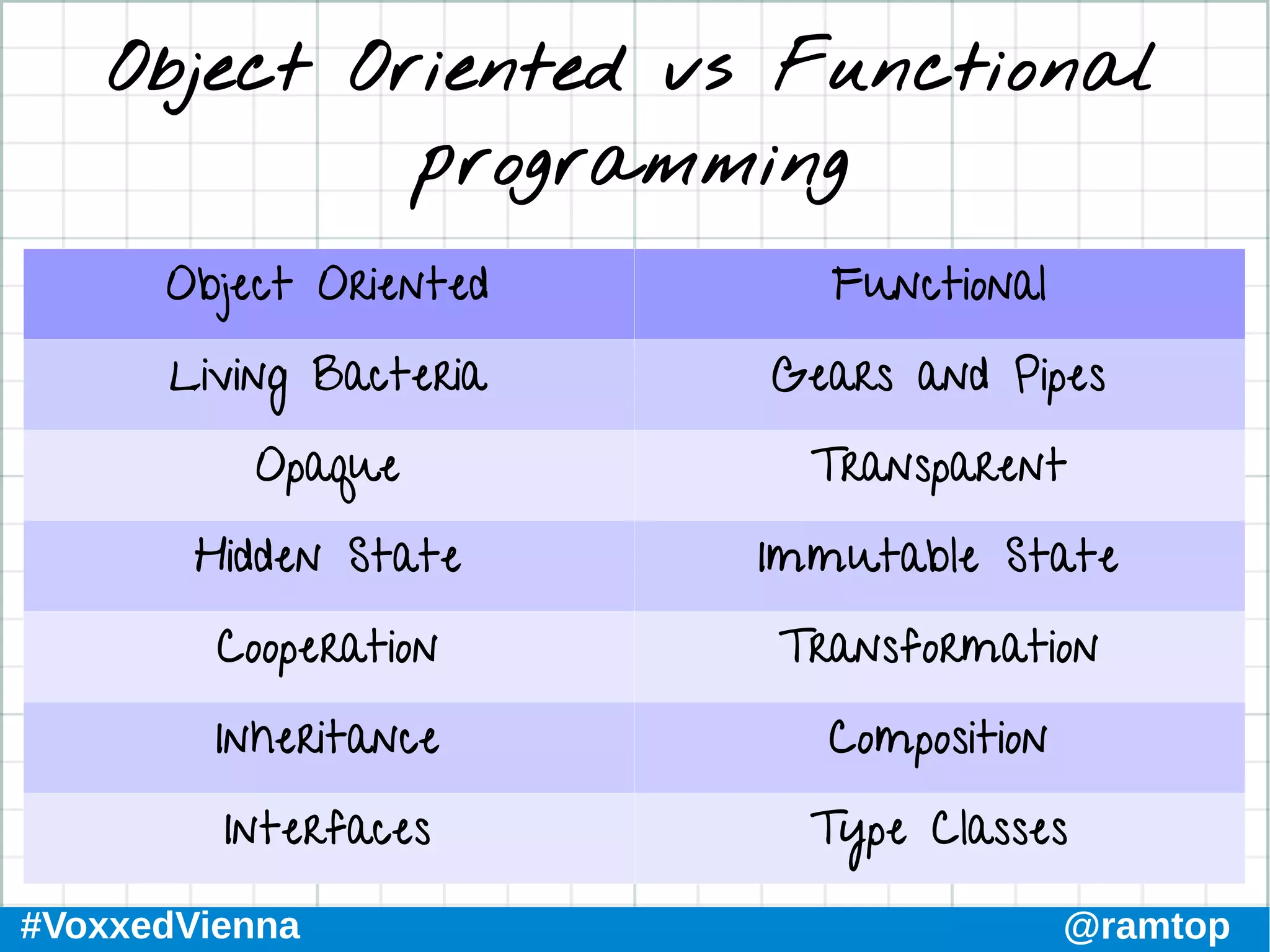
Object Oriented vs Functional
programming
Object Oriented Functional
Living Bacteria Gears and Pipes
Opaque Transparent
Hidden State Immutable State
Cooperation Transformation
Inheritance Composition
Interfaces Type Classes
#VoxxedVienna @ramtop
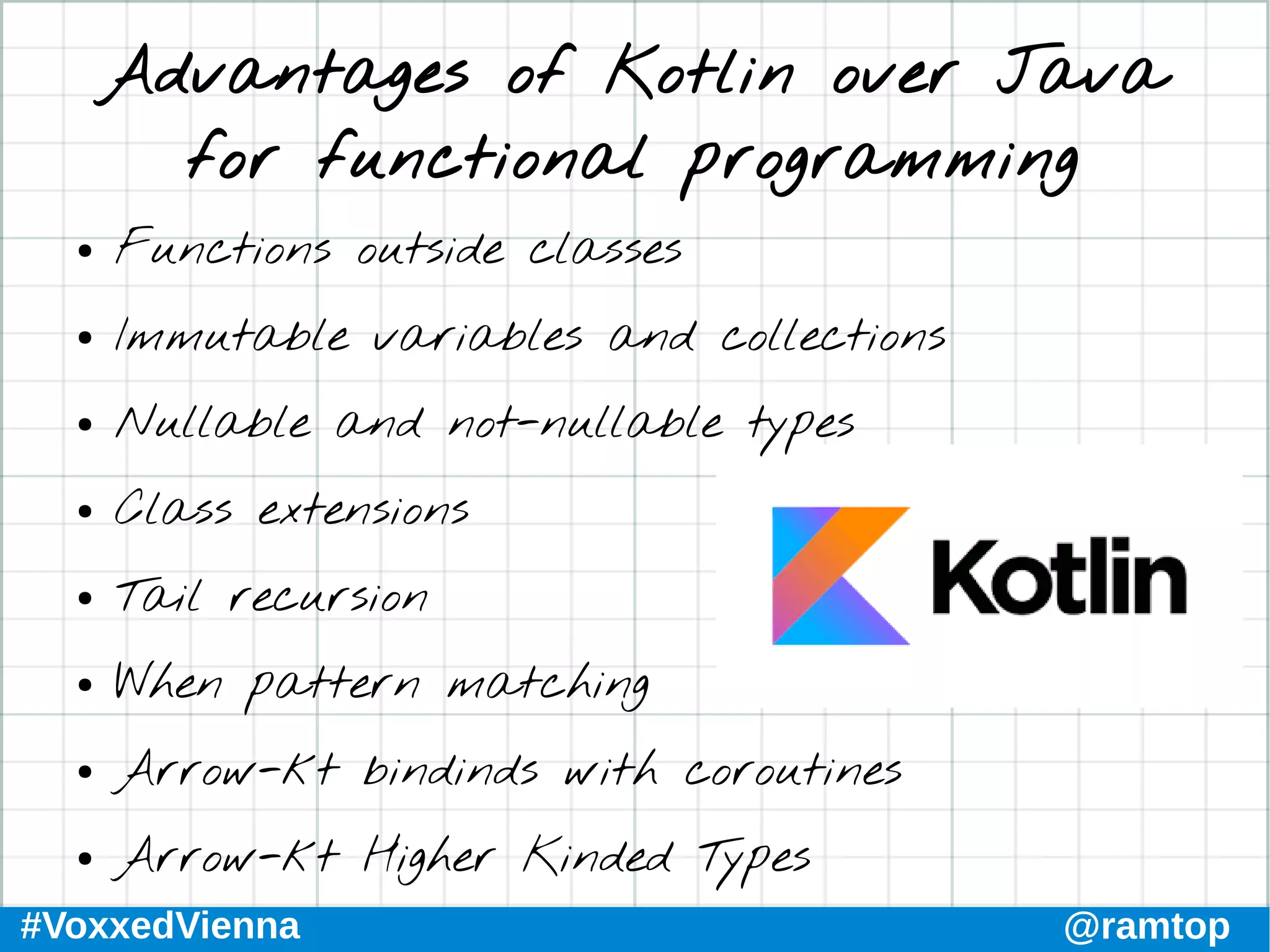
Advantages of Kotlin over Java
for functional programming
● Functions outside classes
● Immutable variables and collections
● Nullable and not-nullable types
● Class extensions
● Tail recursion
● When pattern matching
● Arrow-kt bindinds with coroutines
● Arrow-kt Higher Kinded Types
#VoxxedVienna @ramtop
Two words about Kotlin syntax
● No semicolon!
● String? Is a different type from String
● myFun{println(it)} is equivalent to
myFun(x -> println(x))
● val xy is declaring xy immutable
var xy is declaring xy mutable
● User(“Joe”) is equivalent to Java
new User(“Joe”)
#VoxxedVienna @ramtop
Ok… but why using a Object
Oriented Language for Functional
Programming at all?
#VoxxedVienna @ramtop
arrow-kt.io
#VoxxedVienna @ramtop
KEEP-87 TypeClasses and HKT
#VoxxedVienna @ramtop
Purity and
Immutability
For the Category morphisms to work in
programming we need Purity and Immutability.
What does it mean pure?
How can I work only with immutable data?
But ultimately everything is converted in
assembly which is neither pure nor immutable.
We need those quality only for reachable code
#VoxxedVienna @ramtop
Monoid
What about the category of morphisms of a
category?
Are they composable?
It’s a Category with a single Object and lots of
Morphisms
If it is a Category and it has only one Object
is a Monoid
#VoxxedVienna @ramtop
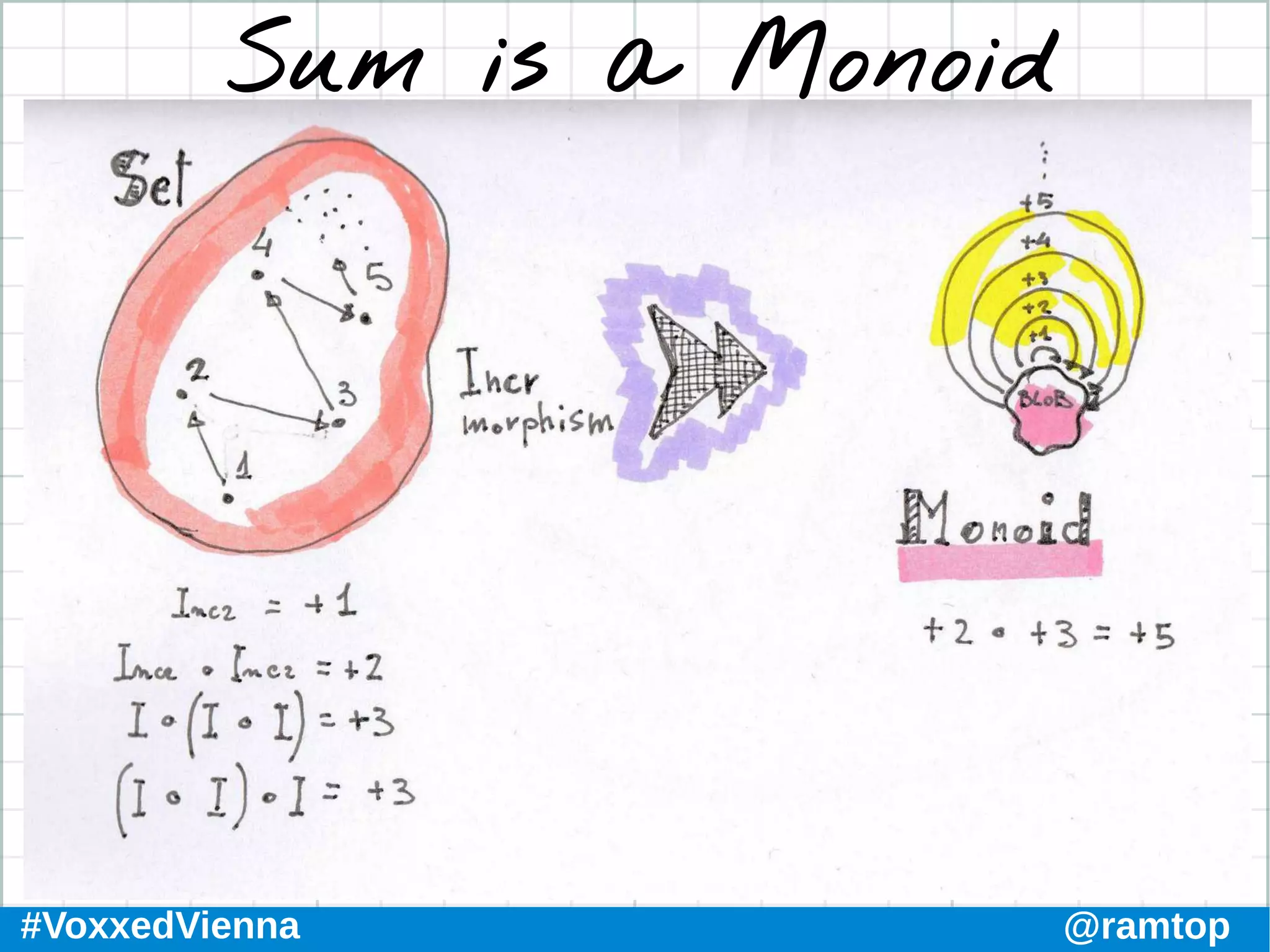
Sum is a Monoid
#VoxxedVienna @ramtop
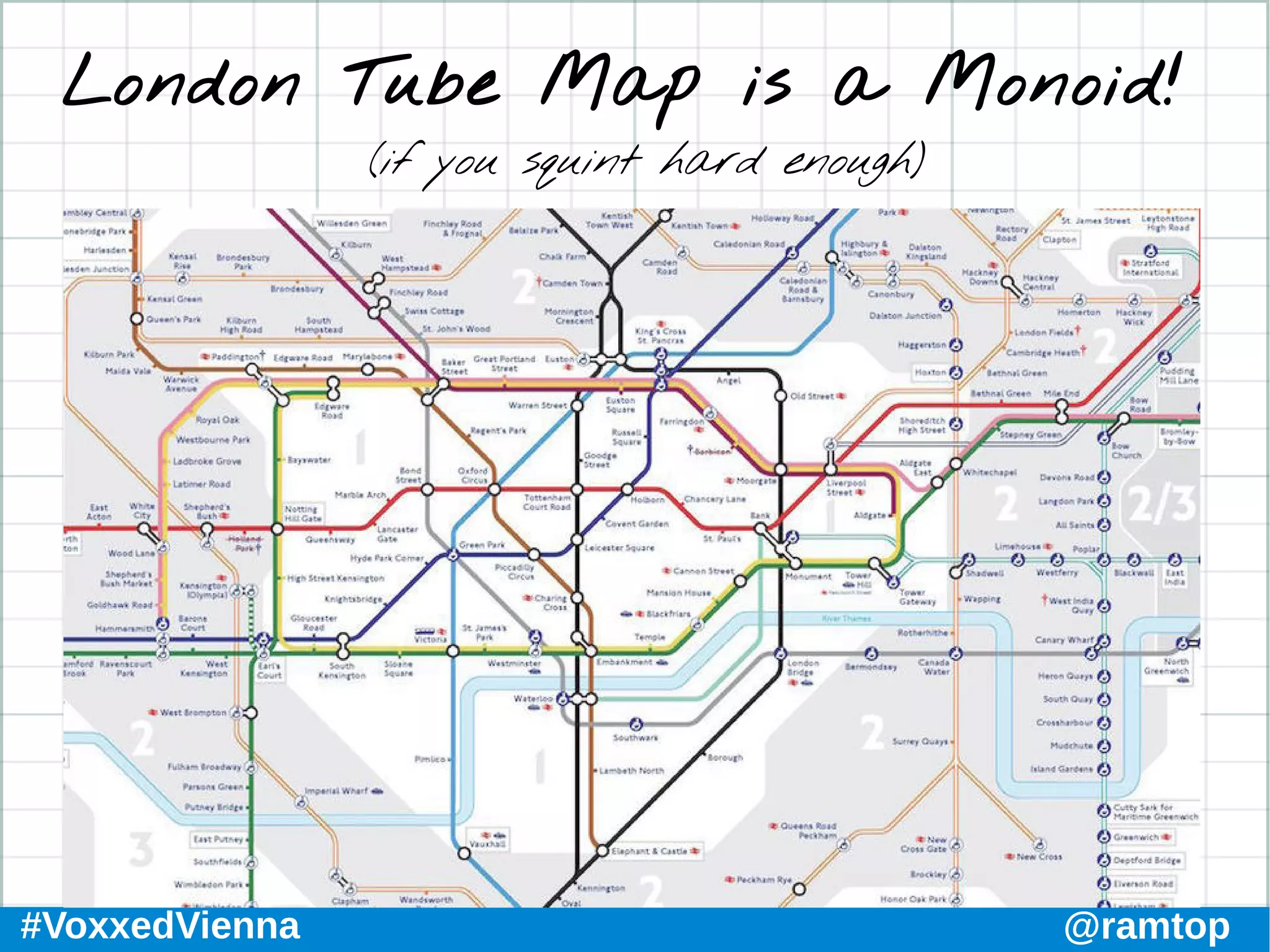
London Tube Map is a Monoid!
(if you squint hard enough)
#VoxxedVienna @ramtop
Programming with Monoids
A type class with two methods
combine monoid append→
empty neutral element→
(x <> y) <> z = x <> (y <> z) -- associativity
empty <> x = x -- left identity
x <> empty = x -- right identity
#VoxxedVienna @ramtop
Type Class vs
Interface
● Interfaces “unify” different types:
Cat and Dogs can be treated as Animals
● Type Classes “group” types with similar
behaviour, without hiding their types:
Cats and Dogs can both mate but cats
can mate only with cats and dogs with dogs
● As an example, let’s consider the Equals
method in Java
#VoxxedVienna @ramtop
About Typeclass Instances
● Typeclasses works with instances
● List is not a Monoid nor a Functor nor a
Monad but it has an (or more) instance of
Monoid one of Functor and one of Monad
● Technically we implement instances as an
interface with a singletons specific
implementation.
● We can have different implementation for
difference in evaluation, for example because
of concurrency
#VoxxedVienna @ramtop
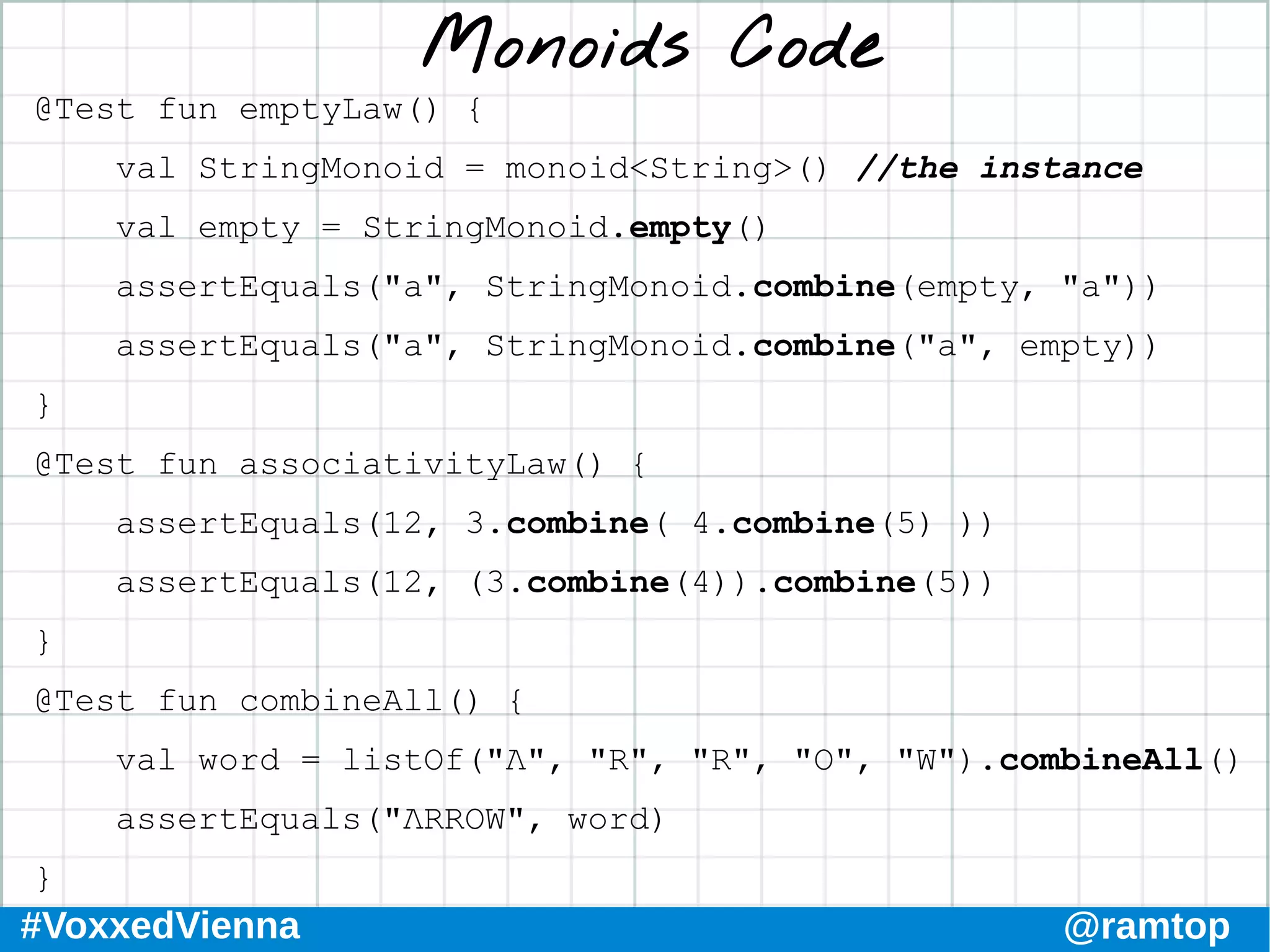
Monoids Code
@Test fun emptyLaw() {
val StringMonoid = monoid<String>() //the instance
val empty = StringMonoid.empty()
assertEquals("a", StringMonoid.combine(empty, "a"))
assertEquals("a", StringMonoid.combine("a", empty))
}
@Test fun associativityLaw() {
assertEquals(12, 3.combine( 4.combine(5) ))
assertEquals(12, (3.combine(4)).combine(5))
}
@Test fun combineAll() {
val word = listOf("Λ", "R", "R", "O", "W").combineAll()
assertEquals("ΛRROW", word)
}
#VoxxedVienna @ramtop
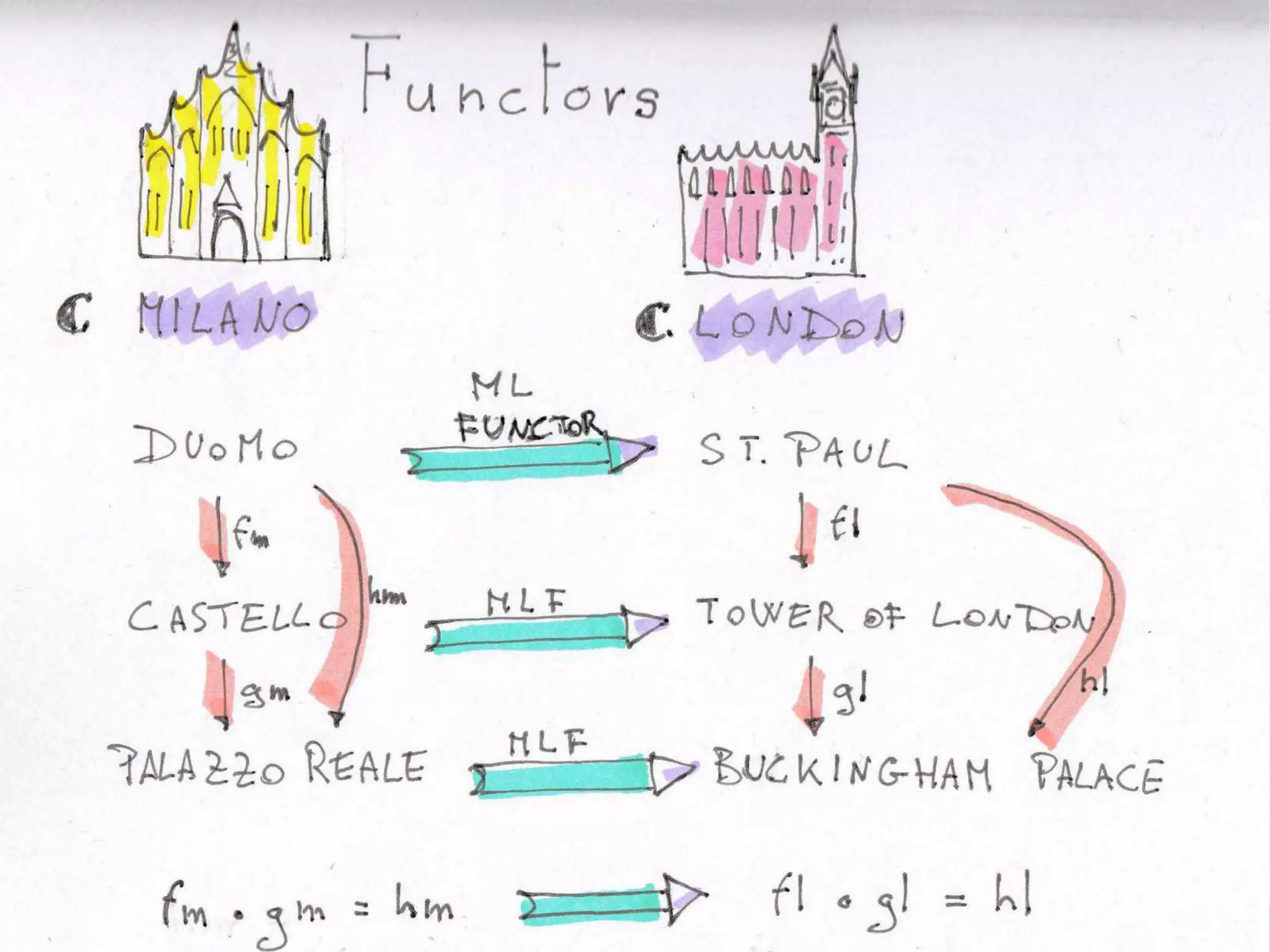
Functors
Functors can map both objects (types) and
morphism (functions) between two categories
Functors map must preserve the structure
and some properties
But can also work inside the same category
(Endofunctors)
#VoxxedVienna @ramtop
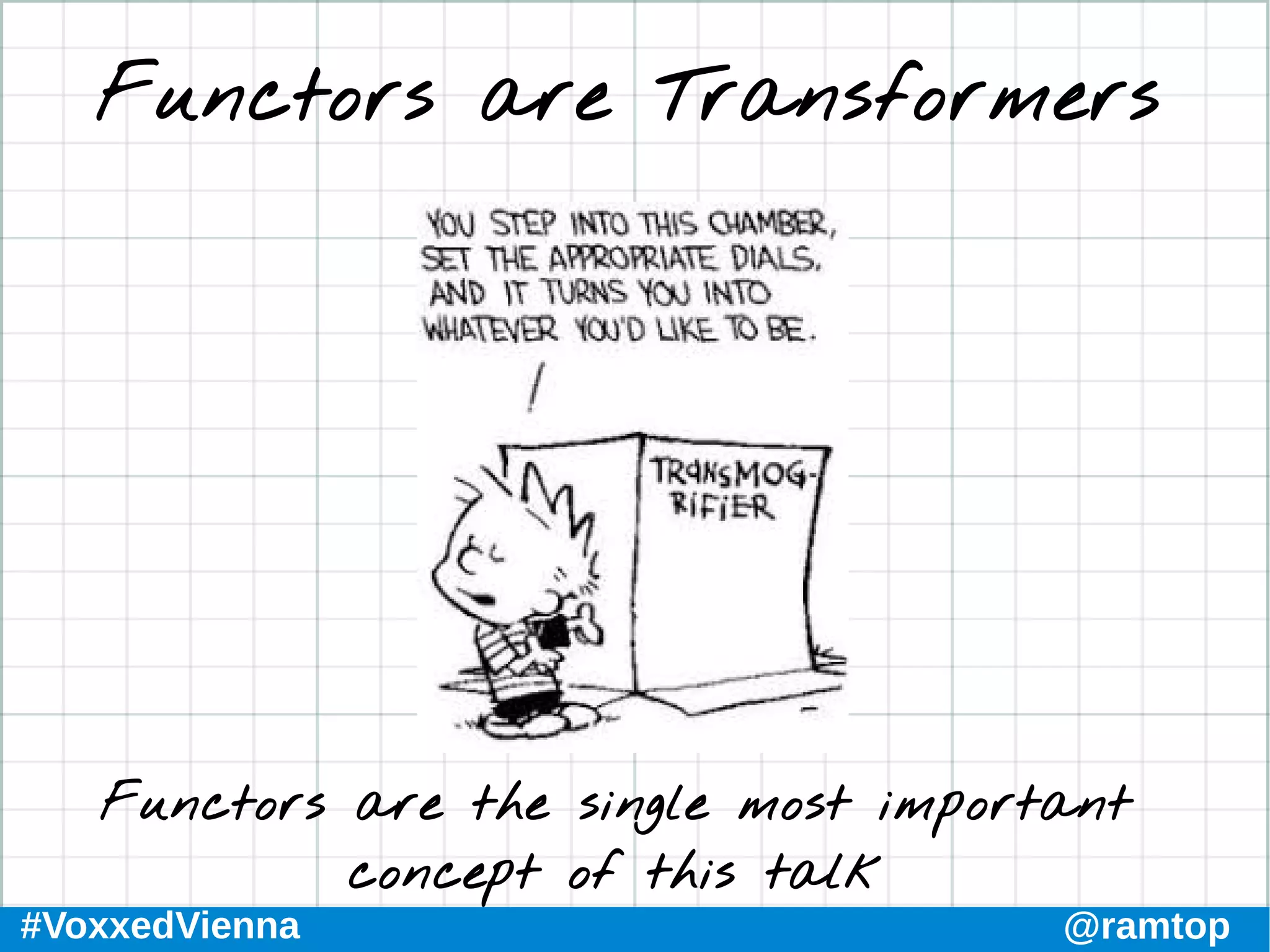
Functors are Transformers
Functors are the single most important
concept of this talk
#VoxxedVienna @ramtop
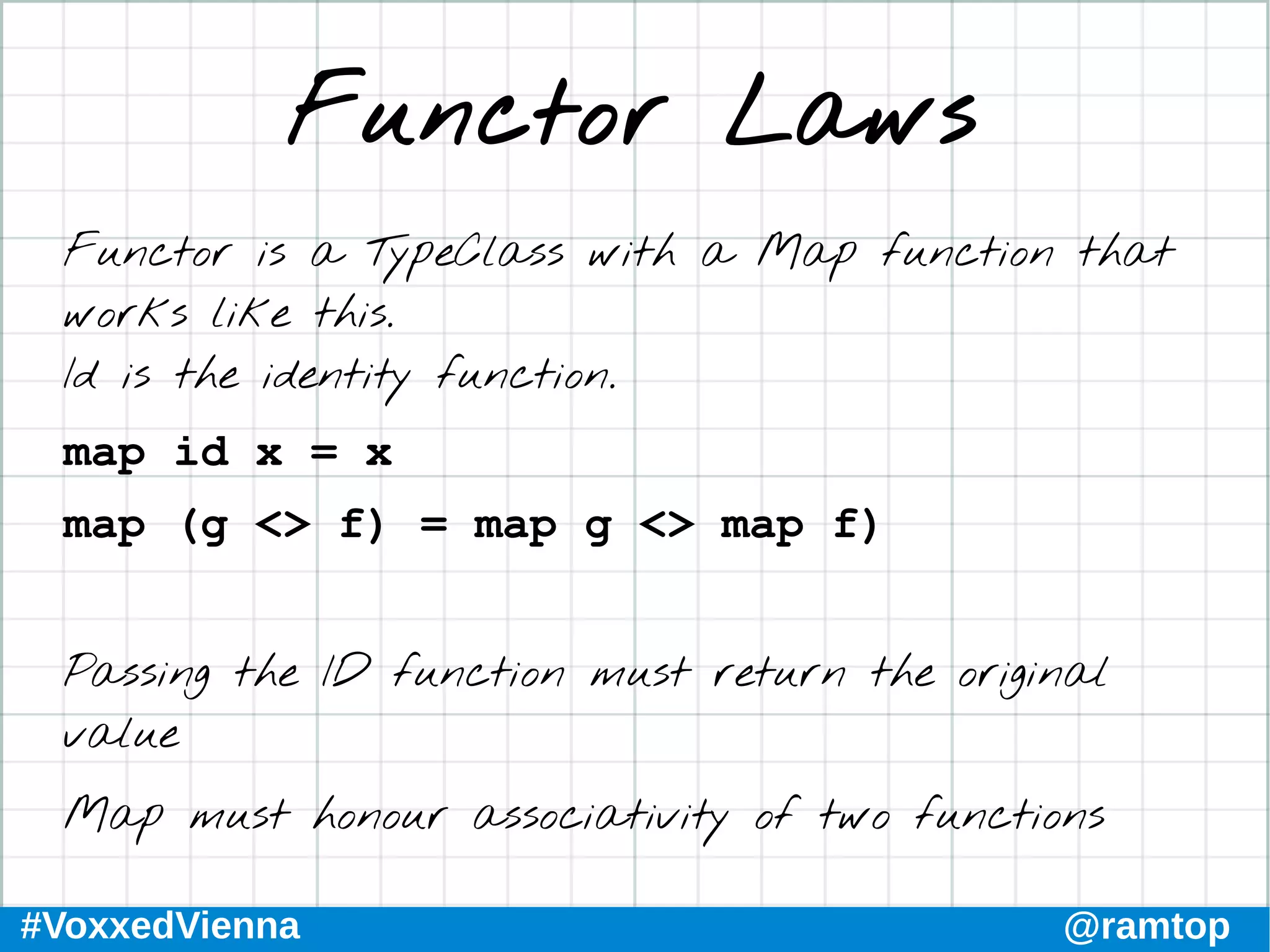
Functor Laws
Functor is a TypeClass with a Map function that
works like this.
Id is the identity function.
map id x = x
map (g <> f) = map g <> map f)
Passing the ID function must return the original
value
Map must honour associativity of two functions
#VoxxedVienna @ramtop
Endofunctors
● In programming we only work with
Endofunctors in the Category of our types
● Endofunctor map a => F a where F a is a
type constructor in the same category of a
(the type system category)
● Endofunctors are very important because
we can compose them!
#VoxxedVienna @ramtop
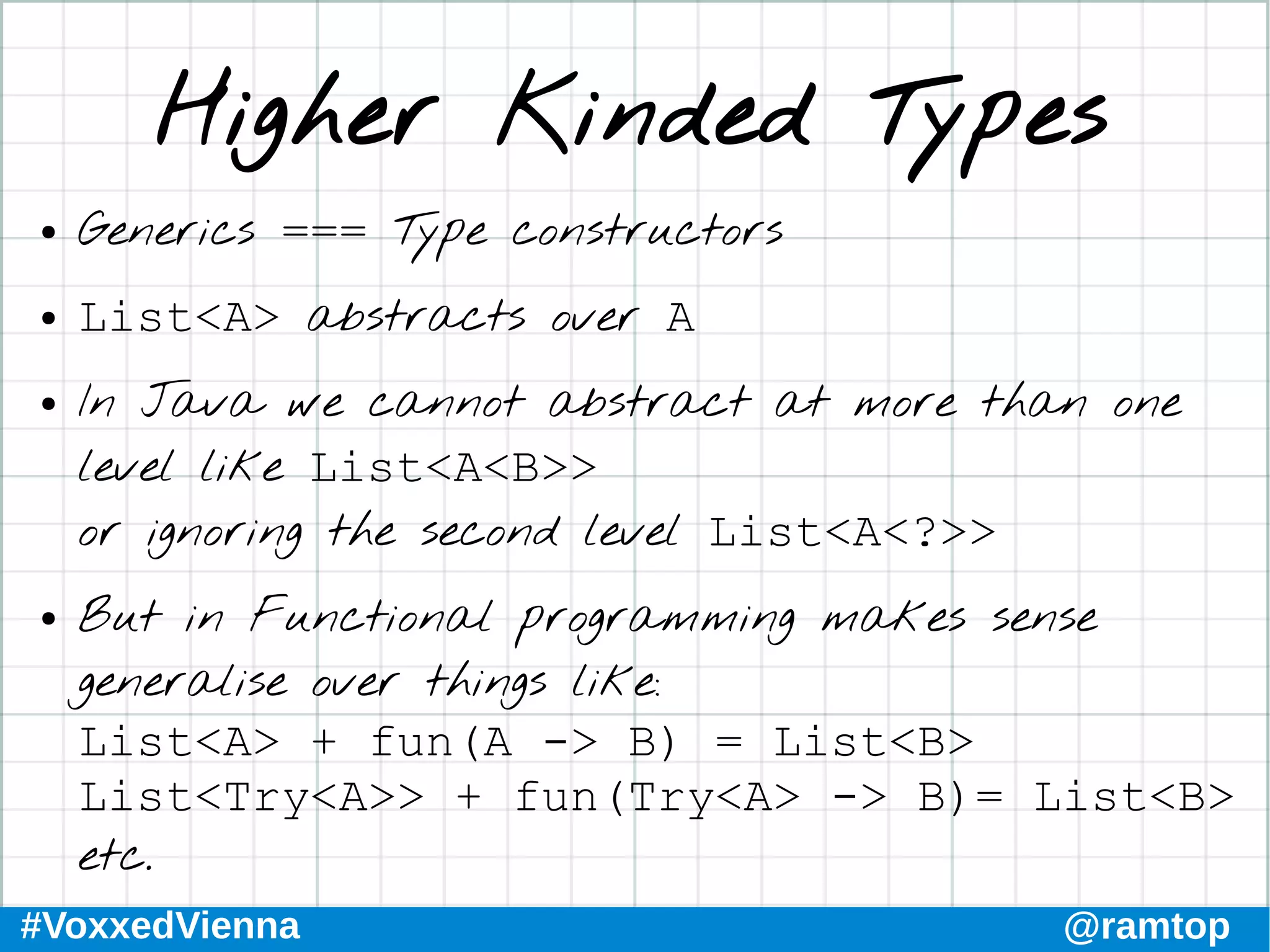
Higher Kinded Types
● Generics === Type constructors
● List<A> abstracts over A
● In Java we cannot abstract at more than one
level like List<A<B>>
or ignoring the second level List<A<?>>
● But in Functional programming makes sense
generalise over things like:
List<A> + fun(A -> B) = List<B>
List<Try<A>> + fun(Try<A> -> B)= List<B>
etc.
#VoxxedVienna @ramtop
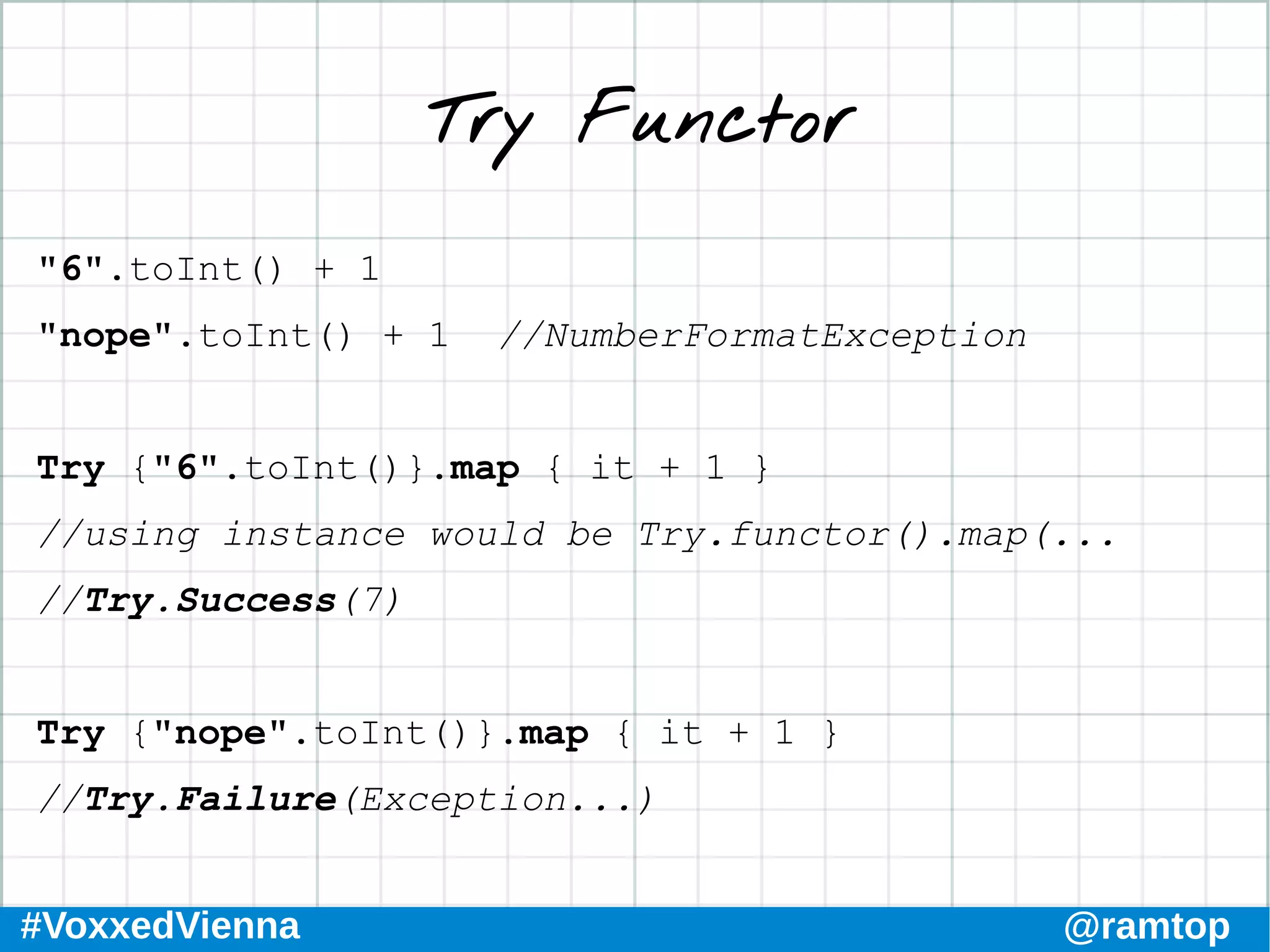
Try Functor
"6".toInt() + 1
"nope".toInt() + 1 //NumberFormatException
Try {"6".toInt()}.map { it + 1 }
//using instance would be Try.functor().map(...
//Try.Success(7)
Try {"nope".toInt()}.map { it + 1 }
//Try.Failure(Exception...)
#VoxxedVienna @ramtop
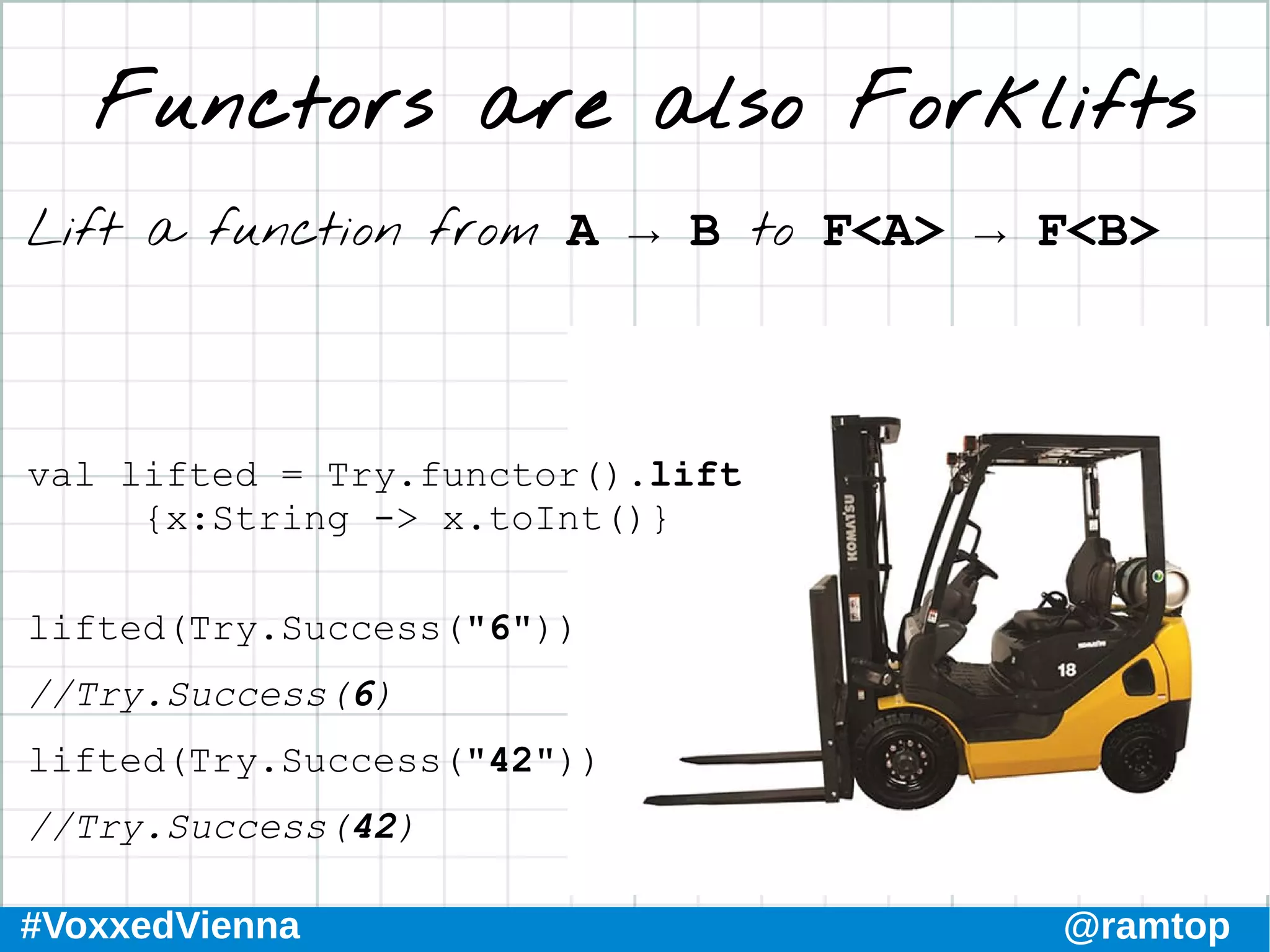
Functors are also Forklifts
val lifted = Try.functor().lift
{x:String -> x.toInt()}
lifted(Try.Success("6"))
//Try.Success(6)
lifted(Try.Success("42"))
//Try.Success(42)
Lift a function from A → B to F<A> → F<B>
#VoxxedVienna @ramtop
Reader: A Functor on functions
Val userId = 123
val reader = Reader{dbUrl:String -> DbConn(dbUrl)}
val name = reader.run("myDbConn")
.map{it.getUser(userId) }
.map{it.name}
.value()
//"Joe"
#VoxxedVienna @ramtop
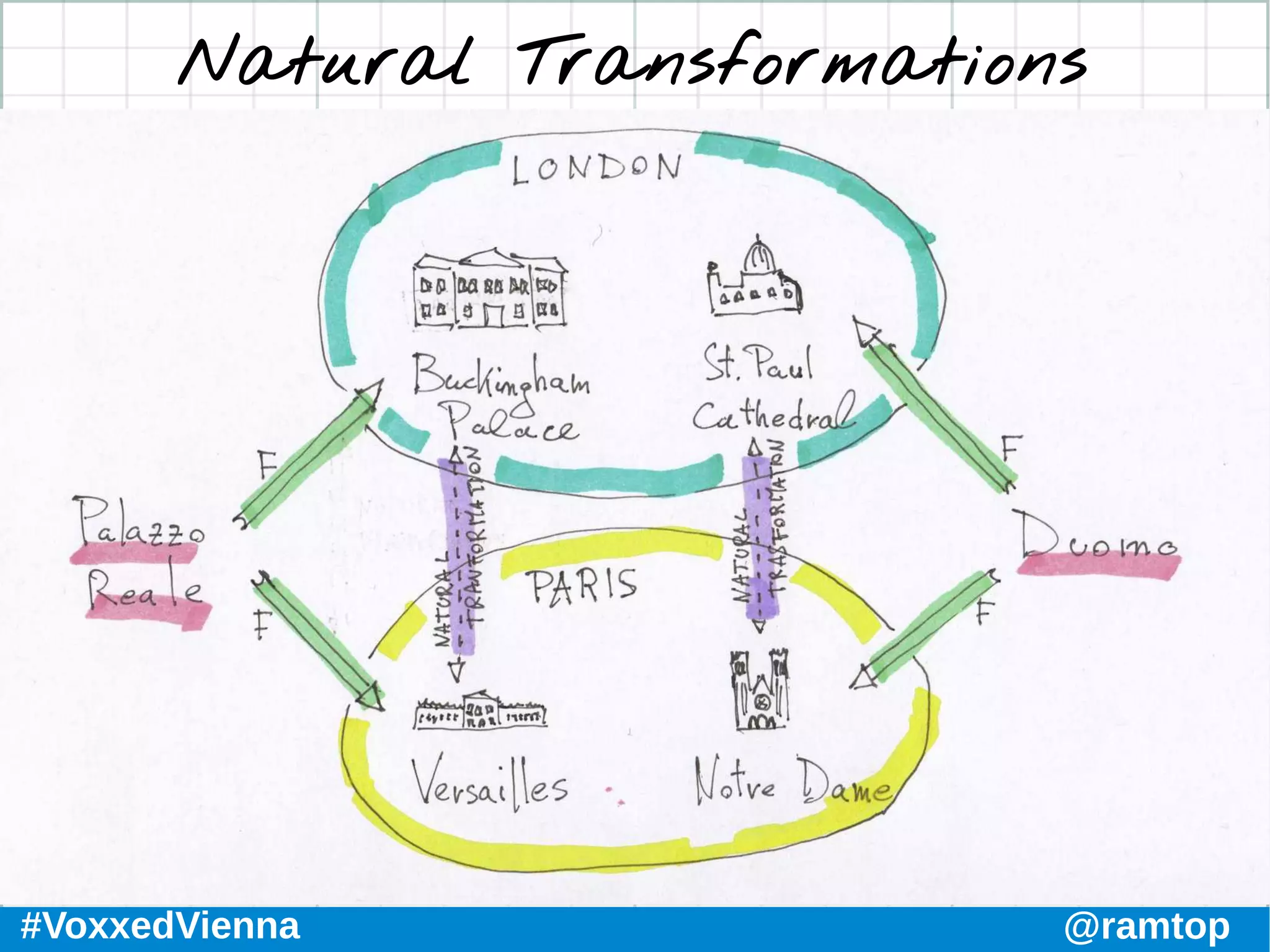
Natural Transformations
A natural transformation provides a way of
transforming one functor into another while respecting
the internal structure of the categories involved.
Transforming Data Functions→
Transforming Functions Functors→
Transforming Functors Natural Transformations→
#VoxxedVienna @ramtop
Natural Transformations
#VoxxedVienna @ramtop
Natural Transformations Code
val list = Try {"3".toInt()}.toOption().toList()
//[3]
val fail = Try {"xyz".toInt()}.toOption().toList()
//[]
#VoxxedVienna @ramtop
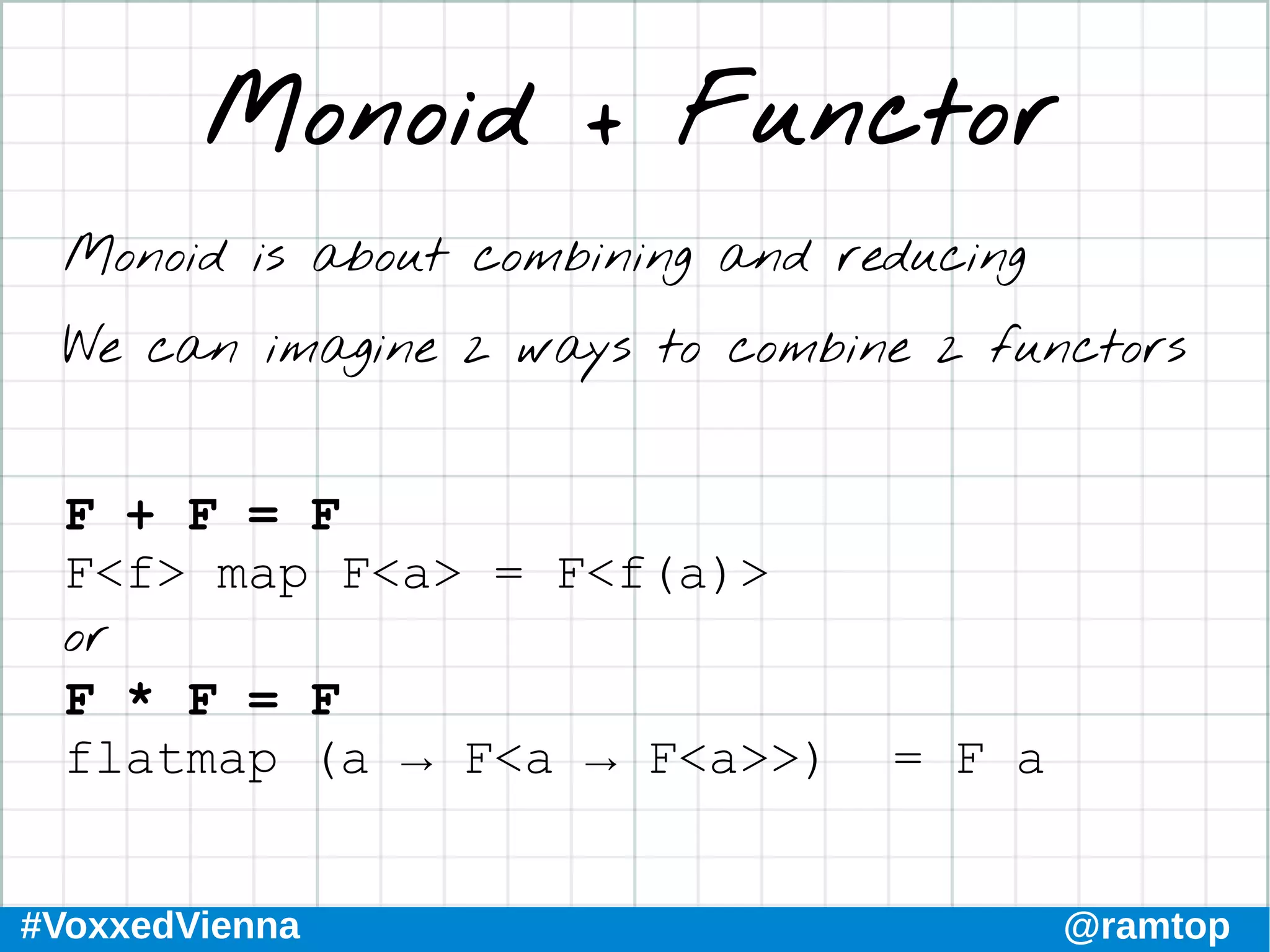
Monoid + Functor
Monoid is about combining and reducing
We can imagine 2 ways to combine 2 functors
F + F = F
F<f> map F<a> = F<f(a)>
or
F * F = F
flatmap (a → F<a → F<a>>) = F a
#VoxxedVienna @ramtop
Applicative Functors
● So far we considered only functions with 1 parameter
● We can combine a value inside a Functor with a
function inside another Functor
● If the function want more than 1 param it will
return a function with x-1 params
● Applicative can apply
F<A->B> to F<A> to create F<B>
or F<A,B ->C> to F<A> and F<B> to create F<C>
#VoxxedVienna @ramtop
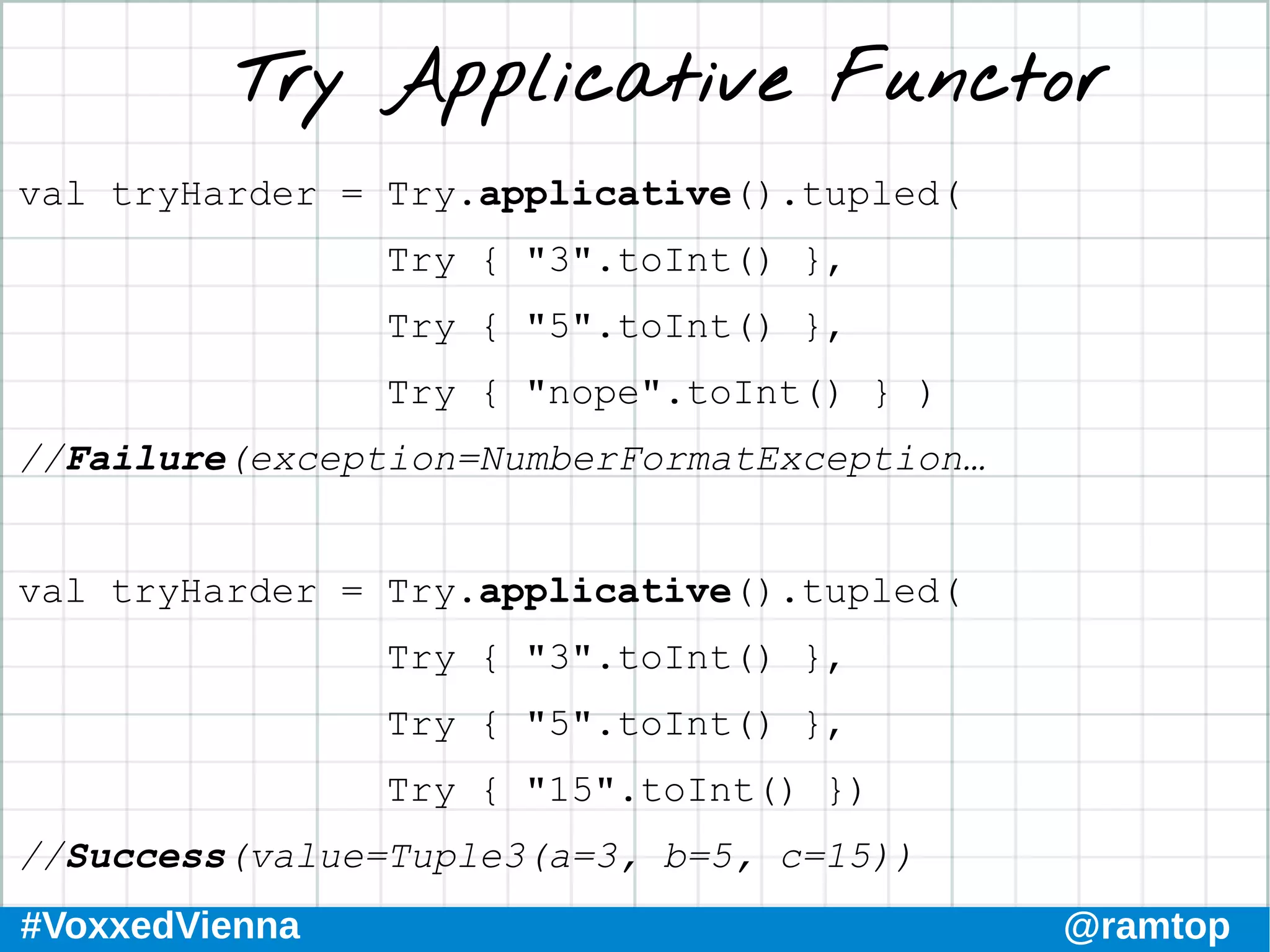
Try Applicative Functor
val tryHarder = Try.applicative().tupled(
Try { "3".toInt() },
Try { "5".toInt() },
Try { "nope".toInt() } )
//Failure(exception=NumberFormatException…
val tryHarder = Try.applicative().tupled(
Try { "3".toInt() },
Try { "5".toInt() },
Try { "15".toInt() })
//Success(value=Tuple3(a=3, b=5, c=15))
#VoxxedVienna @ramtop
Monads
● What about a category of (endo)functors?
● Some functors have a monoid instance,
others not.
● Ok now how we call all those Endofunctors
with a Monoid instance?
#VoxxedVienna @ramtop
Monad Recipe:
1 Category of Endofunctors
2 Natural Transformations: Unit and
Multiplication
#VoxxedVienna @ramtop
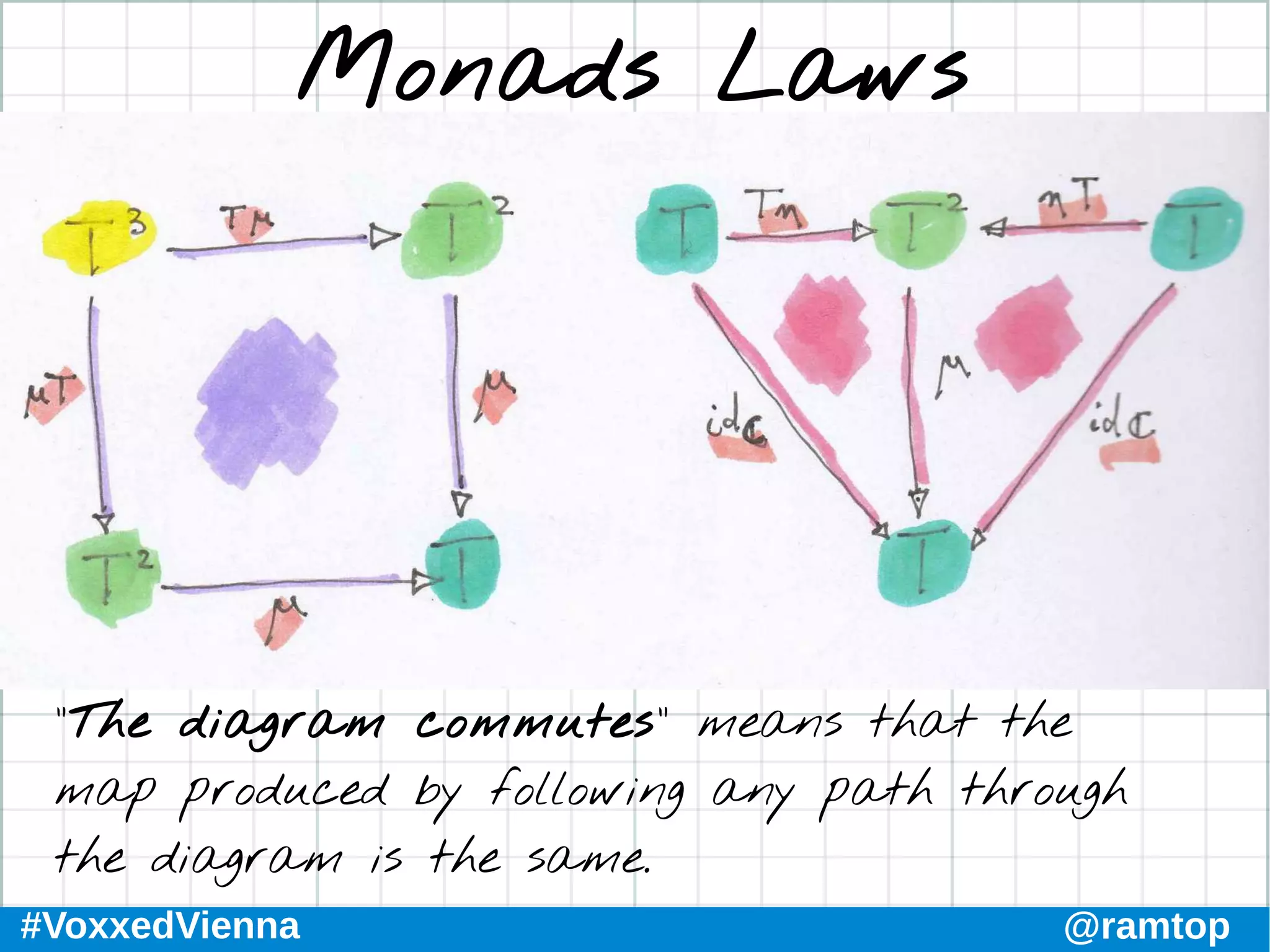
Monads Laws
"The diagram commutes" means that the
map produced by following any path through
the diagram is the same.
#VoxxedVienna @ramtop
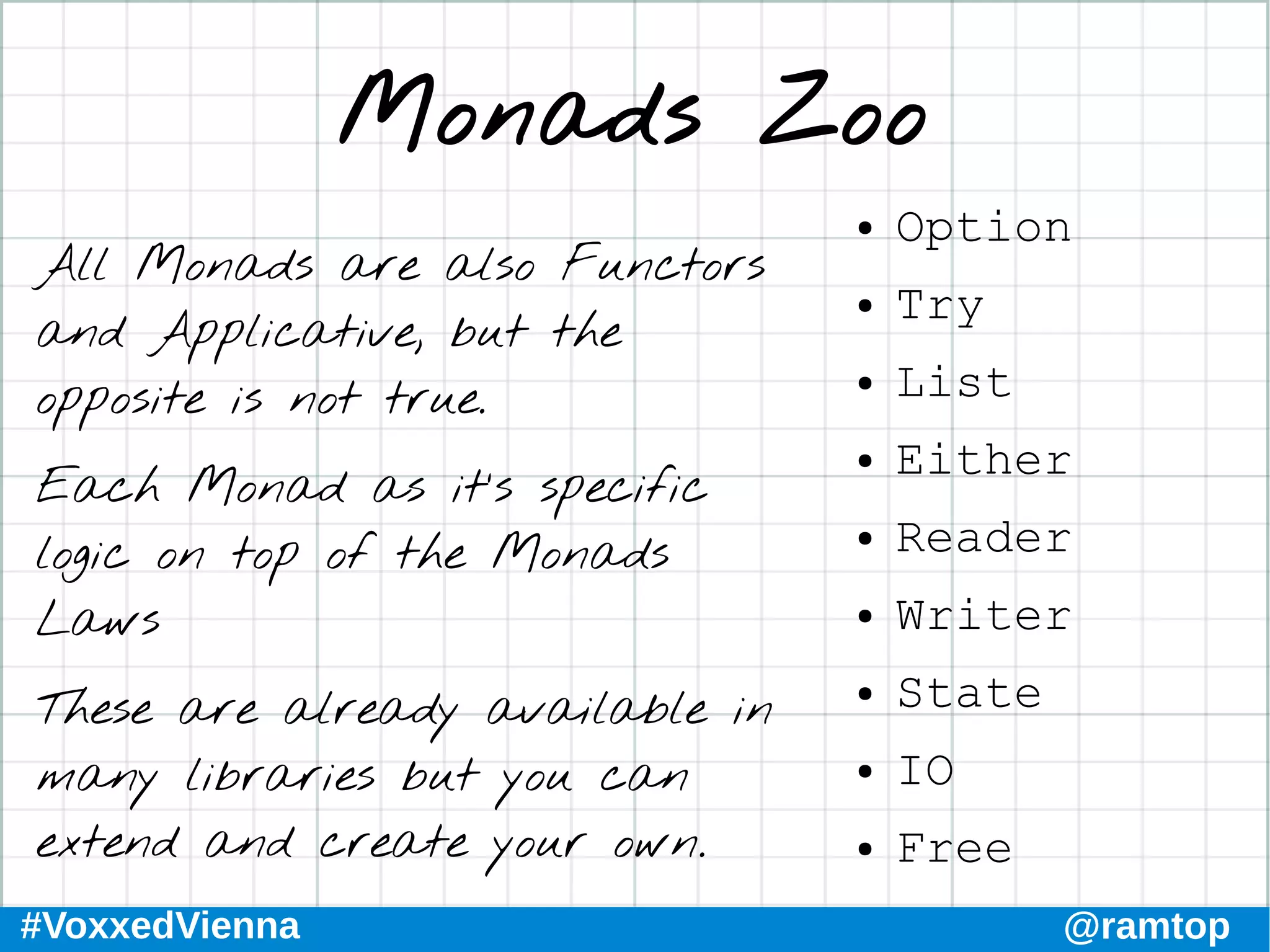
Monads Zoo
All Monads are also Functors
and Applicative, but the
opposite is not true.
Each Monad as it’s specific
logic on top of the Monads
Laws
These are already available in
many libraries but you can
extend and create your own.
● Option
● Try
● List
● Either
● Reader
● Writer
● State
● IO
● Free
#VoxxedVienna @ramtop
Monads Binding
#VoxxedVienna @ramtop
Monads Binding
From here:
val university: IO<University> =
getStudent("John Smith").flatMap { student ->
getUniversity(student.universityId).flatMap { university ->
getDean(university.deanId)
}
}
To here:
val university: IO<University> =
IO.monad().binding {
val student = getStudent("John Smith").bind()
val university = getUniversity(student.universityId).bind()
val dean = getDean(university.deanId).bind()
dean
}
#VoxxedVienna @ramtop
Reader Monad Bindings
fun getUserFromContext(userId:String) =
Reader<DbConn, User>{c -> c.getUser(userId)}
val res = Reader().monad<DbConn>().binding{
val u1 = getUserFromContext("Frankie").bind()
val u2 = getUserFromContext("Jonnny").bind()
"$u1 & $u2"
}.ev().run(DbConn("myDbUrl"))
//User(name=Frankie) & User(name=Jonnny)
#VoxxedVienna @ramtop
How to use morphisms in
real world programs?
#VoxxedVienna @ramtop
"Rather than thinking about function purity as
a goal, you have to think about which
properties you want your program to preserve."
@raulraja
Perfectly Pure Programs
are Perfectly Useless
#VoxxedVienna @ramtop
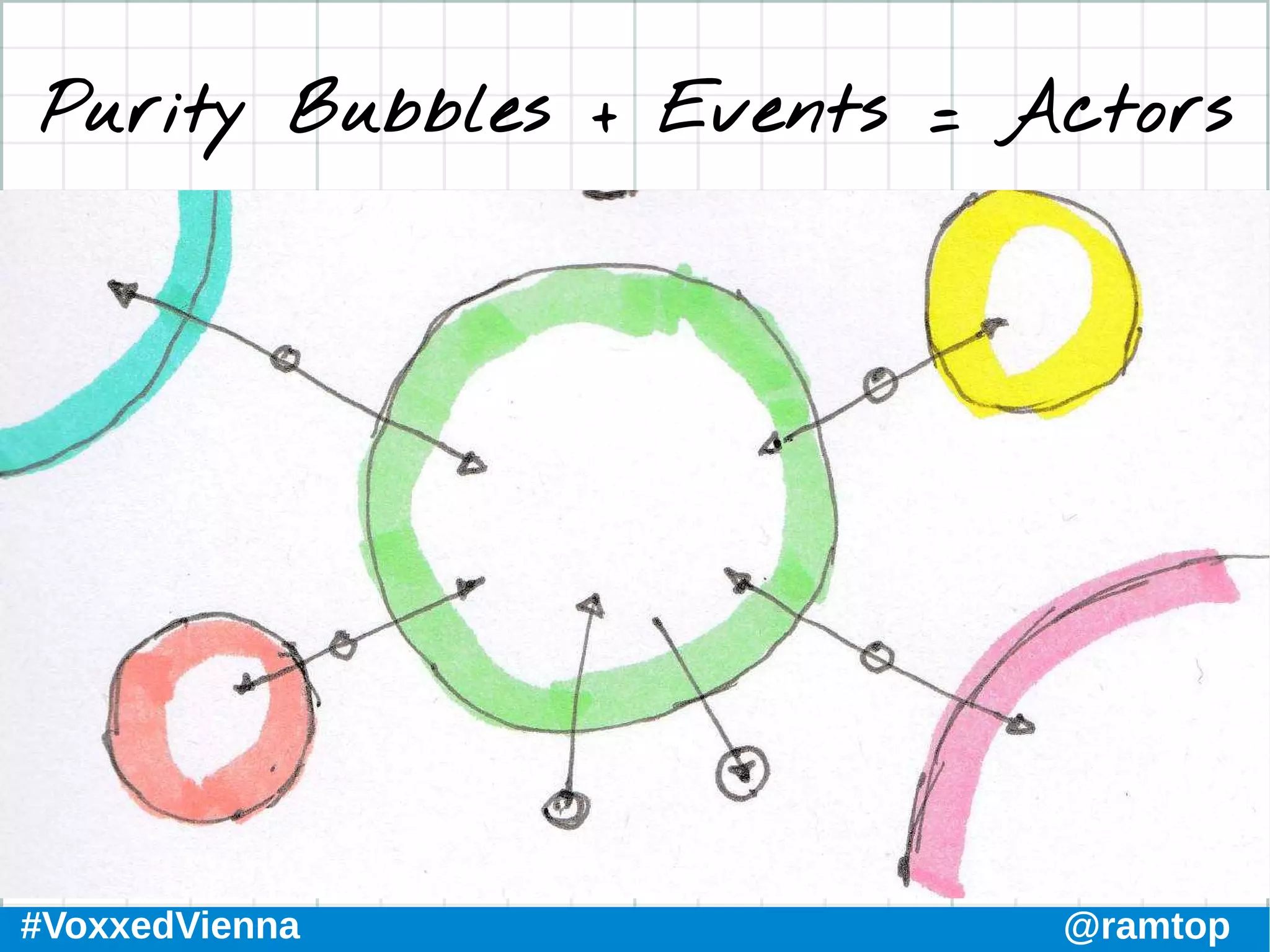
Purity Bubbles + Events = Actors
#VoxxedVienna @ramtop
Conclusions:
why functional programming?
For sure is not because the code is
easier to read!
#VoxxedVienna @ramtop
Conclusions:
why functional programming?
More composition
Less boilerplate
Less repetitions
Less bugs
Less need for tests
Easier concurrency
Less sugar
Different thinking
Performance issues
Complex state
More precision
Different testing style
VS
#VoxxedVienna @ramtop
Conclusions:
why studying CT?
Morphisms allows you to work at compile time
with your Domain Knowledge
Learn how to compose functions and preserve
properties
Monads and other typeclasses should emerge
from your code, not the other way round
Learn a common terminology and the reasons
behind that
#VoxxedVienna @ramtop
To learn more
Notes on category theory in the context of (functional)
programming
https://github.com/jwbuurlage/category-theory-
programmers
Category Theory for Programmers bartoszmilewski.com
Learn You A Haskell For Great Good
http://learnyouahaskell.com
Hardcore Mathematical stuff:
https://www.youtube.com/user/TheCatsters
nLab https://ncatlab.org/nlab/show/HomePage
#VoxxedVienna @ramtop
Monads Transformers
● Monads don’t compose
#VoxxedVienna @ramtop
Kleisli Arrows
Original problem: Monads don’t allow for
concurrency
Arrows can be useful in Reactive Functional
Programming
Kleisli is a type of Arrow for a Monadic
context
It’s old ReaderT actually
#VoxxedVienna @ramtop
Arrows
#VoxxedVienna @ramtop
CandyDispenser
● Code example
● Let’s bring all together
● We have a function Seed (Seed, Candy)→
● Another one (State, Input) State→
● How can we combine them?
● We want
(Dispenser, [Input]) (Dispenser, [Candy])→
#VoxxedVienna @ramtop
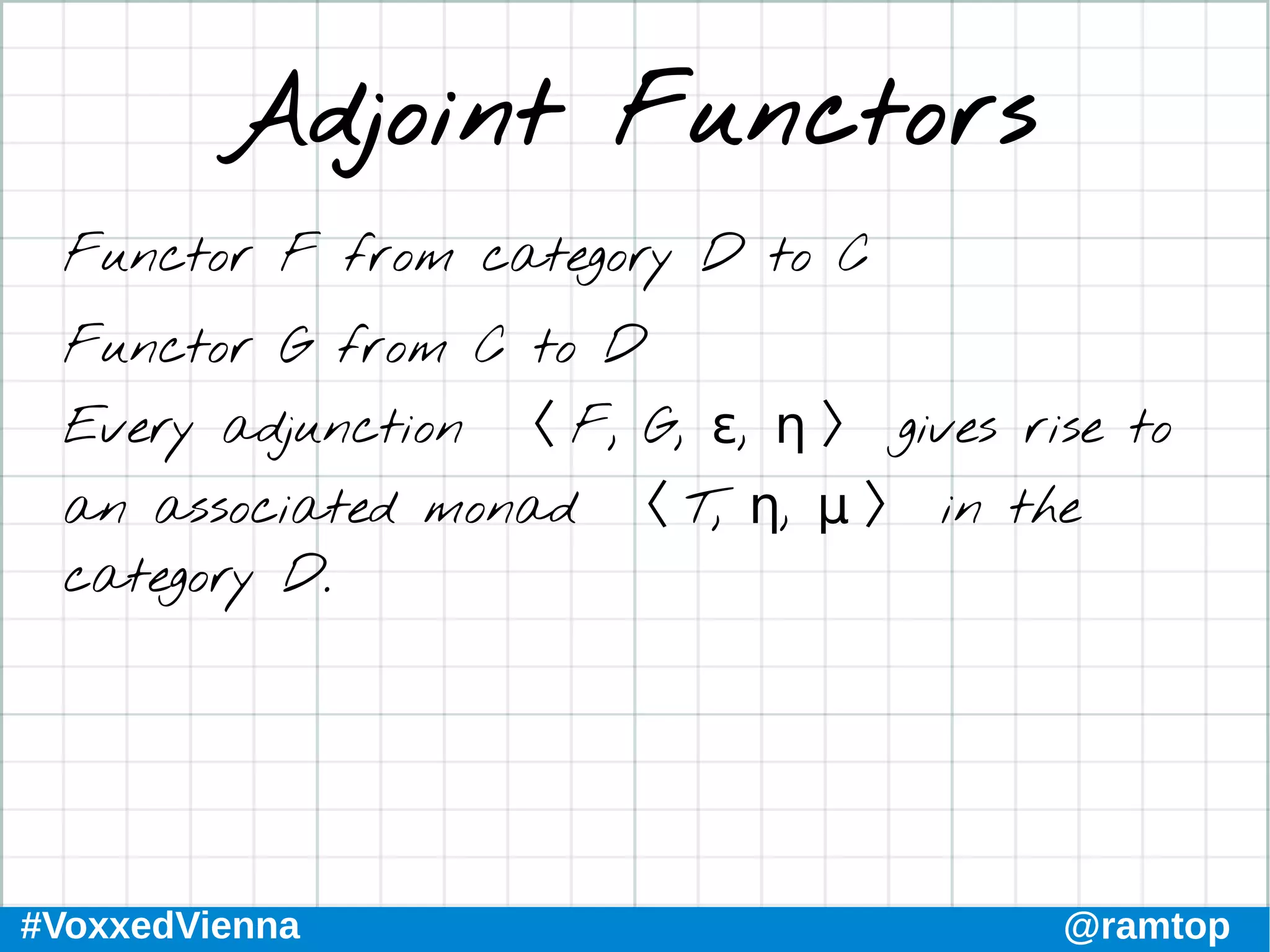
Adjoint Functors
Functor F from category D to C
Functor G from C to D
Every adjunction 〈 F, G, ,ε η 〉 gives rise to
an associated monad 〈 T, ,η μ 〉 in the
category D.

It's All About Morphisms

  • 1.
    #VoxxedVienna @ramtop It’s AllAbout Morphisms Uberto Barbini
  • 2.
    #VoxxedVienna @ramtop Map ofthis presentation Category Monoid Functor Applicative Monad Natural Transformation The Foundations of Functional Programming
  • 3.
    #VoxxedVienna @ramtop This presentationwill be a success if most of you will not fall asleep
  • 4.
    #VoxxedVienna @ramtop This presentationwill be a success if most of you will not fall asleep As a secondary goal, I hope to encourage people using Functional Programming and studying Category Theory It’s ok if you don’t understand all the first time
  • 5.
    #VoxxedVienna @ramtop What isthis Category thingy? Invented in 1940s “with the goal of understanding the processes that preserve mathematical structure.” “Category Theory is about relation between things” “General abstract nonsense”
  • 6.
    #VoxxedVienna @ramtop Category Theoryis all about Transformations and preserving Properties
  • 7.
  • 8.
    #VoxxedVienna @ramtop A CategoryExample Tube Map: Objects stations→ Arrows travel routes→ Each Arrows connect 2 stations Arrow composition is travelling along the line Identity Arrow is staying in the same station
  • 9.
  • 10.
    #VoxxedVienna @ramtop Functional Programming isalso a Category Each programming language has a Category: Types are the objects and Functions are the morphisms. Partial functions don’t have a defined return for all inputs, raise Exceptions or never end. It’s Bottom Type ⊥. But we can ignore it for the moment...
  • 11.
    #VoxxedVienna @ramtop Object Orientedvs Functional programming Object Oriented Functional Living Bacteria Gears and Pipes Opaque Transparent Hidden State Immutable State Cooperation Transformation Inheritance Composition Interfaces Type Classes
  • 12.
    #VoxxedVienna @ramtop Advantages ofKotlin over Java for functional programming ● Functions outside classes ● Immutable variables and collections ● Nullable and not-nullable types ● Class extensions ● Tail recursion ● When pattern matching ● Arrow-kt bindinds with coroutines ● Arrow-kt Higher Kinded Types
  • 13.
    #VoxxedVienna @ramtop Two wordsabout Kotlin syntax ● No semicolon! ● String? Is a different type from String ● myFun{println(it)} is equivalent to myFun(x -> println(x)) ● val xy is declaring xy immutable var xy is declaring xy mutable ● User(“Joe”) is equivalent to Java new User(“Joe”)
  • 14.
    #VoxxedVienna @ramtop Ok… butwhy using a Object Oriented Language for Functional Programming at all?
  • 15.
  • 16.
  • 17.
    #VoxxedVienna @ramtop Purity and Immutability Forthe Category morphisms to work in programming we need Purity and Immutability. What does it mean pure? How can I work only with immutable data? But ultimately everything is converted in assembly which is neither pure nor immutable. We need those quality only for reachable code
  • 18.
    #VoxxedVienna @ramtop Monoid What aboutthe category of morphisms of a category? Are they composable? It’s a Category with a single Object and lots of Morphisms If it is a Category and it has only one Object is a Monoid
  • 19.
  • 20.
    #VoxxedVienna @ramtop London TubeMap is a Monoid! (if you squint hard enough)
  • 21.
    #VoxxedVienna @ramtop Programming withMonoids A type class with two methods combine monoid append→ empty neutral element→ (x <> y) <> z = x <> (y <> z) -- associativity empty <> x = x -- left identity x <> empty = x -- right identity
  • 22.
    #VoxxedVienna @ramtop Type Classvs Interface ● Interfaces “unify” different types: Cat and Dogs can be treated as Animals ● Type Classes “group” types with similar behaviour, without hiding their types: Cats and Dogs can both mate but cats can mate only with cats and dogs with dogs ● As an example, let’s consider the Equals method in Java
  • 23.
    #VoxxedVienna @ramtop About TypeclassInstances ● Typeclasses works with instances ● List is not a Monoid nor a Functor nor a Monad but it has an (or more) instance of Monoid one of Functor and one of Monad ● Technically we implement instances as an interface with a singletons specific implementation. ● We can have different implementation for difference in evaluation, for example because of concurrency
  • 24.
    #VoxxedVienna @ramtop Monoids Code @Testfun emptyLaw() { val StringMonoid = monoid<String>() //the instance val empty = StringMonoid.empty() assertEquals("a", StringMonoid.combine(empty, "a")) assertEquals("a", StringMonoid.combine("a", empty)) } @Test fun associativityLaw() { assertEquals(12, 3.combine( 4.combine(5) )) assertEquals(12, (3.combine(4)).combine(5)) } @Test fun combineAll() { val word = listOf("Λ", "R", "R", "O", "W").combineAll() assertEquals("ΛRROW", word) }
  • 25.
    #VoxxedVienna @ramtop Functors Functors canmap both objects (types) and morphism (functions) between two categories Functors map must preserve the structure and some properties But can also work inside the same category (Endofunctors)
  • 26.
    #VoxxedVienna @ramtop Functors areTransformers Functors are the single most important concept of this talk
  • 27.
    #VoxxedVienna @ramtop Functor Laws Functoris a TypeClass with a Map function that works like this. Id is the identity function. map id x = x map (g <> f) = map g <> map f) Passing the ID function must return the original value Map must honour associativity of two functions
  • 28.
  • 29.
    #VoxxedVienna @ramtop Endofunctors ● Inprogramming we only work with Endofunctors in the Category of our types ● Endofunctor map a => F a where F a is a type constructor in the same category of a (the type system category) ● Endofunctors are very important because we can compose them!
  • 30.
    #VoxxedVienna @ramtop Higher KindedTypes ● Generics === Type constructors ● List<A> abstracts over A ● In Java we cannot abstract at more than one level like List<A<B>> or ignoring the second level List<A<?>> ● But in Functional programming makes sense generalise over things like: List<A> + fun(A -> B) = List<B> List<Try<A>> + fun(Try<A> -> B)= List<B> etc.
  • 31.
    #VoxxedVienna @ramtop Try Functor "6".toInt()+ 1 "nope".toInt() + 1 //NumberFormatException Try {"6".toInt()}.map { it + 1 } //using instance would be Try.functor().map(... //Try.Success(7) Try {"nope".toInt()}.map { it + 1 } //Try.Failure(Exception...)
  • 32.
    #VoxxedVienna @ramtop Functors arealso Forklifts val lifted = Try.functor().lift {x:String -> x.toInt()} lifted(Try.Success("6")) //Try.Success(6) lifted(Try.Success("42")) //Try.Success(42) Lift a function from A → B to F<A> → F<B>
  • 33.
    #VoxxedVienna @ramtop Reader: AFunctor on functions Val userId = 123 val reader = Reader{dbUrl:String -> DbConn(dbUrl)} val name = reader.run("myDbConn") .map{it.getUser(userId) } .map{it.name} .value() //"Joe"
  • 34.
    #VoxxedVienna @ramtop Natural Transformations Anatural transformation provides a way of transforming one functor into another while respecting the internal structure of the categories involved. Transforming Data Functions→ Transforming Functions Functors→ Transforming Functors Natural Transformations→
  • 35.
  • 36.
    #VoxxedVienna @ramtop Natural TransformationsCode val list = Try {"3".toInt()}.toOption().toList() //[3] val fail = Try {"xyz".toInt()}.toOption().toList() //[]
  • 37.
    #VoxxedVienna @ramtop Monoid +Functor Monoid is about combining and reducing We can imagine 2 ways to combine 2 functors F + F = F F<f> map F<a> = F<f(a)> or F * F = F flatmap (a → F<a → F<a>>) = F a
  • 38.
    #VoxxedVienna @ramtop Applicative Functors ●So far we considered only functions with 1 parameter ● We can combine a value inside a Functor with a function inside another Functor ● If the function want more than 1 param it will return a function with x-1 params ● Applicative can apply F<A->B> to F<A> to create F<B> or F<A,B ->C> to F<A> and F<B> to create F<C>
  • 39.
    #VoxxedVienna @ramtop Try ApplicativeFunctor val tryHarder = Try.applicative().tupled( Try { "3".toInt() }, Try { "5".toInt() }, Try { "nope".toInt() } ) //Failure(exception=NumberFormatException… val tryHarder = Try.applicative().tupled( Try { "3".toInt() }, Try { "5".toInt() }, Try { "15".toInt() }) //Success(value=Tuple3(a=3, b=5, c=15))
  • 40.
    #VoxxedVienna @ramtop Monads ● Whatabout a category of (endo)functors? ● Some functors have a monoid instance, others not. ● Ok now how we call all those Endofunctors with a Monoid instance?
  • 41.
    #VoxxedVienna @ramtop Monad Recipe: 1Category of Endofunctors 2 Natural Transformations: Unit and Multiplication
  • 42.
    #VoxxedVienna @ramtop Monads Laws "Thediagram commutes" means that the map produced by following any path through the diagram is the same.
  • 43.
    #VoxxedVienna @ramtop Monads Zoo AllMonads are also Functors and Applicative, but the opposite is not true. Each Monad as it’s specific logic on top of the Monads Laws These are already available in many libraries but you can extend and create your own. ● Option ● Try ● List ● Either ● Reader ● Writer ● State ● IO ● Free
  • 44.
  • 45.
    #VoxxedVienna @ramtop Monads Binding Fromhere: val university: IO<University> = getStudent("John Smith").flatMap { student -> getUniversity(student.universityId).flatMap { university -> getDean(university.deanId) } } To here: val university: IO<University> = IO.monad().binding { val student = getStudent("John Smith").bind() val university = getUniversity(student.universityId).bind() val dean = getDean(university.deanId).bind() dean }
  • 46.
    #VoxxedVienna @ramtop Reader MonadBindings fun getUserFromContext(userId:String) = Reader<DbConn, User>{c -> c.getUser(userId)} val res = Reader().monad<DbConn>().binding{ val u1 = getUserFromContext("Frankie").bind() val u2 = getUserFromContext("Jonnny").bind() "$u1 & $u2" }.ev().run(DbConn("myDbUrl")) //User(name=Frankie) & User(name=Jonnny)
  • 47.
    #VoxxedVienna @ramtop How touse morphisms in real world programs?
  • 48.
    #VoxxedVienna @ramtop "Rather thanthinking about function purity as a goal, you have to think about which properties you want your program to preserve." @raulraja Perfectly Pure Programs are Perfectly Useless
  • 49.
  • 50.
    #VoxxedVienna @ramtop Conclusions: why functionalprogramming? For sure is not because the code is easier to read!
  • 51.
    #VoxxedVienna @ramtop Conclusions: why functionalprogramming? More composition Less boilerplate Less repetitions Less bugs Less need for tests Easier concurrency Less sugar Different thinking Performance issues Complex state More precision Different testing style VS
  • 52.
    #VoxxedVienna @ramtop Conclusions: why studyingCT? Morphisms allows you to work at compile time with your Domain Knowledge Learn how to compose functions and preserve properties Monads and other typeclasses should emerge from your code, not the other way round Learn a common terminology and the reasons behind that
  • 53.
    #VoxxedVienna @ramtop To learnmore Notes on category theory in the context of (functional) programming https://github.com/jwbuurlage/category-theory- programmers Category Theory for Programmers bartoszmilewski.com Learn You A Haskell For Great Good http://learnyouahaskell.com Hardcore Mathematical stuff: https://www.youtube.com/user/TheCatsters nLab https://ncatlab.org/nlab/show/HomePage
  • 54.
  • 55.
  • 56.
  • 57.
  • 58.
  • 59.
  • 60.
  • 61.
    #VoxxedVienna @ramtop Kleisli Arrows Originalproblem: Monads don’t allow for concurrency Arrows can be useful in Reactive Functional Programming Kleisli is a type of Arrow for a Monadic context It’s old ReaderT actually
  • 62.
  • 63.
    #VoxxedVienna @ramtop CandyDispenser ● Codeexample ● Let’s bring all together ● We have a function Seed (Seed, Candy)→ ● Another one (State, Input) State→ ● How can we combine them? ● We want (Dispenser, [Input]) (Dispenser, [Candy])→
  • 64.
    #VoxxedVienna @ramtop Adjoint Functors FunctorF from category D to C Functor G from C to D Every adjunction 〈 F, G, ,ε η 〉 gives rise to an associated monad 〈 T, ,η μ 〉 in the category D.