FORM-FOCUSED
INSTRUCTION
R O D E L L I S
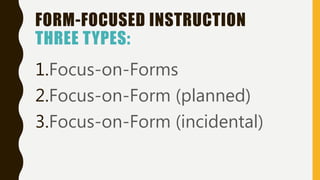
FORM-FOCUSED INSTRUCTION
THREE TYPES:
1.Focus-on-Forms
2.Focus-on-Form (planned)
3.Focus-on-Form (incidental)
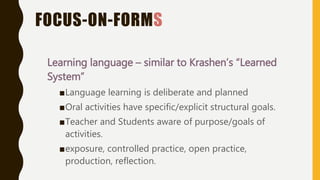
FOCUS-ON-FORMS
Learning language – similar to Krashen’s “Learned
System”
■Language learning is deliberate and planned
■Oral activities have specific/explicit structural goals.
■Teacher and Students aware of purpose/goals of
activities.
■exposure, controlled practice, open practice,
production, reflection.
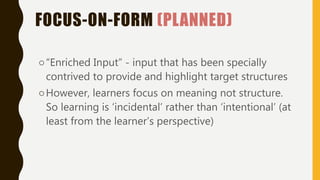
FOCUS-ON-FORM (PLANNED)
○“Enriched Input” - input that has been specially
contrived to provide and highlight target structures
○However, learners focus on meaning not structure.
So learning is ‘incidental’ rather than ‘intentional’ (at
least from the learner’s perspective)
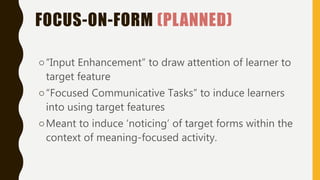
FOCUS-ON-FORM (PLANNED)
○“Input Enhancement” to draw attention of learner to
target feature
○“Focused Communicative Tasks” to induce learners
into using target features
○Meant to induce ‘noticing’ of target forms within the
context of meaning-focused activity.
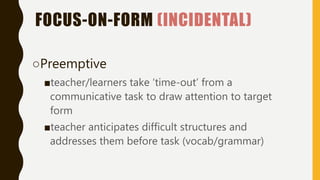
FOCUS-ON-FORM (INCIDENTAL)
○Preemptive
■teacher/learners take ‘time-out’ from a
communicative task to draw attention to target
form
■teacher anticipates difficult structures and
addresses them before task (vocab/grammar)
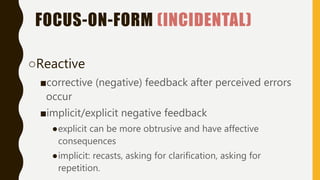
FOCUS-ON-FORM (INCIDENTAL)
○Reactive
■corrective (negative) feedback after perceived errors
occur
■implicit/explicit negative feedback
●explicit can be more obtrusive and have affective
consequences
●implicit: recasts, asking for clarification, asking for
repetition.
NOTICING
HYPOTHESIS
R I C H A R D S C H M I D T
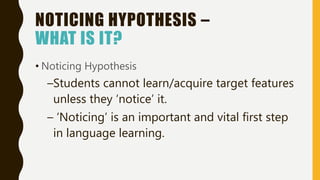
NOTICING HYPOTHESIS –
WHAT IS IT?
• Noticing Hypothesis
–Students cannot learn/acquire target features
unless they ‘notice’ it.
– ‘Noticing’ is an important and vital first step
in language learning.
https://www.youtube.com/watch?v=H_qMGCk7EjI
PUTTING IT ALL TOGETHER
When teaching oral skills…
• …how can we move from Krashen’s “Natural
Approach” to a more ‘form-focused’ approach?
• How do we get our students to “notice” their own
language skills and development?
MINI-WORKSHOP:
FOCUS-ON-FORM AND ‘NOTICING’
•Consider the common oral activities we
use.
–How can we ‘focus-on-form’ in these
common tasks?
–How can we get our students to ‘notice’ in
these tasks?
ACTIVITY:
Classroom
Discussions
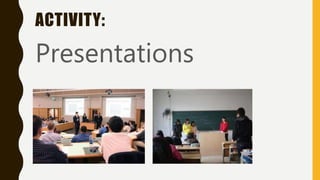
ACTIVITY:
Presentations
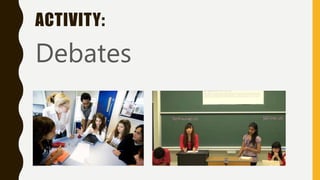
ACTIVITY:
Debates
ACTIVITY:
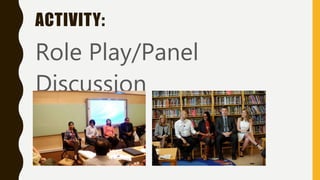
Role Play/Panel
Discussion
ACTIVITY:
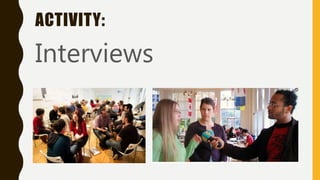
Interviews
ACTIVITY
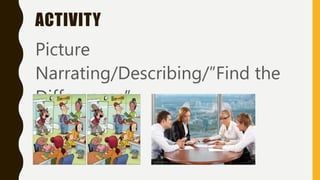
Picture
Narrating/Describing/”Find the
Differences”
ACTIVITY:
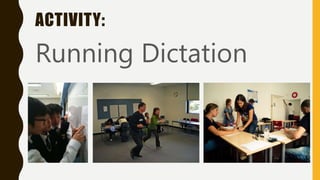
Running Dictation
SPEAKING ACTIVITIES TO TRY
Pecha Kucha
•20x20 presentation
•20 slides, 20 seconds per slide
•Live or Recorded
•http://www.pechakucha.org/
https://www.youtube.com/watch?v=wGaCLWa
ZLI4
SPEAKING ACTIVITIES TO TRY
Digital Recording
•Record discussion, presentation, oral activity.
Review and reflect on performance.
•Digital Storytelling
•Recorded presentations, interviews, projects
SPEAKING ACTIVITIES TO TRY
Sentence Auction
•Write 10 sentences on the board (some with
mistakes)
•Students are placed in groups and each group
has $1500-2000.
•Auction each sentence.
•In order sold, ask students if sentence is correct.
If not, give 10 seconds to correct it.
•Continue until each sentence is corrected.
SPEAKING ACTIVITIES TO TRY
Sentence Auction
1 point for every $100 left over at the end
5 points for every correct sentence
-3 points for every incorrect sentence they
couldn't correct
3 points for every corrected sentence.
Students with the most points win
SPEAKING ACTIVITIES TO TRY
Anything else?
•What are some speaking activities
(structured or unstructured) that have
worked for you?

Form focused instruction and noticing without embedded video