BY
R.V.Mutusamy.
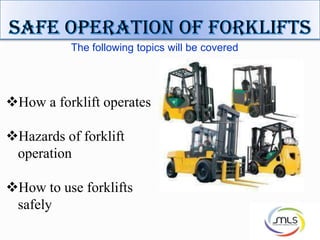
The following topics will be covered
How a forklift operates
Hazards of forklift
operation
How to use forklifts
safely
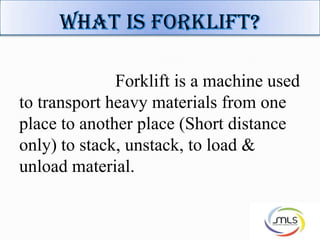
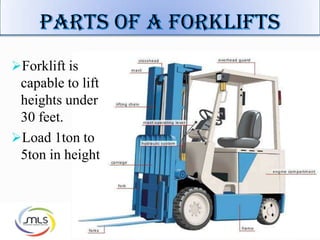
Forklift is a machine used
to transport heavy materials from one
place to another place (Short distance
only) to stack, unstack, to load &
unload material.
Forklift is
capable to lift
heights under
30 feet.
Load 1ton to
5ton in height
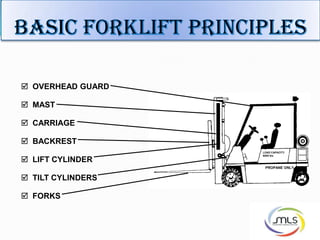
 OVERHEAD GUARD
 MAST
 CARRIAGE
 BACKREST
 LIFT CYLINDER
 TILT CYLINDERS
 FORKS
LOAD CAPACITY
6000 lbs
PROPANE ONLY
Only Trained authorized personnel are
permitted to operate a forklift.
Badges or other visual indications shall be
displayed on the body of the operators at all
time during operation.
The operator should not drive the truck up to a
person standing in front of a bench or other
object.
The operator should not carry loads heavier
than those for which the truck rated. 6
Forklift controls operated only from
driver’s seat
Never block exits or emergency equipment
Smoking is not permitted when operating the
forklift
No person should stand under elevated
portion of lift truck
7
The operator should avoid making fast
starts, sudden stops and quick turns.
The operator should report all accident
involving personnel, building structures and
other equipment.
Operation on main roads outside the factory
premises should be permitted only with proper
authorization of local transport authority.
Unless specifically authorized to do any
repair, the operator should not make
repairs, alterations or adjustments to the 8
Workplace hazards: ramps, slippery
floors, poor lighting, congestion
Loads: large or bulky, uneven weight, broken
pallets, poor stacked
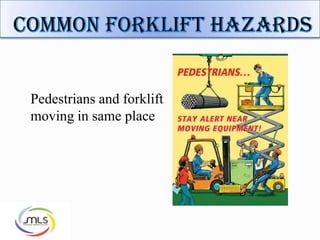
Pedestrians: horseplay, unaware of forklift
areas, not paying attention
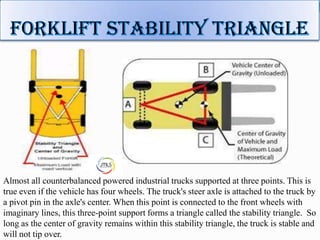
Almost all counterbalanced powered industrial trucks supported at three points. This is
true even if the vehicle has four wheels. The truck's steer axle is attached to the truck by
a pivot pin in the axle's center. When this point is connected to the front wheels with
imaginary lines, this three-point support forms a triangle called the stability triangle. So
long as the center of gravity remains within this stability triangle, the truck is stable and
will not tip over.
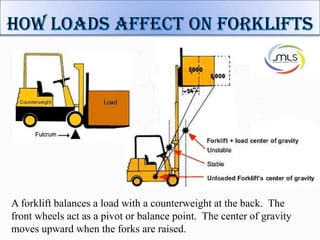
A forklift balances a load with a counterweight at the back. The
front wheels act as a pivot or balance point. The center of gravity
moves upward when the forks are raised.
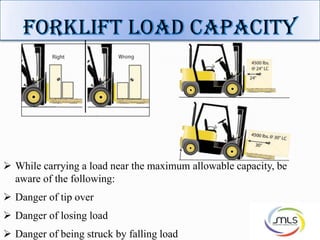
 While carrying a load near the maximum allowable capacity, be
aware of the following:
 Danger of tip over
 Danger of losing load
 Danger of being struck by falling load
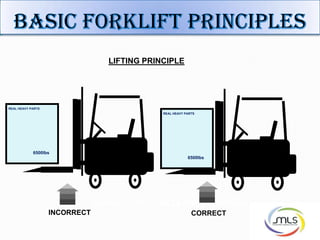
LIFTING PRINCIPLE
CONSULT YOUR VEHICLE OWNERS MANUAL
6500lbs
REAL HEAVY PARTS
INCORRECT CORRECT
6500lbs
REAL HEAVY PARTS
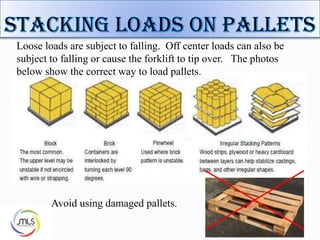
Loose loads are subject to falling. Off center loads can also be
subject to falling or cause the forklift to tip over. The photos
below show the correct way to load pallets.
Avoid using damaged pallets.
Before raising a load, understand:
Approximate weight of the load
Location of the load’s center of gravity
Inspect load for stability, projections,
damaged pallets before lifting
Restack unstable loads
Never place weight on the back of
a lift truck to increase its capacity
Towing always done from rear towing pin
15
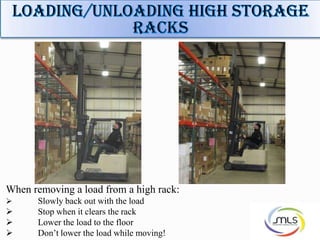
When removing a load from a high rack:
 Slowly back out with the load
 Stop when it clears the rack
 Lower the load to the floor
 Don’t lower the load while moving!
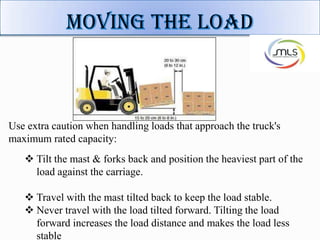
Use extra caution when handling loads that approach the truck's
maximum rated capacity:
 Tilt the mast & forks back and position the heaviest part of the
load against the carriage.
 Travel with the mast tilted back to keep the load stable.
 Never travel with the load tilted forward. Tilting the load
forward increases the load distance and makes the load less
stable
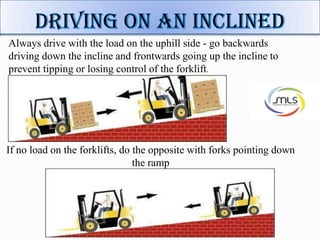
Always drive with the load on the uphill side - go backwards
driving down the incline and frontwards going up the incline to
prevent tipping or losing control of the forklift.
If no load on the forklifts, do the opposite with forks pointing down
the ramp
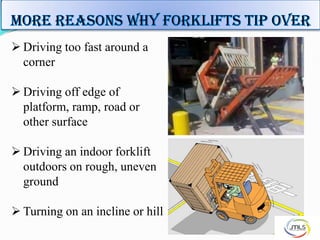
 Driving too fast around a
corner
 Driving off edge of
platform, ramp, road or
other surface
 Driving an indoor forklift
outdoors on rough, uneven
ground
 Turning on an incline or hill
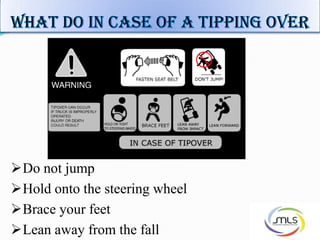
Do not jump
Hold onto the steering wheel
Brace your feet
Lean away from the fall
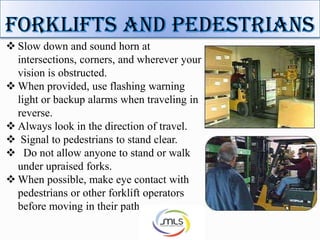
 Slow down and sound horn at
intersections, corners, and wherever your
vision is obstructed.
 When provided, use flashing warning
light or backup alarms when traveling in
reverse.
 Always look in the direction of travel.
 Signal to pedestrians to stand clear.
 Do not allow anyone to stand or walk
under upraised forks.
 When possible, make eye contact with
pedestrians or other forklift operators
before moving in their path.
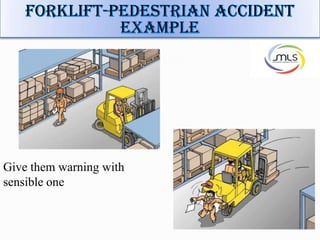
Give them warning with
sensible one
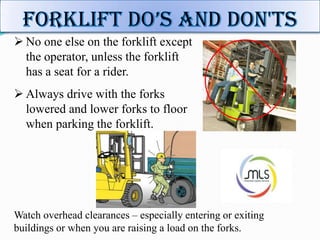
 No one else on the forklift except
the operator, unless the forklift
has a seat for a rider.
 Always drive with the forks
lowered and lower forks to floor
when parking the forklift.
Watch overhead clearances – especially entering or exiting
buildings or when you are raising a load on the forks.
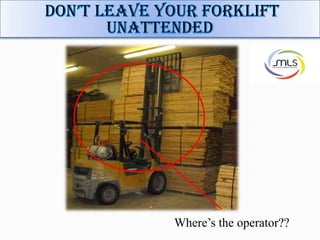
Where’s the operator??
Pedestrians and forklift
moving in same place
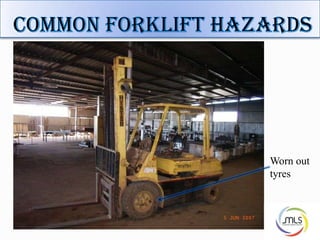
Worn out
tyres
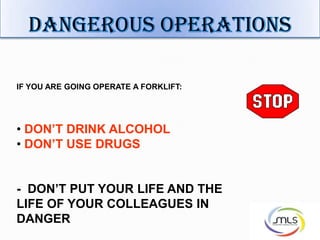
IF YOU ARE GOING OPERATE A FORKLIFT:
• DON’T DRINK ALCOHOL
• DON’T USE DRUGS
- DON’T PUT YOUR LIFE AND THE
LIFE OF YOUR COLLEAGUES IN
DANGER
28
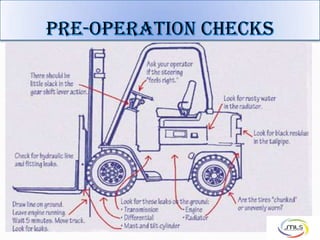
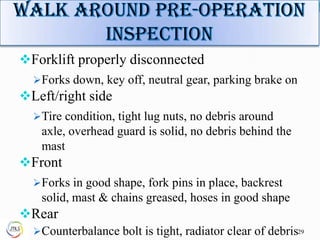
Forklift properly disconnected
Forks down, key off, neutral gear, parking brake on
Left/right side
Tire condition, tight lug nuts, no debris around
axle, overhead guard is solid, no debris behind the
mast
Front
Forks in good shape, fork pins in place, backrest
solid, mast & chains greased, hoses in good shape
Rear
Counterbalance bolt is tight, radiator clear of debris29
Non-moving checks
Gauges, lights, horn, Reverse alarm, blinking
warning light, operate the tilt & lift
mechanism, check the parking brake
Moving checks
Check the running brakes, check the steering
Look for oil or water leaks on the floor
Daily check list
30
Always look in the direction of travel
Keep body inside the cage
When moving, the mast must not be
raised
Sound the horn
Operate at safe speeds
When turning, watch rear end swing
Clearance under overhead installations 31
32
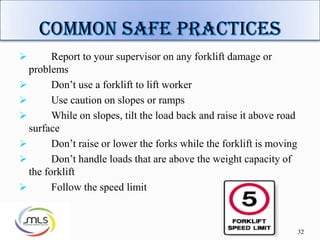
 Report to your supervisor on any forklift damage or
problems
 Don’t use a forklift to lift worker
 Use caution on slopes or ramps
 While on slopes, tilt the load back and raise it above road
surface
 Don’t raise or lower the forks while the forklift is moving
 Don’t handle loads that are above the weight capacity of
the forklift
 Follow the speed limit
33
 Slow down and sound the horn at crossings and locations
where view is blocked
 Focus on the travelling path and keep a clear view of it
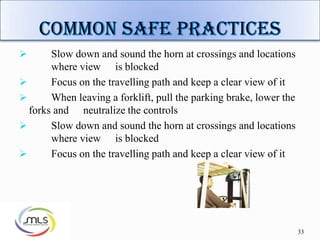
 When leaving a forklift, pull the parking brake, lower the
forks and neutralize the controls
 Slow down and sound the horn at crossings and locations
where view is blocked
 Focus on the travelling path and keep a clear view of it
34
The engine of diesel forklift should be stopped before
refueling.
It should not be restarted unless the fuel line has been
removed from the forklift and the filler cap has been
properly replaced on the tank.
Particular attention should be paid to avoid fuel spilling
over the engine or exhaust system.
If spillages occur the fuel should be wiped away properly
before restating the engine.
Contact between the metal outlet of the refueling hose and
the fuel tank opening on the forklift should be maintained
at all time during refueling process.
Naked flames should never be used to check fuel levels in
tanks.
35
1 Does the forklift specification meet the operating requirement?
2 Is forklift maximum load capacity clearly printed on the forklift
body?
3 Does the forklift maximum speed controlled?
4 Do horn, reversing beeper, proximity indicator and flashing light
function properly?
5 Are the forklift maintenance performed regularly?
6 Are forklift maintenance and repair records maintained?
7 Are the tires in good conditions?
8 Forklift breaks conditions
9 Is the steering work well?
10 Does the gear control work?
11 Are the left, right and rear view mirrors available and clear?
12 Do all indicators and gauges function properly?
13 Are there any liquid leaks from the forklift?
14 Are Mast, Lifting system are in good condition?
36
Workplace Premise: Warehouse premise in a distribution
park
Forklift: 3 ton (load capacity)
Work Activity: Deceased was taking stock of goods to be
transported out of the warehouse. He squeezed
through the gap between two racks and was crushed when
a forklift pushed the racks closer to make space for more
racks.
Nature of Accident: Crushed between objects
37
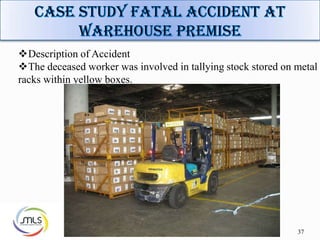
Description of Accident
The deceased worker was involved in tallying stock stored on metal
racks within yellow boxes.
38
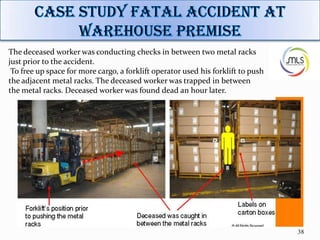
The deceased worker was conducting checks in between two metal racks
just prior to the accident.
To free up space for more cargo, a forklift operator used his forklift to push
the adjacent metal racks. The deceased worker was trapped in between
the metal racks. Deceased worker was found dead an hour later.
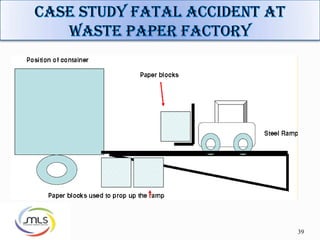
39
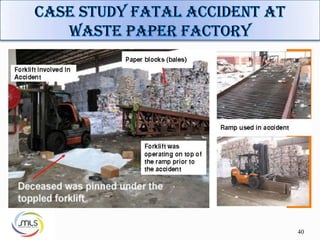
40
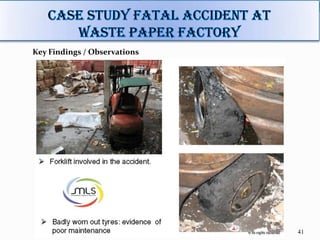
41
Key Findings / Observations
HOW MANY SAFETY METHODS?
 Accident / Incident Investigation
 Accident Statistics
 Asbestos
 Behavioural Safety
 Construction
 Control of Contractors
 COSHH
 Culture
 Diploma Unit A
 Diploma Unit B
 Diploma Unit C
 Diploma Unit D
 Disability Discrimination Act (DDA)
 Display Screen Equipment - DSE
 Driving
 Electricity
 Environmental
 Ergonomics
 Excavations
 Fire Safety
 General Tools
 Hands
 Law
HOW MANY SAFETY METHODS?
 Lifting Operations and Lifting Equipment - LOLER
 Management of Health and Safety
 Manual Handling
 Noise
 Occupational Health
 OHSAS
 PAUSE
 Permit to Work
 Personal Protective Equipment (PPE)
 Policy
 Practice Questions and Answers
 Provision and Use of Work Equipment (PUWER)
 Reporting
 RIDDOR
 Risk Assessment
 Safety Induction
 Signage
 Stress
 Terrorism
 Training Tools
 Travel
 Work at Height
 Workplace Transport
Safe operating of forklift

Safe operating of forklift

  • 1.
  • 2.
    The following topicswill be covered How a forklift operates Hazards of forklift operation How to use forklifts safely
  • 3.
    Forklift is amachine used to transport heavy materials from one place to another place (Short distance only) to stack, unstack, to load & unload material.
  • 4.
    Forklift is capable tolift heights under 30 feet. Load 1ton to 5ton in height
  • 5.
     OVERHEAD GUARD MAST  CARRIAGE  BACKREST  LIFT CYLINDER  TILT CYLINDERS  FORKS LOAD CAPACITY 6000 lbs PROPANE ONLY
  • 6.
    Only Trained authorizedpersonnel are permitted to operate a forklift. Badges or other visual indications shall be displayed on the body of the operators at all time during operation. The operator should not drive the truck up to a person standing in front of a bench or other object. The operator should not carry loads heavier than those for which the truck rated. 6
  • 7.
    Forklift controls operatedonly from driver’s seat Never block exits or emergency equipment Smoking is not permitted when operating the forklift No person should stand under elevated portion of lift truck 7
  • 8.
    The operator shouldavoid making fast starts, sudden stops and quick turns. The operator should report all accident involving personnel, building structures and other equipment. Operation on main roads outside the factory premises should be permitted only with proper authorization of local transport authority. Unless specifically authorized to do any repair, the operator should not make repairs, alterations or adjustments to the 8
  • 9.
    Workplace hazards: ramps,slippery floors, poor lighting, congestion Loads: large or bulky, uneven weight, broken pallets, poor stacked Pedestrians: horseplay, unaware of forklift areas, not paying attention
  • 10.
    Almost all counterbalancedpowered industrial trucks supported at three points. This is true even if the vehicle has four wheels. The truck's steer axle is attached to the truck by a pivot pin in the axle's center. When this point is connected to the front wheels with imaginary lines, this three-point support forms a triangle called the stability triangle. So long as the center of gravity remains within this stability triangle, the truck is stable and will not tip over.
  • 11.
    A forklift balancesa load with a counterweight at the back. The front wheels act as a pivot or balance point. The center of gravity moves upward when the forks are raised.
  • 12.
     While carryinga load near the maximum allowable capacity, be aware of the following:  Danger of tip over  Danger of losing load  Danger of being struck by falling load
  • 13.
    LIFTING PRINCIPLE CONSULT YOURVEHICLE OWNERS MANUAL 6500lbs REAL HEAVY PARTS INCORRECT CORRECT 6500lbs REAL HEAVY PARTS
  • 14.
    Loose loads aresubject to falling. Off center loads can also be subject to falling or cause the forklift to tip over. The photos below show the correct way to load pallets. Avoid using damaged pallets.
  • 15.
    Before raising aload, understand: Approximate weight of the load Location of the load’s center of gravity Inspect load for stability, projections, damaged pallets before lifting Restack unstable loads Never place weight on the back of a lift truck to increase its capacity Towing always done from rear towing pin 15
  • 16.
    When removing aload from a high rack:  Slowly back out with the load  Stop when it clears the rack  Lower the load to the floor  Don’t lower the load while moving!
  • 17.
    Use extra cautionwhen handling loads that approach the truck's maximum rated capacity:  Tilt the mast & forks back and position the heaviest part of the load against the carriage.  Travel with the mast tilted back to keep the load stable.  Never travel with the load tilted forward. Tilting the load forward increases the load distance and makes the load less stable
  • 18.
    Always drive withthe load on the uphill side - go backwards driving down the incline and frontwards going up the incline to prevent tipping or losing control of the forklift. If no load on the forklifts, do the opposite with forks pointing down the ramp
  • 19.
     Driving toofast around a corner  Driving off edge of platform, ramp, road or other surface  Driving an indoor forklift outdoors on rough, uneven ground  Turning on an incline or hill
  • 20.
    Do not jump Holdonto the steering wheel Brace your feet Lean away from the fall
  • 21.
     Slow downand sound horn at intersections, corners, and wherever your vision is obstructed.  When provided, use flashing warning light or backup alarms when traveling in reverse.  Always look in the direction of travel.  Signal to pedestrians to stand clear.  Do not allow anyone to stand or walk under upraised forks.  When possible, make eye contact with pedestrians or other forklift operators before moving in their path.
  • 22.
    Give them warningwith sensible one
  • 23.
     No oneelse on the forklift except the operator, unless the forklift has a seat for a rider.  Always drive with the forks lowered and lower forks to floor when parking the forklift. Watch overhead clearances – especially entering or exiting buildings or when you are raising a load on the forks.
  • 24.
  • 25.
  • 26.
  • 27.
    IF YOU AREGOING OPERATE A FORKLIFT: • DON’T DRINK ALCOHOL • DON’T USE DRUGS - DON’T PUT YOUR LIFE AND THE LIFE OF YOUR COLLEAGUES IN DANGER
  • 28.
  • 29.
    Forklift properly disconnected Forksdown, key off, neutral gear, parking brake on Left/right side Tire condition, tight lug nuts, no debris around axle, overhead guard is solid, no debris behind the mast Front Forks in good shape, fork pins in place, backrest solid, mast & chains greased, hoses in good shape Rear Counterbalance bolt is tight, radiator clear of debris29
  • 30.
    Non-moving checks Gauges, lights,horn, Reverse alarm, blinking warning light, operate the tilt & lift mechanism, check the parking brake Moving checks Check the running brakes, check the steering Look for oil or water leaks on the floor Daily check list 30
  • 31.
    Always look inthe direction of travel Keep body inside the cage When moving, the mast must not be raised Sound the horn Operate at safe speeds When turning, watch rear end swing Clearance under overhead installations 31
  • 32.
    32  Report toyour supervisor on any forklift damage or problems  Don’t use a forklift to lift worker  Use caution on slopes or ramps  While on slopes, tilt the load back and raise it above road surface  Don’t raise or lower the forks while the forklift is moving  Don’t handle loads that are above the weight capacity of the forklift  Follow the speed limit
  • 33.
    33  Slow downand sound the horn at crossings and locations where view is blocked  Focus on the travelling path and keep a clear view of it  When leaving a forklift, pull the parking brake, lower the forks and neutralize the controls  Slow down and sound the horn at crossings and locations where view is blocked  Focus on the travelling path and keep a clear view of it
  • 34.
    34 The engine ofdiesel forklift should be stopped before refueling. It should not be restarted unless the fuel line has been removed from the forklift and the filler cap has been properly replaced on the tank. Particular attention should be paid to avoid fuel spilling over the engine or exhaust system. If spillages occur the fuel should be wiped away properly before restating the engine. Contact between the metal outlet of the refueling hose and the fuel tank opening on the forklift should be maintained at all time during refueling process. Naked flames should never be used to check fuel levels in tanks.
  • 35.
    35 1 Does theforklift specification meet the operating requirement? 2 Is forklift maximum load capacity clearly printed on the forklift body? 3 Does the forklift maximum speed controlled? 4 Do horn, reversing beeper, proximity indicator and flashing light function properly? 5 Are the forklift maintenance performed regularly? 6 Are forklift maintenance and repair records maintained? 7 Are the tires in good conditions? 8 Forklift breaks conditions 9 Is the steering work well? 10 Does the gear control work? 11 Are the left, right and rear view mirrors available and clear? 12 Do all indicators and gauges function properly? 13 Are there any liquid leaks from the forklift? 14 Are Mast, Lifting system are in good condition?
  • 36.
    36 Workplace Premise: Warehousepremise in a distribution park Forklift: 3 ton (load capacity) Work Activity: Deceased was taking stock of goods to be transported out of the warehouse. He squeezed through the gap between two racks and was crushed when a forklift pushed the racks closer to make space for more racks. Nature of Accident: Crushed between objects
  • 37.
    37 Description of Accident Thedeceased worker was involved in tallying stock stored on metal racks within yellow boxes.
  • 38.
    38 The deceased workerwas conducting checks in between two metal racks just prior to the accident. To free up space for more cargo, a forklift operator used his forklift to push the adjacent metal racks. The deceased worker was trapped in between the metal racks. Deceased worker was found dead an hour later.
  • 39.
  • 40.
  • 41.
    41 Key Findings /Observations
  • 42.
    HOW MANY SAFETYMETHODS?  Accident / Incident Investigation  Accident Statistics  Asbestos  Behavioural Safety  Construction  Control of Contractors  COSHH  Culture  Diploma Unit A  Diploma Unit B  Diploma Unit C  Diploma Unit D  Disability Discrimination Act (DDA)  Display Screen Equipment - DSE  Driving  Electricity  Environmental  Ergonomics  Excavations  Fire Safety  General Tools  Hands  Law
  • 43.
    HOW MANY SAFETYMETHODS?  Lifting Operations and Lifting Equipment - LOLER  Management of Health and Safety  Manual Handling  Noise  Occupational Health  OHSAS  PAUSE  Permit to Work  Personal Protective Equipment (PPE)  Policy  Practice Questions and Answers  Provision and Use of Work Equipment (PUWER)  Reporting  RIDDOR  Risk Assessment  Safety Induction  Signage  Stress  Terrorism  Training Tools  Travel  Work at Height  Workplace Transport

Editor's Notes

  • #11 The stability of a forklift is important when you are handling heavy loads. The stability triangle is a way of describing how to keep the forklift stable and prevent it from tipping over with a heavy load. The next slide illustrates this idea further.
  • #12 As the load is raised up and away, the center of gravity also shifts up and away from middle of the forklift.  If it moves outside the triangle formed by the front wheels and the center of the rear axle, the forklift will tip forward or fall to the side.  
  • #13 As you can see from these illustrations, the center of gravity of the load should be as close to the forklift wheels and mast as possible.
  • #15 Pallet loads are often shrink-wrapped or otherwise secured with strapping or other devices, especially in warehouses. But sometimes one-time or short-term jobs or other work conditions make that impossible. In those cases, proper stacking on a pallet is important. In addition, damaged pallets are subject to collapsing suddenly and the load being dumped or dropped.
  • #17 In warehouses with high storage racks, the lightest loads should be placed on the top racks, and the heavier loads on the bottom racks. Remember a forklift is less stable with a load raised high, especially while moving.
  • #18 In addition to the points on this slide, you should not pick up a load with just the tip or front part of the forks. Place the forks all the way under the load and then tip it back slightly. You may need to tilt the forks forward slightly to get under the load and later to deposit the load. But at all other times the forks need to be tilted back.
  • #19 When you drive on an incline with a load, always have the load on the uphill side. L & I rules requires these procedures be followed if the incline is 10% or more. In addition, its especially important to tilt the load backward and keep it low. Raise the forks just enough to clear the surface.
  • #20 Forklifts can turn over for all the reasons shown on this slide.
  • #21 In the case of a tipover, whatever you do – don't jump. Hold on and lean away from the direction of the fall. You may be shook up and banged up a bit, but you will survive.
  • #22 Your employer may have restricted lanes for other workers – pedestrians – but people don’t always pay attention. You are often moving faster than a pedestrian and forklifts can’t stop suddenly, especially with a load. 10% of all fatalities involving forklifts are from workers being struck or run-over by a forklift. Don’t let it be your fault.
  • #23 In this example of a real accident, the pedestrian walked behind the forklift without catching the attention of forklift operator even though the back-up alarm was sounding. The forklift operator failed to look backwards, so the forklift hit the pedestrian, knocked him down and badly injuring his leg.
  • #24 The link to the Yale forklift company poster at the bottom of the slide is a good list of forklift safety practices. It can be simply viewed or printed out.
  • #25 Not leaving an operating forklift unattended is another requirement of the L & I safety regulations on forklifts.
  • #26 Not leaving an operating forklift unattended is another requirement of the L & I safety regulations on forklifts.
  • #27 Not leaving an operating forklift unattended is another requirement of the L & I safety regulations on forklifts.