Forklift Safety Awareness
FORKLIFT STABILITY TRIANGLE
CENTER OF GRAVITY
FORKLIFT STABILITY TRIANGLE - CENTER OF
GRAVITY
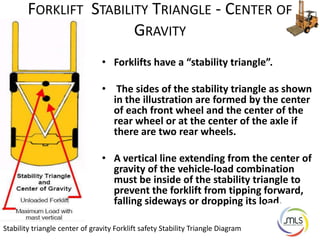
• Forklifts have a “stability triangle”.
• The sides of the stability triangle as shown
in the illustration are formed by the center
of each front wheel and the center of the
rear wheel or at the center of the axle if
there are two rear wheels.
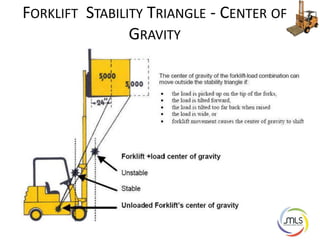
• A vertical line extending from the center of
gravity of the vehicle-load combination
must be inside of the stability triangle to
prevent the forklift from tipping forward,
falling sideways or dropping its load.
Stability triangle center of gravity Forklift safety Stability Triangle Diagram
FORKLIFT STABILITY TRIANGLE - CENTER OF
GRAVITY
FORKLIFT STABILITY TRIANGLE - CENTER OF
GRAVITY
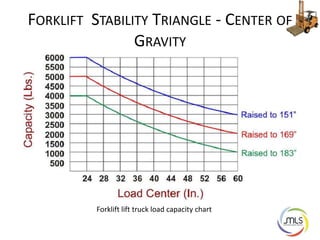
Forklift lift truck load capacity chart
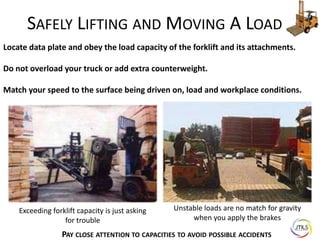
Locate data plate and obey the load capacity of the forklift and its attachments.
Do not overload your truck or add extra counterweight.
Match your speed to the surface being driven on, load and workplace conditions.
Exceeding forklift capacity is just asking
for trouble
Unstable loads are no match for gravity
when you apply the brakes
PAY CLOSE ATTENTION TO CAPACITIES TO AVOID POSSIBLE ACCIDENTS
SAFELY LIFTING AND MOVING A LOAD
Capacity Forklift Type Attachment ID
Capacity with
Attachment
SAFELY LIFTING AND MOVING A LOAD
This LP Gas Forklift can safely lift 5000 Lbs. 173" high
with a center of gravity 24" from the face of the forks.
With an attachment labeled "HSS", the safe load drops to 4500 Lbs.
Data plate load capacity forklift
SAFELY LIFTING AND MOVING A LOAD
Ensure the forks are level and high enough to go
into the pallet but not puncture the load.
Place forks as far under the load as possible
while keeping in mind the length of the forks
and objects behind the load.
Lift the load straight up until it is clear, then tilt
back, drive with the load against the backrest.
Watch that the load or forks do not catch on
adjacent loads or obstructions.
Allow safe working distance between forklifts.
Do not pass a forklift travelling in the same
direction at intersections, blind spots or other
dangerous locations.
Stay constantly alert to changing or unusual
conditions.
Do not permit anyone to stand or walk under the
elevated part of any forklift, whether loaded or
unloaded.
SAFELY LIFTING AND MOVING A LOAD
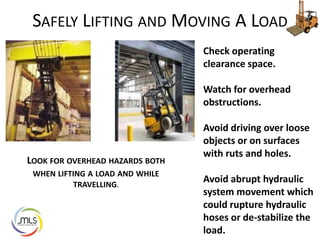
Check operating
clearance space.
Watch for overhead
obstructions.
Avoid driving over loose
objects or on surfaces
with ruts and holes.
Avoid abrupt hydraulic
system movement which
could rupture hydraulic
hoses or de-stabilize the
load.
LOOK FOR OVERHEAD HAZARDS BOTH
WHEN LIFTING A LOAD AND WHILE
TRAVELLING.
SAFELY LIFTING AND MOVING A LOAD
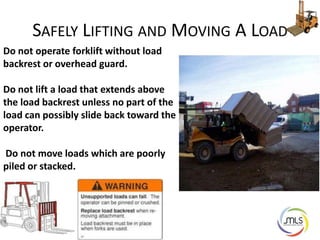
Do not operate forklift without load
backrest or overhead guard.
Do not lift a load that extends above
the load backrest unless no part of the
load can possibly slide back toward the
operator.
Do not move loads which are poorly
piled or stacked.
SAFELY LIFTING AND MOVING A LOAD
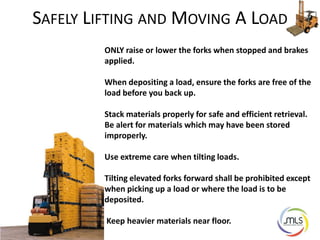
ONLY raise or lower the forks when stopped and brakes
applied.
When depositing a load, ensure the forks are free of the
load before you back up.
Stack materials properly for safe and efficient retrieval.
Be alert for materials which may have been stored
improperly.
Use extreme care when tilting loads.
Tilting elevated forks forward shall be prohibited except
when picking up a load or where the load is to be
deposited.
Keep heavier materials near floor.
SAFELY LIFTING AND MOVING A LOAD
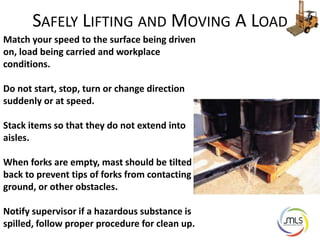
Match your speed to the surface being driven
on, load being carried and workplace
conditions.
Do not start, stop, turn or change direction
suddenly or at speed.
Stack items so that they do not extend into
aisles.
When forks are empty, mast should be tilted
back to prevent tips of forks from contacting
ground, or other obstacles.
Notify supervisor if a hazardous substance is
spilled, follow proper procedure for clean up.
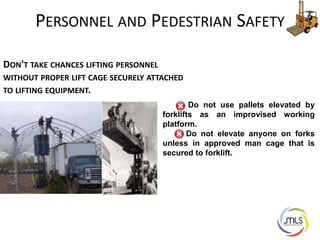
PERSONNEL AND PEDESTRIAN SAFETY
Do not use pallets elevated by
forklifts as an improvised working
platform.
Do not elevate anyone on forks
unless in approved man cage that is
secured to forklift.
DON'T TAKE CHANCES LIFTING PERSONNEL
WITHOUT PROPER LIFT CAGE SECURELY ATTACHED
TO LIFTING EQUIPMENT.
Use of Mirror PERSONNEL AND PEDESTRIAN
SAFETY
Use mirrors, sound horn and slow down
when approaching pedestrians, hazardous
passageways and work areas.
When forks are empty, mast should be
tilted back to prevent tips of forks from
contacting ground, or other obstacles.
Match your speed to the surface being
driven on, load and workplace conditions.
Do not start, stop, turn or change direction
suddenly or at speed.
PERSONNEL AND PEDESTRIAN SAFETY
Do not try to move or adjust any
part of the load, the forklift or the
surroundings while on the forklift.
Do not climb between mast and
load or between mast and
machine
PERSONNEL AND PEDESTRIAN SAFETY
Do not drive with hands, arms,
head, legs or feet outside the
confines of the forklift or between
mast uprights or other parts of the
unit where shear or crushing
hazards exist.
Only operate controls while sitting
in the operator’s seat.
TRAVELLING ON INCLINES
Know the forklift wheel position and
your direction of travel in relation to
loading docks, trucks, and platforms.
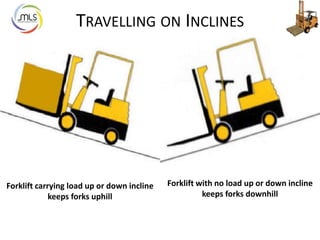
When travelling up or down an incline
with a load, keep the load pointed uphill.
When driving up or down an incline
without a load, keep the forks pointed
downhill.
Do not turn until you are on level ground.
Fatal forklift accident, fork lift tipped over
crushing driver
TRAVELLING ON INCLINES
Forklift carrying load up or down incline
keeps forks uphill
Forklift with no load up or down incline
keeps forks downhill
TRAVELLING ON INCLINES
If you ever begin to tip, DON’T JUMP OUT
! ! ! Brace yourself, hold steering wheel
tightly with both hands, push yourself
into the seat and lean away from the fall.
Most forklift fatalities are due to crushing
injuries when driver becomes pinned
under part of the machine.
Scene of fatal tow motor tip over forklift
accident
LOADING TRUCKS
Ensure that truck and trailer brakes are set and wheels are
blocked.
Trailers not hooked to a tractor at a dock should be secured
by trailer jacks or sufficient support.
LOADING TRUCKS
Watch for holes or weak floors.
Watch for trash, loose objects and
obstructions.
Inspect condition of truck or
trailer before entering.
Ensure the floors will support the
combined weight of the forklift
and the load.
ALWAYS OBSERVE THE CONDITION OF THE TRAILER
BEFORE ENTERING
LOADING TRUCKS
Even Lite loads can add up
Never Overload Any Trailer
LOADING TRUCKS
Do not allow pedestrians in trailers while a lift truck is loading or unloading.
The likelihood of being crushed by a forklift is greater in tight spaces.
Ensure proper lighting in trailer and work area.
AVOID THE PITFALLS OF AN UNSTABLE OR OVERWEIGHT LOAD
LOADING TRUCKS
Never park a forklift on a dock
plate.
Ensure that portable dock plates
are properly secured before
driving over.
Ensure plate capacity is
capable of supporting forklift
and load.
Dock levelers must be extended
and securely resting on trailer
floor
LOADING TRUCKS
Install anti-slipping material in any
area that could be a hazard due to
weather conditions.
Ensure that docks and dock plates
are clear of obstructions and not
oily, wet or coated with ice or
snow.
Know where to find safety salt, ice
melter or oil absorbent.
HAVE A POLICY IN PLACE TO PREVENT TRUCK
PULLING OUT PREMATURELY
FACTORS CONTRIBUTING TO TOW MOTOR
AND FORKLIFT ACCIDENTS
Behavioural / Operational Factors
Excessive speed
Lack of worker training.
Improper vehicle restraints on
trucks and trailers.
Inadequate servicing of the forklift
Improper backing, turning, braking.
Improperly parking the forklift.
FACTORS CONTRIBUTING TO TOW MOTOR
AND FORKLIFT ACCIDENTS
Walking and working in the general area of
forklift operations.
Poor communication during shared tasks,
or in shared spaces.
Improper warnings to others of forklift
presence.
Allowing passengers on the forklift or load.
Non-acceptable behaviours, horseplay,
showing off
NEVER TAKE SAFETY FOR GRANTED,
ACCIDENTS CAN HAPPEN ANYWHERE,
ANYTIME.
FACTORS CONTRIBUTING TO TOW MOTOR
AND FORKLIFT ACCIDENTS
Characteristics of the
Workplace
Narrow, crowded, or cluttered aisles.
Intersections and doorways.
Concentrations of traffic.
Type of materials being stored or
moved.
Visibility restrictions and
obstructions
FACTORS CONTRIBUTING TO TOW MOTOR
AND FORKLIFT ACCIDENTS
Lighting conditions, shadows and
glare.
Condition of loading dock.
Ramps, inclines or different
surface conditions.
Potholes or obstacles on the
ground Other factors - noise,
odours, toxic gases, dust.
FACTORS CONTRIBUTING TO TOW MOTOR
AND FORKLIFT ACCIDENTS
Operational Systems
Production factors - speed, stress, lack
of proper attachments or accessories
Policies and procedures
Age of forklifts.
Maintenance program.
KNOW YOUR WORK AREA, LEARN THE HAZARDS
FACTORS CONTRIBUTING TO TOW MOTOR
AND FORKLIFT ACCIDENTS
Characteristics of the Load
Poor palletizing.
Damaged Skids.
Load too heavy.
Load unstable.
Load blocking vision.
NEVER TRY TO MOVE AN UNSTABLE LOAD,
FIX IT FIRST!
FORKLIFT CIRCLE CHECK
BE THOROUGH, BE SAFE Daily Visual and Operational Safety
Inspection
An individual checklist should be developed for each
machine tailored to the make, model and attachments of the
machine.
FORKLIFT CIRCLE CHECK
Walk around the forklift, checking for obstructions or hazards in
the area, fluid leaks, damp spots or drips.
Check condition of wheels/tires.
Inspect belts, hoses and connections.
Check propane, engine oil, coolant level and battery condition.
FORKLIFT CIRCLE CHECK
Lights working properly.
Fire extinguisher-present and charged.
Foot brake pedal holds, unit stops
smoothly.
Parking brake should hold against
slight acceleration.
Dash control panel all lights, gauges
and horn operational.
FORKLIFT CIRCLE CHECK
Clutch and gearshift smooth shifting no jumping or
jerking.
Steering functioning properly, no excessive play in the
wheel.
FORKLIFT CIRCLE CHECK
No external or internal leaks at lift and tilt
cylinders. also, no leaking hydraulic
hoses.
Chains, rollers, hose pulleys in good
shape.
FORKLIFT CIRCLE CHECK
Check forks for positioning, latches and anchor pins worn, loose or bent.
Beware of damaged, cracked or bent forks.

Forllift safety

  • 1.
    Forklift Safety Awareness FORKLIFTSTABILITY TRIANGLE CENTER OF GRAVITY
  • 2.
    FORKLIFT STABILITY TRIANGLE- CENTER OF GRAVITY • Forklifts have a “stability triangle”. • The sides of the stability triangle as shown in the illustration are formed by the center of each front wheel and the center of the rear wheel or at the center of the axle if there are two rear wheels. • A vertical line extending from the center of gravity of the vehicle-load combination must be inside of the stability triangle to prevent the forklift from tipping forward, falling sideways or dropping its load. Stability triangle center of gravity Forklift safety Stability Triangle Diagram
  • 3.
    FORKLIFT STABILITY TRIANGLE- CENTER OF GRAVITY
  • 4.
    FORKLIFT STABILITY TRIANGLE- CENTER OF GRAVITY Forklift lift truck load capacity chart
  • 5.
    Locate data plateand obey the load capacity of the forklift and its attachments. Do not overload your truck or add extra counterweight. Match your speed to the surface being driven on, load and workplace conditions. Exceeding forklift capacity is just asking for trouble Unstable loads are no match for gravity when you apply the brakes PAY CLOSE ATTENTION TO CAPACITIES TO AVOID POSSIBLE ACCIDENTS SAFELY LIFTING AND MOVING A LOAD
  • 6.
    Capacity Forklift TypeAttachment ID Capacity with Attachment SAFELY LIFTING AND MOVING A LOAD This LP Gas Forklift can safely lift 5000 Lbs. 173" high with a center of gravity 24" from the face of the forks. With an attachment labeled "HSS", the safe load drops to 4500 Lbs. Data plate load capacity forklift
  • 7.
    SAFELY LIFTING ANDMOVING A LOAD Ensure the forks are level and high enough to go into the pallet but not puncture the load. Place forks as far under the load as possible while keeping in mind the length of the forks and objects behind the load. Lift the load straight up until it is clear, then tilt back, drive with the load against the backrest. Watch that the load or forks do not catch on adjacent loads or obstructions.
  • 8.
    Allow safe workingdistance between forklifts. Do not pass a forklift travelling in the same direction at intersections, blind spots or other dangerous locations. Stay constantly alert to changing or unusual conditions. Do not permit anyone to stand or walk under the elevated part of any forklift, whether loaded or unloaded. SAFELY LIFTING AND MOVING A LOAD
  • 9.
    SAFELY LIFTING ANDMOVING A LOAD Check operating clearance space. Watch for overhead obstructions. Avoid driving over loose objects or on surfaces with ruts and holes. Avoid abrupt hydraulic system movement which could rupture hydraulic hoses or de-stabilize the load. LOOK FOR OVERHEAD HAZARDS BOTH WHEN LIFTING A LOAD AND WHILE TRAVELLING.
  • 10.
    SAFELY LIFTING ANDMOVING A LOAD Do not operate forklift without load backrest or overhead guard. Do not lift a load that extends above the load backrest unless no part of the load can possibly slide back toward the operator. Do not move loads which are poorly piled or stacked.
  • 11.
    SAFELY LIFTING ANDMOVING A LOAD ONLY raise or lower the forks when stopped and brakes applied. When depositing a load, ensure the forks are free of the load before you back up. Stack materials properly for safe and efficient retrieval. Be alert for materials which may have been stored improperly. Use extreme care when tilting loads. Tilting elevated forks forward shall be prohibited except when picking up a load or where the load is to be deposited. Keep heavier materials near floor.
  • 12.
    SAFELY LIFTING ANDMOVING A LOAD Match your speed to the surface being driven on, load being carried and workplace conditions. Do not start, stop, turn or change direction suddenly or at speed. Stack items so that they do not extend into aisles. When forks are empty, mast should be tilted back to prevent tips of forks from contacting ground, or other obstacles. Notify supervisor if a hazardous substance is spilled, follow proper procedure for clean up.
  • 13.
    PERSONNEL AND PEDESTRIANSAFETY Do not use pallets elevated by forklifts as an improvised working platform. Do not elevate anyone on forks unless in approved man cage that is secured to forklift. DON'T TAKE CHANCES LIFTING PERSONNEL WITHOUT PROPER LIFT CAGE SECURELY ATTACHED TO LIFTING EQUIPMENT.
  • 14.
    Use of MirrorPERSONNEL AND PEDESTRIAN SAFETY Use mirrors, sound horn and slow down when approaching pedestrians, hazardous passageways and work areas. When forks are empty, mast should be tilted back to prevent tips of forks from contacting ground, or other obstacles. Match your speed to the surface being driven on, load and workplace conditions. Do not start, stop, turn or change direction suddenly or at speed.
  • 15.
    PERSONNEL AND PEDESTRIANSAFETY Do not try to move or adjust any part of the load, the forklift or the surroundings while on the forklift. Do not climb between mast and load or between mast and machine
  • 16.
    PERSONNEL AND PEDESTRIANSAFETY Do not drive with hands, arms, head, legs or feet outside the confines of the forklift or between mast uprights or other parts of the unit where shear or crushing hazards exist. Only operate controls while sitting in the operator’s seat.
  • 17.
    TRAVELLING ON INCLINES Knowthe forklift wheel position and your direction of travel in relation to loading docks, trucks, and platforms. When travelling up or down an incline with a load, keep the load pointed uphill. When driving up or down an incline without a load, keep the forks pointed downhill. Do not turn until you are on level ground. Fatal forklift accident, fork lift tipped over crushing driver
  • 18.
    TRAVELLING ON INCLINES Forkliftcarrying load up or down incline keeps forks uphill Forklift with no load up or down incline keeps forks downhill
  • 19.
    TRAVELLING ON INCLINES Ifyou ever begin to tip, DON’T JUMP OUT ! ! ! Brace yourself, hold steering wheel tightly with both hands, push yourself into the seat and lean away from the fall. Most forklift fatalities are due to crushing injuries when driver becomes pinned under part of the machine. Scene of fatal tow motor tip over forklift accident
  • 20.
    LOADING TRUCKS Ensure thattruck and trailer brakes are set and wheels are blocked. Trailers not hooked to a tractor at a dock should be secured by trailer jacks or sufficient support.
  • 21.
    LOADING TRUCKS Watch forholes or weak floors. Watch for trash, loose objects and obstructions. Inspect condition of truck or trailer before entering. Ensure the floors will support the combined weight of the forklift and the load. ALWAYS OBSERVE THE CONDITION OF THE TRAILER BEFORE ENTERING
  • 22.
    LOADING TRUCKS Even Liteloads can add up Never Overload Any Trailer
  • 23.
    LOADING TRUCKS Do notallow pedestrians in trailers while a lift truck is loading or unloading. The likelihood of being crushed by a forklift is greater in tight spaces. Ensure proper lighting in trailer and work area. AVOID THE PITFALLS OF AN UNSTABLE OR OVERWEIGHT LOAD
  • 24.
    LOADING TRUCKS Never parka forklift on a dock plate. Ensure that portable dock plates are properly secured before driving over. Ensure plate capacity is capable of supporting forklift and load. Dock levelers must be extended and securely resting on trailer floor
  • 25.
    LOADING TRUCKS Install anti-slippingmaterial in any area that could be a hazard due to weather conditions. Ensure that docks and dock plates are clear of obstructions and not oily, wet or coated with ice or snow. Know where to find safety salt, ice melter or oil absorbent. HAVE A POLICY IN PLACE TO PREVENT TRUCK PULLING OUT PREMATURELY
  • 26.
    FACTORS CONTRIBUTING TOTOW MOTOR AND FORKLIFT ACCIDENTS Behavioural / Operational Factors Excessive speed Lack of worker training. Improper vehicle restraints on trucks and trailers. Inadequate servicing of the forklift Improper backing, turning, braking. Improperly parking the forklift.
  • 27.
    FACTORS CONTRIBUTING TOTOW MOTOR AND FORKLIFT ACCIDENTS Walking and working in the general area of forklift operations. Poor communication during shared tasks, or in shared spaces. Improper warnings to others of forklift presence. Allowing passengers on the forklift or load. Non-acceptable behaviours, horseplay, showing off NEVER TAKE SAFETY FOR GRANTED, ACCIDENTS CAN HAPPEN ANYWHERE, ANYTIME.
  • 28.
    FACTORS CONTRIBUTING TOTOW MOTOR AND FORKLIFT ACCIDENTS Characteristics of the Workplace Narrow, crowded, or cluttered aisles. Intersections and doorways. Concentrations of traffic. Type of materials being stored or moved. Visibility restrictions and obstructions
  • 29.
    FACTORS CONTRIBUTING TOTOW MOTOR AND FORKLIFT ACCIDENTS Lighting conditions, shadows and glare. Condition of loading dock. Ramps, inclines or different surface conditions. Potholes or obstacles on the ground Other factors - noise, odours, toxic gases, dust.
  • 30.
    FACTORS CONTRIBUTING TOTOW MOTOR AND FORKLIFT ACCIDENTS Operational Systems Production factors - speed, stress, lack of proper attachments or accessories Policies and procedures Age of forklifts. Maintenance program. KNOW YOUR WORK AREA, LEARN THE HAZARDS
  • 31.
    FACTORS CONTRIBUTING TOTOW MOTOR AND FORKLIFT ACCIDENTS Characteristics of the Load Poor palletizing. Damaged Skids. Load too heavy. Load unstable. Load blocking vision. NEVER TRY TO MOVE AN UNSTABLE LOAD, FIX IT FIRST!
  • 32.
    FORKLIFT CIRCLE CHECK BETHOROUGH, BE SAFE Daily Visual and Operational Safety Inspection An individual checklist should be developed for each machine tailored to the make, model and attachments of the machine.
  • 33.
    FORKLIFT CIRCLE CHECK Walkaround the forklift, checking for obstructions or hazards in the area, fluid leaks, damp spots or drips. Check condition of wheels/tires. Inspect belts, hoses and connections. Check propane, engine oil, coolant level and battery condition.
  • 34.
    FORKLIFT CIRCLE CHECK Lightsworking properly. Fire extinguisher-present and charged. Foot brake pedal holds, unit stops smoothly. Parking brake should hold against slight acceleration. Dash control panel all lights, gauges and horn operational.
  • 35.
    FORKLIFT CIRCLE CHECK Clutchand gearshift smooth shifting no jumping or jerking. Steering functioning properly, no excessive play in the wheel.
  • 36.
    FORKLIFT CIRCLE CHECK Noexternal or internal leaks at lift and tilt cylinders. also, no leaking hydraulic hoses. Chains, rollers, hose pulleys in good shape.
  • 37.
    FORKLIFT CIRCLE CHECK Checkforks for positioning, latches and anchor pins worn, loose or bent. Beware of damaged, cracked or bent forks.