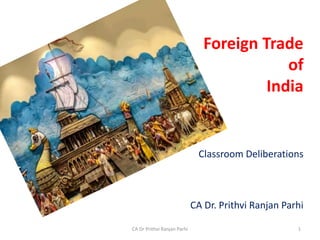
Foreign Trade
of
India
Classroom Deliberations
CA Dr. Prithvi Ranjan Parhi
CA Dr Prithvi Ranjan Parhi 1
703- INTERNATIONAL TRADE AND BUSINESS
MODULE- I
International Trade: Concept, Importance, Benefits of International Trade, international
Marking vs. Domestic Marking (differences).
Theory of International Trade: theory of comparative Cost, factor proportion Theory.
MODULE-II
Multinational corporations (MNCs): Definition, Role of MNCs in International marking.
International Trade barriers: Meaning, tariff and non-Tariff Barriers, Impact of Non-tariff
barriers.
MODULE-III
Organizational and Agreements: WTO (Functions, Principle, agreements), IMF (Purposes,
Facilities Provided by IMF), World Bank (Purpose, Principle, Policies).
MODULE-IV
Foreign Trade of India: Organizational Setup (Autonomous Bodies, Attached and
subordinate offices), Major Export and Imports, Concept of Export House, EXIM Policy
(2002-2007) of India (Features and Objectives of the Policy).
MODULE-V
Foreign Exchange market: Concept, Functions, Methods of international Payment, concept
of Balance of Payment, Concept of Fixed and Flexible Exchange Rate and Convertibility of
Rupee.
CA Dr Prithvi Ranjan Parhi 2
Major Indian Organisations for
Promoting Trade
1. India Trade Promotion Organisation (ITPO)
2. Indian Institute of Foreign Trade (IIFT)
3. Indian Institute of Packaging (IIP)
4. Directorate General of Trade Remedies (DGTR)
5. Agricultural and Processed Food Products
Export Development Authority (APEDA)
6. Others
CA Dr Prithvi Ranjan Parhi 3
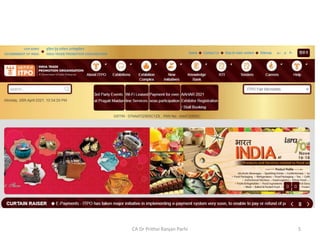
1. India Trade Promotion Organisation
(ITPO):
• The ITPO was set up under Section 25 of the
Companies Act, 1956, on January 1, 1992,
consequent to the merger of the erstwhile Trade
Fair Authority of India and Trade Development
Authority.
• It is a service organisation and maintains regular
and close interaction with trade, industry and
government.
CA Dr Prithvi Ranjan Parhi 4
CA Dr Prithvi Ranjan Parhi 5
ITPO
• The ITPO regularly organises fairs and exhibitions both in India and
abroad, buyer-seller meets, exchange of business delegations, product
development programmes etc. The international events organised by
ITPO, that have over the years developed an institutionalised character,
include the International Shoe Fair, Shoe Camp India, International
Trade Fair, and AHARA (all in Delhi); India International Leather Fair,
Chennai; International Leather Goods Fair, Kolkata; etc. Exhibitions
organised in cooperation with other agencies in India focus on various
key sectors of industry such as sports, automobile, textiles, books,
health and medicare, computers, metals, jewellery, broadcast cable,
handicrafts, engineering, gifts, carpets, plastic, telecommunications,
electronics etc.
• The Information & Computer Department, comprising Trade
Information Centre, Documentation Centre (Library) and Computer
Centre, has been designed to help the new potential as well as
established manufacturers and exporters in their export promotion
efforts, besides providing information inputs to the various export
developmental activities of the ITPO, such as trade fairs and exhibitions
held abroad and in India.
CA Dr Prithvi Ranjan Parhi 6
2. Indian Institute of Foreign Trade
(IIFT):
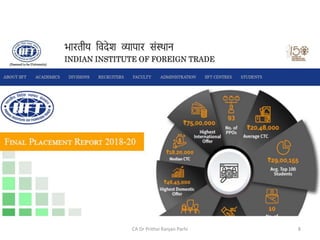
• The IIFT is an autonomous organisation established
in May 1983 and is registered under the Societies
Registration Act of 1860.
• Its objective is to provide training in international
trade; organise research in problems of foreign
trade; organise market research, area surveys,
commodity surveys; disseminate information arising
from its activities relating to research and market
studies.
CA Dr Prithvi Ranjan Parhi 7
CA Dr Prithvi Ranjan Parhi 8
IIFT
• The following foundational programmes are organised
by the IIFT—
i. Masters Programme in International Business;
ii. Post-graduate Diploma Programme in International
Trade;
iii. Executive Masters in International trade;
iv. Certificate Course in Export Marketing;
v. Certificate Course in International Business.
• These programmes have been so oriented that they
can cater to the evolving needs of clients, industries,
student community, government and trade, both in
India and abroad.
CA Dr Prithvi Ranjan Parhi 9
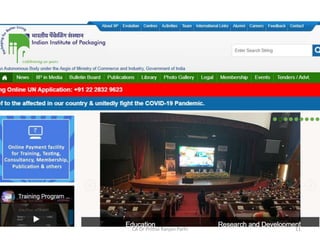
3. Indian Institute of Packaging (IIP):
• The IIP is a training and educational organisation set up in
1966 with the aim of bringing about improvements in the
standards of packaging in the country, particularly for
exports.
• It undertakes technical consultancy, testing services on
packaging developments, training and educational
programmes, promotional awards contests, information
services, and other activities.
• The education and training programmes of the institute
include post-graduate programmes, certificate programme
in packaging, distance education programme on packaging
technology and short-term programmes on specific
packaging media or specific product packaging.
CA Dr Prithvi Ranjan Parhi 10
CA Dr Prithvi Ranjan Parhi 11
IIP
• Several packaging technology development projects have been
taken up by the IIP on behalf of other ministries and agencies.
Some of these include packaging of meat and poultry products,
fresh fruits and vegetables and electronic goods for export.
• The institute also provides laboratories for testing facilities
which have gone a long way in creating consciousness
regarding quality control among the industries.
• It has been recognised by the directorate general of shipping as
the agency for testing and evaluation of packages for
hazardous cargo for UN certification. The institute has built up
a large and useful reference library at its headquarters at
Mumbai for providing information services.
• The technical bi-monthly journal of the institute—Packaging
India—has become the accepted national reference standard
journal for the industries for various techno- commercial
information on packaging development and technology.
CA Dr Prithvi Ranjan Parhi 12
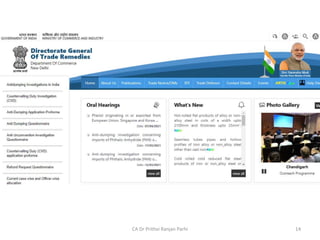
4. Directorate General of Trade Remedies
(DGTR)
• This institution was created in April 1998.
• The directorate investigates allegations of
dumping and subsidies and recommends suitable
duties to the Central government.
• It also advises all interested parties of
information required, procedures and time frame
involved besides assisting the industry regarding
technical issues.
CA Dr Prithvi Ranjan Parhi 13
CA Dr Prithvi Ranjan Parhi 14
5. Agricultural and Processed Food Products Export
Development Authority (APEDA):
• APEDA is engaged in the export promotion and
development of fruits and vegetables and their products,
meat and meat products, rice, wheat, floriculture and
floriculture products, processed fruits and juices and
several other miscellaneous agricultural products.
• APEDA is a promotional agency and does not undertake
direct exports of any products on its own account.
• Growers/exporters are provided assistance under various
schemes of APEDA for improvement in packaging, quality
up gradation, creation of infrastructure, etc.
CA Dr Prithvi Ranjan Parhi 15
CA Dr Prithvi Ranjan Parhi 16
6. Others:
• Apart from these, there are other autonomous institutions, councils, etc.,
working for the promotion of trade activities. These include the Export
Inspection Council which is responsible for quality control and compulsory pre-
shipment inspections of various exportable commodities;
• the Indian Diamond Institute, which was set up to strengthen and improve
availability of trained manpower for the diamond industry;
• the Federation of Indian Export Organisation (FIEO) which functions as a
primary servicing agency to provide integrated assistance to government
recognised export houses/trading houses and as a central coordinated agency
in respect of export promotional efforts in the field of consultancy services in
the country;
• the Indian Council of Arbitration which promotes arbitration as a means of
settling commercial disputes among traders;
• the Marine Products Exports Development Authority which is responsible for
Development of the marine products industry with special reference to
exports;
• the Agricultural and Processed Food Products Export Development Authority
which serves as a focal point for agricultural exports.
• The public sector undertakings involved in trade activities are State Trading
Corporation of India, MMTC Ltd., Projects and Equipment Corporation of India,
Tea Trading Corporation of India, Spices Trading Corporation of India and
Export Credit Guarantee Corporation of India Ltd.
CA Dr Prithvi Ranjan Parhi 17
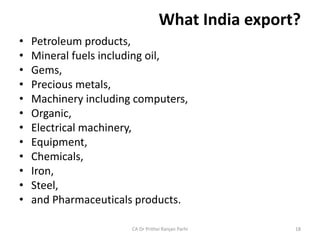
What India export?
• Petroleum products,
• Mineral fuels including oil,
• Gems,
• Precious metals,
• Machinery including computers,
• Organic,
• Electrical machinery,
• Equipment,
• Chemicals,
• Iron,
• Steel,
• and Pharmaceuticals products.
CA Dr Prithvi Ranjan Parhi 18
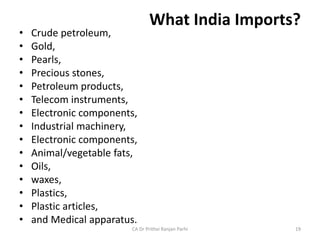
What India Imports?
• Crude petroleum,
• Gold,
• Pearls,
• Precious stones,
• Petroleum products,
• Telecom instruments,
• Electronic components,
• Industrial machinery,
• Electronic components,
• Animal/vegetable fats,
• Oils,
• waxes,
• Plastics,
• Plastic articles,
• and Medical apparatus.
CA Dr Prithvi Ranjan Parhi 19
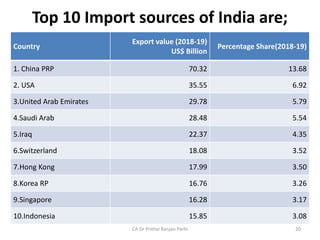
Top 10 Import sources of India are;
Country
Export value (2018-19)
US$ Billion
Percentage Share(2018-19)
1. China PRP 70.32 13.68
2. USA 35.55 6.92
3.United Arab Emirates 29.78 5.79
4.Saudi Arab 28.48 5.54
5.Iraq 22.37 4.35
6.Switzerland 18.08 3.52
7.Hong Kong 17.99 3.50
8.Korea RP 16.76 3.26
9.Singapore 16.28 3.17
10.Indonesia 15.85 3.08
CA Dr Prithvi Ranjan Parhi 20
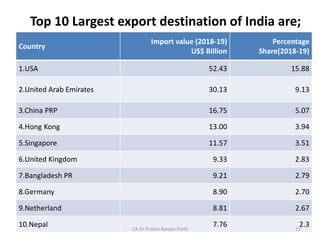
Top 10 Largest export destination of India are;
Country
Import value (2018-19)
US$ Billion
Percentage
Share(2018-19)
1.USA 52.43 15.88
2.United Arab Emirates 30.13 9.13
3.China PRP 16.75 5.07
4.Hong Kong 13.00 3.94
5.Singapore 11.57 3.51
6.United Kingdom 9.33 2.83
7.Bangladesh PR 9.21 2.79
8.Germany 8.90 2.70
9.Netherland 8.81 2.67
10.Nepal 7.76 2.3
CA Dr Prithvi Ranjan Parhi 21
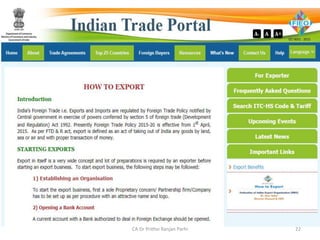
CA Dr Prithvi Ranjan Parhi 22
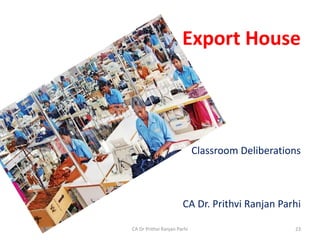
Export House
Classroom Deliberations
CA Dr. Prithvi Ranjan Parhi
CA Dr Prithvi Ranjan Parhi 23
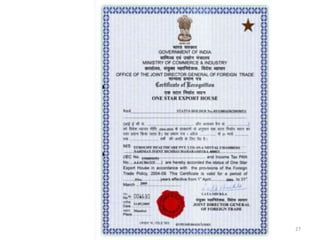
Export House
• Export House is defined as a registered
exporter holding a valid Export House
Certificate issued by the Director general of
Foreign Trade in India.
CA Dr Prithvi Ranjan Parhi 24
Objectives Of Export House
1. To make available supplies of essential commodities to
consumers at reasonable prices on a regular basis.
2. To ensure a fair price of the produce to the farmers so
that there may be an adequate incentive to increase
production.
3. To minimize Price fluctuations.
4. To arrange for supply of fertilizers and insecticides.
5. To undertake the procurement and maintenance of
buffer stock and their distribution whenever and
wherever necessary.
6. To arrange for storage, transportation, packaging and
processing.
CA Dr Prithvi Ranjan Parhi 25
Forms
1. Manufacturer Exporter
2. Merchant Exporter
3. Service Providers
4. Export Oriented Units (EOU’s)
5. Special Economic Zones (SEZ’s)
6. Software Technology Parks (STP’s)
CA Dr Prithvi Ranjan Parhi 26
CA Dr Prithvi Ranjan Parhi 27
Validity of Status Holder Certificate:
• Status Holder Certificate or Export House
Certificate shall be valid for 5 Years from the
date of issue of certificate.
• Certificate renewal shall be filed before the
expiry of existing validity period.
CA Dr Prithvi Ranjan Parhi 28
Conclusion
1. Export houses better take care of the buyers
specifications and provide them good quality
products.
2. Exporters should invest in technological tools, and
come at par to compete with their foreign
competitors.
3. Export trading houses export large volumes of
products from many sources of lower unit costs
through established networks of overseas offices.
CA Dr Prithvi Ranjan Parhi 29
Exim Policy
• Export Import Policy or better known as Exim
Policy is a set of guidelines and instructions
related to the import and export of goods.
• The Export Import Policy is updated every year
on the 31st of March and the modifications,
improvements and new schemes becomes
effective from 1st April of every year.
CA Dr Prithvi Ranjan Parhi 30
Foreign Trade Policy
• FTP 2015-20 introduces two new schemes, namely
1. "Merchandise Exports from India Scheme (MEIS)" and
2. "Services Exports from India Scheme (SEIS)".
• The 'Services Exports from India Scheme' (SEIS) is for
increasing exports of notified services.
• These schemes (MEIS and SEIS) replace multiple
schemes earlier in place, each with different conditions
for eligibility and usage.
• Incentives (MEIS & SEIS) to be available for SEZs also.
CA Dr Prithvi Ranjan Parhi 31
• Agricultural and village industry products to be supported
across the globe at rates of 3% and 5% under MEIS.
• Higher level of support to be provided to processed and
packaged agricultural and food items under MEIS.
• Industrial products to be supported in major markets at
rates ranging from 2% to 3%.
• Branding campaigns planned to promote exports in sectors
where ..
CA Dr Prithvi Ranjan Parhi 32
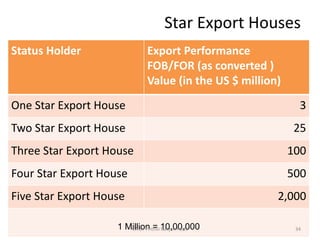
• Nomenclature of Export House, Star Export
House, Trading House, Premier Trading House
certificate changed to 1,2,3,4,5 Star Export
House.
• No need to repeatedly submit physical copies
of documents available on Exporter Importer
Profile.
CA Dr Prithvi Ranjan Parhi 33
Star Export Houses
Status Holder Export Performance
FOB/FOR (as converted )
Value (in the US $ million)
One Star Export House 3
Two Star Export House 25
Three Star Export House 100
Four Star Export House 500
Five Star Export House 2,000
1 Million = 10,00,000
CA Dr Prithvi Ranjan Parhi 34
THANK YOU
35
CA Dr Prithvi Ranjan Parhi

Foreign Trade in India

  • 1.
    Foreign Trade of India Classroom Deliberations CADr. Prithvi Ranjan Parhi CA Dr Prithvi Ranjan Parhi 1
  • 2.
    703- INTERNATIONAL TRADEAND BUSINESS MODULE- I International Trade: Concept, Importance, Benefits of International Trade, international Marking vs. Domestic Marking (differences). Theory of International Trade: theory of comparative Cost, factor proportion Theory. MODULE-II Multinational corporations (MNCs): Definition, Role of MNCs in International marking. International Trade barriers: Meaning, tariff and non-Tariff Barriers, Impact of Non-tariff barriers. MODULE-III Organizational and Agreements: WTO (Functions, Principle, agreements), IMF (Purposes, Facilities Provided by IMF), World Bank (Purpose, Principle, Policies). MODULE-IV Foreign Trade of India: Organizational Setup (Autonomous Bodies, Attached and subordinate offices), Major Export and Imports, Concept of Export House, EXIM Policy (2002-2007) of India (Features and Objectives of the Policy). MODULE-V Foreign Exchange market: Concept, Functions, Methods of international Payment, concept of Balance of Payment, Concept of Fixed and Flexible Exchange Rate and Convertibility of Rupee. CA Dr Prithvi Ranjan Parhi 2
  • 3.
    Major Indian Organisationsfor Promoting Trade 1. India Trade Promotion Organisation (ITPO) 2. Indian Institute of Foreign Trade (IIFT) 3. Indian Institute of Packaging (IIP) 4. Directorate General of Trade Remedies (DGTR) 5. Agricultural and Processed Food Products Export Development Authority (APEDA) 6. Others CA Dr Prithvi Ranjan Parhi 3
  • 4.
    1. India TradePromotion Organisation (ITPO): • The ITPO was set up under Section 25 of the Companies Act, 1956, on January 1, 1992, consequent to the merger of the erstwhile Trade Fair Authority of India and Trade Development Authority. • It is a service organisation and maintains regular and close interaction with trade, industry and government. CA Dr Prithvi Ranjan Parhi 4
  • 5.
    CA Dr PrithviRanjan Parhi 5
  • 6.
    ITPO • The ITPOregularly organises fairs and exhibitions both in India and abroad, buyer-seller meets, exchange of business delegations, product development programmes etc. The international events organised by ITPO, that have over the years developed an institutionalised character, include the International Shoe Fair, Shoe Camp India, International Trade Fair, and AHARA (all in Delhi); India International Leather Fair, Chennai; International Leather Goods Fair, Kolkata; etc. Exhibitions organised in cooperation with other agencies in India focus on various key sectors of industry such as sports, automobile, textiles, books, health and medicare, computers, metals, jewellery, broadcast cable, handicrafts, engineering, gifts, carpets, plastic, telecommunications, electronics etc. • The Information & Computer Department, comprising Trade Information Centre, Documentation Centre (Library) and Computer Centre, has been designed to help the new potential as well as established manufacturers and exporters in their export promotion efforts, besides providing information inputs to the various export developmental activities of the ITPO, such as trade fairs and exhibitions held abroad and in India. CA Dr Prithvi Ranjan Parhi 6
  • 7.
    2. Indian Instituteof Foreign Trade (IIFT): • The IIFT is an autonomous organisation established in May 1983 and is registered under the Societies Registration Act of 1860. • Its objective is to provide training in international trade; organise research in problems of foreign trade; organise market research, area surveys, commodity surveys; disseminate information arising from its activities relating to research and market studies. CA Dr Prithvi Ranjan Parhi 7
  • 8.
    CA Dr PrithviRanjan Parhi 8
  • 9.
    IIFT • The followingfoundational programmes are organised by the IIFT— i. Masters Programme in International Business; ii. Post-graduate Diploma Programme in International Trade; iii. Executive Masters in International trade; iv. Certificate Course in Export Marketing; v. Certificate Course in International Business. • These programmes have been so oriented that they can cater to the evolving needs of clients, industries, student community, government and trade, both in India and abroad. CA Dr Prithvi Ranjan Parhi 9
  • 10.
    3. Indian Instituteof Packaging (IIP): • The IIP is a training and educational organisation set up in 1966 with the aim of bringing about improvements in the standards of packaging in the country, particularly for exports. • It undertakes technical consultancy, testing services on packaging developments, training and educational programmes, promotional awards contests, information services, and other activities. • The education and training programmes of the institute include post-graduate programmes, certificate programme in packaging, distance education programme on packaging technology and short-term programmes on specific packaging media or specific product packaging. CA Dr Prithvi Ranjan Parhi 10
  • 11.
    CA Dr PrithviRanjan Parhi 11
  • 12.
    IIP • Several packagingtechnology development projects have been taken up by the IIP on behalf of other ministries and agencies. Some of these include packaging of meat and poultry products, fresh fruits and vegetables and electronic goods for export. • The institute also provides laboratories for testing facilities which have gone a long way in creating consciousness regarding quality control among the industries. • It has been recognised by the directorate general of shipping as the agency for testing and evaluation of packages for hazardous cargo for UN certification. The institute has built up a large and useful reference library at its headquarters at Mumbai for providing information services. • The technical bi-monthly journal of the institute—Packaging India—has become the accepted national reference standard journal for the industries for various techno- commercial information on packaging development and technology. CA Dr Prithvi Ranjan Parhi 12
  • 13.
    4. Directorate Generalof Trade Remedies (DGTR) • This institution was created in April 1998. • The directorate investigates allegations of dumping and subsidies and recommends suitable duties to the Central government. • It also advises all interested parties of information required, procedures and time frame involved besides assisting the industry regarding technical issues. CA Dr Prithvi Ranjan Parhi 13
  • 14.
    CA Dr PrithviRanjan Parhi 14
  • 15.
    5. Agricultural andProcessed Food Products Export Development Authority (APEDA): • APEDA is engaged in the export promotion and development of fruits and vegetables and their products, meat and meat products, rice, wheat, floriculture and floriculture products, processed fruits and juices and several other miscellaneous agricultural products. • APEDA is a promotional agency and does not undertake direct exports of any products on its own account. • Growers/exporters are provided assistance under various schemes of APEDA for improvement in packaging, quality up gradation, creation of infrastructure, etc. CA Dr Prithvi Ranjan Parhi 15
  • 16.
    CA Dr PrithviRanjan Parhi 16
  • 17.
    6. Others: • Apartfrom these, there are other autonomous institutions, councils, etc., working for the promotion of trade activities. These include the Export Inspection Council which is responsible for quality control and compulsory pre- shipment inspections of various exportable commodities; • the Indian Diamond Institute, which was set up to strengthen and improve availability of trained manpower for the diamond industry; • the Federation of Indian Export Organisation (FIEO) which functions as a primary servicing agency to provide integrated assistance to government recognised export houses/trading houses and as a central coordinated agency in respect of export promotional efforts in the field of consultancy services in the country; • the Indian Council of Arbitration which promotes arbitration as a means of settling commercial disputes among traders; • the Marine Products Exports Development Authority which is responsible for Development of the marine products industry with special reference to exports; • the Agricultural and Processed Food Products Export Development Authority which serves as a focal point for agricultural exports. • The public sector undertakings involved in trade activities are State Trading Corporation of India, MMTC Ltd., Projects and Equipment Corporation of India, Tea Trading Corporation of India, Spices Trading Corporation of India and Export Credit Guarantee Corporation of India Ltd. CA Dr Prithvi Ranjan Parhi 17
  • 18.
    What India export? •Petroleum products, • Mineral fuels including oil, • Gems, • Precious metals, • Machinery including computers, • Organic, • Electrical machinery, • Equipment, • Chemicals, • Iron, • Steel, • and Pharmaceuticals products. CA Dr Prithvi Ranjan Parhi 18
  • 19.
    What India Imports? •Crude petroleum, • Gold, • Pearls, • Precious stones, • Petroleum products, • Telecom instruments, • Electronic components, • Industrial machinery, • Electronic components, • Animal/vegetable fats, • Oils, • waxes, • Plastics, • Plastic articles, • and Medical apparatus. CA Dr Prithvi Ranjan Parhi 19
  • 20.
    Top 10 Importsources of India are; Country Export value (2018-19) US$ Billion Percentage Share(2018-19) 1. China PRP 70.32 13.68 2. USA 35.55 6.92 3.United Arab Emirates 29.78 5.79 4.Saudi Arab 28.48 5.54 5.Iraq 22.37 4.35 6.Switzerland 18.08 3.52 7.Hong Kong 17.99 3.50 8.Korea RP 16.76 3.26 9.Singapore 16.28 3.17 10.Indonesia 15.85 3.08 CA Dr Prithvi Ranjan Parhi 20
  • 21.
    Top 10 Largestexport destination of India are; Country Import value (2018-19) US$ Billion Percentage Share(2018-19) 1.USA 52.43 15.88 2.United Arab Emirates 30.13 9.13 3.China PRP 16.75 5.07 4.Hong Kong 13.00 3.94 5.Singapore 11.57 3.51 6.United Kingdom 9.33 2.83 7.Bangladesh PR 9.21 2.79 8.Germany 8.90 2.70 9.Netherland 8.81 2.67 10.Nepal 7.76 2.3 CA Dr Prithvi Ranjan Parhi 21
  • 22.
    CA Dr PrithviRanjan Parhi 22
  • 23.
    Export House Classroom Deliberations CADr. Prithvi Ranjan Parhi CA Dr Prithvi Ranjan Parhi 23
  • 24.
    Export House • ExportHouse is defined as a registered exporter holding a valid Export House Certificate issued by the Director general of Foreign Trade in India. CA Dr Prithvi Ranjan Parhi 24
  • 25.
    Objectives Of ExportHouse 1. To make available supplies of essential commodities to consumers at reasonable prices on a regular basis. 2. To ensure a fair price of the produce to the farmers so that there may be an adequate incentive to increase production. 3. To minimize Price fluctuations. 4. To arrange for supply of fertilizers and insecticides. 5. To undertake the procurement and maintenance of buffer stock and their distribution whenever and wherever necessary. 6. To arrange for storage, transportation, packaging and processing. CA Dr Prithvi Ranjan Parhi 25
  • 26.
    Forms 1. Manufacturer Exporter 2.Merchant Exporter 3. Service Providers 4. Export Oriented Units (EOU’s) 5. Special Economic Zones (SEZ’s) 6. Software Technology Parks (STP’s) CA Dr Prithvi Ranjan Parhi 26
  • 27.
    CA Dr PrithviRanjan Parhi 27
  • 28.
    Validity of StatusHolder Certificate: • Status Holder Certificate or Export House Certificate shall be valid for 5 Years from the date of issue of certificate. • Certificate renewal shall be filed before the expiry of existing validity period. CA Dr Prithvi Ranjan Parhi 28
  • 29.
    Conclusion 1. Export housesbetter take care of the buyers specifications and provide them good quality products. 2. Exporters should invest in technological tools, and come at par to compete with their foreign competitors. 3. Export trading houses export large volumes of products from many sources of lower unit costs through established networks of overseas offices. CA Dr Prithvi Ranjan Parhi 29
  • 30.
    Exim Policy • ExportImport Policy or better known as Exim Policy is a set of guidelines and instructions related to the import and export of goods. • The Export Import Policy is updated every year on the 31st of March and the modifications, improvements and new schemes becomes effective from 1st April of every year. CA Dr Prithvi Ranjan Parhi 30
  • 31.
    Foreign Trade Policy •FTP 2015-20 introduces two new schemes, namely 1. "Merchandise Exports from India Scheme (MEIS)" and 2. "Services Exports from India Scheme (SEIS)". • The 'Services Exports from India Scheme' (SEIS) is for increasing exports of notified services. • These schemes (MEIS and SEIS) replace multiple schemes earlier in place, each with different conditions for eligibility and usage. • Incentives (MEIS & SEIS) to be available for SEZs also. CA Dr Prithvi Ranjan Parhi 31
  • 32.
    • Agricultural andvillage industry products to be supported across the globe at rates of 3% and 5% under MEIS. • Higher level of support to be provided to processed and packaged agricultural and food items under MEIS. • Industrial products to be supported in major markets at rates ranging from 2% to 3%. • Branding campaigns planned to promote exports in sectors where .. CA Dr Prithvi Ranjan Parhi 32
  • 33.
    • Nomenclature ofExport House, Star Export House, Trading House, Premier Trading House certificate changed to 1,2,3,4,5 Star Export House. • No need to repeatedly submit physical copies of documents available on Exporter Importer Profile. CA Dr Prithvi Ranjan Parhi 33
  • 34.
    Star Export Houses StatusHolder Export Performance FOB/FOR (as converted ) Value (in the US $ million) One Star Export House 3 Two Star Export House 25 Three Star Export House 100 Four Star Export House 500 Five Star Export House 2,000 1 Million = 10,00,000 CA Dr Prithvi Ranjan Parhi 34
  • 35.
    THANK YOU 35 CA DrPrithvi Ranjan Parhi