1
2
SN Panigrahi is a Versatile Practitioner, Strategist, Energetic Coach, Learning Enabler & Public Speaker.
He is an International-Corporate Trainer, Mentor & Author
He has diverse experience and expertise in Project Management,
Contract Management, Supply Chain Management, Procurement,
Strategic Sourcing, Global Sourcing, Logistics, Exports & Imports,
Indirect Taxes – GST etc.
He had done more than 100 Workshops on above
He is an Engineer + MBA +PGD ISO 9000 / TQM with around 29 Yrs of
Experience
He is a certified PMP® from PMI (USA) and become PMI India
Champion
Also a Certified Lean Six Sigma Green Belt from Exemplar Global
Trained in COD for 31/2 Yrs. on Strategy & Leadership
GST Certified – MSME – Tech. Dev. Centre (Govt of India Organization)
ZED Consultant – Certified by QCI – MSME (Govt of India Organization)
Member Board of Studies, IIMM & Co-Chairman,
Indirect Tax Committee, FTAPCCI
Empanelled Faculty in NI MSME
He has shared his domain expertise in various forums as a speaker & presented a number of papers in various national and
international public forums and received a number of awards for his writings and contribution to business thoughts.
SN Panigrahi
9652571117
snpanigrahi1963@gmail.com
Hyderabad
3
SN Panigrahi
4
Export & Import in India is governed by the certain rules and regulation, which are issued by the
import-export governing bodies. They are not only Regulating Authorities but also focus Primarily on
Promotion of Exports and Long Term Growth of Foreign Trade in a holistic Manner.
The Regulating & Promotional Authorities in India are :
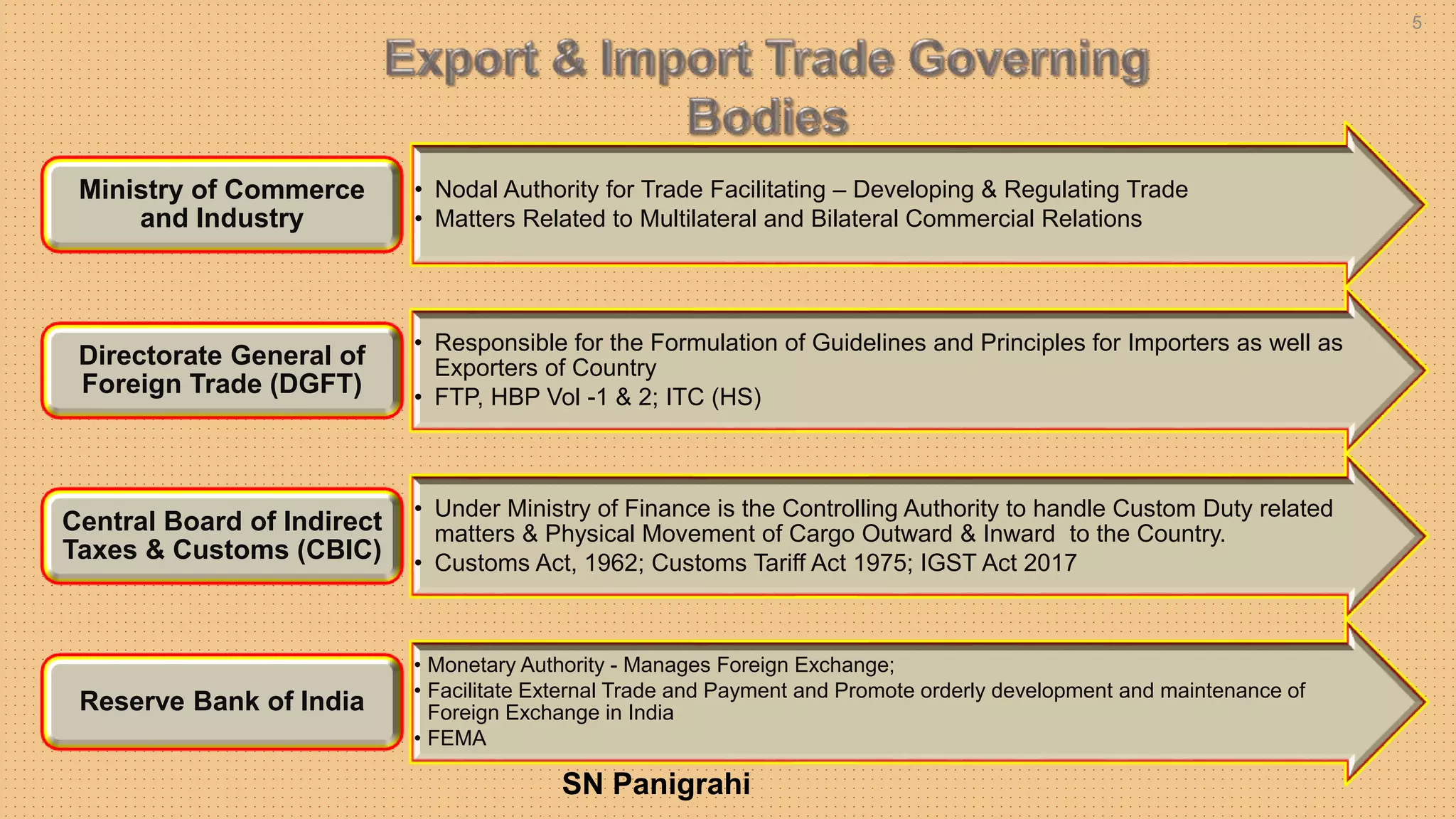
 Ministry of Commerce and Industry
 Directorate General of Foreign Trade (DGFT)
 Central Board of Indirect Taxes & Customs (CBIC)
 Reserve Bank of India (RBI)
Foreign Trade
Introduction To Regulatory Framework
SN Panigrahi
5
• Nodal Authority for Trade Facilitating – Developing & Regulating Trade
• Matters Related to Multilateral and Bilateral Commercial Relations
Ministry of Commerce
and Industry
• Responsible for the Formulation of Guidelines and Principles for Importers as well as
Exporters of Country
• FTP, HBP Vol -1 & 2; ITC (HS)
Directorate General of
Foreign Trade (DGFT)
• Under Ministry of Finance is the Controlling Authority to handle Custom Duty related
matters & Physical Movement of Cargo Outward & Inward to the Country.
• Customs Act, 1962; Customs Tariff Act 1975; IGST Act 2017
Central Board of Indirect
Taxes & Customs (CBIC)
• Monetary Authority - Manages Foreign Exchange;
• Facilitate External Trade and Payment and Promote orderly development and maintenance of
Foreign Exchange in India
• FEMA
Reserve Bank of India
SN Panigrahi
6
SN Panigrahi
7
International business operations at firm level are considerably influenced by various policy
measures employed to regulate trade, both by home and host countries. Exportability and
importability of a firm’s goods are often determined by trade policies of the countries involved. Price-
competitiveness of traded goods is affected by import and export tariffs.
The host country’s trade and FDI policies often influence entry decisions in international
markets. Policy incentives help exporters increase their profitability through foreign sales. High
import tariffs and other import restrictions distort free market forces guarding domestic industry
against foreign competition and support indigenous manufacturing.
Therefore, a thorough understanding of the country’s trade policy and incentives are crucial
to the development of a successful international business strategy.
Trade policy refers to the complete framework of laws, regulations, international
agreements, and negotiating stances adopted by a government to achieve legally binding
market access for domestic firms. It also seeks to develop rules providing predictability and
security for firms. To be effective, trade policy needs to be supported by domestic policies to foster
innovation and international competitiveness.
Besides, the trade policy should have flexibility and pragmatism.
SN Panigrahi
8
India’s foreign trade policy is formulated under the Foreign Trade (Development
and Regulation) Act, for a period of five years by the Ministry of Commerce,
Government of India.
The government is empowered to prohibit or restrict subject to conditions, export of
certain goods for reasons of national security, public order, morality, prevention of
smuggling, and safeguarding balance of payments.
Policy measures to promote international trade, such as schemes and incentives for
duty-free and concessional imports, augmenting export production, and other export
promotion measures are discussed in-depth.
The multilateral trading system under the WTO trade regime significantly
influences trade promotion measures and member countries need to integrate
their trade policies with the WTO framework. The WTO trade policy review mechanism
provides an institutional framework to review trade policies of member countries at
regular intervals.
SN Panigrahi
9
DGFT GST Customs Bank
ECGC
Shipping
Line / Air
Line
Port
ICD /
CFS
EPC CONCOR
Get license for benefit
under export
promotion scheme
Get Export Credit
Insurance
Get Export
Assistance
Inland
Transportation
Pay/Exempt
from GST
Payment
Get Credit/
Guarantees
Pay duties/ clear
immigration
Intermediate
Inland
Storage
Overseas
Shipment
Port Caro
Handling
Procedures
Exporter
SN Panigrahi
10
Organizations
Supporting to
Exporters
DGFT
EPCs
Commodity
Boards
FIEO
IIFT & IIP
ECGCEIC
Chambers of
Commerce
ITPO
BIS
DGCIS
SN Panigrahi
11
• Directorate General of Foreign Trade (DGFT) under Foreign Trade (Development and
Regulation) Act , 1992.
• DGFT Headquarter in Delhi and 35 Regional offices in the country with about 2400
employees.
DGFT
Organization
• Formulation of FTP & Import / Export controls;
• Export Promotion;
• Issuance & monitoring of Certificates / authorisation;
• Trade Facilitation AND Grievance Redressal AND RSCQC
• Enforcement
DGFT
Functions
• FOREIGN TRADE POLICY(FTP)
• HANDBOOK OF PROCEDURES
• VOLUME -I - Procedures; the Appendices & Aayat Niryat forms.
• VOLUME – II - SION (Standard Input Output Norms)
• •ITC (HS) CLASSIFICATION OF EXPORT AND IMPORT ITEMS
• All these Policy documents are available in DGFT website: dgft.gov.in
FTP
Documents
SN Panigrahi
Key Characteristics of India’s Foreign Trade
12
Key characteristics of developing countries’ trade include the following:
(i) Heavy Dependence Upon Developed Countries:
Developing countries’ trade is often dependent upon developed countries which form export destinations
for the majority of their goods.
(ii) Dominance of Primary Products:
Exports from developing countries traditionally comprised primary products, such as agricultural goods,
raw materials and fuels or labour-intensive manufactured goods, such as textiles.
(iii) Over-dependence on a Few Markets and a Few Products:
A large number of developing countries are dependent on just a few markets and products for their
exports.
(iv) Worsening Terms of Trade:
Distribution of gains from trade has always been disproportionate and therefore, a controversial issue.
Developing countries often complain of deterioration in their terms of trade, mainly due to high share of
primary products in their exports.
(v) Global Protectionism:
Developed countries often provide heavy subsidies to their farmers for agricultural production and shield
them from competition from imported products, besides imposing tariffs. Moreover, a number of non-
tariff barriers such as quality requirements, sanitary and phytosanitary measures, and environmental and
social issues, such as child labour offers considerable obstacles to products emanating from developing
countries.
SN Panigrahi
Trade Policy Strategic Options for International Trade
13
A country may adopt any of the following strategic options for its trade policy.
(i) Inward Looking Strategy (Import Substitution):
Emphasis is laid on extensive use of trade barriers to protect domestic industries
from import competition under the import-substitution strategy. Domestic
production is encouraged so as to achieve self-sufficiency and imports are
discouraged.
(ii) Outward Looking Strategy (Export-led Growth):
Under the outward looking strategy, the domestic economy is linked to the world
economy, promoting economic growth through exports. The strategy involves
incentives to promote exports rather than restrictions to imports.
SN Panigrahi
14
Goals and Objectives
The FTP for 2015-2020 seeks to achieve the following objectives:
(i) To provide a stable and sustainable policy environment for growth of foreign
trade in merchandise and services and creation of employment;
(ii) To link rules, procedures and incentives for exports and imports with other
initiatives such as ‘Make in India’, ‘Digital India’, ‘Skills India’, ‘Startup India’ and
‘Swachh Bharat’ to create an ‘Export Promotion Mission’ for India;
(iii) To promote the diversification of India’s export basket by helping various
sectors of the Indian economy to gain global competitiveness;
(iv) To create an architecture for India’s global trade engagement with a view to
expanding its markets and better integrating into major regions, thereby increasing
the demand for India’s products and contributing to the government’s flagship
‘Make in India’ initiative;
(v) To provide a mechanism for regular appraisal in order to rationalize imports and
reduce the trade imbalance.
SN Panigrahi
15
Focus of the FTP
The Foreign Trade Policy is primarily focused on accelerating exports.
To make the Export Promotion schemes more focused and
effective.
Exporting more Value-Added Goods
Foreign Trade Policy 2015-20 and other schemes provide promotional
measures to boost India’s exports with the objective to offset
infrastructural inefficiencies and associated costs involved to provide
exporters a level playing field.
Directorate General of Foreign Trade (DGFT) issues various types of
scrips/ authorizations under different export promotion schemes through
its Regional Authorities (RAs) across the country.
SN Panigrahi
16
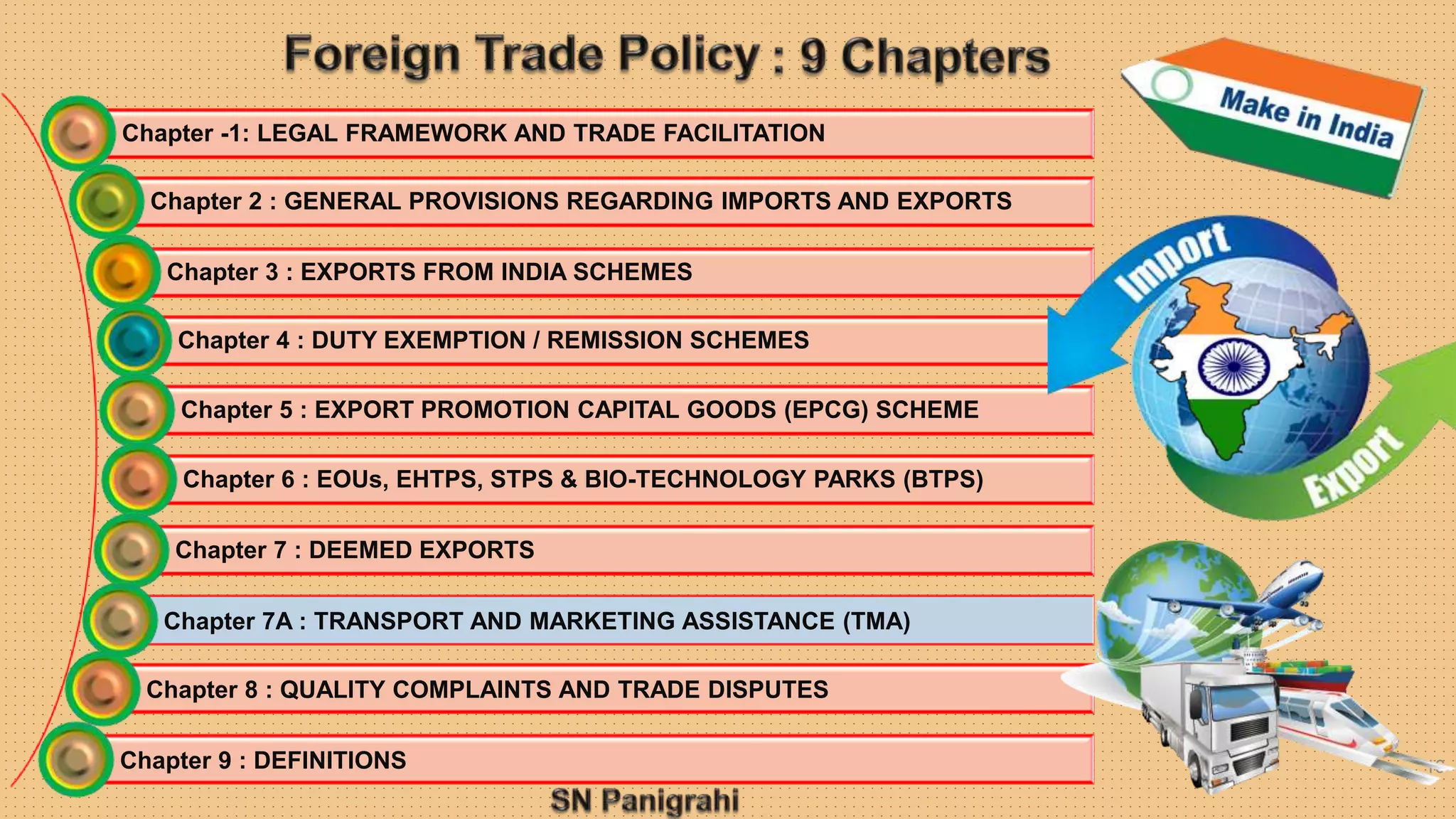
Chapter -1: LEGAL FRAMEWORK AND TRADE FACILITATION
Chapter 2 : GENERAL PROVISIONS REGARDING IMPORTS AND EXPORTS
Chapter 3 : EXPORTS FROM INDIA SCHEMES
Chapter 4 : DUTY EXEMPTION / REMISSION SCHEMES
Chapter 5 : EXPORT PROMOTION CAPITAL GOODS (EPCG) SCHEME
Chapter 6 : EOUs, EHTPS, STPS & BIO-TECHNOLOGY PARKS (BTPS)
Chapter 7 : DEEMED EXPORTS
Chapter 8 : QUALITY COMPLAINTS AND TRADE DISPUTES
Chapter 9 : DEFINITIONS
Chapter 7A : TRANSPORT AND MARKETING ASSISTANCE (TMA)
17
18
Para 1.06 of FTP
Objective
Trade facilitation is a priority of the Government for cutting down the transaction cost and time,
thereby rendering Indian exports more competitive. The various provisions of FTP and
measures taken by the Government in the direction of trade facilitation are consolidated under this
chapter for the benefit of stakeholders of import and export trade.
1.07 DGFT as a facilitator of exports/imports
DGFT has a commitment to function as a facilitator of exports and imports.
Focus is on good governance, which depends on efficient, transparent and accountable delivery
systems.
In order to facilitate international trade, DGFT consults various Export Promotion Councils as well as
Trade and Industry bodies from time to time.
SN Panigrahi
19
Para 1.08 of FTP
Niryat Bandhu - Hand Holding Scheme for new export / import Entrepreneurs
(a) DGFT is implementing the Niryat Bandhu Scheme for mentoring new and potential exporter on the
intricacies of foreign trade through counselling, training and outreach programmes.
(b) Considering the strategic significance of small and medium scale enterprises in the manufacturing sector
and in employment generation, ‘MSME clusters’ have been identified, based on the export potential of the
product and the density of industries in the cluster, for focussed interventions to boost exports.
(c) Outreach activities shall be organized in a structured way with the help of Export Promotion Councils as
‘industry partners’ and other willing ‘knowledge partners’ in academia and research community to achieve
the objective of Niryat Bandhu Scheme. Further, in order to ensure optimum utilization of resources, efforts
would be made to associate all the stakeholders, including Customs, ECGC, Banks and concerned
Ministries.
1.09 Citizen’s Charter
DGFT has in place a Citizen’s Charter, giving time schedules for providing various services to clients. Time
line for disposal of an Application is given in Para 9.10 of HBP.
SN Panigrahi
20
Para 1.10 of FTP
Online Complaint Registration and Monitoring System
An EDI Help Desk is available to assist the exporters in filing online applications on the DGFT portal
and resolving other EDI related issues.
For assistance an email may be sent at dgftedi@nic.in or Toll Free number 1800111550 can be used.
Help Desk facility is also operational at the DGFT Zonal Offices (details at http://dgft.gov.in).
An Online Complaint registration and monitoring system allows users to register complaint and
receive status/ reply online (details are at http://dgft.gov.in).
SN Panigrahi
21
Para 1.11 of FTP
Issue of e-IEC (Electronic-Importer Exporter Code)
(a) Importer Exporter Code (IEC) is mandatory for export/import from/to India as detailed in paragraph
2.05 of this Policy. DGFT issues Importer Exporter Code in electronic form (e-IEC). For issuance of
e-IEC an application can be made on DGFT (http//:dgft.gov.in). Applicant can upload the documents
and pay the requisite fee through Net banking. Applicant shall, however, submit the application duly
signed digitally.
(b) Processing of such applications by Regional Authority (RAs) of DGFT would be done online and a
digitally signed e-IEC would normally be issued/ e-mailed to the applicant within 2 working
days.
(c) In case the application is incomplete or otherwise ineligible, the same shall be rejected and a
Rejection letter/email (with reasons for rejection) would be sent to the applicant.
(d) Application for issue of e-IEC can also be made from eBiz platform (https://www.ebiz.gov.in)
SN Panigrahi
22
Para 1.12 of FTP
e-BRC
(a) One prominent initiative in recent times has been the e-BRC (Electronic Bank Realisation
Certificate) project and its successful implementation by DGFT. It has enabled DGFT to
capture details of realisation of export proceeds directly from the Banks through secured
electronic mode. This has facilitated the implementation of various export promotion
schemes without any physical interface with the stake holders.
(b) RBI has also developed a comprehensive IT-based system called Export Data Processing
and Monitoring System (EDPMS) for monitoring of export of goods and software and
facilitating AD banks to report various returns through a single platform.
SN Panigrahi
23
Para 1.15 of FTP
Reduction in mandatory documents required for Export and Import
The number of mandatory documents required for exports and imports of goods from/into India
have been reduced to three each, as prescribed under paragraph 2.06 of FTP.
SN Panigrahi
24
MANDATORY DOCUMENTS FOR EXPORT & IMPORT
S. No. EXPORTS IMPORTS
1 Bill of Lading/ Airway Bill Bill of Lading/ Airway Bill
2 Commercial Invoice cum Packing List Commercial Invoice cum Packing List
3 Shipping Bill/ Bill of Export Bill of Entry
MANDATORY DOCUMENTS LISTED BY WORLD BANK IN DOING BUSINESS REPORT 2015
S. No. EXPORTS IMPORTS
1 Shipping Bill Bill of Entry
2 Commercial Invoice Commercial invoice
3 Packing List Packing List
4 Bill of Lading Bill of Lading
5 Foreign Exchange Control Form (SDF) Foreign Exchange Control Form (Form A-1)
6 Terminal Handling Receipt Terminal Handling Receipt
7 Technical Standard Certificate Certified Engineer's
Report
8 Cargo Release Order
9 Product manual
10 Inspection report
DGFT NOTIFICATION No.08/2015-2020 Dated 4 th June, 2015
SN Panigrahi
25
1.16 Facility of online filing of applications
All the Regional Authorities (RA) of DGFT and extension counters have been networked with high
speed internet. The applications are received and processed electronically. DGFT under the EDI
initiatives has provided the facility of on line filing of applications to obtain Importer Exporter Code and
various Authorisations /scrip’s. DGFT is one of the first digital signature enabled organisation of the
Government of India (GOI), which has introduced a higher level of Encrypted 2048bit digital signature.
There is a web interface for online filing of application after accessing DGFT website
(http://dgft.gov.in). The application can be filed by exporter/CHA sitting at home or office in 24X7
environments. Application fee can also be paid online from linked banks or by using debit/credit card.
The applications are signed with a digital signature and submitted electronically to the concerned
Regional Authority of DGFT, which are then processed on computer by the Regional Authority and
Authorisations/ scrip’s are issued.
Online filing of Application has minimized the physical interface with RA.
SN Panigrahi
26
Para 1.18 of FTP
Facility to upload documents by CA/ CS / Cost Accountant In order to move towards paperless
processing, an electronic procedure is being developed to upload digitally signed documents by
Chartered Accountant / Company Secretary / Cost Accountant.
To start with, this facility would be created for Export From India Schemes under Chapter 3.
Such documents like Annexure Attached to ANF 3B, ANF 3C and ANF 3D, which are at present
signed by these signatories, can be facilitated by this procedure.
Exporter shall link digitally uploaded annexure with his online applications after creation of such
facility.
These facilities may be extended in phased manner to upload documents pertaining to other
schemes like Advance Authorisation, DFIA and EPCG.
SN Panigrahi
27
Para 1.19 of FTP
Electronic Data Interchange (EDI)
DGFT has put in place a robust EDI system for the purpose of export facilitation and good
governance. DGFT has set up a secured EDI message exchange system for various
documentation related activities including import and export Authorisations established with
other administrative departments, namely, Customs, Banks and EPCs.
This has reduced the physical interface of exporters and importers with the Government
Departments and is a significant measure in the direction of reduction of transaction cost.
The endeavour of DGFT has been to enlarge the scope of EDI to achieve higher level of
integration with partner departments.
SN Panigrahi
28
Para 1.22 of FTP
Forthcoming e-Governance Initiatives
DGFT is currently working on the following EDI initiatives:
(i) Message exchange for transmission of Bills of Entry (import details) from Customs to
DGFT.
(ii) Online issuance of Export Obligation Discharge Certificate (EODC).
(iii) Message exchange with Ministry of Corporate Affairs for CIN & DIN Information.
(iv) Message exchange with CBDT for PAN.
(v) Open API for submission of e-IEC Application.
(vi) Mobile Applications for FTP.
SN Panigrahi
29
Para 1.25 of FTP
24 X 7 Customs clearance
CBEC introduced the facility of 24 X 7 customs clearance in the year 2012 for facilitated Bills of Entry
and factory stuffed container and goods exported under free Shipping Bills. At present, this facility is
available at 19 sea port and 17 air cargo complexes.
The 24 X 7 Customs clearance facility has now been extended to all Bills of Entry (not only facilitated
Bills of Entry) at 19 sea port and 17 Air Cargo Complexes.
Further, no MOT (Merchant Over Time) charges are required to be collected in respect of the services
provided by the Customs officers at 24 X 7 Customs Ports and Airports.
SN Panigrahi
30
1.26 Single Window in Customs
Indian Customs has introduced SWIFT (Single Window Interface for Facilitating trade) w.e.f.
01.04.2016 for ensuring ease of doing business.
Under SWIFT, the Importers electronically lodge Integrated Declaration at a single point only with
Customs. The required permission, if any, from other regulatory agencies (such as Animal
quarantine, Plant quarantine, Drug Controller, Textile Committee etc.) is obtained online without
the importer/exporter having to separately approach these agencies. Benefits of Single Window
Scheme include:
a. Reduced Cost of doing business;
b. Enhanced transparency;
c. Reduced duplicity and cost of compliance;
d. Optimal utilization of man power.
SN Panigrahi
31
Para 1.27 of FTP
Self-Assessment of Customs Duty
(a) Self-Assessment of Customs duty by importers or exporters was introduced vide Finance Act,
2011. The system is trust based.
The objective is to expedite release of imported / export goods. The system operates on an electronic
Risk Management System (RMS)
(b) The Finance Act, 2017 has amended Section 47 of the Customs Act, 1962 to Authorize an importer
to pay duty /tax/ cess on the date of presentation of self-assessed Bill of Entry.
SN Panigrahi
32
Discontinuing submission of physical copy of RCMCs with effect from 1.7.2019 while filing
application for incentives / entitlements under FTP
DGFT TRADE NOTICE NO. 12/2019-20; 13th May, 2019
A copy of the RCMC is a requirement for filing any application to DGFT offices for obtaining
incentives/entitlements under FTP, 2015-20.Till now applicants have been submitting the physical copy of the
ECMC with the application. In order to improve ease of doing business and reduce transaction cost it has been
decided to discontinue the requirement of submission of physical copy of the RCMC with effect from 1.7.2019.
The validity of RCMCs will be checked directly from the DGFT’s data base which has the uploaded data of
RCMCs from EPCs.
2. DGFT had already issued instructions vide Trade Notice No 37/dated 02.11.2018 requesting all EPCS to
upload the old valid and new RCMCS of all the exporters registered with them. As on 31 April, 2019, 32,060
valid RCMCs are available on DGFT’s data base. A statement of EPC-wise number of valid RCMCs is attached.
All exporters are advised to ensure that their valid RCMCs are duly uploaded by their respective EPCS in the
DGFT server. All EPCS are requested to ensure that their latest data regarding RCMCs is uploaded in the
DGFT server urgently and also on a regular basis so that exporters are not put to any disadvantages in availing
incentives/entitlements.
SN Panigrahi
33
Para 1.28 of FTP
Authorised Economic Operator (AEO) Programme
(a) Based upon WCO’s SAFE Framework of Standards (FoS), ‘Authorised Economic Operator
(AEO) programme’ has been developed by Indian Customs to enable business involved in the
international trade to reap the following benefits:
(i) Secure supply chain from point of export to import;
(ii) Ability to demonstrate compliance with security standards
when contracting to supply overseas importers / exporters;
(iii) Enhanced border clearance privileges in Mutual Recognition
Agreement (MRA) partner countries;
(iv) Minimal disruption to flow of cargo after a security related
disruption;
(v) Reduction in dwell time and related costs; and
(vi) Customs advice / assistance if trade faces unexpected issues
with Customs of countries with which India have MRA.
SN Panigrahi
34
In order to improve ease of doing business and reduce transaction cost, vide Trade Notice No.12 dated
13.05.2019, requirement of physical copy of RCMC has been dispensed with from 1.07.2019 and it was
decided that the validity of RCMCs will be checked directly from the DGFT’s database as uploaded and
updated from time to time by various EPCs. DGFT has already provided the facility for exporters to check
status of uploading of their RCMCs by their respective EPCs on DGFT’s website which may be assessed
at dgft.delhi.nic.in:8100/RCMCproj/rcmcCheck_input.isp.
2. Further, many times questions arise with regard to appropriateness of EPCs issuing RCMCs under para
2.56 of FTP read with 2.94 of HBP. In this regard, it is clarified that:
(i) An entity requires only one RCMC from its relevant EPC as per Appendix-2T. It can keep on adding
any number of businesses afterwards and RCMCs from other EPCs will be optional only.
(ii) If an entity, having RCMC for goods from a particular EPC/FIEO, exports services subsequently,
there is no need to obtain second RCMC from SEPC(membership with SEPC in such a case is merely
optional).
An entity requires only one RCMC from its relevant EPC
Trade Notice No. 17/2019-20; Dated 22nd May, 2019
SN Panigrahi
35
(b) The AEO programmes have been implemented by other Customs administrations that give AEO status
holders preferential Customs treatment in terms of reduced examination, faster clearances and
other benefits.
Thus, the AEO programme is expected to result in Mutual Recognition Agreements (MRA) with these
Customs administrations. MRAs would ensure export goods get due Customs facilitation at the point of entry
in the foreign country. Apart from securing supply chain, the benefits include reduction in dwell time and
consequent cost of doing business.
Indian Customs has signed MRA with Hong Kong Customs to recognise respective AEO Programmes to
enable trade to get benefits on reciprocal basis.
Indian Customs is also engaged in finalising MRA with other counties such as South Korea, Taiwan, USA
etc.
(c) As a step further towards trust based compliance, Indian Customs has introduced the new/revamped
Authorised Economic Operator (AEO) Programme wherein extensive benefits, including greater facilitation
and self-certification, have been provided to those entities who have demonstrated internal strong control
system and compliance with CBEC.
Cont………
SN Panigrahi
36
Discontinuation of Physical Copy of Advance /
EPCG Authorisations issued from 01.03.2019 onwards, for EDI ports
Policy Circular No. 19/2015-2020; Dated: 14th Februar y 20 1 9
In order to imp rove ease of doing business and improving online transact ions , it has been decided to discontinue issue
of physical copy of Advance/EPCG Authorisations issued on or after 01.03.2019 by Regional Authorities, in
respect of EDI ports
2. Applicants will continue to apply for Advance / EPCG Authorisations as per current practice on DGFT
website (www.dgft.gov.in).
Regional Authorities will not issue any hard copy of authorisation to the applicants.
Instead, in case of approval by the RA the applicant will get the following message on the Mobile and email
address (as fil1ed in the eCommunication for eAuthorisation window) that,
''Authori sahon No ..........dated ... ... ......has been issued against RA File No... ... ... ... ... .....No Authorisation on security
paper is required to be issued. You can prinll view Authorisalion detail s online. ··
SN Panigrahi
37
SN Panigrahi
38
Para 2.01 FTP
Exports and Imports – ‘Free’, unless regulated
(a) Exports and Imports shall be ‘Free’ except when regulated by way of ‘prohibition’, ‘restriction’ or
‘exclusive trading through State Trading Enterprises (STEs)’ as laid down in Indian Trade
Classification (Harmonized System) [ITC (HS)] of Exports and Imports. The list of ‘Prohibited’,
‘Restricted’, and STE items can be viewed by clicking on ‘Downloads’ at http://dgft.gov.in
(b) Further, there are some items which are ‘free’ for import/export, but subject to conditions
stipulated in other Acts or in law for the time being in force.
(c) The import/export policies for all goods are indicated against each item in ITC (HS).Schedule 1 of
ITC (HS) lays down the Import Policy regime while Schedule 2 of ITC (HS) details the Export Policy
regime.
(d) Except where it is clearly specified, Schedule 1 of ITC (HS), Import Policy is for new goods and
not for t h e Second Hand goods. For Second Hand goods, the Import Policy regime is given in Para
2.31 in this FTP.
SN Panigrahi
39
Para 2.02 of FTP
Indian Trade Classification (Harmonised System) [ITC (HS)] of Exports and Imports.
(a) ITC (HS) is a compilation of codes for all merchandise / goods for export/ import. Goods are classified
based on their group or sub-group at 2/4/6/8 digits.
(b) ITC (HS) is aligned at 6 digit level with international Harmonized System goods nomenclature maintained
by World Customs Organization (http://www.wcoomd.org).
However, India maintains national Harmonized System of goods at 8 digit level which may be viewed by
clicking on ‘Downloads’ at http://dgft.gov.in
SN Panigrahi
40
ITC-HS Codes
Schedules
Schedule – I
ITC(HS) Import
Schedule – II
ITC(HS) Export
Divided into 21 Sections and each section is
further divided into chapters. The Total 98
Number of Chapters in the schedule I
Contain 97 Chapters giving all the details about
the guidelines related to the export policies.
ITC-HS Codes or better known as Indian Trade Clarification based on Harmonized System of Coding was
adopted in India for import-export operations. Indian custom uses an eight digit ITC-HS Codes
SN Panigrahi
41
The item wise export and import policy shall be, as specified in ITC(HS) published and notified by
Director General of Foreign Trade which Specifies Conditions according to which any goods are
allowed for Export or Import.
Schedule 1 of ITC (HS) Provides for Import and
Schedule 2 of ITC (HS) Provides for Export
• These Items can’t
be Exported /
Imported at all.
• Allowed only through
Designated State
Trading Enterprises
like STC; MMTC
• Must get
Authorization
Explicitly
Permitting such
Goods
• No Permission
Required
Freely
Allowed
Restricted
Items
Prohibited
Items
Channelized
Items
ITC
(HS)
SN Panigrahi
42
Para 2.05 of FTP
Importer-Exporter Code (IEC)
(I) An IEC is a 10-character alpha-numeric number allotted to a person that is mandatory for
undertaking any export/import activities.
With a view to maintain the unique identity of an entity (firm/company/LLP etc.), consequent upon
introduction / implementation of GST, IEC will be equal to PAN and will be separately issued by
DGFT based on an application.
New Procedure for online IEC application/modification has been introduced vide Trade Notice No
23/2018-19 New Delhi, Dated the 8 th August,2018
Detailed guidelines for applying for e-IEC is available at
http://dgft.gov.in/exim/2000/iec_anf/iecanf.htm
No export or import shall be made by any person without obtaining an IEC number unless
specifically exempted.
SN Panigrahi
43
Export promotional Councils (EPC) are authorities which are basically promoting, supporting
and assisting firms in entering the International markets and realising their optimum
potential from given resources. They also provide guidance and assistance to the exporters.
In legal terms, export promotional councils are Govt-Controlled non-profit organisation
registered as a company or society. Each Export promotional council is responsible for his
particular group of products and can use a wide array of tools to facilitate trade.
Para 2.55 of FTP : Recognition of EPCs to function as Registering Authority for issue of RCMC
(a) Export Promotion Councils (EPCs) are organizations of exporters, set up with the objective to
promote and develop Indian exports. Each Council is responsible for promotion of a particular
group of products/ projects/services as given in Appendix 2T of AANF.
(b) EPCs are also eligible to function as Registering Authorities to issue Registration-cum-
Membership Certificate (RCMC) to its members. The criteria for EPCs to be recognized as
Registering Authorities for issue of RCMC to its members are detailed in Para 2.92 of the Handbook
of Procedures.
SN Panigrahi
44
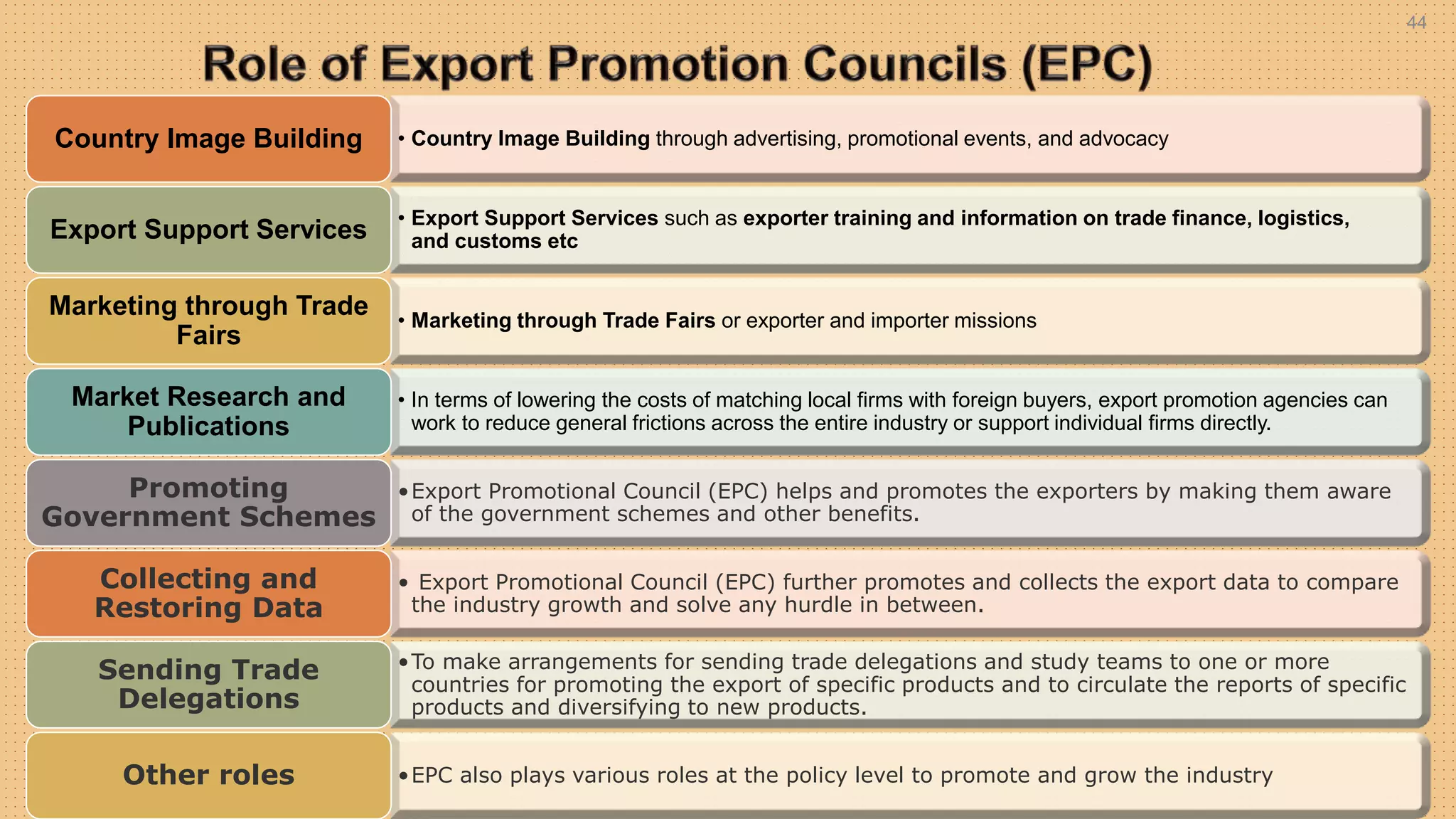
• Country Image Building through advertising, promotional events, and advocacyCountry Image Building
• Export Support Services such as exporter training and information on trade finance, logistics,
and customs etcExport Support Services
• Marketing through Trade Fairs or exporter and importer missions
Marketing through Trade
Fairs
• In terms of lowering the costs of matching local firms with foreign buyers, export promotion agencies can
work to reduce general frictions across the entire industry or support individual firms directly.
Market Research and
Publications
•Export Promotional Council (EPC) helps and promotes the exporters by making them aware
of the government schemes and other benefits.
Promoting
Government Schemes
• Export Promotional Council (EPC) further promotes and collects the export data to compare
the industry growth and solve any hurdle in between.
Collecting and
Restoring Data
•To make arrangements for sending trade delegations and study teams to one or more
countries for promoting the export of specific products and to circulate the reports of specific
products and diversifying to new products.
Sending Trade
Delegations
•EPC also plays various roles at the policy level to promote and grow the industryOther roles
45
WHY EXPORT PROMOTIONAL COUNCILS ARE USEFUL FOR FIRST TIME EXPORTER
As per the Foreign trade policy of India, any person who either wants to acquire any license
to import export restricted or other similar categories of goods or to avail any export related
benefit or scheme is liable to register for Registration Cum Membership Certificate (RCMC).
Export promotional councils provide various benefits to the registered exporters. And hence
plays a significant role for any exporter in India.
HOW TO REGISTER WITH EXPORT PROMOTIONAL COUNCILS
The export promotional councils promote a specific set of the product. Hence, the exporter
should register under the concerned Export Promotional Councils as per their line of
products.
E.g. if you are an exporter of coconut, then you should register under Coconut Board of
India.
SN Panigrahi
46
Para 2.56 of FTP : Registration-cum-Membership Certificate (RCMC)
Any person, applying for:
(a) An Authorisation to import/export (except items) listed as ‘Restricted’ items in ITC (HS)
Or
(b) Any other benefit or concession under FTP shall be required to furnish or upload on DGFT’s website
in the Importer Exporter Profile, the RCMC granted by competent authority in accordance with
Procedures specified in Handbook of Procedures unless specifically exempted under FTP.
Certificate of Registration as Exporter of Spices (CRES) issued by Spices Board and Certificate of
Registration as Exporter of coir & coir products issued by the Coir Board shall be treated as Registration-
Cum-Membership Certificate (RCMC) for the purposes under this Policy.
SN Panigrahi
47
APPENDIX-2 T of HB
Provides
LIST OF EXPORT PROMOTION
COUNCILS/COMMODITY BOARDS/EXPORT
DEVELOPMENT
AUTHORITIES
SN Panigrahi
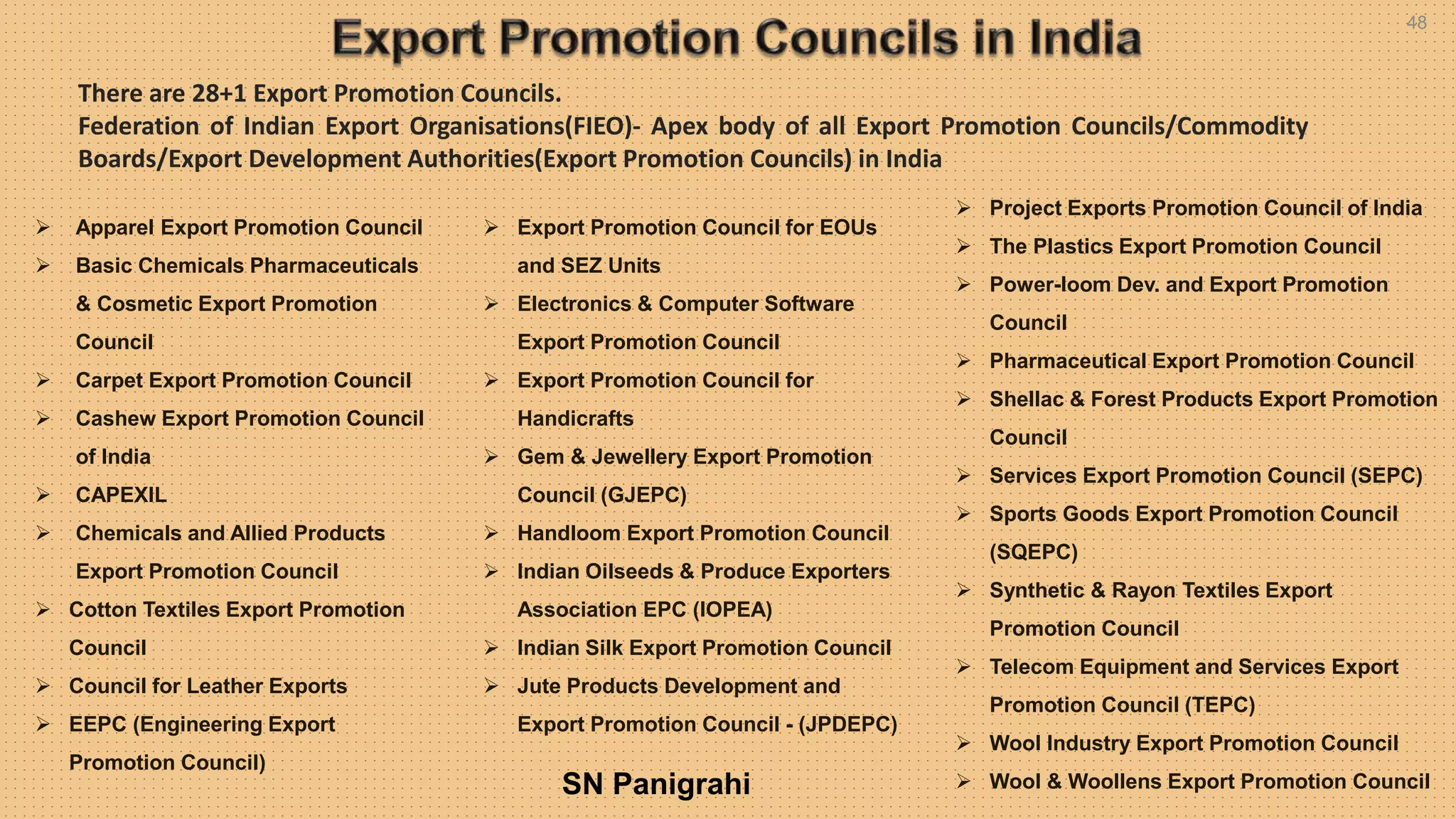
48
 Apparel Export Promotion Council
 Basic Chemicals Pharmaceuticals
& Cosmetic Export Promotion
Council
 Carpet Export Promotion Council
 Cashew Export Promotion Council
of India
 CAPEXIL
 Chemicals and Allied Products
Export Promotion Council
 Cotton Textiles Export Promotion
Council
 Council for Leather Exports
 EEPC (Engineering Export
Promotion Council)
There are 28+1 Export Promotion Councils.
Federation of Indian Export Organisations(FIEO)- Apex body of all Export Promotion Councils/Commodity
Boards/Export Development Authorities(Export Promotion Councils) in India
 Project Exports Promotion Council of India
 The Plastics Export Promotion Council
 Power-loom Dev. and Export Promotion
Council
 Pharmaceutical Export Promotion Council
 Shellac & Forest Products Export Promotion
Council
 Services Export Promotion Council (SEPC)
 Sports Goods Export Promotion Council
(SQEPC)
 Synthetic & Rayon Textiles Export
Promotion Council
 Telecom Equipment and Services Export
Promotion Council (TEPC)
 Wool Industry Export Promotion Council
 Wool & Woollens Export Promotion Council
 Export Promotion Council for EOUs
and SEZ Units
 Electronics & Computer Software
Export Promotion Council
 Export Promotion Council for
Handicrafts
 Gem & Jewellery Export Promotion
Council (GJEPC)
 Handloom Export Promotion Council
 Indian Oilseeds & Produce Exporters
Association EPC (IOPEA)
 Indian Silk Export Promotion Council
 Jute Products Development and
Export Promotion Council - (JPDEPC)
SN Panigrahi
49
 Agricultural and Processed Food Products Export Development Authority (APEDA)
 Marine Products Export Development Authority (MPEDA)
 Rubber Board
 Coffee Board
 Coir Board
 Tea Board
 Tobacco Board Coconut Development Board
There are 7 Commodity Boards / Development Authorities
SN Panigrahi
50
Export Promotion Council Established for MSME Sector
SN Panigrahi
51
Press Information Bureau
Government of India
Ministry of Micro,Small & Medium Enterprises
31-December-2018 14:56 IST
Export Promotion Council Established for MSME Sector
Ministry of Micro, Small and Medium Enterprises (MSME) has recently established an Export
Promotion Cell with an aim to create a sustainable ecosystem for entire MSME development.The
benefits likely to accrue to the MSMEs are:
i. Evaluate readiness of MSMEs to export their products and services
ii. Recognize areas where improvements are required in order to be able to export effectively
and efficiently
iii. Integration of MSME into global value chain. This was stated by Minister of State
(Independent Charge) for Micro, Small and Medium Enterprises,Giriraj Singh in theLok Sabha
today, while replying to a question.
SN Panigrahi
52
The MSME Minister further said that the current status of exports from the MSME sector as per
the information received from Directorate General of Commercial Intelligence and Statistics
(DGCIS), the value of MSME related products is USD 147,390.08 million and share of MSME
related products in the country’s exports was 48.56% during 2017-18.
To ensure efficient and effective delivery of all MSME export related interventions, the Ministry
proposed to formulate a governing council that will be chaired by Secretary, M/o MSME and
Co-chaired by Development Commissioner, M/o MSME. The council will comprise of senior
officials and members from M/o MSME, Commerce, MSME Export Promotion Councils, Export
Development Authorities, Commodity Boards, and other bodies.
An action plan is also proposed to be put in place to achieve the following objectives:
•Target of USD 100 billion of exports from India by 2020
•Evaluate readiness of MSMEs to export their products and services
•Recognize areas where improvements are required in order to be able to export
effectively and efficiently
•Integration of MSMEs into Global Value Chain.
SN Panigrahi
53
Foreign Trade Policy (FTP) notified by the Director General of Foreign Trade (‘DGFT’) from
time to time, prescribes various incentives and measures to promote export of goods and
services from India. Some of the popular incentive schemes relating to exports are:
•Merchandise Exports from India Scheme (‘MEIS’/’SEIS’);
•Export Promotion Capital Goods Scheme (‘EPCG’);
•Advance Authorization Scheme (‘AA’) ; and
•Duty Drawback Scheme
Manufacturer/Service exporters are eligible to avail the benefit of the above schemes. While
MEIS scheme is intended to cut down the transaction costs for exports, EPCG and AA
scheme are designed to enable manufacturer exporters to import capital goods and raw
material without payment of customs duties.
SN Panigrahi
SN Panigrahi 54
SN Panigrahi
55
Merchandise Exports from India Scheme (‘MEIS’/’SEIS’):
•This scheme has been announced under the New Foreign Trade Policy 2015-2020 and is
applicable for notified goods exported to notified markets on or after 1 April 2015.
•Rewards for export of notified goods to most of the countries is payable as percentage of
realized FOB value.
•Incentive ranges from 2% to 7% of the FOB value of the goods exported.
•The incentive is given in the form of duty credit scrip which can be used for payment of
customs duty or can be transferred to other importers.
Export Promotion Capital Goods Scheme (‘EPCG’):
Under EPCG Scheme, duty free import of capital goods which are required for manufacture of
the export products is allowed.
The exporter is obligated to export the goods of an amount equal to 6 times of the amount of
duty saved.
The said goods should be manufactured using the same capital goods which have been
imported under EPCG scheme.
The export obligation is required to be fulfilled in 6 years.
Basic customs duty, social welfare cess and IGST is exempted under EPCG scheme.
SN Panigrahi
56
Advance Authorization Scheme (‘AA’):
•Under AA Scheme, duty free import of raw materials and inputs which are required for manufacture of export products is
allowed.
•Only those inputs/ raw material are allowed to be imported under AA scheme which will be actually consumed within the
process of manufacture.
•The exporter is obligated to manufacture and export the finished products using the inputs/ raw materials imported duty
free under AA scheme.
•Basic customs duty, social welfare cess and IGST is exempted under AA scheme.
Duty Drawback Scheme:
Duty Drawback is a relief by way of refund of custom and excise duties paid on inputs or raw materials used in the
manufacture of export goods. To entitle goods to drawback, they must be exported to a foreign port. Duty drawback
provisions are given under section 74 and 75 of the Customs Act. Section 74 allows duty drawback on re-export of duty
paid goods. Section 75 allows drawback on imported goods used in the manufacture of export goods.
The Duty Drawback is of two types: (i) All Industry Rate (AIR) and (ii) Brand Rate.
The All Industry Rate (AIR) of Duty Drawback is generally fixed as a percentage of FOB price of export products.
Where the export product has not been notified in All Industry Rate (AIR) of Duty Drawback or where the exporter
considers the All Industry Rate (AIR) of Duty Drawback insufficient to fully neutralize the duties suffered by his export
product, he may opt for the Brand Rate of Duty Drawback.
Drawback is not allowed when the assessee opts for Advance Authorisation Scheme. Therefore, it is advisable to analyse
beneficial options before choosing any particular option.
57
Objective : The objective of MEIS is to offset infrastructural inefficiencies and associated
costs involved in export of goods/products, which are produced/ manufactured in India,
especially those having high export intensity, employment potential and thereby
enhancing India’s export competitiveness.
Similarly, the objective of SEIS is to encourage export of notified Services from India.
To provide rewards to exporters to offset infrastructural inefficiencies and associated costs
SN Panigrahi
EXPORTS FROM
INDIA SCHEMES
Merchandise Exports
from India Scheme
(MEIS)
Service Exports
from India Scheme
(SEIS)
Duty Scrips are issued for
Value ranging from 2-7% of
FOB Value of Exports as per
Para 3.02 of FTP.
The Duty Credit Scrips &
Goods imported under the
Scrips are Freely
Transferable.
For Notified Goods /
Products X Markets
APPENDIX -3B of HB
For Notified
Services
APPENDIX- 3D of HB
SN Panigrahi
59
MEIS
The MEIS Entitlement would be 2% / 3% / 5% / 7% of FOB
value of notified goods exported to notified markets [based on
three distinct categories framed and covered in Appendix 3B]
in free foreign exchange or FOB value of exports as given in
the Shipping Bills in free foreign exchange, whichever is less.
Country Groups
Category A: Traditional Markets (30) - European Union (28),
USA, Canada.
Category B - Emerging & Focus Markets (139), Africa (55),
Latin America and Mexico (45), CIS countries (12),Turkey and
West Asian countries (13), ASEAN countries (10), Japan,
South Korea, China, Taiwan and
Category C: Other Markets (70).
Appendix 3B]
SN Panigrahi
60
Ineligible categories under MEIS
Para 3.06 of FTP
The following exports categories /sectors shall be ineligible for Duty Credit
Scrip entitlement under MEIS
(i) Supplies made from DTA units to SEZ units
(ii) Export of imported goods covered under paragraph 2.46 of FTP;
(iii) Exports through trans-shipment, meaning thereby exports that are
originating in third country but trans-shipped through India;
(iv) Deemed Exports;
(v) SEZ/ EOU /EHTP/ BTP /FTWZ products exported through DTA units;
(vi) Export products which are subject to Minimum export price or
export duty.
(vii) Exports made by units in FTWZ.
SN Panigrahi
61
Policy Circular No. 20/2015-2020;
Dated: 22nd February, 2019
Subject: Clarification on eligibility of Exports made from SEZ/EOU units on behalf of the DTA units, but not
through DTA units
This Directorate has received references from exporters seeking clarification on eligibility of Exports made
from SEZ/EOU units on behalf of DTA units under the Merchandise Exports from India Scheme (MEIS) , in
the context of the Para 3.06 – ineligible categories of MEIS , sub para (v) , which states that SEZ/ EOU
/EHTP/ BTP /FTWZ products exported through DTA units are ineligible for MEIS rewards.
2. The matter has been examined in this Directorate. It is clarified that the exports which are made/have been
made directly from a EOU/ SEZ unit to Foreign consumer in which export documents are prepared and filed at
the customs office of concerned SEZ/EOU Unit, mentioning the name of the EOU/SEZ unit along with the
name of the DTA unit on whose behalf the exports is made, would be eligible for MEIS benefits subject to
condition that only one of the said units i.e. either EOU/SEZ unit or the DTA unit can claim the benefits under
MEIS. It is further clarified that the eligibility as above, is applicable to only those cases where goods are
produced by the EOU/SEZ unit and are exported directly to the foreign consumer, with the name of the DTA .
SN Panigrahi
62
Policy Circular No. 20/2015-2020;
Dated: 22nd February, 2019
Subject: Clarification on eligibility of Exports made from SEZ/EOU units on behalf of the DTA units, but not
through DTA units
3. It is further clarified that the MEIS benefits may be taken by the SEZ/ EOU or DTA and not both, on the
basis of disclaimer from the other firm, subject to fulfillment of each of the criterion as below for every shipping
bill for which claim is made under MEIS.
i. The Commercial Invoice shows the name of the DTA exporter and shows the name of the SEZ/EOU unit as
the manufacturer.
ii. The declaration of intent to avail MEIS benefits has been specified in the Commercial Invoice.
iii. The related GST Invoice/ARE-1 has been filed by the DTA firm and shows the name of the SEZ/ EOU unit
as manufacturer and it has been signed by both the DTA and SEZ/EOU unit as the case may be.
iv. The relevant Shipping bill shows the name of the exporter and shows the details as Factory sealed with the
address and name of the EOU/SEZ unit.
v. The scheme details in the related shipping bill are shown as EOU/EPZ/SEZ/EHTP/STP (with Scheme Code
as 21-E0U/EPZ/SEZIEHTP/STP).
vi. Third party details in the related Shipping bill should show DTA.
vii. The e-BRC is in the name of the DTA firm.
SN Panigrahi
63
(b)Importer Exporter Code(IEC) holders having units in SEZs /EOUs shall apply to the concerned
Development Commissioner of Special Economic Zones (SEZs) given in appendix 1A for availing benefit
under Merchandise Exports from India Scheme (MEIS) and Service Exports from India Scheme (SEIS)
provided in FTP 2015-2020.
(c) In case of IEC holders that have units in SEZ/EOUs as well as in DTA, such IEC holders, for
availing benefits under MEIS and SEIS provided in FTP 2015-2020, shall file their applications as under
:-
(i) DTA units shall apply to concerned Regional Authority(RA), DGFT as given in Appendix 1A;
(ii) SEZ/EOU units shall apply to concerned Development Commissioner (DC), SEZ as given in
Appendix 1A.
New sub-paragraphs (b) & (c) are added
under paragraph 3.06 which shall read as:
03 Sep 2015
SN Panigrahi
64
Scheme for Rebate of State and Central Taxes and Levies on export of garments and made-ups (RoSCTL)
Ministry of Textiles (MoT) has notified a new scheme called Scheme for Rebate of State and Central Taxes
and Levies on export of garments and made-ups (hereinafter referred to as RoSCTL) vide notification No.
14/26/2016-IT (Vol II) dated 7.3.2019 (http://egazette.nic.in/WriteReadData/2019/199440.pdf).
The new scheme has come into effect from 7.3.2019. Rates of rebate under RoSCTL have been notified
by MoT vide notification No. 14/26/2016-IT (Vol II) dated 8.3.2019
(http://egazette.nic.in/WriteReadData/2019/199526.pdf).
In view of the above CBIC in its Circular No. 10/ 2019-Customs dated 12 March, 2019
(http://www.cbic.gov.in/resources//htdocs-cbec/customs/cs-circulars/cs-circulars-2019/Circular-No-10-
12032019.pdf;jsessionid=4BB6EAAE09BC290BFA2EC2F18045C093)
has stated that claims under the erstwhile RoSL scheme are to be processed for shipping bills with Let Export
Order (LEO) date upto 6.3.2019 only. Directorate General of Systems and Data Management has already
been advised to make necessary changes in the System.
Field formations under your jurisdiction may be instructed accordingly. It is to point out that under the
RoSCTL, the benefit to exporters shall be given by DGFT in form of Merchandise Exports from India Scheme
(MEIS) type duty credit scrips. Detailed procedure for claiming benefit under the RoSCTL, issuance of scrips
and their usage is being worked out. Till finalisation of such details, in the transition period, it has been
decided that claims filed under the existing scheme codes for the erstwhile RoSL scheme will be treated as
claims filed under RoSCTL scheme.
RoSCTL Scheme
SN Panigrahi
65
SEIS
Under SEIS, Service providers of notified services (under
Appendix 3D) will be eligible for rewards in the form of duty
credit scrips @ 5% and 7% on the net foreign exchange
earned from notified services (w.e.f. 05.12.2017)..
Only services provided in the manner/mode specified at
Para 9.51 (i) & (ii) are eligible, i.e. Supply of a ’service’ from
India to any other country (Mode 1-Cross border trade) and
Supply of a ’service’ from India to service consumers of any
other country (Mode 2- Consumption abroad).
Minimum net free foreign exchange earnings of USD 15,000
in the preceding year is the eligibility criteria. For Individual
Service Providers and Sole Proprietorship minimum
USD 10,000/-.
SN Panigrahi
66
The Duty Credit Scrips can be
used for
a) BCD
b) CVD & SAD
c) Payment of Central
excise duties on
domestic procurement
of inputs or goods
Duty Credit Scrips can’t be
used for payment of IGST and
GST compensation cess in
case of imports, and
Also can’t be used for CGST,
SGST, IGST and GST
compensation cess for
domestic procurement.
Trade Notice No. 11 dated
30/06/2017
EXPORTS FROM
INDIA SCHEMES:
MEIS & SEIS
May be Utilized
SN Panigrahi
67
“122A HSN
Code
4907
Duty Credit Scrips
Notification No. 2/2017- Central Tax (Rate), dated the 28th June, 2017
As Amended vide Notification No. 35/2017-Central Tax (Rate)
13th October, 2017
Exempts GST on Duty Credit Scrips
Duty credit scrips –Validity period increased – Validity period of duty
credit scrips issued under Chapter 3 of the Foreign Trade Policy has
been increased from 18 months to 24 months for Duty Credit Scrip
issued on or after 01.01.2016. Public Notice No. 33/2015-20, dated 23-
10-2017 has been issued in this regard.
{under S.No. 122A of Notification No. 2/2017-Central Tax (Rate) dated
28.06.2017, as amended vide Notification No. 35/2017-Central Tax
(Rate) dated 13.10.2017}
GST is Exempted on Sale / Transfer of Duty Credit Scrips
SN Panigrahi
68
•DGFT Public Notice no 84/2015-20 published on 03 April 2019 (Click Here) introduced a procedure for
doing away with the physical copy of MEIS/SEIS scrips issued with EDI ports.
•
DGFT Trade Notice no 03/2019-20 published on 03 April 2019 (Click Here) regarding discontinuation of
issue of physical copy of MEIS/SEIS scrips for EDI ports with effect from 10.04.2019
Doing away with the Physical Copy of MEIS/SEIS
scrips issued with EDI ports.
SN Panigrahi
Chapter 4 : DUTY EXEMPTION / REMISSION SCHEMES
Objective:
Schemes under this Chapter enable duty free import of
inputs for export production, including replenishment of
inputs or duty remission.
SN Panigrahi
70
Duty Remission
Scheme
Duty Drawback (DBK)
Scheme, administered by
Department of Revenue.
Para 4.01 & 4.02
of FTP
Administered by DGFT
Administered by Revenue Dept.
SCHEMES
Under Chapter 4
Of FTP
•Advance Authorisation (AA)
(which will include
Advance Authorisation for
•Annual Requirement).
Duty Exemption
Schemes
•Duty Free Import Authorisation
(DFIA)
Two
Schemes
Duty
Exemption
Schemes
Advance
Authorisation
Duty Free Import
Authorisation
Scheme (DFIA)
Advance Authorisation is issued to allow duty
free import of input, which is physically
incorporated in export product (making normal
allowance for wastage).
In addition, fuel, oil, catalyst which is consumed
/ utilized in the process of production of export
product, may also be allowed.
Advance Authorisation is issued based on SION
Duty Free Import Authorisation is issued
to allow duty free import of inputs. In
addition, import of oil and catalyst which
is consumed / utilised in the process of
production of export product, may also be
allowed.
DFIA is Transferable after Export
Obligation is Fulfilled
Para 4.25 of FTP
Para 4.03 of FTP
SN Panigrahi
Advance
Authorisation
Issued to
(As per
Para 4.05
(a) & (b) of
FTP)
Issued for
(As per
Para 4.05 (C)
of
FTP)
Advance
Authorization
Manufacturer
Merchant Exporter tied to
Supporting Manufacturer
or
Physical Export
(including export to SEZ)
Intermediate supply
Supply of Goods –
Deemed Exports
Supply of ‘stores’ on
board of foreign going
vessel / aircraft
73
(a)Validity period for import of Advance Authorisation shall be 12 months from the date
of issue of Authorisation.
(b) Validity of Advance Authorisation for supplies under Chapter-7 of FTP shall be co-terminus
with contracted duration of project execution or 12 months from the date of issue of
Authorisation, whichever is later.
(c) Regional Authority may consider a request of original Authorisation holder and grant one
revalidation for six months from expiry date.
Request(s) for revalidation of Authorisation shall be filed online in ANF 4D.
SN Panigrahi
74
Value Addition
(Para 4.08 of FTP)
A-B
VA = ----------- x100, where
B
A =FOB value of export realized/FOR value of supply received.
B =CIF value of inputs covered by Authorisation, plus value of any other
input used on which benefit of DBK is claimed or intended to be claimed.
Minimum Value Addition (Para 4.09 of FTP)
(i) Minimum value addition required to be achieved under Advance Authorisation is 15%.
(ii) Export Products where value addition could be less than 15% are given in Appendix 4D.
(iv) Minimum value addition for Gems & Jewellery Sector is given in
paragraph 4.61 of Handbook of Procedures.
(v) In case of Tea, minimum value addition shall be 50%.
SN Panigrahi
75
Export Obligation (EO) Period and its Extension
Para 4.22 of FTP & Para 4.42 (a) & (e’) of HB
Period for fulfillment of export obligation under Advance
Authorisation shall be 18 months from the date of issue of
Authorisation.
Regional Authority may consider a request of Advance
Authorisation holder for one extension of EO period upto six
months from the date of expiry of EO period subject to payment
of composition fee of 0.5% of the shortfall in EO.
SN Panigrahi
Import
Entitlement
Export
Obligation
Advance
Authorisation
As per
SION
or as per
Specific
Fixation
Export
Obligation
Validity
For Import
Within
12 Months
Export
Obligation
(EO)
Min. 15% or
As Prescribed
Period for
Fulfillment
of Export
Obligation
18 Months
Allowed Duty Free
Import of Inputs,
which are
Physically
Incorporated in
Export Product
Allowed Duty Free Imports Subject to Fulfilment of Export Obligation
Subject to ‘Actual User’ condition
77
Advance Authorization
Exemption from Duty on
Imports
(As per Para 4.14 of FTP) Import of
GST
Applicable
Items
Import of
Non-GST
Items
Import Under
Advance
Authorisation
Exempted from Payment of
Basic Customs Duty,
Additional Customs Duty,
Education Cess + SH Ed. Cess,
Anti-dumping Duty,
Countervailing Duty,
Safeguard Duty,
Transition Product Specific
Safeguard Duty, wherever applicable.
Basic Customs Duty,
IGST
Anti-dumping Duty,
Safeguard Duty,
Transition Product Specific
Safeguard Duty, wherever applicable.
Imports against Advance
Authorisations for physical exports are
exempted from Integrated Tax and
Compensation Cess upto 31-3-2020
only.
DGFT Notification : No. 57/2015-20; Dated 20.03.2019
Customs Notification : 08/2019-Cus, dt. 25-03-2019
78
Para 4.16 of FTP
(i) Advance Authorisation and / or material imported under Advance Authorisation shall be subject to
‘Actual User’ condition. The same shall not be transferable even after completion of export obligation.
However, Authorisation holder will have option to dispose of product manufactured out of duty free
input once export obligation is completed.
(ii) In case where CENVAT/input tax credit facility on input has been availed for the exported goods,
even after completion of export obligation, the goods imported against such Advance Authorisation
shall be utilized only in the manufacture of dutiable goods whether within the same factory or outside
(by a supporting manufacturer). For this, the Authorisation holder shall produce a certificate from
either the jurisdictional Customs Authority or Chartered Accountant, at the option of the exporter, at
the time of filing application for Export Obligation Discharge Certificate to Regional Authority
concerned.
(iii) Waste / Scrap arising out of manufacturing process, as allowed, can be disposed off on payment
of applicable duty even before fulfillment of export obligation.
SN Panigrahi
79
Para 4.20 of FTP
(i) Holder of an Advance Authorisation / Duty Free Import Authorisation can procure inputs from indigenous
supplier/ State Trading Enterprise/EOU/EHTP/BTP/STP in lieu of direct import.
Such procurement can be against Advance Release Order (ARO), or Invalidation Letter.
(ii) When domestic supplier intends to obtain duty free material for inputs through Advance Authorisation for
supplying resultant product to another Advance Authorisation / DFIA / EPCG Authorisation, Regional Authority
shall issue Invalidation Letter.
(iii) Regional Authority shall issue Advance Release Order if the domestic supplier intends to seek refund of
duties exempted through Deemed Exports mechanism as per provisions under Chapter-7 of FTP.
(iv) Regional Authority may issue Advance Release Order or Invalidation Letter at the time of issue of
Authorisation simultaneously or subsequently.
(v) Advance Authorisation holder under DTA can procure inputs from / SEZ units without obtaining Advance
Release Order or Invalidation Letter.
SN Panigrahi
AA Holder Apply to RA
For Advance Release
Order (ARO),
or Invalidation Letter
Domestic Sourcing
Under
Advance
Authorisation
Domestic Sourcing of Inputs
Para 4.20 of FTP
Invalidation Letter
For Supplier to get
Advance Authorisation
Advance Release
Order (ARO)
Only for inputs listed in
Schedule 4 of Central Excise
Act, 1944 - Supplier to seek refund
of duties exempted
through Deemed
Exports mechanism from DGFT
(i) Holder of an Advance Authorisation / Duty Free Import Authorisation can procure inputs from
indigenous supplier/ State Trading Enterprise/EOU/EHTP/BTP/STP in lieu of direct import.
Such procurement can be against Advance Release Order (ARO), or Invalidation Letter.
SN Panigrahi
Indigenous
Sourcing of Inputs
Domestic Supplier
of Inputs
Advance
Authorization
Holder
Supply on
Payment of GST
Treated as Deemed Exports
Notification No. 48/2017-Central Tax
Dated 18th Oct’ 2017
Refund of Deemed Exports supply
can be claimed by either
Recipient or Supplier
Notification No. 47/2017–Central Tax
Dated 18
th
Oct’ 2017
Para 4.20 of FTP
82
As per Para 4.47 of HB
On completion of exports and imports, the Authorisation holder shall submit online application in
ANF-4F as in (a) (i) above.
In such cases, if EO has been fulfilled, the Regional Authority may issue EODC / Redemption
Certificate to Authorisation holder and forward a copy to the Customs authority at the port of
registration of Authorisation indicating the same details of proof of fulfilment of EO as stated in
paragraph (a) above evidencing fulfilment of Export Obligation.
(ii) Copy of EODC will also be endorsed by Regional Authority to Customs at the Port of
Registration by post till system of transmitting these through EDI under message exchange
between DGFT and CBEC is introduced.
Redemption & Export Obligation
Discharge Certificate (EODC)
SN Panigrahi
83
Duty Free Import
Authorisation
Scheme (DFIA)
Para 4.25 of FTP
DFIA - Duties Exempted
Exempted on Import from Payment of
Duty Free Import Authorisation shall be exempted
only from payment of Basic Customs Duty (BCD)
+ Ed. Cess + SH Ed. Cess.
IGST & Compensation Cess Payable - Not
Exempted
Para 4.26 of FTP
Minimum Value Addition - Para 4.28 of FTP
Minimum value addition of 20% shall be required to be achieved.
Validity &Transferability of DFIA - Para 4.29 of FTP
(i) Applicant shall file online application to Regional Authority
concerned before starting export under DFIA.
(ii) Export shall be completed within 12 months from the date of online
filing of application and generation of file number.
Domestic Supply to DFIA shall not be Treated as Deemed Exports
Notification No. 48/2017-Central Tax, 18th October, 2017
SN Panigrahi
84
Pay GST on Sale and Purchase of Duty Free Import
Authorization (DFIA) licences : AAR
Duty Free Import Authorization (DFIA) licences, issued to allow duty free import of inputs that go into
manufacture of products that are exported, is covered under HSN code 4907 and shall attract applicable
GST.
DFIA cannot be considered as ‘Duty Credit scrip’ as envisaged under Sr. No. 122A of Notification
No. 1/2017-Central Tax (Rate) inserted vide Notification No. 35/2017-Central Tax(Rate) even though
it falls under Heading No. 4907.
As per Para 3.02 of FTP, Duty Credit Scrips are granted as rewards under MEIS and SEIS and can be
used to pay various duties/taxes to Central Govt. whereas ‘there is a lot of difference between Duty
Credit Scrips and DFIA’. When the FTP itself has segregated both Duty Credit Scrips and DFIAs in
different Chapters with different procedures, it would not be proper to consider the two schemes as one
and the same.
AUTHORITY FOR ADVANCE RULINGS, MAHARASHTRA
Spaceage Syntex (P.) Ltd., In re
B.V. BORHADE AND PANKAJ KUMAR MEMBER
ORDER NO. GST/ARA/13/2018-19/B-86
AUGUST 6, 2018
SN Panigrahi
Chapter 5 : EXPORT PROMOTION CAPITAL GOODS (EPCG) SCHEME
Objective:
The objective of the EPCG Scheme is to facilitate
import of capital goods for producing quality goods and
services and enhance India’s manufacturing
competitiveness.
SN Panigrahi
EPCG Scheme
@ Zero Basic
Customs Duty
Under Section 12 of
Customs Act, 1962
Notification No. 16/
2015 – Customs;
Dt 1 st April, 2015.
Para 5.01(a) of
FTP 2015-20
IGST & Compansation
Cess Exempted only upto
31-03-2020
DGFT Notification : No.
57/2015-20; Dated
20.03.2019
Customs Notification :
08/2019-Cus, dt. 25-03-2019
IGST
Exempted
Compensation
Cess
Exempted
Sec 3.7 of
Customs Tariff
Act, 1975
Sec 3.9 of
Customs Tariff
Act, 1975
Allows Import Except those
specified in
Negative list in
Appendix 5 F
For Pre-
Production
For
Production
For Post
Production
87
Import of
Capital
Goods
Procure
Capital Goods
from
Indigenous
Sources
EPCG Scheme
To Supplier
Exemption
Alternatively, the EPCG Authorisation
holder may also procure Capital Goods
from indigenous sources
Benefits to Domestic Supplier :
Treated as Deemed Exports
Supplier of Deemed Export supplies may
claim Refund under Rule 89(2)(g) of the
CGST Rules, 2017
EPCG Scheme allows import of capital
goods (except those specified in negative
list in Appendix 5 F) for pre-production,
production and post-production at zero
customs duty.
Capital goods imported under EPCG
Authorisation for physical exports are also
exempt from IGST and Compensation
Cess upto 31.03.2020 only,.
Para 5.01 of FTP
EPCG Scheme
Para 5.01(a) of FTP
Para 5.01(a) of FTP
DGFT Notification : No. 57/2015-20;
Dated 20.03.2019
Customs Notification : 08/2019-Cus,
dt. 25-03-2019
SN Panigrahi
88
Para 5.01(a) of FTP
Capital Goods for the purpose of the EPCG scheme
shall include:
(i) Capital Goods as defined in Chapter 9 including in CKD/SKD condition thereof;
(ii) Computer systems and software which are a part of the Capital Goods being
imported;
(iii) Spares, moulds, dies, jigs, fixtures, tools & refractories; and
(iv) Catalysts for initial charge plus one subsequent charge.
Para 5.01(b) of FTP
Import of capital goods for Project Imports notified by Central Board
of Excise and Customs is also permitted under EPCG Scheme.
SN Panigrahi
89
As per Para 9.08 of FTP
"Capital Goods" means any plant, machinery, equipment or accessories required for
manufacture or production, either directly or indirectly, of goods or for rendering
services, including those required for replacement, modernisation, technological up-
gradation or expansion. It includes packaging machinery and equipment, refrigeration
equipment, power generating sets, machine tools, equipment and instruments for testing,
research and development, quality and pollution control.
Capital goods may be for use in manufacturing, mining, agriculture, aquaculture, animal
husbandry, floriculture, horticulture, pisciculture, poultry, sericulture and viticulture as well
as for use in services sector.
As per Sec 2(19) of CGST Act
“capital goods” means goods, the value of which is capitalised in the books of account of
the person claiming the input tax credit and which are used or intended to be used in the
course or furtherance of business
Capital Goods Definition
SN Panigrahi
Export Obligation
6 times of Duties, Taxes and Cess saved
To be fulfilled in 6 years reckoned from
date of issue of Authorisation.
Validity for Import
24 months from the date of issue of
Authorisation.
No Revalidation permitted.
EPCG Scheme
Para 5.01 of FTP
Para 5.01(c) of FTP
Para 5.01(d) of FTP
In case IGST and Compensation Cess
are paid & Input Tax Credit is not availed
then incidence of the said Taxes would
not be taken for computation of net duty Saved.
Para 5.01(e) of FTP
Para 5.04 of FTP
EO under the scheme shall be, over and above, the average level of exports achieved by the applicant in the preceding three licensing years for
the same and similar products
Actual User Condition
Imported CG shall be subject to Actual
User condition till export obligation is
completed and EODC is granted.
Para 5.03 of FTP
91
Applicability of para 5.10(c) of HBP 2015-20 on third party exports
Policy Circular No. 22/2015-20
Dated the 29 March, 2019
2. Para 5.10 (c) of HBP (2015-20) (updated as on 5.12.2017) states that :-
“In case the Authorization Holder wants to export through a third party, export documents viz., shipping bills /
Bill of exports etc. shall indicate name of both authorization holder and supporting manufacturer, if any, along
with EPCG authorization number. BRC, GR declaration, export order and invoice should be in the name of
third party exporter. The goods exported through third party should be manufactured by the EPCG
Authorisation Holder or the supporting manufacturer where the capital goods imported under the authorisation
have been installed. Proceeds realised through normal banking channel from third party exporter’s
account to the authorisation holder’s account on account of such exports only shall be counted
towards fulfilment of export obligation.”
(Text in bold is an amendment incorporated in the mid-term review)
3. It is clarified that the amendment to the para 5.10(c) of HBP 2015-20 shall be applicable to third party
exports made on or after 05.12.2017. Third party exports which have been made prior to 05.12.2017 will be
governed by the provisions of the relevant policy/procedure.
4. Accordingly, in the case of third party exports, an authorisation holder can count till 04.12.2017 the full
realised value of the shipping bill towards fulfilment of export obligation subject to counting of exports only
once towards the EPCG obligation and maintenance of Average Export Obligation.
5. All the shipments made 05.12.2017 onwards will be counted towards Export Obligation only for the actual
payment realised through the normal banking channel from the third party exporter’s account to the
authorisation holder’s account.
SN Panigrahi
92
Discontinuation of Physical Copy of Advance
/EPCG Authorisations
Policy Circular No. 19/2015-2020; Dated: 14th February 2019
In order to improve ease of doing business and improving online transactions, it has been decided
to discontinue issue of physical copy of Advance/EPCG Authorisations issued on or after 01.03.2019
by Regional Authorities, in respect of EDI ports
2. Applicants will continue to apply for Advance/EPCG Authorisations as per current practice on DGFT
website (dgft.gov.in).Regional Authorities will not issue any hard copy of authorisation to the applicants.
Instead, in case of approval by the RA, the applicant will get the following message on the Mobile and email
address (as filled in the eCommunication for eAuthorisation window) that,
“Authorisation No ……….dated…… …… has been issued against RA File No No Authorisation on security
paper is required to be issued. You can print/view Authorisation details online.–
3. In order to take printout of the authorisation, the applicant needs to log on DGFT website (dgft.gov.in)
choosing respective scheme. After login, in the first window, details of all applications submitted during the last
one year will appear. For getting the status in respect of any particular file, applicant needs to double click on
that file. In case authorisation has been issued by the RA, the applicant can print/save the Authorisation. On
the basis of PDF copy of Authorisation, the exporter can approach the Customs Authority concerned at
registered EDI port for execution of BG/LUT, as the case may be. In such cases the Customs Authority shall
not insist for Authorisation on the security paper as was the practice so far.
4. Only the latest amended version of the Authorisation is available in the System in pdf format for print.
Exporters are advised to print/save the Authorisation so issued/amended by the DGFT RA, on an immediate
basis, at every stage [whether fresh issue or amendment] for their record/future use.
SN Panigrahi
93
Discontinuation of Physical Copy of Advance
/EPCG Authorisations
Policy Circular No. 19/2015-2020; Dated: 14th February 2019
5. RA will continue to examine the application as per current practice and, after approval, shall take a print out
of the Authorisation on plain paper and keep the same in the relevant file. DGFT RAs shall also, as is being
done earlier, continue to send the Authorisation details to other Agencies/Departments wherever required [a
system generated version may be used by the RA for this purpose].
It is being emphasized that henceforth Regional Authority shall ensure that all data/information (including
additional conditions or endorsements, if any) relating to the AA/EPCG so issued is transmitted to DGFT
server at the end of each working day through ECOM client server [as there is no scope for a paper copy]. Any
amendment(s) made in AA/EPCG will be done by the Regional Authority on T + 2 working day [where T is the
earlier transmission date for the Authorisation] to take care of the systems transmission lag.
6. The applicant intending to procure goods from domestic sources shall make request for issue of
Invalidation/ARO to the RA concerned. In such cases, as per the current practice, RA shall amend
Authorisation making quantity and value invalid for direct import and issue the Invalidation Letter /ARO
[endorsing one copy to supplier of goods and another copy to RA of the supplier]. In all such cases, this will
also be done by the Regional Authority on T + 2 working day [where T is the earlier transmission date for the
Authorisation] to ensure data transmission to the DGFT/Customs server without any error.
7. No TRA facility under such Advance/EPCG Authorisations issued from 01.03.2019 onwards will be available
from EDI ports to non-EDI ports.
8. In case an applicant chooses a non EDI port as Port of Registration while filing application for
Advance/EPCG Authorisation, existing system of printing of Authorisation on security paper will continue.
SN Panigrahi
94
Discontinuation of printing of Advance Authorisations/Export Promotion Capital Goods (EPCG) Authorisations on
security paper by DGFT for authorisations issued with EDI ports as port of registration.
Circular No. 07/2019-Customs; Dated 21st February, 2019
In order to enhance the ease of doing business for exporters, DGFT has decided to discontinue the issuance of Advance/EPCG
Authorisations on security paper as was the practice so far. DGFT has issued Policy Circular 19/2015-2020 dated 14.02.2019notifying this
change. This shall come into effect for authorisations issued from 01.03.2019 onwards for cases where the port of registration is an EDI
port.
2. Advance/EPCG Authorisations shall continue to be transmitted electronically by DGFT to the Customs server. The details of the said
authorisations would be visible in ICES to all officers involved in import/export cycle i.e. registration of the authorisation, assessment of Bill
of Entry, examination of imported goods, giving out of charge to imported goods as also assessment of shipping bills, examination of export
goods and giving let export order for export goods.
3. The process of registration of authorisations and taking bond/bank guarantee remains unchanged except that no physical copy of the
authorisation shall be presented by the authorisation holder. The authorisation holder or his duly authorized representative shall approach
the designated officer at the port of registration with details of his authorisation i.e. IEC Number and the authorisation number. The details of
the authorisation will be available on ICES, which will include any additional/special condition transmitted on the ICES such as imposition of
higher bank guarantee, waiver of bond/bank guarantee etc. The amount of bond/bank guarantee will continue to be determined and the
authorisations registered as per the instructions contained in relevant Board’s Circulars and ICES.
4. In case any amendment, invalidation etc. in respect of already registered authorisations are made by the Regional Authority of DGFT, the
same shall also be transmitted electronically to Customs server and updated. No physical copy of such amendment needs to be sought
from the authorisation holder. It may be noted that in terms of the Customs Act 1962, importer/exporter is required to self-assess the Bill of
Entry/Shipping Bill. The authorisation holder must ensure that his claims/declarations are correct as per the authorisation.
SN Panigrahi
95
Discontinuation of printing of Advance Authorisations/Export Promotion Capital Goods (EPCG) Authorisations on
security paper by DGFT for authorisations issued with EDI ports as port of registration.
Circular No. 07/2019-Customs; Dated 21st February, 2019
4. In case any amendment, invalidation etc. in respect of already registered authorisations are made by the Regional Authority of DGFT, the
same shall also be transmitted electronically to Customs server and updated. No physical copy of such amendment needs to be sought
from the authorisation holder. It may be noted that in terms of the Customs Act 1962, importer/exporter is required to self-assess the Bill of
Entry/Shipping Bill. The authorisation holder must ensure that his claims/declarations are correct as per the authorisation.
4.1 Further, the relevant exemption notifications under the Customs Act, 1962 inter-alia prescribe that the authorisation shall be presented
before the proper officer of Customs at the time of clearance for debit. Since the authorisation is available electronically in ICES and the
view of the authorisation details is available in ICES to officers dealing with import and export, the correctness of the debits made
electronically in ICES shall continue to be verified by the appropriate officer. As all debits of the authorisation shall be made in ICES, no
physical debits would be required on copy of the authorisation generated by authorisation holder from DGFT website.
5. No TRA facility would be available in respect of Advance/EPCG authorisations issued electronically by DGFT for EDI ports.
Consequently, such electronically issued authorisations for EDI ports cannot be used for making imports at non-EDI ports. DGFT shall
continue to issue physical copy of Advance/EPCG authorisations on security paper as per current practice for non-EDI ports. The facility of
TRA would be available for such physical authorisations for making imports at other EDI/non-EDI ports.
6. Para 3 of Board’s Instruction F.No.605/30/2015-DBK dated 28.09.2016 prescribes a procedure for ARO/invalidation of Advance
Authorisation. In view of DGFT’s above stated Policy Circular wherein it has been prescribed that details of invalidations/ARO shall be
electronically transmitted to Customs server, the said procedure for ARO/invalidation by Customs stands withdrawn.
SN Panigrahi
96
Exporters need not submit hard copy of AA/EPCG application to DGFT RA
Policy Circular No. 23/2015-20; Dated : 15 May 2019
3. Therefore with effect from 20th May 2019, all exporters filing online AA & EPCG applications will, In
addition, need to upload supporting documents also as prescribed in ANF/FTP/HBP. With the use of this
facility, exporters will not be required to submit hard copy of the AA/EPCG application and its related
documents to the DGFT RA.
4. RAs would examine/process such ECOM applications based on the information & documents filed online
by the exporter and issue AA/EPCG within the laid down timelines of 3 working days.
5. In cases where the basic prescribed documents have not been uploaded online by the exporter or in
exceptional cases where additional document/information is needed for Further clarity or decision making,
RA may issue an online deficiency letter. Exporter can log in the Online ECOM module and view the
deficiency raised online. Although the exporter can submit the reply in writing at the RA counter/post but for a
quick response from the RA, it is desirable that exporter also submits the deficiency reply by email to the
official email id of the concerned RA [with RA File no. in the subject line] along with necessary scanned
documents as attachments.
SN Panigrahi
97
Discontinuation of physical copy of Advanced/EPCG Authorisation – Procurement from SEZs.
It has come to the notice of this Directorate that procurement from SEZs has been adversely affected due to
the discontinuation of TRA facility for authorizations from EDI to non EDI ports vide Policy circular 19 dt.
14.02.2019. The process of integration of SEZ online with ICEGate might take some time. Therefore, for
trade facilitation, it has been decided that, in partial modification of Policy circular 19 dt. 14.02.3019, the
following process will be followed:
2 Procurement from SEZ
2.1 In case of procurement from SEZs, TRA facility shall be operated by RAs of DGFT as outlined below. The
request for TRAs from EDI ports to SEZs shall be made to the concerned RA.
2.2 In cases where the request on a plain paper is made along with the application for authorization, the RA
may issue a “Certificate of supplies from SEZ”, containing details as given in Para 4.30 (d) of the HBP 2015-
20, for the requested item, after making the import item “Invalid for direct imports”. The “Certificate of supplies
from SEZ” shall be marked in quadruplicate with a copy each to the authorization holder, SEZ supplier unit,
designated officer at SEZ, and the relevant port customs authorities. The above certificate shall be issued as
an online amendment to the authorization and has to be transmitted.
2.3 In cases where the request for issue of “Certificate of supplies from SEZ” is made in clue course, it shall
be accompanied with an authorization utilization status issued by the relevant customs authorities mentioned
on the authorization for the RA to verify the actual utilization of authorization at the time of application. The
certificate may be issued to the extent of quantity available as per utilization status. The remaining procedure
shall remain same as the case where the request is made along with the application.
SN Panigrahi
Chapter 6 : EOUs, EHTPS, STPS & BIO-TECHNOLOGY PARKS (BTPS)
Units undertaking to export their entire production of
goods and services(except permissible sales in DTA),
may be set up under the Export Oriented Unit (EOU)
Scheme, Electronics Hardware Technology Park (EHTP)
Scheme, Software Technology Park(STP) Scheme or
Bio-Technology Park (BTP) Scheme for manufacture of
Goods.
Trading units are not covered under these schemes.
Objectives of these schemes :
To promote exports, enhance foreign exchange arnings,
attract investment for export production and employment
generation.
SN Panigrahi
99
Export
Export their Entire Production of
goods and services
(except permissible sales in DTA)
May export all kinds of goods and services
except items that are prohibited in ITC (HS).
Import
Allowed all types of goods, including capital
goods, provided they are not prohibited items
The imports and / or procurement from bonded
Warehouse: Without Payment of BCD, CVD,
SAD. IGST / Compensation Cess
Exempted only upto 31-03-2020
EOU / EHTP /
STP / BTP unit
Para 6.00 of FTP
Para 6.00 (a) of FTP
Para 6.01(a) of FTP
Procurement from DTA
Goods covered under GST : On Payment
of Applicable GST and Compensation Cess
(No Exemption)
Non-GST Goods : Excise Duty Exempted
Para 6.01(d) (iii)
of FTP
Para 6.01(d) (i) & (ii)
of FTP
DGFT Notification No.
57/2015-20; Dated 20.03.2019
•Customs Notf No 09/2019-
Cus,; dt. 25-03-2019
SN Panigrahi
BCD – Exempted
First-Schedule to Customs Act,1962
IGST – Exempted
Sect 3(7) of Customs Tariff Act, 1975
Comp. Cess – Exempted
Sect 3(9) of Customs Tariff Act, 1975
EOU / EHTP /
STP / BTP unit
BCD – Exempted
First-Schedule to Customs Act,1962
CVD – Exempted
Sect 3(1 & 3) of Customs Tariff Act, 1975
SAD – Exempted
Sect 3(5) of Customs Tariff Act, 1975
Goods Covered
under GST
Non - GST
Goods (Crude
Petroleum, Petrol,
Diesel, Natural
Gas, ATF &
Alcohol)
Imports and / or Procurement from Bonded Warehouse
IGST / Compensation Cess
Exempted only upto 31-03-2020
DGFT Notification No. 57/2015-20; Dated 20.03.2019
Customs Notf No 09/2019-Cus,; dt. 25-03-2019
SN Panigrahi
101
Procurement of supplies of goods from DTA by Export Oriented
Unit (EOU) / Electronic Hardware Technology Park (EHTP) Unit /
Software Technology Park (STP) Unit / Bio-Technology Parks (BTP)
Unit under deemed export benefits under section 147 of CGST Act,
2017
Circular No. 14/14 /2017 – GST, 6th November, 2017
Registered
DTA
Supplier(s)
EOU / EHTP / STP
/ BTP
Notification No. 48/2017-Central Tax, dated 18.10.2017
DGFT’s Notification no.33/2015-2020, 13th October, 2017
Treated as Deemed
Exports
Supplies
SN Panigrahi
102
Jurisdictional GST
Officer in charge of
Supplier
Registered
DTA
Supplier(s)
EOU / EHTP /
STP / BTP
Jurisdictional GST Officer of
EOU / EHTP / STP / BTP
Prior Intimation in a Prescribed Proforma in "Form–A"
Supply goods under Tax Invoice
GST Payable
Copy of Endorsed Tax Invoice
Prior Intimation in a Prescribed Proforma in "Form–A"
PriorIntimation
in"Form–A"
CopyofEndorsed
TaxInvoice
Maintain
Records in
"Form-B"
DigitalcopyofForm–B
ForTransactionsforthe
Month(bythe10thof
month)inaCDorPendrive
Supply of Goods by DTA Supplier to EOU / EHTP / STP / BTP
Procedure
Circular No. 14/14 /2017 – GST, 6th November, 2017
SN Panigrahi
103
Registered
DTA
Supplier(s)
EOU / EHTP / STP
/ BTP
Supply
Goods under
Tax Invoice
GST Payable
Notification No. 47/2017- Central Tax dated 18.10.2017
Either the Recipient or Supplier can claim Refund of Tax Paid
Intra-State
CGST + SCGST
Refund
Claim
Inter-State
IGST
Refund
Claim
Deemed Export Refund Claim as per Rule 89 - 92
In cases where the Recipient
does not avail of input tax
credit on such supplies and
furnishes an undertaking to the
effect that the supplier may
claim the refund
SNPanigrahi
Eligible to Claim Refund of Tax
Take
ITC
Utilize towards
GST Liability on
DTA Sale
(or)
SN Panigrahi
104
EOU /
EHTP /
STP / BTP
DTA Sales by EOU/EHTP/STP/BTP units
Para 6.8 (a) to (m) of FTP
Notification No. 59/2017 Cus dtd. 30.06.2017
DTA Sale
As per
Para 6.08
of FTP
Finished
Goods
manufactured,
Including
Byproducts,
Rejects, Waste
and Scraps
On
Payment
of
Reversal of Duties of
Custom
(BCD + Ed. Cess +
SHEd. Cess
As per SION Norms
Refund of any Benefits
under Chapter 7 of FTP
Excise Duty, if
Applicable,
GST and
Compensation Cess
And / or
DTA Sale subject to Fulfilment of positive
NFE & as specified in LoP and other
Provisions as per Para 6.08 of FTP
Pay through GAR-7
Customs BCD Account Code 00370002
Education Cess Account Code 0037 00 66
Higher & Secondary Ed. Cess Account Code 00370068
SN Panigrahi
105
FTP - Chapter 7 : DEEMED EXPORTS
Objective:
To provide a level-playing field to domestic manufacturers
in certain specified cases, as may be decided by the
Government from time to time.
SN Panigrahi
106
As GST LawAs per Para 7.01(i) of FTP
Goods Supplied do not
leave country &
Payment for such
supplies is received either
in Indian rupees or in free
foreign exchange &
Goods Manufactured in
India
Supply of goods as
specified in Para 7.02
of FTP
Only the supplies notified
under Section 147 of the
CGST/SGST Act
Notification No. 48/2017-
Central Tax; 18/10/2017
Deemed
Exports
SN Panigrahi
107
Deemed Exports
Domestic
Supplier
Advance
Authorization
Holder
on Payment of GST
Treated as Deemed
Exports
Notification No. 48/2017-Central Tax
Dated 18th Oct’ 2017
Refund of Deemed Exports supply
can be claimed by either
Recipient or Supplier
Notification No. 47/2017–Central Tax
Dated 18
th
Oct’ 2017
EPCG
Authorization
Holder
EOU / EHTP /
STP / BTP unit
Supply of gold by
a bank or Public
Sector
Undertaking
Supply (GST Items)
SN Panigrahi
108
Transport and Marketing Assistance (TMA)
SN Panigrahi
109
There is a huge potential to increase agri-exports from India. We need to
explore all market to boost exports
During April-October 2018, exports of agricultural and processed food products totalled US$ 21.61 billion.
During the period, top five exported commodities were marine products (US$ 4.18 billion), basmati rice (US$
2.48 billion), buffalo meat (US$ 2.20 billion), spices (US$ 1.84 billion) and non-basmati rice (US$ 1.77
billion).
Indian agricultural/horticultural and processed foods are exported to more than 100 countries/regions; chief
among them are the Middle East, Southeast Asia, SAARC countries, the EU and the US.
Ministry of Commerce & Industry is planning to introduce an “Agriculture Export Policy” which will aim at
doubling the agricultural exports from the country and integrating Indian farmers and agricultural products to
the global value chain. As of November 2018, the draft of the policy has been prepared.
Last year, the government approved an agriculture export policy with an aim to double the shipments to $60
billion by 2022. It is aimed at boosting exports of agriculture commodities such as tea, coffee and rice and
increase the country's share in global agri-trade
SN Panigrahi
110
 The commerce ministry has laid out a detailed procedure for claiming benefits
under the Transport and Marketing Assistance (TMA) scheme, which aims at
boosting agricultural exports.
 Under the scheme Financial Assistance shall be provided for transport and
marketing of agriculture products to boost exports of such commodities to certain
countries in Europe and North America.
 DGFT Notification No 58/2015-2020 published on 29 March 2019 (Click
Here) regarding addition of a new chapter 7(A) added in FTP on Transport and
Marketing assistance (TMA) for Specified Agricultural Products
 DGFT Public Notice No 82/2015-20 published on 29 March 2019 regarding
procedure and ANF for availing Transport and Marketing Assistance (TMA) for
Specified Agriculture Productions.
 Transport and Marketing Assistance (TMA) for export of Specified Agriculture
Products to specified destinations would be available as per Department of
Commerce’s Notification No. 17/3/2018-EP (Agri.IV) dated 27.2.2019
New chapter 7(A) added in FTP
SN Panigrahi
111
Transport and Marketing Assistance (TMA)
Objective
The “Transport and Marketing Assistance” (TMA) for specified agriculture products scheme aims to provide
assistance for the international component of freight and marketing of agricultural produce which is likely to
mitigate disadvantage of higher cost of transportation of export of specified agriculture products due to
trans-shipment and to promote brand recognition for Indian agricultural products in the specified overseas
markets.
Coverage
All exporters, duly registered with relevant Export Promotion Council as per Foreign Trade Policy, of eligible
agriculture products shall be covered under this scheme.
The assistance, at notified rates, will be available for export of eligible agriculture products to the permissible
countries, as specified from time to time.
Applicability:
The Scheme would be applicable for a period as specified from time to time. Presently the Scheme would be
available for exports effected from 1.3.2019 to 31.03.2020
Eligibility of Products:
The assistance will be provided on export of all agriculture products covered in HSN chapter 1 to 24 including
marine and plantation products except those mentioned in Annexure (1).
SN Panigrahi
112
TMA Scheme
Objectives
Assistance for
the International
Component of
Freight
and
Marketing of
Agricultural
Produce
To mitigate
Disadvantage of
Higher Cost of
Transportation
Coverage
All Exporters, Duly Registered
with Relevant Export Promotion
Council (EPC)
ie Having RCMC
Assistance, at Notified Rates
As per
Annexure (3)
For Export of Eligible Agriculture
Products to the Permissible
Countries as per Annexure (2)
Applicability
Available for exports
effected from
1.3.2019 to 31.03.2020
Eligibility of Products
Export of all agriculture
products covered in HSN
Chapter 1 to 24 including
marine and plantation products
except those mentioned in
Annexure (1).
Pattern of Assistance
Cash through
Direct Bank Transfer
SN Panigrahi
113
Pattern of Assistance
(a) Assistance under TMA would be provided in cash through direct bank transfer as part reimbursement of
freight paid. FOB supplies where no freight is paid by Indian exporters are not covered under this scheme.
(b) The level of assistance would be different for different regions as notified from time to time for export of
eligible products. List of export destinations/countries in each region eligible for assistance under TMA are mentioned
in Annexure (2).
(c) The assistance shall be admissible only if payments for the exports are received in Free Foreign Exchange
through normal banking channels.
(d) The scheme shall be admissible for the exports made through EDI ports only.
(e) The scheme covers freight and marketing assistance for export by air as well as by sea (both normal and
reefer cargo).
(f) For export of products by sea, TMA will be based on the freight paid for a full Twenty-feet Equivalent Unit
(TEU) containers. The assistance will not be available for (i) Less than Container Load (LCL) and (ii) a container
having both eligible and ineligible category of cargo. Further, no TMA is available where the cargo is shipped in
bulk/break bulk mode. A forty feet container will be treated as two TEUs.
(g) Assistance for products exported by air would be based on per ton freight charges on net weight of the export
cargo, calculated on the full ton basis, ignoring any fraction thereof.
(h) The assistance will be provided at the rates as notified in Annexure 3.
SN Panigrahi
114
Export by Air as well as by Sea
For Export of Products by Sea
 TMA will be based on the Freight paid for a Full Twenty-feet Equivalent Unit (TEU) containers
 A Forty Feet container will be treated as two TEUs.
The assistance will not be available for
(i) Less than Container Load (LCL) and
(ii) a container having both eligible and ineligible category of cargo.
(iii) where the cargo is shipped in bulk / break bulk mode
For Products Exported by Air
Assistance for products exported by air would be based on per ton freight charges on net weight of
the export cargo, calculated on the full ton basis, ignoring any fraction thereof
SN Panigrahi
115
Categories of Export Ineligible for TMA
The following exports categories / sectors shall be ineligible under this scheme:
Products exported from SEZs/ EOUs/ EHTPs/ STPs/ BTPs/ FTWZs
SEZ/EOU/EHTPs/STPs/BTPs/FTWZs products exported through DTA
units
Export of imported goods covered under paragraph 2.46 of the FTP;
Exports through trans-shipment, i.e. exports that are originating in third
country but trans- shipped through India;
Items, which are restricted or prohibited for export under Schedule-2 of
Export Policy in ITC (HS), unless specifically notified.
Export products which are subject to Minimum Export Price or export duty,
unless specifically notified.
Export of goods through courier or foreign post offices using e-Commerce
SN Panigrahi
116
Procedure for Availing Assistance under the Scheme
TMA would be reimbursed through the Regional Authorities of DGFT as per the
procedure laid down in Chapter 7(A) of Handbook of Procedures (2015-2020).
Mechanism for Scrutiny of the claims, audit, recovery and penal action.
DGFT will lay down procedure for scrutiny of the claims, audit of the payments made,
recovery of the ineligible/excess paid assistance, interest on such recoveries. The
defaulters shall be liable for penal action under the provisions of Foreign Trade
(Development & Regulation) Act, 1992, Rules and orders made thereunder.
SN Panigrahi
117
Procedure for Claiming TMA
Para 7(A).01
 Application by Registered Eligible Exporter having Valid RCMC from EPC
 Application to be Filled with RAs Headed Additional DGFT
 Application to be Filled Online on DGFT website : www.dgft.gov.in , on a Form ANF –
7(A)A with Application Fee
 Manually Submit to Concerned RA, Physical pdf Copy of Printout of Form ANF – 7(A)A
along with prescribed documents within 30 Days
 Application shall be made on Quarterly basis
 Claim shall be made within one year from the completion of the quarter
 All claims for shipments made in a quarter shall be bunched together and submit a single
application along with Chartered Accountant or Cost Accountant or Company Secretary
Certificate.
SN Panigrahi
118
Documents to Submit
Para 7(A).02
Along with Application in Form ANF – 7(A)A, following Documents should be attached
 EP Copy of Shipping Bill(s) / Airway Bills
 Commercial Invoices
 On Board Bill of Lading in case of Shipment by Sea
 Certificate of Chartered Accountant or Cost Accountant or Company Secretary Certificate
in Annexure A to Form ANF – 7(A)A .
 Proof of Landing as per Annexure B to Form ANF – 7(A)A
SN Panigrahi
119
Other Conditions
Para 7(A).03
 The Assistance shall be paid only to the Exporter Exporting the cargo and in whose name
Payment is realized in Free Foreign Exchange through Normal Banking Channels.
 FOB Supplies where No Freight is Paid by Indian Exporters are Not Covered in the Scheme
 The Scheme is Admissible for Exports made through EDI Ports only
 Claim should be made only for Full Container Loads (FCL) in case of shipments by Sea and
in Multiples of Metric Tons (ignoring any fraction thereof)
 A Fourty Feet Container shall be treated as Two TEUs
 Less than Container Load (LCL) shipments and TEUs Containing both Eligible and In-
eligible cargo shall not be Considered under the Scheme
 In case of Return of the Consignment by customer, the applicant who claimed the assistance
should refund the amount along with Interest of 15%
SN Panigrahi
120
Chapter HS Codes Description
Chapters 1, 2 & 5 All HS Codes
- Live animals
- Meat and Edible Meat Offal
- Products of Animal Origin, not elsewhere specified or included
Chapter 3 030617 - Other shrimps and prawns :
Chapter 4
0401 -Milk and cream, not concentrated nor containing added sugar or other sweetening matter
0402 - Milk and cream, concentrated or containing added sugar or other sweetening matter
0403
- Buttermilk, curdled milk and cream, yogurt, kephir and other fermented or acidified milk and
cream, whether or not concentrated or containing added sugar or other sweetening matter or
flavoured or containing added fruit, nuts or cocoa
0404
- Whey, whether or not concentrated or containing added sugar or other sweetening matter;
products consisting of natural milk constituents, whether or not containing added sugar or other
sweetening matter, not elsewhere specified or included
0405 - Butter and other fats and oils derived from milk; dairy spreads
0406 - Cheese and curd
Chapter 7 0703 - Onions, shallots, garlic, leeks and other alliaceous vegetables, fresh or chilled
Chapter 10
1001,
1006
-Wheat AndMeslin
-Rice
Chapters 13 & 14 All HS Codes
- Lac; Gums, Resins and other Vegetable Saps and Extracts
- Vegetable Plaiting Materials; Vegetable Products not elsewhere specified or included
Chapter 17
1701,
1703
-Cane Or Beet Sugar And Chemically Pure Sucrose, In Solid Form - Raw Sugar Not Containing
Added Flavouring Or Colouring Matter ;
-Molasses resulting from the extraction or refining of sugar
Chapters-22 & 24 All HS Codes
- Beverages, Spirits and Vinegar
- Tobacco and Manufactured Tobacco Substitutes
Annexure (1) : List of agriculture products not eligible under TMA
SN Panigrahi 121
Annexure (2) : List of Export destinations/countries in each region under TMA
Region Country Name
West Africa Benin, Mali, Burkina Faso, Mauritania, Ivory Coast, Niger, Cape Verde, Nigeria
EU
Albania, Andorra, Austria, Belgium, Bosnia and Herzegovina, Bulgaria, Croatia, Cyprus, Czech
Republic, Denmark, Estonia, Finland, France, Germany, Greece, Hungary, Iceland, Ireland, Italy,
Kosovo, Latvia, Liechtenstein, Lithuania, Luxembourg, Macedonia, Malta, Monaco, Montenegro,
Netherlands, Norway, Poland, Portugal, Romania, San Marino, Serbia, Slovakia, Slovenia, Spain,
Sweden, Switzerland, Turkey, United Kingdom, Vatican City
Gulf
•Bahrain, Kuwait, Oman, Qatar, Saudi Arabia, United Arab Emirates
North America
Antigua and Barbuda, Bahamas, Barbados, Belize, Canada, Costa Rica, Cuba, Dominica, Dominican
Republic, El Salvador, Grenada, Guatemala, Haiti, Honduras, Jamaica, Mexico, Nicaragua, Panama,
Saint Kitts and Nevis, Saint Lucia, Saint Vincent and the Grenadines, Trinidad and Tobago, United
States of America
ASEAN
Brunei Darussalam, Cambodia, Indonesia, Laos, Malaysia, Myanmar, Philippines, Singapore,
Thailand, Vietnam
Russia & CIS
Armenia, Azerbaijan, Belarus, Estonia, Georgia, Kazakhstan, Kyrgyzstan, Latvia, Lithuania, Moldova,
Russia, Tajikistan, Turkmenistan, Ukraine, Uzbekistan
Far East Japan, North Korea, South Korea
Oceana
Australia, Fiji, Kiribati, Marshall Islands, Micronesia, Nauru, New Zealand, Palau, Papua New Guinea,
Samoa, Solomon Islands, Tonga, Tuvalu, Vanuatu
China PRC China, Hong Kong, Taiwan
South America
Argentina, Bolivia, Brazil, Chile, Colombia, Ecuador, Guyana, Peru, Paraguay, Suriname,
Uruguay, Venezuela
122
Annexure (3) : Differential Rate of Assistance under TMA (Amount in Indian Rupees)
Region Amount Per TEU (Normal) Amount Per TEU (Reefer)
By Air
Amount per tonne
West Africa 11200 19600 840
EU 9800 21000 1120
Gulf 8400 14000 700
North America 21000 28700 2800
ASEAN 5600 12600 700
Russia & CIS 12600 22400 700
Far East 8400 12250 840
Oceana 16800 24500 2800
China 0 12600 840
South America 23800 31500 3500
SN Panigrahi
123
•Public Notice no 02/2015-2020 dated 5 April 2019 (Click here) notifies Rs. 1000 application fee
for reimbursement of benefits under Transport and Marketing Assistance (TMA).
SN Panigrahi
Duty Drawback
124
SN Panigrahi
Duty Exemption & Remission Scheme
125
DUTY EXEMPTION /
REMISSION SCHEMES
Duty Exemption Schemes
Administered by DGFT
Advance
Authorisation
(AA)
Duty Free Import
Authorisation
(DFIA)
Duty Remission Scheme
Administered by
Department of Revenue
CHAPTER 4 of FTP
Objective
Schemes under this Chapter enable duty free import of inputs for export
production, including replenishment of inputs or duty remission.
SN Panigrahi
Duty Drawback
126
Duty Drawback has been one of the popular and principal methods of
encouraging export. It is a method of refund of custom duties paid on the
inputs or raw materials and service tax paid on the input services used in the
manufacture of export goods. Duty Drawback provisions are given under
section 74 and 75 of the custom Act, 1962. Section 74 allows the duty
drawback on the re-export of duty paid goods. Whereas Section 75 allows the
drawback on imported / Domestic goods used in the manufacture of export
goods.
Duty Drawback
Sec 74
Re-Export of
Imported Goods
Sec 75
Export of
Manufactured Goods
Sec 76
Prohibitions in Duty
Drawback
SN Panigrahi
Sec 74
Re-Export of Imported Goods
127
Re‐export is sending back goods imported for specific purposes like
Jobbing, execution of a contract, servicing/repairing of machineries,
display in fair/exhibition etc.
According to section 74 of Customs Act 1962, when duty‐paid imported goods
are re‐exported in used or unused condition within two years, the importer
may claim refund of import duty up to maximum 98 % of the Customs duties
paid at the time of importation as duty drawback. The rates of drawback for
used goods and conditions thereof are prescribed in Notification No.19/65 dated
6‐2‐1965, as amended, and are governed by the Re‐export of Imported Goods
(Drawback of Customs Duties) Rules, 1995.
Sec 74
Sec 74(1)
Un-Used
Condition
Sec 74(2)
Used Goods
1) Re-export within 2 years from
date of payment of import duty
2) 2 years from when cleared from
warehouse after paying duty
3) Rate of Duty Drawback Max. 98%
of Import Duty
4) 2% deducted is for the
administrative charges of
customs
SN Panigrahi
Sec 74(2) –Re-export after putting to use
128
S.
No.
Length of period between the date of clearance for home
consumption and the date when the goods are placed under
Customs control for export
Percentage of
import duty to be
paid as Drawback
(1) (2) (3)
1. Not more than three months 95%
2. More than three months but not more than six months 85%
3. More than six months but not more than nine months 75%
4. More than nine months but not more than twelve months 70%
5. More than twelve months but not more than fifteen months 65%
6. More than fifteen months but not more than eighteen months 60%
7. More than eighteen months Nil”;
Notification No.19-Cus., dated 6-2-1965; Reexport of Imported Goods (Drawback of
Customs Duties) Rules 1995
Where the goods are not put into use ninety eight per cent of Duty
Drawback is admissible.
Otherwise drawback is granted based on extent of use. Used goods do not get
Drawback if exported 18 months after import.
Not permitted for the following
1) Wearing Apparel, Tea chests, Exposed Cinematography films, Unexposed
photo films, paper, plates, Xray
Commercial goods
SN Panigrahi
129
Application for such Drawback is required to be made within 3 months, from
the date of export of goods, which may be extended up to 12 months subject to
conditions and payment of requisite fee as provided [Refer Circular
No.13/2010-Cus., dated 24-6-2010]
Reexport of Imported Goods (Drawback of Customs Duties) Rules 1995
Sec 74(2) –Re-export after Putting to Use
SN Panigrahi
Goods Manufactured in India and Exported - Duty
Drawback : Definition
130
The Customs and Central Excise Duties Drawback Rules, 2017
Notification No. 88/ 2017-CUSTOMS (N.T.), 21st September, 2017
Circular No. 38/2017-Customs; dated 22nd September, 2017
“Drawback” in relation to any goods manufactured in India and exported,
means the rebate of duty excluding integrated tax leviable under sub-section
(7) and compensation cess leviable under subsection (9) respectively of
section 3 of the Customs Tariff Act, 1975 (51 of 1975) chargeable on any
imported materials or excisable materials used in the manufacture of such
goods;
Duty Drawback
Compensation Cess
Sec 3(9) of Customs
Tariff Act
IGST
Sec 3(7) of Customs
Tariff Act 1975
Rebate of Duty on Goods Manufacture in India &
Exported
Excludes
SN Panigrahi
Duty Drawback Rates- Sec75
131
All Industry Rate (AIR) : Rule 3
Government fixes Rate : Every year 1st June AIR is fixed
Brand Rate : Rule 6
Applies in Specific cases where AIR is Not Available against
Specific Application
Special Brand Rate : Rule 7
If AIR is less than 80% of the duties paid
Applicable for Goods Manufactured in India and Exported
Customs and Central Excise Duties Drawback Rules 2017
SN Panigrahi
All Industry Rates (AIR)
132
The All Industry Rates (AIR) are notified, generally every year, by the Government in
the form of a Drawback Schedule based on the average quantity and value of inputs and
duties (both Excise & Customs), and Service Tax on input services, borne by export
products. The AIR are essentially average rates based on assessment of average
incidence. Government fixes Rate : Every year 1st June AIR is fixed
AIR are fixed after extensive discussions with stake holders like Export Promotion
Councils, Trade Associations, individual exporters so as to obtain relevant data, which
includes procurement prices of inputs, indigenous as well as imported, applicable duty
rates, consumption ratios and FOB values of export products. Data is also sought from
Central Excise and Customs field formations and information received from Ministries
taken into account.
The AIR may be fixed as a percentage of FOB price of export product or as specific
rates. Drawback Caps are imposed in most cases to obviate the possibility of misuse.
The scrutiny, sanction and payment of Duty Drawback claims at EDI locations is carried
out with the aid of the EDI system which also facilitates payment directly to the exporter’s
bank account once the EGM has been correctly filed by the airlines / shipping lines, if
other conditions are fulfilled.
SN Panigrahi
133
Support to exporters under various schemes such as the popular
Merchandise/Services Export from India Schemes, the Advance
Authorization Scheme and the Export Promotion Capital Goods Scheme
would cross ₹1,00,000 crore in 2017-18
In 2016-17, the outgo on export promotion schemes was ₹76,980 crore.
Govt. Spend on Export Promotion Schemes
SN Panigrahi
SN Panigrahi 134
Pegging the quantum of subsidies at $7 billion, the US had in March, dragged India to WTO for
violating commitments under the ASCM in five of its most used export promotion schemes—the
export-oriented units scheme and sector-specific schemes including electronics hardware
technology parks scheme, merchandise exports from India scheme, export promotion capital
goods scheme, special economic zones and duty-free import authorisation scheme.
It alleged that despite the expiry of India’s exemption under the WTO’s special and differential
provisions for developing countries in 2015, New Delhi has increased the size and scope of these
programmes.
The agreement envisages the eventual phasing out of export subsidies and provides eight years
for graduating countries (least developed and developing), which cross the $1,000 mark at 1990
exchange rate to phase out export subsidies.
Under existing WTO rules, a country can no longer offer export subsidies if its per-capita GNI has
crossed $1,000 for three years in a row. In 2017, WTO notified that India’s GNI was $1,051 in
2013, $1,100 in 2014 and $1,178 in 2015.
Export Promotion Schemes in RED with WTO
135
SN Panigrahi
136
The claim and sanctioning procedure will be completely online and time bound
which is a marked departure from the time consuming and cumbersome
procedure in the previous regime.
It has been decided, however, that since the online refund module is not available
immediately, the refund process would be handled manually and Circular No.
17/17/2017- GST dated 15.11.2017 and Circular no. 24/24/2017-GST dated
21.12.2017 prescribing the detailed procedure have been issued.
SN Panigrahi
137
Exporter
Without Payment
of Tax
Under Bond / LUT
FORM GST RFD-11
With Payment of
IGST
Payment of
IGST
Refund of
ITC
Refund of
IGST
Option - 1
Option - 2
Sec 16. (3)(a)
Sec 16. (3)(b)
Separate
Application
In RFD -01A
No Separate
Application
S/B Treated as
Application
Separate
Application
In RFD - 01A
Export of Goods
Export of Services /
Supplies to SEZ
Circular No. 17/17/2017- GST dated 15.11.2017 and
Circular no. 24/24/2017-GST dated 21.12.2017
Zero Rated Supply
Export / Supplies to
SEZ / SEZ Dev.
ITC
Allowed
ITC
Allowed
Credit Ledger Debited to the Extent of Refund Claimed
ITC Utilized towards Payment of IGST
SNPanigrahi
GST Paid
Inward Supply
Application for Refund in
FORM GST RFD-01
Rule 89
Acknowledgement in FORM
GST RFD-02 within 15 Days
Rule 90(2)
Proper Officer Scrutinizes &
Verifies completeness of
Application
Claim for Refund Counted
from Date of
Acknowledgement
Deficiencies Intimated in
FORM GST RFD-03 Rule
90(3)
Provisional Refund of 90% in
FORM GST RFD-04
Within 7 Days
Sec 54(6) & Rule 91(2)
Deficiency?Yes
No
Person not been prosecuted
for any offence for Previous
5 Years –
Tax Evasion > Rs 250 L
Rule 91(1)
Payment Advice in FORM
GST RFD-05
Rule 91(3)
Electronically Credited to
Bank Account
Order Sanctioning Balance
Refund within 60 Days
in FORM GST RFD-06
Sec 54(7) & Rule 92(1)
Order Sanctioning Interest on
Delayed Refunds – Rule 94
Interest @ 6% is payable if
Full Refund is not Granted
within 60 days
Fresh Refund
Application
after
Rectification
Application before the expiry of
Two Years
Sec 54. (1) of CGST Act
138
139
Applicant shall Debit an
Amount Equal to the
Refund so Claimed
Rule 89 (3)
Rule 89(4) of CGST Rules
Refund Amount
=
(Turnover of zero-rated supply of goods + Turnover of zero-rated supply of
services)
x
Net ITC
÷
Adjusted Total Turnover
"Adjusted Total Turnover" means the turnover in a State or a Union
territory, as defined under clause (112) of section 2, excluding – (a) the
value of exempt supplies other than zero-rated supplies and 69 (b) the
turnover of supplies in respect of which refund is claimed under
subrules (4A) or (4B) or both, if any, during the relevant period
SN Panigrahi
140
GST
Portal
Customs
EDI
Details of
Relevant Export
Invoices as per
Table 6A of
FORM GSTR-
1 + Return in
FORM GSTR-
3B Filed by
Exporter
Details of the
Export Invoices
Confirmation that
Exported out of India
Option -1: Procedure of Claiming ITC Refund on Exports
Timelines
Rule 96A(2)
Verification by Proper Officer Starts
Issue of Acknowledgement within 15 Days
Rule 90(2)
Provisional Refund of 90% within 7 Days from
Acknowledgement
Sec 54(6) & Rule 91(2)
Balance 10% within 60 Days from Acknowledgement
Sec 54(7) & Rule 92(1)
Timelines
SN Panigrahi
141
File Application in FORM GST RFD-01A on the common portal
Amount claimed as refund shall get debited from the amount in the
Electronic Credit Ledger
The common portal shall generate a proof of debit (ARN-
Acknowledgement Receipt Number)
Manual Submission to jurisdictional proper officer :
Print out of FORM GST RFD-01A mentioning ARN along with
all necessary documentary evidences as applicable
(as per details in statement 3 or 5 of Annexure to FORM GST RFD-01)
Circular No. 17/17/2017-GST dated 15.11.2017 and
Circular no. 24/24/2017-GST dated 21.12.2017
Procedure for filing refund claims of unutilised ITC on
account of zero rated supply (Option – 1)
SN Panigrahi
142
Exhaustive List of Documents required for processing the various
categories of refund claims on exports is provided in the Table below:
Refunds may not be withheld due to minor procedural lapses or non-
substantive errors or omission.
Type of Refund Documents
Export of Services with
payment of tax (Refund of
IGST paid on export of
services)
-Copy of Form RFD-01A filed on common portal
-Copy of Statement 2 of FORM RFD-01A
-Invoices w.r.t. input, input services and capital
goods
-BRC/FIRC for export of services
-Undertaking / Declaration in FORM RFD-01A
Export (goods or services)
without payment of tax
(Refund of accumulated ITC
of IGST / CGST / SGST /
UTGST / Cess)
-Copy of FORM RFD-01A filed on common portal
-Copy of Statement 3A of FORM RFD-01A
generated on common portal
-Copy of Statement 3 of FORM RFD-01A
-Invoices w.r.t. input and input services
-BRC/FIRC for export of services -
-Undertaking / Declaration in FORM RFD-01A
SN Panigrahi
143
Option -2: Procedure of Claiming IGST Refund on Exports
Shipping
Bill filed by an Exporter
shall be Deemed to be
an Application
No Separate Application
Required
Rule 96(1)
Carrier of Conveyance Files
EGM
Applicant Furnished GSTR-3 or
GSTR- 3B
Confirmation by
Customs EDI that
Goods Covered by the
said Invoices have
been Exported out of
India.
As per Details of the
Relevant Export Invoices
contained in FORM
GSTR-1
Rule 96(2)
Processing the claim
for Refund -
Amount Credited to
the Bank Account
Credit to Bank A/C as
intimated to the Customs
authorities.
Rule 96(3)
Applicant Furnished Invoice
Details in Table 6A of GSTR -1
Exporter
Exports on
Payment of
IGST & Claims
Refund of IGST
SN Panigrahi
144
GST
Portal
Customs
EDI
Details
of Relevant
Export Invoices
per GSTR-1
Details of the
Export Invoices
Confirmation that
Exported out of India
Refund Processing Starts
Option -2: Procedure of Claiming IGST Refund on Exports
Rule 96(2) of CGST Rules
SN Panigrahi
145
Option -2: Procedure of Claiming IGST Refund on Exports
Guidelines
Instruction No. 15/2017- Customs, dated the 9th October 2017.
Ensure that Correct EGM/Export Reports are filed in a timely manner and
Updated in EDI System of Customs
Correct Filling of Details of Export Supplies in Table 6A of GSTR-1
Filing of Valid Return in GSTR-3 or GSTR-3B
Declaring Correct Details of Bank Account to Customs
Processing of Refund Claims by Concerned Customs Officials
SN Panigrahi
146
Code Meaning Rectification
SB000 Successfully validated
SB001 Invalid SB details Amend GSTR-1 by using Form
9A and fill correct SB details
SB002 EGM not filed Approach shipping line for filing
of EGM
SB003 GSTIN mismatch Amend GSTR-1 by using Form
9A
SB004 Record already received
and validated
No action required
SB005 Invalid Invoice Number Amend GSTR·1 by using Form 9A
and fill correct
SB006 Gateway EGM not available Approach shipping line or Gateway
port Customs
PFMS Validation
Errors
Bank account details of
exporter not validated in
PFMS
Approach EDI section at the
gateway post Customs with correct
account number, bank name and
branch address and IFSC Code of
the branch
Common Errors and Rectification Procedures
SN Panigrahi
SN Panigrahi 147
Event Relevant Date
Export of goods by sea or air Date on which the ship or aircraft in which goods are
loaded, leaves India.
Export of goods by land Date on which such goods pass the frontier
Export of goods by post Date of dispatch of goods by the post office, to a place
outside India
Export of services (where supply is completed
before receipt of payment)
Date of receipt of payment in convertible foreign
exchange
Export of services (where supply is completed
after receipt of payment)
Date of issue of Invoice
Supply to SEZ unit or SEZ Developer Date on which such goods or services has been
admitted in full in SEZ for authorised operations.
Inverted Duty structure The due date of filing return (u/s 39) for the period in
which such claim for refund arises.
The meaning of relevant date is as below:
SN Panigrahi
Rule Descrition
89 Application for refund of tax, interest, penalty, fees or any other
amount
90 Acknowledgement
91 Grant of provisional refund
92 Order sanctioning refund
93 Credit of the amount of rejected refund claim
94 Order sanctioning interest on delayed refunds
95 Refund of tax to certain persons
96 Refund of integrated tax paid on goods [or services]48 exported
out of India
96A Refund of integrated tax paid on export of goods or services
under bond or Letter of Undertaking
97 Consumer Welfare Fund
97A Manual filing and processing
148
Relevant Rules
SN Panigrahi
SN Panigrahi 149
SN Panigrahi
150
Para 1.35 of FTP
Towns of Export Excellence (TEE)
(a) Objective: Development and growth of export production centres. A number of towns have emerged as
dynamic industrial clusters contributing handsomely to India’s exports. It is necessary to grant
recognition to these industrial clusters with a view to maximize their potential and enable them to move
up the value chain and also to tap new markets.
(b) Selected towns producing goods of Rs. 750 Crore or more may be notified as TEE based on potential for
growth in exports. However, for TEE in Handloom, Handicraft, Agriculture and Fisheries sector, threshold
limit would be Rs.150 Crore. The following facilities will be provided to such TEE’s:
(i) Recognized associations of units will be provided financial assistance under MAI scheme, on priority
basis, for export promotion projects for marketing, capacity building and technological services.
(ii) Common Service Providers in these areas shall be entitled for Authorisation under EPCG scheme.
(c) Notified Towns (TEEs) are listed in Appendix 1 B of Appendices & ANFs.
SN Panigrahi
151
MARKET ACCESS INITIATIVE SCHEME, 2018 - 16 th February, 2018
1. Objective: A scheme to play catalytic role for promoting exports and addressing interventions
required by India for exploring new markets and promoting export oriented activities for
commodities and services.
2. Scope: To provide financial support to eligible agencies for undertaking various market access
initiatives delineated in the Scheme including any direct / indirect activities for marketing, market
research, capacity building, branding and statutory compliances in importing markets.
The Scheme envisages to cover the scope of both the erstwhile Market Access Initiative Scheme
and Marketing Development Assistance Scheme
SN Panigrahi
152
Activities to be Funded under Marketing Project:
•Opening of showrooms;
•Opening of warehouses;
•Display in international Dept. stores;
•Publicity campaign and Brand promotion;
•Participation in trade fair etc. abroad;
•Research & Product development;
•Reverse visits of the prominent buyers from project focus countries;
•Export potential survey of the states;
•Registration charges for product registration abroad for pharmaceuticals, bio-
technology and agro-chemicals;
•Testing charges for engineering products abroad;
•Support cottage and handicrafts units;
•Support recognised associations in industrial clusters for marketing aborad;
SN Panigrahi
153
3. Operation of the Scheme
3.1 Eligible Agencies: Unless otherwise specified under a specific provision, the scheme is open
to the following Organisations/Agencies:
Departments of Central Government and Organization of Central / State Governments including
Indian Missions abroad
Export Promotion Councils
Registered Trade Promotion Organizations
Commodity Boards under the Department of Commerce
Apex Trade Bodies recognized under Foreign Trade Policy of Government of India
Recognized Industrial & Artisan Clusters
Individual Exporters (only where specifically indicated)
National Level Institutions (e.g. Indian Institute of Technologies (IITs), Indian Institute of
Management (IIMs), National Institute of Designs (NIDs), NIFT etc.) Research Institutions /
Universities / Recognized laboratories, etc.
SN Panigrahi
154
3.2. Criteria for Sanction
3.2.1 Market Access Initiatives (MAI) Scheme is based on Market – Product / Services approach
and the eligible agencies should submit a comprehensive project for market access on the basis
of scientific analysis for gaining market access under the various provisions of the scheme.
3.2.2 To maximize the benefits of participation in international fairs and exhibitions, such efforts
should be linked with effective publicity campaign, seminars, buyers-sellers meets etc.
3.2.3 Project proposals consisting of eligible activities under the scheme would be submitted to
Department of Commerce by the Eligible Agencies as per procedure notified from time to time.
SN Panigrahi
155
MAI Scheme Reimbursement Limit for Exporters Raised from Rs.50 lakh to Rs.2 crore
As per a circular issued by the ministry on January 7 this year, MAI Scheme, 2018 and
guidelines for funding under the Scheme have been amended to replace ceiling limit of Rs.50
lakh per annum per exporter with ceiling limit of Rs.2 crore per annum per exporter.
Besides this, several additional components are included in para 4.2(8) of the MAI Scheme
2018 such as plant inspection cost, one-time grant of Rs.25 lakh to assist small scale pharma
exporters (below the f.o.b value of exports of Rs.30 crore) in implementing bar-coding
requirements for exports and data generation/letter of access cost including study cost, data
purchase cost, research on existing data, data evaluation cost, consultancy cost, study
monitoring cost etc for chemicals.
SN Panigrahi
156
Status Holder
SN Panigrahi
157
Para 3.20 of FTP : Status Holder
(a) Status Holders are business leaders who have excelled in international trade and have
successfully contributed to country’s foreign trade. Status Holders are expected to not only contribute
towards India’s exports but also provide guidance and handholding to new entrepreneurs.
(b) All exporters of goods, services and technology having an import export code (IEC) number shall
be eligible for recognition as a status holder. Status recognition will depend on export
performance.
An applicant shall be categorized as status holder on achieving export performance during the
current and previous three financial years (for Gems & Jewellery Sector the performance during the
current and previous two financial years shall be considered for recognition as status holder) as
indicated in paragraph 3.21 of Foreign Trade Policy.
The export performance will be counted on the basis of FOB of export earning in freely
convertible foreign currencies
(c) For deemed export, FOR value of exports in Indian Rupees shall be converted in US$ at the
exchange rate notified by CBEC, as applicable on 1st April of each Financial Year.
(d) For granting status, export performance is necessary in at least two out of four years.
SN Panigrahi
158
3.21 Status Category
Status Category Export Performance
FOB / FOR (as
converted) Value
(in US $ million)
One Star Export
House
3
Two Star Export
House
25
Three Star Export
House
100
Four Star Export
House
500
Five Star Export
House
2000
One
Star
Two
Star
Three
Star
Four
Star
Five
Star
Status
Holder
SN Panigrahi
159
3.22 Grant of Double Weightage
(a) The exports by IEC holders under the following categories shall be granted double weightage for
calculation of export performance for grant of status.
(i) Micro, Small & Medium Enterprises (MSME) as defined in Micro, Small & Medium
Enterprises Development (MSMED) Act 2006.
(ii) Manufacturing units having ISO/BIS.
(iii) Units located in North Eastern States including Sikkim and Jammu & Kashmir.
(iv) Units located in Agri Export Zones.
(b) Double Weightage shall be available for grant of One Star Export House Status category only. Such
benefit of double weightage shall not be admissible for grant of status recognition of other categories
namely Two Star Export House, Three Star Export House, Four Star export House and Five Star Export
House.
(c) A shipment can get double weightage only once in any one of above categories.
SN Panigrahi
160
3.23 Other conditions for grant of status
(a) Export performance of one IEC holder shall not be permitted to be transferred to another IEC
holder. Hence, calculation of exports performance based on disclaimer shall not be allowed.
(b) Exports made on re-export basis shall not be counted for recognition.
(c) Export of items under Authorisation, including SCOMET items, would be included for calculation
of export performance.
SN Panigrahi
161
3.24 Privileges of Status Holders
A Status Holder shall be eligible for privileges as under:
(a) Authorisation and Customs Clearances for both imports and exports may be granted on self-
declaration basis;
(b) Input-Output norms may be fixed on priority within 60 days by the Norms Committee ;Special
scheme in respect of Input Output Norms to be notified by DGFT from time to time, for specified
status holder
(c) Exemption from furnishing of Bank Guarantee for Schemes under FTP, unless specified
otherwise anywhere in FTP or HBP;
(d) Exemption from compulsory negotiation of documents through banks. Remittance / receipts,
however, would be received through banking channels;
(e) Two star and above Export houses shall be permitted to establish Export Warehouses as per
Department of Revenue guidelines.
(f) Three Star and above Export House shall be entitled to get benefit of Accredited Clients
Programme (ACP) as per the guidelines of CBEC (website: http://cbec.gov.in).
(g) The status holders would be entitled to preferential treatment and priority in handling of their
consignments by the concerned agencies.
(h) Manufacturers who are also status holders (Three Star/Four Star/Five Star) will be enabled to
self-certify their manufactured goods (as per their IEM/IL/LOI) as originating from India with a
view to qualify for preferential treatment under different preferential trading agreements (PTA), Free
Trade Agreements (FTAs), Comprehensive Economic Cooperation Agreements (CECA) and
Comprehensive Economic Partnership Agreements (CEPA).
SN Panigrahi
162
Subsequently, the scheme may be extended to remaining Status Holders.
(i) Manufacturer exporters who are also Status Holders shall be eligible to self-certify their goods
as originating from India as per Para 2.108 (d) of Hand Book of Procedures.
(j) Status holders shall be entitled to export freely exportable items (excluding Gems and Jewellery,
Articles of Gold and precious metals) on free of cost basis for export promotion subject to an annual
limit of Rupees One Crore or 2% of average annual export realization during preceding three
licensing years, whichever is lower.
For export of pharma products by pharmaceutical companies, the annual limit would be 2% of the
average annual export realisation during preceding three licensing years. In case of supplies of
pharmaceutical products, vaccines and lifesaving drugs to health programmes of international
agencies such as UN, WHO-PAHO and Government health programmes, the annual limit shall be
upto 8% of the average annual export realisation during preceding three licensing years.
Such free of cost supplies shall not be entitled to Duty Drawback or any other export incentive under
any export promotion scheme.
SN Panigrahi
SN Panigrahi 163
Type of
Export
Promotion
Scheme
FTP
Chapter
Objective
Import Export Obligation
Entitlement Exemptions
Validity
for
Import
Value
Addition
Period for EO
Fulfilment
Advance
Authorization
Scheme
Chapter
- 4
Enable Duty
Free Import of
Inputs for
Export
Production
Import as
SION
Exempted from payment
of Basic
Customs Duty,
Additional Customs Duty,
Education Cess, Anti-
dumping
Duty, Countervailing
Duty, Safeguard Duty,
Transition Product
Specific
Safeguard Duty & IGST
and Compensation
Cess
12
Months
Minimum
Value
Addition of
15% or as
Prescribed
in HB
18
Months
EPCG
Scheme
Six Times
Duty Saved
164
Extension of Integrated Goods and Service Tax (IGST) and Compensation Cess Exemption
under Advance Authorisation, EPCG and EOU scheme upto 31.03.2020
Type of Export Promotion
Scheme
Exemption from IGST & Compensation Cess
FTP Para
Exemption Notifications
DGFT Notification Customs Notification
Advance Authorization
Scheme
Para 4.14 of
FTP 2015-20
Notification No.
57/2015-20
Dated 20.03.2019
08/2019-Cus,
dt. 25-03-2019
EPCG Scheme Para 5.01(a)
of FTP 2015-20
EOUs Para 6.01(d)(ii) of
FTP 2015-20
09/2019-Cus,
dt. 25-03-2019
Note:
SN Panigrahi
165
166
https://www.youtube.com/channel/UCVZ
ScNa_leR8XbYINEwTFwQ/videos
SN Panigrahi
167SN Panigrahi
Session - 1
Overview of
International
Trade
How to Start
Export Business
Session – 2
How to Identify
Export Product &
Customers
Product X Market
Selection
Session – 7
Packing, Labeling
& Quality
Standards;
Risks in
International
Business
Session – 4
Export Costing –
Pricing
How to Negotiate
International
Contracts
Session – 3
Export Logistics:
Air, Sea, Road
Transportation
INCOTERMS; Port
& Shipping
Formalities
Session - 6
Export
Procedures &
Documentation
Customs
Clearances
Export - Import
Session – 5
Introduction to
Foreign Trade
Policy; Export
Incentives &
Export Promotion
Schemes
Session – 8
Export Payment
Methods
Payment Risks
Export Finance :
Pre & Post Export
Finance
SN Panigrahi
Two Days Workshop on
Export – Import Management
169
Contact Details:
SN Panigrahi
9652571117
snpanigrahi1963@gmail.com 170

#Export Promotion Schemes# By SN Panigrahi

  • 1.
  • 2.
    2 SN Panigrahi isa Versatile Practitioner, Strategist, Energetic Coach, Learning Enabler & Public Speaker. He is an International-Corporate Trainer, Mentor & Author He has diverse experience and expertise in Project Management, Contract Management, Supply Chain Management, Procurement, Strategic Sourcing, Global Sourcing, Logistics, Exports & Imports, Indirect Taxes – GST etc. He had done more than 100 Workshops on above He is an Engineer + MBA +PGD ISO 9000 / TQM with around 29 Yrs of Experience He is a certified PMP® from PMI (USA) and become PMI India Champion Also a Certified Lean Six Sigma Green Belt from Exemplar Global Trained in COD for 31/2 Yrs. on Strategy & Leadership GST Certified – MSME – Tech. Dev. Centre (Govt of India Organization) ZED Consultant – Certified by QCI – MSME (Govt of India Organization) Member Board of Studies, IIMM & Co-Chairman, Indirect Tax Committee, FTAPCCI Empanelled Faculty in NI MSME He has shared his domain expertise in various forums as a speaker & presented a number of papers in various national and international public forums and received a number of awards for his writings and contribution to business thoughts. SN Panigrahi 9652571117 snpanigrahi1963@gmail.com Hyderabad
  • 3.
  • 4.
    4 Export & Importin India is governed by the certain rules and regulation, which are issued by the import-export governing bodies. They are not only Regulating Authorities but also focus Primarily on Promotion of Exports and Long Term Growth of Foreign Trade in a holistic Manner. The Regulating & Promotional Authorities in India are :  Ministry of Commerce and Industry  Directorate General of Foreign Trade (DGFT)  Central Board of Indirect Taxes & Customs (CBIC)  Reserve Bank of India (RBI) Foreign Trade Introduction To Regulatory Framework SN Panigrahi
  • 5.
    5 • Nodal Authorityfor Trade Facilitating – Developing & Regulating Trade • Matters Related to Multilateral and Bilateral Commercial Relations Ministry of Commerce and Industry • Responsible for the Formulation of Guidelines and Principles for Importers as well as Exporters of Country • FTP, HBP Vol -1 & 2; ITC (HS) Directorate General of Foreign Trade (DGFT) • Under Ministry of Finance is the Controlling Authority to handle Custom Duty related matters & Physical Movement of Cargo Outward & Inward to the Country. • Customs Act, 1962; Customs Tariff Act 1975; IGST Act 2017 Central Board of Indirect Taxes & Customs (CBIC) • Monetary Authority - Manages Foreign Exchange; • Facilitate External Trade and Payment and Promote orderly development and maintenance of Foreign Exchange in India • FEMA Reserve Bank of India SN Panigrahi
  • 6.
  • 7.
    7 International business operationsat firm level are considerably influenced by various policy measures employed to regulate trade, both by home and host countries. Exportability and importability of a firm’s goods are often determined by trade policies of the countries involved. Price- competitiveness of traded goods is affected by import and export tariffs. The host country’s trade and FDI policies often influence entry decisions in international markets. Policy incentives help exporters increase their profitability through foreign sales. High import tariffs and other import restrictions distort free market forces guarding domestic industry against foreign competition and support indigenous manufacturing. Therefore, a thorough understanding of the country’s trade policy and incentives are crucial to the development of a successful international business strategy. Trade policy refers to the complete framework of laws, regulations, international agreements, and negotiating stances adopted by a government to achieve legally binding market access for domestic firms. It also seeks to develop rules providing predictability and security for firms. To be effective, trade policy needs to be supported by domestic policies to foster innovation and international competitiveness. Besides, the trade policy should have flexibility and pragmatism. SN Panigrahi
  • 8.
    8 India’s foreign tradepolicy is formulated under the Foreign Trade (Development and Regulation) Act, for a period of five years by the Ministry of Commerce, Government of India. The government is empowered to prohibit or restrict subject to conditions, export of certain goods for reasons of national security, public order, morality, prevention of smuggling, and safeguarding balance of payments. Policy measures to promote international trade, such as schemes and incentives for duty-free and concessional imports, augmenting export production, and other export promotion measures are discussed in-depth. The multilateral trading system under the WTO trade regime significantly influences trade promotion measures and member countries need to integrate their trade policies with the WTO framework. The WTO trade policy review mechanism provides an institutional framework to review trade policies of member countries at regular intervals. SN Panigrahi
  • 9.
    9 DGFT GST CustomsBank ECGC Shipping Line / Air Line Port ICD / CFS EPC CONCOR Get license for benefit under export promotion scheme Get Export Credit Insurance Get Export Assistance Inland Transportation Pay/Exempt from GST Payment Get Credit/ Guarantees Pay duties/ clear immigration Intermediate Inland Storage Overseas Shipment Port Caro Handling Procedures Exporter SN Panigrahi
  • 10.
    10 Organizations Supporting to Exporters DGFT EPCs Commodity Boards FIEO IIFT &IIP ECGCEIC Chambers of Commerce ITPO BIS DGCIS SN Panigrahi
  • 11.
    11 • Directorate Generalof Foreign Trade (DGFT) under Foreign Trade (Development and Regulation) Act , 1992. • DGFT Headquarter in Delhi and 35 Regional offices in the country with about 2400 employees. DGFT Organization • Formulation of FTP & Import / Export controls; • Export Promotion; • Issuance & monitoring of Certificates / authorisation; • Trade Facilitation AND Grievance Redressal AND RSCQC • Enforcement DGFT Functions • FOREIGN TRADE POLICY(FTP) • HANDBOOK OF PROCEDURES • VOLUME -I - Procedures; the Appendices & Aayat Niryat forms. • VOLUME – II - SION (Standard Input Output Norms) • •ITC (HS) CLASSIFICATION OF EXPORT AND IMPORT ITEMS • All these Policy documents are available in DGFT website: dgft.gov.in FTP Documents SN Panigrahi
  • 12.
    Key Characteristics ofIndia’s Foreign Trade 12 Key characteristics of developing countries’ trade include the following: (i) Heavy Dependence Upon Developed Countries: Developing countries’ trade is often dependent upon developed countries which form export destinations for the majority of their goods. (ii) Dominance of Primary Products: Exports from developing countries traditionally comprised primary products, such as agricultural goods, raw materials and fuels or labour-intensive manufactured goods, such as textiles. (iii) Over-dependence on a Few Markets and a Few Products: A large number of developing countries are dependent on just a few markets and products for their exports. (iv) Worsening Terms of Trade: Distribution of gains from trade has always been disproportionate and therefore, a controversial issue. Developing countries often complain of deterioration in their terms of trade, mainly due to high share of primary products in their exports. (v) Global Protectionism: Developed countries often provide heavy subsidies to their farmers for agricultural production and shield them from competition from imported products, besides imposing tariffs. Moreover, a number of non- tariff barriers such as quality requirements, sanitary and phytosanitary measures, and environmental and social issues, such as child labour offers considerable obstacles to products emanating from developing countries. SN Panigrahi
  • 13.
    Trade Policy StrategicOptions for International Trade 13 A country may adopt any of the following strategic options for its trade policy. (i) Inward Looking Strategy (Import Substitution): Emphasis is laid on extensive use of trade barriers to protect domestic industries from import competition under the import-substitution strategy. Domestic production is encouraged so as to achieve self-sufficiency and imports are discouraged. (ii) Outward Looking Strategy (Export-led Growth): Under the outward looking strategy, the domestic economy is linked to the world economy, promoting economic growth through exports. The strategy involves incentives to promote exports rather than restrictions to imports. SN Panigrahi
  • 14.
    14 Goals and Objectives TheFTP for 2015-2020 seeks to achieve the following objectives: (i) To provide a stable and sustainable policy environment for growth of foreign trade in merchandise and services and creation of employment; (ii) To link rules, procedures and incentives for exports and imports with other initiatives such as ‘Make in India’, ‘Digital India’, ‘Skills India’, ‘Startup India’ and ‘Swachh Bharat’ to create an ‘Export Promotion Mission’ for India; (iii) To promote the diversification of India’s export basket by helping various sectors of the Indian economy to gain global competitiveness; (iv) To create an architecture for India’s global trade engagement with a view to expanding its markets and better integrating into major regions, thereby increasing the demand for India’s products and contributing to the government’s flagship ‘Make in India’ initiative; (v) To provide a mechanism for regular appraisal in order to rationalize imports and reduce the trade imbalance. SN Panigrahi
  • 15.
    15 Focus of theFTP The Foreign Trade Policy is primarily focused on accelerating exports. To make the Export Promotion schemes more focused and effective. Exporting more Value-Added Goods Foreign Trade Policy 2015-20 and other schemes provide promotional measures to boost India’s exports with the objective to offset infrastructural inefficiencies and associated costs involved to provide exporters a level playing field. Directorate General of Foreign Trade (DGFT) issues various types of scrips/ authorizations under different export promotion schemes through its Regional Authorities (RAs) across the country. SN Panigrahi
  • 16.
    16 Chapter -1: LEGALFRAMEWORK AND TRADE FACILITATION Chapter 2 : GENERAL PROVISIONS REGARDING IMPORTS AND EXPORTS Chapter 3 : EXPORTS FROM INDIA SCHEMES Chapter 4 : DUTY EXEMPTION / REMISSION SCHEMES Chapter 5 : EXPORT PROMOTION CAPITAL GOODS (EPCG) SCHEME Chapter 6 : EOUs, EHTPS, STPS & BIO-TECHNOLOGY PARKS (BTPS) Chapter 7 : DEEMED EXPORTS Chapter 8 : QUALITY COMPLAINTS AND TRADE DISPUTES Chapter 9 : DEFINITIONS Chapter 7A : TRANSPORT AND MARKETING ASSISTANCE (TMA)
  • 17.
  • 18.
    18 Para 1.06 ofFTP Objective Trade facilitation is a priority of the Government for cutting down the transaction cost and time, thereby rendering Indian exports more competitive. The various provisions of FTP and measures taken by the Government in the direction of trade facilitation are consolidated under this chapter for the benefit of stakeholders of import and export trade. 1.07 DGFT as a facilitator of exports/imports DGFT has a commitment to function as a facilitator of exports and imports. Focus is on good governance, which depends on efficient, transparent and accountable delivery systems. In order to facilitate international trade, DGFT consults various Export Promotion Councils as well as Trade and Industry bodies from time to time. SN Panigrahi
  • 19.
    19 Para 1.08 ofFTP Niryat Bandhu - Hand Holding Scheme for new export / import Entrepreneurs (a) DGFT is implementing the Niryat Bandhu Scheme for mentoring new and potential exporter on the intricacies of foreign trade through counselling, training and outreach programmes. (b) Considering the strategic significance of small and medium scale enterprises in the manufacturing sector and in employment generation, ‘MSME clusters’ have been identified, based on the export potential of the product and the density of industries in the cluster, for focussed interventions to boost exports. (c) Outreach activities shall be organized in a structured way with the help of Export Promotion Councils as ‘industry partners’ and other willing ‘knowledge partners’ in academia and research community to achieve the objective of Niryat Bandhu Scheme. Further, in order to ensure optimum utilization of resources, efforts would be made to associate all the stakeholders, including Customs, ECGC, Banks and concerned Ministries. 1.09 Citizen’s Charter DGFT has in place a Citizen’s Charter, giving time schedules for providing various services to clients. Time line for disposal of an Application is given in Para 9.10 of HBP. SN Panigrahi
  • 20.
    20 Para 1.10 ofFTP Online Complaint Registration and Monitoring System An EDI Help Desk is available to assist the exporters in filing online applications on the DGFT portal and resolving other EDI related issues. For assistance an email may be sent at dgftedi@nic.in or Toll Free number 1800111550 can be used. Help Desk facility is also operational at the DGFT Zonal Offices (details at http://dgft.gov.in). An Online Complaint registration and monitoring system allows users to register complaint and receive status/ reply online (details are at http://dgft.gov.in). SN Panigrahi
  • 21.
    21 Para 1.11 ofFTP Issue of e-IEC (Electronic-Importer Exporter Code) (a) Importer Exporter Code (IEC) is mandatory for export/import from/to India as detailed in paragraph 2.05 of this Policy. DGFT issues Importer Exporter Code in electronic form (e-IEC). For issuance of e-IEC an application can be made on DGFT (http//:dgft.gov.in). Applicant can upload the documents and pay the requisite fee through Net banking. Applicant shall, however, submit the application duly signed digitally. (b) Processing of such applications by Regional Authority (RAs) of DGFT would be done online and a digitally signed e-IEC would normally be issued/ e-mailed to the applicant within 2 working days. (c) In case the application is incomplete or otherwise ineligible, the same shall be rejected and a Rejection letter/email (with reasons for rejection) would be sent to the applicant. (d) Application for issue of e-IEC can also be made from eBiz platform (https://www.ebiz.gov.in) SN Panigrahi
  • 22.
    22 Para 1.12 ofFTP e-BRC (a) One prominent initiative in recent times has been the e-BRC (Electronic Bank Realisation Certificate) project and its successful implementation by DGFT. It has enabled DGFT to capture details of realisation of export proceeds directly from the Banks through secured electronic mode. This has facilitated the implementation of various export promotion schemes without any physical interface with the stake holders. (b) RBI has also developed a comprehensive IT-based system called Export Data Processing and Monitoring System (EDPMS) for monitoring of export of goods and software and facilitating AD banks to report various returns through a single platform. SN Panigrahi
  • 23.
    23 Para 1.15 ofFTP Reduction in mandatory documents required for Export and Import The number of mandatory documents required for exports and imports of goods from/into India have been reduced to three each, as prescribed under paragraph 2.06 of FTP. SN Panigrahi
  • 24.
    24 MANDATORY DOCUMENTS FOREXPORT & IMPORT S. No. EXPORTS IMPORTS 1 Bill of Lading/ Airway Bill Bill of Lading/ Airway Bill 2 Commercial Invoice cum Packing List Commercial Invoice cum Packing List 3 Shipping Bill/ Bill of Export Bill of Entry MANDATORY DOCUMENTS LISTED BY WORLD BANK IN DOING BUSINESS REPORT 2015 S. No. EXPORTS IMPORTS 1 Shipping Bill Bill of Entry 2 Commercial Invoice Commercial invoice 3 Packing List Packing List 4 Bill of Lading Bill of Lading 5 Foreign Exchange Control Form (SDF) Foreign Exchange Control Form (Form A-1) 6 Terminal Handling Receipt Terminal Handling Receipt 7 Technical Standard Certificate Certified Engineer's Report 8 Cargo Release Order 9 Product manual 10 Inspection report DGFT NOTIFICATION No.08/2015-2020 Dated 4 th June, 2015 SN Panigrahi
  • 25.
    25 1.16 Facility ofonline filing of applications All the Regional Authorities (RA) of DGFT and extension counters have been networked with high speed internet. The applications are received and processed electronically. DGFT under the EDI initiatives has provided the facility of on line filing of applications to obtain Importer Exporter Code and various Authorisations /scrip’s. DGFT is one of the first digital signature enabled organisation of the Government of India (GOI), which has introduced a higher level of Encrypted 2048bit digital signature. There is a web interface for online filing of application after accessing DGFT website (http://dgft.gov.in). The application can be filed by exporter/CHA sitting at home or office in 24X7 environments. Application fee can also be paid online from linked banks or by using debit/credit card. The applications are signed with a digital signature and submitted electronically to the concerned Regional Authority of DGFT, which are then processed on computer by the Regional Authority and Authorisations/ scrip’s are issued. Online filing of Application has minimized the physical interface with RA. SN Panigrahi
  • 26.
    26 Para 1.18 ofFTP Facility to upload documents by CA/ CS / Cost Accountant In order to move towards paperless processing, an electronic procedure is being developed to upload digitally signed documents by Chartered Accountant / Company Secretary / Cost Accountant. To start with, this facility would be created for Export From India Schemes under Chapter 3. Such documents like Annexure Attached to ANF 3B, ANF 3C and ANF 3D, which are at present signed by these signatories, can be facilitated by this procedure. Exporter shall link digitally uploaded annexure with his online applications after creation of such facility. These facilities may be extended in phased manner to upload documents pertaining to other schemes like Advance Authorisation, DFIA and EPCG. SN Panigrahi
  • 27.
    27 Para 1.19 ofFTP Electronic Data Interchange (EDI) DGFT has put in place a robust EDI system for the purpose of export facilitation and good governance. DGFT has set up a secured EDI message exchange system for various documentation related activities including import and export Authorisations established with other administrative departments, namely, Customs, Banks and EPCs. This has reduced the physical interface of exporters and importers with the Government Departments and is a significant measure in the direction of reduction of transaction cost. The endeavour of DGFT has been to enlarge the scope of EDI to achieve higher level of integration with partner departments. SN Panigrahi
  • 28.
    28 Para 1.22 ofFTP Forthcoming e-Governance Initiatives DGFT is currently working on the following EDI initiatives: (i) Message exchange for transmission of Bills of Entry (import details) from Customs to DGFT. (ii) Online issuance of Export Obligation Discharge Certificate (EODC). (iii) Message exchange with Ministry of Corporate Affairs for CIN & DIN Information. (iv) Message exchange with CBDT for PAN. (v) Open API for submission of e-IEC Application. (vi) Mobile Applications for FTP. SN Panigrahi
  • 29.
    29 Para 1.25 ofFTP 24 X 7 Customs clearance CBEC introduced the facility of 24 X 7 customs clearance in the year 2012 for facilitated Bills of Entry and factory stuffed container and goods exported under free Shipping Bills. At present, this facility is available at 19 sea port and 17 air cargo complexes. The 24 X 7 Customs clearance facility has now been extended to all Bills of Entry (not only facilitated Bills of Entry) at 19 sea port and 17 Air Cargo Complexes. Further, no MOT (Merchant Over Time) charges are required to be collected in respect of the services provided by the Customs officers at 24 X 7 Customs Ports and Airports. SN Panigrahi
  • 30.
    30 1.26 Single Windowin Customs Indian Customs has introduced SWIFT (Single Window Interface for Facilitating trade) w.e.f. 01.04.2016 for ensuring ease of doing business. Under SWIFT, the Importers electronically lodge Integrated Declaration at a single point only with Customs. The required permission, if any, from other regulatory agencies (such as Animal quarantine, Plant quarantine, Drug Controller, Textile Committee etc.) is obtained online without the importer/exporter having to separately approach these agencies. Benefits of Single Window Scheme include: a. Reduced Cost of doing business; b. Enhanced transparency; c. Reduced duplicity and cost of compliance; d. Optimal utilization of man power. SN Panigrahi
  • 31.
    31 Para 1.27 ofFTP Self-Assessment of Customs Duty (a) Self-Assessment of Customs duty by importers or exporters was introduced vide Finance Act, 2011. The system is trust based. The objective is to expedite release of imported / export goods. The system operates on an electronic Risk Management System (RMS) (b) The Finance Act, 2017 has amended Section 47 of the Customs Act, 1962 to Authorize an importer to pay duty /tax/ cess on the date of presentation of self-assessed Bill of Entry. SN Panigrahi
  • 32.
    32 Discontinuing submission ofphysical copy of RCMCs with effect from 1.7.2019 while filing application for incentives / entitlements under FTP DGFT TRADE NOTICE NO. 12/2019-20; 13th May, 2019 A copy of the RCMC is a requirement for filing any application to DGFT offices for obtaining incentives/entitlements under FTP, 2015-20.Till now applicants have been submitting the physical copy of the ECMC with the application. In order to improve ease of doing business and reduce transaction cost it has been decided to discontinue the requirement of submission of physical copy of the RCMC with effect from 1.7.2019. The validity of RCMCs will be checked directly from the DGFT’s data base which has the uploaded data of RCMCs from EPCs. 2. DGFT had already issued instructions vide Trade Notice No 37/dated 02.11.2018 requesting all EPCS to upload the old valid and new RCMCS of all the exporters registered with them. As on 31 April, 2019, 32,060 valid RCMCs are available on DGFT’s data base. A statement of EPC-wise number of valid RCMCs is attached. All exporters are advised to ensure that their valid RCMCs are duly uploaded by their respective EPCS in the DGFT server. All EPCS are requested to ensure that their latest data regarding RCMCs is uploaded in the DGFT server urgently and also on a regular basis so that exporters are not put to any disadvantages in availing incentives/entitlements. SN Panigrahi
  • 33.
    33 Para 1.28 ofFTP Authorised Economic Operator (AEO) Programme (a) Based upon WCO’s SAFE Framework of Standards (FoS), ‘Authorised Economic Operator (AEO) programme’ has been developed by Indian Customs to enable business involved in the international trade to reap the following benefits: (i) Secure supply chain from point of export to import; (ii) Ability to demonstrate compliance with security standards when contracting to supply overseas importers / exporters; (iii) Enhanced border clearance privileges in Mutual Recognition Agreement (MRA) partner countries; (iv) Minimal disruption to flow of cargo after a security related disruption; (v) Reduction in dwell time and related costs; and (vi) Customs advice / assistance if trade faces unexpected issues with Customs of countries with which India have MRA. SN Panigrahi
  • 34.
    34 In order toimprove ease of doing business and reduce transaction cost, vide Trade Notice No.12 dated 13.05.2019, requirement of physical copy of RCMC has been dispensed with from 1.07.2019 and it was decided that the validity of RCMCs will be checked directly from the DGFT’s database as uploaded and updated from time to time by various EPCs. DGFT has already provided the facility for exporters to check status of uploading of their RCMCs by their respective EPCs on DGFT’s website which may be assessed at dgft.delhi.nic.in:8100/RCMCproj/rcmcCheck_input.isp. 2. Further, many times questions arise with regard to appropriateness of EPCs issuing RCMCs under para 2.56 of FTP read with 2.94 of HBP. In this regard, it is clarified that: (i) An entity requires only one RCMC from its relevant EPC as per Appendix-2T. It can keep on adding any number of businesses afterwards and RCMCs from other EPCs will be optional only. (ii) If an entity, having RCMC for goods from a particular EPC/FIEO, exports services subsequently, there is no need to obtain second RCMC from SEPC(membership with SEPC in such a case is merely optional). An entity requires only one RCMC from its relevant EPC Trade Notice No. 17/2019-20; Dated 22nd May, 2019 SN Panigrahi
  • 35.
    35 (b) The AEOprogrammes have been implemented by other Customs administrations that give AEO status holders preferential Customs treatment in terms of reduced examination, faster clearances and other benefits. Thus, the AEO programme is expected to result in Mutual Recognition Agreements (MRA) with these Customs administrations. MRAs would ensure export goods get due Customs facilitation at the point of entry in the foreign country. Apart from securing supply chain, the benefits include reduction in dwell time and consequent cost of doing business. Indian Customs has signed MRA with Hong Kong Customs to recognise respective AEO Programmes to enable trade to get benefits on reciprocal basis. Indian Customs is also engaged in finalising MRA with other counties such as South Korea, Taiwan, USA etc. (c) As a step further towards trust based compliance, Indian Customs has introduced the new/revamped Authorised Economic Operator (AEO) Programme wherein extensive benefits, including greater facilitation and self-certification, have been provided to those entities who have demonstrated internal strong control system and compliance with CBEC. Cont……… SN Panigrahi
  • 36.
    36 Discontinuation of PhysicalCopy of Advance / EPCG Authorisations issued from 01.03.2019 onwards, for EDI ports Policy Circular No. 19/2015-2020; Dated: 14th Februar y 20 1 9 In order to imp rove ease of doing business and improving online transact ions , it has been decided to discontinue issue of physical copy of Advance/EPCG Authorisations issued on or after 01.03.2019 by Regional Authorities, in respect of EDI ports 2. Applicants will continue to apply for Advance / EPCG Authorisations as per current practice on DGFT website (www.dgft.gov.in). Regional Authorities will not issue any hard copy of authorisation to the applicants. Instead, in case of approval by the RA the applicant will get the following message on the Mobile and email address (as fil1ed in the eCommunication for eAuthorisation window) that, ''Authori sahon No ..........dated ... ... ......has been issued against RA File No... ... ... ... ... .....No Authorisation on security paper is required to be issued. You can prinll view Authorisalion detail s online. ·· SN Panigrahi
  • 37.
  • 38.
    38 Para 2.01 FTP Exportsand Imports – ‘Free’, unless regulated (a) Exports and Imports shall be ‘Free’ except when regulated by way of ‘prohibition’, ‘restriction’ or ‘exclusive trading through State Trading Enterprises (STEs)’ as laid down in Indian Trade Classification (Harmonized System) [ITC (HS)] of Exports and Imports. The list of ‘Prohibited’, ‘Restricted’, and STE items can be viewed by clicking on ‘Downloads’ at http://dgft.gov.in (b) Further, there are some items which are ‘free’ for import/export, but subject to conditions stipulated in other Acts or in law for the time being in force. (c) The import/export policies for all goods are indicated against each item in ITC (HS).Schedule 1 of ITC (HS) lays down the Import Policy regime while Schedule 2 of ITC (HS) details the Export Policy regime. (d) Except where it is clearly specified, Schedule 1 of ITC (HS), Import Policy is for new goods and not for t h e Second Hand goods. For Second Hand goods, the Import Policy regime is given in Para 2.31 in this FTP. SN Panigrahi
  • 39.
    39 Para 2.02 ofFTP Indian Trade Classification (Harmonised System) [ITC (HS)] of Exports and Imports. (a) ITC (HS) is a compilation of codes for all merchandise / goods for export/ import. Goods are classified based on their group or sub-group at 2/4/6/8 digits. (b) ITC (HS) is aligned at 6 digit level with international Harmonized System goods nomenclature maintained by World Customs Organization (http://www.wcoomd.org). However, India maintains national Harmonized System of goods at 8 digit level which may be viewed by clicking on ‘Downloads’ at http://dgft.gov.in SN Panigrahi
  • 40.
    40 ITC-HS Codes Schedules Schedule –I ITC(HS) Import Schedule – II ITC(HS) Export Divided into 21 Sections and each section is further divided into chapters. The Total 98 Number of Chapters in the schedule I Contain 97 Chapters giving all the details about the guidelines related to the export policies. ITC-HS Codes or better known as Indian Trade Clarification based on Harmonized System of Coding was adopted in India for import-export operations. Indian custom uses an eight digit ITC-HS Codes SN Panigrahi
  • 41.
    41 The item wiseexport and import policy shall be, as specified in ITC(HS) published and notified by Director General of Foreign Trade which Specifies Conditions according to which any goods are allowed for Export or Import. Schedule 1 of ITC (HS) Provides for Import and Schedule 2 of ITC (HS) Provides for Export • These Items can’t be Exported / Imported at all. • Allowed only through Designated State Trading Enterprises like STC; MMTC • Must get Authorization Explicitly Permitting such Goods • No Permission Required Freely Allowed Restricted Items Prohibited Items Channelized Items ITC (HS) SN Panigrahi
  • 42.
    42 Para 2.05 ofFTP Importer-Exporter Code (IEC) (I) An IEC is a 10-character alpha-numeric number allotted to a person that is mandatory for undertaking any export/import activities. With a view to maintain the unique identity of an entity (firm/company/LLP etc.), consequent upon introduction / implementation of GST, IEC will be equal to PAN and will be separately issued by DGFT based on an application. New Procedure for online IEC application/modification has been introduced vide Trade Notice No 23/2018-19 New Delhi, Dated the 8 th August,2018 Detailed guidelines for applying for e-IEC is available at http://dgft.gov.in/exim/2000/iec_anf/iecanf.htm No export or import shall be made by any person without obtaining an IEC number unless specifically exempted. SN Panigrahi
  • 43.
    43 Export promotional Councils(EPC) are authorities which are basically promoting, supporting and assisting firms in entering the International markets and realising their optimum potential from given resources. They also provide guidance and assistance to the exporters. In legal terms, export promotional councils are Govt-Controlled non-profit organisation registered as a company or society. Each Export promotional council is responsible for his particular group of products and can use a wide array of tools to facilitate trade. Para 2.55 of FTP : Recognition of EPCs to function as Registering Authority for issue of RCMC (a) Export Promotion Councils (EPCs) are organizations of exporters, set up with the objective to promote and develop Indian exports. Each Council is responsible for promotion of a particular group of products/ projects/services as given in Appendix 2T of AANF. (b) EPCs are also eligible to function as Registering Authorities to issue Registration-cum- Membership Certificate (RCMC) to its members. The criteria for EPCs to be recognized as Registering Authorities for issue of RCMC to its members are detailed in Para 2.92 of the Handbook of Procedures. SN Panigrahi
  • 44.
    44 • Country ImageBuilding through advertising, promotional events, and advocacyCountry Image Building • Export Support Services such as exporter training and information on trade finance, logistics, and customs etcExport Support Services • Marketing through Trade Fairs or exporter and importer missions Marketing through Trade Fairs • In terms of lowering the costs of matching local firms with foreign buyers, export promotion agencies can work to reduce general frictions across the entire industry or support individual firms directly. Market Research and Publications •Export Promotional Council (EPC) helps and promotes the exporters by making them aware of the government schemes and other benefits. Promoting Government Schemes • Export Promotional Council (EPC) further promotes and collects the export data to compare the industry growth and solve any hurdle in between. Collecting and Restoring Data •To make arrangements for sending trade delegations and study teams to one or more countries for promoting the export of specific products and to circulate the reports of specific products and diversifying to new products. Sending Trade Delegations •EPC also plays various roles at the policy level to promote and grow the industryOther roles
  • 45.
    45 WHY EXPORT PROMOTIONALCOUNCILS ARE USEFUL FOR FIRST TIME EXPORTER As per the Foreign trade policy of India, any person who either wants to acquire any license to import export restricted or other similar categories of goods or to avail any export related benefit or scheme is liable to register for Registration Cum Membership Certificate (RCMC). Export promotional councils provide various benefits to the registered exporters. And hence plays a significant role for any exporter in India. HOW TO REGISTER WITH EXPORT PROMOTIONAL COUNCILS The export promotional councils promote a specific set of the product. Hence, the exporter should register under the concerned Export Promotional Councils as per their line of products. E.g. if you are an exporter of coconut, then you should register under Coconut Board of India. SN Panigrahi
  • 46.
    46 Para 2.56 ofFTP : Registration-cum-Membership Certificate (RCMC) Any person, applying for: (a) An Authorisation to import/export (except items) listed as ‘Restricted’ items in ITC (HS) Or (b) Any other benefit or concession under FTP shall be required to furnish or upload on DGFT’s website in the Importer Exporter Profile, the RCMC granted by competent authority in accordance with Procedures specified in Handbook of Procedures unless specifically exempted under FTP. Certificate of Registration as Exporter of Spices (CRES) issued by Spices Board and Certificate of Registration as Exporter of coir & coir products issued by the Coir Board shall be treated as Registration- Cum-Membership Certificate (RCMC) for the purposes under this Policy. SN Panigrahi
  • 47.
    47 APPENDIX-2 T ofHB Provides LIST OF EXPORT PROMOTION COUNCILS/COMMODITY BOARDS/EXPORT DEVELOPMENT AUTHORITIES SN Panigrahi
  • 48.
    48  Apparel ExportPromotion Council  Basic Chemicals Pharmaceuticals & Cosmetic Export Promotion Council  Carpet Export Promotion Council  Cashew Export Promotion Council of India  CAPEXIL  Chemicals and Allied Products Export Promotion Council  Cotton Textiles Export Promotion Council  Council for Leather Exports  EEPC (Engineering Export Promotion Council) There are 28+1 Export Promotion Councils. Federation of Indian Export Organisations(FIEO)- Apex body of all Export Promotion Councils/Commodity Boards/Export Development Authorities(Export Promotion Councils) in India  Project Exports Promotion Council of India  The Plastics Export Promotion Council  Power-loom Dev. and Export Promotion Council  Pharmaceutical Export Promotion Council  Shellac & Forest Products Export Promotion Council  Services Export Promotion Council (SEPC)  Sports Goods Export Promotion Council (SQEPC)  Synthetic & Rayon Textiles Export Promotion Council  Telecom Equipment and Services Export Promotion Council (TEPC)  Wool Industry Export Promotion Council  Wool & Woollens Export Promotion Council  Export Promotion Council for EOUs and SEZ Units  Electronics & Computer Software Export Promotion Council  Export Promotion Council for Handicrafts  Gem & Jewellery Export Promotion Council (GJEPC)  Handloom Export Promotion Council  Indian Oilseeds & Produce Exporters Association EPC (IOPEA)  Indian Silk Export Promotion Council  Jute Products Development and Export Promotion Council - (JPDEPC) SN Panigrahi
  • 49.
    49  Agricultural andProcessed Food Products Export Development Authority (APEDA)  Marine Products Export Development Authority (MPEDA)  Rubber Board  Coffee Board  Coir Board  Tea Board  Tobacco Board Coconut Development Board There are 7 Commodity Boards / Development Authorities SN Panigrahi
  • 50.
    50 Export Promotion CouncilEstablished for MSME Sector SN Panigrahi
  • 51.
    51 Press Information Bureau Governmentof India Ministry of Micro,Small & Medium Enterprises 31-December-2018 14:56 IST Export Promotion Council Established for MSME Sector Ministry of Micro, Small and Medium Enterprises (MSME) has recently established an Export Promotion Cell with an aim to create a sustainable ecosystem for entire MSME development.The benefits likely to accrue to the MSMEs are: i. Evaluate readiness of MSMEs to export their products and services ii. Recognize areas where improvements are required in order to be able to export effectively and efficiently iii. Integration of MSME into global value chain. This was stated by Minister of State (Independent Charge) for Micro, Small and Medium Enterprises,Giriraj Singh in theLok Sabha today, while replying to a question. SN Panigrahi
  • 52.
    52 The MSME Ministerfurther said that the current status of exports from the MSME sector as per the information received from Directorate General of Commercial Intelligence and Statistics (DGCIS), the value of MSME related products is USD 147,390.08 million and share of MSME related products in the country’s exports was 48.56% during 2017-18. To ensure efficient and effective delivery of all MSME export related interventions, the Ministry proposed to formulate a governing council that will be chaired by Secretary, M/o MSME and Co-chaired by Development Commissioner, M/o MSME. The council will comprise of senior officials and members from M/o MSME, Commerce, MSME Export Promotion Councils, Export Development Authorities, Commodity Boards, and other bodies. An action plan is also proposed to be put in place to achieve the following objectives: •Target of USD 100 billion of exports from India by 2020 •Evaluate readiness of MSMEs to export their products and services •Recognize areas where improvements are required in order to be able to export effectively and efficiently •Integration of MSMEs into Global Value Chain. SN Panigrahi
  • 53.
    53 Foreign Trade Policy(FTP) notified by the Director General of Foreign Trade (‘DGFT’) from time to time, prescribes various incentives and measures to promote export of goods and services from India. Some of the popular incentive schemes relating to exports are: •Merchandise Exports from India Scheme (‘MEIS’/’SEIS’); •Export Promotion Capital Goods Scheme (‘EPCG’); •Advance Authorization Scheme (‘AA’) ; and •Duty Drawback Scheme Manufacturer/Service exporters are eligible to avail the benefit of the above schemes. While MEIS scheme is intended to cut down the transaction costs for exports, EPCG and AA scheme are designed to enable manufacturer exporters to import capital goods and raw material without payment of customs duties. SN Panigrahi
  • 54.
  • 55.
    55 Merchandise Exports fromIndia Scheme (‘MEIS’/’SEIS’): •This scheme has been announced under the New Foreign Trade Policy 2015-2020 and is applicable for notified goods exported to notified markets on or after 1 April 2015. •Rewards for export of notified goods to most of the countries is payable as percentage of realized FOB value. •Incentive ranges from 2% to 7% of the FOB value of the goods exported. •The incentive is given in the form of duty credit scrip which can be used for payment of customs duty or can be transferred to other importers. Export Promotion Capital Goods Scheme (‘EPCG’): Under EPCG Scheme, duty free import of capital goods which are required for manufacture of the export products is allowed. The exporter is obligated to export the goods of an amount equal to 6 times of the amount of duty saved. The said goods should be manufactured using the same capital goods which have been imported under EPCG scheme. The export obligation is required to be fulfilled in 6 years. Basic customs duty, social welfare cess and IGST is exempted under EPCG scheme. SN Panigrahi
  • 56.
    56 Advance Authorization Scheme(‘AA’): •Under AA Scheme, duty free import of raw materials and inputs which are required for manufacture of export products is allowed. •Only those inputs/ raw material are allowed to be imported under AA scheme which will be actually consumed within the process of manufacture. •The exporter is obligated to manufacture and export the finished products using the inputs/ raw materials imported duty free under AA scheme. •Basic customs duty, social welfare cess and IGST is exempted under AA scheme. Duty Drawback Scheme: Duty Drawback is a relief by way of refund of custom and excise duties paid on inputs or raw materials used in the manufacture of export goods. To entitle goods to drawback, they must be exported to a foreign port. Duty drawback provisions are given under section 74 and 75 of the Customs Act. Section 74 allows duty drawback on re-export of duty paid goods. Section 75 allows drawback on imported goods used in the manufacture of export goods. The Duty Drawback is of two types: (i) All Industry Rate (AIR) and (ii) Brand Rate. The All Industry Rate (AIR) of Duty Drawback is generally fixed as a percentage of FOB price of export products. Where the export product has not been notified in All Industry Rate (AIR) of Duty Drawback or where the exporter considers the All Industry Rate (AIR) of Duty Drawback insufficient to fully neutralize the duties suffered by his export product, he may opt for the Brand Rate of Duty Drawback. Drawback is not allowed when the assessee opts for Advance Authorisation Scheme. Therefore, it is advisable to analyse beneficial options before choosing any particular option.
  • 57.
    57 Objective : Theobjective of MEIS is to offset infrastructural inefficiencies and associated costs involved in export of goods/products, which are produced/ manufactured in India, especially those having high export intensity, employment potential and thereby enhancing India’s export competitiveness. Similarly, the objective of SEIS is to encourage export of notified Services from India. To provide rewards to exporters to offset infrastructural inefficiencies and associated costs SN Panigrahi
  • 58.
    EXPORTS FROM INDIA SCHEMES MerchandiseExports from India Scheme (MEIS) Service Exports from India Scheme (SEIS) Duty Scrips are issued for Value ranging from 2-7% of FOB Value of Exports as per Para 3.02 of FTP. The Duty Credit Scrips & Goods imported under the Scrips are Freely Transferable. For Notified Goods / Products X Markets APPENDIX -3B of HB For Notified Services APPENDIX- 3D of HB SN Panigrahi
  • 59.
    59 MEIS The MEIS Entitlementwould be 2% / 3% / 5% / 7% of FOB value of notified goods exported to notified markets [based on three distinct categories framed and covered in Appendix 3B] in free foreign exchange or FOB value of exports as given in the Shipping Bills in free foreign exchange, whichever is less. Country Groups Category A: Traditional Markets (30) - European Union (28), USA, Canada. Category B - Emerging & Focus Markets (139), Africa (55), Latin America and Mexico (45), CIS countries (12),Turkey and West Asian countries (13), ASEAN countries (10), Japan, South Korea, China, Taiwan and Category C: Other Markets (70). Appendix 3B] SN Panigrahi
  • 60.
    60 Ineligible categories underMEIS Para 3.06 of FTP The following exports categories /sectors shall be ineligible for Duty Credit Scrip entitlement under MEIS (i) Supplies made from DTA units to SEZ units (ii) Export of imported goods covered under paragraph 2.46 of FTP; (iii) Exports through trans-shipment, meaning thereby exports that are originating in third country but trans-shipped through India; (iv) Deemed Exports; (v) SEZ/ EOU /EHTP/ BTP /FTWZ products exported through DTA units; (vi) Export products which are subject to Minimum export price or export duty. (vii) Exports made by units in FTWZ. SN Panigrahi
  • 61.
    61 Policy Circular No.20/2015-2020; Dated: 22nd February, 2019 Subject: Clarification on eligibility of Exports made from SEZ/EOU units on behalf of the DTA units, but not through DTA units This Directorate has received references from exporters seeking clarification on eligibility of Exports made from SEZ/EOU units on behalf of DTA units under the Merchandise Exports from India Scheme (MEIS) , in the context of the Para 3.06 – ineligible categories of MEIS , sub para (v) , which states that SEZ/ EOU /EHTP/ BTP /FTWZ products exported through DTA units are ineligible for MEIS rewards. 2. The matter has been examined in this Directorate. It is clarified that the exports which are made/have been made directly from a EOU/ SEZ unit to Foreign consumer in which export documents are prepared and filed at the customs office of concerned SEZ/EOU Unit, mentioning the name of the EOU/SEZ unit along with the name of the DTA unit on whose behalf the exports is made, would be eligible for MEIS benefits subject to condition that only one of the said units i.e. either EOU/SEZ unit or the DTA unit can claim the benefits under MEIS. It is further clarified that the eligibility as above, is applicable to only those cases where goods are produced by the EOU/SEZ unit and are exported directly to the foreign consumer, with the name of the DTA . SN Panigrahi
  • 62.
    62 Policy Circular No.20/2015-2020; Dated: 22nd February, 2019 Subject: Clarification on eligibility of Exports made from SEZ/EOU units on behalf of the DTA units, but not through DTA units 3. It is further clarified that the MEIS benefits may be taken by the SEZ/ EOU or DTA and not both, on the basis of disclaimer from the other firm, subject to fulfillment of each of the criterion as below for every shipping bill for which claim is made under MEIS. i. The Commercial Invoice shows the name of the DTA exporter and shows the name of the SEZ/EOU unit as the manufacturer. ii. The declaration of intent to avail MEIS benefits has been specified in the Commercial Invoice. iii. The related GST Invoice/ARE-1 has been filed by the DTA firm and shows the name of the SEZ/ EOU unit as manufacturer and it has been signed by both the DTA and SEZ/EOU unit as the case may be. iv. The relevant Shipping bill shows the name of the exporter and shows the details as Factory sealed with the address and name of the EOU/SEZ unit. v. The scheme details in the related shipping bill are shown as EOU/EPZ/SEZ/EHTP/STP (with Scheme Code as 21-E0U/EPZ/SEZIEHTP/STP). vi. Third party details in the related Shipping bill should show DTA. vii. The e-BRC is in the name of the DTA firm. SN Panigrahi
  • 63.
    63 (b)Importer Exporter Code(IEC)holders having units in SEZs /EOUs shall apply to the concerned Development Commissioner of Special Economic Zones (SEZs) given in appendix 1A for availing benefit under Merchandise Exports from India Scheme (MEIS) and Service Exports from India Scheme (SEIS) provided in FTP 2015-2020. (c) In case of IEC holders that have units in SEZ/EOUs as well as in DTA, such IEC holders, for availing benefits under MEIS and SEIS provided in FTP 2015-2020, shall file their applications as under :- (i) DTA units shall apply to concerned Regional Authority(RA), DGFT as given in Appendix 1A; (ii) SEZ/EOU units shall apply to concerned Development Commissioner (DC), SEZ as given in Appendix 1A. New sub-paragraphs (b) & (c) are added under paragraph 3.06 which shall read as: 03 Sep 2015 SN Panigrahi
  • 64.
    64 Scheme for Rebateof State and Central Taxes and Levies on export of garments and made-ups (RoSCTL) Ministry of Textiles (MoT) has notified a new scheme called Scheme for Rebate of State and Central Taxes and Levies on export of garments and made-ups (hereinafter referred to as RoSCTL) vide notification No. 14/26/2016-IT (Vol II) dated 7.3.2019 (http://egazette.nic.in/WriteReadData/2019/199440.pdf). The new scheme has come into effect from 7.3.2019. Rates of rebate under RoSCTL have been notified by MoT vide notification No. 14/26/2016-IT (Vol II) dated 8.3.2019 (http://egazette.nic.in/WriteReadData/2019/199526.pdf). In view of the above CBIC in its Circular No. 10/ 2019-Customs dated 12 March, 2019 (http://www.cbic.gov.in/resources//htdocs-cbec/customs/cs-circulars/cs-circulars-2019/Circular-No-10- 12032019.pdf;jsessionid=4BB6EAAE09BC290BFA2EC2F18045C093) has stated that claims under the erstwhile RoSL scheme are to be processed for shipping bills with Let Export Order (LEO) date upto 6.3.2019 only. Directorate General of Systems and Data Management has already been advised to make necessary changes in the System. Field formations under your jurisdiction may be instructed accordingly. It is to point out that under the RoSCTL, the benefit to exporters shall be given by DGFT in form of Merchandise Exports from India Scheme (MEIS) type duty credit scrips. Detailed procedure for claiming benefit under the RoSCTL, issuance of scrips and their usage is being worked out. Till finalisation of such details, in the transition period, it has been decided that claims filed under the existing scheme codes for the erstwhile RoSL scheme will be treated as claims filed under RoSCTL scheme. RoSCTL Scheme SN Panigrahi
  • 65.
    65 SEIS Under SEIS, Serviceproviders of notified services (under Appendix 3D) will be eligible for rewards in the form of duty credit scrips @ 5% and 7% on the net foreign exchange earned from notified services (w.e.f. 05.12.2017).. Only services provided in the manner/mode specified at Para 9.51 (i) & (ii) are eligible, i.e. Supply of a ’service’ from India to any other country (Mode 1-Cross border trade) and Supply of a ’service’ from India to service consumers of any other country (Mode 2- Consumption abroad). Minimum net free foreign exchange earnings of USD 15,000 in the preceding year is the eligibility criteria. For Individual Service Providers and Sole Proprietorship minimum USD 10,000/-. SN Panigrahi
  • 66.
    66 The Duty CreditScrips can be used for a) BCD b) CVD & SAD c) Payment of Central excise duties on domestic procurement of inputs or goods Duty Credit Scrips can’t be used for payment of IGST and GST compensation cess in case of imports, and Also can’t be used for CGST, SGST, IGST and GST compensation cess for domestic procurement. Trade Notice No. 11 dated 30/06/2017 EXPORTS FROM INDIA SCHEMES: MEIS & SEIS May be Utilized SN Panigrahi
  • 67.
    67 “122A HSN Code 4907 Duty CreditScrips Notification No. 2/2017- Central Tax (Rate), dated the 28th June, 2017 As Amended vide Notification No. 35/2017-Central Tax (Rate) 13th October, 2017 Exempts GST on Duty Credit Scrips Duty credit scrips –Validity period increased – Validity period of duty credit scrips issued under Chapter 3 of the Foreign Trade Policy has been increased from 18 months to 24 months for Duty Credit Scrip issued on or after 01.01.2016. Public Notice No. 33/2015-20, dated 23- 10-2017 has been issued in this regard. {under S.No. 122A of Notification No. 2/2017-Central Tax (Rate) dated 28.06.2017, as amended vide Notification No. 35/2017-Central Tax (Rate) dated 13.10.2017} GST is Exempted on Sale / Transfer of Duty Credit Scrips SN Panigrahi
  • 68.
    68 •DGFT Public Noticeno 84/2015-20 published on 03 April 2019 (Click Here) introduced a procedure for doing away with the physical copy of MEIS/SEIS scrips issued with EDI ports. • DGFT Trade Notice no 03/2019-20 published on 03 April 2019 (Click Here) regarding discontinuation of issue of physical copy of MEIS/SEIS scrips for EDI ports with effect from 10.04.2019 Doing away with the Physical Copy of MEIS/SEIS scrips issued with EDI ports. SN Panigrahi
  • 69.
    Chapter 4 :DUTY EXEMPTION / REMISSION SCHEMES Objective: Schemes under this Chapter enable duty free import of inputs for export production, including replenishment of inputs or duty remission. SN Panigrahi
  • 70.
    70 Duty Remission Scheme Duty Drawback(DBK) Scheme, administered by Department of Revenue. Para 4.01 & 4.02 of FTP Administered by DGFT Administered by Revenue Dept. SCHEMES Under Chapter 4 Of FTP •Advance Authorisation (AA) (which will include Advance Authorisation for •Annual Requirement). Duty Exemption Schemes •Duty Free Import Authorisation (DFIA) Two Schemes
  • 71.
    Duty Exemption Schemes Advance Authorisation Duty Free Import Authorisation Scheme(DFIA) Advance Authorisation is issued to allow duty free import of input, which is physically incorporated in export product (making normal allowance for wastage). In addition, fuel, oil, catalyst which is consumed / utilized in the process of production of export product, may also be allowed. Advance Authorisation is issued based on SION Duty Free Import Authorisation is issued to allow duty free import of inputs. In addition, import of oil and catalyst which is consumed / utilised in the process of production of export product, may also be allowed. DFIA is Transferable after Export Obligation is Fulfilled Para 4.25 of FTP Para 4.03 of FTP SN Panigrahi
  • 72.
    Advance Authorisation Issued to (As per Para4.05 (a) & (b) of FTP) Issued for (As per Para 4.05 (C) of FTP) Advance Authorization Manufacturer Merchant Exporter tied to Supporting Manufacturer or Physical Export (including export to SEZ) Intermediate supply Supply of Goods – Deemed Exports Supply of ‘stores’ on board of foreign going vessel / aircraft
  • 73.
    73 (a)Validity period forimport of Advance Authorisation shall be 12 months from the date of issue of Authorisation. (b) Validity of Advance Authorisation for supplies under Chapter-7 of FTP shall be co-terminus with contracted duration of project execution or 12 months from the date of issue of Authorisation, whichever is later. (c) Regional Authority may consider a request of original Authorisation holder and grant one revalidation for six months from expiry date. Request(s) for revalidation of Authorisation shall be filed online in ANF 4D. SN Panigrahi
  • 74.
    74 Value Addition (Para 4.08of FTP) A-B VA = ----------- x100, where B A =FOB value of export realized/FOR value of supply received. B =CIF value of inputs covered by Authorisation, plus value of any other input used on which benefit of DBK is claimed or intended to be claimed. Minimum Value Addition (Para 4.09 of FTP) (i) Minimum value addition required to be achieved under Advance Authorisation is 15%. (ii) Export Products where value addition could be less than 15% are given in Appendix 4D. (iv) Minimum value addition for Gems & Jewellery Sector is given in paragraph 4.61 of Handbook of Procedures. (v) In case of Tea, minimum value addition shall be 50%. SN Panigrahi
  • 75.
    75 Export Obligation (EO)Period and its Extension Para 4.22 of FTP & Para 4.42 (a) & (e’) of HB Period for fulfillment of export obligation under Advance Authorisation shall be 18 months from the date of issue of Authorisation. Regional Authority may consider a request of Advance Authorisation holder for one extension of EO period upto six months from the date of expiry of EO period subject to payment of composition fee of 0.5% of the shortfall in EO. SN Panigrahi
  • 76.
    Import Entitlement Export Obligation Advance Authorisation As per SION or asper Specific Fixation Export Obligation Validity For Import Within 12 Months Export Obligation (EO) Min. 15% or As Prescribed Period for Fulfillment of Export Obligation 18 Months Allowed Duty Free Import of Inputs, which are Physically Incorporated in Export Product Allowed Duty Free Imports Subject to Fulfilment of Export Obligation Subject to ‘Actual User’ condition
  • 77.
    77 Advance Authorization Exemption fromDuty on Imports (As per Para 4.14 of FTP) Import of GST Applicable Items Import of Non-GST Items Import Under Advance Authorisation Exempted from Payment of Exempted from Payment of Basic Customs Duty, Additional Customs Duty, Education Cess + SH Ed. Cess, Anti-dumping Duty, Countervailing Duty, Safeguard Duty, Transition Product Specific Safeguard Duty, wherever applicable. Basic Customs Duty, IGST Anti-dumping Duty, Safeguard Duty, Transition Product Specific Safeguard Duty, wherever applicable. Imports against Advance Authorisations for physical exports are exempted from Integrated Tax and Compensation Cess upto 31-3-2020 only. DGFT Notification : No. 57/2015-20; Dated 20.03.2019 Customs Notification : 08/2019-Cus, dt. 25-03-2019
  • 78.
    78 Para 4.16 ofFTP (i) Advance Authorisation and / or material imported under Advance Authorisation shall be subject to ‘Actual User’ condition. The same shall not be transferable even after completion of export obligation. However, Authorisation holder will have option to dispose of product manufactured out of duty free input once export obligation is completed. (ii) In case where CENVAT/input tax credit facility on input has been availed for the exported goods, even after completion of export obligation, the goods imported against such Advance Authorisation shall be utilized only in the manufacture of dutiable goods whether within the same factory or outside (by a supporting manufacturer). For this, the Authorisation holder shall produce a certificate from either the jurisdictional Customs Authority or Chartered Accountant, at the option of the exporter, at the time of filing application for Export Obligation Discharge Certificate to Regional Authority concerned. (iii) Waste / Scrap arising out of manufacturing process, as allowed, can be disposed off on payment of applicable duty even before fulfillment of export obligation. SN Panigrahi
  • 79.
    79 Para 4.20 ofFTP (i) Holder of an Advance Authorisation / Duty Free Import Authorisation can procure inputs from indigenous supplier/ State Trading Enterprise/EOU/EHTP/BTP/STP in lieu of direct import. Such procurement can be against Advance Release Order (ARO), or Invalidation Letter. (ii) When domestic supplier intends to obtain duty free material for inputs through Advance Authorisation for supplying resultant product to another Advance Authorisation / DFIA / EPCG Authorisation, Regional Authority shall issue Invalidation Letter. (iii) Regional Authority shall issue Advance Release Order if the domestic supplier intends to seek refund of duties exempted through Deemed Exports mechanism as per provisions under Chapter-7 of FTP. (iv) Regional Authority may issue Advance Release Order or Invalidation Letter at the time of issue of Authorisation simultaneously or subsequently. (v) Advance Authorisation holder under DTA can procure inputs from / SEZ units without obtaining Advance Release Order or Invalidation Letter. SN Panigrahi
  • 80.
    AA Holder Applyto RA For Advance Release Order (ARO), or Invalidation Letter Domestic Sourcing Under Advance Authorisation Domestic Sourcing of Inputs Para 4.20 of FTP Invalidation Letter For Supplier to get Advance Authorisation Advance Release Order (ARO) Only for inputs listed in Schedule 4 of Central Excise Act, 1944 - Supplier to seek refund of duties exempted through Deemed Exports mechanism from DGFT (i) Holder of an Advance Authorisation / Duty Free Import Authorisation can procure inputs from indigenous supplier/ State Trading Enterprise/EOU/EHTP/BTP/STP in lieu of direct import. Such procurement can be against Advance Release Order (ARO), or Invalidation Letter. SN Panigrahi
  • 81.
    Indigenous Sourcing of Inputs DomesticSupplier of Inputs Advance Authorization Holder Supply on Payment of GST Treated as Deemed Exports Notification No. 48/2017-Central Tax Dated 18th Oct’ 2017 Refund of Deemed Exports supply can be claimed by either Recipient or Supplier Notification No. 47/2017–Central Tax Dated 18 th Oct’ 2017 Para 4.20 of FTP
  • 82.
    82 As per Para4.47 of HB On completion of exports and imports, the Authorisation holder shall submit online application in ANF-4F as in (a) (i) above. In such cases, if EO has been fulfilled, the Regional Authority may issue EODC / Redemption Certificate to Authorisation holder and forward a copy to the Customs authority at the port of registration of Authorisation indicating the same details of proof of fulfilment of EO as stated in paragraph (a) above evidencing fulfilment of Export Obligation. (ii) Copy of EODC will also be endorsed by Regional Authority to Customs at the Port of Registration by post till system of transmitting these through EDI under message exchange between DGFT and CBEC is introduced. Redemption & Export Obligation Discharge Certificate (EODC) SN Panigrahi
  • 83.
    83 Duty Free Import Authorisation Scheme(DFIA) Para 4.25 of FTP DFIA - Duties Exempted Exempted on Import from Payment of Duty Free Import Authorisation shall be exempted only from payment of Basic Customs Duty (BCD) + Ed. Cess + SH Ed. Cess. IGST & Compensation Cess Payable - Not Exempted Para 4.26 of FTP Minimum Value Addition - Para 4.28 of FTP Minimum value addition of 20% shall be required to be achieved. Validity &Transferability of DFIA - Para 4.29 of FTP (i) Applicant shall file online application to Regional Authority concerned before starting export under DFIA. (ii) Export shall be completed within 12 months from the date of online filing of application and generation of file number. Domestic Supply to DFIA shall not be Treated as Deemed Exports Notification No. 48/2017-Central Tax, 18th October, 2017 SN Panigrahi
  • 84.
    84 Pay GST onSale and Purchase of Duty Free Import Authorization (DFIA) licences : AAR Duty Free Import Authorization (DFIA) licences, issued to allow duty free import of inputs that go into manufacture of products that are exported, is covered under HSN code 4907 and shall attract applicable GST. DFIA cannot be considered as ‘Duty Credit scrip’ as envisaged under Sr. No. 122A of Notification No. 1/2017-Central Tax (Rate) inserted vide Notification No. 35/2017-Central Tax(Rate) even though it falls under Heading No. 4907. As per Para 3.02 of FTP, Duty Credit Scrips are granted as rewards under MEIS and SEIS and can be used to pay various duties/taxes to Central Govt. whereas ‘there is a lot of difference between Duty Credit Scrips and DFIA’. When the FTP itself has segregated both Duty Credit Scrips and DFIAs in different Chapters with different procedures, it would not be proper to consider the two schemes as one and the same. AUTHORITY FOR ADVANCE RULINGS, MAHARASHTRA Spaceage Syntex (P.) Ltd., In re B.V. BORHADE AND PANKAJ KUMAR MEMBER ORDER NO. GST/ARA/13/2018-19/B-86 AUGUST 6, 2018 SN Panigrahi
  • 85.
    Chapter 5 :EXPORT PROMOTION CAPITAL GOODS (EPCG) SCHEME Objective: The objective of the EPCG Scheme is to facilitate import of capital goods for producing quality goods and services and enhance India’s manufacturing competitiveness. SN Panigrahi
  • 86.
    EPCG Scheme @ ZeroBasic Customs Duty Under Section 12 of Customs Act, 1962 Notification No. 16/ 2015 – Customs; Dt 1 st April, 2015. Para 5.01(a) of FTP 2015-20 IGST & Compansation Cess Exempted only upto 31-03-2020 DGFT Notification : No. 57/2015-20; Dated 20.03.2019 Customs Notification : 08/2019-Cus, dt. 25-03-2019 IGST Exempted Compensation Cess Exempted Sec 3.7 of Customs Tariff Act, 1975 Sec 3.9 of Customs Tariff Act, 1975 Allows Import Except those specified in Negative list in Appendix 5 F For Pre- Production For Production For Post Production
  • 87.
    87 Import of Capital Goods Procure Capital Goods from Indigenous Sources EPCGScheme To Supplier Exemption Alternatively, the EPCG Authorisation holder may also procure Capital Goods from indigenous sources Benefits to Domestic Supplier : Treated as Deemed Exports Supplier of Deemed Export supplies may claim Refund under Rule 89(2)(g) of the CGST Rules, 2017 EPCG Scheme allows import of capital goods (except those specified in negative list in Appendix 5 F) for pre-production, production and post-production at zero customs duty. Capital goods imported under EPCG Authorisation for physical exports are also exempt from IGST and Compensation Cess upto 31.03.2020 only,. Para 5.01 of FTP EPCG Scheme Para 5.01(a) of FTP Para 5.01(a) of FTP DGFT Notification : No. 57/2015-20; Dated 20.03.2019 Customs Notification : 08/2019-Cus, dt. 25-03-2019 SN Panigrahi
  • 88.
    88 Para 5.01(a) ofFTP Capital Goods for the purpose of the EPCG scheme shall include: (i) Capital Goods as defined in Chapter 9 including in CKD/SKD condition thereof; (ii) Computer systems and software which are a part of the Capital Goods being imported; (iii) Spares, moulds, dies, jigs, fixtures, tools & refractories; and (iv) Catalysts for initial charge plus one subsequent charge. Para 5.01(b) of FTP Import of capital goods for Project Imports notified by Central Board of Excise and Customs is also permitted under EPCG Scheme. SN Panigrahi
  • 89.
    89 As per Para9.08 of FTP "Capital Goods" means any plant, machinery, equipment or accessories required for manufacture or production, either directly or indirectly, of goods or for rendering services, including those required for replacement, modernisation, technological up- gradation or expansion. It includes packaging machinery and equipment, refrigeration equipment, power generating sets, machine tools, equipment and instruments for testing, research and development, quality and pollution control. Capital goods may be for use in manufacturing, mining, agriculture, aquaculture, animal husbandry, floriculture, horticulture, pisciculture, poultry, sericulture and viticulture as well as for use in services sector. As per Sec 2(19) of CGST Act “capital goods” means goods, the value of which is capitalised in the books of account of the person claiming the input tax credit and which are used or intended to be used in the course or furtherance of business Capital Goods Definition SN Panigrahi
  • 90.
    Export Obligation 6 timesof Duties, Taxes and Cess saved To be fulfilled in 6 years reckoned from date of issue of Authorisation. Validity for Import 24 months from the date of issue of Authorisation. No Revalidation permitted. EPCG Scheme Para 5.01 of FTP Para 5.01(c) of FTP Para 5.01(d) of FTP In case IGST and Compensation Cess are paid & Input Tax Credit is not availed then incidence of the said Taxes would not be taken for computation of net duty Saved. Para 5.01(e) of FTP Para 5.04 of FTP EO under the scheme shall be, over and above, the average level of exports achieved by the applicant in the preceding three licensing years for the same and similar products Actual User Condition Imported CG shall be subject to Actual User condition till export obligation is completed and EODC is granted. Para 5.03 of FTP
  • 91.
    91 Applicability of para5.10(c) of HBP 2015-20 on third party exports Policy Circular No. 22/2015-20 Dated the 29 March, 2019 2. Para 5.10 (c) of HBP (2015-20) (updated as on 5.12.2017) states that :- “In case the Authorization Holder wants to export through a third party, export documents viz., shipping bills / Bill of exports etc. shall indicate name of both authorization holder and supporting manufacturer, if any, along with EPCG authorization number. BRC, GR declaration, export order and invoice should be in the name of third party exporter. The goods exported through third party should be manufactured by the EPCG Authorisation Holder or the supporting manufacturer where the capital goods imported under the authorisation have been installed. Proceeds realised through normal banking channel from third party exporter’s account to the authorisation holder’s account on account of such exports only shall be counted towards fulfilment of export obligation.” (Text in bold is an amendment incorporated in the mid-term review) 3. It is clarified that the amendment to the para 5.10(c) of HBP 2015-20 shall be applicable to third party exports made on or after 05.12.2017. Third party exports which have been made prior to 05.12.2017 will be governed by the provisions of the relevant policy/procedure. 4. Accordingly, in the case of third party exports, an authorisation holder can count till 04.12.2017 the full realised value of the shipping bill towards fulfilment of export obligation subject to counting of exports only once towards the EPCG obligation and maintenance of Average Export Obligation. 5. All the shipments made 05.12.2017 onwards will be counted towards Export Obligation only for the actual payment realised through the normal banking channel from the third party exporter’s account to the authorisation holder’s account. SN Panigrahi
  • 92.
    92 Discontinuation of PhysicalCopy of Advance /EPCG Authorisations Policy Circular No. 19/2015-2020; Dated: 14th February 2019 In order to improve ease of doing business and improving online transactions, it has been decided to discontinue issue of physical copy of Advance/EPCG Authorisations issued on or after 01.03.2019 by Regional Authorities, in respect of EDI ports 2. Applicants will continue to apply for Advance/EPCG Authorisations as per current practice on DGFT website (dgft.gov.in).Regional Authorities will not issue any hard copy of authorisation to the applicants. Instead, in case of approval by the RA, the applicant will get the following message on the Mobile and email address (as filled in the eCommunication for eAuthorisation window) that, “Authorisation No ……….dated…… …… has been issued against RA File No No Authorisation on security paper is required to be issued. You can print/view Authorisation details online.– 3. In order to take printout of the authorisation, the applicant needs to log on DGFT website (dgft.gov.in) choosing respective scheme. After login, in the first window, details of all applications submitted during the last one year will appear. For getting the status in respect of any particular file, applicant needs to double click on that file. In case authorisation has been issued by the RA, the applicant can print/save the Authorisation. On the basis of PDF copy of Authorisation, the exporter can approach the Customs Authority concerned at registered EDI port for execution of BG/LUT, as the case may be. In such cases the Customs Authority shall not insist for Authorisation on the security paper as was the practice so far. 4. Only the latest amended version of the Authorisation is available in the System in pdf format for print. Exporters are advised to print/save the Authorisation so issued/amended by the DGFT RA, on an immediate basis, at every stage [whether fresh issue or amendment] for their record/future use. SN Panigrahi
  • 93.
    93 Discontinuation of PhysicalCopy of Advance /EPCG Authorisations Policy Circular No. 19/2015-2020; Dated: 14th February 2019 5. RA will continue to examine the application as per current practice and, after approval, shall take a print out of the Authorisation on plain paper and keep the same in the relevant file. DGFT RAs shall also, as is being done earlier, continue to send the Authorisation details to other Agencies/Departments wherever required [a system generated version may be used by the RA for this purpose]. It is being emphasized that henceforth Regional Authority shall ensure that all data/information (including additional conditions or endorsements, if any) relating to the AA/EPCG so issued is transmitted to DGFT server at the end of each working day through ECOM client server [as there is no scope for a paper copy]. Any amendment(s) made in AA/EPCG will be done by the Regional Authority on T + 2 working day [where T is the earlier transmission date for the Authorisation] to take care of the systems transmission lag. 6. The applicant intending to procure goods from domestic sources shall make request for issue of Invalidation/ARO to the RA concerned. In such cases, as per the current practice, RA shall amend Authorisation making quantity and value invalid for direct import and issue the Invalidation Letter /ARO [endorsing one copy to supplier of goods and another copy to RA of the supplier]. In all such cases, this will also be done by the Regional Authority on T + 2 working day [where T is the earlier transmission date for the Authorisation] to ensure data transmission to the DGFT/Customs server without any error. 7. No TRA facility under such Advance/EPCG Authorisations issued from 01.03.2019 onwards will be available from EDI ports to non-EDI ports. 8. In case an applicant chooses a non EDI port as Port of Registration while filing application for Advance/EPCG Authorisation, existing system of printing of Authorisation on security paper will continue. SN Panigrahi
  • 94.
    94 Discontinuation of printingof Advance Authorisations/Export Promotion Capital Goods (EPCG) Authorisations on security paper by DGFT for authorisations issued with EDI ports as port of registration. Circular No. 07/2019-Customs; Dated 21st February, 2019 In order to enhance the ease of doing business for exporters, DGFT has decided to discontinue the issuance of Advance/EPCG Authorisations on security paper as was the practice so far. DGFT has issued Policy Circular 19/2015-2020 dated 14.02.2019notifying this change. This shall come into effect for authorisations issued from 01.03.2019 onwards for cases where the port of registration is an EDI port. 2. Advance/EPCG Authorisations shall continue to be transmitted electronically by DGFT to the Customs server. The details of the said authorisations would be visible in ICES to all officers involved in import/export cycle i.e. registration of the authorisation, assessment of Bill of Entry, examination of imported goods, giving out of charge to imported goods as also assessment of shipping bills, examination of export goods and giving let export order for export goods. 3. The process of registration of authorisations and taking bond/bank guarantee remains unchanged except that no physical copy of the authorisation shall be presented by the authorisation holder. The authorisation holder or his duly authorized representative shall approach the designated officer at the port of registration with details of his authorisation i.e. IEC Number and the authorisation number. The details of the authorisation will be available on ICES, which will include any additional/special condition transmitted on the ICES such as imposition of higher bank guarantee, waiver of bond/bank guarantee etc. The amount of bond/bank guarantee will continue to be determined and the authorisations registered as per the instructions contained in relevant Board’s Circulars and ICES. 4. In case any amendment, invalidation etc. in respect of already registered authorisations are made by the Regional Authority of DGFT, the same shall also be transmitted electronically to Customs server and updated. No physical copy of such amendment needs to be sought from the authorisation holder. It may be noted that in terms of the Customs Act 1962, importer/exporter is required to self-assess the Bill of Entry/Shipping Bill. The authorisation holder must ensure that his claims/declarations are correct as per the authorisation. SN Panigrahi
  • 95.
    95 Discontinuation of printingof Advance Authorisations/Export Promotion Capital Goods (EPCG) Authorisations on security paper by DGFT for authorisations issued with EDI ports as port of registration. Circular No. 07/2019-Customs; Dated 21st February, 2019 4. In case any amendment, invalidation etc. in respect of already registered authorisations are made by the Regional Authority of DGFT, the same shall also be transmitted electronically to Customs server and updated. No physical copy of such amendment needs to be sought from the authorisation holder. It may be noted that in terms of the Customs Act 1962, importer/exporter is required to self-assess the Bill of Entry/Shipping Bill. The authorisation holder must ensure that his claims/declarations are correct as per the authorisation. 4.1 Further, the relevant exemption notifications under the Customs Act, 1962 inter-alia prescribe that the authorisation shall be presented before the proper officer of Customs at the time of clearance for debit. Since the authorisation is available electronically in ICES and the view of the authorisation details is available in ICES to officers dealing with import and export, the correctness of the debits made electronically in ICES shall continue to be verified by the appropriate officer. As all debits of the authorisation shall be made in ICES, no physical debits would be required on copy of the authorisation generated by authorisation holder from DGFT website. 5. No TRA facility would be available in respect of Advance/EPCG authorisations issued electronically by DGFT for EDI ports. Consequently, such electronically issued authorisations for EDI ports cannot be used for making imports at non-EDI ports. DGFT shall continue to issue physical copy of Advance/EPCG authorisations on security paper as per current practice for non-EDI ports. The facility of TRA would be available for such physical authorisations for making imports at other EDI/non-EDI ports. 6. Para 3 of Board’s Instruction F.No.605/30/2015-DBK dated 28.09.2016 prescribes a procedure for ARO/invalidation of Advance Authorisation. In view of DGFT’s above stated Policy Circular wherein it has been prescribed that details of invalidations/ARO shall be electronically transmitted to Customs server, the said procedure for ARO/invalidation by Customs stands withdrawn. SN Panigrahi
  • 96.
    96 Exporters need notsubmit hard copy of AA/EPCG application to DGFT RA Policy Circular No. 23/2015-20; Dated : 15 May 2019 3. Therefore with effect from 20th May 2019, all exporters filing online AA & EPCG applications will, In addition, need to upload supporting documents also as prescribed in ANF/FTP/HBP. With the use of this facility, exporters will not be required to submit hard copy of the AA/EPCG application and its related documents to the DGFT RA. 4. RAs would examine/process such ECOM applications based on the information & documents filed online by the exporter and issue AA/EPCG within the laid down timelines of 3 working days. 5. In cases where the basic prescribed documents have not been uploaded online by the exporter or in exceptional cases where additional document/information is needed for Further clarity or decision making, RA may issue an online deficiency letter. Exporter can log in the Online ECOM module and view the deficiency raised online. Although the exporter can submit the reply in writing at the RA counter/post but for a quick response from the RA, it is desirable that exporter also submits the deficiency reply by email to the official email id of the concerned RA [with RA File no. in the subject line] along with necessary scanned documents as attachments. SN Panigrahi
  • 97.
    97 Discontinuation of physicalcopy of Advanced/EPCG Authorisation – Procurement from SEZs. It has come to the notice of this Directorate that procurement from SEZs has been adversely affected due to the discontinuation of TRA facility for authorizations from EDI to non EDI ports vide Policy circular 19 dt. 14.02.2019. The process of integration of SEZ online with ICEGate might take some time. Therefore, for trade facilitation, it has been decided that, in partial modification of Policy circular 19 dt. 14.02.3019, the following process will be followed: 2 Procurement from SEZ 2.1 In case of procurement from SEZs, TRA facility shall be operated by RAs of DGFT as outlined below. The request for TRAs from EDI ports to SEZs shall be made to the concerned RA. 2.2 In cases where the request on a plain paper is made along with the application for authorization, the RA may issue a “Certificate of supplies from SEZ”, containing details as given in Para 4.30 (d) of the HBP 2015- 20, for the requested item, after making the import item “Invalid for direct imports”. The “Certificate of supplies from SEZ” shall be marked in quadruplicate with a copy each to the authorization holder, SEZ supplier unit, designated officer at SEZ, and the relevant port customs authorities. The above certificate shall be issued as an online amendment to the authorization and has to be transmitted. 2.3 In cases where the request for issue of “Certificate of supplies from SEZ” is made in clue course, it shall be accompanied with an authorization utilization status issued by the relevant customs authorities mentioned on the authorization for the RA to verify the actual utilization of authorization at the time of application. The certificate may be issued to the extent of quantity available as per utilization status. The remaining procedure shall remain same as the case where the request is made along with the application. SN Panigrahi
  • 98.
    Chapter 6 :EOUs, EHTPS, STPS & BIO-TECHNOLOGY PARKS (BTPS) Units undertaking to export their entire production of goods and services(except permissible sales in DTA), may be set up under the Export Oriented Unit (EOU) Scheme, Electronics Hardware Technology Park (EHTP) Scheme, Software Technology Park(STP) Scheme or Bio-Technology Park (BTP) Scheme for manufacture of Goods. Trading units are not covered under these schemes. Objectives of these schemes : To promote exports, enhance foreign exchange arnings, attract investment for export production and employment generation. SN Panigrahi
  • 99.
    99 Export Export their EntireProduction of goods and services (except permissible sales in DTA) May export all kinds of goods and services except items that are prohibited in ITC (HS). Import Allowed all types of goods, including capital goods, provided they are not prohibited items The imports and / or procurement from bonded Warehouse: Without Payment of BCD, CVD, SAD. IGST / Compensation Cess Exempted only upto 31-03-2020 EOU / EHTP / STP / BTP unit Para 6.00 of FTP Para 6.00 (a) of FTP Para 6.01(a) of FTP Procurement from DTA Goods covered under GST : On Payment of Applicable GST and Compensation Cess (No Exemption) Non-GST Goods : Excise Duty Exempted Para 6.01(d) (iii) of FTP Para 6.01(d) (i) & (ii) of FTP DGFT Notification No. 57/2015-20; Dated 20.03.2019 •Customs Notf No 09/2019- Cus,; dt. 25-03-2019 SN Panigrahi
  • 100.
    BCD – Exempted First-Scheduleto Customs Act,1962 IGST – Exempted Sect 3(7) of Customs Tariff Act, 1975 Comp. Cess – Exempted Sect 3(9) of Customs Tariff Act, 1975 EOU / EHTP / STP / BTP unit BCD – Exempted First-Schedule to Customs Act,1962 CVD – Exempted Sect 3(1 & 3) of Customs Tariff Act, 1975 SAD – Exempted Sect 3(5) of Customs Tariff Act, 1975 Goods Covered under GST Non - GST Goods (Crude Petroleum, Petrol, Diesel, Natural Gas, ATF & Alcohol) Imports and / or Procurement from Bonded Warehouse IGST / Compensation Cess Exempted only upto 31-03-2020 DGFT Notification No. 57/2015-20; Dated 20.03.2019 Customs Notf No 09/2019-Cus,; dt. 25-03-2019 SN Panigrahi
  • 101.
    101 Procurement of suppliesof goods from DTA by Export Oriented Unit (EOU) / Electronic Hardware Technology Park (EHTP) Unit / Software Technology Park (STP) Unit / Bio-Technology Parks (BTP) Unit under deemed export benefits under section 147 of CGST Act, 2017 Circular No. 14/14 /2017 – GST, 6th November, 2017 Registered DTA Supplier(s) EOU / EHTP / STP / BTP Notification No. 48/2017-Central Tax, dated 18.10.2017 DGFT’s Notification no.33/2015-2020, 13th October, 2017 Treated as Deemed Exports Supplies SN Panigrahi
  • 102.
    102 Jurisdictional GST Officer incharge of Supplier Registered DTA Supplier(s) EOU / EHTP / STP / BTP Jurisdictional GST Officer of EOU / EHTP / STP / BTP Prior Intimation in a Prescribed Proforma in "Form–A" Supply goods under Tax Invoice GST Payable Copy of Endorsed Tax Invoice Copy of Endorsed Tax Invoice Prior Intimation in a Prescribed Proforma in "Form–A" PriorIntimation in"Form–A" CopyofEndorsed TaxInvoice Maintain Records in "Form-B" DigitalcopyofForm–B ForTransactionsforthe Month(bythe10thof month)inaCDorPendrive Supply of Goods by DTA Supplier to EOU / EHTP / STP / BTP Procedure Circular No. 14/14 /2017 – GST, 6th November, 2017 SN Panigrahi
  • 103.
    103 Registered DTA Supplier(s) EOU / EHTP/ STP / BTP Supply Goods under Tax Invoice GST Payable Notification No. 47/2017- Central Tax dated 18.10.2017 Either the Recipient or Supplier can claim Refund of Tax Paid Intra-State CGST + SCGST Refund Claim Inter-State IGST Refund Claim Deemed Export Refund Claim as per Rule 89 - 92 In cases where the Recipient does not avail of input tax credit on such supplies and furnishes an undertaking to the effect that the supplier may claim the refund SNPanigrahi Eligible to Claim Refund of Tax Take ITC Utilize towards GST Liability on DTA Sale (or) SN Panigrahi
  • 104.
    104 EOU / EHTP / STP/ BTP DTA Sales by EOU/EHTP/STP/BTP units Para 6.8 (a) to (m) of FTP Notification No. 59/2017 Cus dtd. 30.06.2017 DTA Sale As per Para 6.08 of FTP Finished Goods manufactured, Including Byproducts, Rejects, Waste and Scraps On Payment of Reversal of Duties of Custom (BCD + Ed. Cess + SHEd. Cess As per SION Norms Refund of any Benefits under Chapter 7 of FTP Excise Duty, if Applicable, GST and Compensation Cess And / or DTA Sale subject to Fulfilment of positive NFE & as specified in LoP and other Provisions as per Para 6.08 of FTP Pay through GAR-7 Customs BCD Account Code 00370002 Education Cess Account Code 0037 00 66 Higher & Secondary Ed. Cess Account Code 00370068 SN Panigrahi
  • 105.
    105 FTP - Chapter7 : DEEMED EXPORTS Objective: To provide a level-playing field to domestic manufacturers in certain specified cases, as may be decided by the Government from time to time. SN Panigrahi
  • 106.
    106 As GST LawAsper Para 7.01(i) of FTP Goods Supplied do not leave country & Payment for such supplies is received either in Indian rupees or in free foreign exchange & Goods Manufactured in India Supply of goods as specified in Para 7.02 of FTP Only the supplies notified under Section 147 of the CGST/SGST Act Notification No. 48/2017- Central Tax; 18/10/2017 Deemed Exports SN Panigrahi
  • 107.
    107 Deemed Exports Domestic Supplier Advance Authorization Holder on Paymentof GST Treated as Deemed Exports Notification No. 48/2017-Central Tax Dated 18th Oct’ 2017 Refund of Deemed Exports supply can be claimed by either Recipient or Supplier Notification No. 47/2017–Central Tax Dated 18 th Oct’ 2017 EPCG Authorization Holder EOU / EHTP / STP / BTP unit Supply of gold by a bank or Public Sector Undertaking Supply (GST Items) SN Panigrahi
  • 108.
    108 Transport and MarketingAssistance (TMA) SN Panigrahi
  • 109.
    109 There is ahuge potential to increase agri-exports from India. We need to explore all market to boost exports During April-October 2018, exports of agricultural and processed food products totalled US$ 21.61 billion. During the period, top five exported commodities were marine products (US$ 4.18 billion), basmati rice (US$ 2.48 billion), buffalo meat (US$ 2.20 billion), spices (US$ 1.84 billion) and non-basmati rice (US$ 1.77 billion). Indian agricultural/horticultural and processed foods are exported to more than 100 countries/regions; chief among them are the Middle East, Southeast Asia, SAARC countries, the EU and the US. Ministry of Commerce & Industry is planning to introduce an “Agriculture Export Policy” which will aim at doubling the agricultural exports from the country and integrating Indian farmers and agricultural products to the global value chain. As of November 2018, the draft of the policy has been prepared. Last year, the government approved an agriculture export policy with an aim to double the shipments to $60 billion by 2022. It is aimed at boosting exports of agriculture commodities such as tea, coffee and rice and increase the country's share in global agri-trade SN Panigrahi
  • 110.
    110  The commerceministry has laid out a detailed procedure for claiming benefits under the Transport and Marketing Assistance (TMA) scheme, which aims at boosting agricultural exports.  Under the scheme Financial Assistance shall be provided for transport and marketing of agriculture products to boost exports of such commodities to certain countries in Europe and North America.  DGFT Notification No 58/2015-2020 published on 29 March 2019 (Click Here) regarding addition of a new chapter 7(A) added in FTP on Transport and Marketing assistance (TMA) for Specified Agricultural Products  DGFT Public Notice No 82/2015-20 published on 29 March 2019 regarding procedure and ANF for availing Transport and Marketing Assistance (TMA) for Specified Agriculture Productions.  Transport and Marketing Assistance (TMA) for export of Specified Agriculture Products to specified destinations would be available as per Department of Commerce’s Notification No. 17/3/2018-EP (Agri.IV) dated 27.2.2019 New chapter 7(A) added in FTP SN Panigrahi
  • 111.
    111 Transport and MarketingAssistance (TMA) Objective The “Transport and Marketing Assistance” (TMA) for specified agriculture products scheme aims to provide assistance for the international component of freight and marketing of agricultural produce which is likely to mitigate disadvantage of higher cost of transportation of export of specified agriculture products due to trans-shipment and to promote brand recognition for Indian agricultural products in the specified overseas markets. Coverage All exporters, duly registered with relevant Export Promotion Council as per Foreign Trade Policy, of eligible agriculture products shall be covered under this scheme. The assistance, at notified rates, will be available for export of eligible agriculture products to the permissible countries, as specified from time to time. Applicability: The Scheme would be applicable for a period as specified from time to time. Presently the Scheme would be available for exports effected from 1.3.2019 to 31.03.2020 Eligibility of Products: The assistance will be provided on export of all agriculture products covered in HSN chapter 1 to 24 including marine and plantation products except those mentioned in Annexure (1). SN Panigrahi
  • 112.
    112 TMA Scheme Objectives Assistance for theInternational Component of Freight and Marketing of Agricultural Produce To mitigate Disadvantage of Higher Cost of Transportation Coverage All Exporters, Duly Registered with Relevant Export Promotion Council (EPC) ie Having RCMC Assistance, at Notified Rates As per Annexure (3) For Export of Eligible Agriculture Products to the Permissible Countries as per Annexure (2) Applicability Available for exports effected from 1.3.2019 to 31.03.2020 Eligibility of Products Export of all agriculture products covered in HSN Chapter 1 to 24 including marine and plantation products except those mentioned in Annexure (1). Pattern of Assistance Cash through Direct Bank Transfer SN Panigrahi
  • 113.
    113 Pattern of Assistance (a)Assistance under TMA would be provided in cash through direct bank transfer as part reimbursement of freight paid. FOB supplies where no freight is paid by Indian exporters are not covered under this scheme. (b) The level of assistance would be different for different regions as notified from time to time for export of eligible products. List of export destinations/countries in each region eligible for assistance under TMA are mentioned in Annexure (2). (c) The assistance shall be admissible only if payments for the exports are received in Free Foreign Exchange through normal banking channels. (d) The scheme shall be admissible for the exports made through EDI ports only. (e) The scheme covers freight and marketing assistance for export by air as well as by sea (both normal and reefer cargo). (f) For export of products by sea, TMA will be based on the freight paid for a full Twenty-feet Equivalent Unit (TEU) containers. The assistance will not be available for (i) Less than Container Load (LCL) and (ii) a container having both eligible and ineligible category of cargo. Further, no TMA is available where the cargo is shipped in bulk/break bulk mode. A forty feet container will be treated as two TEUs. (g) Assistance for products exported by air would be based on per ton freight charges on net weight of the export cargo, calculated on the full ton basis, ignoring any fraction thereof. (h) The assistance will be provided at the rates as notified in Annexure 3. SN Panigrahi
  • 114.
    114 Export by Airas well as by Sea For Export of Products by Sea  TMA will be based on the Freight paid for a Full Twenty-feet Equivalent Unit (TEU) containers  A Forty Feet container will be treated as two TEUs. The assistance will not be available for (i) Less than Container Load (LCL) and (ii) a container having both eligible and ineligible category of cargo. (iii) where the cargo is shipped in bulk / break bulk mode For Products Exported by Air Assistance for products exported by air would be based on per ton freight charges on net weight of the export cargo, calculated on the full ton basis, ignoring any fraction thereof SN Panigrahi
  • 115.
    115 Categories of ExportIneligible for TMA The following exports categories / sectors shall be ineligible under this scheme: Products exported from SEZs/ EOUs/ EHTPs/ STPs/ BTPs/ FTWZs SEZ/EOU/EHTPs/STPs/BTPs/FTWZs products exported through DTA units Export of imported goods covered under paragraph 2.46 of the FTP; Exports through trans-shipment, i.e. exports that are originating in third country but trans- shipped through India; Items, which are restricted or prohibited for export under Schedule-2 of Export Policy in ITC (HS), unless specifically notified. Export products which are subject to Minimum Export Price or export duty, unless specifically notified. Export of goods through courier or foreign post offices using e-Commerce SN Panigrahi
  • 116.
    116 Procedure for AvailingAssistance under the Scheme TMA would be reimbursed through the Regional Authorities of DGFT as per the procedure laid down in Chapter 7(A) of Handbook of Procedures (2015-2020). Mechanism for Scrutiny of the claims, audit, recovery and penal action. DGFT will lay down procedure for scrutiny of the claims, audit of the payments made, recovery of the ineligible/excess paid assistance, interest on such recoveries. The defaulters shall be liable for penal action under the provisions of Foreign Trade (Development & Regulation) Act, 1992, Rules and orders made thereunder. SN Panigrahi
  • 117.
    117 Procedure for ClaimingTMA Para 7(A).01  Application by Registered Eligible Exporter having Valid RCMC from EPC  Application to be Filled with RAs Headed Additional DGFT  Application to be Filled Online on DGFT website : www.dgft.gov.in , on a Form ANF – 7(A)A with Application Fee  Manually Submit to Concerned RA, Physical pdf Copy of Printout of Form ANF – 7(A)A along with prescribed documents within 30 Days  Application shall be made on Quarterly basis  Claim shall be made within one year from the completion of the quarter  All claims for shipments made in a quarter shall be bunched together and submit a single application along with Chartered Accountant or Cost Accountant or Company Secretary Certificate. SN Panigrahi
  • 118.
    118 Documents to Submit Para7(A).02 Along with Application in Form ANF – 7(A)A, following Documents should be attached  EP Copy of Shipping Bill(s) / Airway Bills  Commercial Invoices  On Board Bill of Lading in case of Shipment by Sea  Certificate of Chartered Accountant or Cost Accountant or Company Secretary Certificate in Annexure A to Form ANF – 7(A)A .  Proof of Landing as per Annexure B to Form ANF – 7(A)A SN Panigrahi
  • 119.
    119 Other Conditions Para 7(A).03 The Assistance shall be paid only to the Exporter Exporting the cargo and in whose name Payment is realized in Free Foreign Exchange through Normal Banking Channels.  FOB Supplies where No Freight is Paid by Indian Exporters are Not Covered in the Scheme  The Scheme is Admissible for Exports made through EDI Ports only  Claim should be made only for Full Container Loads (FCL) in case of shipments by Sea and in Multiples of Metric Tons (ignoring any fraction thereof)  A Fourty Feet Container shall be treated as Two TEUs  Less than Container Load (LCL) shipments and TEUs Containing both Eligible and In- eligible cargo shall not be Considered under the Scheme  In case of Return of the Consignment by customer, the applicant who claimed the assistance should refund the amount along with Interest of 15% SN Panigrahi
  • 120.
    120 Chapter HS CodesDescription Chapters 1, 2 & 5 All HS Codes - Live animals - Meat and Edible Meat Offal - Products of Animal Origin, not elsewhere specified or included Chapter 3 030617 - Other shrimps and prawns : Chapter 4 0401 -Milk and cream, not concentrated nor containing added sugar or other sweetening matter 0402 - Milk and cream, concentrated or containing added sugar or other sweetening matter 0403 - Buttermilk, curdled milk and cream, yogurt, kephir and other fermented or acidified milk and cream, whether or not concentrated or containing added sugar or other sweetening matter or flavoured or containing added fruit, nuts or cocoa 0404 - Whey, whether or not concentrated or containing added sugar or other sweetening matter; products consisting of natural milk constituents, whether or not containing added sugar or other sweetening matter, not elsewhere specified or included 0405 - Butter and other fats and oils derived from milk; dairy spreads 0406 - Cheese and curd Chapter 7 0703 - Onions, shallots, garlic, leeks and other alliaceous vegetables, fresh or chilled Chapter 10 1001, 1006 -Wheat AndMeslin -Rice Chapters 13 & 14 All HS Codes - Lac; Gums, Resins and other Vegetable Saps and Extracts - Vegetable Plaiting Materials; Vegetable Products not elsewhere specified or included Chapter 17 1701, 1703 -Cane Or Beet Sugar And Chemically Pure Sucrose, In Solid Form - Raw Sugar Not Containing Added Flavouring Or Colouring Matter ; -Molasses resulting from the extraction or refining of sugar Chapters-22 & 24 All HS Codes - Beverages, Spirits and Vinegar - Tobacco and Manufactured Tobacco Substitutes Annexure (1) : List of agriculture products not eligible under TMA
  • 121.
    SN Panigrahi 121 Annexure(2) : List of Export destinations/countries in each region under TMA Region Country Name West Africa Benin, Mali, Burkina Faso, Mauritania, Ivory Coast, Niger, Cape Verde, Nigeria EU Albania, Andorra, Austria, Belgium, Bosnia and Herzegovina, Bulgaria, Croatia, Cyprus, Czech Republic, Denmark, Estonia, Finland, France, Germany, Greece, Hungary, Iceland, Ireland, Italy, Kosovo, Latvia, Liechtenstein, Lithuania, Luxembourg, Macedonia, Malta, Monaco, Montenegro, Netherlands, Norway, Poland, Portugal, Romania, San Marino, Serbia, Slovakia, Slovenia, Spain, Sweden, Switzerland, Turkey, United Kingdom, Vatican City Gulf •Bahrain, Kuwait, Oman, Qatar, Saudi Arabia, United Arab Emirates North America Antigua and Barbuda, Bahamas, Barbados, Belize, Canada, Costa Rica, Cuba, Dominica, Dominican Republic, El Salvador, Grenada, Guatemala, Haiti, Honduras, Jamaica, Mexico, Nicaragua, Panama, Saint Kitts and Nevis, Saint Lucia, Saint Vincent and the Grenadines, Trinidad and Tobago, United States of America ASEAN Brunei Darussalam, Cambodia, Indonesia, Laos, Malaysia, Myanmar, Philippines, Singapore, Thailand, Vietnam Russia & CIS Armenia, Azerbaijan, Belarus, Estonia, Georgia, Kazakhstan, Kyrgyzstan, Latvia, Lithuania, Moldova, Russia, Tajikistan, Turkmenistan, Ukraine, Uzbekistan Far East Japan, North Korea, South Korea Oceana Australia, Fiji, Kiribati, Marshall Islands, Micronesia, Nauru, New Zealand, Palau, Papua New Guinea, Samoa, Solomon Islands, Tonga, Tuvalu, Vanuatu China PRC China, Hong Kong, Taiwan South America Argentina, Bolivia, Brazil, Chile, Colombia, Ecuador, Guyana, Peru, Paraguay, Suriname, Uruguay, Venezuela
  • 122.
    122 Annexure (3) :Differential Rate of Assistance under TMA (Amount in Indian Rupees) Region Amount Per TEU (Normal) Amount Per TEU (Reefer) By Air Amount per tonne West Africa 11200 19600 840 EU 9800 21000 1120 Gulf 8400 14000 700 North America 21000 28700 2800 ASEAN 5600 12600 700 Russia & CIS 12600 22400 700 Far East 8400 12250 840 Oceana 16800 24500 2800 China 0 12600 840 South America 23800 31500 3500 SN Panigrahi
  • 123.
    123 •Public Notice no02/2015-2020 dated 5 April 2019 (Click here) notifies Rs. 1000 application fee for reimbursement of benefits under Transport and Marketing Assistance (TMA). SN Panigrahi
  • 124.
  • 125.
    Duty Exemption &Remission Scheme 125 DUTY EXEMPTION / REMISSION SCHEMES Duty Exemption Schemes Administered by DGFT Advance Authorisation (AA) Duty Free Import Authorisation (DFIA) Duty Remission Scheme Administered by Department of Revenue CHAPTER 4 of FTP Objective Schemes under this Chapter enable duty free import of inputs for export production, including replenishment of inputs or duty remission. SN Panigrahi
  • 126.
    Duty Drawback 126 Duty Drawbackhas been one of the popular and principal methods of encouraging export. It is a method of refund of custom duties paid on the inputs or raw materials and service tax paid on the input services used in the manufacture of export goods. Duty Drawback provisions are given under section 74 and 75 of the custom Act, 1962. Section 74 allows the duty drawback on the re-export of duty paid goods. Whereas Section 75 allows the drawback on imported / Domestic goods used in the manufacture of export goods. Duty Drawback Sec 74 Re-Export of Imported Goods Sec 75 Export of Manufactured Goods Sec 76 Prohibitions in Duty Drawback SN Panigrahi
  • 127.
    Sec 74 Re-Export ofImported Goods 127 Re‐export is sending back goods imported for specific purposes like Jobbing, execution of a contract, servicing/repairing of machineries, display in fair/exhibition etc. According to section 74 of Customs Act 1962, when duty‐paid imported goods are re‐exported in used or unused condition within two years, the importer may claim refund of import duty up to maximum 98 % of the Customs duties paid at the time of importation as duty drawback. The rates of drawback for used goods and conditions thereof are prescribed in Notification No.19/65 dated 6‐2‐1965, as amended, and are governed by the Re‐export of Imported Goods (Drawback of Customs Duties) Rules, 1995. Sec 74 Sec 74(1) Un-Used Condition Sec 74(2) Used Goods 1) Re-export within 2 years from date of payment of import duty 2) 2 years from when cleared from warehouse after paying duty 3) Rate of Duty Drawback Max. 98% of Import Duty 4) 2% deducted is for the administrative charges of customs SN Panigrahi
  • 128.
    Sec 74(2) –Re-exportafter putting to use 128 S. No. Length of period between the date of clearance for home consumption and the date when the goods are placed under Customs control for export Percentage of import duty to be paid as Drawback (1) (2) (3) 1. Not more than three months 95% 2. More than three months but not more than six months 85% 3. More than six months but not more than nine months 75% 4. More than nine months but not more than twelve months 70% 5. More than twelve months but not more than fifteen months 65% 6. More than fifteen months but not more than eighteen months 60% 7. More than eighteen months Nil”; Notification No.19-Cus., dated 6-2-1965; Reexport of Imported Goods (Drawback of Customs Duties) Rules 1995 Where the goods are not put into use ninety eight per cent of Duty Drawback is admissible. Otherwise drawback is granted based on extent of use. Used goods do not get Drawback if exported 18 months after import. Not permitted for the following 1) Wearing Apparel, Tea chests, Exposed Cinematography films, Unexposed photo films, paper, plates, Xray Commercial goods SN Panigrahi
  • 129.
    129 Application for suchDrawback is required to be made within 3 months, from the date of export of goods, which may be extended up to 12 months subject to conditions and payment of requisite fee as provided [Refer Circular No.13/2010-Cus., dated 24-6-2010] Reexport of Imported Goods (Drawback of Customs Duties) Rules 1995 Sec 74(2) –Re-export after Putting to Use SN Panigrahi
  • 130.
    Goods Manufactured inIndia and Exported - Duty Drawback : Definition 130 The Customs and Central Excise Duties Drawback Rules, 2017 Notification No. 88/ 2017-CUSTOMS (N.T.), 21st September, 2017 Circular No. 38/2017-Customs; dated 22nd September, 2017 “Drawback” in relation to any goods manufactured in India and exported, means the rebate of duty excluding integrated tax leviable under sub-section (7) and compensation cess leviable under subsection (9) respectively of section 3 of the Customs Tariff Act, 1975 (51 of 1975) chargeable on any imported materials or excisable materials used in the manufacture of such goods; Duty Drawback Compensation Cess Sec 3(9) of Customs Tariff Act IGST Sec 3(7) of Customs Tariff Act 1975 Rebate of Duty on Goods Manufacture in India & Exported Excludes SN Panigrahi
  • 131.
    Duty Drawback Rates-Sec75 131 All Industry Rate (AIR) : Rule 3 Government fixes Rate : Every year 1st June AIR is fixed Brand Rate : Rule 6 Applies in Specific cases where AIR is Not Available against Specific Application Special Brand Rate : Rule 7 If AIR is less than 80% of the duties paid Applicable for Goods Manufactured in India and Exported Customs and Central Excise Duties Drawback Rules 2017 SN Panigrahi
  • 132.
    All Industry Rates(AIR) 132 The All Industry Rates (AIR) are notified, generally every year, by the Government in the form of a Drawback Schedule based on the average quantity and value of inputs and duties (both Excise & Customs), and Service Tax on input services, borne by export products. The AIR are essentially average rates based on assessment of average incidence. Government fixes Rate : Every year 1st June AIR is fixed AIR are fixed after extensive discussions with stake holders like Export Promotion Councils, Trade Associations, individual exporters so as to obtain relevant data, which includes procurement prices of inputs, indigenous as well as imported, applicable duty rates, consumption ratios and FOB values of export products. Data is also sought from Central Excise and Customs field formations and information received from Ministries taken into account. The AIR may be fixed as a percentage of FOB price of export product or as specific rates. Drawback Caps are imposed in most cases to obviate the possibility of misuse. The scrutiny, sanction and payment of Duty Drawback claims at EDI locations is carried out with the aid of the EDI system which also facilitates payment directly to the exporter’s bank account once the EGM has been correctly filed by the airlines / shipping lines, if other conditions are fulfilled. SN Panigrahi
  • 133.
    133 Support to exportersunder various schemes such as the popular Merchandise/Services Export from India Schemes, the Advance Authorization Scheme and the Export Promotion Capital Goods Scheme would cross ₹1,00,000 crore in 2017-18 In 2016-17, the outgo on export promotion schemes was ₹76,980 crore. Govt. Spend on Export Promotion Schemes SN Panigrahi
  • 134.
    SN Panigrahi 134 Peggingthe quantum of subsidies at $7 billion, the US had in March, dragged India to WTO for violating commitments under the ASCM in five of its most used export promotion schemes—the export-oriented units scheme and sector-specific schemes including electronics hardware technology parks scheme, merchandise exports from India scheme, export promotion capital goods scheme, special economic zones and duty-free import authorisation scheme. It alleged that despite the expiry of India’s exemption under the WTO’s special and differential provisions for developing countries in 2015, New Delhi has increased the size and scope of these programmes. The agreement envisages the eventual phasing out of export subsidies and provides eight years for graduating countries (least developed and developing), which cross the $1,000 mark at 1990 exchange rate to phase out export subsidies. Under existing WTO rules, a country can no longer offer export subsidies if its per-capita GNI has crossed $1,000 for three years in a row. In 2017, WTO notified that India’s GNI was $1,051 in 2013, $1,100 in 2014 and $1,178 in 2015. Export Promotion Schemes in RED with WTO
  • 135.
  • 136.
    136 The claim andsanctioning procedure will be completely online and time bound which is a marked departure from the time consuming and cumbersome procedure in the previous regime. It has been decided, however, that since the online refund module is not available immediately, the refund process would be handled manually and Circular No. 17/17/2017- GST dated 15.11.2017 and Circular no. 24/24/2017-GST dated 21.12.2017 prescribing the detailed procedure have been issued. SN Panigrahi
  • 137.
    137 Exporter Without Payment of Tax UnderBond / LUT FORM GST RFD-11 With Payment of IGST Payment of IGST Refund of ITC Refund of IGST Option - 1 Option - 2 Sec 16. (3)(a) Sec 16. (3)(b) Separate Application In RFD -01A No Separate Application S/B Treated as Application Separate Application In RFD - 01A Export of Goods Export of Services / Supplies to SEZ Circular No. 17/17/2017- GST dated 15.11.2017 and Circular no. 24/24/2017-GST dated 21.12.2017 Zero Rated Supply Export / Supplies to SEZ / SEZ Dev. ITC Allowed ITC Allowed Credit Ledger Debited to the Extent of Refund Claimed ITC Utilized towards Payment of IGST SNPanigrahi GST Paid Inward Supply
  • 138.
    Application for Refundin FORM GST RFD-01 Rule 89 Acknowledgement in FORM GST RFD-02 within 15 Days Rule 90(2) Proper Officer Scrutinizes & Verifies completeness of Application Claim for Refund Counted from Date of Acknowledgement Deficiencies Intimated in FORM GST RFD-03 Rule 90(3) Provisional Refund of 90% in FORM GST RFD-04 Within 7 Days Sec 54(6) & Rule 91(2) Deficiency?Yes No Person not been prosecuted for any offence for Previous 5 Years – Tax Evasion > Rs 250 L Rule 91(1) Payment Advice in FORM GST RFD-05 Rule 91(3) Electronically Credited to Bank Account Order Sanctioning Balance Refund within 60 Days in FORM GST RFD-06 Sec 54(7) & Rule 92(1) Order Sanctioning Interest on Delayed Refunds – Rule 94 Interest @ 6% is payable if Full Refund is not Granted within 60 days Fresh Refund Application after Rectification Application before the expiry of Two Years Sec 54. (1) of CGST Act 138
  • 139.
    139 Applicant shall Debitan Amount Equal to the Refund so Claimed Rule 89 (3) Rule 89(4) of CGST Rules Refund Amount = (Turnover of zero-rated supply of goods + Turnover of zero-rated supply of services) x Net ITC ÷ Adjusted Total Turnover "Adjusted Total Turnover" means the turnover in a State or a Union territory, as defined under clause (112) of section 2, excluding – (a) the value of exempt supplies other than zero-rated supplies and 69 (b) the turnover of supplies in respect of which refund is claimed under subrules (4A) or (4B) or both, if any, during the relevant period SN Panigrahi
  • 140.
    140 GST Portal Customs EDI Details of Relevant Export Invoicesas per Table 6A of FORM GSTR- 1 + Return in FORM GSTR- 3B Filed by Exporter Details of the Export Invoices Confirmation that Exported out of India Option -1: Procedure of Claiming ITC Refund on Exports Timelines Rule 96A(2) Verification by Proper Officer Starts Issue of Acknowledgement within 15 Days Rule 90(2) Provisional Refund of 90% within 7 Days from Acknowledgement Sec 54(6) & Rule 91(2) Balance 10% within 60 Days from Acknowledgement Sec 54(7) & Rule 92(1) Timelines SN Panigrahi
  • 141.
    141 File Application inFORM GST RFD-01A on the common portal Amount claimed as refund shall get debited from the amount in the Electronic Credit Ledger The common portal shall generate a proof of debit (ARN- Acknowledgement Receipt Number) Manual Submission to jurisdictional proper officer : Print out of FORM GST RFD-01A mentioning ARN along with all necessary documentary evidences as applicable (as per details in statement 3 or 5 of Annexure to FORM GST RFD-01) Circular No. 17/17/2017-GST dated 15.11.2017 and Circular no. 24/24/2017-GST dated 21.12.2017 Procedure for filing refund claims of unutilised ITC on account of zero rated supply (Option – 1) SN Panigrahi
  • 142.
    142 Exhaustive List ofDocuments required for processing the various categories of refund claims on exports is provided in the Table below: Refunds may not be withheld due to minor procedural lapses or non- substantive errors or omission. Type of Refund Documents Export of Services with payment of tax (Refund of IGST paid on export of services) -Copy of Form RFD-01A filed on common portal -Copy of Statement 2 of FORM RFD-01A -Invoices w.r.t. input, input services and capital goods -BRC/FIRC for export of services -Undertaking / Declaration in FORM RFD-01A Export (goods or services) without payment of tax (Refund of accumulated ITC of IGST / CGST / SGST / UTGST / Cess) -Copy of FORM RFD-01A filed on common portal -Copy of Statement 3A of FORM RFD-01A generated on common portal -Copy of Statement 3 of FORM RFD-01A -Invoices w.r.t. input and input services -BRC/FIRC for export of services - -Undertaking / Declaration in FORM RFD-01A SN Panigrahi
  • 143.
    143 Option -2: Procedureof Claiming IGST Refund on Exports Shipping Bill filed by an Exporter shall be Deemed to be an Application No Separate Application Required Rule 96(1) Carrier of Conveyance Files EGM Applicant Furnished GSTR-3 or GSTR- 3B Confirmation by Customs EDI that Goods Covered by the said Invoices have been Exported out of India. As per Details of the Relevant Export Invoices contained in FORM GSTR-1 Rule 96(2) Processing the claim for Refund - Amount Credited to the Bank Account Credit to Bank A/C as intimated to the Customs authorities. Rule 96(3) Applicant Furnished Invoice Details in Table 6A of GSTR -1 Exporter Exports on Payment of IGST & Claims Refund of IGST SN Panigrahi
  • 144.
    144 GST Portal Customs EDI Details of Relevant Export Invoices perGSTR-1 Details of the Export Invoices Confirmation that Exported out of India Refund Processing Starts Option -2: Procedure of Claiming IGST Refund on Exports Rule 96(2) of CGST Rules SN Panigrahi
  • 145.
    145 Option -2: Procedureof Claiming IGST Refund on Exports Guidelines Instruction No. 15/2017- Customs, dated the 9th October 2017. Ensure that Correct EGM/Export Reports are filed in a timely manner and Updated in EDI System of Customs Correct Filling of Details of Export Supplies in Table 6A of GSTR-1 Filing of Valid Return in GSTR-3 or GSTR-3B Declaring Correct Details of Bank Account to Customs Processing of Refund Claims by Concerned Customs Officials SN Panigrahi
  • 146.
    146 Code Meaning Rectification SB000Successfully validated SB001 Invalid SB details Amend GSTR-1 by using Form 9A and fill correct SB details SB002 EGM not filed Approach shipping line for filing of EGM SB003 GSTIN mismatch Amend GSTR-1 by using Form 9A SB004 Record already received and validated No action required SB005 Invalid Invoice Number Amend GSTR·1 by using Form 9A and fill correct SB006 Gateway EGM not available Approach shipping line or Gateway port Customs PFMS Validation Errors Bank account details of exporter not validated in PFMS Approach EDI section at the gateway post Customs with correct account number, bank name and branch address and IFSC Code of the branch Common Errors and Rectification Procedures SN Panigrahi
  • 147.
    SN Panigrahi 147 EventRelevant Date Export of goods by sea or air Date on which the ship or aircraft in which goods are loaded, leaves India. Export of goods by land Date on which such goods pass the frontier Export of goods by post Date of dispatch of goods by the post office, to a place outside India Export of services (where supply is completed before receipt of payment) Date of receipt of payment in convertible foreign exchange Export of services (where supply is completed after receipt of payment) Date of issue of Invoice Supply to SEZ unit or SEZ Developer Date on which such goods or services has been admitted in full in SEZ for authorised operations. Inverted Duty structure The due date of filing return (u/s 39) for the period in which such claim for refund arises. The meaning of relevant date is as below: SN Panigrahi
  • 148.
    Rule Descrition 89 Applicationfor refund of tax, interest, penalty, fees or any other amount 90 Acknowledgement 91 Grant of provisional refund 92 Order sanctioning refund 93 Credit of the amount of rejected refund claim 94 Order sanctioning interest on delayed refunds 95 Refund of tax to certain persons 96 Refund of integrated tax paid on goods [or services]48 exported out of India 96A Refund of integrated tax paid on export of goods or services under bond or Letter of Undertaking 97 Consumer Welfare Fund 97A Manual filing and processing 148 Relevant Rules SN Panigrahi
  • 149.
  • 150.
    150 Para 1.35 ofFTP Towns of Export Excellence (TEE) (a) Objective: Development and growth of export production centres. A number of towns have emerged as dynamic industrial clusters contributing handsomely to India’s exports. It is necessary to grant recognition to these industrial clusters with a view to maximize their potential and enable them to move up the value chain and also to tap new markets. (b) Selected towns producing goods of Rs. 750 Crore or more may be notified as TEE based on potential for growth in exports. However, for TEE in Handloom, Handicraft, Agriculture and Fisheries sector, threshold limit would be Rs.150 Crore. The following facilities will be provided to such TEE’s: (i) Recognized associations of units will be provided financial assistance under MAI scheme, on priority basis, for export promotion projects for marketing, capacity building and technological services. (ii) Common Service Providers in these areas shall be entitled for Authorisation under EPCG scheme. (c) Notified Towns (TEEs) are listed in Appendix 1 B of Appendices & ANFs. SN Panigrahi
  • 151.
    151 MARKET ACCESS INITIATIVESCHEME, 2018 - 16 th February, 2018 1. Objective: A scheme to play catalytic role for promoting exports and addressing interventions required by India for exploring new markets and promoting export oriented activities for commodities and services. 2. Scope: To provide financial support to eligible agencies for undertaking various market access initiatives delineated in the Scheme including any direct / indirect activities for marketing, market research, capacity building, branding and statutory compliances in importing markets. The Scheme envisages to cover the scope of both the erstwhile Market Access Initiative Scheme and Marketing Development Assistance Scheme SN Panigrahi
  • 152.
    152 Activities to beFunded under Marketing Project: •Opening of showrooms; •Opening of warehouses; •Display in international Dept. stores; •Publicity campaign and Brand promotion; •Participation in trade fair etc. abroad; •Research & Product development; •Reverse visits of the prominent buyers from project focus countries; •Export potential survey of the states; •Registration charges for product registration abroad for pharmaceuticals, bio- technology and agro-chemicals; •Testing charges for engineering products abroad; •Support cottage and handicrafts units; •Support recognised associations in industrial clusters for marketing aborad; SN Panigrahi
  • 153.
    153 3. Operation ofthe Scheme 3.1 Eligible Agencies: Unless otherwise specified under a specific provision, the scheme is open to the following Organisations/Agencies: Departments of Central Government and Organization of Central / State Governments including Indian Missions abroad Export Promotion Councils Registered Trade Promotion Organizations Commodity Boards under the Department of Commerce Apex Trade Bodies recognized under Foreign Trade Policy of Government of India Recognized Industrial & Artisan Clusters Individual Exporters (only where specifically indicated) National Level Institutions (e.g. Indian Institute of Technologies (IITs), Indian Institute of Management (IIMs), National Institute of Designs (NIDs), NIFT etc.) Research Institutions / Universities / Recognized laboratories, etc. SN Panigrahi
  • 154.
    154 3.2. Criteria forSanction 3.2.1 Market Access Initiatives (MAI) Scheme is based on Market – Product / Services approach and the eligible agencies should submit a comprehensive project for market access on the basis of scientific analysis for gaining market access under the various provisions of the scheme. 3.2.2 To maximize the benefits of participation in international fairs and exhibitions, such efforts should be linked with effective publicity campaign, seminars, buyers-sellers meets etc. 3.2.3 Project proposals consisting of eligible activities under the scheme would be submitted to Department of Commerce by the Eligible Agencies as per procedure notified from time to time. SN Panigrahi
  • 155.
    155 MAI Scheme ReimbursementLimit for Exporters Raised from Rs.50 lakh to Rs.2 crore As per a circular issued by the ministry on January 7 this year, MAI Scheme, 2018 and guidelines for funding under the Scheme have been amended to replace ceiling limit of Rs.50 lakh per annum per exporter with ceiling limit of Rs.2 crore per annum per exporter. Besides this, several additional components are included in para 4.2(8) of the MAI Scheme 2018 such as plant inspection cost, one-time grant of Rs.25 lakh to assist small scale pharma exporters (below the f.o.b value of exports of Rs.30 crore) in implementing bar-coding requirements for exports and data generation/letter of access cost including study cost, data purchase cost, research on existing data, data evaluation cost, consultancy cost, study monitoring cost etc for chemicals. SN Panigrahi
  • 156.
  • 157.
    157 Para 3.20 ofFTP : Status Holder (a) Status Holders are business leaders who have excelled in international trade and have successfully contributed to country’s foreign trade. Status Holders are expected to not only contribute towards India’s exports but also provide guidance and handholding to new entrepreneurs. (b) All exporters of goods, services and technology having an import export code (IEC) number shall be eligible for recognition as a status holder. Status recognition will depend on export performance. An applicant shall be categorized as status holder on achieving export performance during the current and previous three financial years (for Gems & Jewellery Sector the performance during the current and previous two financial years shall be considered for recognition as status holder) as indicated in paragraph 3.21 of Foreign Trade Policy. The export performance will be counted on the basis of FOB of export earning in freely convertible foreign currencies (c) For deemed export, FOR value of exports in Indian Rupees shall be converted in US$ at the exchange rate notified by CBEC, as applicable on 1st April of each Financial Year. (d) For granting status, export performance is necessary in at least two out of four years. SN Panigrahi
  • 158.
    158 3.21 Status Category StatusCategory Export Performance FOB / FOR (as converted) Value (in US $ million) One Star Export House 3 Two Star Export House 25 Three Star Export House 100 Four Star Export House 500 Five Star Export House 2000 One Star Two Star Three Star Four Star Five Star Status Holder SN Panigrahi
  • 159.
    159 3.22 Grant ofDouble Weightage (a) The exports by IEC holders under the following categories shall be granted double weightage for calculation of export performance for grant of status. (i) Micro, Small & Medium Enterprises (MSME) as defined in Micro, Small & Medium Enterprises Development (MSMED) Act 2006. (ii) Manufacturing units having ISO/BIS. (iii) Units located in North Eastern States including Sikkim and Jammu & Kashmir. (iv) Units located in Agri Export Zones. (b) Double Weightage shall be available for grant of One Star Export House Status category only. Such benefit of double weightage shall not be admissible for grant of status recognition of other categories namely Two Star Export House, Three Star Export House, Four Star export House and Five Star Export House. (c) A shipment can get double weightage only once in any one of above categories. SN Panigrahi
  • 160.
    160 3.23 Other conditionsfor grant of status (a) Export performance of one IEC holder shall not be permitted to be transferred to another IEC holder. Hence, calculation of exports performance based on disclaimer shall not be allowed. (b) Exports made on re-export basis shall not be counted for recognition. (c) Export of items under Authorisation, including SCOMET items, would be included for calculation of export performance. SN Panigrahi
  • 161.
    161 3.24 Privileges ofStatus Holders A Status Holder shall be eligible for privileges as under: (a) Authorisation and Customs Clearances for both imports and exports may be granted on self- declaration basis; (b) Input-Output norms may be fixed on priority within 60 days by the Norms Committee ;Special scheme in respect of Input Output Norms to be notified by DGFT from time to time, for specified status holder (c) Exemption from furnishing of Bank Guarantee for Schemes under FTP, unless specified otherwise anywhere in FTP or HBP; (d) Exemption from compulsory negotiation of documents through banks. Remittance / receipts, however, would be received through banking channels; (e) Two star and above Export houses shall be permitted to establish Export Warehouses as per Department of Revenue guidelines. (f) Three Star and above Export House shall be entitled to get benefit of Accredited Clients Programme (ACP) as per the guidelines of CBEC (website: http://cbec.gov.in). (g) The status holders would be entitled to preferential treatment and priority in handling of their consignments by the concerned agencies. (h) Manufacturers who are also status holders (Three Star/Four Star/Five Star) will be enabled to self-certify their manufactured goods (as per their IEM/IL/LOI) as originating from India with a view to qualify for preferential treatment under different preferential trading agreements (PTA), Free Trade Agreements (FTAs), Comprehensive Economic Cooperation Agreements (CECA) and Comprehensive Economic Partnership Agreements (CEPA). SN Panigrahi
  • 162.
    162 Subsequently, the schememay be extended to remaining Status Holders. (i) Manufacturer exporters who are also Status Holders shall be eligible to self-certify their goods as originating from India as per Para 2.108 (d) of Hand Book of Procedures. (j) Status holders shall be entitled to export freely exportable items (excluding Gems and Jewellery, Articles of Gold and precious metals) on free of cost basis for export promotion subject to an annual limit of Rupees One Crore or 2% of average annual export realization during preceding three licensing years, whichever is lower. For export of pharma products by pharmaceutical companies, the annual limit would be 2% of the average annual export realisation during preceding three licensing years. In case of supplies of pharmaceutical products, vaccines and lifesaving drugs to health programmes of international agencies such as UN, WHO-PAHO and Government health programmes, the annual limit shall be upto 8% of the average annual export realisation during preceding three licensing years. Such free of cost supplies shall not be entitled to Duty Drawback or any other export incentive under any export promotion scheme. SN Panigrahi
  • 163.
    SN Panigrahi 163 Typeof Export Promotion Scheme FTP Chapter Objective Import Export Obligation Entitlement Exemptions Validity for Import Value Addition Period for EO Fulfilment Advance Authorization Scheme Chapter - 4 Enable Duty Free Import of Inputs for Export Production Import as SION Exempted from payment of Basic Customs Duty, Additional Customs Duty, Education Cess, Anti- dumping Duty, Countervailing Duty, Safeguard Duty, Transition Product Specific Safeguard Duty & IGST and Compensation Cess 12 Months Minimum Value Addition of 15% or as Prescribed in HB 18 Months EPCG Scheme Six Times Duty Saved
  • 164.
    164 Extension of IntegratedGoods and Service Tax (IGST) and Compensation Cess Exemption under Advance Authorisation, EPCG and EOU scheme upto 31.03.2020 Type of Export Promotion Scheme Exemption from IGST & Compensation Cess FTP Para Exemption Notifications DGFT Notification Customs Notification Advance Authorization Scheme Para 4.14 of FTP 2015-20 Notification No. 57/2015-20 Dated 20.03.2019 08/2019-Cus, dt. 25-03-2019 EPCG Scheme Para 5.01(a) of FTP 2015-20 EOUs Para 6.01(d)(ii) of FTP 2015-20 09/2019-Cus, dt. 25-03-2019 Note: SN Panigrahi
  • 165.
  • 166.
  • 167.
  • 168.
    Session - 1 Overviewof International Trade How to Start Export Business Session – 2 How to Identify Export Product & Customers Product X Market Selection Session – 7 Packing, Labeling & Quality Standards; Risks in International Business Session – 4 Export Costing – Pricing How to Negotiate International Contracts Session – 3 Export Logistics: Air, Sea, Road Transportation INCOTERMS; Port & Shipping Formalities Session - 6 Export Procedures & Documentation Customs Clearances Export - Import Session – 5 Introduction to Foreign Trade Policy; Export Incentives & Export Promotion Schemes Session – 8 Export Payment Methods Payment Risks Export Finance : Pre & Post Export Finance SN Panigrahi Two Days Workshop on Export – Import Management
  • 169.
  • 170.