Global Business Environment
Presented By,
Shweta Patil THA2016MBA3P007
Kavita Suvarna THA2016MBA3P007
MBA – 3 Batch
Foreign Trade & Policies
Foreign Trade
• What is Foreign Trade
• Significant share of gross domestic product
(GDP)
• High economic, social, and political
importance
• Regulated by laws, rules and regulations of the
concerned countries.
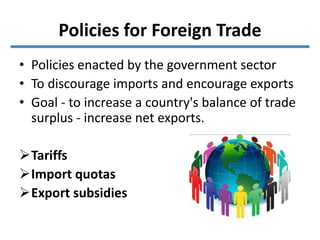
Policies for Foreign Trade
• Policies enacted by the government sector
• To discourage imports and encourage exports
• Goal - to increase a country's balance of trade
surplus - increase net exports.
Tariffs
Import quotas
Export subsidies
FTDR Act 1992
Foreign Trade Development & regulation Act
• 19th June 1992 - As a replacement to the Import
and Exports (Control) Act, 1947.
• Government of India enormous powers to control
• Objectives:
- To provide framework
- Development, Standardization & Regulation
on Facilitating Imports – Augmenting Exports
from India
• Provisions:
1) Development & Regulation
2) Prohibition and Restriction
3) Exim Policy
4) DGFT – Director General of foreign trade
5) IEC – Importer Exporter Code no.
6) Issues & Suspension/Cancellation of Licenses
7) Search, Inspection & Seizure
8) Penalty and Contravention
FTDR Act 1992
Foreign Trade Development & regulation Act
Foreign Trade Policy (FTP)
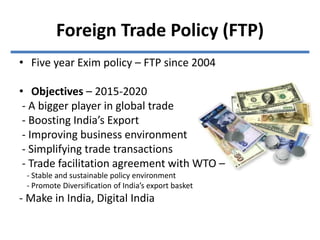
• Five year Exim policy – FTP since 2004
• Objectives – 2015-2020
- A bigger player in global trade
- Boosting India’s Export
- Improving business environment
- Simplifying trade transactions
- Trade facilitation agreement with WTO –
- Stable and sustainable policy environment
- Promote Diversification of India’s export basket
- Make in India, Digital India
• Key Features:
1) Export Growth Targets –
- $466 billions in 2013-2014 to $900 by 2019-2020
- Raising India’s share from 2% to 3.5%
2) Restructuring Reward Schemes –
- MEIS: Merchandise Export from India Scheme – no
condionality attached to the scrips
- (SEIS): Services Export from India Scheme – service providers
3) Status Holders –
- Nomenclature
- The criteria for export performance for recognition of status
holder - Rupees to US dollar earnings
Foreign Trade Policy (FTP)
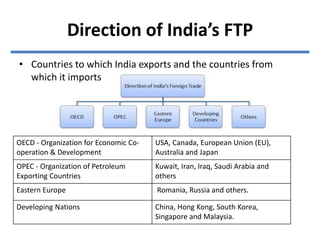
Direction of India’s FTP
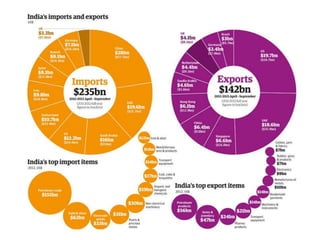
• Countries to which India exports and the countries from
which it imports
OECD - Organization for Economic Co-
operation & Development
USA, Canada, European Union (EU),
Australia and Japan
OPEC - Organization of Petroleum
Exporting Countries
Kuwait, Iran, Iraq, Saudi Arabia and
others
Eastern Europe Romania, Russia and others.
Developing Nations China, Hong Kong, South Korea,
Singapore and Malaysia.
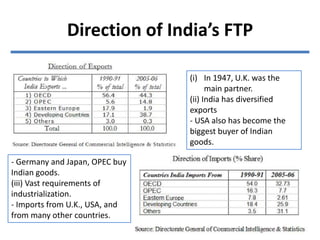
Direction of India’s FTP
- Germany and Japan, OPEC buy
Indian goods.
(iii) Vast requirements of
industrialization.
- Imports from U.K., USA, and
from many other countries.
(i) In 1947, U.K. was the
main partner.
(ii) India has diversified
exports
- USA also has become the
biggest buyer of Indian
goods.
What is export promotion:
“Public policy measures which actually or potentially enhance
exporting activity at the company, industry, or national level”.
Export development is important to the firm and to the economy as
a whole.
Goal of export promotion :
 General benefits of the economy
 Potential industries for competition with the foreign rivals
 Opportunity to acheive economies of scale and growth
Export Promotion Measures
Objectives of Export Promotion
 Compensate the exporters for the hihg domestic cost of
production
 Assistance to new and infant exporters to develop export
business
 Increase profits of the export business
 Improve in technologies and quality to compete
Organisational Set UP:
 Government has established number of organisations to provide different
types of assistance to exporters
Ministry of Commerce :
Most important organ concerned with the promotion and regulation of
foreign trade
Department of Commerce Divisions
 Administrative and General Divisions
 Finance division
 Economic division
 Trade Policy Division
 Foreign Trade Territorial Division
 Exports Products Division
 Service Division
 Industries Division
Measures taken by Government to improve production
efficiency and quality
 Raw material and other input at reasonable price
 Establish and expand production capacity
 Import of capital goods and technology
 modernise production Facilties
 Provision of infrastructure for growth
Marketing Assistance:
Market Development Assistance: Market and
commodity research, trade delegations, trade fairs
Foreign Exchange
Production & Marketing Assistance
Marketing assistance
 Trade Fair and Exhibitions
 Export Risk Insurance
 Finance
 Quality Control and Preshipment Inspection
 Institutional Assistance
 India Brand Equity fund
Export Promotion Schemes
Export Promotion Zones(EPZ's): Industrial estates form
enclaves from national custom territory ,situated near
sea ports or airports
Objective of EPZ :
 To earn foreign exchange
 To generate employment opportunity
 Transfer of technology by foreign investment and
other means
 To contribute overall development of the country
Hundred per cent Export Oriented Industrial Units:
Export promotion ad export targets considered
by Export promotion Council
Objectives of EOUs:
To create additional export capacity
Special Economic Zones:
Introduced in 2000-01,to boost country's export
Virtually industrial township provide infrastructure
In India First SEZ was set up in Gujurat ,Positra
Inspired by success of SEZ in China contribute about
40 % of her exports
Export Promotion Schemes
Thank You..!!
Presented By,
Shweta Patil THA2016MBA3P007
Kavita Suvarna THA2016MBA3P007
MBA – 3 Batch

Global business management - foreign trade

  • 1.
    Global Business Environment PresentedBy, Shweta Patil THA2016MBA3P007 Kavita Suvarna THA2016MBA3P007 MBA – 3 Batch Foreign Trade & Policies
  • 2.
    Foreign Trade • Whatis Foreign Trade • Significant share of gross domestic product (GDP) • High economic, social, and political importance • Regulated by laws, rules and regulations of the concerned countries.
  • 3.
    Policies for ForeignTrade • Policies enacted by the government sector • To discourage imports and encourage exports • Goal - to increase a country's balance of trade surplus - increase net exports. Tariffs Import quotas Export subsidies
  • 4.
    FTDR Act 1992 ForeignTrade Development & regulation Act • 19th June 1992 - As a replacement to the Import and Exports (Control) Act, 1947. • Government of India enormous powers to control • Objectives: - To provide framework - Development, Standardization & Regulation on Facilitating Imports – Augmenting Exports from India
  • 5.
    • Provisions: 1) Development& Regulation 2) Prohibition and Restriction 3) Exim Policy 4) DGFT – Director General of foreign trade 5) IEC – Importer Exporter Code no. 6) Issues & Suspension/Cancellation of Licenses 7) Search, Inspection & Seizure 8) Penalty and Contravention FTDR Act 1992 Foreign Trade Development & regulation Act
  • 6.
    Foreign Trade Policy(FTP) • Five year Exim policy – FTP since 2004 • Objectives – 2015-2020 - A bigger player in global trade - Boosting India’s Export - Improving business environment - Simplifying trade transactions - Trade facilitation agreement with WTO – - Stable and sustainable policy environment - Promote Diversification of India’s export basket - Make in India, Digital India
  • 7.
    • Key Features: 1)Export Growth Targets – - $466 billions in 2013-2014 to $900 by 2019-2020 - Raising India’s share from 2% to 3.5% 2) Restructuring Reward Schemes – - MEIS: Merchandise Export from India Scheme – no condionality attached to the scrips - (SEIS): Services Export from India Scheme – service providers 3) Status Holders – - Nomenclature - The criteria for export performance for recognition of status holder - Rupees to US dollar earnings Foreign Trade Policy (FTP)
  • 8.
    Direction of India’sFTP • Countries to which India exports and the countries from which it imports OECD - Organization for Economic Co- operation & Development USA, Canada, European Union (EU), Australia and Japan OPEC - Organization of Petroleum Exporting Countries Kuwait, Iran, Iraq, Saudi Arabia and others Eastern Europe Romania, Russia and others. Developing Nations China, Hong Kong, South Korea, Singapore and Malaysia.
  • 9.
    Direction of India’sFTP - Germany and Japan, OPEC buy Indian goods. (iii) Vast requirements of industrialization. - Imports from U.K., USA, and from many other countries. (i) In 1947, U.K. was the main partner. (ii) India has diversified exports - USA also has become the biggest buyer of Indian goods.
  • 11.
    What is exportpromotion: “Public policy measures which actually or potentially enhance exporting activity at the company, industry, or national level”. Export development is important to the firm and to the economy as a whole. Goal of export promotion :  General benefits of the economy  Potential industries for competition with the foreign rivals  Opportunity to acheive economies of scale and growth Export Promotion Measures
  • 12.
    Objectives of ExportPromotion  Compensate the exporters for the hihg domestic cost of production  Assistance to new and infant exporters to develop export business  Increase profits of the export business  Improve in technologies and quality to compete Organisational Set UP:  Government has established number of organisations to provide different types of assistance to exporters Ministry of Commerce : Most important organ concerned with the promotion and regulation of foreign trade
  • 13.
    Department of CommerceDivisions  Administrative and General Divisions  Finance division  Economic division  Trade Policy Division  Foreign Trade Territorial Division  Exports Products Division  Service Division  Industries Division
  • 14.
    Measures taken byGovernment to improve production efficiency and quality  Raw material and other input at reasonable price  Establish and expand production capacity  Import of capital goods and technology  modernise production Facilties  Provision of infrastructure for growth Marketing Assistance: Market Development Assistance: Market and commodity research, trade delegations, trade fairs Foreign Exchange Production & Marketing Assistance
  • 15.
    Marketing assistance  TradeFair and Exhibitions  Export Risk Insurance  Finance  Quality Control and Preshipment Inspection  Institutional Assistance  India Brand Equity fund
  • 16.
    Export Promotion Schemes ExportPromotion Zones(EPZ's): Industrial estates form enclaves from national custom territory ,situated near sea ports or airports Objective of EPZ :  To earn foreign exchange  To generate employment opportunity  Transfer of technology by foreign investment and other means  To contribute overall development of the country
  • 17.
    Hundred per centExport Oriented Industrial Units: Export promotion ad export targets considered by Export promotion Council Objectives of EOUs: To create additional export capacity Special Economic Zones: Introduced in 2000-01,to boost country's export Virtually industrial township provide infrastructure In India First SEZ was set up in Gujurat ,Positra Inspired by success of SEZ in China contribute about 40 % of her exports Export Promotion Schemes
  • 18.
    Thank You..!! Presented By, ShwetaPatil THA2016MBA3P007 Kavita Suvarna THA2016MBA3P007 MBA – 3 Batch