Indian 
Foreign Trade 
BY, 
ROLL NO: 96-105
Imports
Import 
 An import is a good brought into a jurisdiction, 
especially across a national border, from an 
external source. 
 The import sector of Indian economy is one of 
the most important sector of India's economic 
health. Imports in India increased to 39956.20 
USD Million in July of 2014 from 38243 USD Million 
in June of 2014. 
 The 2 commodities that India is highly 
dependent on from foreign imports are mineral 
fuels and oils & pearls and precious and semi-precious 
stones. Other products include nuclear 
and electrical equipment, machinery, organic 
chemicals, plastics & iron and steel.
Top Import Sources 
 India's top import source is China followed by the 
UAE, Switzerland and Saudi Arabia. The UK came in 
at 21st place in 2011-12 with India importing a total 
of $7.7bn. In the six months recorded so far for 2012- 
13, the UK has dropped a place and has a 1.4% 
share of the India's import sources. 
 The table below shows India's imports and exports 
by country including the share.
Top ten exporters to India 
Country 2012-2013 (Apr- Sep) %Share (2012-2013 (Apr- Sep) 
CHINA 28025.57 11.92 
UAE 19622.81 8.35 
SAUDI ARABIA 16094.83 6.85 
USA 12208.05 5.19 
SWITZERLAND 10779.45 4.59 
IRAQ 9803.79 4.17 
QATAR 8144.45 3.47 
KUWAIT 8134.73 3.46 
GERMANY 7154.41 3.04 
INDONESIA 6944.86 2.95
Top Imports 
1. CRUDE OIL- 
 India overtook Japan to become the 
THIRD LARGEST crude oil importer in the 
World. 
 India imported 3.86 million barrels-per-day 
of crude oil in the year 2013. 
India's crude oil imports were nearly 6 
percent higher than Japan's . 
 India is diversifying its crude purchases, 
tapping nations like 
Brazil, Columbia and Venezuela in the 
Latin America for supplies. 
 Crude petroleum is India's biggest 
import with $155bn spent on it in 2012
Top Imports 
2. GOLD- 
 Relaxation in curbs on gold imports by the new 
government and decrease in premium on gold have led 
to highest gold imports in the state in last 13 months. 
 According to latest figures, 14.33 metric tonnes (MT) of 
gold were imported in June 2014 compared to 3.74 MT 
in the same period in 2013, recording growth of 74%.
Top Imports 
3. ELECTRONICS- 
 During 3-Aug-2014 to 3-Sep-2014, India imported 
electronic component worth USD 515,142. 
 JNPT accounted for 52% of Import followed by Bombay 
Air and Delhi Air which account for 20% and 15% of 
imports respectively. 
 Average value per shipment of electronic component 
imports in India is USD 46,831. 
 Currently, 65 per cent of demand for electronic 
products is met by imports in the country.
Top Imports 
4. COAL- 
 Import of coal is practically rising every month and 
every year, and it is likely to remain so as domestic 
production is not enough to meet demand. 
 Imports of thermal coal, used in power generation, 
are expected to surge 11% to 150 million tonnes this 
fiscal year. 
 Of the total imports in July, thermal coal accounted 
for 14.5 million tonnes,based on monitoring of vessels’ 
positions and figures from shipping companies.
Commodity Imports
Export
Export 
Export is the shipping of goods and services out of the port of a country. 
India’s main export partners are United Arab Emirates (12 percent of total 
exports) and United States (11 percent). Others include: China, 
Singapore, Hong Kong and Netherlands. 
 Major export items of India : 
 Live animals, milk products 
 Wheat, rice, coffee, tea, spices, cumin seed, tamarind powder, 
sesame seed, sugar, henna, herbal extract, medicines, fertilizers, 
chemicals, salt 
 iron ores, minerals 
 books, leather products, textile, dyes and pigments, home furnishing, 
footwear, brass items, Aluminium items, sanitary wear, ceramic 
 glassware, flanges, fittings, embroidered and Zari items 
 pipe and pipe fittings, handicraft, cables, medical disposables, 
laboratory equipments, surgical equipments, sports goods, wooden 
furniture and various other engineering and electrical products
Top Exports 
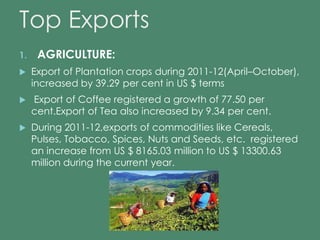
1. AGRICULTURE: 
 Export of Plantation crops during 2011-12(April–October), 
increased by 39.29 per cent in US $ terms 
 Export of Coffee registered a growth of 77.50 per 
cent.Export of Tea also increased by 9.34 per cent. 
 During 2011-12,exports of commodities like Cereals, 
Pulses, Tobacco, Spices, Nuts and Seeds, etc. registered 
an increase from US $ 8165.03 million to US $ 13300.63 
million during the current year.
Top Exports 
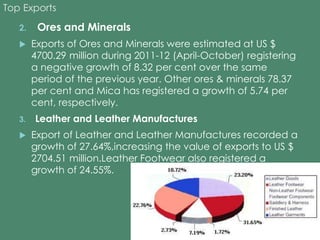
2. Ores and Minerals 
 Exports of Ores and Minerals were estimated at US $ 
4700.29 million during 2011-12 (April-October) registering 
a negative growth of 8.32 per cent over the same 
period of the previous year. Other ores & minerals 78.37 
per cent and Mica has registered a growth of 5.74 per 
cent, respectively. 
3. Leather and Leather Manufactures 
 Export of Leather and Leather Manufactures recorded a 
growth of 27.64%,increasing the value of exports to US $ 
2704.51 million.Leather Footwear also registered a 
growth of 24.55%.
Top Exports 
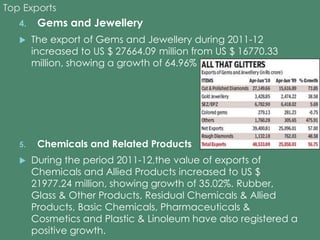
4. Gems and Jewellery 
 The export of Gems and Jewellery during 2011-12 
increased to US $ 27664.09 million from US $ 16770.33 
million, showing a growth of 64.96% 
5. Chemicals and Related Products 
 During the period 2011-12,the value of exports of 
Chemicals and Allied Products increased to US $ 
21977.24 million, showing growth of 35.02%. Rubber, 
Glass & Other Products, Residual Chemicals & Allied 
Products, Basic Chemicals, Pharmaceuticals & 
Cosmetics and Plastic & Linoleum have also registered a 
positive growth.
Top Exports 
6. Textiles 
 During the period 2011-12 the value of Textiles 
exports was estimated at US $ 15101.96 million 
recording a growth of 25.98%.The export of 
Readymade Garments registered a growth of 
28.60%, Cotton yarn/Fabrics/Made-ups etc. 
registered a growth of 23.06%, Wool and Woollen 
manufactures 54.21%, Coir and coir manufactures 
38.85%, Manmade Textiles & Made Ups has shown a 
growth of 30.25%,
Top five commodities of 
Export by Growth 2010-11 & 
2011-12
Policies
NEW GOVERNMENT POLICIES 
 The new Foreign trade Policy will focus on ways to boost 
India’s exports and reduce dependence on imports. 
 Therefore, the focus of the new policy would be to 
vigorously promote both exports and imports with 
significantly substantial focus on exports. 
 Old procedures and regulations governing exporters will be 
trimmed and pruned to suit the export requirements of the 
modern times so that the realistic targets are made 
achievable. 
 It would be the attempt of the policy makers to take 
India’s share in global trade to over 5 per cent from current 
level of 2 per cent in the next five year period. 
 On the pharmacy sector, the new government will make 
sure that the domestic industry gets a fair deal in other 
countries.
Examples of Policies 
1. EXIM POLICY 
The main objective of the Exim Policy is: 
 To accelerate the economy from low level of economic 
activities to high level of economic activities by making it a 
globally oriented vibrant economy and to derive maximum 
benefits from expanding global market opportunities. 
 To stimulate sustained economic growth by providing access to 
essential raw materials, intermediates, components,' 
consumables and capital goods required for augmenting 
production. 
 To enhance the techno local strength and efficiency of Indian 
agriculture, industry and services, thereby, improving their 
competitiveness. 
 To generate new employment. 
 Opportunities and encourage the attainment of internationally
Examples of 
Policies 
2. Export Incentives 
 The Government of India has framed several schemes to 
promote exports and to obtain foreign exchange. These 
schemes grants incentive and other benefits. The few 
important export incentives, from the point of view of 
indirect taxes are briefed below: 
3. Free Trade Zones (FTZ) 
 No excise duties are payable on goods manufactured in 
these zones provided they are made for export purpose.
Institutions 
ORGANIZATIONS THAT SUPPORT 
FOREIGN TRADE
India Trade Promotion 
Organization 
 India Trade Promotion Organisation (ITPO), 
headquartered at Pragati Maidan, is the nodal 
agency of the Government of India for promoting 
country's external trade. It’s promotional tools 
include organizing of fairs and exhibitions in India 
and abroad, Buyer-Seller Meets, Contact Promotion 
Programmes, Product Promotion Programmes, etc.
ITPO 
The main activities of the ITPO include: 
 Timely and efficient services to overseas buyers in vendor identification, 
drawing itineraries, fixing appointments and even accompanying them 
where required. 
 Establishing durable contacts between Indian suppliers and overseas 
buyers. 
 Assisting Indian companies in product development and adaptation to 
meet buyers' requirements. 
 Organising Buyer-Seller Meets and other exclusive India shows with a view 
to bringing buyers and sellers together. 
 Organising India Promotions with department stores and Mail Order 
Houses abroad. 
 Participating in overseas trade fairs and exhibitions. 
 Arranging product displays for visiting overseas buyers. 
 Organising seminars/conferences/workshops on trade-related subjects 
 Encouraging small and medium scale units in export promotion efforts. 
 Conducting in-house and need-based research on trade and export 
promotion.
EXIM Bank 
Export-Import Bank of India is the premier export 
finance institution in India, established in 1982 under 
the Export-Import Bank of India Act 1981. Since its 
inception, Exim Bank of India has been both a 
catalyst and a key player in the promotion of cross 
border trade and investment.
EXIM Bank 
The objectives of EXIM Bank include: 
 1. To ensure and integrated and co-ordinated approach in 
solving the allied problems encountered by exporters in India. 
 2. To pay specific attention to the exports of capital goods; 
 3. Export projection 
 4. To facilitate and encourage joint ventures and export of 
technical services and international and merchant banking; 
 5. To extend buyers’ credit and lines of credit; 
 6. To tap domestic and foreign markets for resources for 
undertaking development and FINANCIAL activities in the 
export sector.
Thank You

trade in india

  • 1.
    Indian Foreign Trade BY, ROLL NO: 96-105
  • 2.
  • 3.
    Import  Animport is a good brought into a jurisdiction, especially across a national border, from an external source.  The import sector of Indian economy is one of the most important sector of India's economic health. Imports in India increased to 39956.20 USD Million in July of 2014 from 38243 USD Million in June of 2014.  The 2 commodities that India is highly dependent on from foreign imports are mineral fuels and oils & pearls and precious and semi-precious stones. Other products include nuclear and electrical equipment, machinery, organic chemicals, plastics & iron and steel.
  • 4.
    Top Import Sources  India's top import source is China followed by the UAE, Switzerland and Saudi Arabia. The UK came in at 21st place in 2011-12 with India importing a total of $7.7bn. In the six months recorded so far for 2012- 13, the UK has dropped a place and has a 1.4% share of the India's import sources.  The table below shows India's imports and exports by country including the share.
  • 5.
    Top ten exportersto India Country 2012-2013 (Apr- Sep) %Share (2012-2013 (Apr- Sep) CHINA 28025.57 11.92 UAE 19622.81 8.35 SAUDI ARABIA 16094.83 6.85 USA 12208.05 5.19 SWITZERLAND 10779.45 4.59 IRAQ 9803.79 4.17 QATAR 8144.45 3.47 KUWAIT 8134.73 3.46 GERMANY 7154.41 3.04 INDONESIA 6944.86 2.95
  • 6.
    Top Imports 1.CRUDE OIL-  India overtook Japan to become the THIRD LARGEST crude oil importer in the World.  India imported 3.86 million barrels-per-day of crude oil in the year 2013. India's crude oil imports were nearly 6 percent higher than Japan's .  India is diversifying its crude purchases, tapping nations like Brazil, Columbia and Venezuela in the Latin America for supplies.  Crude petroleum is India's biggest import with $155bn spent on it in 2012
  • 7.
    Top Imports 2.GOLD-  Relaxation in curbs on gold imports by the new government and decrease in premium on gold have led to highest gold imports in the state in last 13 months.  According to latest figures, 14.33 metric tonnes (MT) of gold were imported in June 2014 compared to 3.74 MT in the same period in 2013, recording growth of 74%.
  • 8.
    Top Imports 3.ELECTRONICS-  During 3-Aug-2014 to 3-Sep-2014, India imported electronic component worth USD 515,142.  JNPT accounted for 52% of Import followed by Bombay Air and Delhi Air which account for 20% and 15% of imports respectively.  Average value per shipment of electronic component imports in India is USD 46,831.  Currently, 65 per cent of demand for electronic products is met by imports in the country.
  • 9.
    Top Imports 4.COAL-  Import of coal is practically rising every month and every year, and it is likely to remain so as domestic production is not enough to meet demand.  Imports of thermal coal, used in power generation, are expected to surge 11% to 150 million tonnes this fiscal year.  Of the total imports in July, thermal coal accounted for 14.5 million tonnes,based on monitoring of vessels’ positions and figures from shipping companies.
  • 10.
  • 11.
  • 12.
    Export Export isthe shipping of goods and services out of the port of a country. India’s main export partners are United Arab Emirates (12 percent of total exports) and United States (11 percent). Others include: China, Singapore, Hong Kong and Netherlands.  Major export items of India :  Live animals, milk products  Wheat, rice, coffee, tea, spices, cumin seed, tamarind powder, sesame seed, sugar, henna, herbal extract, medicines, fertilizers, chemicals, salt  iron ores, minerals  books, leather products, textile, dyes and pigments, home furnishing, footwear, brass items, Aluminium items, sanitary wear, ceramic  glassware, flanges, fittings, embroidered and Zari items  pipe and pipe fittings, handicraft, cables, medical disposables, laboratory equipments, surgical equipments, sports goods, wooden furniture and various other engineering and electrical products
  • 13.
    Top Exports 1.AGRICULTURE:  Export of Plantation crops during 2011-12(April–October), increased by 39.29 per cent in US $ terms  Export of Coffee registered a growth of 77.50 per cent.Export of Tea also increased by 9.34 per cent.  During 2011-12,exports of commodities like Cereals, Pulses, Tobacco, Spices, Nuts and Seeds, etc. registered an increase from US $ 8165.03 million to US $ 13300.63 million during the current year.
  • 14.
    Top Exports 2.Ores and Minerals  Exports of Ores and Minerals were estimated at US $ 4700.29 million during 2011-12 (April-October) registering a negative growth of 8.32 per cent over the same period of the previous year. Other ores & minerals 78.37 per cent and Mica has registered a growth of 5.74 per cent, respectively. 3. Leather and Leather Manufactures  Export of Leather and Leather Manufactures recorded a growth of 27.64%,increasing the value of exports to US $ 2704.51 million.Leather Footwear also registered a growth of 24.55%.
  • 15.
    Top Exports 4.Gems and Jewellery  The export of Gems and Jewellery during 2011-12 increased to US $ 27664.09 million from US $ 16770.33 million, showing a growth of 64.96% 5. Chemicals and Related Products  During the period 2011-12,the value of exports of Chemicals and Allied Products increased to US $ 21977.24 million, showing growth of 35.02%. Rubber, Glass & Other Products, Residual Chemicals & Allied Products, Basic Chemicals, Pharmaceuticals & Cosmetics and Plastic & Linoleum have also registered a positive growth.
  • 16.
    Top Exports 6.Textiles  During the period 2011-12 the value of Textiles exports was estimated at US $ 15101.96 million recording a growth of 25.98%.The export of Readymade Garments registered a growth of 28.60%, Cotton yarn/Fabrics/Made-ups etc. registered a growth of 23.06%, Wool and Woollen manufactures 54.21%, Coir and coir manufactures 38.85%, Manmade Textiles & Made Ups has shown a growth of 30.25%,
  • 17.
    Top five commoditiesof Export by Growth 2010-11 & 2011-12
  • 18.
  • 19.
    NEW GOVERNMENT POLICIES  The new Foreign trade Policy will focus on ways to boost India’s exports and reduce dependence on imports.  Therefore, the focus of the new policy would be to vigorously promote both exports and imports with significantly substantial focus on exports.  Old procedures and regulations governing exporters will be trimmed and pruned to suit the export requirements of the modern times so that the realistic targets are made achievable.  It would be the attempt of the policy makers to take India’s share in global trade to over 5 per cent from current level of 2 per cent in the next five year period.  On the pharmacy sector, the new government will make sure that the domestic industry gets a fair deal in other countries.
  • 20.
    Examples of Policies 1. EXIM POLICY The main objective of the Exim Policy is:  To accelerate the economy from low level of economic activities to high level of economic activities by making it a globally oriented vibrant economy and to derive maximum benefits from expanding global market opportunities.  To stimulate sustained economic growth by providing access to essential raw materials, intermediates, components,' consumables and capital goods required for augmenting production.  To enhance the techno local strength and efficiency of Indian agriculture, industry and services, thereby, improving their competitiveness.  To generate new employment.  Opportunities and encourage the attainment of internationally
  • 21.
    Examples of Policies 2. Export Incentives  The Government of India has framed several schemes to promote exports and to obtain foreign exchange. These schemes grants incentive and other benefits. The few important export incentives, from the point of view of indirect taxes are briefed below: 3. Free Trade Zones (FTZ)  No excise duties are payable on goods manufactured in these zones provided they are made for export purpose.
  • 22.
    Institutions ORGANIZATIONS THATSUPPORT FOREIGN TRADE
  • 23.
    India Trade Promotion Organization  India Trade Promotion Organisation (ITPO), headquartered at Pragati Maidan, is the nodal agency of the Government of India for promoting country's external trade. It’s promotional tools include organizing of fairs and exhibitions in India and abroad, Buyer-Seller Meets, Contact Promotion Programmes, Product Promotion Programmes, etc.
  • 24.
    ITPO The mainactivities of the ITPO include:  Timely and efficient services to overseas buyers in vendor identification, drawing itineraries, fixing appointments and even accompanying them where required.  Establishing durable contacts between Indian suppliers and overseas buyers.  Assisting Indian companies in product development and adaptation to meet buyers' requirements.  Organising Buyer-Seller Meets and other exclusive India shows with a view to bringing buyers and sellers together.  Organising India Promotions with department stores and Mail Order Houses abroad.  Participating in overseas trade fairs and exhibitions.  Arranging product displays for visiting overseas buyers.  Organising seminars/conferences/workshops on trade-related subjects  Encouraging small and medium scale units in export promotion efforts.  Conducting in-house and need-based research on trade and export promotion.
  • 25.
    EXIM Bank Export-ImportBank of India is the premier export finance institution in India, established in 1982 under the Export-Import Bank of India Act 1981. Since its inception, Exim Bank of India has been both a catalyst and a key player in the promotion of cross border trade and investment.
  • 26.
    EXIM Bank Theobjectives of EXIM Bank include:  1. To ensure and integrated and co-ordinated approach in solving the allied problems encountered by exporters in India.  2. To pay specific attention to the exports of capital goods;  3. Export projection  4. To facilitate and encourage joint ventures and export of technical services and international and merchant banking;  5. To extend buyers’ credit and lines of credit;  6. To tap domestic and foreign markets for resources for undertaking development and FINANCIAL activities in the export sector.
  • 27.