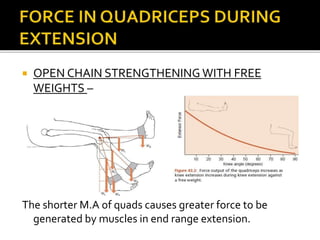
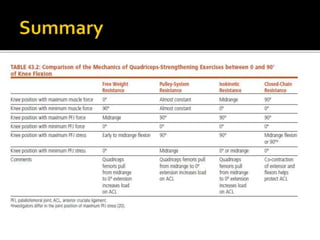
 OPEN CHAIN STRENGTHENING WITH FREE
WEIGHTS –
The shorter M.A of quads causes greater force to be
generated by muscles in end range extension.
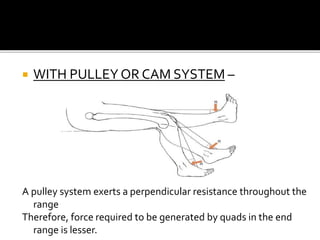
 WITH PULLEY OR CAM SYSTEM –
A pulley system exerts a perpendicular resistance throughout the
range
Therefore, force required to be generated by quads in the end
range is lesser.
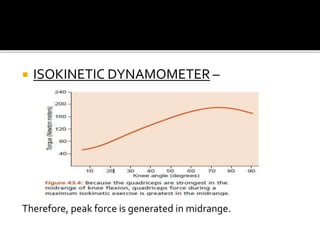
 ISOKINETIC DYNAMOMETER –
Therefore, peak force is generated in midrange.
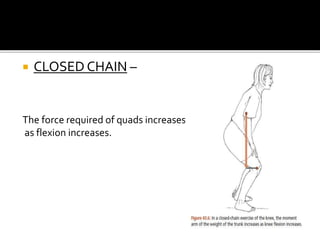
 CLOSED CHAIN –
The force required of quads increases
as flexion increases.
 Different strengthening exercises target different
ranges i.e
a. Strengthening with free weights maximum
strengthening forces occur at end range extension.
b. With pulley or cam system at initial half range.
c. With dynamometer at midrange.
d. In closed chain exercises as flexion angle increases.
 Normal extensor moment
a. Normal locomotion – 30Nm
b. Kicking a ball – 260Nm
c. Rising from chair- 200Nm
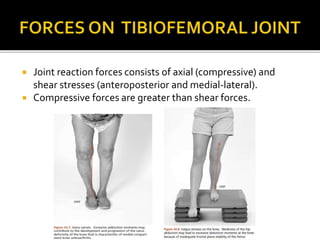
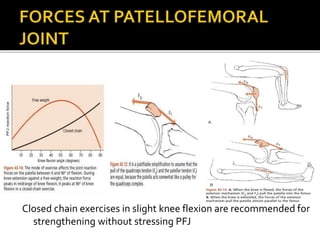
 Joint reaction forces consists of axial (compressive) and
shear stresses (anteroposterior and medial-lateral).
 Compressive forces are greater than shear forces.
Closed chain exercises in slight knee flexion are recommended for
strengthening without stressing PFJ
 Kinesiology mechanics and pathomechanics; 2nd edition.
Carol.A. Oatis.
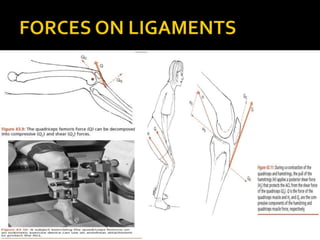
Forces on knee joint during activity

Forces on knee joint during activity

  • 2.
     OPEN CHAINSTRENGTHENING WITH FREE WEIGHTS – The shorter M.A of quads causes greater force to be generated by muscles in end range extension.
  • 3.
     WITH PULLEYOR CAM SYSTEM – A pulley system exerts a perpendicular resistance throughout the range Therefore, force required to be generated by quads in the end range is lesser.
  • 4.
     ISOKINETIC DYNAMOMETER– Therefore, peak force is generated in midrange.
  • 5.
     CLOSED CHAIN– The force required of quads increases as flexion increases.
  • 6.
     Different strengtheningexercises target different ranges i.e a. Strengthening with free weights maximum strengthening forces occur at end range extension. b. With pulley or cam system at initial half range. c. With dynamometer at midrange. d. In closed chain exercises as flexion angle increases.  Normal extensor moment a. Normal locomotion – 30Nm b. Kicking a ball – 260Nm c. Rising from chair- 200Nm
  • 7.
     Joint reactionforces consists of axial (compressive) and shear stresses (anteroposterior and medial-lateral).  Compressive forces are greater than shear forces.
  • 9.
    Closed chain exercisesin slight knee flexion are recommended for strengthening without stressing PFJ
  • 11.
     Kinesiology mechanicsand pathomechanics; 2nd edition. Carol.A. Oatis.