AGE RELATED CHANGES IN THE CARDIOVASCULAR SYSTEM
SHRUTI.DHOKPATIL
AKHILA. NATESAN
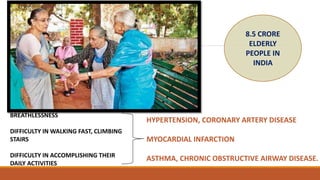
BREATHLESSNESS
DIFFICULTY IN WALKING FAST, CLIMBING
STAIRS
DIFFICULTY IN ACCOMPLISHING THEIR
DAILY ACTIVITIES
HYPERTENSION, CORONARY ARTERY DISEASE
MYOCARDIAL INFARCTION
ASTHMA, CHRONIC OBSTRUCTIVE AIRWAY DISEASE.
8.5 CRORE
ELDERLY
PEOPLE IN
INDIA
OBJECTIVES:
1. The age related changes in the cardiovascular system in elderly
2. The effects on the body physiology in elderly
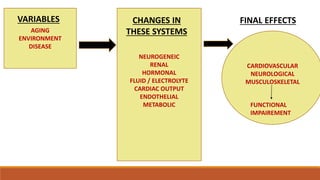
Though, the biological decline of elderly, majorly is genetic ( aging ) basis, but the other half can be
attributed to the sedentary lifestyle coupled with inadequate nutrient intake, excess body weight
(which predisposes toward disease), and variables such as smoking and excessive alcohol intake.
AGING
ENVIRONMENT
DISEASE
NEUROGENEIC
RENAL
HORMONAL
FLUID / ELECTROLYTE
CARDIAC OUTPUT
ENDOTHELIAL
METABOLIC
CARDIOVASCULAR
NEUROLOGICAL
MUSCULOSKELETAL
FUNCTIONAL
IMPAIREMENT
VARIABLES CHANGES IN
THESE SYSTEMS
FINAL EFFECTS
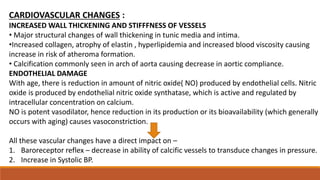
CARDIOVASCULAR CHANGES :
INCREASED WALL THICKENING AND STIFFFNESS OF VESSELS
• Major structural changes of wall thickening in tunic media and intima.
•Increased collagen, atrophy of elastin , hyperlipidemia and increased blood viscosity causing
increase in risk of atheroma formation.
• Calcification commonly seen in arch of aorta causing decrease in aortic compliance.
ENDOTHELIAL DAMAGE
With age, there is reduction in amount of nitric oxide( NO) produced by endothelial cells. Nitric
oxide is produced by endothelial nitric oxide synthatase, which is active and regulated by
intracellular concentration on calcium.
NO is potent vasodilator, hence reduction in its production or its bioavailability (which generally
occurs with aging) causes vasoconstriction.
All these vascular changes have a direct impact on –
1. Baroreceptor reflex – decrease in ability of calcific vessels to transduce changes in pressure.
2. Increase in Systolic BP.
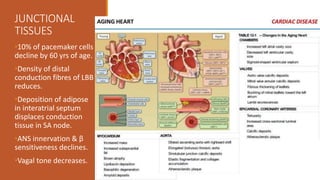
JUNCTIONAL
TISSUES
•10% of pacemaker cells
decline by 60 yrs of age.
•Density of distal
conduction fibres of LBB
reduces.
•Deposition of adipose
in interatrial septum
displaces conduction
tissue in SA node.
•ANS innervation & β
sensitiveness declines.
•Vagal tone decreases.
All above mentioned changes (STRUCTURAL CHANGES) +
Pre-existing Hypertension, atherosclerosis, previous history of coronary artery
disease, family history, diabetes, alcohol, tobacco, smoking.
•Elevated systolic blood pressure , widening of pulse pressure,
•Reduction in early diastolic filling with reduced CARDIAC OUTPUT,
• Heart rate decreases linearly with age (220- age).
DECREASE IN AEROBIC CAPACITY ( By age of 65, aerobic capacity is 30-40% of young
adult)
DECREASE IN PROPER EXCHANGE OF OXYGEN AND NUTRIENTS AT THE TISSUE LEVEL ,
REDUCED ARTERIOVENOUS UPTAKE OF OXYGEN.
PHYSIOLOGICAL CHANGES
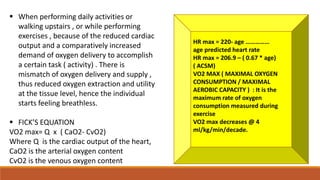
HR max = 220- age ……………
age predicted heart rate
HR max = 206.9 – ( 0.67 * age)
( ACSM)
VO2 MAX ( MAXIMAL OXYGEN
CONSUMPTION / MAXIMAL
AEROBIC CAPACITY ) : It is the
maximum rate of oxygen
consumption measured during
exercise.
VO2 max decreases @ 4
ml/kg/min/decade.
 When performing daily activities or
walking upstairs , or while performing
exercises , because of the reduced cardiac
output and a comparatively increased
demand of oxygen delivery to accomplish
a certain task ( activity) . There is
mismatch of oxygen delivery and supply ,
thus reduced oxygen extraction and utility
at the tissue level, hence the individual
starts feeling breathless.
 FICK’S EQUATION
VO2 max= Q x ( CaO2- CvO2)
Where Q is the cardiac output of the heart,
CaO2 is the arterial oxygen content
CvO2 is the venous oxygen content
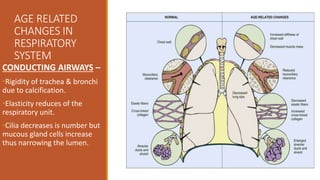
AGE RELATED
CHANGES IN
RESPIRATORY
SYSTEM
CONDUCTING AIRWAYS –
•Rigidity of trachea & bronchi
due to calcification.
•Elasticity reduces of the
respiratory unit.
•Cilia decreases is number but
mucous gland cells increase
thus narrowing the lumen.
Due to above mentioned STRUCTURAL changes
PHYSIOLOGICAL CHANGES
•Work of breathing increase.
•FVC & FEV₁ decreases.
•RV & FRC increases.
•Use of accessory muscles of breathing.
REFERENCES
1.Principles and practice of Cardiopulmonary Physical Therapy; 3 rd edition. Donna Frownfelter,
Elizabeth Dean .
2. Physiotherapy in community health and rehabilitation ; Waqar Naqvi.
3. Effect of ageing on blooad and plasma viscosity; Clinical hemorheology and microcirculation,
2011 ; Carolo C et al.
4. http.clinicalgate.com.
THANK YOU.

Age Related Changes in Cardiovascular System

  • 1.
    AGE RELATED CHANGESIN THE CARDIOVASCULAR SYSTEM SHRUTI.DHOKPATIL AKHILA. NATESAN
  • 2.
    BREATHLESSNESS DIFFICULTY IN WALKINGFAST, CLIMBING STAIRS DIFFICULTY IN ACCOMPLISHING THEIR DAILY ACTIVITIES HYPERTENSION, CORONARY ARTERY DISEASE MYOCARDIAL INFARCTION ASTHMA, CHRONIC OBSTRUCTIVE AIRWAY DISEASE. 8.5 CRORE ELDERLY PEOPLE IN INDIA
  • 3.
    OBJECTIVES: 1. The agerelated changes in the cardiovascular system in elderly 2. The effects on the body physiology in elderly Though, the biological decline of elderly, majorly is genetic ( aging ) basis, but the other half can be attributed to the sedentary lifestyle coupled with inadequate nutrient intake, excess body weight (which predisposes toward disease), and variables such as smoking and excessive alcohol intake.
  • 4.
    AGING ENVIRONMENT DISEASE NEUROGENEIC RENAL HORMONAL FLUID / ELECTROLYTE CARDIACOUTPUT ENDOTHELIAL METABOLIC CARDIOVASCULAR NEUROLOGICAL MUSCULOSKELETAL FUNCTIONAL IMPAIREMENT VARIABLES CHANGES IN THESE SYSTEMS FINAL EFFECTS
  • 5.
    CARDIOVASCULAR CHANGES : INCREASEDWALL THICKENING AND STIFFFNESS OF VESSELS • Major structural changes of wall thickening in tunic media and intima. •Increased collagen, atrophy of elastin , hyperlipidemia and increased blood viscosity causing increase in risk of atheroma formation. • Calcification commonly seen in arch of aorta causing decrease in aortic compliance. ENDOTHELIAL DAMAGE With age, there is reduction in amount of nitric oxide( NO) produced by endothelial cells. Nitric oxide is produced by endothelial nitric oxide synthatase, which is active and regulated by intracellular concentration on calcium. NO is potent vasodilator, hence reduction in its production or its bioavailability (which generally occurs with aging) causes vasoconstriction. All these vascular changes have a direct impact on – 1. Baroreceptor reflex – decrease in ability of calcific vessels to transduce changes in pressure. 2. Increase in Systolic BP.
  • 6.
    JUNCTIONAL TISSUES •10% of pacemakercells decline by 60 yrs of age. •Density of distal conduction fibres of LBB reduces. •Deposition of adipose in interatrial septum displaces conduction tissue in SA node. •ANS innervation & β sensitiveness declines. •Vagal tone decreases.
  • 7.
    All above mentionedchanges (STRUCTURAL CHANGES) + Pre-existing Hypertension, atherosclerosis, previous history of coronary artery disease, family history, diabetes, alcohol, tobacco, smoking. •Elevated systolic blood pressure , widening of pulse pressure, •Reduction in early diastolic filling with reduced CARDIAC OUTPUT, • Heart rate decreases linearly with age (220- age). DECREASE IN AEROBIC CAPACITY ( By age of 65, aerobic capacity is 30-40% of young adult) DECREASE IN PROPER EXCHANGE OF OXYGEN AND NUTRIENTS AT THE TISSUE LEVEL , REDUCED ARTERIOVENOUS UPTAKE OF OXYGEN. PHYSIOLOGICAL CHANGES
  • 8.
    HR max =220- age …………… age predicted heart rate HR max = 206.9 – ( 0.67 * age) ( ACSM) VO2 MAX ( MAXIMAL OXYGEN CONSUMPTION / MAXIMAL AEROBIC CAPACITY ) : It is the maximum rate of oxygen consumption measured during exercise. VO2 max decreases @ 4 ml/kg/min/decade.  When performing daily activities or walking upstairs , or while performing exercises , because of the reduced cardiac output and a comparatively increased demand of oxygen delivery to accomplish a certain task ( activity) . There is mismatch of oxygen delivery and supply , thus reduced oxygen extraction and utility at the tissue level, hence the individual starts feeling breathless.  FICK’S EQUATION VO2 max= Q x ( CaO2- CvO2) Where Q is the cardiac output of the heart, CaO2 is the arterial oxygen content CvO2 is the venous oxygen content
  • 9.
    AGE RELATED CHANGES IN RESPIRATORY SYSTEM CONDUCTINGAIRWAYS – •Rigidity of trachea & bronchi due to calcification. •Elasticity reduces of the respiratory unit. •Cilia decreases is number but mucous gland cells increase thus narrowing the lumen.
  • 10.
    Due to abovementioned STRUCTURAL changes PHYSIOLOGICAL CHANGES •Work of breathing increase. •FVC & FEV₁ decreases. •RV & FRC increases. •Use of accessory muscles of breathing.
  • 11.
    REFERENCES 1.Principles and practiceof Cardiopulmonary Physical Therapy; 3 rd edition. Donna Frownfelter, Elizabeth Dean . 2. Physiotherapy in community health and rehabilitation ; Waqar Naqvi. 3. Effect of ageing on blooad and plasma viscosity; Clinical hemorheology and microcirculation, 2011 ; Carolo C et al. 4. http.clinicalgate.com.
  • 12.