IMD StrengthBryan Guido HassinIMD MBA 2008IFA-Certified Personal Trainer
DisclaimerThis document represents only the author’s opinions and he accepts no liability for any consequences that may come from your having read itIn fact, he accepts no liability for anything ever
Strength is a critical component of total fitnessOther components includeendurance, flexibility, and body compositionComprehensive, balanced fitness programs address strength, endurance, flexibility, and dietLean muscle mass (on which strength is based) is highly correlated with numerous health benefits, includingAutoimmune responseBone densityMetabolismMany others
Unfortunately, most information about strength training is wrongIt is founded on mythologies created long ago and perpetuated by:Anecdotal data from coaches/friends/colleagues/etc.Fitness magazines whose goals are to make their advertisers rich, not to make you fitBut scientific research DOES exist, and it is the foundation of this document
Strength is gained by stimulating muscle fibers and then restingTo determine how best to gain strength, we must first understand how strength is gainedThe sliding filament model shows that muscles contract in order to do workWhen they do hard work, the muscle fibers literally break down (referred to as stimulation)Then, during rest, the body builds them back up with protein and overcompensates, building them stronger than beforeStrength gain is a product of how many muscle fibers are stimulated and how adequately they are subsequently restedA muscle has been maximally stimulated when it can literally no longer do work (all of its fibers have been broken down)A maximally stimulated muscle requires ~1 week of rest to be rebuilt stronger
Conventional approaches to strength training use submaximumstimulationFor example, one classic methodology uses 3 sets of 10 repetitions of the same resistance (weight)If you can still do a 3rd set at the same weight, why did you do the 1st and 2nd sets???Your muscles have simply not been very stimulated at allIf your muscles have been thoroughly stimulated (Remember, this means that you have broken down muscle fibers so they are no longer able to do work.), a subsequent set will only be possible at lower weight and/or repetitions
Conventional approaches to strength training use inadequate restFor example, one classic methodology works out the same muscle 3x/week—providing much less than the week of rest required Resting a muscle is just as important as stimulating itWithout adequate rest, a muscle will not be built all the way back up before it is once again broken down. Over time this will actually lead to a decrease in muscle, referred to as catabolismIf adequate rest is given to a maximally stimulated muscle, the next time the exercise is performed, you will be able to do more repetitions and/or use higher resistance
Conventional approaches take more time and are less effectiveStrength is built by stimulating muscle and then resting itBut conventional approaches to strength training don’t stimulate as much muscle as possibleAnd they don’t allow for adequate restThis makes conventional approaches to strength training “busy-work” activities that suck time and fail to produce results
The special needs of executives require a more efficient approachThere are many reasons to spend time at the gym, including social onesHowever, executives have many other demands on their time and energyTherefore the goal of this document is to propose a maximally efficient method of strength trainingThis means 1. stimulating the maximum amount of muscle in the least amount of time—working smarter, not longer—and 2. restingExecutives can then use the time and energy they would have spent on inefficient strength training instead on:Other fitness activities for balanceRest/mental well beingTime with family/friendsWork!
1. Maximum stimulation requires maximum intensity in each repetitionMaximum intensity requires two elements:The neurological intent for the muscle to do work as hard as it canAdequate resistance such that a repetition, even under such neurological intent, still takes several seconds to performFurther intensity can be gained by holding an exercise at the point of peak contraction (where the sliding filament model tells us that the most amount of muscle fiber is engaged)
1. Maximum intensity must be applied to a muscle’s full ROMMaximum intensity must be applied to a muscle’s full range of motion for maximum stimulationFull ROM goes in two directions: when the muscle is doing work and when it is returning to its starting position (the negative portion of the repetition)
1. No cheating!Using momentum and cheating (even inadvertently) do not stimulate muscle! Remember that the goal is not to lift a certain weight or perform a certain number of repetitions; the goal is to stimulate the most muscle fiber
2. RestThis does not preclude sports, yoga, or cardiovascular activityThis precludes the breakdown of muscle fibers by overloading them with resistance such that they can not be used until they have recovered
These principles result in faster, safer, more effective strength trainingFaster: the entire body can be maximally stimulated in 30-60 minutes each weekSafer: the focus on intensity and no cheating allows for maximum stimulation with lower resistance, which is easier on the joints and reduces the likelihood of injuryMore effective: stimulation + rest == more effective strength training, not to mention freeing up time for more effectiveness in other areas
A demonstration validates these principlesSeeing is believing so I find it instructive to demonstrate the differences between conventional strength training techniques and theseI usually use a shoulder exercise such as front dumbbell raises
1. Establish a baselineHave the participant do one set of 10 repetitions using the weights she would normally useOnce the set is complete, ask her how she feelsThe answer is usually “OK, but I could do more.”
2. Identify areas for optimizationDiscuss the areas of inefficiency in the exercise as she performed it:Maximum resistance is only realized when the arms are parallel to the floorThe shoulder joint supports much greater ROMOften the participant cheats/uses momentumOften the participant lets gravity carry the weights back to the starting position
3. Optimize!After time to rest, try the exercise again with some key modifications:Seated to reduce hip swinging/cheatingOn an incline bench to allow longer ROMTo provide constant, maximum resistance throughout the ROM, I place my hand on the participant’s wrist. When the arm is perpendicular to the floor, I provide strong resistance. When the arm is parallel to the floor and working against the full resistance of gravity and the dumbbell, I provide no resistance. I provide enough resistance throughout the ROM for the positive portion of the repetition to take 4 seconds.The participant holds the repetition at peak contraction for 2 secondsThe participant makes me push his arm back down to rest position, requiring 4 seconds for the negative
4. Establish that much greater stimulation has been achievedUsually the participant is unable to continue using the dumbbell after 2-4 repetitions and the need for me to provide manual resistance decreases dramatically with each repI can use fewer and fewer fingers to apply resistance, sometimes removing my hand completely!Often the participant breaks into a sweat.When asked how she feels, a very different answer is given!
Even in IMD’s substandard gym, full-body stimulation is possible in 30-60mUse 10-second repetitions4 seconds positive (exhale)hold for 2 seconds during peak contraction (exhale)4 seconds negative (inhale)If possible, use a partner to provide variable resistance and spottingAim for complete muscle failure in 6-9 repetitions for upper body exercises and 10-12 for lower-body exercisesIf you can perform more then 9 repetitions (as listed above) of an upper body exercise or 12 for a lower-body exercise, increase resistance
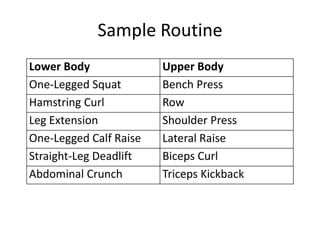
Sample Routine
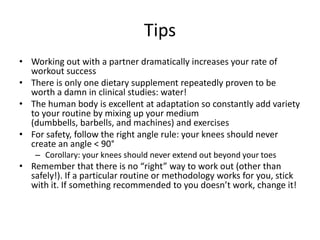
TipsWorking out with a partner dramatically increases your rate of workout successThere is only one dietary supplement repeatedly proven to be worth a damn in clinical studies: water!The human body is excellent at adaptation so constantly add variety to your routine by mixing up your medium (dumbbells, barbells, and machines) and exercisesFor safety, follow the right angle rule: your knees should never create an angle < 90°Corollary: your knees should never extend out beyond your toesRemember that there is no “right” way to work out (other than safely!). If a particular routine or methodology works for you, stick with it. If something recommended to you doesn’t work, change it!
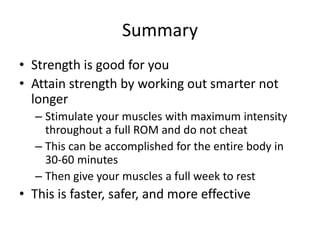
SummaryStrength is good for youAttain strength by working out smarter not longerStimulate your muscles with maximum intensity throughout a full ROM and do not cheatThis can be accomplished for the entire body in 30-60 minutesThen give your muscles a full week to restThis is faster, safer, and more effective

Strength Training for Executives

  • 1.
    IMD StrengthBryan GuidoHassinIMD MBA 2008IFA-Certified Personal Trainer
  • 2.
    DisclaimerThis document representsonly the author’s opinions and he accepts no liability for any consequences that may come from your having read itIn fact, he accepts no liability for anything ever
  • 3.
    Strength is acritical component of total fitnessOther components includeendurance, flexibility, and body compositionComprehensive, balanced fitness programs address strength, endurance, flexibility, and dietLean muscle mass (on which strength is based) is highly correlated with numerous health benefits, includingAutoimmune responseBone densityMetabolismMany others
  • 4.
    Unfortunately, most informationabout strength training is wrongIt is founded on mythologies created long ago and perpetuated by:Anecdotal data from coaches/friends/colleagues/etc.Fitness magazines whose goals are to make their advertisers rich, not to make you fitBut scientific research DOES exist, and it is the foundation of this document
  • 5.
    Strength is gainedby stimulating muscle fibers and then restingTo determine how best to gain strength, we must first understand how strength is gainedThe sliding filament model shows that muscles contract in order to do workWhen they do hard work, the muscle fibers literally break down (referred to as stimulation)Then, during rest, the body builds them back up with protein and overcompensates, building them stronger than beforeStrength gain is a product of how many muscle fibers are stimulated and how adequately they are subsequently restedA muscle has been maximally stimulated when it can literally no longer do work (all of its fibers have been broken down)A maximally stimulated muscle requires ~1 week of rest to be rebuilt stronger
  • 6.
    Conventional approaches tostrength training use submaximumstimulationFor example, one classic methodology uses 3 sets of 10 repetitions of the same resistance (weight)If you can still do a 3rd set at the same weight, why did you do the 1st and 2nd sets???Your muscles have simply not been very stimulated at allIf your muscles have been thoroughly stimulated (Remember, this means that you have broken down muscle fibers so they are no longer able to do work.), a subsequent set will only be possible at lower weight and/or repetitions
  • 7.
    Conventional approaches tostrength training use inadequate restFor example, one classic methodology works out the same muscle 3x/week—providing much less than the week of rest required Resting a muscle is just as important as stimulating itWithout adequate rest, a muscle will not be built all the way back up before it is once again broken down. Over time this will actually lead to a decrease in muscle, referred to as catabolismIf adequate rest is given to a maximally stimulated muscle, the next time the exercise is performed, you will be able to do more repetitions and/or use higher resistance
  • 8.
    Conventional approaches takemore time and are less effectiveStrength is built by stimulating muscle and then resting itBut conventional approaches to strength training don’t stimulate as much muscle as possibleAnd they don’t allow for adequate restThis makes conventional approaches to strength training “busy-work” activities that suck time and fail to produce results
  • 9.
    The special needsof executives require a more efficient approachThere are many reasons to spend time at the gym, including social onesHowever, executives have many other demands on their time and energyTherefore the goal of this document is to propose a maximally efficient method of strength trainingThis means 1. stimulating the maximum amount of muscle in the least amount of time—working smarter, not longer—and 2. restingExecutives can then use the time and energy they would have spent on inefficient strength training instead on:Other fitness activities for balanceRest/mental well beingTime with family/friendsWork!
  • 10.
    1. Maximum stimulationrequires maximum intensity in each repetitionMaximum intensity requires two elements:The neurological intent for the muscle to do work as hard as it canAdequate resistance such that a repetition, even under such neurological intent, still takes several seconds to performFurther intensity can be gained by holding an exercise at the point of peak contraction (where the sliding filament model tells us that the most amount of muscle fiber is engaged)
  • 11.
    1. Maximum intensitymust be applied to a muscle’s full ROMMaximum intensity must be applied to a muscle’s full range of motion for maximum stimulationFull ROM goes in two directions: when the muscle is doing work and when it is returning to its starting position (the negative portion of the repetition)
  • 12.
    1. No cheating!Usingmomentum and cheating (even inadvertently) do not stimulate muscle! Remember that the goal is not to lift a certain weight or perform a certain number of repetitions; the goal is to stimulate the most muscle fiber
  • 13.
    2. RestThis doesnot preclude sports, yoga, or cardiovascular activityThis precludes the breakdown of muscle fibers by overloading them with resistance such that they can not be used until they have recovered
  • 14.
    These principles resultin faster, safer, more effective strength trainingFaster: the entire body can be maximally stimulated in 30-60 minutes each weekSafer: the focus on intensity and no cheating allows for maximum stimulation with lower resistance, which is easier on the joints and reduces the likelihood of injuryMore effective: stimulation + rest == more effective strength training, not to mention freeing up time for more effectiveness in other areas
  • 15.
    A demonstration validatesthese principlesSeeing is believing so I find it instructive to demonstrate the differences between conventional strength training techniques and theseI usually use a shoulder exercise such as front dumbbell raises
  • 16.
    1. Establish abaselineHave the participant do one set of 10 repetitions using the weights she would normally useOnce the set is complete, ask her how she feelsThe answer is usually “OK, but I could do more.”
  • 17.
    2. Identify areasfor optimizationDiscuss the areas of inefficiency in the exercise as she performed it:Maximum resistance is only realized when the arms are parallel to the floorThe shoulder joint supports much greater ROMOften the participant cheats/uses momentumOften the participant lets gravity carry the weights back to the starting position
  • 18.
    3. Optimize!After timeto rest, try the exercise again with some key modifications:Seated to reduce hip swinging/cheatingOn an incline bench to allow longer ROMTo provide constant, maximum resistance throughout the ROM, I place my hand on the participant’s wrist. When the arm is perpendicular to the floor, I provide strong resistance. When the arm is parallel to the floor and working against the full resistance of gravity and the dumbbell, I provide no resistance. I provide enough resistance throughout the ROM for the positive portion of the repetition to take 4 seconds.The participant holds the repetition at peak contraction for 2 secondsThe participant makes me push his arm back down to rest position, requiring 4 seconds for the negative
  • 19.
    4. Establish thatmuch greater stimulation has been achievedUsually the participant is unable to continue using the dumbbell after 2-4 repetitions and the need for me to provide manual resistance decreases dramatically with each repI can use fewer and fewer fingers to apply resistance, sometimes removing my hand completely!Often the participant breaks into a sweat.When asked how she feels, a very different answer is given!
  • 20.
    Even in IMD’ssubstandard gym, full-body stimulation is possible in 30-60mUse 10-second repetitions4 seconds positive (exhale)hold for 2 seconds during peak contraction (exhale)4 seconds negative (inhale)If possible, use a partner to provide variable resistance and spottingAim for complete muscle failure in 6-9 repetitions for upper body exercises and 10-12 for lower-body exercisesIf you can perform more then 9 repetitions (as listed above) of an upper body exercise or 12 for a lower-body exercise, increase resistance
  • 21.
  • 22.
    TipsWorking out witha partner dramatically increases your rate of workout successThere is only one dietary supplement repeatedly proven to be worth a damn in clinical studies: water!The human body is excellent at adaptation so constantly add variety to your routine by mixing up your medium (dumbbells, barbells, and machines) and exercisesFor safety, follow the right angle rule: your knees should never create an angle < 90°Corollary: your knees should never extend out beyond your toesRemember that there is no “right” way to work out (other than safely!). If a particular routine or methodology works for you, stick with it. If something recommended to you doesn’t work, change it!
  • 23.
    SummaryStrength is goodfor youAttain strength by working out smarter not longerStimulate your muscles with maximum intensity throughout a full ROM and do not cheatThis can be accomplished for the entire body in 30-60 minutesThen give your muscles a full week to restThis is faster, safer, and more effective