Future System Planning to
                     Meet New Challenges

                     Stephen Lee
                     Senior Technical Executive
                     Power Delivery & Utilization
                     June 17, 2009


10th International Workshop on Electric Power Control Centers
                        Dublin, Ireland
Outline

     • Holistic Power Supply and Delivery Chain – Foundations
       for a Smart Grid
     • Holistic Planning
     • Raising the Bar on Reliability Standards
     • Key Messages
        – Focus on Benefits to Cost Payback
        – Consider all parts together (Holistic approach)
        – Remove deficiencies in foundations
        – Implement new solutions


© 2009 Electric Power Research Institute, Inc. All rights reserved.   2
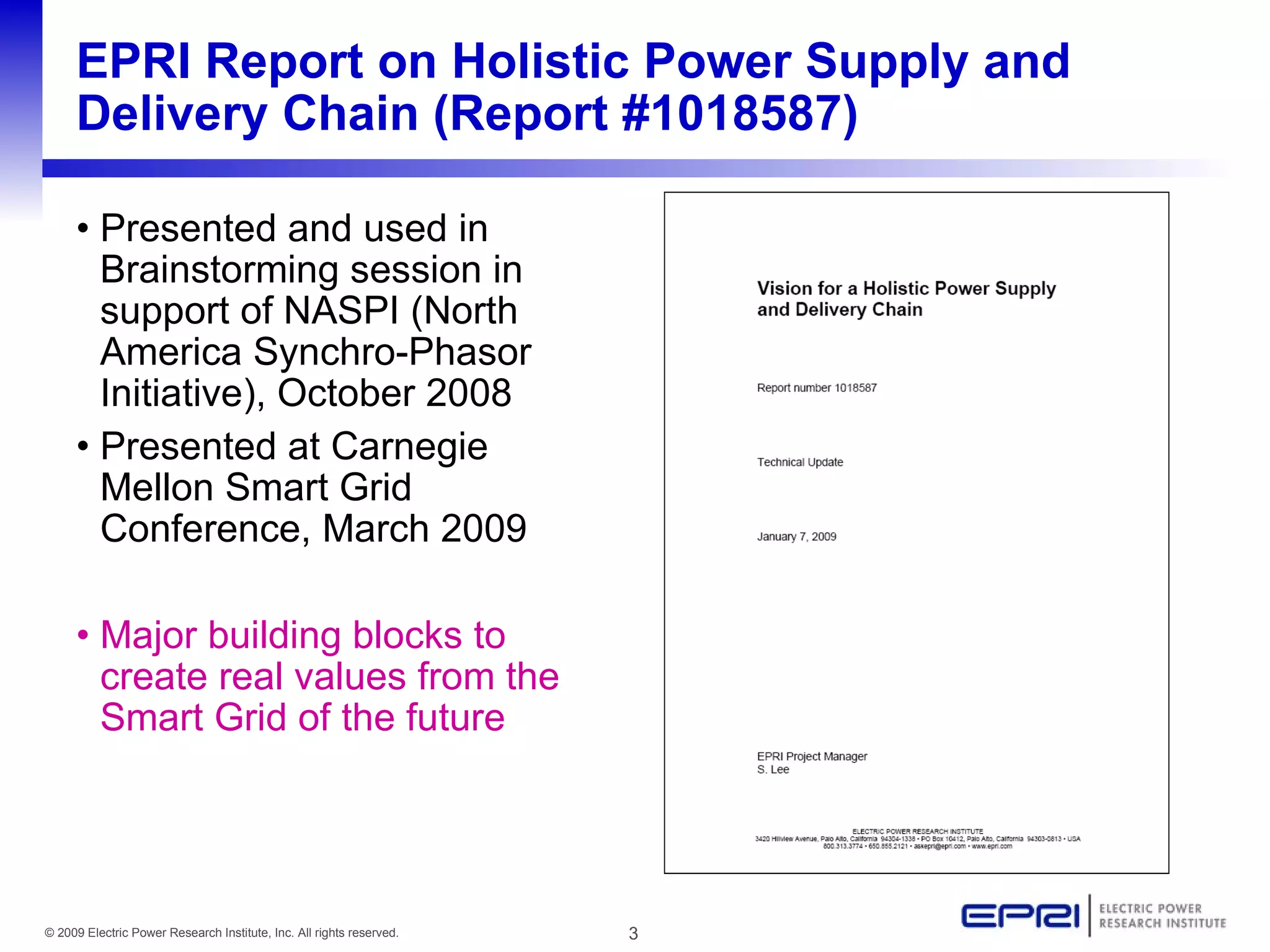
EPRI Report on Holistic Power Supply and
     Delivery Chain (Report #1018587)

     • Presented and used in
       Brainstorming session in
       support of NASPI (North
       America Synchro-Phasor
       Initiative), October 2008
     • Presented at Carnegie
       Mellon Smart Grid
       Conference, March 2009

     • Major building blocks to
       create real values from the
       Smart Grid of the future


© 2009 Electric Power Research Institute, Inc. All rights reserved.   3
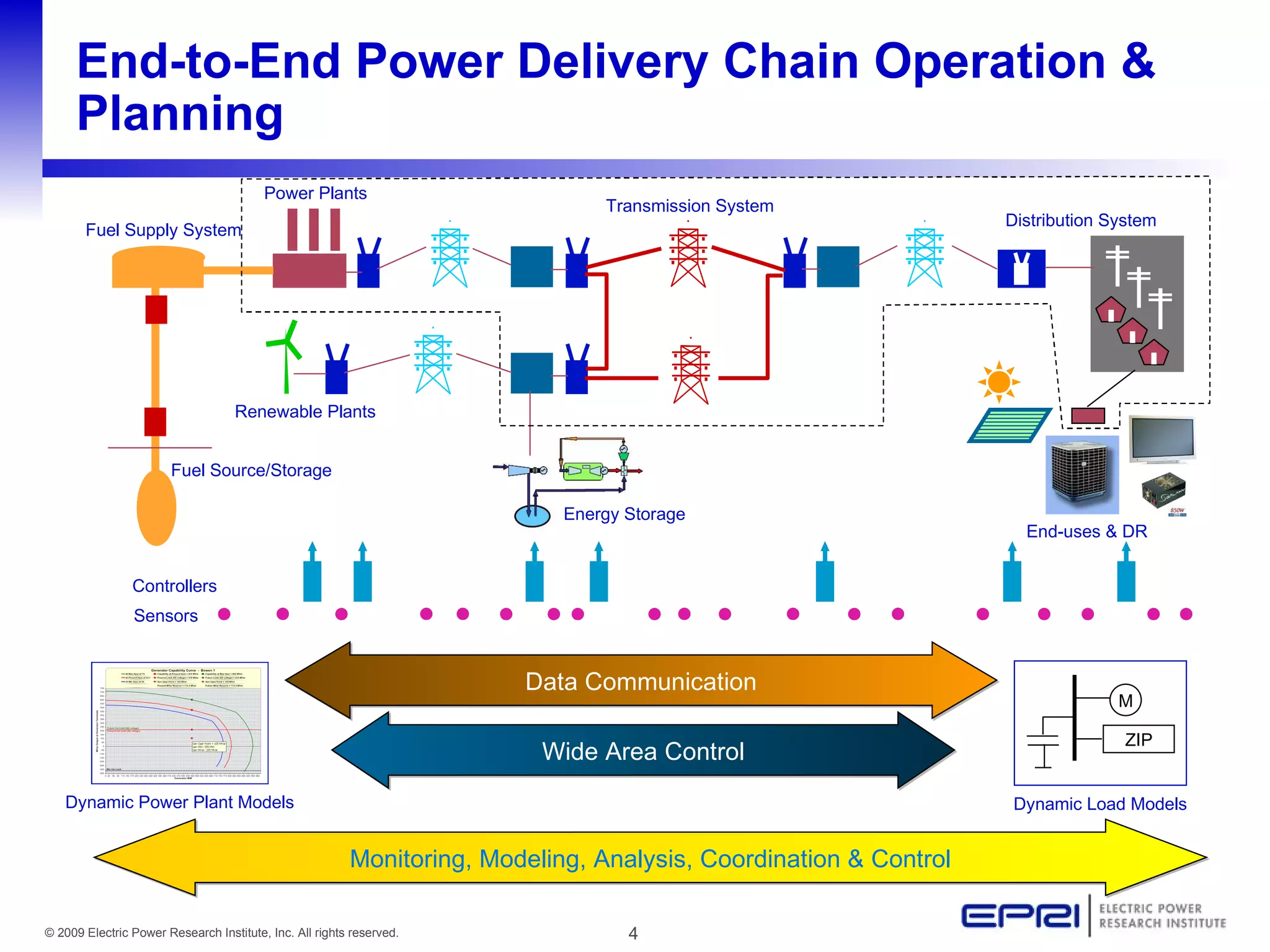
End-to-End Power Delivery Chain Operation &
     Planning
                                         Power Plants
                                                                                Transmission System
                                                                                                                  Distribution System
       Fuel Supply System


                                   Renewable Plants


                       Fuel Source/Storage

                                                                            Energy Storage
                                                                                                                    End-uses & DR


                Controllers
                Sensors


                                                                        Data Communication
                                                                                                                                M

                                                                                                                                 ZIP
                                                                          Wide Area Control
   Dynamic Power Plant Models                                                                                      Dynamic Load Models


                                                         Monitoring, Modeling, Analysis, Coordination & Control

© 2009 Electric Power Research Institute, Inc. All rights reserved.                4
Foundations Need Strengthening

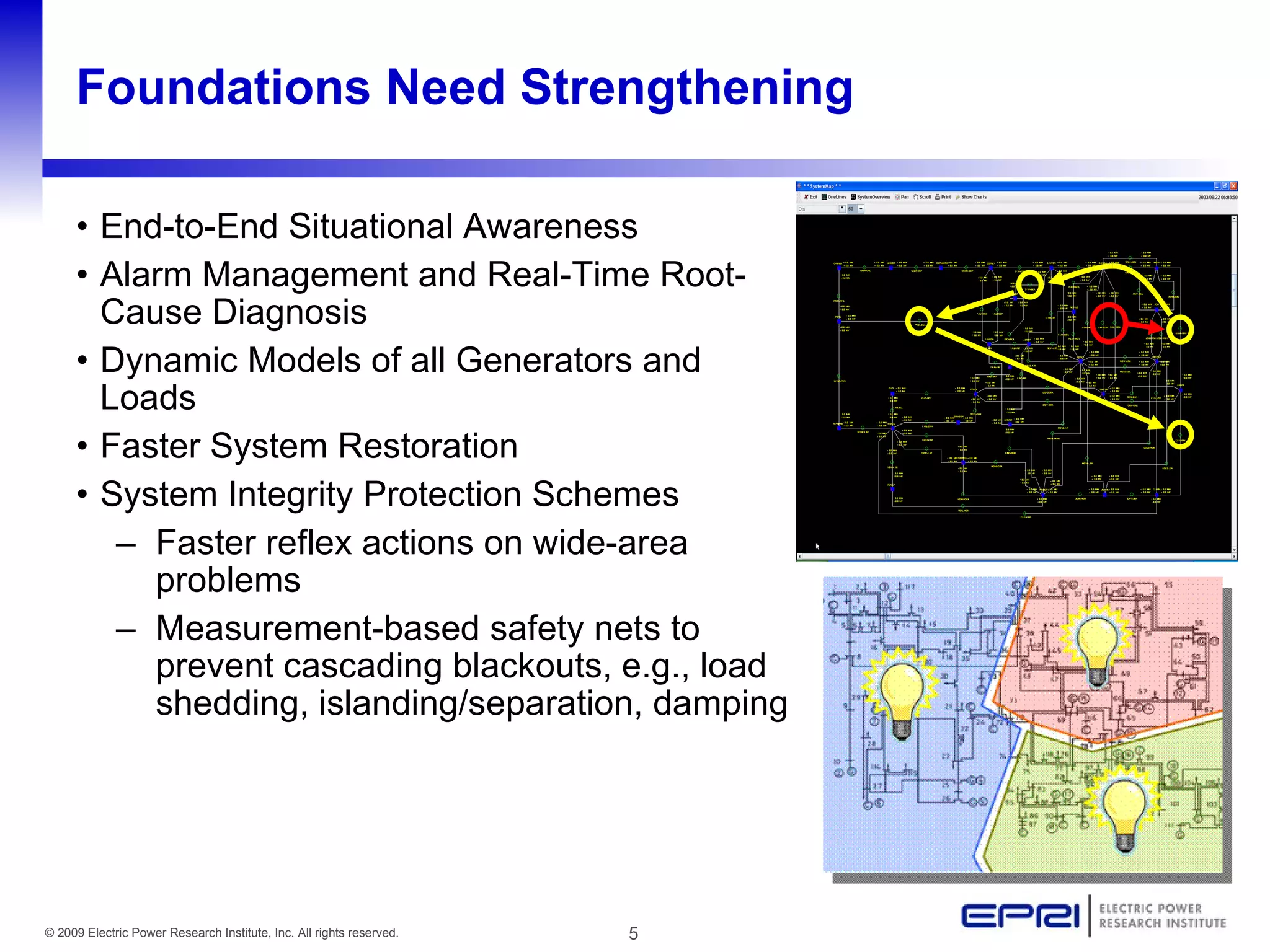
     • End-to-End Situational Awareness
     • Alarm Management and Real-Time Root-
       Cause Diagnosis
     • Dynamic Models of all Generators and
       Loads
     • Faster System Restoration
     • System Integrity Protection Schemes
        – Faster reflex actions on wide-area
          problems
        – Measurement-based safety nets to
          prevent cascading blackouts, e.g., load
          shedding, islanding/separation, damping


© 2009 Electric Power Research Institute, Inc. All rights reserved.   5
New Solutions Are Needed

     • Optimal end-to-end commitment and dispatch by ISO/RTO as
       backstop for system reliability
     • Virtual Service Aggregators serving as Energy Balancing Authorities
        – Dispatch and control stochastic renewable generation
        – Dispatch and control (and own?) large scale energy storage
           plants
        – Manage demand response proactively
        – Manage smart electric vehicle charging
     • “Virtual” Vertically Integrated Utilities
        – Own/operate Generation/renewable/storage, some transmission,
           & Virtual Service Aggregator
        – Interstate ownership and operation (overcome NIMBY-ism)
     • National/Continental Backbone Transmission Grid
        – Holistic transmission planning
        – Virtual RTO
        – Transmission toll collection system
                                         http://www.energypulse.net/centers/author.cfm?at_id=259

© 2009 Electric Power Research Institute, Inc. All rights reserved.   6
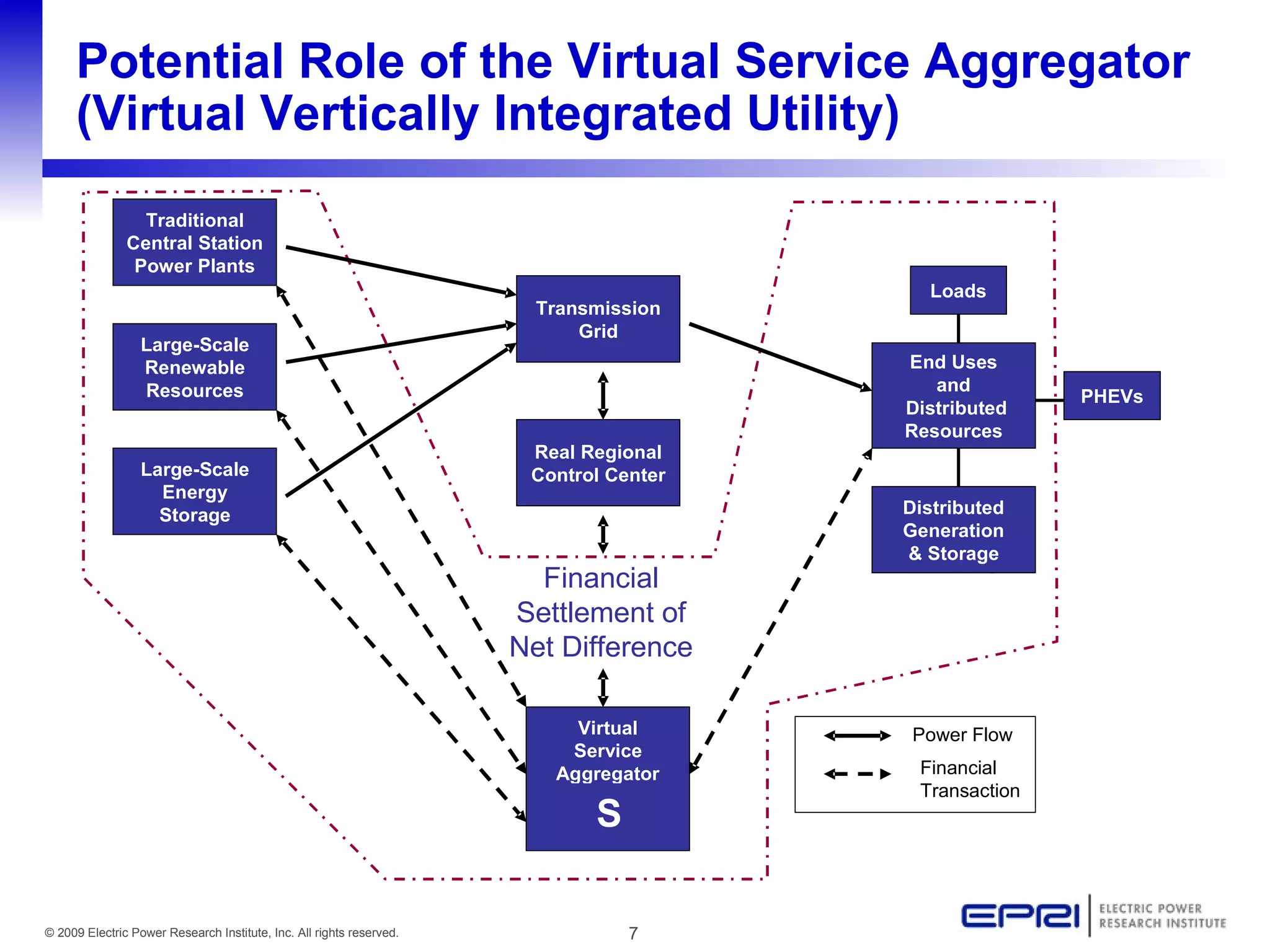
Potential Role of the Virtual Service Aggregator
     (Virtual Vertically Integrated Utility)
                 Traditional
                  Traditional
               Central Station
                Central Station
                Power Plants
                 Power Plants
                                                                                           Loads
                                                                        Transmission        Loads
                                                                         Transmission
                                                                            Grid
                                                                             Grid
                  Large-Scale
                   Large-Scale                                                           End Uses
                  Renewable
                   Renewable                                                              End Uses
                  Resources                                                                 and
                   Resources                                                                  and       PHEVs
                                                                                         Distributed     PHEVs
                                                                                          Distributed
                                                                                         Resources
                                                                                          Resources
                                                                       Real Regional
                                                                        Real Regional
                  Large-Scale                                          Control Center
                   Large-Scale                                          Control Center
                    Energy
                     Energy
                    Storage                                                              Distributed
                     Storage                                                              Distributed
                                                                                         Generation
                                                                                          Generation
                                                                                         & Storage
                                                                                          & Storage
                                                                        Financial
                                                                      Settlement of
                                                                      Net Difference

                                                                           Virtual
                                                                            Virtual       Power Flow
                                                                           Service
                                                                            Service
                                                                         Aggregator       Financial
                                                                          Aggregator      Transaction
                                                                             S

© 2009 Electric Power Research Institute, Inc. All rights reserved.              7
What is Holistic Planning?

     • Holistic Planning is to develop a whole or a part of the
       electric power system, with full consideration of the
       WHOLE, responsive to the public, modeling all
       reasonably probable scenarios of uncertainties affecting
       planning as well as future power system operating
       conditions, with additional tests to assess the robustness
       of the system when exposed to “unlikely” but potentially
       devastating disturbances or other events, in order to
       achieve a system which has:
        – Economic efficiency
        – Adequate reliability
        – Acceptable environmental impacts


© 2009 Electric Power Research Institute, Inc. All rights reserved.   8
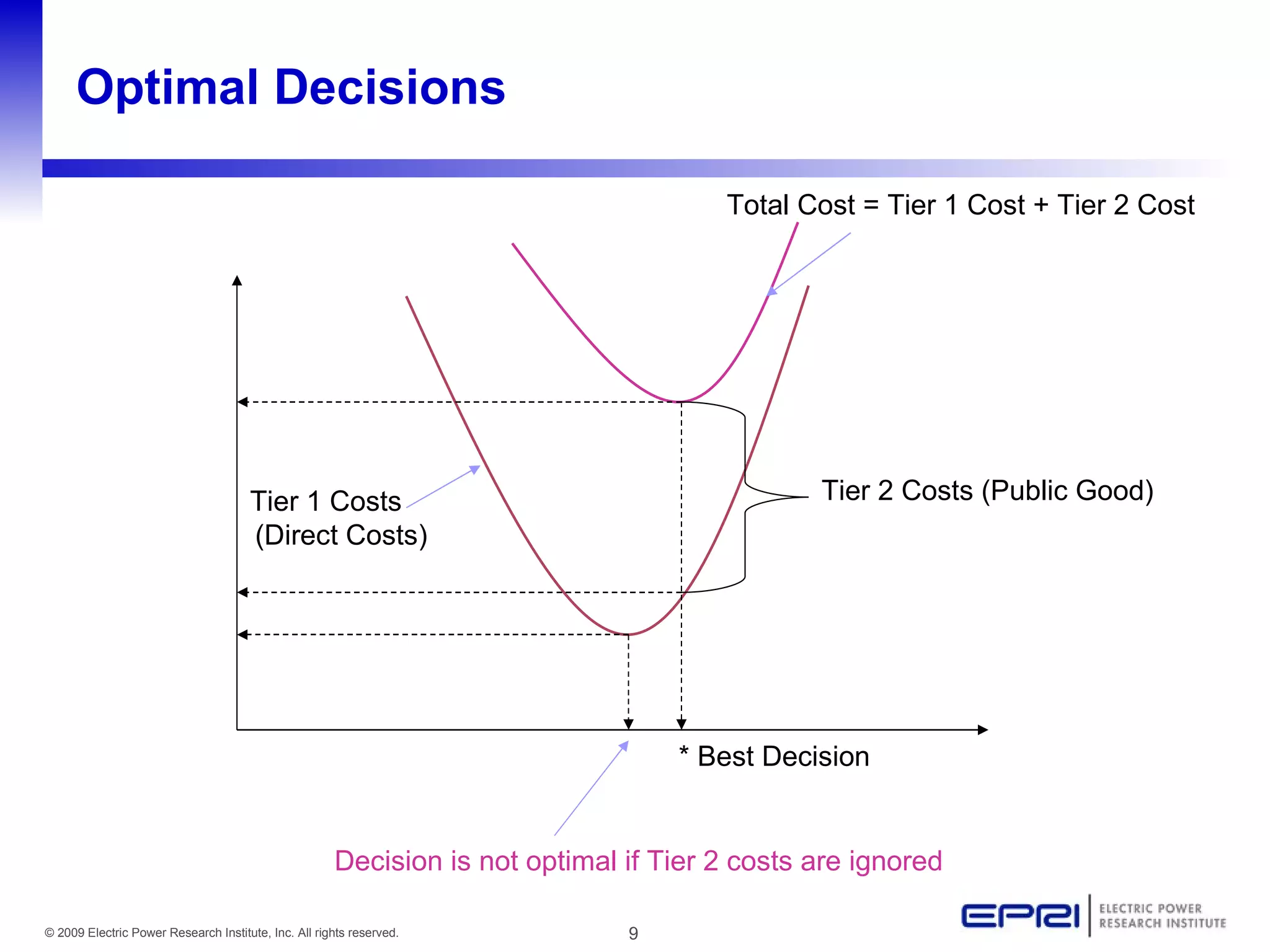
Optimal Decisions

                                                                                      Total Cost = Tier 1 Cost + Tier 2 Cost


                                      Tier 1 Costs                                            Tier 2 Costs (Public Good)
                                      (Direct Costs)


                                                                                  * Best Decision


                                                      Decision is not optimal if Tier 2 costs are ignored

© 2009 Electric Power Research Institute, Inc. All rights reserved.           9
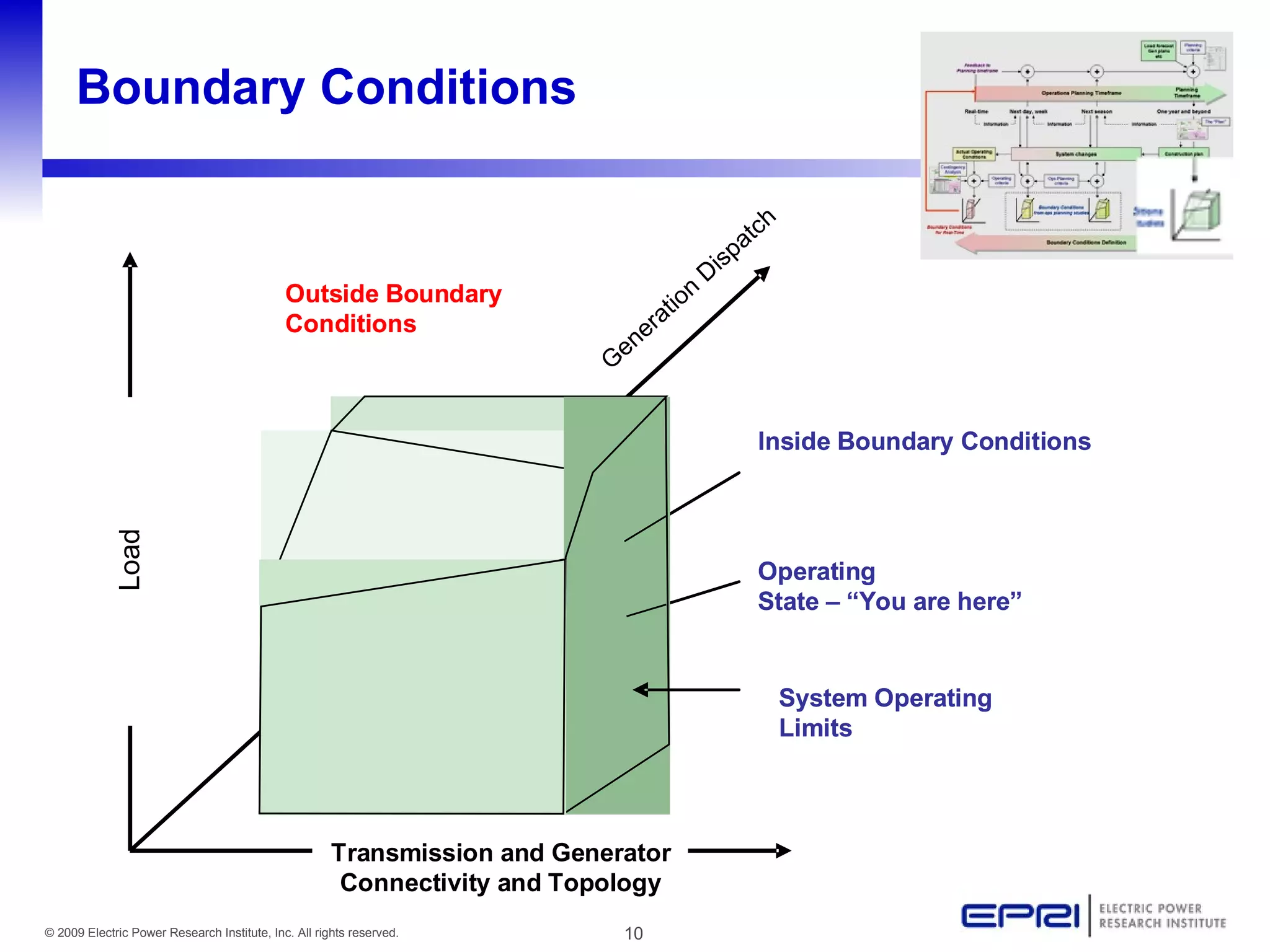
Boundary Conditions

                                                                                                    Wh
                                                                                                 Mtc
                                                                                                  a
                                                                                               –p
                                                                                             sis
                                                                                             D
                                             Outside Boundary                            ow
                                                                                       ilo
                                                                                           n
                                                                                    Ft
                                             Conditions
                                                                              n erra
                                                                             ew
                                                                           Po
                                                                           G
            Load and Load Profile


                                                                                                  Inside Boundary Conditions
                     Voltage


                                                                                                  Operating
                                                                                                  State – “You are here”


                                                                                                         System Operating
                                                                                                         Limits


                                                      Transmission and Generator
                                                       Connectivity and Topology
© 2009 Electric Power Research Institute, Inc. All rights reserved.          10
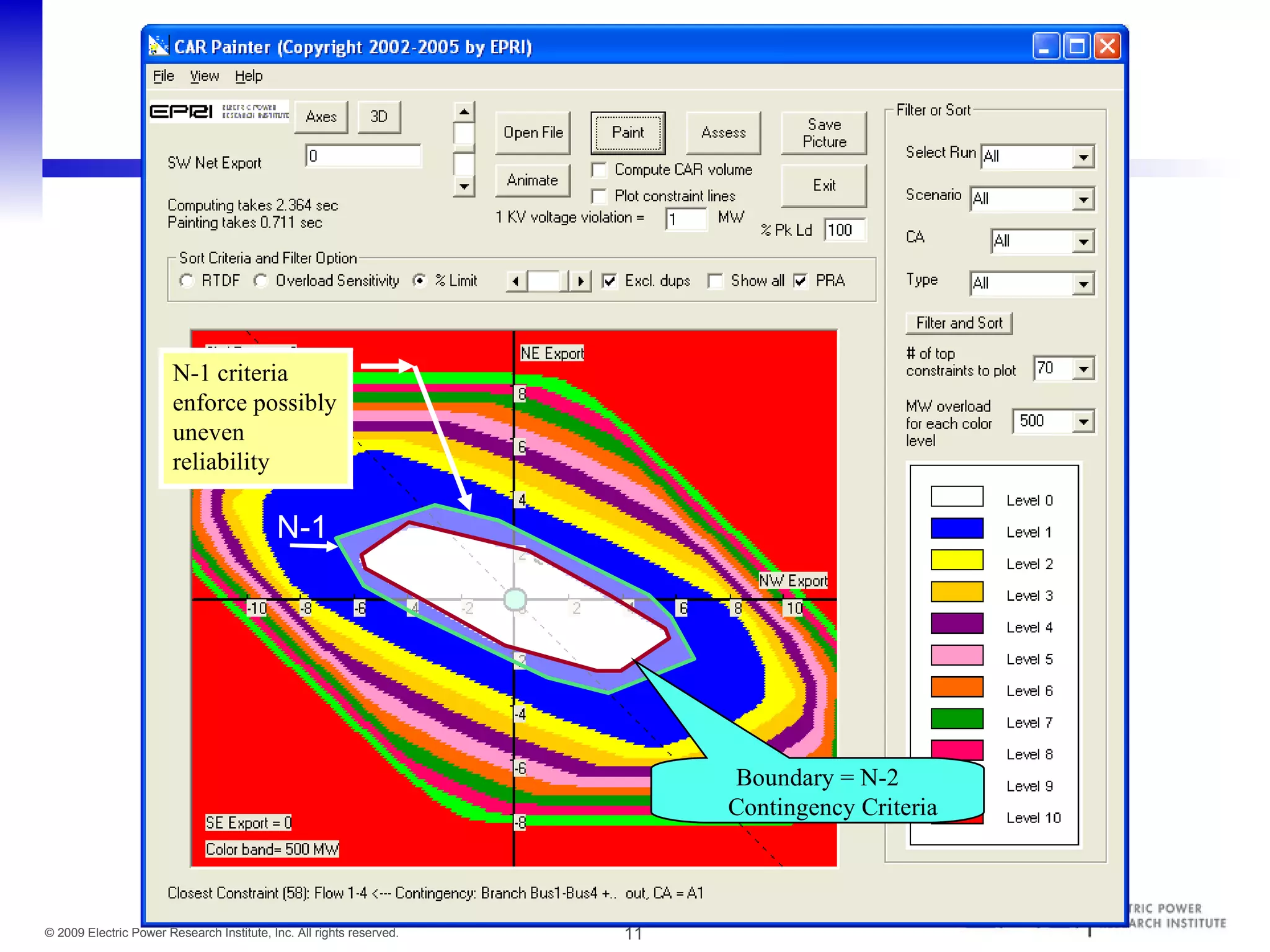
N-1 criteria
                        enforce possibly
                        uneven
                        reliability

                                           N-1


                                                                           Boundary = N-2
                                                                           Contingency Criteria


© 2009 Electric Power Research Institute, Inc. All rights reserved.   11
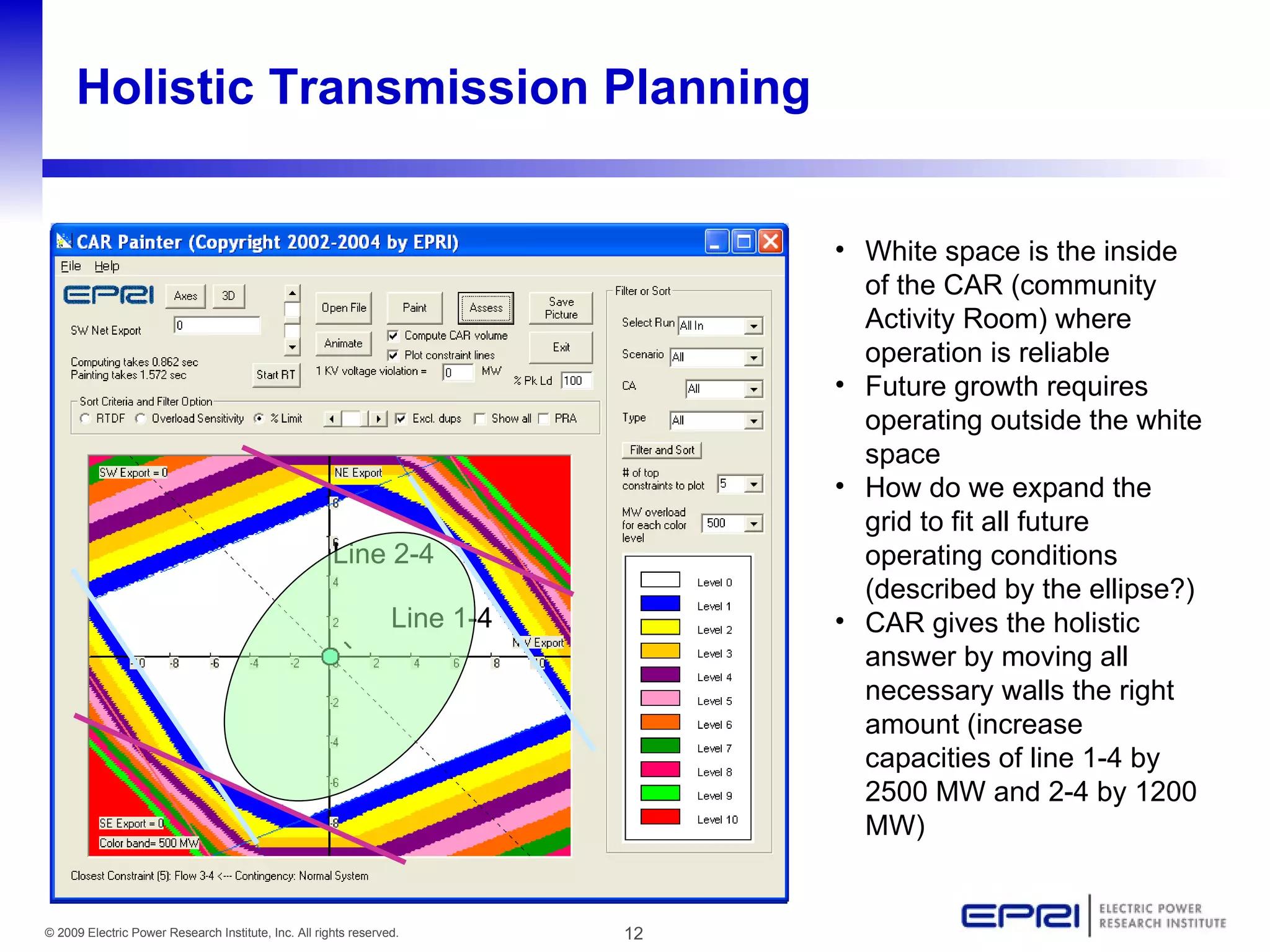
Holistic Transmission Planning


                                                                                 • White space is the inside
                                                                                   of the CAR (community
                                                                                   Activity Room) where
                                                                                   operation is reliable
                                                                                 • Future growth requires
                                                                                   operating outside the white
                                                                                   space
                                                                                 • How do we expand the
                                                                                   grid to fit all future
                                                      Line 2-4                     operating conditions
                                                                                   (described by the ellipse?)
                                                                 Line 1-4        • CAR gives the holistic
                                                                                   answer by moving all
                                                                                   necessary walls the right
                                                                                   amount (increase
                                                                                   capacities of line 1-4 by
                                                                                   2500 MW and 2-4 by 1200
                                                                                   MW)


© 2009 Electric Power Research Institute, Inc. All rights reserved.         12
NERC TPL-001-01 (Transmission System Planning
     Performance Requirements) “Raises the Bar”

     • Draft 3 posted on 5/26/09 -
       Comments due 7/9/09
     • Loss of Non-Consequential Load or                                   Implications:
       interruption of firm transfers is no
       longer allowed for certain events                                   Need to study
       (effects of cascading outages)                                       cascading outages
     • May have significant budget, siting,
       permitting, and construction impacts                                Need to assure
       on many Transmission Owners                                          system stability
     • Submit standard(s) to NERC Board –                                   with sufficient
       1Q2010                                                               confidence
     • Submit to regulatory authorities for
       approval – 1Q2010


© 2009 Electric Power Research Institute, Inc. All rights reserved.   13
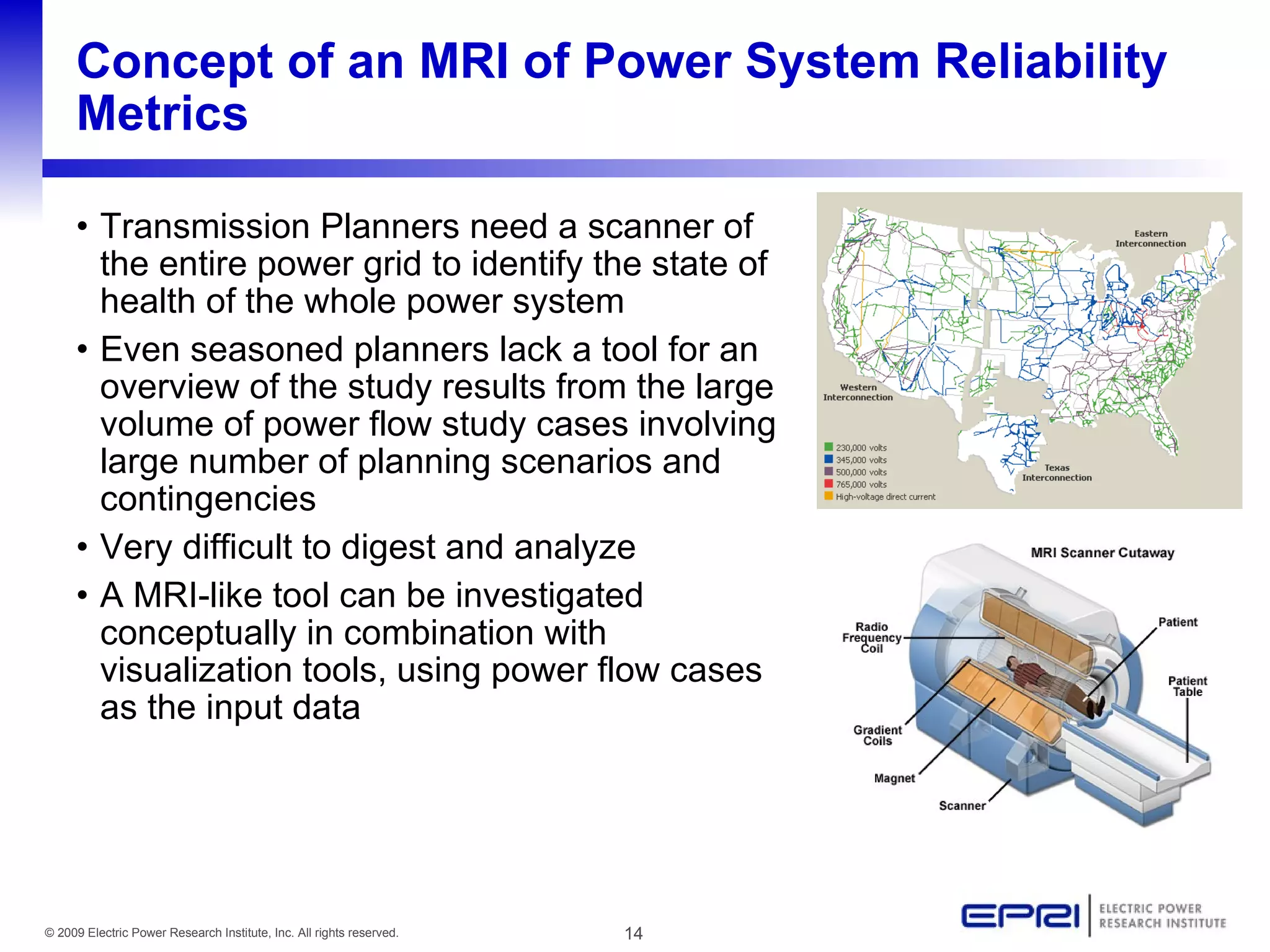
Concept of an MRI of Power System Reliability
     Metrics

     • Transmission Planners need a scanner of
       the entire power grid to identify the state of
       health of the whole power system
     • Even seasoned planners lack a tool for an
       overview of the study results from the large
       volume of power flow study cases involving
       large number of planning scenarios and
       contingencies
     • Very difficult to digest and analyze
     • A MRI-like tool can be investigated
       conceptually in combination with
       visualization tools, using power flow cases
       as the input data


© 2009 Electric Power Research Institute, Inc. All rights reserved.   14
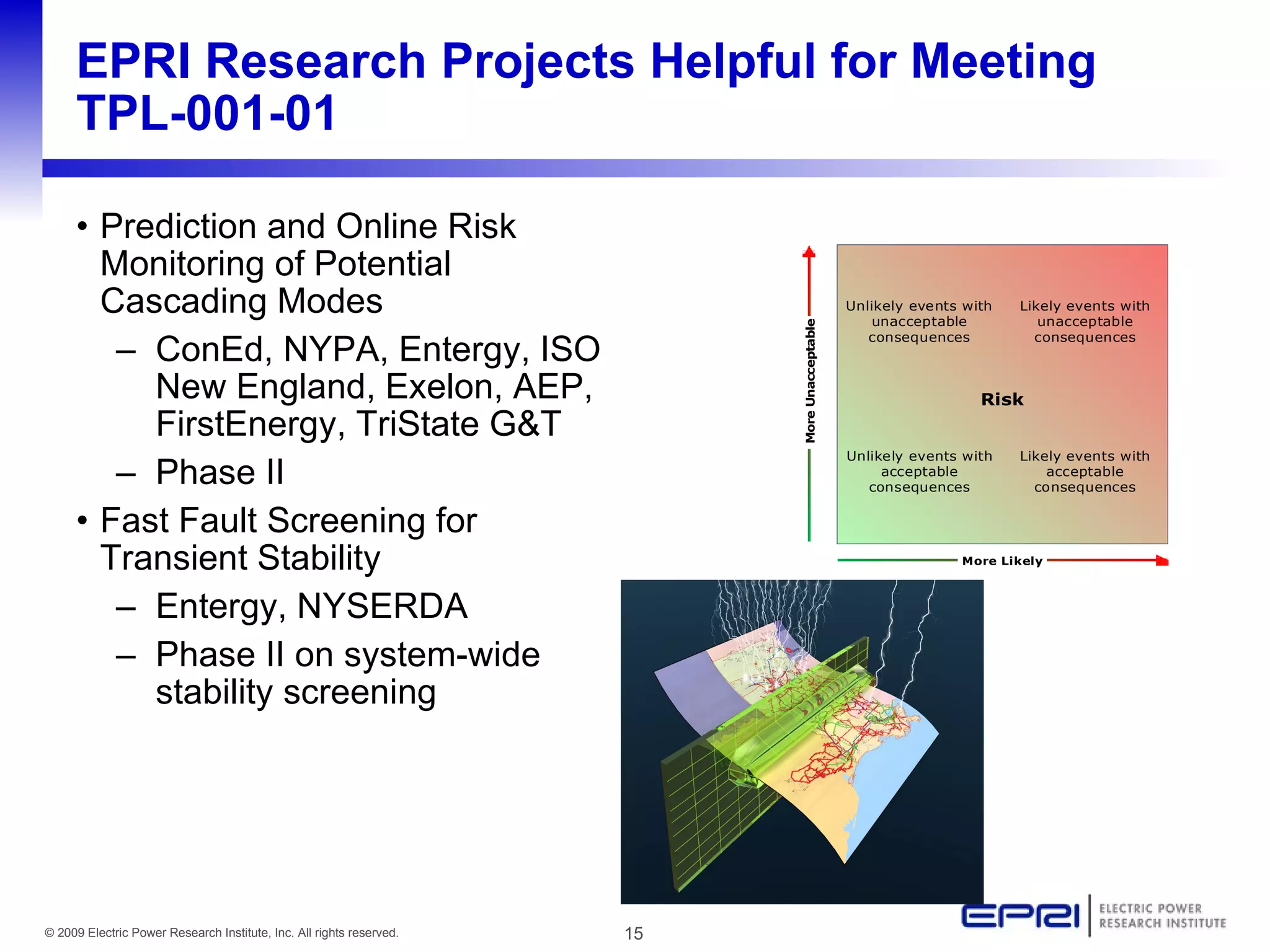
EPRI Research Projects Helpful for Meeting
     TPL-001-01

     • Prediction and Online Risk
       Monitoring of Potential
       Cascading Modes                                                                         Unlikely events with
                                                                                                   unacceptable
                                                                                                                      Likely events with
                                                                                                                         unacceptable


                                                                           More Unacceptable
                                                                                                  consequences          consequences
        – ConEd, NYPA, Entergy, ISO
          New England, Exelon, AEP,                                                                              Risk
          FirstEnergy, TriState G&T
                                                                                               Unlikely events with   Likely events with
        – Phase II                                                                                  acceptable
                                                                                                  consequences
                                                                                                                          acceptable
                                                                                                                        consequences


     • Fast Fault Screening for
       Transient Stability                                                                                    More Likely


        – Entergy, NYSERDA
        – Phase II on system-wide
          stability screening


© 2009 Electric Power Research Institute, Inc. All rights reserved.   15
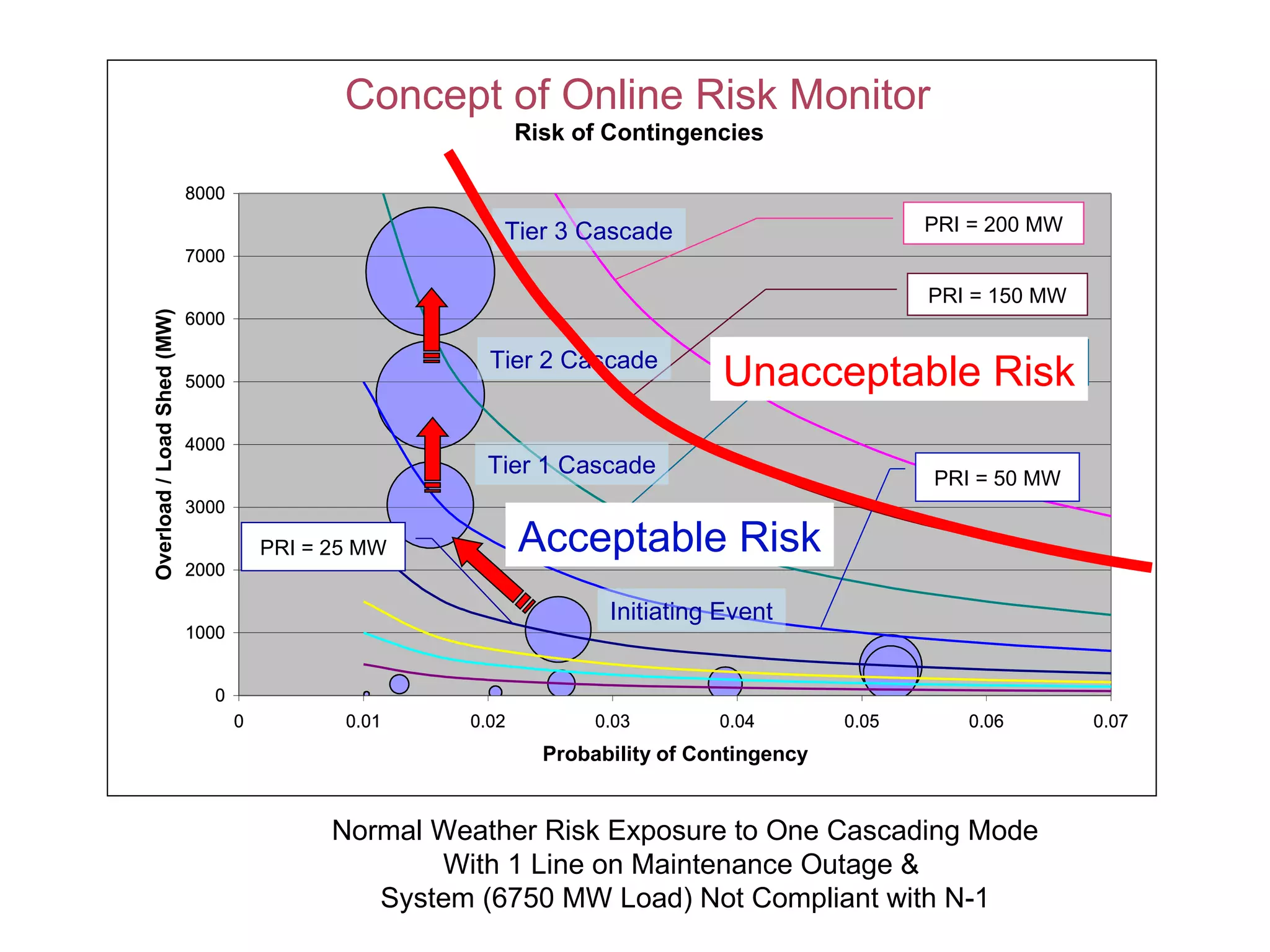
Concept of Online Risk Monitor
                                                             Risk of Contingencies

                            8000

                                                         Tier 3 Cascade                            PRI = 200 MW
                            7000

                                                                                                   PRI = 150 MW
Overload / Load Shed (MW)


                            6000

                                                        Tier 2 Cascade
                            5000                                                Unacceptable= Risk
                                                                                          PRI 90 MW


                            4000
                                                        Tier 1 Cascade                             PRI = 50 MW
                            3000

                                       PRI = 25 MW           Acceptable Risk
                            2000

                                                                     Initiating Event
                            1000


                               0
                                   0          0.01    0.02          0.03        0.04        0.05      0.06        0.07
                                                               Probability of Contingency


                                             Normal Weather Risk Exposure to One Cascading Mode
                                                    With 1 Line on Maintenance Outage &
                                                System (6750 MW Load) Not Compliant with N-1
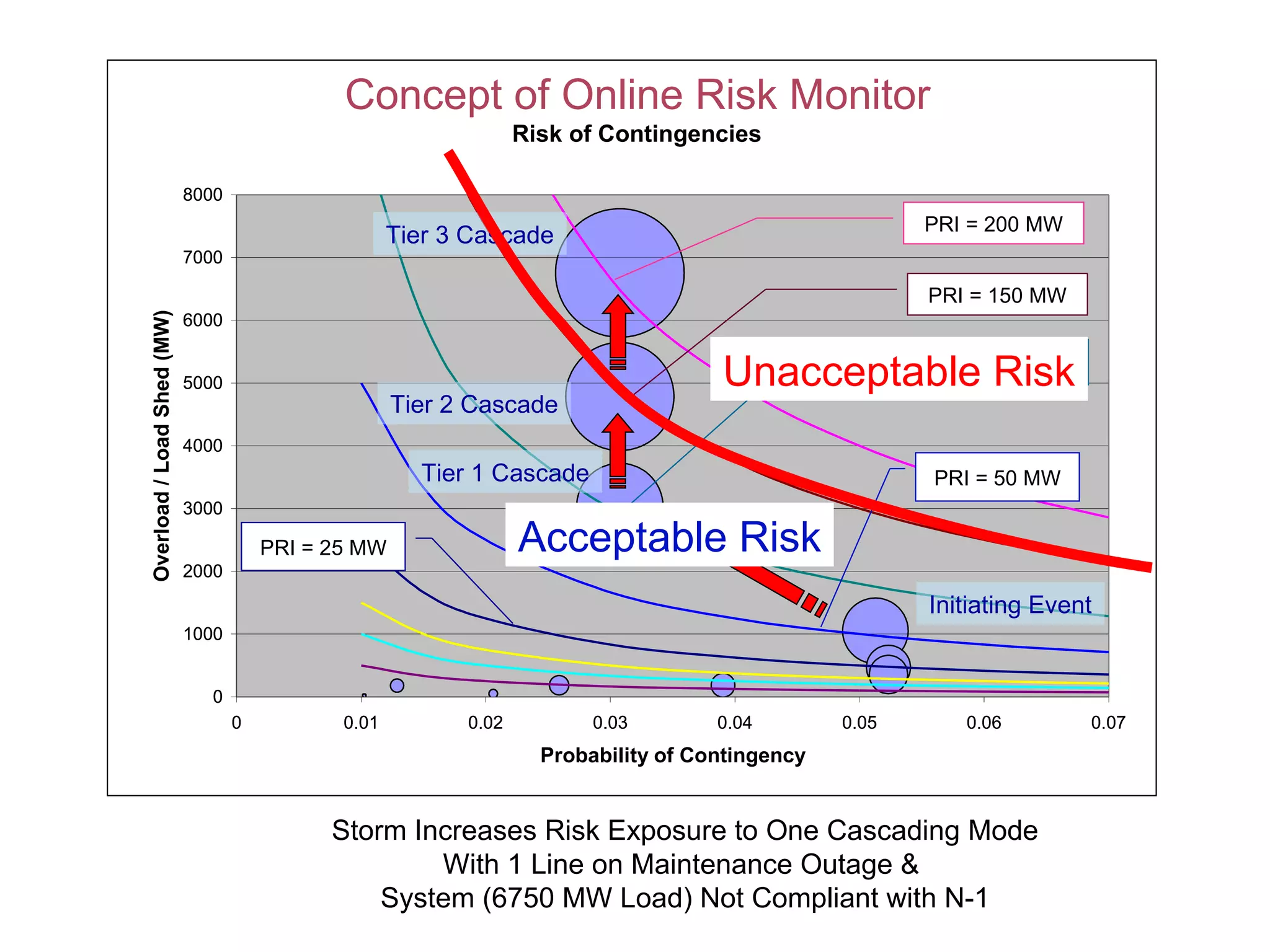
Concept of Online Risk Monitor
                                                                  Risk of Contingencies

                            8000
                                                                                                        PRI = 200 MW
                                                     Tier 3 Cascade
                            7000

                                                                                                        PRI = 150 MW
Overload / Load Shed (MW)


                            6000


                            5000                                                     Unacceptable= Risk
                                                                                               PRI 90 MW
                                                     Tier 2 Cascade
                            4000
                                                       Tier 1 Cascade                                   PRI = 50 MW
                            3000

                                       PRI = 25 MW                Acceptable Risk
                            2000

                                                                                                        Initiating Event
                            1000


                               0
                                   0          0.01         0.02          0.03        0.04        0.05      0.06        0.07
                                                                    Probability of Contingency


                                             Storm Increases Risk Exposure to One Cascading Mode
                                                     With 1 Line on Maintenance Outage &
                                                 System (6750 MW Load) Not Compliant with N-1
Conclusions

     • Holistic Planning – works for central planning, free
       markets or mixed environment
     • What is the optimal level of reliability?
     • Key Messages for Smart Grid:
        – Focus on Benefits to Cost Payback
        – Consider all parts together (Holistic approach)
        – Remove deficiencies in foundations
        – Implement new solutions


                                                                      THANK YOU!
                                                                        slee@epri.com

© 2009 Electric Power Research Institute, Inc. All rights reserved.          18

Future Planning in Power Grid

  • 1.
    Future System Planningto Meet New Challenges Stephen Lee Senior Technical Executive Power Delivery & Utilization June 17, 2009 10th International Workshop on Electric Power Control Centers Dublin, Ireland
  • 2.
    Outline • Holistic Power Supply and Delivery Chain – Foundations for a Smart Grid • Holistic Planning • Raising the Bar on Reliability Standards • Key Messages – Focus on Benefits to Cost Payback – Consider all parts together (Holistic approach) – Remove deficiencies in foundations – Implement new solutions © 2009 Electric Power Research Institute, Inc. All rights reserved. 2
  • 3.
    EPRI Report onHolistic Power Supply and Delivery Chain (Report #1018587) • Presented and used in Brainstorming session in support of NASPI (North America Synchro-Phasor Initiative), October 2008 • Presented at Carnegie Mellon Smart Grid Conference, March 2009 • Major building blocks to create real values from the Smart Grid of the future © 2009 Electric Power Research Institute, Inc. All rights reserved. 3
  • 4.
    End-to-End Power DeliveryChain Operation & Planning Power Plants Transmission System Distribution System Fuel Supply System Renewable Plants Fuel Source/Storage Energy Storage End-uses & DR Controllers Sensors Data Communication M ZIP Wide Area Control Dynamic Power Plant Models Dynamic Load Models Monitoring, Modeling, Analysis, Coordination & Control © 2009 Electric Power Research Institute, Inc. All rights reserved. 4
  • 5.
    Foundations Need Strengthening • End-to-End Situational Awareness • Alarm Management and Real-Time Root- Cause Diagnosis • Dynamic Models of all Generators and Loads • Faster System Restoration • System Integrity Protection Schemes – Faster reflex actions on wide-area problems – Measurement-based safety nets to prevent cascading blackouts, e.g., load shedding, islanding/separation, damping © 2009 Electric Power Research Institute, Inc. All rights reserved. 5
  • 6.
    New Solutions AreNeeded • Optimal end-to-end commitment and dispatch by ISO/RTO as backstop for system reliability • Virtual Service Aggregators serving as Energy Balancing Authorities – Dispatch and control stochastic renewable generation – Dispatch and control (and own?) large scale energy storage plants – Manage demand response proactively – Manage smart electric vehicle charging • “Virtual” Vertically Integrated Utilities – Own/operate Generation/renewable/storage, some transmission, & Virtual Service Aggregator – Interstate ownership and operation (overcome NIMBY-ism) • National/Continental Backbone Transmission Grid – Holistic transmission planning – Virtual RTO – Transmission toll collection system http://www.energypulse.net/centers/author.cfm?at_id=259 © 2009 Electric Power Research Institute, Inc. All rights reserved. 6
  • 7.
    Potential Role ofthe Virtual Service Aggregator (Virtual Vertically Integrated Utility) Traditional Traditional Central Station Central Station Power Plants Power Plants Loads Transmission Loads Transmission Grid Grid Large-Scale Large-Scale End Uses Renewable Renewable End Uses Resources and Resources and PHEVs Distributed PHEVs Distributed Resources Resources Real Regional Real Regional Large-Scale Control Center Large-Scale Control Center Energy Energy Storage Distributed Storage Distributed Generation Generation & Storage & Storage Financial Settlement of Net Difference Virtual Virtual Power Flow Service Service Aggregator Financial Aggregator Transaction S © 2009 Electric Power Research Institute, Inc. All rights reserved. 7
  • 8.
    What is HolisticPlanning? • Holistic Planning is to develop a whole or a part of the electric power system, with full consideration of the WHOLE, responsive to the public, modeling all reasonably probable scenarios of uncertainties affecting planning as well as future power system operating conditions, with additional tests to assess the robustness of the system when exposed to “unlikely” but potentially devastating disturbances or other events, in order to achieve a system which has: – Economic efficiency – Adequate reliability – Acceptable environmental impacts © 2009 Electric Power Research Institute, Inc. All rights reserved. 8
  • 9.
    Optimal Decisions Total Cost = Tier 1 Cost + Tier 2 Cost Tier 1 Costs Tier 2 Costs (Public Good) (Direct Costs) * Best Decision Decision is not optimal if Tier 2 costs are ignored © 2009 Electric Power Research Institute, Inc. All rights reserved. 9
  • 10.
    Boundary Conditions Wh Mtc a –p sis D Outside Boundary ow ilo n Ft Conditions n erra ew Po G Load and Load Profile Inside Boundary Conditions Voltage Operating State – “You are here” System Operating Limits Transmission and Generator Connectivity and Topology © 2009 Electric Power Research Institute, Inc. All rights reserved. 10
  • 11.
    N-1 criteria enforce possibly uneven reliability N-1 Boundary = N-2 Contingency Criteria © 2009 Electric Power Research Institute, Inc. All rights reserved. 11
  • 12.
    Holistic Transmission Planning • White space is the inside of the CAR (community Activity Room) where operation is reliable • Future growth requires operating outside the white space • How do we expand the grid to fit all future Line 2-4 operating conditions (described by the ellipse?) Line 1-4 • CAR gives the holistic answer by moving all necessary walls the right amount (increase capacities of line 1-4 by 2500 MW and 2-4 by 1200 MW) © 2009 Electric Power Research Institute, Inc. All rights reserved. 12
  • 13.
    NERC TPL-001-01 (TransmissionSystem Planning Performance Requirements) “Raises the Bar” • Draft 3 posted on 5/26/09 - Comments due 7/9/09 • Loss of Non-Consequential Load or Implications: interruption of firm transfers is no longer allowed for certain events Need to study (effects of cascading outages) cascading outages • May have significant budget, siting, permitting, and construction impacts Need to assure on many Transmission Owners system stability • Submit standard(s) to NERC Board – with sufficient 1Q2010 confidence • Submit to regulatory authorities for approval – 1Q2010 © 2009 Electric Power Research Institute, Inc. All rights reserved. 13
  • 14.
    Concept of anMRI of Power System Reliability Metrics • Transmission Planners need a scanner of the entire power grid to identify the state of health of the whole power system • Even seasoned planners lack a tool for an overview of the study results from the large volume of power flow study cases involving large number of planning scenarios and contingencies • Very difficult to digest and analyze • A MRI-like tool can be investigated conceptually in combination with visualization tools, using power flow cases as the input data © 2009 Electric Power Research Institute, Inc. All rights reserved. 14
  • 15.
    EPRI Research ProjectsHelpful for Meeting TPL-001-01 • Prediction and Online Risk Monitoring of Potential Cascading Modes Unlikely events with unacceptable Likely events with unacceptable More Unacceptable consequences consequences – ConEd, NYPA, Entergy, ISO New England, Exelon, AEP, Risk FirstEnergy, TriState G&T Unlikely events with Likely events with – Phase II acceptable consequences acceptable consequences • Fast Fault Screening for Transient Stability More Likely – Entergy, NYSERDA – Phase II on system-wide stability screening © 2009 Electric Power Research Institute, Inc. All rights reserved. 15
  • 16.
    Concept of OnlineRisk Monitor Risk of Contingencies 8000 Tier 3 Cascade PRI = 200 MW 7000 PRI = 150 MW Overload / Load Shed (MW) 6000 Tier 2 Cascade 5000 Unacceptable= Risk PRI 90 MW 4000 Tier 1 Cascade PRI = 50 MW 3000 PRI = 25 MW Acceptable Risk 2000 Initiating Event 1000 0 0 0.01 0.02 0.03 0.04 0.05 0.06 0.07 Probability of Contingency Normal Weather Risk Exposure to One Cascading Mode With 1 Line on Maintenance Outage & System (6750 MW Load) Not Compliant with N-1
  • 17.
    Concept of OnlineRisk Monitor Risk of Contingencies 8000 PRI = 200 MW Tier 3 Cascade 7000 PRI = 150 MW Overload / Load Shed (MW) 6000 5000 Unacceptable= Risk PRI 90 MW Tier 2 Cascade 4000 Tier 1 Cascade PRI = 50 MW 3000 PRI = 25 MW Acceptable Risk 2000 Initiating Event 1000 0 0 0.01 0.02 0.03 0.04 0.05 0.06 0.07 Probability of Contingency Storm Increases Risk Exposure to One Cascading Mode With 1 Line on Maintenance Outage & System (6750 MW Load) Not Compliant with N-1
  • 18.
    Conclusions • Holistic Planning – works for central planning, free markets or mixed environment • What is the optimal level of reliability? • Key Messages for Smart Grid: – Focus on Benefits to Cost Payback – Consider all parts together (Holistic approach) – Remove deficiencies in foundations – Implement new solutions THANK YOU! slee@epri.com © 2009 Electric Power Research Institute, Inc. All rights reserved. 18