
By Greete Kereme
   Introduction
   Lameness Structure
    ◦ Phase 1
    ◦ Phase 2-3
   Prevention
    ◦ Lameness Control program
   Effect on productivity
   Conclusion
   Increasing problem in dairy cattles
   Painful for animal
   Effects productivity:
-   Milk production
-   Pregnancy
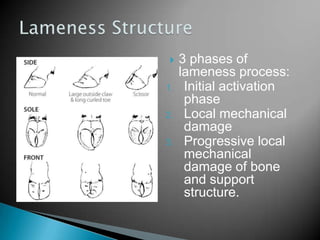
   3 phases of
     lameness process:
1.    Initial activation
      phase
2.    Local mechanical
      damage
3.    Progressive local
      mechanical
      damage of bone
      and support
      structure.
   Associated with a systemic metabolic insult
   Vasoactive mehanism increases digital pulse and
    total blood flow.
   Expansion of the corium
   Associated with the vascular system.
   Fewer nutriens and less oxygen reaches to the
    epidermal cells.
   “Heart attack” of the feet -> phase 3, where bone
    shifts in position.
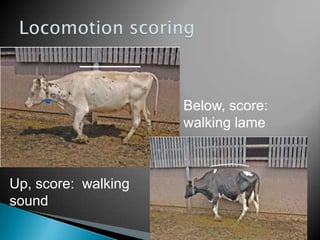
   Locomotion scoring - reproducible technique, it
    consists of watching each cow walk on an even
    non-slip surface. (sound, uneven/slow, lame
   Routine foot trimming – likely the most important
    control measure for reducing lameness.
Below, score:
                     walking lame


Up, score: walking
sound
   Monitoring lameness incidence and causes
   A planned foot trimming program
   Strategic, regular footbathing
   Prompt treatment of lame cows
   Specific management of first lactation cattle
   Clean and comfortable walking surface for
    the cows.
   Decline in milk production 0,5 to 1,5 lts/day
   Causes late pregnancy
   Prolongs calving interval by 35-50 days.
   Animals whose lying time after calving gets
    redused are more likely to suffer claw horn
    diseas in peak or mid lactation.
   Lameness can be easily prevented with right
    strategy.
   As an huge effect on animal health and
    production.
“Recent Concepts in the Aetiopathogenesis
 of Foot Lameness in Cattle”
Authors: U N Zahid, Swaran S Randhawa and
 M A Ganie.
http://vetscan.co.in/v5n2/62-foot-lameness-
 cattle.htm
Preventing lameness in dairy cows: hoof lesions;
 their identification, treatment, management and
 prevention.
Authors: Colin Mason, Jill Offer
http://www.sac.ac.uk/mainrep/pdfs/tn599lamene
 ss.pdf

Foot Lameness in Cattle

  • 1.
  • 2.
    Introduction  Lameness Structure ◦ Phase 1 ◦ Phase 2-3  Prevention ◦ Lameness Control program  Effect on productivity  Conclusion
  • 3.
    Increasing problem in dairy cattles  Painful for animal  Effects productivity: - Milk production - Pregnancy
  • 4.
    3 phases of lameness process: 1. Initial activation phase 2. Local mechanical damage 3. Progressive local mechanical damage of bone and support structure.
  • 5.
    Associated with a systemic metabolic insult  Vasoactive mehanism increases digital pulse and total blood flow.  Expansion of the corium
  • 6.
    Associated with the vascular system.  Fewer nutriens and less oxygen reaches to the epidermal cells.  “Heart attack” of the feet -> phase 3, where bone shifts in position.
  • 7.
    Locomotion scoring - reproducible technique, it consists of watching each cow walk on an even non-slip surface. (sound, uneven/slow, lame  Routine foot trimming – likely the most important control measure for reducing lameness.
  • 8.
    Below, score: walking lame Up, score: walking sound
  • 9.
    Monitoring lameness incidence and causes  A planned foot trimming program  Strategic, regular footbathing  Prompt treatment of lame cows  Specific management of first lactation cattle  Clean and comfortable walking surface for the cows.
  • 10.
    Decline in milk production 0,5 to 1,5 lts/day  Causes late pregnancy  Prolongs calving interval by 35-50 days.
  • 11.
    Animals whose lying time after calving gets redused are more likely to suffer claw horn diseas in peak or mid lactation.  Lameness can be easily prevented with right strategy.  As an huge effect on animal health and production.
  • 12.
    “Recent Concepts inthe Aetiopathogenesis of Foot Lameness in Cattle” Authors: U N Zahid, Swaran S Randhawa and M A Ganie. http://vetscan.co.in/v5n2/62-foot-lameness- cattle.htm Preventing lameness in dairy cows: hoof lesions; their identification, treatment, management and prevention. Authors: Colin Mason, Jill Offer http://www.sac.ac.uk/mainrep/pdfs/tn599lamene ss.pdf