



Mastitis and its effect on
milk processing
Atheer Jasim Mohammed
Topics
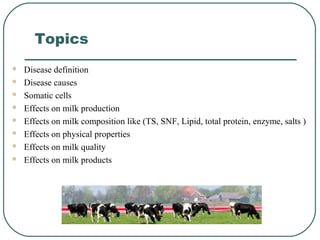
 Disease definition
 Disease causes
 Somatic cells
 Effects on milk production
 Effects on milk composition like (TS, SNF, Lipid, total protein, enzyme, salts )
 Effects on physical properties
 Effects on milk quality
 Effects on milk products
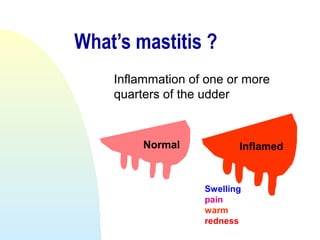
What’s mastitis ?
Inflammation of one or more
quarters of the udder
Normal Inflamed
Swelling
pain
warm
redness
How severe can mastitis
be ?
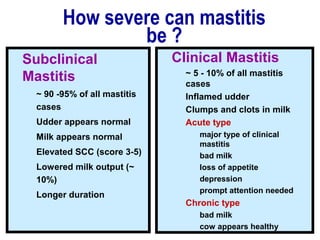
Subclinical
Mastitis
~ 90 -95% of all mastitis
cases
Udder appears normal
Milk appears normal
Elevated SCC (score 3-5)
Lowered milk output (~
10%)
Longer duration
Clinical Mastitis
~ 5 - 10% of all mastitis
cases
Inflamed udder
Clumps and clots in milk
Acute type
major type of clinical
mastitis
bad milk
loss of appetite
depression
prompt attention needed
Chronic type
bad milk
cow appears healthy
What causes mastitis ?
Bacteria ( ~ 70%)
Yeasts and molds ( ~
2%)
Unknown ( ~ 28%)
physical
trauma
weather extremes
Where do these organisms
come from ?
Infected udder
Environment
bedding
soil
water
manure
Replacement
animals
BACTERIA
Streptococci
Environmental
S. uberis
S. dysgalactiae
S. equinus
More subclinical
mastitis
Environment
Predominant early
and late lactation
Contagious
S. agalactiae
Clinical mastitis
Cannot live
outside the
udder
Treated easily
with penicillin
BACTERIA
Staphylococci
Staph. aureus
Summer mastitis
Spread by milking equipment and milker’s
hands
Persistent, difficult to eliminate
If unattended leads to chronic mastitis
Other Staph
Found normally on skin
Lowers milk yield
Elevated SCC
Easily responds to antibiotics
Relapse frequently seen
BACTERIA
Coliforms
Groups of organisms
E. coli, Klebsiella, Enterobacter
Environmental source (manure,
bedding, barns, floors and cows)
Coliforms cause acute clinical
mastitis
high temp, and inflamed quarter
watery milk with clots and pus
toxemia
vaccine
Other organisms
Pseudomonas aeruginosa
outbreaks of clinical mastitis
Serratia
outbreaks of clinical mastitis
Corynebacterium pyogenes
Fungi
Candida
Mycoplasma bovis
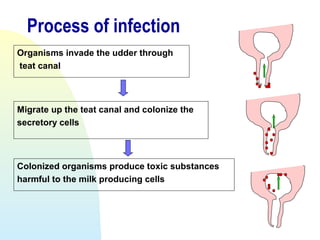
Process of infection
Organisms invade the udder through
teat canal
Migrate up the teat canal and colonize the
secretory cells
Colonized organisms produce toxic substances
harmful to the milk producing cells
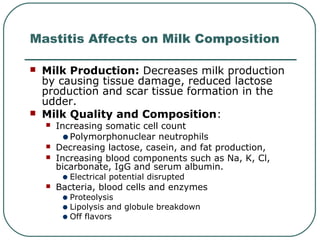
 Milk Production: Decreases milk production
by causing tissue damage, reduced lactose
production and scar tissue formation in the
udder.
 Milk Quality and Composition:
 Increasing somatic cell count
•Polymorphonuclear neutrophils
 Decreasing lactose, casein, and fat production,
 Increasing blood components such as Na, K, Cl,
bicarbonate, IgG and serum albumin.
•Electrical potential disrupted
 Bacteria, blood cells and enzymes
•Proteolysis
•Lipolysis and globule breakdown
•Off flavors
Mastitis Affects on Milk Composition
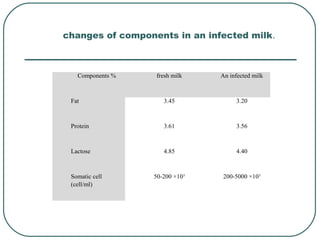
changes of components in an infected milk.
Components % fresh milk An infected milk
Fat 3.45 3.20
Protein 3.61 3.56
Lactose 4.85 4.40
Somatic cell
(cell/ml)
50-200 ×103
200-5000 ×103
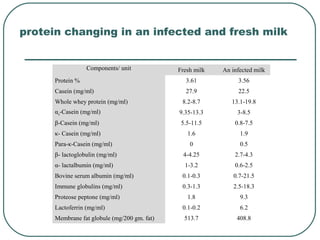
protein changing in an infected and fresh milk
Components/ unit Fresh milk An infected milk
Protein % 3.61 3.56
Casein (mg/ml) 27.9 22.5
Whole whey protein (mg/ml) 8.2-8.7 13.1-19.8
αs-Casein (mg/ml) 9.35-13.3 3-8.5
β-Casein (mg/ml) 5.5-11.5 0.8-7.5
κ- Casein (mg/ml) 1.6 1.9
Para-κ-Casein (mg/ml) 0 0.5
β- lactoglobulin (mg/ml) 4-4.25 2.7-4.3
α- lactalbumin (mg/ml) 1-3.2 0.6-2.5
Bovine serum albumin (mg/ml) 0.1-0.3 0.7-21.5
Immune globulins (mg/ml) 0.3-1.3 2.5-18.3
Proteose peptone (mg/ml) 1.8 9.3
Lactoferrin (mg/ml) 0.1-0.2 6.2
Membrane fat globule (mg/200 gm. fat) 513.7 408.8
Effects on physical properties
Isoelectric point (pH) increased with rising of somatic
cells.
no correlation between mastitis disease and freezing point
Effects on milk products
 Mastitis disease effects on cheese making via influence on time of
milk clotting by rennet, softness of clotting, more leak of whey
and developed of acidity.
 lower cohesion of clot and decreased of starter culture activity in
milk produced from infected cows.
 In study shows that infected milk takes long time to coagulate
from 23 to 11.8 minutes compared with fresh milk is 4.1 minutes.
 milk from infected animals produces low coagulate with high
whey and short storage stability with high proteolysis in yoghurt.
 infected milk effects on characteristics of butter which produced
by developed acidity and reduced of fat due to lipase activity.
 mastitis disease is causing of
 increased a SCC
 decreased of chemical composition in milk and its qualities.
 dropped of thermal stability to dairy products
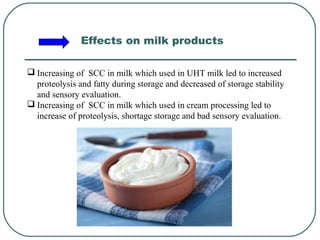
 Increasing of SCC in milk which used in UHT milk led to increased
proteolysis and fatty during storage and decreased of storage stability
and sensory evaluation.
 Increasing of SCC in milk which used in cream processing led to
increase of proteolysis, shortage storage and bad sensory evaluation.
Effects on milk products
 establishment of goals for udder health
 maintenance of clean, comfortable environment
 proper milking procedures
 proper maintenance and use of milking equipment
 good record keeping
 appropriate management of clinical mastitis during
lactation
 effective dry cow management
 maintenance of biosecurity for contagious pathogens
and culling of chronically infected cows
 regular monitoring of udder health status
 periodic review of mastitis control program
10 ways to rise milk quality and stopped mastitis
Reference in Hard copy
Thanks, Question?Thanks, Question?

Mastitis and its effect on milk processing

  • 1.
    Mastitis and itseffect on milk processing Atheer Jasim Mohammed
  • 2.
    Topics  Disease definition Disease causes  Somatic cells  Effects on milk production  Effects on milk composition like (TS, SNF, Lipid, total protein, enzyme, salts )  Effects on physical properties  Effects on milk quality  Effects on milk products
  • 3.
    What’s mastitis ? Inflammationof one or more quarters of the udder Normal Inflamed Swelling pain warm redness
  • 4.
    How severe canmastitis be ? Subclinical Mastitis ~ 90 -95% of all mastitis cases Udder appears normal Milk appears normal Elevated SCC (score 3-5) Lowered milk output (~ 10%) Longer duration Clinical Mastitis ~ 5 - 10% of all mastitis cases Inflamed udder Clumps and clots in milk Acute type major type of clinical mastitis bad milk loss of appetite depression prompt attention needed Chronic type bad milk cow appears healthy
  • 5.
    What causes mastitis? Bacteria ( ~ 70%) Yeasts and molds ( ~ 2%) Unknown ( ~ 28%) physical trauma weather extremes
  • 6.
    Where do theseorganisms come from ? Infected udder Environment bedding soil water manure Replacement animals
  • 7.
    BACTERIA Streptococci Environmental S. uberis S. dysgalactiae S.equinus More subclinical mastitis Environment Predominant early and late lactation Contagious S. agalactiae Clinical mastitis Cannot live outside the udder Treated easily with penicillin
  • 8.
    BACTERIA Staphylococci Staph. aureus Summer mastitis Spreadby milking equipment and milker’s hands Persistent, difficult to eliminate If unattended leads to chronic mastitis Other Staph Found normally on skin Lowers milk yield Elevated SCC Easily responds to antibiotics Relapse frequently seen
  • 9.
    BACTERIA Coliforms Groups of organisms E.coli, Klebsiella, Enterobacter Environmental source (manure, bedding, barns, floors and cows) Coliforms cause acute clinical mastitis high temp, and inflamed quarter watery milk with clots and pus toxemia vaccine
  • 10.
    Other organisms Pseudomonas aeruginosa outbreaksof clinical mastitis Serratia outbreaks of clinical mastitis Corynebacterium pyogenes Fungi Candida Mycoplasma bovis
  • 11.
    Process of infection Organismsinvade the udder through teat canal Migrate up the teat canal and colonize the secretory cells Colonized organisms produce toxic substances harmful to the milk producing cells
  • 12.
     Milk Production:Decreases milk production by causing tissue damage, reduced lactose production and scar tissue formation in the udder.  Milk Quality and Composition:  Increasing somatic cell count •Polymorphonuclear neutrophils  Decreasing lactose, casein, and fat production,  Increasing blood components such as Na, K, Cl, bicarbonate, IgG and serum albumin. •Electrical potential disrupted  Bacteria, blood cells and enzymes •Proteolysis •Lipolysis and globule breakdown •Off flavors Mastitis Affects on Milk Composition
  • 13.
    changes of componentsin an infected milk. Components % fresh milk An infected milk Fat 3.45 3.20 Protein 3.61 3.56 Lactose 4.85 4.40 Somatic cell (cell/ml) 50-200 ×103 200-5000 ×103
  • 14.
    protein changing inan infected and fresh milk Components/ unit Fresh milk An infected milk Protein % 3.61 3.56 Casein (mg/ml) 27.9 22.5 Whole whey protein (mg/ml) 8.2-8.7 13.1-19.8 αs-Casein (mg/ml) 9.35-13.3 3-8.5 β-Casein (mg/ml) 5.5-11.5 0.8-7.5 κ- Casein (mg/ml) 1.6 1.9 Para-κ-Casein (mg/ml) 0 0.5 β- lactoglobulin (mg/ml) 4-4.25 2.7-4.3 α- lactalbumin (mg/ml) 1-3.2 0.6-2.5 Bovine serum albumin (mg/ml) 0.1-0.3 0.7-21.5 Immune globulins (mg/ml) 0.3-1.3 2.5-18.3 Proteose peptone (mg/ml) 1.8 9.3 Lactoferrin (mg/ml) 0.1-0.2 6.2 Membrane fat globule (mg/200 gm. fat) 513.7 408.8
  • 15.
    Effects on physicalproperties Isoelectric point (pH) increased with rising of somatic cells. no correlation between mastitis disease and freezing point
  • 16.
    Effects on milkproducts  Mastitis disease effects on cheese making via influence on time of milk clotting by rennet, softness of clotting, more leak of whey and developed of acidity.  lower cohesion of clot and decreased of starter culture activity in milk produced from infected cows.  In study shows that infected milk takes long time to coagulate from 23 to 11.8 minutes compared with fresh milk is 4.1 minutes.  milk from infected animals produces low coagulate with high whey and short storage stability with high proteolysis in yoghurt.  infected milk effects on characteristics of butter which produced by developed acidity and reduced of fat due to lipase activity.  mastitis disease is causing of  increased a SCC  decreased of chemical composition in milk and its qualities.  dropped of thermal stability to dairy products
  • 17.
     Increasing ofSCC in milk which used in UHT milk led to increased proteolysis and fatty during storage and decreased of storage stability and sensory evaluation.  Increasing of SCC in milk which used in cream processing led to increase of proteolysis, shortage storage and bad sensory evaluation. Effects on milk products
  • 18.
     establishment ofgoals for udder health  maintenance of clean, comfortable environment  proper milking procedures  proper maintenance and use of milking equipment  good record keeping  appropriate management of clinical mastitis during lactation  effective dry cow management  maintenance of biosecurity for contagious pathogens and culling of chronically infected cows  regular monitoring of udder health status  periodic review of mastitis control program 10 ways to rise milk quality and stopped mastitis
  • 19.
    Reference in Hardcopy Thanks, Question?Thanks, Question?