Key aspects of mastitis and solutions for reducing new infections
Mastitis and SCC training
21/01/2017 1
DeLaval Asia Pacific
William Smits
Security Level
2
Mastitis and SCC training
Agenda
1. What is Mastitis
2. Mastitis stages & classification
3. Mastitis and milk yield loss
4. Cost of clinical mastitis cases
5. Cost of teat dipping  cost of mastitis
6. KPI’s used to monitor & manage mastitis
7. Ways to prevent mastitis
8. Dip or Spray & Recommended milking routine
9. Free iodine & available iodine
10. DeLaval solutions for top performing farms
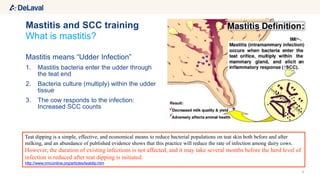
Mastitis means “Udder Infection”
1. Mastitis bacteria enter the udder through
the teat end
2. Bacteria culture (multiply) within the udder
tissue
3. The cow responds to the infection:
Increased SCC counts
3
What is mastitis?
Mastitis and SCC training
Teat dipping is a simple, effective, and economical means to reduce bacterial populations on teat skin both before and after
milking, and an abundance of published evidence shows that this practice will reduce the rate of infection among dairy cows.
However, the duration of existing infections is not affected, and it may take several months before the herd level of
infection is reduced after teat dipping is initiated.
http://www.nmconline.org/articles/teatdip.htm
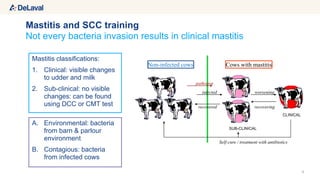
A. Environmental: bacteria
from barn & parlour
environment
B. Contagious: bacteria
from infected cows
4
Not every bacteria invasion results in clinical mastitis
Mastitis and SCC training
CLINICAL
SUB-CLINICAL
infected
recovered
Non-infected cows Cows with mastitis
worsening
recovering
Self-cure / treatment with antibiotics
pathogen
Mastitis classifications:
1. Clinical: visible changes
to udder and milk
2. Sub-clinical: no visible
changes: can be found
using DCC or CMT test
5
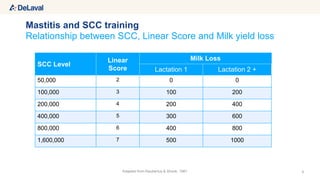
Relationship between SCC, Linear Score and Milk yield loss
Mastitis and SCC training
Adapted from Raubertus & Shook, 1981
SCC Level
Linear
Score
Milk Loss
Lactation 1 Lactation 2 +
50,000 2 0 0
100,000 3 100 200
200,000 4 200 400
400,000 5 300 600
800,000 6 400 800
1,600,000 7 500 1000
6
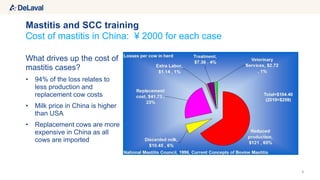
Cost of mastitis in China: ¥ 2000 for each case
Mastitis and SCC training
What drives up the cost of
mastitis cases?
• 94% of the loss relates to
less production and
replacement cow costs
• Milk price in China is higher
than USA
• Replacement cows are more
expensive in China as all
cows are imported
7
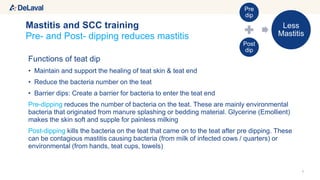
Pre- and Post- dipping reduces mastitis
Mastitis and SCC training
Functions of teat dip
• Maintain and support the healing of teat skin & teat end
• Reduce the bacteria number on the teat
• Barrier dips: Create a barrier for bacteria to enter the teat end
Pre-dipping reduces the number of bacteria on the teat. These are mainly environmental
bacteria that originated from manure splashing or bedding material. Glycerine (Emollient)
makes the skin soft and supple for painless milking
Post-dipping kills the bacteria on the teat that came on to the teat after pre dipping. These
can be contagious mastitis causing bacteria (from milk of infected cows / quarters) or
environmental (from hands, teat cups, towels)
Pre
dip
Post
dip
Less
Mastitis
8
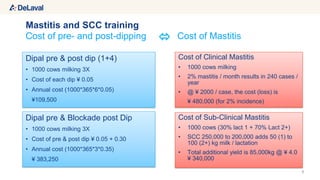
Cost of pre- and post-dipping Cost of Mastitis
Mastitis and SCC training
Dipal pre & post dip (1+4)
• 1000 cows milking 3X
• Cost of each dip ¥ 0.05
• Annual cost (1000*365*6*0.05)
¥109,500
Dipal pre & Blockade post Dip
• 1000 cows milking 3X
• Cost of pre & post dip ¥ 0.05 + 0.30
• Annual cost (1000*365*3*0.35)
¥ 383,250
Cost of Clinical Mastitis
• 1000 cows milking
• 2% mastitis / month results in 240 cases /
year
• @ ¥ 2000 / case, the cost (loss) is
¥ 480,000 (for 2% incidence)
Cost of Sub-Clinical Mastitis
• 1000 cows (30% lact 1 + 70% Lact 2+)
• SCC 250,000 to 200,000 adds 50 (1) to
100 (2+) kg milk / lactation
• Total additional yield is 85,000kg @ ¥ 4.0
¥ 340,000

9
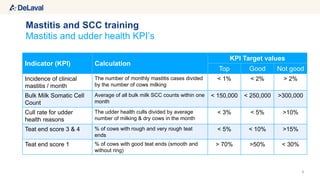
Mastitis and udder health KPI’s
Mastitis and SCC training
Indicator (KPI) Calculation
KPI Target values
Top Good Not good
Incidence of clinical
mastitis / month
The number of monthly mastitis cases divided
by the number of cows milking
< 1% < 2% > 2%
Bulk Milk Somatic Cell
Count
Average of all bulk milk SCC counts within one
month
< 150,000 < 250,000 >300,000
Cull rate for udder
health reasons
The udder health culls divided by average
number of milking & dry cows in the month
< 3% < 5% >10%
Teat end score 3 & 4 % of cows with rough and very rough teat
ends
< 5% < 10% >15%
Teat end score 1 % of cows with good teat ends (smooth and
without ring)
> 70% >50% < 30%
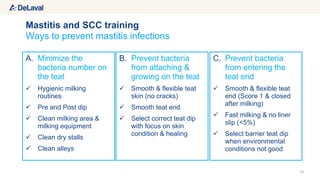
A. Minimize the
bacteria number on
the teat
 Hygienic milking
routines
 Pre and Post dip
 Clean milking area &
milking equipment
 Clean dry stalls
 Clean alleys
10
Ways to prevent mastitis infections
Mastitis and SCC training
B. Prevent bacteria
from attaching &
growing on the teat
 Smooth & flexible teat
skin (no cracks)
 Smooth teat end
 Select correct teat dip
with focus on skin
condition & healing
C. Prevent bacteria
from entering the
teat end
 Smooth & flexible teat
end (Score 1 & closed
after milking)
 Fast milking & no liner
slip (<5%)
 Select barrier teat dip
when environmental
conditions not good
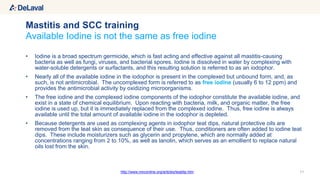
• Iodine is a broad spectrum germicide, which is fast acting and effective against all mastitis-causing
bacteria as well as fungi, viruses, and bacterial spores. Iodine is dissolved in water by complexing with
water-soluble detergents or surfactants, and this resulting solution is referred to as an iodophor.
• Nearly all of the available iodine in the iodophor is present in the complexed but unbound form, and, as
such, is not antimicrobial. The uncomplexed form is referred to as free iodine (usually 6 to 12 ppm) and
provides the antimicrobial activity by oxidizing microorganisms.
• The free iodine and the complexed iodine components of the iodophor constitute the available iodine, and
exist in a state of chemical equilibrium. Upon reacting with bacteria, milk, and organic matter, the free
iodine is used up, but it is immediately replaced from the complexed iodine. Thus, free iodine is always
available until the total amount of available iodine in the iodophor is depleted.
• Because detergents are used as complexing agents in iodophor teat dips, natural protective oils are
removed from the teat skin as consequence of their use. Thus, conditioners are often added to iodine teat
dips. These include moisturizers such as glycerin and propylene, which are normally added at
concentrations ranging from 2 to 10%, as well as lanolin, which serves as an emollient to replace natural
oils lost from the skin.
11
Available Iodine is not the same as free iodine
Mastitis and SCC training
http://www.nmconline.org/articles/teatdip.htm
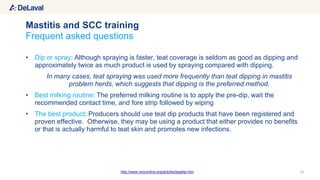
• Dip or spray: Although spraying is faster, teat coverage is seldom as good as dipping and
approximately twice as much product is used by spraying compared with dipping.
In many cases, teat spraying was used more frequently than teat dipping in mastitis
problem herds, which suggests that dipping is the preferred method.
• Best milking routine: The preferred milking routine is to apply the pre-dip, wait the
recommended contact time, and fore strip followed by wiping
• The best product: Producers should use teat dip products that have been registered and
proven effective. Otherwise, they may be using a product that either provides no benefits
or that is actually harmful to teat skin and promotes new infections.
12
Frequent asked questions
Mastitis and SCC training
http://www.nmconline.org/articles/teatdip.htm
13
DeLaval solutions that reduce mastitis & SCC counts
1. Optimal Equipment function, service & settings
2. Dipal Pre-Dip for optimal pre milking hygiene
3. Dipal Post-Dip for post milking hygiene
4. Blockade Barrier post dip for less infections and best skin condition
5. Clover liner for gentle milking & healthy teat ends
6. Biofoam for cleaning teats covered in dirt
7. DeLaval DDA milking performance service: improve teat end condition and reduce mastitis
Mastitis and SCC training
We make
sustainable
food production
possible

Delaval mastitis and scc training ppt

  • 1.
    Key aspects ofmastitis and solutions for reducing new infections Mastitis and SCC training 21/01/2017 1 DeLaval Asia Pacific William Smits Security Level
  • 2.
    2 Mastitis and SCCtraining Agenda 1. What is Mastitis 2. Mastitis stages & classification 3. Mastitis and milk yield loss 4. Cost of clinical mastitis cases 5. Cost of teat dipping  cost of mastitis 6. KPI’s used to monitor & manage mastitis 7. Ways to prevent mastitis 8. Dip or Spray & Recommended milking routine 9. Free iodine & available iodine 10. DeLaval solutions for top performing farms
  • 3.
    Mastitis means “UdderInfection” 1. Mastitis bacteria enter the udder through the teat end 2. Bacteria culture (multiply) within the udder tissue 3. The cow responds to the infection: Increased SCC counts 3 What is mastitis? Mastitis and SCC training Teat dipping is a simple, effective, and economical means to reduce bacterial populations on teat skin both before and after milking, and an abundance of published evidence shows that this practice will reduce the rate of infection among dairy cows. However, the duration of existing infections is not affected, and it may take several months before the herd level of infection is reduced after teat dipping is initiated. http://www.nmconline.org/articles/teatdip.htm
  • 4.
    A. Environmental: bacteria frombarn & parlour environment B. Contagious: bacteria from infected cows 4 Not every bacteria invasion results in clinical mastitis Mastitis and SCC training CLINICAL SUB-CLINICAL infected recovered Non-infected cows Cows with mastitis worsening recovering Self-cure / treatment with antibiotics pathogen Mastitis classifications: 1. Clinical: visible changes to udder and milk 2. Sub-clinical: no visible changes: can be found using DCC or CMT test
  • 5.
    5 Relationship between SCC,Linear Score and Milk yield loss Mastitis and SCC training Adapted from Raubertus & Shook, 1981 SCC Level Linear Score Milk Loss Lactation 1 Lactation 2 + 50,000 2 0 0 100,000 3 100 200 200,000 4 200 400 400,000 5 300 600 800,000 6 400 800 1,600,000 7 500 1000
  • 6.
    6 Cost of mastitisin China: ¥ 2000 for each case Mastitis and SCC training What drives up the cost of mastitis cases? • 94% of the loss relates to less production and replacement cow costs • Milk price in China is higher than USA • Replacement cows are more expensive in China as all cows are imported
  • 7.
    7 Pre- and Post-dipping reduces mastitis Mastitis and SCC training Functions of teat dip • Maintain and support the healing of teat skin & teat end • Reduce the bacteria number on the teat • Barrier dips: Create a barrier for bacteria to enter the teat end Pre-dipping reduces the number of bacteria on the teat. These are mainly environmental bacteria that originated from manure splashing or bedding material. Glycerine (Emollient) makes the skin soft and supple for painless milking Post-dipping kills the bacteria on the teat that came on to the teat after pre dipping. These can be contagious mastitis causing bacteria (from milk of infected cows / quarters) or environmental (from hands, teat cups, towels) Pre dip Post dip Less Mastitis
  • 8.
    8 Cost of pre-and post-dipping Cost of Mastitis Mastitis and SCC training Dipal pre & post dip (1+4) • 1000 cows milking 3X • Cost of each dip ¥ 0.05 • Annual cost (1000*365*6*0.05) ¥109,500 Dipal pre & Blockade post Dip • 1000 cows milking 3X • Cost of pre & post dip ¥ 0.05 + 0.30 • Annual cost (1000*365*3*0.35) ¥ 383,250 Cost of Clinical Mastitis • 1000 cows milking • 2% mastitis / month results in 240 cases / year • @ ¥ 2000 / case, the cost (loss) is ¥ 480,000 (for 2% incidence) Cost of Sub-Clinical Mastitis • 1000 cows (30% lact 1 + 70% Lact 2+) • SCC 250,000 to 200,000 adds 50 (1) to 100 (2+) kg milk / lactation • Total additional yield is 85,000kg @ ¥ 4.0 ¥ 340,000 
  • 9.
    9 Mastitis and udderhealth KPI’s Mastitis and SCC training Indicator (KPI) Calculation KPI Target values Top Good Not good Incidence of clinical mastitis / month The number of monthly mastitis cases divided by the number of cows milking < 1% < 2% > 2% Bulk Milk Somatic Cell Count Average of all bulk milk SCC counts within one month < 150,000 < 250,000 >300,000 Cull rate for udder health reasons The udder health culls divided by average number of milking & dry cows in the month < 3% < 5% >10% Teat end score 3 & 4 % of cows with rough and very rough teat ends < 5% < 10% >15% Teat end score 1 % of cows with good teat ends (smooth and without ring) > 70% >50% < 30%
  • 10.
    A. Minimize the bacterianumber on the teat  Hygienic milking routines  Pre and Post dip  Clean milking area & milking equipment  Clean dry stalls  Clean alleys 10 Ways to prevent mastitis infections Mastitis and SCC training B. Prevent bacteria from attaching & growing on the teat  Smooth & flexible teat skin (no cracks)  Smooth teat end  Select correct teat dip with focus on skin condition & healing C. Prevent bacteria from entering the teat end  Smooth & flexible teat end (Score 1 & closed after milking)  Fast milking & no liner slip (<5%)  Select barrier teat dip when environmental conditions not good
  • 11.
    • Iodine isa broad spectrum germicide, which is fast acting and effective against all mastitis-causing bacteria as well as fungi, viruses, and bacterial spores. Iodine is dissolved in water by complexing with water-soluble detergents or surfactants, and this resulting solution is referred to as an iodophor. • Nearly all of the available iodine in the iodophor is present in the complexed but unbound form, and, as such, is not antimicrobial. The uncomplexed form is referred to as free iodine (usually 6 to 12 ppm) and provides the antimicrobial activity by oxidizing microorganisms. • The free iodine and the complexed iodine components of the iodophor constitute the available iodine, and exist in a state of chemical equilibrium. Upon reacting with bacteria, milk, and organic matter, the free iodine is used up, but it is immediately replaced from the complexed iodine. Thus, free iodine is always available until the total amount of available iodine in the iodophor is depleted. • Because detergents are used as complexing agents in iodophor teat dips, natural protective oils are removed from the teat skin as consequence of their use. Thus, conditioners are often added to iodine teat dips. These include moisturizers such as glycerin and propylene, which are normally added at concentrations ranging from 2 to 10%, as well as lanolin, which serves as an emollient to replace natural oils lost from the skin. 11 Available Iodine is not the same as free iodine Mastitis and SCC training http://www.nmconline.org/articles/teatdip.htm
  • 12.
    • Dip orspray: Although spraying is faster, teat coverage is seldom as good as dipping and approximately twice as much product is used by spraying compared with dipping. In many cases, teat spraying was used more frequently than teat dipping in mastitis problem herds, which suggests that dipping is the preferred method. • Best milking routine: The preferred milking routine is to apply the pre-dip, wait the recommended contact time, and fore strip followed by wiping • The best product: Producers should use teat dip products that have been registered and proven effective. Otherwise, they may be using a product that either provides no benefits or that is actually harmful to teat skin and promotes new infections. 12 Frequent asked questions Mastitis and SCC training http://www.nmconline.org/articles/teatdip.htm
  • 13.
    13 DeLaval solutions thatreduce mastitis & SCC counts 1. Optimal Equipment function, service & settings 2. Dipal Pre-Dip for optimal pre milking hygiene 3. Dipal Post-Dip for post milking hygiene 4. Blockade Barrier post dip for less infections and best skin condition 5. Clover liner for gentle milking & healthy teat ends 6. Biofoam for cleaning teats covered in dirt 7. DeLaval DDA milking performance service: improve teat end condition and reduce mastitis Mastitis and SCC training
  • 14.