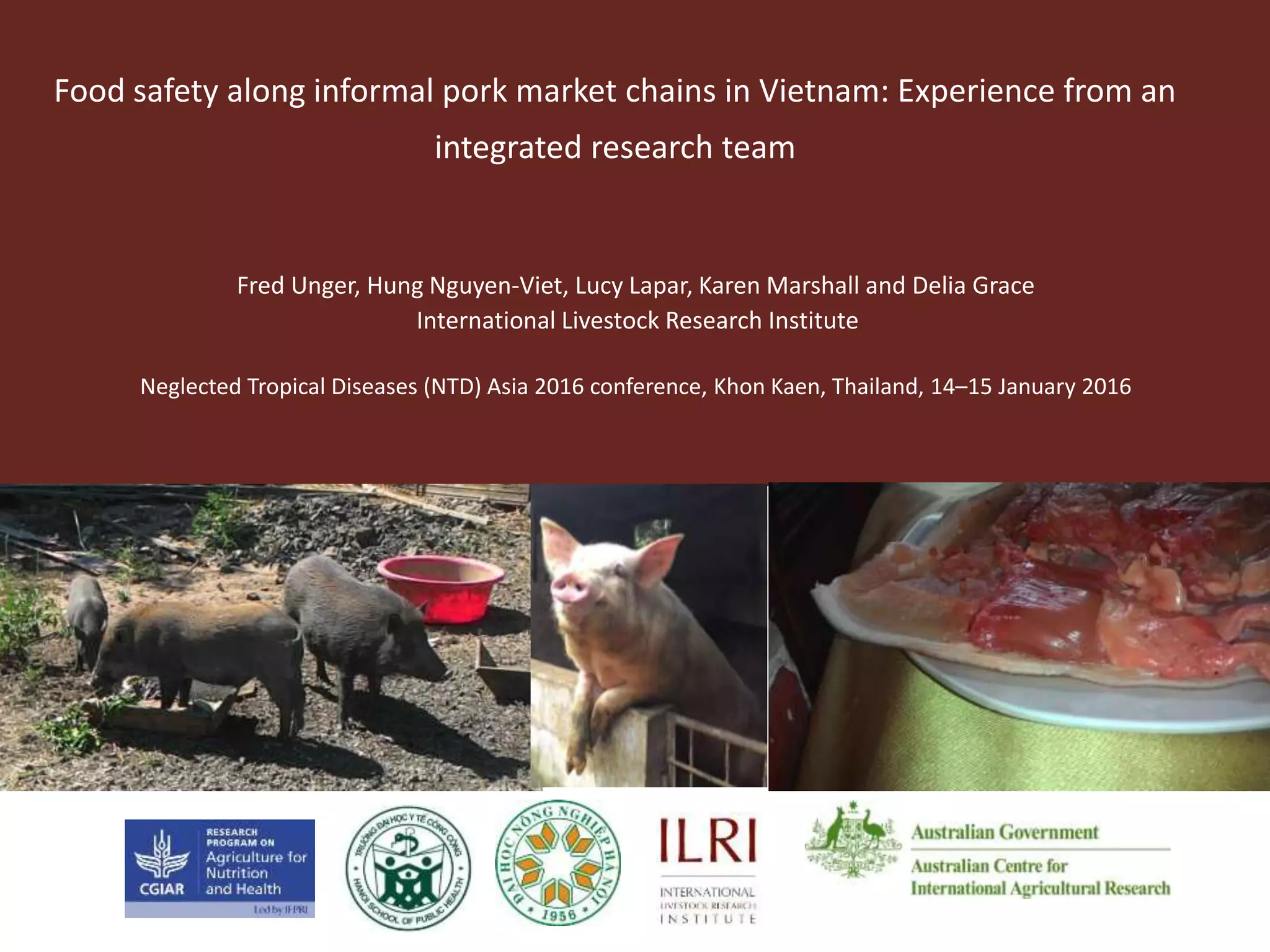
Food safety along informal pork market chains in Vietnam: Experience from an
integrated research team
Fred Unger, Hung Nguyen-Viet, Lucy Lapar, Karen Marshall and Delia Grace
International Livestock Research Institute
Neglected Tropical Diseases (NTD) Asia 2016 conference, Khon Kaen, Thailand, 14–15 January 2016
Outline
• Background
• ILRI work along the pig/pork value chain in Vietnam
– Pig risk project
– Scoping study on indigenous pig systems
• Interdisciplinary research experience
• Key messages
Background - pigs in Vietnam
• Pork is an important component of the Vietnamese diet
• More than 70% of consumed meat is pork
• More than 80% supplied by small scale sector
• Preference for chilled pork provided by traditional market chains (90%)
• Dominance of smallholders in pig production, significant
contribution to household (HH) income
Background - pigs in Vietnam
• Various challenges to increase production of smallholders from an
animal health perspective
• Lack of biosecurity, poor on-farm hygiene
• Limited reproductive management
• Very limited resources of farmers to change
• Pig diseases are common, wide range of notifiable diseases are endemic
• Limited surveillance and response capacity
Background – food safety – global perspective
WHO’s report: Global estimates of foodborne diseases
- First ever estimates of the global burden of foodborne diseases
show almost 1 in 10 people fall ill every year from eating
contaminated food and 420,000 die as a result
- Children under 5 years of age are at particularly high risk
- Africa and Southeast Asia have the highest burden
- Diarrhoeal diseases are responsible for more than half of the global
burden of foodborne diseases, with 230,000 deaths every year.
- Diarrhoea is often caused by norovirus, Campylobacter, non-
typhoidal Salmonella and pathogenic E. coli.
http://www.who.int/foodsafety/publications/foodborne_disease/fergreport/en/
Background – food safety Vietnam
• Majority of pork distributed through informal market chains
– traditional processing, and retail practices (e.g. wet markets, temporally
and/or permanent)
– escape effective health and safety regulation (lack of regular inspection)
– affordable, accessible, addressing local demands (e.g. fresh pork, meat pie,
blood pudding)
• Approximately 30,000 small-scale pig slaughter units
− Implementation of food safety law a challenge
− Regular inspections focus on medium to large scale slaughterhouses
Background – food safety
• Increasing consumer concerns on animal diseases and food safety
• Risky consumption habits are common (raw pork sausage, blood pudding)
• Existing studies focus on assessment of hazards
• Investigating the related risk for consumers, impact and
intervention studies are lacking
• Legal framework
• Various ministries involved, MoH (VFA), MoA (Nafiqad)
• Food safety law from 2010, 2016 revision expected
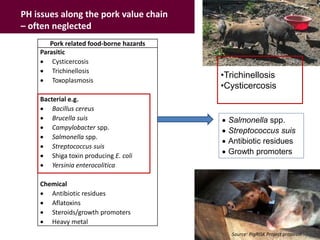
PH issues along the pork value chain
– often neglected
Pork related food-borne hazards
Parasitic
 Cysticercosis
 Trichinellosis
 Toxoplasmosis
Bacterial e.g.
 Bacillus cereus
 Brucella suis
 Campylobacter spp.
 Salmonella spp.
 Streptococcus suis
 Shiga toxin producing E. coli
 Yersinia enterocolitica
Chemical
 Antibiotic residues
 Aflatoxins
 Steroids/growth promoters
 Heavy metal
Source: PigRISK Project proposal
 Salmonella spp.
 Streptococcus suis
 Antibiotic residues
 Growth promoters
•Trichinellosis
•Cysticercosis
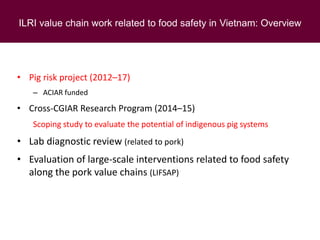
ILRI value chain work related to food safety in Vietnam: Overview
• Pig risk project (2012–17)
– ACIAR funded
• Cross-CGIAR Research Program (2014–15)
Scoping study to evaluate the potential of indigenous pig systems
• Lab diagnostic review (related to pork)
• Evaluation of large-scale interventions related to food safety
along the pork value chains (LIFSAP)
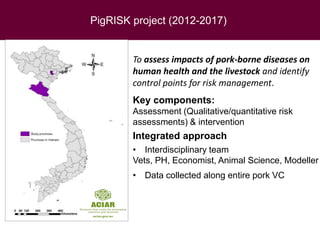
PigRISK project (2012-2017)
To assess impacts of pork-borne diseases on
human health and the livestock and identify
control points for risk management.
Key components:
Assessment (Qualitative/quantitative risk
assessments) & intervention
Integrated approach
• Interdisciplinary team
Vets, PH, Economist, Animal Science, Modeller
• Data collected along entire pork VC
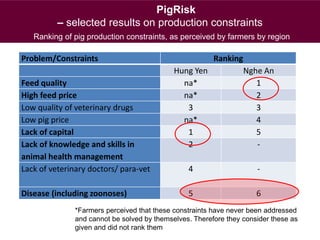
Problem/Constraints Ranking
Hung Yen Nghe An
Feed quality na* 1
High feed price na* 2
Low quality of veterinary drugs 3 3
Low pig price na* 4
Lack of capital 1 5
Lack of knowledge and skills in
animal health management
2 -
Lack of veterinary doctors/ para-vet 4 -
Disease (including zoonoses) 5 6
Ranking of pig production constraints, as perceived by farmers by region
PigRisk
– selected results on production constraints
*Farmers perceived that these constraints have never been addressed
and cannot be solved by themselves. Therefore they consider these as
given and did not rank them
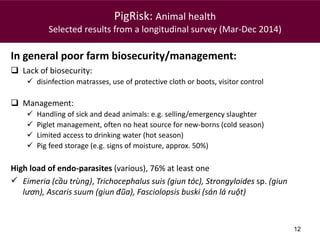
PigRisk: Animal health
Selected results from a longitudinal survey (Mar-Dec 2014)
12
In general poor farm biosecurity/management:
 Lack of biosecurity:
 disinfection matrasses, use of protective cloth or boots, visitor control
 Management:
 Handling of sick and dead animals: e.g. selling/emergency slaughter
 Piglet management, often no heat source for new-borns (cold season)
 Limited access to drinking water (hot season)
 Pig feed storage (e.g. signs of moisture, approx. 50%)
High load of endo-parasites (various), 76% at least one
 Eimeria (cầu trùng), Trichocephalus suis (giun tóc), Strongyloides sp. (giun
lươn), Ascaris suum (giun đũa), Fasciolopsis buski (sán lá ruột)
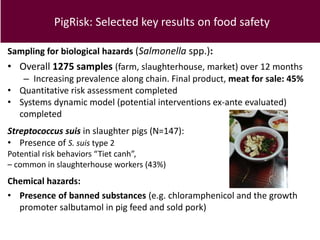
PigRisk: Selected key results on food safety
Sampling for biological hazards (Salmonella spp.):
• Overall 1275 samples (farm, slaughterhouse, market) over 12 months
– Increasing prevalence along chain. Final product, meat for sale: 45%
• Quantitative risk assessment completed
• Systems dynamic model (potential interventions ex-ante evaluated)
completed
Streptococcus suis in slaughter pigs (N=147):
• Presence of S. suis type 2
Potential risk behaviors “Tiet canh”,
– common in slaughterhouse workers (43%)
Chemical hazards:
• Presence of banned substances (e.g. chloramphenicol and the growth
promoter salbutamol in pig feed and sold pork)
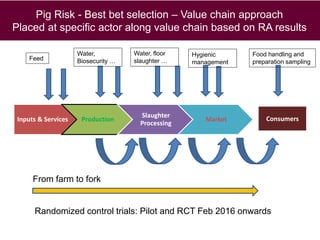
Value chain approach
Inputs & Services Production
Slaughter
Processing
Market Consumers
From farm to fork
Pig Risk - Best bet selection – Value chain approach
Placed at specific actor along value chain based on RA results
Feed
Water,
Biosecurity …
Water, floor
slaughter …
Hygienic
management
Food handling and
preparation sampling
Randomized control trials: Pilot and RCT Feb 2016 onwards
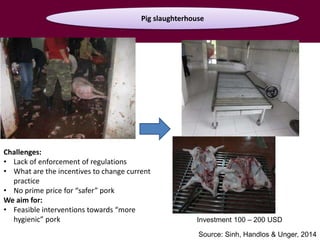
Source: Sinh, Handlos & Unger, 2014
Pig slaughterhouse
Investment 100 – 200 USD
Challenges:
• Lack of enforcement of regulations
• What are the incentives to change current
practice
• No prime price for “safer” pork
We aim for:
• Feasible interventions towards “more
hygienic” pork
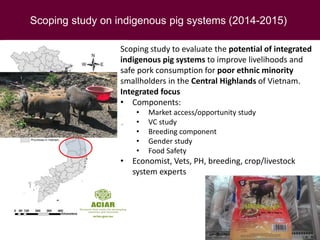
Scoping study on indigenous pig systems (2014-2015)
Scoping study to evaluate the potential of integrated
indigenous pig systems to improve livelihoods and
safe pork consumption for poor ethnic minority
smallholders in the Central Highlands of Vietnam.
Integrated focus
• Components:
• Market access/opportunity study
• VC study
• Breeding component
• Gender study
• Food Safety
• Economist, Vets, PH, breeding, crop/livestock
system experts
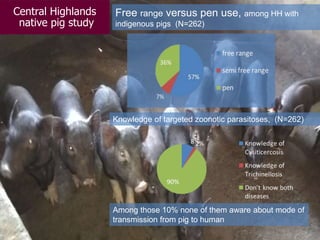
Free range versus pen use, among HH with
indigenous pigs (N=262)
Knowledge of targeted zoonotic parasitoses, (N=262)
Among those 10% none of them aware about mode of
transmission from pig to human
Central Highlands
native pig study
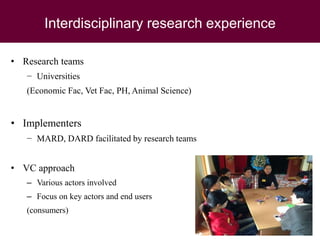
Interdisciplinary research experience
• Research teams
− Universities
(Economic Fac, Vet Fac, PH, Animal Science)
• Implementers
− MARD, DARD facilitated by research teams
• VC approach
– Various actors involved
– Focus on key actors and end users
(consumers)
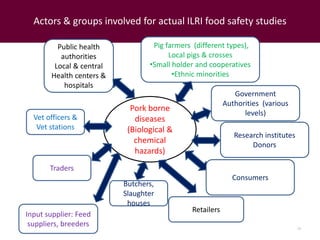
Actors & groups involved for actual ILRI food safety studies
19
Pork borne
diseases
(Biological &
chemical
hazards)
Public health
authorities
Local & central
Health centers &
hospitals
Vet officers &
Vet stations
Government
Authorities (various
levels)
Pig farmers (different types),
Local pigs & crosses
•Small holder and cooperatives
•Ethnic minorities
Traders
Retailers
Butchers,
Slaughter
houses
Research institutes
Donors
Input supplier: Feed
suppliers, breeders
Consumers
What worked well and why
• Research teams
– Across discipline spirit from the start of project
• Most of partners already involved in proposal development
• 1 partner joint later, some challenges
• Existing partnership build up on previous projects
• 1 partner championed in interdisciplinary research (CENPHER/HSPH)
• Teams accept and understand the need of other teams expertise
• Link between researcher and implementer
– Research team strongly connected to implementers
• Via authorities (MARD, DARD) good relation to provincial/district/commune level
• ILRI couldn't facilitate this
What worked well and why
• Research tools
– Qualitative and quantitative tools well perceived and used by teams
• Econ team – experienced in qualitative data collection – has the lead here
• PH/Vet stronger in bio-metric
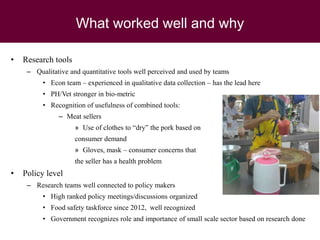
• Recognition of usefulness of combined tools:
– Meat sellers
» Use of clothes to “dry” the pork based on
consumer demand
» Gloves, mask – consumer concerns that
the seller has a health problem
• Policy level
– Research teams well connected to policy makers
• High ranked policy meetings/discussions organized
• Food safety taskforce since 2012, well recognized
• Government recognizes role and importance of small scale sector based on research done
Challenges
• Data analysis
– Teams strong in their own field
• Econ. team, e.g. pig productivity, willingness to pay
• PH team, e.g. disease impact, risk assessment
– Cross cutting analysis and conceptualization of cross-sectoral issues a
challenge
• Publications
– Reasonable number of sector specific papers and presentations
(2014: 24; 2015: 35)
– Across discipline papers remains a constant challenge
Challenges
• Time commitment
– E.g. Vet Team (VNUA)
• Approximately 3000 students & 80 staff (teaching/research)
• High staff turnover (MSc, PhD)
• Recognition of current food safety challenges
– MOH sometimes critical on value of ongoing research and presented hazards
• “Biased, not representative”
• Impact studies missing
• Risk communication
• What can be changed?
– How to find an appropriate interventions in an resource poor context
– Requires strong involvement of targeted groups and consideration of all
options
Potential solution to address stated challenges
– Joint team session (monthly/bi-monthly)
– Intensive mentoring by ILRI team (Economist, Vet, PH)
• Volunteer, Vet with PH background
• 1day/week work with each team
– Cross cutting data analysis & publications
– Partners approached by other food safety initiatives (WB) to
support their work
– Success of interventions (?)
– Awarded publications as an incentives
• ICAE, Milan, Aug 2015
• Safe Pork, Porto, Sep 2015
The presentation has a Creative Commons licence. You are free to re-use or distribute this work, provided credit is given to ILRI.
better lives through livestock
ilri.org
Special thanks to:
Hanoi School of Public Health
Vietnam National University of Agriculture,
WASI,
MARD, DARD
VC actors and groups
HP2, healthy pigs, healthy people

Food safety along informal pork market chains in Vietnam: Experience from an integrated research team

  • 1.
    Food safety alonginformal pork market chains in Vietnam: Experience from an integrated research team Fred Unger, Hung Nguyen-Viet, Lucy Lapar, Karen Marshall and Delia Grace International Livestock Research Institute Neglected Tropical Diseases (NTD) Asia 2016 conference, Khon Kaen, Thailand, 14–15 January 2016
  • 2.
    Outline • Background • ILRIwork along the pig/pork value chain in Vietnam – Pig risk project – Scoping study on indigenous pig systems • Interdisciplinary research experience • Key messages
  • 3.
    Background - pigsin Vietnam • Pork is an important component of the Vietnamese diet • More than 70% of consumed meat is pork • More than 80% supplied by small scale sector • Preference for chilled pork provided by traditional market chains (90%) • Dominance of smallholders in pig production, significant contribution to household (HH) income
  • 4.
    Background - pigsin Vietnam • Various challenges to increase production of smallholders from an animal health perspective • Lack of biosecurity, poor on-farm hygiene • Limited reproductive management • Very limited resources of farmers to change • Pig diseases are common, wide range of notifiable diseases are endemic • Limited surveillance and response capacity
  • 5.
    Background – foodsafety – global perspective WHO’s report: Global estimates of foodborne diseases - First ever estimates of the global burden of foodborne diseases show almost 1 in 10 people fall ill every year from eating contaminated food and 420,000 die as a result - Children under 5 years of age are at particularly high risk - Africa and Southeast Asia have the highest burden - Diarrhoeal diseases are responsible for more than half of the global burden of foodborne diseases, with 230,000 deaths every year. - Diarrhoea is often caused by norovirus, Campylobacter, non- typhoidal Salmonella and pathogenic E. coli. http://www.who.int/foodsafety/publications/foodborne_disease/fergreport/en/
  • 6.
    Background – foodsafety Vietnam • Majority of pork distributed through informal market chains – traditional processing, and retail practices (e.g. wet markets, temporally and/or permanent) – escape effective health and safety regulation (lack of regular inspection) – affordable, accessible, addressing local demands (e.g. fresh pork, meat pie, blood pudding) • Approximately 30,000 small-scale pig slaughter units − Implementation of food safety law a challenge − Regular inspections focus on medium to large scale slaughterhouses
  • 7.
    Background – foodsafety • Increasing consumer concerns on animal diseases and food safety • Risky consumption habits are common (raw pork sausage, blood pudding) • Existing studies focus on assessment of hazards • Investigating the related risk for consumers, impact and intervention studies are lacking • Legal framework • Various ministries involved, MoH (VFA), MoA (Nafiqad) • Food safety law from 2010, 2016 revision expected
  • 8.
    PH issues alongthe pork value chain – often neglected Pork related food-borne hazards Parasitic  Cysticercosis  Trichinellosis  Toxoplasmosis Bacterial e.g.  Bacillus cereus  Brucella suis  Campylobacter spp.  Salmonella spp.  Streptococcus suis  Shiga toxin producing E. coli  Yersinia enterocolitica Chemical  Antibiotic residues  Aflatoxins  Steroids/growth promoters  Heavy metal Source: PigRISK Project proposal  Salmonella spp.  Streptococcus suis  Antibiotic residues  Growth promoters •Trichinellosis •Cysticercosis
  • 9.
    ILRI value chainwork related to food safety in Vietnam: Overview • Pig risk project (2012–17) – ACIAR funded • Cross-CGIAR Research Program (2014–15) Scoping study to evaluate the potential of indigenous pig systems • Lab diagnostic review (related to pork) • Evaluation of large-scale interventions related to food safety along the pork value chains (LIFSAP)
  • 10.
    PigRISK project (2012-2017) Toassess impacts of pork-borne diseases on human health and the livestock and identify control points for risk management. Key components: Assessment (Qualitative/quantitative risk assessments) & intervention Integrated approach • Interdisciplinary team Vets, PH, Economist, Animal Science, Modeller • Data collected along entire pork VC
  • 11.
    Problem/Constraints Ranking Hung YenNghe An Feed quality na* 1 High feed price na* 2 Low quality of veterinary drugs 3 3 Low pig price na* 4 Lack of capital 1 5 Lack of knowledge and skills in animal health management 2 - Lack of veterinary doctors/ para-vet 4 - Disease (including zoonoses) 5 6 Ranking of pig production constraints, as perceived by farmers by region PigRisk – selected results on production constraints *Farmers perceived that these constraints have never been addressed and cannot be solved by themselves. Therefore they consider these as given and did not rank them
  • 12.
    PigRisk: Animal health Selectedresults from a longitudinal survey (Mar-Dec 2014) 12 In general poor farm biosecurity/management:  Lack of biosecurity:  disinfection matrasses, use of protective cloth or boots, visitor control  Management:  Handling of sick and dead animals: e.g. selling/emergency slaughter  Piglet management, often no heat source for new-borns (cold season)  Limited access to drinking water (hot season)  Pig feed storage (e.g. signs of moisture, approx. 50%) High load of endo-parasites (various), 76% at least one  Eimeria (cầu trùng), Trichocephalus suis (giun tóc), Strongyloides sp. (giun lươn), Ascaris suum (giun đũa), Fasciolopsis buski (sán lá ruột)
  • 13.
    PigRisk: Selected keyresults on food safety Sampling for biological hazards (Salmonella spp.): • Overall 1275 samples (farm, slaughterhouse, market) over 12 months – Increasing prevalence along chain. Final product, meat for sale: 45% • Quantitative risk assessment completed • Systems dynamic model (potential interventions ex-ante evaluated) completed Streptococcus suis in slaughter pigs (N=147): • Presence of S. suis type 2 Potential risk behaviors “Tiet canh”, – common in slaughterhouse workers (43%) Chemical hazards: • Presence of banned substances (e.g. chloramphenicol and the growth promoter salbutamol in pig feed and sold pork)
  • 14.
    Value chain approach Inputs& Services Production Slaughter Processing Market Consumers From farm to fork Pig Risk - Best bet selection – Value chain approach Placed at specific actor along value chain based on RA results Feed Water, Biosecurity … Water, floor slaughter … Hygienic management Food handling and preparation sampling Randomized control trials: Pilot and RCT Feb 2016 onwards
  • 15.
    Source: Sinh, Handlos& Unger, 2014 Pig slaughterhouse Investment 100 – 200 USD Challenges: • Lack of enforcement of regulations • What are the incentives to change current practice • No prime price for “safer” pork We aim for: • Feasible interventions towards “more hygienic” pork
  • 16.
    Scoping study onindigenous pig systems (2014-2015) Scoping study to evaluate the potential of integrated indigenous pig systems to improve livelihoods and safe pork consumption for poor ethnic minority smallholders in the Central Highlands of Vietnam. Integrated focus • Components: • Market access/opportunity study • VC study • Breeding component • Gender study • Food Safety • Economist, Vets, PH, breeding, crop/livestock system experts
  • 17.
    Free range versuspen use, among HH with indigenous pigs (N=262) Knowledge of targeted zoonotic parasitoses, (N=262) Among those 10% none of them aware about mode of transmission from pig to human Central Highlands native pig study
  • 18.
    Interdisciplinary research experience •Research teams − Universities (Economic Fac, Vet Fac, PH, Animal Science) • Implementers − MARD, DARD facilitated by research teams • VC approach – Various actors involved – Focus on key actors and end users (consumers)
  • 19.
    Actors & groupsinvolved for actual ILRI food safety studies 19 Pork borne diseases (Biological & chemical hazards) Public health authorities Local & central Health centers & hospitals Vet officers & Vet stations Government Authorities (various levels) Pig farmers (different types), Local pigs & crosses •Small holder and cooperatives •Ethnic minorities Traders Retailers Butchers, Slaughter houses Research institutes Donors Input supplier: Feed suppliers, breeders Consumers
  • 20.
    What worked welland why • Research teams – Across discipline spirit from the start of project • Most of partners already involved in proposal development • 1 partner joint later, some challenges • Existing partnership build up on previous projects • 1 partner championed in interdisciplinary research (CENPHER/HSPH) • Teams accept and understand the need of other teams expertise • Link between researcher and implementer – Research team strongly connected to implementers • Via authorities (MARD, DARD) good relation to provincial/district/commune level • ILRI couldn't facilitate this
  • 21.
    What worked welland why • Research tools – Qualitative and quantitative tools well perceived and used by teams • Econ team – experienced in qualitative data collection – has the lead here • PH/Vet stronger in bio-metric • Recognition of usefulness of combined tools: – Meat sellers » Use of clothes to “dry” the pork based on consumer demand » Gloves, mask – consumer concerns that the seller has a health problem • Policy level – Research teams well connected to policy makers • High ranked policy meetings/discussions organized • Food safety taskforce since 2012, well recognized • Government recognizes role and importance of small scale sector based on research done
  • 22.
    Challenges • Data analysis –Teams strong in their own field • Econ. team, e.g. pig productivity, willingness to pay • PH team, e.g. disease impact, risk assessment – Cross cutting analysis and conceptualization of cross-sectoral issues a challenge • Publications – Reasonable number of sector specific papers and presentations (2014: 24; 2015: 35) – Across discipline papers remains a constant challenge
  • 23.
    Challenges • Time commitment –E.g. Vet Team (VNUA) • Approximately 3000 students & 80 staff (teaching/research) • High staff turnover (MSc, PhD) • Recognition of current food safety challenges – MOH sometimes critical on value of ongoing research and presented hazards • “Biased, not representative” • Impact studies missing • Risk communication • What can be changed? – How to find an appropriate interventions in an resource poor context – Requires strong involvement of targeted groups and consideration of all options
  • 24.
    Potential solution toaddress stated challenges – Joint team session (monthly/bi-monthly) – Intensive mentoring by ILRI team (Economist, Vet, PH) • Volunteer, Vet with PH background • 1day/week work with each team – Cross cutting data analysis & publications – Partners approached by other food safety initiatives (WB) to support their work – Success of interventions (?) – Awarded publications as an incentives • ICAE, Milan, Aug 2015 • Safe Pork, Porto, Sep 2015
  • 25.
    The presentation hasa Creative Commons licence. You are free to re-use or distribute this work, provided credit is given to ILRI. better lives through livestock ilri.org Special thanks to: Hanoi School of Public Health Vietnam National University of Agriculture, WASI, MARD, DARD VC actors and groups HP2, healthy pigs, healthy people