Food Security
Week 3, Lesson 1
2
REFRESH
https://wordwall.net/resource/80254038
3
4
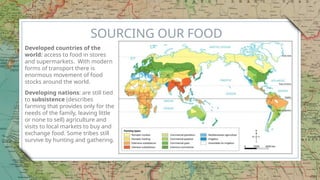
SOURCING OUR FOOD
Developed countries of the
world: access to food in stores
and supermarkets. With modern
forms of transport there is
enormous movement of food
stocks around the world.
Developing nations: are still tied
to subsistence (describes
farming that provides only for the
needs of the family, leaving little
or none to sell) agriculture and
visits to local markets to buy and
exchange food. Some tribes still
survive by hunting and gathering.
LEARNING OBJECTIVES
➢ Define food security
➢ Outline who is at risk of food insecurity
➢ Describe the factors that contribute to food security.
5
FOOD FOR THOUGHT….
At the beginning of the twentieth century, the entire world
population was less than 2 billion people. Today, the current world
population is more than 7 billion. Earth’s population is projected to
rise to 9 billion people by 2050, and we all need food. What can we
do to ensure there is enough food for everyone?​
6
7
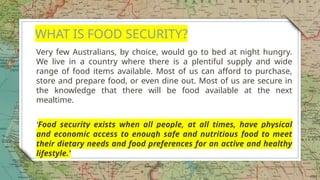
WHAT IS FOOD SECURITY?
Very few Australians, by choice, would go to bed at night hungry.
We live in a country where there is a plentiful supply and wide
range of food items available. Most of us can afford to purchase,
store and prepare food, or even dine out. Most of us are secure in
the knowledge that there will be food available at the next
mealtime.
‘Food security exists when all people, at all times, have physical
and economic access to enough safe and nutritious food to meet
their dietary needs and food preferences for an active and healthy
lifestyle.'
8
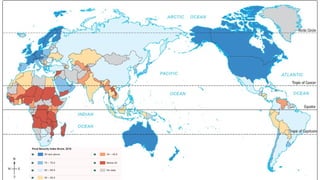
The map on the next slide shows the countries of the world, scored
according to the Global Food Security Index. This is based on a
range of 12 different indicators.
Countries that have a high rating on the index are able to produce
more food than they require, so they can export their surplus, or
they are able to afford to import all of their food needs, as is the
case for Singapore.
9
10
Hunger and food insecurity can have a number of causes. Politics,
economics, social justice and environmental conditions are all part
of the way that food is produced and distributed around the world.
Tackling hunger and food insecurity is about more than increasing
the food supply; it's also about challenging structures that create an
unfair distribution of food and inhibit people from building their
own food security.
11
12
POVERTY
Poverty is the main cause of hunger. There are three legal ways to
get food: grow it, trade it or buy it. Some people might also receive
food for free, but this is not a reliable or consistent source of food.
Limited education and training in sustainable food production
methods or income generation can impact food security. Training in
sustainable agriculture, animal raising or fish raising can empower
people to learn new ways of producing food to eat and to sell for an
income. Training and education can build on traditional knowledge
and introduce new methods or technologies to address such
challenges as farm irrigation in remote areas or changing climate
patterns.
13
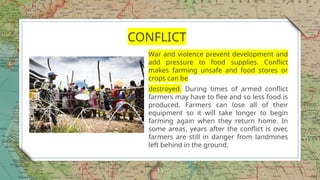
CONFLICT
War and violence prevent development and
add pressure to food supplies. Conflict
makes farming unsafe and food stores or
crops can be
destroyed. During times of armed conflict
farmers may have to flee and so less food is
produced. Farmers can lose all of their
equipment so it will take longer to begin
farming again when they return home. In
some areas, years after the conflict is over,
farmers are still in danger from landmines
left behind in the ground.
14
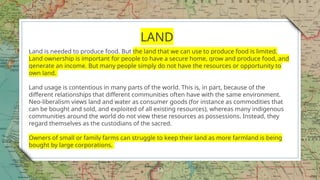
LAND
Land is needed to produce food. But the land that we can use to produce food is limited.
Land ownership is important for people to have a secure home, grow and produce food, and
generate an income. But many people simply do not have the resources or opportunity to
own land.
Land usage is contentious in many parts of the world. This is, in part, because of the
different relationships that different communities often have with the same environment.
Neo-liberalism views land and water as consumer goods (for instance as commodities that
can be bought and sold, and exploited of all existing resources), whereas many indigenous
communities around the world do not view these resources as possessions. Instead, they
regard themselves as the custodians of the sacred.
Owners of small or family farms can struggle to keep their land as more farmland is being
bought by large corporations.
15
BIOFUEL PRODUCTION
Plants such as sugar cane, wheat, corn,
sunflowers, soya beans and oil palm trees can be
used to produce a fuel alternative. These are
called bio-fuels or agro fuels. Increases in the
production of biofuels from food crops means
that more farms are growing crops to sell as
biofuel rather than food. Companies are clearing
forests and often forcibly using land that many
communities experiencing poverty relied on to
grow food to sell and eat. This is causing a
shortage and also increasing the price of other
foods like rice and wheat.
16
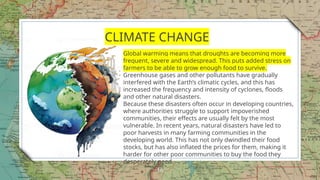
CLIMATE CHANGE
Global warming means that droughts are becoming more
frequent, severe and widespread. This puts added stress on
farmers to be able to grow enough food to survive.
Greenhouse gases and other pollutants have gradually
interfered with the Earth’s climatic cycles, and this has
increased the frequency and intensity of cyclones, floods
and other natural disasters.
Because these disasters often occur in developing countries,
where authorities struggle to support impoverished
communities, their effects are usually felt by the most
vulnerable. In recent years, natural disasters have led to
poor harvests in many farming communities in the
developing world. This has not only dwindled their food
stocks, but has also inflated the prices for them, making it
harder for other poor communities to buy the food they
desperately need.
17
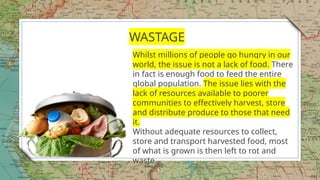
WASTAGE
Whilst millions of people go hungry in our
world, the issue is not a lack of food. There
in fact is enough food to feed the entire
global population. The issue lies with the
lack of resources available to poorer
communities to effectively harvest, store
and distribute produce to those that need
it.
Without adequate resources to collect,
store and transport harvested food, most
of what is grown is then left to rot and
waste.

Food Security Powerpoint geography year 9

  • 1.
  • 2.
  • 3.
  • 4.
    4 SOURCING OUR FOOD Developedcountries of the world: access to food in stores and supermarkets. With modern forms of transport there is enormous movement of food stocks around the world. Developing nations: are still tied to subsistence (describes farming that provides only for the needs of the family, leaving little or none to sell) agriculture and visits to local markets to buy and exchange food. Some tribes still survive by hunting and gathering.
  • 5.
    LEARNING OBJECTIVES ➢ Definefood security ➢ Outline who is at risk of food insecurity ➢ Describe the factors that contribute to food security. 5
  • 6.
    FOOD FOR THOUGHT…. Atthe beginning of the twentieth century, the entire world population was less than 2 billion people. Today, the current world population is more than 7 billion. Earth’s population is projected to rise to 9 billion people by 2050, and we all need food. What can we do to ensure there is enough food for everyone?​ 6
  • 7.
  • 8.
    WHAT IS FOODSECURITY? Very few Australians, by choice, would go to bed at night hungry. We live in a country where there is a plentiful supply and wide range of food items available. Most of us can afford to purchase, store and prepare food, or even dine out. Most of us are secure in the knowledge that there will be food available at the next mealtime. ‘Food security exists when all people, at all times, have physical and economic access to enough safe and nutritious food to meet their dietary needs and food preferences for an active and healthy lifestyle.' 8
  • 9.
    The map onthe next slide shows the countries of the world, scored according to the Global Food Security Index. This is based on a range of 12 different indicators. Countries that have a high rating on the index are able to produce more food than they require, so they can export their surplus, or they are able to afford to import all of their food needs, as is the case for Singapore. 9
  • 10.
  • 11.
    Hunger and foodinsecurity can have a number of causes. Politics, economics, social justice and environmental conditions are all part of the way that food is produced and distributed around the world. Tackling hunger and food insecurity is about more than increasing the food supply; it's also about challenging structures that create an unfair distribution of food and inhibit people from building their own food security. 11
  • 12.
    12 POVERTY Poverty is themain cause of hunger. There are three legal ways to get food: grow it, trade it or buy it. Some people might also receive food for free, but this is not a reliable or consistent source of food. Limited education and training in sustainable food production methods or income generation can impact food security. Training in sustainable agriculture, animal raising or fish raising can empower people to learn new ways of producing food to eat and to sell for an income. Training and education can build on traditional knowledge and introduce new methods or technologies to address such challenges as farm irrigation in remote areas or changing climate patterns.
  • 13.
    13 CONFLICT War and violenceprevent development and add pressure to food supplies. Conflict makes farming unsafe and food stores or crops can be destroyed. During times of armed conflict farmers may have to flee and so less food is produced. Farmers can lose all of their equipment so it will take longer to begin farming again when they return home. In some areas, years after the conflict is over, farmers are still in danger from landmines left behind in the ground.
  • 14.
    14 LAND Land is neededto produce food. But the land that we can use to produce food is limited. Land ownership is important for people to have a secure home, grow and produce food, and generate an income. But many people simply do not have the resources or opportunity to own land. Land usage is contentious in many parts of the world. This is, in part, because of the different relationships that different communities often have with the same environment. Neo-liberalism views land and water as consumer goods (for instance as commodities that can be bought and sold, and exploited of all existing resources), whereas many indigenous communities around the world do not view these resources as possessions. Instead, they regard themselves as the custodians of the sacred. Owners of small or family farms can struggle to keep their land as more farmland is being bought by large corporations.
  • 15.
    15 BIOFUEL PRODUCTION Plants suchas sugar cane, wheat, corn, sunflowers, soya beans and oil palm trees can be used to produce a fuel alternative. These are called bio-fuels or agro fuels. Increases in the production of biofuels from food crops means that more farms are growing crops to sell as biofuel rather than food. Companies are clearing forests and often forcibly using land that many communities experiencing poverty relied on to grow food to sell and eat. This is causing a shortage and also increasing the price of other foods like rice and wheat.
  • 16.
    16 CLIMATE CHANGE Global warmingmeans that droughts are becoming more frequent, severe and widespread. This puts added stress on farmers to be able to grow enough food to survive. Greenhouse gases and other pollutants have gradually interfered with the Earth’s climatic cycles, and this has increased the frequency and intensity of cyclones, floods and other natural disasters. Because these disasters often occur in developing countries, where authorities struggle to support impoverished communities, their effects are usually felt by the most vulnerable. In recent years, natural disasters have led to poor harvests in many farming communities in the developing world. This has not only dwindled their food stocks, but has also inflated the prices for them, making it harder for other poor communities to buy the food they desperately need.
  • 17.
    17 WASTAGE Whilst millions ofpeople go hungry in our world, the issue is not a lack of food. There in fact is enough food to feed the entire global population. The issue lies with the lack of resources available to poorer communities to effectively harvest, store and distribute produce to those that need it. Without adequate resources to collect, store and transport harvested food, most of what is grown is then left to rot and waste.

Editor's Notes

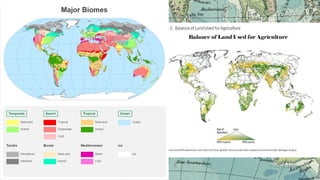
  • #3 Which biomes are mostly used for cropland? Which biomes are mostly used for pasture, i.e. animal grazing? Which biomes produce the least food? Is there an interconnection between biomes and land used for agriculture? Give examples to illustrate your answer. 4. Which countries does this affect the most?
  • #8 Food security for you, as a student, means that your family either grows its own food, has sufficient income to purchase food, or is able to barter or swap food. Similarly, food security for a country means that it is able to grow sufficient food, or it has enough wealth to import food, or it combines the two. Not all people in the world are able to achieve this. Further, access to a wide variety of foods varies from place to place.
  • #9 Food security for you, as a student, means that your family either grows its own food, has sufficient income to purchase food, or is able to barter or swap food. Similarly, food security for a country means that it is able to grow sufficient food, or it has enough wealth to import food, or it combines the two. Not all people in the world are able to achieve this. Further, access to a wide variety of foods varies from place to place.
  • #10 https://content2.learnon.com.au/player?isbn=9780730372387&assetid=20765
  • #11 Food security for you, as a student, means that your family either grows its own food, has sufficient income to purchase food, or is able to barter or swap food. Similarly, food security for a country means that it is able to grow sufficient food, or it has enough wealth to import food, or it combines the two. Not all people in the world are able to achieve this. Further, access to a wide variety of foods varies from place to place.