E M I L Y G E R L A C H
Food for Thought:
PHYTOCHEMICALS
Objectives
 Accurately define phytochemicals and food sources of
phytochemicals.
 State potential health benefits of phytochemicals.
 Recognize neurodegenerative conditions that may be
affected by phytochemicals.
 Understand the connection between aging and cognition.
 Understand the connection between phytochemicals and
neurological function, particularly related to cognition.
 Discuss how to incorporate this information into
practice.
Phytochemicals
 Plant-derived compounds
 Responsible for color, flavor and odor
 Disease protection
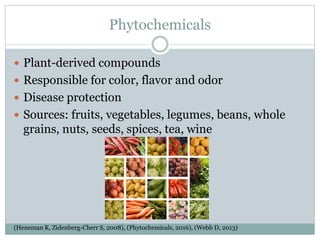
 Sources: fruits, vegetables, legumes, beans, whole
grains, nuts, seeds, spices, tea, wine
(Heneman K, Zidenberg-Cherr S, 2008), (Phytochemicals, 2016), (Webb D, 2013)
Potential Health Benefits
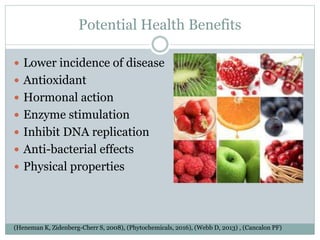
 Lower incidence of disease
 Antioxidant
 Hormonal action
 Enzyme stimulation
 Inhibit DNA replication
 Anti-bacterial effects
 Physical properties
(Heneman K, Zidenberg-Cherr S, 2008), (Phytochemicals, 2016), (Webb D, 2013) , (Cancalon PF)
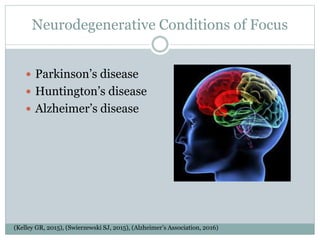
Neurodegenerative Conditions of Focus
 Parkinson’s disease
 Huntington’s disease
 Alzheimer’s disease
(Kelley GR, 2015), (Swierzewski SJ, 2015), (Alzheimer’s Association, 2016)
Aging and Cognition
 Oxidative stress and inflammation
 Domains most affected
 Attention
 Memory
 Affect brain and the development of
neurodegenerative diseases
 Alzheimer’s
 Parkinson’s
 Huntington’s
(Harada CN, 2014), (Harada CN, 2013), (Emory University Alzheimer’s Disease Research Center, 2016), (Gilsky EL,
2007)
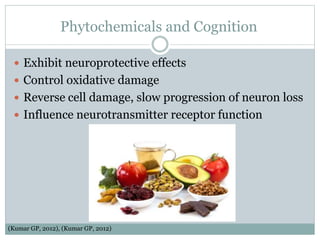
Phytochemicals and Cognition
 Exhibit neuroprotective effects
 Control oxidative damage
 Reverse cell damage, slow progression of neuron loss
 Influence neurotransmitter receptor function
(Kumar GP, 2012), (Kumar GP, 2012)
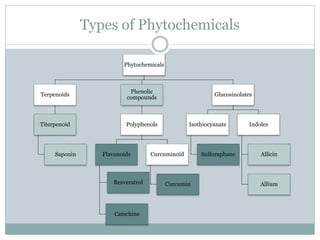
Types of Phytochemicals
Phytochemicals
Terpenoids
Titerpenoid
Saponin
Phenolic
compounds
Polyphenols
Flavonoids
Resveratrol
Catechins
Curcuminoid
Curcumin
Glucosinolates
Isothiocyanate
Sulforaphane
Indoles
Allicin
Allium
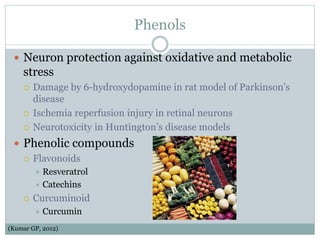
Phenols
 Neuron protection against oxidative and metabolic
stress
 Damage by 6-hydroxydopamine in rat model of Parkinson’s
disease
 Ischemia reperfusion injury in retinal neurons
 Neurotoxicity in Huntington’s disease models
 Phenolic compounds
 Flavonoids
 Resveratrol
 Catechins
 Curcuminoid
 Curcumin
(Kumar GP, 2012)
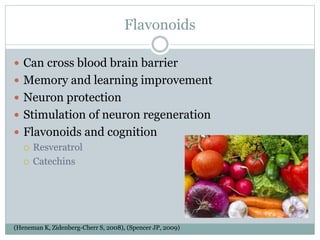
Flavonoids
 Can cross blood brain barrier
 Memory and learning improvement
 Neuron protection
 Stimulation of neuron regeneration
 Flavonoids and cognition
 Resveratrol
 Catechins
(Heneman K, Zidenberg-Cherr S, 2008), (Spencer JP, 2009)
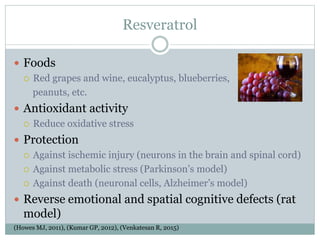
Resveratrol
 Foods
 Red grapes and wine, eucalyptus, blueberries,
peanuts, etc.
 Antioxidant activity
 Reduce oxidative stress
 Protection
 Against ischemic injury (neurons in the brain and spinal cord)
 Against metabolic stress (Parkinson’s model)
 Against death (neuronal cells, Alzheimer’s model)
 Reverse emotional and spatial cognitive defects (rat
model)
(Howes MJ, 2011), (Kumar GP, 2012), (Venkatesan R, 2015)
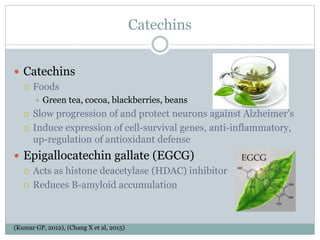
Catechins
 Catechins
 Foods
 Green tea, cocoa, blackberries, beans
 Slow progression of and protect neurons against Alzheimer’s
 Induce expression of cell-survival genes, anti-inflammatory,
up-regulation of antioxidant defense
 Epigallocatechin gallate (EGCG)
 Acts as histone deacetylase (HDAC) inhibitor
 Reduces B-amyloid accumulation
(Kumar GP, 2012), (Chang X et al, 2015)
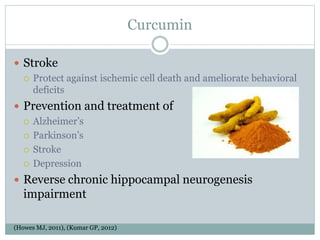
Curcumin
 Stroke
 Protect against ischemic cell death and ameliorate behavioral
deficits
 Prevention and treatment of
 Alzheimer’s
 Parkinson’s
 Stroke
 Depression
 Reverse chronic hippocampal neurogenesis
impairment
(Howes MJ, 2011), (Kumar GP, 2012)
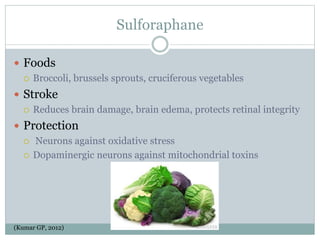
Sulforaphane
 Foods
 Broccoli, brussels sprouts, cruciferous vegetables
 Stroke
 Reduces brain damage, brain edema, protects retinal integrity
 Protection
 Neurons against oxidative stress
 Dopaminergic neurons against mitochondrial toxins
(Kumar GP, 2012)
Others
 Terpenoids and Saponins
 Foods: soy, beans, garlic
 Learning and memory
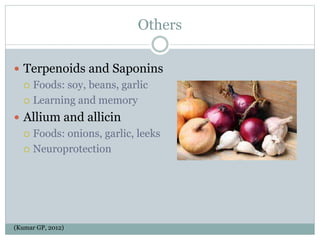
 Allium and allicin
 Foods: onions, garlic, leeks
 Neuroprotection
(Kumar GP, 2012)
Other Possible Interventions
 Diet
 Mono- and polyunsaturated fats (omega 3s)
 Fiber
 Exercise
 Moderate alcohol consumption
 Medication
 Cognitive stimulation
 Chess
 Speaking multiple languages
(Life Extensions, 2016)
Recommendations
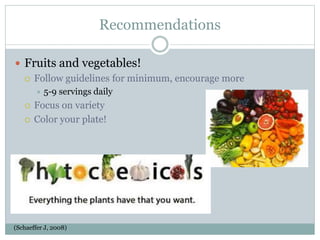
 Fruits and vegetables!
 Follow guidelines for minimum, encourage more
 5-9 servings daily
 Focus on variety
 Color your plate!
(Schaeffer J, 2008)
References
 Heneman K, Zidenberg-Cherr S. Some Facts About Phytochemicals.
http://nutrition.ucdavis.edu/content/infosheets/fact-pro-phytochemical.pdf. Published
October 2008. Accessed March 17, 2016.
 Phytochemicals. Phytochemicals. http://www.phytochemicals.info/. Accessed March 17, 2016.
 Webb D. Phytochemicals’ Role in Good Health. Today’s Dietitian.
http://www.todaysdietitian.com/newarchives/090313p70.shtml. Published September 2013.
Accessed March 17, 2016.
 Davinelli S, Sapere N, Zella D, Bracale R, Intrieri M, Scapagnini G. Pleiotropic protective effects
of phytochemicals in Alzheimer’s Disease. Oxid Med Cell Longev. 2012;2012:386527.
 Mythri RB, Bharath MM. Curcumin: a potential neuroprotective agent in Parkinson’s
disease.Curr Pharm Des. 2012;18(1):91-99.
 Howes MJ, Perry E. The role of phytochemicals in the treatment ad prevention of dementia.
Drugs Aging. 201128(6):439-68.
 Kumar GP, Khanum F. Neuroprotective potential of phytochemicals. Pharmacogn Rev.
2012;6(12):81-90.
 Cancalon PF. Brain and cognitive processes beneficial roles of
citrus.http://www.fdocgrower.com/wp-content/uploads/2011/01/CNS-and-cognition-comsec-
042011.pdf
 Alvarez-Parilla E, Gonzalez-Aguilar GA. Fruit and Vegetable Phytochemicals: Chemistry,
Nutritional Value and Stability. 2nd ed. City, State: Wiley-Blackwell; 2010.
 Harada CN, Natelson Love MC, Triebel K. Normal cognitive aging. Clin Geriatr Med.
2013;29(4):737-752.

Food for Thought- Phytochemicals

  • 1.
    E M IL Y G E R L A C H Food for Thought: PHYTOCHEMICALS
  • 2.
    Objectives  Accurately definephytochemicals and food sources of phytochemicals.  State potential health benefits of phytochemicals.  Recognize neurodegenerative conditions that may be affected by phytochemicals.  Understand the connection between aging and cognition.  Understand the connection between phytochemicals and neurological function, particularly related to cognition.  Discuss how to incorporate this information into practice.
  • 3.
    Phytochemicals  Plant-derived compounds Responsible for color, flavor and odor  Disease protection  Sources: fruits, vegetables, legumes, beans, whole grains, nuts, seeds, spices, tea, wine (Heneman K, Zidenberg-Cherr S, 2008), (Phytochemicals, 2016), (Webb D, 2013)
  • 4.
    Potential Health Benefits Lower incidence of disease  Antioxidant  Hormonal action  Enzyme stimulation  Inhibit DNA replication  Anti-bacterial effects  Physical properties (Heneman K, Zidenberg-Cherr S, 2008), (Phytochemicals, 2016), (Webb D, 2013) , (Cancalon PF)
  • 5.
    Neurodegenerative Conditions ofFocus  Parkinson’s disease  Huntington’s disease  Alzheimer’s disease (Kelley GR, 2015), (Swierzewski SJ, 2015), (Alzheimer’s Association, 2016)
  • 6.
    Aging and Cognition Oxidative stress and inflammation  Domains most affected  Attention  Memory  Affect brain and the development of neurodegenerative diseases  Alzheimer’s  Parkinson’s  Huntington’s (Harada CN, 2014), (Harada CN, 2013), (Emory University Alzheimer’s Disease Research Center, 2016), (Gilsky EL, 2007)
  • 7.
    Phytochemicals and Cognition Exhibit neuroprotective effects  Control oxidative damage  Reverse cell damage, slow progression of neuron loss  Influence neurotransmitter receptor function (Kumar GP, 2012), (Kumar GP, 2012)
  • 8.
  • 9.
    Phenols  Neuron protectionagainst oxidative and metabolic stress  Damage by 6-hydroxydopamine in rat model of Parkinson’s disease  Ischemia reperfusion injury in retinal neurons  Neurotoxicity in Huntington’s disease models  Phenolic compounds  Flavonoids  Resveratrol  Catechins  Curcuminoid  Curcumin (Kumar GP, 2012)
  • 10.
    Flavonoids  Can crossblood brain barrier  Memory and learning improvement  Neuron protection  Stimulation of neuron regeneration  Flavonoids and cognition  Resveratrol  Catechins (Heneman K, Zidenberg-Cherr S, 2008), (Spencer JP, 2009)
  • 11.
    Resveratrol  Foods  Redgrapes and wine, eucalyptus, blueberries, peanuts, etc.  Antioxidant activity  Reduce oxidative stress  Protection  Against ischemic injury (neurons in the brain and spinal cord)  Against metabolic stress (Parkinson’s model)  Against death (neuronal cells, Alzheimer’s model)  Reverse emotional and spatial cognitive defects (rat model) (Howes MJ, 2011), (Kumar GP, 2012), (Venkatesan R, 2015)
  • 12.
    Catechins  Catechins  Foods Green tea, cocoa, blackberries, beans  Slow progression of and protect neurons against Alzheimer’s  Induce expression of cell-survival genes, anti-inflammatory, up-regulation of antioxidant defense  Epigallocatechin gallate (EGCG)  Acts as histone deacetylase (HDAC) inhibitor  Reduces B-amyloid accumulation (Kumar GP, 2012), (Chang X et al, 2015)
  • 13.
    Curcumin  Stroke  Protectagainst ischemic cell death and ameliorate behavioral deficits  Prevention and treatment of  Alzheimer’s  Parkinson’s  Stroke  Depression  Reverse chronic hippocampal neurogenesis impairment (Howes MJ, 2011), (Kumar GP, 2012)
  • 14.
    Sulforaphane  Foods  Broccoli,brussels sprouts, cruciferous vegetables  Stroke  Reduces brain damage, brain edema, protects retinal integrity  Protection  Neurons against oxidative stress  Dopaminergic neurons against mitochondrial toxins (Kumar GP, 2012)
  • 15.
    Others  Terpenoids andSaponins  Foods: soy, beans, garlic  Learning and memory  Allium and allicin  Foods: onions, garlic, leeks  Neuroprotection (Kumar GP, 2012)
  • 16.
    Other Possible Interventions Diet  Mono- and polyunsaturated fats (omega 3s)  Fiber  Exercise  Moderate alcohol consumption  Medication  Cognitive stimulation  Chess  Speaking multiple languages (Life Extensions, 2016)
  • 17.
    Recommendations  Fruits andvegetables!  Follow guidelines for minimum, encourage more  5-9 servings daily  Focus on variety  Color your plate! (Schaeffer J, 2008)
  • 18.
    References  Heneman K,Zidenberg-Cherr S. Some Facts About Phytochemicals. http://nutrition.ucdavis.edu/content/infosheets/fact-pro-phytochemical.pdf. Published October 2008. Accessed March 17, 2016.  Phytochemicals. Phytochemicals. http://www.phytochemicals.info/. Accessed March 17, 2016.  Webb D. Phytochemicals’ Role in Good Health. Today’s Dietitian. http://www.todaysdietitian.com/newarchives/090313p70.shtml. Published September 2013. Accessed March 17, 2016.  Davinelli S, Sapere N, Zella D, Bracale R, Intrieri M, Scapagnini G. Pleiotropic protective effects of phytochemicals in Alzheimer’s Disease. Oxid Med Cell Longev. 2012;2012:386527.  Mythri RB, Bharath MM. Curcumin: a potential neuroprotective agent in Parkinson’s disease.Curr Pharm Des. 2012;18(1):91-99.  Howes MJ, Perry E. The role of phytochemicals in the treatment ad prevention of dementia. Drugs Aging. 201128(6):439-68.  Kumar GP, Khanum F. Neuroprotective potential of phytochemicals. Pharmacogn Rev. 2012;6(12):81-90.  Cancalon PF. Brain and cognitive processes beneficial roles of citrus.http://www.fdocgrower.com/wp-content/uploads/2011/01/CNS-and-cognition-comsec- 042011.pdf  Alvarez-Parilla E, Gonzalez-Aguilar GA. Fruit and Vegetable Phytochemicals: Chemistry, Nutritional Value and Stability. 2nd ed. City, State: Wiley-Blackwell; 2010.  Harada CN, Natelson Love MC, Triebel K. Normal cognitive aging. Clin Geriatr Med. 2013;29(4):737-752.

Editor's Notes

  • #2 Print this for reference: http://www.phytochemicals.info/phytochemicals.php READ: http://sphweb.bumc.bu.edu/otlt/mph-modules/ph/aging/aging_print.html, http://www.ncbi.nlm.nih.gov/pmc/articles/PMC2995895/
  • #4 Non-essential Thousands known
  • #6 All have cognitive implications Parkinson’s disease: 1 million people in US http://www.healthcommunities.com/parkinsons-disease/incidence-prevalence.shtml (risk increases with age) Huntington’s disease: nearly 30,000 in US http://www.healthcommunities.com/huntingtons-disease/overview-of-huntingtons.shtml (appears between ages 30-50 usually) Alzheimer’s: 5.4 million in US (5.2 million of those over age 65) https://www.google.com/search?q=parkinson%27s+disease&oq=parkinsons&aqs=chrome.1.69i57j0l5.3551j0j7&sourceid=chrome&ie=UTF-8#q=prevalence+of+alzheimer+disease
  • #7 Impt because aging population is growing, we will likely be working with older adults with impaired cognition Americans over 65: 40.2 million in 2010, projected to be 88.5 million in 2050 Gray matter volume decline – shows atrophy in brain (cause: death of neurons coupled with decline in cell division), decrease in size, volume, and connections of neurons White matter changes – leads to decreased communicaiton between hippocampal structures Additional factors: mood changes, medications, sensory changes (loss of hearing) Changes not uniform between all individuals Domains most affected by aging: 1. attention Selective (when told to identify the color ink in which a different color is printed: word red written in green ink; slower response), divided (two tasks at once), sustained 2. memory Short term ok (not necessarily short-term memory, but in activities of reorganization/manipulation of short term memory – memorize 7 digits, fine, but state them backwards=decline) Long term: retrieval of info; aging most affects EPISODIC/(autobiographical) (personally experienced events; subjective- shows decline over lifetime) most of the current research discusses this Perception also declines (related to sensory capacity declines) Other domains may also be affected: language processing, decision making
  • #8 Brain consumes 20% of oxygen – high potential for oxidative stress, but brain has limited ability to counteract oxidative stress Capsaicin (red pepper), curcumin (turmeric), epigallocatechin gallate (catechin in tea- EGCG), resveratrol (grapes, wine, peanuts)- may have neuroprotective effects
  • #9 Over 4,000 different phytochemicals and are categorized based on chemical structure and functional properties… the ones we are discussing today are well-researched for cognitive-enhancing properties and are commonly occurring in foods.
  • #10 Wanted to quickly brush on phenols bc much research done on phenols and cognition Phenols is such a broad category- sooo many foods have phenols Can be mono or poly- overall…. Associated with… Other phenolic compounds: capsaicin, phytoestrogens
  • #11 Largest, most diverse group Associated with reduced mortality rates Well-studied for cardiovascular health - Inverse association with MI As for neurological health- (7) Difficult for substances to cross blood-brain barrier, but flavonoids effective Antioxidant for brain tissue (8), cell-signaling processes through gene interactions and anti-inflammatory properties Studies done in various mammals, including humans, that have shown that flavonoids are effective in: Reversing age related declines Increasing number and strength of neuron connections Increasing blood flow to the brain, and initating neurogenesis Reducing neuronal damage and losses (3, 6) Cocoa (rich in flavanol) consumption improves cerebral blood flow – good for brain function, associated with decreases in dementia and Alzheimer’s Phytoestrogens (soy and whole grains) may prevent cognitive decline following menopauseAlkaloids (hyperzine A and galantamine) improve cognitive function in AD patients (6)
  • #12 A flavanol belonging to the group of flavanoids Stroke model in rats Protected neuronal cells from death by amyloid beta-peptide and promoted clearance of amyloid beta-peptide Rats- reversed after resveratrol treatment- increases in BDNF level and inhibition TNF-a and IL-1B expression levels in the hippocampus; resveratrol suppressed expression of pro-inflammatory mediator and promoted anti-inflammatory mediator potential effects on delaying dementia (6) Alzheimer’s: protect against nerve damage and prevent plaque build-up Reverse defects: interesting bc many phytochemical actions are prophylactic, however this is a more detoxification effect
  • #13 (7) Catechins (flavanol category of flavonoids) Neuroprotective activities Suppress pathogenesis of alzheimers and protect neurons against alzheimers processes Catechins and metabolites active signaling pathways that stimulate cell-survival and anti-inflammatory actions Epigallocatechin: (catechin which is flavanol which is flavanoid) – Green***, oolong, and black teas HDAC activity is associated with neurodegeneration HDAC inhibitors- therapeutic for Alzheimer’s disease Beta-amyloid: gunk that builds up and leads to cognitive deterioration
  • #14 Circuminoid Animal model of stroke: Stress-induced hippocampal neurogenesis impairment Depression: increase expression of brain-derived neurotrophic factor potential effects on delaying dementia (6)
  • #16 T & S: ameliorated learning and memory impairments, improved spatial working memory Revitalize and strengthen nervous function A&A: garlic and onions- neuroprotective; activate stress-response pathways- upregulated protective channels; adaptive cellular responses
  • #17 Research overwhelmingly focused on the diet Switching from diet high in saturated fat and simple sugars to… Exercise: increase brain-derived neurotropic factorenhanced cog function
  • #18 Consumption of fruits and vegetables along with other plant-based foods Vegetables: 2-2.5 for women, 2.5-3 for men (lower end for older adults) Fruit: 1.5-2 cups No recommendations yet on proportion of phytochemicals is the right balance – eat a variety of colors Most Americans not eating enough fruits and vegetables – use color as a guide for increasing produce consumption