









Screening,
 Biomechanical
 Considerations
         and

   Orthotic
  Management
        of the

 Diabetic Foot

Derek Jones PhD, MBA
Presentation
•Impact of Diabetes
•Foot Screening
•Biomechanics
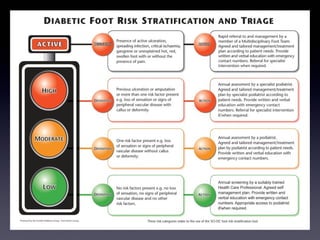
•Orthotic Management
We are living longer
But are we healthier
Chronic
             Imp
Conditions      act
                    o   n So
                            ciet
                                   y
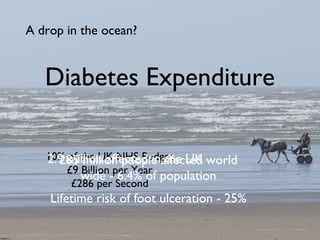
A drop in the ocean?


   Diabetes Expenditure


   •
   10% million affected inaffected world
   2.9 of the UK NHS BudgetBudget
     285 million UK NHS UK
     10% of the people the
       £9 Billion per Year
          wide - 6.4% of population
   • £9£286 per per Year
         Billion Second
    Lifetime risk of foot ulceration - 25%
   • £286 per Second
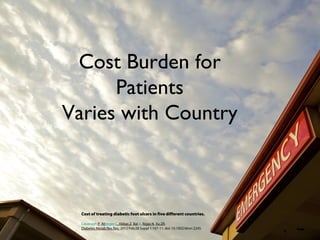
Cost Burden for
      Patients
Varies with Country


  Cost of treating diabetic foot ulcers in five different countries.

  Cavanagh P, Attinger C, Abbas Z, Bal A, Rojas N, Xu ZR.
  Diabetes Metab Res Rev. 2012 Feb;28 Suppl 1:107-11. doi: 10.1002/dmrr.2245.
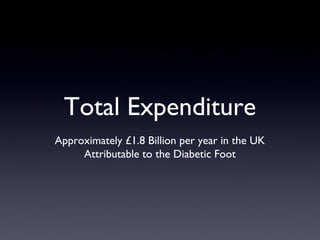
Total Expenditure
Approximately £1.8 Billion per year in the UK
     Attributable to the Diabetic Foot
Life expectancy of someone
      with a foot ulcer


is less than someone with
breast or testicular cancer
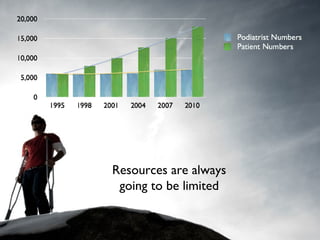
Resources are always
 going to be limited
Screening
 What is it?
 Why do it?
Screening Is..
The Starting Point
 for Effectiveness

 Quick & Simple

 Assess Patient’s
   Risk Level

 Not the Same as
  Assessment
What Do We
   Screen For?

 Previous Amputation
  Significant deformity
    Significant callus
    Active ulceration
  Previous ulceration
 Vascular insufficiency
Neurological insufficiency
    Able to self care?
Find Level of
Individual Risk

  LOW

 MEDIUM

  HIGH

  ACTIVE
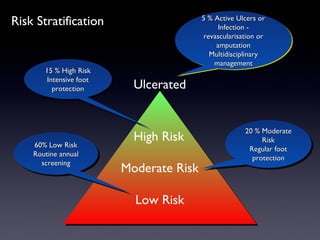
Risk Stratification                       5 % Active Ulcers or
                                          5 % Active Ulcers or
                                                Infection --
                                                 Infection
                                          revascularisation or
                                           revascularisation or
                                               amputation
                                               amputation
                                            Multidisciplinary
                                             Multidisciplinary
                                              management
                                              management
       15 % High Risk
       15 % High Risk
        Intensive foot
         Intensive foot
          protection
           protection
                            Ulcerated


                                                        20 % Moderate
                                                        20 % Moderate
                            High Risk                        Risk
                                                              Risk
    60% Low Risk
     60% Low Risk                                        Regular foot
                                                          Regular foot
    Routine annual
    Routine annual                                        protection
                                                           protection
      screening
       screening
                          Moderate Risk

                            Low Risk
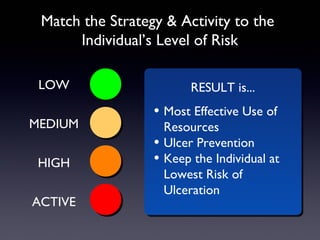
Match the Strategy & Activity to the
      Individual’s Level of Risk

 LOW                       RESULT is...
                  • Most Effective Use of
MEDIUM                Resources
                  •   Ulcer Prevention
 HIGH             •   Keep the Individual at
                      Lowest Risk of
                      Ulceration
ACTIVE
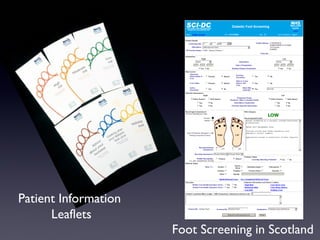
Patient Information
      Leaflets
                      Foot Screening in Scotland
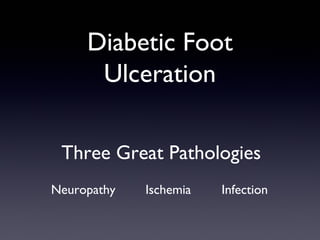
Diabetic Foot
      Ulceration

 Three Great Pathologies
Neuropathy   Ischemia   Infection
Improved Survival of
  the Diabetic Fot
   The role of a specialised foot clinic


          ME Edmonds et al
  QJ Med 1986; August; 60(232):763-71
Getti
       ng to
with B       Grips
       iomec
             hani c
                   s
Sho es
        abe tic”        and R oomy
    “Di           Soft
                         U ppers
   Pressure Relief?            Sto ck?
                            or
                       o ke
                   esp Rock
                  B             er Sol
   W e M us t S                        e?
                ave Money
          .. But Who Has the
                   Skills?
             Relieve Pressure?


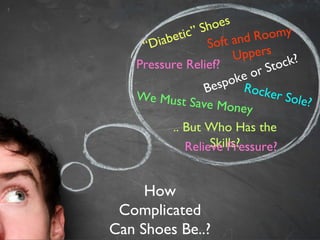
     How
 Complicated
Can Shoes Be..?
Your shoes caused my ulcer!
Enough..
is Enough!
Prevention
“becomes cost effective if we reduce incidence of foot
          ulcers and amputation by 25%”


                   Boulton et al;
                 Lancet Nov 2006
Prevent Ulceration
     Strategy according to individual risk


                 Ulcerated
 Improve
 Extrinsic
Influences       High Risk

               Moderate Risk

                  Low Risk
Problem is one of
         Mechanics
                          Paul Brand


    "The whole problem is one of mechanics, not of medicine.
      The biological responses of these denervated limbs are
           qualitatively similar to those of normal limbs.
It is the permitted pattern of mechanical stress that is different"
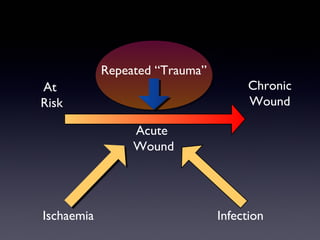
Extrinsic Factors
            Repeated “Trauma”
At                                   Chronic
Risk                                 Wound

                 Acute
                 Wound


Ischaemia                       Infection
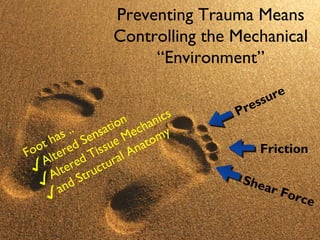
Preventing Trauma Means
                Controlling the Mechanical
                     “Environment”

                                     sure
                                Pr es
                on chan ics
         . nsati e
      s . Se              y
     a
    h d         e M natom
  ot re      su A
Fo lte d Tis al                     Friction
   A e re
 ✓ Alt truct  ur
   ✓ and S                       She
                                     ar
    ✓                                     For
                                              ce
Elevated Plantar Pressure
    Causative Factor
            in
       Ulceration
 and Ulceration is often
            a
      Precursor to
       Amputation
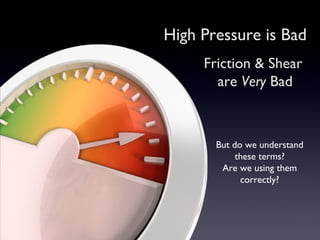
High Pressure is Bad
     Friction & Shear
       are Very Bad


       But do we understand
            these terms?
        Are we using them
             correctly?
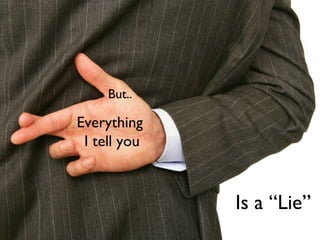
But..

Everything
 I tell you


              Is a “Lie”
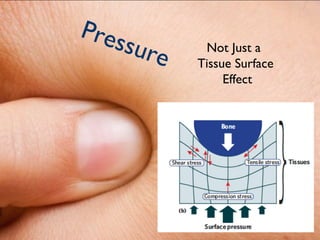
Pres
    s   ure    Not Just a
              Tissue Surface
                   Effect
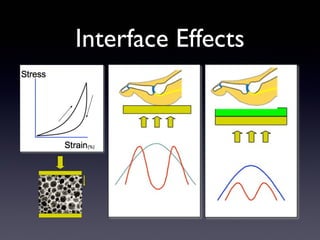
Interface Effects
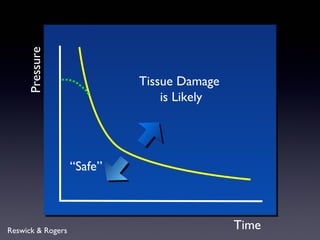
Pressure


                            Tissue Damage
                                is Likely


                   “Safe”


Reswick & Rogers                            Time
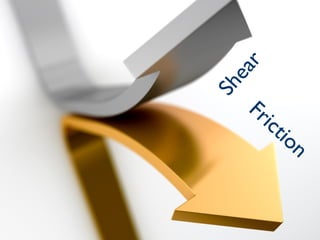
r
  ea
Sh
   Fr
        ict
              io
                   n
Friction.. Good or Bad?
Friction
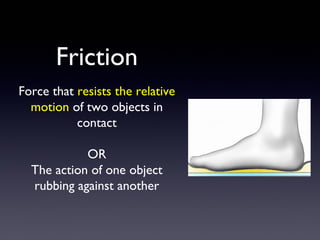
Force that resists the relative
  motion of two objects in
           contact

            OR
  The action of one object
  rubbing against another
Shear Stress
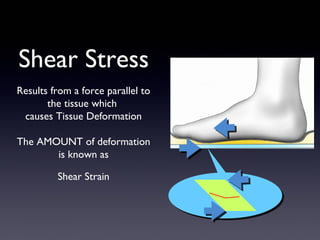
Results from a force parallel to
       the tissue which
 causes Tissue Deformation

The AMOUNT of deformation
       is known as

         Shear Strain
It’s a
  Challenge to
  Understand
“Cause” & “Effect”

We have to have
  a “model”
    “dynamic,
   quasi-linear,
   viscoelastic,
structural model”
NO


     Due to Complexity of the
            Situation
Mechano-transduction
Mechanisms by which cells convert mechanical stimulus
  into physiological activity - anabolic and catabolic


      A field holding the keys to progress?
Improve footbed materials?
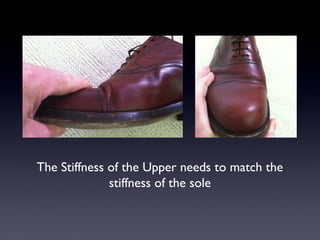
The Stiffness of the Upper needs to match the
              stiffness of the sole
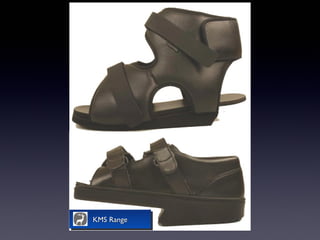
KMS Range
KMS Range
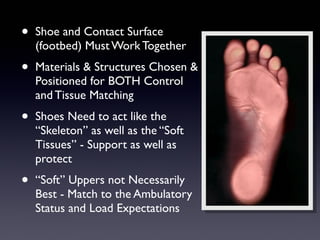
•   Shoe and Contact Surface
    (footbed) Must Work Together
•   Materials & Structures Chosen &
    Positioned for BOTH Control
    and Tissue Matching
•   Shoes Need to act like the
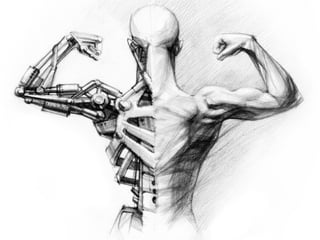
    “Skeleton” as well as the “Soft
    Tissues” - Support as well as
    protect
•   “Soft” Uppers not Necessarily
    Best - Match to the Ambulatory
    Status and Load Expectations
Remember ..
Biomechanics can
 provide insight.
It should support
   every choice.

   But Much
  Confusion of
  Terminology
t ic
    tho nt
Or me
  anage
M
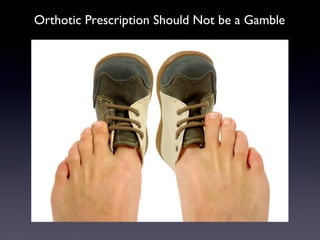
Orthotic Prescription be a Gamble
 Orthotic Prescription Should Not


Not a Gamble
Orthotic Prescription
• Deformity - Is it significant - Require a custom
  last?
• Ambulatory status?
• Biomechanical anomalies? Rigid or Hypermobile
  foot?
• Neuropathic status?
• Ischemia?
• Environmental/Occupational factors?
Devices and Techniques

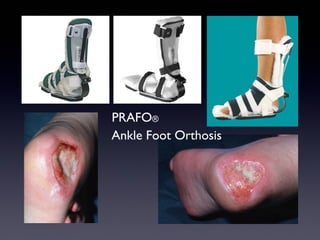
• PRAFO Ankle Foot Orthosis
• “Heel Relief” & “Forefoot Relief” Shoes
• Axial-Offloading
• AirCast
• Wound Healing Casts
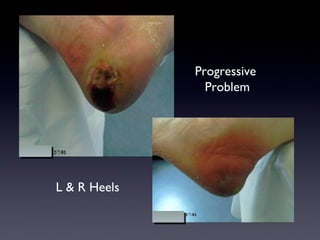
Progressive
                Problem


L & R Heels
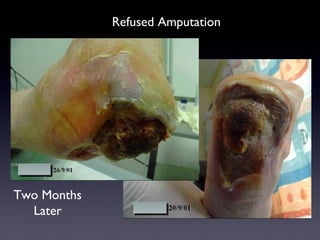
Refused Amputation


Two Months
  Later
156 weeks later


        Clinical Effectiveness Prize
Derek Jones, William Munro, Duncan Stang
PRAFO®
Ankle Foot Orthosis
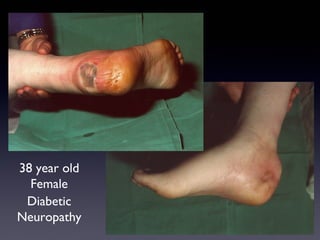
38 year old
  Female
 Diabetic
Neuropathy
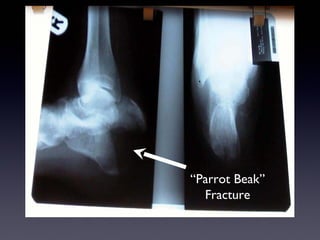
“Parrot Beak”
  Fracture
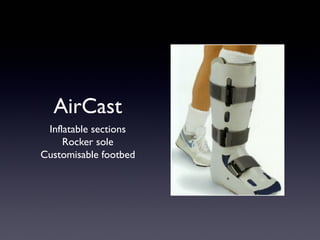
AirCast
 Inflatable sections
     Rocker sole
Customisable footbed
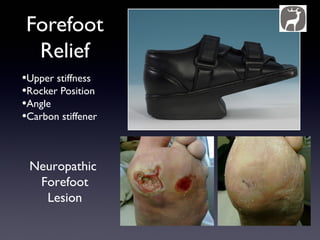
Forefoot
 Relief
•Upper stiffness
•Rocker Position
•Angle
•Carbon stiffener


 Neuropathic
  Forefoot
   Lesion
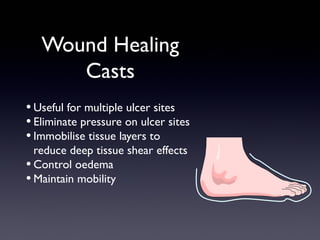
Wound Healing
      Casts
• Useful for multiple ulcer sites
• Eliminate pressure on ulcer sites
• Immobilise tissue layers to
  reduce deep tissue shear effects
• Control oedema
• Maintain mobility
You Have to Have Faith - and
then build rational processes for
          management
Thank you

Derek Jones
   2013

Diabetic Foot Care - DerekJones presenting at Otto Bock Scandinavia

  • 1.
    Screening, Biomechanical Considerations and Orthotic Management of the Diabetic Foot Derek Jones PhD, MBA
  • 2.
    Presentation •Impact of Diabetes •FootScreening •Biomechanics •Orthotic Management
  • 3.
    We are livinglonger But are we healthier
  • 4.
    Chronic Imp Conditions act o n So ciet y
  • 5.
    A drop inthe ocean? Diabetes Expenditure • 10% million affected inaffected world 2.9 of the UK NHS BudgetBudget 285 million UK NHS UK 10% of the people the £9 Billion per Year wide - 6.4% of population • £9£286 per per Year Billion Second Lifetime risk of foot ulceration - 25% • £286 per Second
  • 6.
    Cost Burden for Patients Varies with Country Cost of treating diabetic foot ulcers in five different countries. Cavanagh P, Attinger C, Abbas Z, Bal A, Rojas N, Xu ZR. Diabetes Metab Res Rev. 2012 Feb;28 Suppl 1:107-11. doi: 10.1002/dmrr.2245.
  • 7.
    Total Expenditure Approximately £1.8Billion per year in the UK Attributable to the Diabetic Foot
  • 8.
    Life expectancy ofsomeone with a foot ulcer is less than someone with breast or testicular cancer
  • 9.
    Resources are always going to be limited
  • 10.
    Screening What isit? Why do it?
  • 11.
    Screening Is.. The StartingPoint for Effectiveness Quick & Simple Assess Patient’s Risk Level Not the Same as Assessment
  • 12.
    What Do We Screen For? Previous Amputation Significant deformity Significant callus Active ulceration Previous ulceration Vascular insufficiency Neurological insufficiency Able to self care?
  • 13.
    Find Level of IndividualRisk LOW MEDIUM HIGH ACTIVE
  • 14.
    Risk Stratification 5 % Active Ulcers or 5 % Active Ulcers or Infection -- Infection revascularisation or revascularisation or amputation amputation Multidisciplinary Multidisciplinary management management 15 % High Risk 15 % High Risk Intensive foot Intensive foot protection protection Ulcerated 20 % Moderate 20 % Moderate High Risk Risk Risk 60% Low Risk 60% Low Risk Regular foot Regular foot Routine annual Routine annual protection protection screening screening Moderate Risk Low Risk
  • 15.
    Match the Strategy& Activity to the Individual’s Level of Risk LOW RESULT is... • Most Effective Use of MEDIUM Resources • Ulcer Prevention HIGH • Keep the Individual at Lowest Risk of Ulceration ACTIVE
  • 17.
    Patient Information Leaflets Foot Screening in Scotland
  • 18.
    Diabetic Foot Ulceration Three Great Pathologies Neuropathy Ischemia Infection
  • 19.
    Improved Survival of the Diabetic Fot The role of a specialised foot clinic ME Edmonds et al QJ Med 1986; August; 60(232):763-71
  • 20.
    Getti ng to with B Grips iomec hani c s
  • 21.
    Sho es abe tic” and R oomy “Di Soft U ppers Pressure Relief? Sto ck? or o ke esp Rock B er Sol W e M us t S e? ave Money .. But Who Has the Skills? Relieve Pressure? How Complicated Can Shoes Be..?
  • 22.
  • 23.
  • 24.
    Prevention “becomes cost effectiveif we reduce incidence of foot ulcers and amputation by 25%” Boulton et al; Lancet Nov 2006
  • 25.
    Prevent Ulceration Strategy according to individual risk Ulcerated Improve Extrinsic Influences High Risk Moderate Risk Low Risk
  • 26.
    Problem is oneof Mechanics Paul Brand "The whole problem is one of mechanics, not of medicine. The biological responses of these denervated limbs are qualitatively similar to those of normal limbs. It is the permitted pattern of mechanical stress that is different"
  • 27.
    Extrinsic Factors Repeated “Trauma” At Chronic Risk Wound Acute Wound Ischaemia Infection
  • 28.
    Preventing Trauma Means Controlling the Mechanical “Environment” sure Pr es on chan ics . nsati e s . Se y a h d e M natom ot re su A Fo lte d Tis al Friction A e re ✓ Alt truct ur ✓ and S She ar ✓ For ce
  • 29.
    Elevated Plantar Pressure Causative Factor in Ulceration and Ulceration is often a Precursor to Amputation
  • 30.
    High Pressure isBad Friction & Shear are Very Bad But do we understand these terms? Are we using them correctly?
  • 31.
    But.. Everything I tellyou Is a “Lie”
  • 32.
    Pres s ure Not Just a Tissue Surface Effect
  • 33.
  • 34.
    Pressure Tissue Damage is Likely “Safe” Reswick & Rogers Time
  • 35.
    r ea Sh Fr ict io n
  • 36.
  • 37.
    Friction Force that resiststhe relative motion of two objects in contact OR The action of one object rubbing against another
  • 38.
    Shear Stress Results froma force parallel to the tissue which causes Tissue Deformation The AMOUNT of deformation is known as Shear Strain
  • 39.
    It’s a Challenge to Understand “Cause” & “Effect” We have to have a “model” “dynamic, quasi-linear, viscoelastic, structural model”
  • 40.
    NO Due to Complexity of the Situation
  • 41.
    Mechano-transduction Mechanisms by whichcells convert mechanical stimulus into physiological activity - anabolic and catabolic A field holding the keys to progress?
  • 43.
  • 44.
    The Stiffness ofthe Upper needs to match the stiffness of the sole
  • 45.
  • 46.
    Shoe and Contact Surface (footbed) Must Work Together • Materials & Structures Chosen & Positioned for BOTH Control and Tissue Matching • Shoes Need to act like the “Skeleton” as well as the “Soft Tissues” - Support as well as protect • “Soft” Uppers not Necessarily Best - Match to the Ambulatory Status and Load Expectations
  • 47.
    Remember .. Biomechanics can provide insight. It should support every choice. But Much Confusion of Terminology
  • 48.
    t ic tho nt Or me anage M
  • 49.
    Orthotic Prescription bea Gamble Orthotic Prescription Should Not Not a Gamble
  • 50.
    Orthotic Prescription • Deformity- Is it significant - Require a custom last? • Ambulatory status? • Biomechanical anomalies? Rigid or Hypermobile foot? • Neuropathic status? • Ischemia? • Environmental/Occupational factors?
  • 51.
    Devices and Techniques •PRAFO Ankle Foot Orthosis • “Heel Relief” & “Forefoot Relief” Shoes • Axial-Offloading • AirCast • Wound Healing Casts
  • 52.
    Progressive Problem L & R Heels
  • 53.
  • 54.
    156 weeks later Clinical Effectiveness Prize Derek Jones, William Munro, Duncan Stang
  • 55.
  • 56.
    38 year old Female Diabetic Neuropathy
  • 57.
  • 58.
    AirCast Inflatable sections Rocker sole Customisable footbed
  • 59.
    Forefoot Relief •Upper stiffness •RockerPosition •Angle •Carbon stiffener Neuropathic Forefoot Lesion
  • 60.
    Wound Healing Casts • Useful for multiple ulcer sites • Eliminate pressure on ulcer sites • Immobilise tissue layers to reduce deep tissue shear effects • Control oedema • Maintain mobility
  • 61.
    You Have toHave Faith - and then build rational processes for management
  • 62.

Editor's Notes

  • #2 Preserving and protecting the diabetic foot has been described as a mechanical challenge - a problem of mechanics as much as medicine - and in this presentation we touch upon why this is so. We are going to point out some of the complexity behind terms such as pressure, friction and shear stress and the implications for footwear design. We conclude by listing some of the principles to keep in mind when designing shoes for the diabetic foot.
  • #21 Preserving and protecting the diabetic foot has been described as a mechanical challenge - a problem of mechanics as much as medicine - and in this presentation we touch upon why this is so. We are going to point out some of the complexity behind terms such as pressure, friction and shear stress and the implications for footwear design. We conclude by listing some of the principles to keep in mind when designing shoes for the diabetic foot.
  • #22 There is certainly a lot of confusion on the topic of shoes for persons with diabetic foot disease. We seem to have a general lack of clarity about exactly how shoes for diabetic patients should be designed, manufactured and prescribed. There is certainly confusion - even an abuse of terminology. In the minds of many, there is a belief that prescription shoes can't be all that complicated. However this is a mistaken belief. As in many aspects of biomechanics, the subject is much more complex than we might like.
  • #29 With the diabetic foot, we understand that each affected individual may well have neuropathy, tissues of the foot that have mechanical characteristics that differ from "normal" ranges - and altered anatomical structures. These mechanical characteristics will vary from person to person, and are modified by the disease process and even will vary in one person over time. As we move through our environment the interaction - the points of contact - we have with our environment has mechanical and therefore biological consequences. The forces generated, for example, manifest as changing patterns of pressure, friction and shear force at the foot-shoe interface and deep within the tissues of the foot.
  • #31 Well at a simpler level - what do we know for sure? We know that high pressure is bad and that friction and shear are potentially very bad. We also know that localised pressure, creating pressure gradients and localised tissue deformation generates damaging shear stresses. But that level of knowledge isn't sufficient to help us with the ideal shoe design. In order to influence design we need to delve deeper and this is where biomechanics can be useful.
  • #32 Now I'd better start with a confession. Everything I will tell you is a lie - but hopefully a useful lie. The reason for this comes down to how biomechanics - that is - engineering applied to gain an understanding of body systems - must rely on models of reality. And these models are never perfect - they are simplifications that we can hold to be true for a while or for certain specific situations. The fact is, sooner or later a better model - and improved understanding - comes along. So when we use terms like force, pressure, stress and strain we should do so acknowledging the inherent limitations of our viewpoint.
  • #33 Most of us believe we have a good grasp of the physical meaning of pressure. After all, its simple to imagine how pressure is created though the application of load over an area - but its difficult to accurately measure. And its not just a surface effect when we apply load to tissue. The skin, muscle and soft tissues deform and experience these mechanical loads in different ways. Many of the strategies that are applied in the creation of footbeds and footwear aim to spread applied loads over a greater area - thereby reducing the local pressure gradients.
  • #34 Using a mixture of measurement and mathematics we can predict for example how different interface materials will influence the surface pressures and shear stress. These approaches are always simplifications because we have to make assumptions about the conditions that prevail. Of course we wish to manage the performance of the interface between foot and shoe - knowing that in use the parameters that we need to fine tune that performance vary from situation to situation and from person to person.
  • #36 Two of the terms we frequently hear are "Friction" & "Shear". Actually, strictly speaking, there are a number of different types of friction and shear. Friction is the force that resists the relative motion of solid surfaces in contact. It is in practical terms very difficult to calculate a value for friction - it generally has to be determined empirically. Friction and Shear Stress occur together and this is why we try to minimise them in footwear for diabetics. Shear Stress results when a force acts coplanar to a surface with the result that the tissues deform. And when the tissue deforms and flexes to extremes we have part of the precursor for ulceration.
  • #40 If we take a look at tissue closely we see that it is not homogenous. There are actually multiple layers of skin, fat, muscle, bone and other structures - each with different behaviours under load. An of course the foot and ankle is a dynamic jointed structure that is meant to be rigid at some phases of gait and flexible at others. Engineers have studied areas of the foot such the heel pad to understand how such tissue behaves under dynamic loading conditions such as those experienced during gait. As we try to model this type of situation we truly discover it's inherent complexity. Notice that the dynamic behaviour of the tissue might be modelled using forms well understood by engineers.
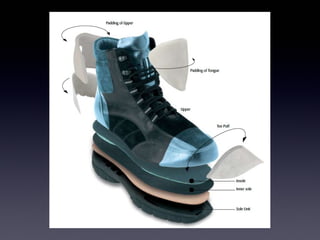
  • #43 When we have to make choices about shoe design for diabetics we have to be mindful of the need for foot protection and control. Just as we saw with tissue, we potentially have multiple layers that have individual mechanical characteristics and shapes with the potential to harm or protect. During walking and other activities the shoe will flex and twist and thought must be given to how the shoe and tissues will interact. By all means have materials that behave like tissue in contact with the plantar surface and high load bearing areas of the foot. But we need to be mindful about how the whole shoe and footbed work together. If the thickness and weight of the upper is not matched to the flexibility of the sole unit, for example, the shoe is likely to distort under the loads generated during walking - the result will be undesirable pressure, friction and shear.
  • #47 Here is a short list of principles that should guide us. First of all we need accurate, reliable measurements of the foot. At present we have a plethora of techniques and beliefs about how measurement should be done. Clearly if measurements cannot be taken consistently and reliably we are off to a bad start. Some areas of the foot are particularly sensitive to localised pressure gradients and therefore prone to ulceration. The insole and components of the shoe should be designed to work together. It is not good enough to put a soft "tissue like" insole inside a shoe and hope for the best. Materials chosen to behave like tissue should go close to tissue if we are to minimise stress. However, these insole materials need to interface with the structure of the shoe. Take a look at the human body that has layers of tissue for good reason. The skeleton, ligaments and tendons transmit force whilst the soft tissues absorb dynamic stresses and strains. The shoes we design should act like the skeleton too - not just like the soft tissues. They should allow safe transmission of dynamic load and should allow control and protection to be imposed. To think that shoes should always have "soft roomy uppers" is very inaccurate and mechanically flawed thinking. Of course we should choose the materials carefully and position them within a shoe so that they have the desired effect of control or tissue matching.