VITAMINS &
MINERALS
Presented by:
Murabiya Udit
FPT-MB2-05
Applied fisheries biochemistry (FPT 505)
CONTENTS
Vitamin:
Classification (Fat & water soluble)
Heat labile & stable vitamin
Vitamin source in fish
Processing effect on vitamin
Minerals:
Major, minor and trace elements
Health benefits
Minerals which get from fish
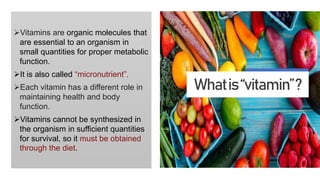
Vitamins are organic molecules that
are essential to an organism in
small quantities for proper metabolic
function.
It is also called “micronutrient”.
Each vitamin has a different role in
maintaining health and body
function.
Vitamins cannot be synthesized in
the organism in sufficient quantities
for survival, so it must be obtained
through the diet.
Whatis“vitamin”?
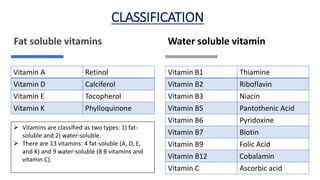
Fat soluble vitamins Water soluble vitamin
Vitamin A Retinol
Vitamin D Calciferol
Vitamin E Tocopherol
Vitamin K Phylloquinone
Vitamin B1 Thiamine
Vitamin B2 Riboflavin
Vitamin B3 Niacin
Vitamin B5 Pantothenic Acid
Vitamin B6 Pyridoxine
Vitamin B7 Biotin
Vitamin B9 Folic Acid
Vitamin B12 Cobalamin
Vitamin C Ascorbic acid
CLASSIFICATION
 Vitamins are classified as two types: 1) fat-
soluble and 2) water-soluble.
 There are 13 vitamins: 4 fat-soluble (A, D, E,
and K) and 9 water-soluble (8 B vitamins and
vitamin C).
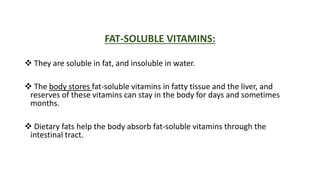
FAT-SOLUBLE VITAMINS:
 They are soluble in fat, and insoluble in water.
 The body stores fat-soluble vitamins in fatty tissue and the liver, and
reserves of these vitamins can stay in the body for days and sometimes
months.
 Dietary fats help the body absorb fat-soluble vitamins through the
intestinal tract.
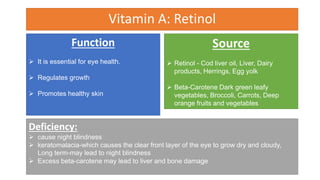
Vitamin A: Retinol
Function
 It is essential for eye health.
 Regulates growth
 Promotes healthy skin
Source
 Retinol - Cod liver oil, Liver, Dairy
products, Herrings, Egg yolk
 Beta-Carotene Dark green leafy
vegetables, Broccoli, Carrots, Deep
orange fruits and vegetables
Deficiency:
 cause night blindness
 keratomalacia-which causes the clear front layer of the eye to grow dry and cloudy,
Long term-may lead to night blindness
 Excess beta-carotene may lead to liver and bone damage
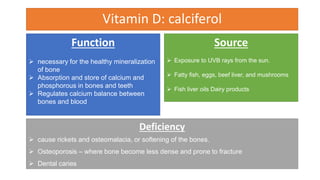
Vitamin D: calciferol
Function
 necessary for the healthy mineralization
of bone
 Absorption and store of calcium and
phosphorous in bones and teeth
 Regulates calcium balance between
bones and blood
Source
 Exposure to UVB rays from the sun.
 Fatty fish, eggs, beef liver, and mushrooms
 Fish liver oils Dairy products
Deficiency
 cause rickets and osteomalacia, or softening of the bones.
 Osteoporosis – where bone become less dense and prone to fracture
 Dental caries
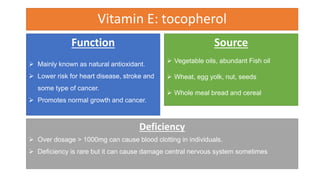
Vitamin E: tocopherol
Function
 Mainly known as natural antioxidant.
 Lower risk for heart disease, stroke and
some type of cancer.
 Promotes normal growth and cancer.
Source
 Vegetable oils, abundant Fish oil
 Wheat, egg yolk, nut, seeds
 Whole meal bread and cereal
Deficiency
 Over dosage > 1000mg can cause blood clotting in individuals.
 Deficiency is rare but it can cause damage central nervous system sometimes
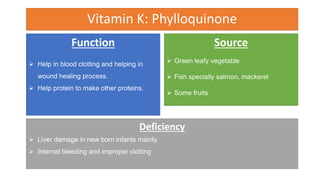
Vitamin K: Phylloquinone
Function
 Help in blood clotting and helping in
wound healing process.
 Help protein to make other proteins.
Source
 Green leafy vegetable
 Fish specially salmon, mackerel
 Some fruits
Deficiency
 Liver damage in new born infants mainly.
 Internal bleeding and improper clotting
WATER-SOLUBLE VITAMINS:
They are soluble in water, and insoluble in fat.
Water-soluble vitamins do not stay in the body for long and cannot
be stored.
They leave the body via the urine. Because of this, people need a
more regular supply of water-soluble vitamins than fat-soluble ones.
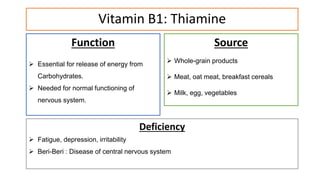
Vitamin B1: Thiamine
Function
 Essential for release of energy from
Carbohydrates.
 Needed for normal functioning of
nervous system.
Source
 Whole-grain products
 Meat, oat meat, breakfast cereals
 Milk, egg, vegetables
Deficiency
 Fatigue, depression, irritability
 Beri-Beri : Disease of central nervous system
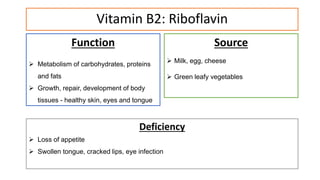
Vitamin B2: Riboflavin
Function
 Metabolism of carbohydrates, proteins
and fats
 Growth, repair, development of body
tissues - healthy skin, eyes and tongue
Source
 Milk, egg, cheese
 Green leafy vegetables
Deficiency
 Loss of appetite
 Swollen tongue, cracked lips, eye infection
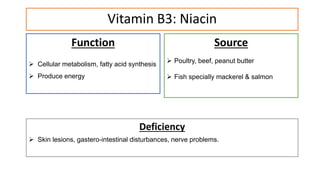
Vitamin B3: Niacin
Function
 Cellular metabolism, fatty acid synthesis
 Produce energy
Source
 Poultry, beef, peanut butter
 Fish specially mackerel & salmon
Deficiency
 Skin lesions, gastero-intestinal disturbances, nerve problems.
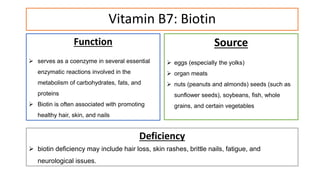
Vitamin B7: Biotin
Function
 serves as a coenzyme in several essential
enzymatic reactions involved in the
metabolism of carbohydrates, fats, and
proteins
 Biotin is often associated with promoting
healthy hair, skin, and nails
Source
 eggs (especially the yolks)
 organ meats
 nuts (peanuts and almonds) seeds (such as
sunflower seeds), soybeans, fish, whole
grains, and certain vegetables
Deficiency
 biotin deficiency may include hair loss, skin rashes, brittle nails, fatigue, and
neurological issues.
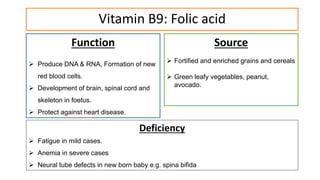
Vitamin B9: Folic acid
Function
 Produce DNA & RNA, Formation of new
red blood cells.
 Development of brain, spinal cord and
skeleton in foetus.
 Protect against heart disease.
Source
 Fortified and enriched grains and cereals
 Green leafy vegetables, peanut,
avocado.
Deficiency
 Fatigue in mild cases.
 Anemia in severe cases
 Neural tube defects in new born baby e.g. spina bifida
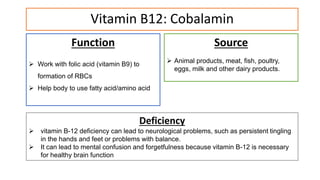
Vitamin B12: Cobalamin
Function
 Work with folic acid (vitamin B9) to
formation of RBCs
 Help body to use fatty acid/amino acid
Source
 Animal products, meat, fish, poultry,
eggs, milk and other dairy products.
Deficiency
 vitamin B-12 deficiency can lead to neurological problems, such as persistent tingling
in the hands and feet or problems with balance.
 It can lead to mental confusion and forgetfulness because vitamin B-12 is necessary
for healthy brain function
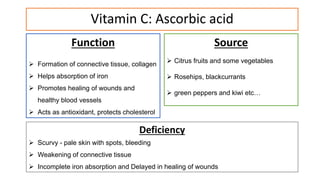
Vitamin C: Ascorbic acid
Function
 Formation of connective tissue, collagen
 Helps absorption of iron
 Promotes healing of wounds and
healthy blood vessels
 Acts as antioxidant, protects cholesterol
Source
 Citrus fruits and some vegetables
 Rosehips, blackcurrants
 green peppers and kiwi etc…
Deficiency
 Scurvy - pale skin with spots, bleeding
 Weakening of connective tissue
 Incomplete iron absorption and Delayed in healing of wounds
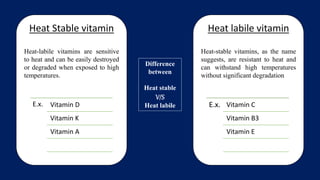
Heat Stable vitamin
Heat-labile vitamins are sensitive
to heat and can be easily destroyed
or degraded when exposed to high
temperatures.
Heat labile vitamin
Heat-stable vitamins, as the name
suggests, are resistant to heat and
can withstand high temperatures
without significant degradation
Difference
between
Heat stable
V/S
Heat labile E.x. Vitamin C
Vitamin B3
Vitamin E
E.x. Vitamin D
Vitamin K
Vitamin A
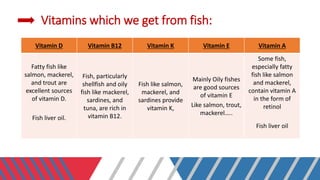
Vitamins which we get from fish:
Make a timeline of the important historical events or list historical contributions made by people of Jewish
American heritage.
Vitamin D Vitamin B12 Vitamin K Vitamin E Vitamin A
Fatty fish like
salmon, mackerel,
and trout are
excellent sources
of vitamin D.
Fish liver oil.
Fish, particularly
shellfish and oily
fish like mackerel,
sardines, and
tuna, are rich in
vitamin B12.
Fish like salmon,
mackerel, and
sardines provide
vitamin K,
Mainly Oily fishes
are good sources
of vitamin E
Like salmon, trout,
mackerel…..
Some fish,
especially fatty
fish like salmon
and mackerel,
contain vitamin A
in the form of
retinol
Fish liver oil
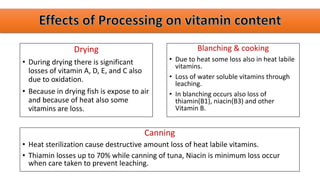
Drying
• During drying there is significant
losses of vitamin A, D, E, and C also
due to oxidation.
• Because in drying fish is expose to air
and because of heat also some
vitamins are loss.
Blanching & cooking
• Due to heat some loss also in heat labile
vitamins.
• Loss of water soluble vitamins through
leaching.
• In blanching occurs also loss of
thiamin(B1), niacin(B3) and other
Vitamin B.
Canning
• Heat sterilization cause destructive amount loss of heat labile vitamins.
• Thiamin losses up to 70% while canning of tuna, Niacin is minimum loss occur
when care taken to prevent leaching.
Freezing
• In proper packaging and
processing condition
vitamin loss during
freezing is negligible.
• But if fish is exposed in
air during ineffective
packaging oxidation
occurs.
• It decrease vitamin E
due to lipid
peroxidation
Irradiation
• Irradiation also cause
large amount of vitamin
loss.
• Irradiation at > 0.kGy is
considerable loss of
specially vitamin B1.
Surimi
• The production of
surimi result in a loss of
vitamins specially water
soluble vitamins.
• Huge loss of niacin (B3)
are observed during
surimi preparation.
Curing & Smoking
• Loss of water soluble vitamin during curing.
• Smoking can destroy heat labile vitamin. Up to 15-20%
thiamin loss during smoking.
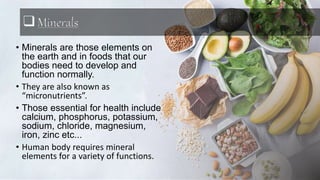
Minerals
• Minerals are those elements on
the earth and in foods that our
bodies need to develop and
function normally.
• They are also known as
“micronutrients”.
• Those essential for health include
calcium, phosphorus, potassium,
sodium, chloride, magnesium,
iron, zinc etc...
• Human body requires mineral
elements for a variety of functions.
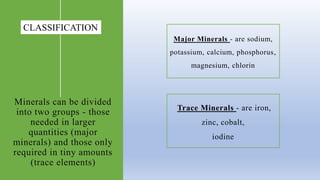
Minerals can be divided
into two groups - those
needed in larger
quantities (major
minerals) and those only
required in tiny amounts
(trace elements)
Major Minerals - are sodium,
potassium, calcium, phosphorus​,
magnesium, chlorin
Trace Minerals - are iron,
zinc, cobalt,
iodine
CLASSIFICATION
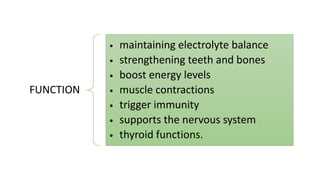
FUNCTION
• maintaining electrolyte balance
• strengthening teeth and bones
• boost energy levels
• muscle contractions
• trigger immunity
• supports the nervous system
• thyroid functions.
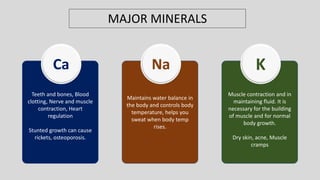
Teeth and bones, Blood
clotting, Nerve and muscle
contraction, Heart
regulation
Stunted growth can cause
rickets, osteoporosis.
Ca
Maintains water balance in
the body and controls body
temperature, helps you
sweat when body temp
rises.
Na
Muscle contraction and in
maintaining fluid. It is
necessary for the building
of muscle and for normal
body growth.
Dry skin, acne, Muscle
cramps
K
MAJOR MINERALS
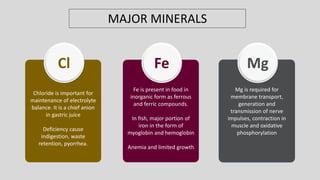
Chloride is important for
maintenance of electrolyte
balance. It is a chief anion
in gastric juice
Deficiency cause
indigestion, waste
retention, pyorrhea.
Cl
Mg is required for
membrane transport,
generation and
transmission of nerve
impulses, contraction in
muscle and oxidative
phosphorylation
Mg
MAJOR MINERALS
Fe is present in food in
inorganic form as ferrous
and ferric compounds.
In fish, major portion of
iron in the form of
myoglobin and hemoglobin
Anemia and limited growth
Fe
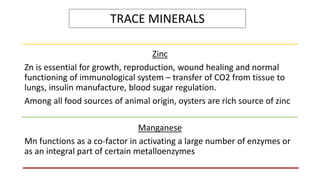
TRACE MINERALS
Zinc
Zn is essential for growth, reproduction, wound healing and normal
functioning of immunological system – transfer of CO2 from tissue to
lungs, insulin manufacture, blood sugar regulation.
Among all food sources of animal origin, oysters are rich source of zinc
Manganese
Mn functions as a co-factor in activating a large number of enzymes or
as an integral part of certain metalloenzymes
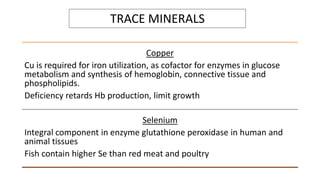
TRACE MINERALS
Copper
Cu is required for iron utilization, as cofactor for enzymes in glucose
metabolism and synthesis of hemoglobin, connective tissue and
phospholipids.
Deficiency retards Hb production, limit growth
Selenium
Integral component in enzyme glutathione peroxidase in human and
animal tissues
Fish contain higher Se than red meat and poultry
TRACE MINERALS
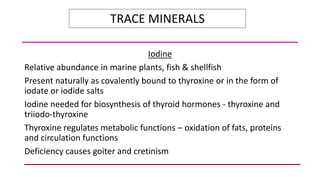
Iodine
Relative abundance in marine plants, fish & shellfish
Present naturally as covalently bound to thyroxine or in the form of
iodate or iodide salts
Iodine needed for biosynthesis of thyroid hormones - thyroxine and
triiodo-thyroxine
Thyroxine regulates metabolic functions – oxidation of fats, proteins
and circulation functions
Deficiency causes goiter and cretinism
TRACE MINERALS
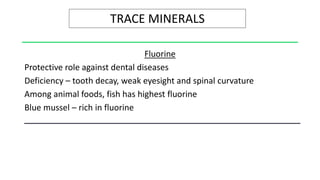
Fluorine
Protective role against dental diseases
Deficiency – tooth decay, weak eyesight and spinal curvature
Among animal foods, fish has highest fluorine
Blue mussel – rich in fluorine
» When we talk about human nutrition, it is
impossible to include every nutritional components
in our regular diet.
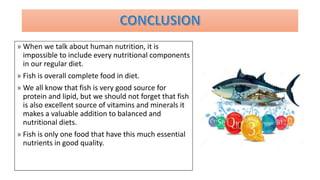
» Fish is overall complete food in diet.
» We all know that fish is very good source for
protein and lipid, but we should not forget that fish
is also excellent source of vitamins and minerals it
makes a valuable addition to balanced and
nutritional diets.
» Fish is only one food that have this much essential
nutrients in good quality.
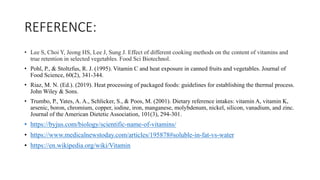
REFERENCE:
• Lee S, Choi Y, Jeong HS, Lee J, Sung J. Effect of different cooking methods on the content of vitamins and
true retention in selected vegetables. Food Sci Biotechnol.
• Pohl, P., & Stoltzfus, R. J. (1995). Vitamin C and heat exposure in canned fruits and vegetables. Journal of
Food Science, 60(2), 341-344.
• Riaz, M. N. (Ed.). (2019). Heat processing of packaged foods: guidelines for establishing the thermal process.
John Wiley & Sons.
• Trumbo, P., Yates, A. A., Schlicker, S., & Poos, M. (2001). Dietary reference intakes: vitamin A, vitamin K,
arsenic, boron, chromium, copper, iodine, iron, manganese, molybdenum, nickel, silicon, vanadium, and zinc.
Journal of the American Dietetic Association, 101(3), 294-301.
• https://byjus.com/biology/scientific-name-of-vitamins/
• https://www.medicalnewstoday.com/articles/195878#soluble-in-fat-vs-water
• https://en.wikipedia.org/wiki/Vitamin
THANK YOU

Vitamins & Minerals and effect of processing.pptx

  • 1.
    VITAMINS & MINERALS Presented by: MurabiyaUdit FPT-MB2-05 Applied fisheries biochemistry (FPT 505)
  • 2.
    CONTENTS Vitamin: Classification (Fat &water soluble) Heat labile & stable vitamin Vitamin source in fish Processing effect on vitamin Minerals: Major, minor and trace elements Health benefits Minerals which get from fish
  • 3.
    Vitamins are organicmolecules that are essential to an organism in small quantities for proper metabolic function. It is also called “micronutrient”. Each vitamin has a different role in maintaining health and body function. Vitamins cannot be synthesized in the organism in sufficient quantities for survival, so it must be obtained through the diet. Whatis“vitamin”?
  • 4.
    Fat soluble vitaminsWater soluble vitamin Vitamin A Retinol Vitamin D Calciferol Vitamin E Tocopherol Vitamin K Phylloquinone Vitamin B1 Thiamine Vitamin B2 Riboflavin Vitamin B3 Niacin Vitamin B5 Pantothenic Acid Vitamin B6 Pyridoxine Vitamin B7 Biotin Vitamin B9 Folic Acid Vitamin B12 Cobalamin Vitamin C Ascorbic acid CLASSIFICATION  Vitamins are classified as two types: 1) fat- soluble and 2) water-soluble.  There are 13 vitamins: 4 fat-soluble (A, D, E, and K) and 9 water-soluble (8 B vitamins and vitamin C).
  • 5.
    FAT-SOLUBLE VITAMINS:  Theyare soluble in fat, and insoluble in water.  The body stores fat-soluble vitamins in fatty tissue and the liver, and reserves of these vitamins can stay in the body for days and sometimes months.  Dietary fats help the body absorb fat-soluble vitamins through the intestinal tract.
  • 6.
    Vitamin A: Retinol Function It is essential for eye health.  Regulates growth  Promotes healthy skin Source  Retinol - Cod liver oil, Liver, Dairy products, Herrings, Egg yolk  Beta-Carotene Dark green leafy vegetables, Broccoli, Carrots, Deep orange fruits and vegetables Deficiency:  cause night blindness  keratomalacia-which causes the clear front layer of the eye to grow dry and cloudy, Long term-may lead to night blindness  Excess beta-carotene may lead to liver and bone damage
  • 7.
    Vitamin D: calciferol Function necessary for the healthy mineralization of bone  Absorption and store of calcium and phosphorous in bones and teeth  Regulates calcium balance between bones and blood Source  Exposure to UVB rays from the sun.  Fatty fish, eggs, beef liver, and mushrooms  Fish liver oils Dairy products Deficiency  cause rickets and osteomalacia, or softening of the bones.  Osteoporosis – where bone become less dense and prone to fracture  Dental caries
  • 8.
    Vitamin E: tocopherol Function Mainly known as natural antioxidant.  Lower risk for heart disease, stroke and some type of cancer.  Promotes normal growth and cancer. Source  Vegetable oils, abundant Fish oil  Wheat, egg yolk, nut, seeds  Whole meal bread and cereal Deficiency  Over dosage > 1000mg can cause blood clotting in individuals.  Deficiency is rare but it can cause damage central nervous system sometimes
  • 9.
    Vitamin K: Phylloquinone Function Help in blood clotting and helping in wound healing process.  Help protein to make other proteins. Source  Green leafy vegetable  Fish specially salmon, mackerel  Some fruits Deficiency  Liver damage in new born infants mainly.  Internal bleeding and improper clotting
  • 10.
    WATER-SOLUBLE VITAMINS: They aresoluble in water, and insoluble in fat. Water-soluble vitamins do not stay in the body for long and cannot be stored. They leave the body via the urine. Because of this, people need a more regular supply of water-soluble vitamins than fat-soluble ones.
  • 11.
    Vitamin B1: Thiamine Function Essential for release of energy from Carbohydrates.  Needed for normal functioning of nervous system. Source  Whole-grain products  Meat, oat meat, breakfast cereals  Milk, egg, vegetables Deficiency  Fatigue, depression, irritability  Beri-Beri : Disease of central nervous system
  • 12.
    Vitamin B2: Riboflavin Function Metabolism of carbohydrates, proteins and fats  Growth, repair, development of body tissues - healthy skin, eyes and tongue Source  Milk, egg, cheese  Green leafy vegetables Deficiency  Loss of appetite  Swollen tongue, cracked lips, eye infection
  • 13.
    Vitamin B3: Niacin Function Cellular metabolism, fatty acid synthesis  Produce energy Source  Poultry, beef, peanut butter  Fish specially mackerel & salmon Deficiency  Skin lesions, gastero-intestinal disturbances, nerve problems.
  • 14.
    Vitamin B7: Biotin Function serves as a coenzyme in several essential enzymatic reactions involved in the metabolism of carbohydrates, fats, and proteins  Biotin is often associated with promoting healthy hair, skin, and nails Source  eggs (especially the yolks)  organ meats  nuts (peanuts and almonds) seeds (such as sunflower seeds), soybeans, fish, whole grains, and certain vegetables Deficiency  biotin deficiency may include hair loss, skin rashes, brittle nails, fatigue, and neurological issues.
  • 15.
    Vitamin B9: Folicacid Function  Produce DNA & RNA, Formation of new red blood cells.  Development of brain, spinal cord and skeleton in foetus.  Protect against heart disease. Source  Fortified and enriched grains and cereals  Green leafy vegetables, peanut, avocado. Deficiency  Fatigue in mild cases.  Anemia in severe cases  Neural tube defects in new born baby e.g. spina bifida
  • 16.
    Vitamin B12: Cobalamin Function Work with folic acid (vitamin B9) to formation of RBCs  Help body to use fatty acid/amino acid Source  Animal products, meat, fish, poultry, eggs, milk and other dairy products. Deficiency  vitamin B-12 deficiency can lead to neurological problems, such as persistent tingling in the hands and feet or problems with balance.  It can lead to mental confusion and forgetfulness because vitamin B-12 is necessary for healthy brain function
  • 17.
    Vitamin C: Ascorbicacid Function  Formation of connective tissue, collagen  Helps absorption of iron  Promotes healing of wounds and healthy blood vessels  Acts as antioxidant, protects cholesterol Source  Citrus fruits and some vegetables  Rosehips, blackcurrants  green peppers and kiwi etc… Deficiency  Scurvy - pale skin with spots, bleeding  Weakening of connective tissue  Incomplete iron absorption and Delayed in healing of wounds
  • 18.
    Heat Stable vitamin Heat-labilevitamins are sensitive to heat and can be easily destroyed or degraded when exposed to high temperatures. Heat labile vitamin Heat-stable vitamins, as the name suggests, are resistant to heat and can withstand high temperatures without significant degradation Difference between Heat stable V/S Heat labile E.x. Vitamin C Vitamin B3 Vitamin E E.x. Vitamin D Vitamin K Vitamin A
  • 19.
    Vitamins which weget from fish: Make a timeline of the important historical events or list historical contributions made by people of Jewish American heritage. Vitamin D Vitamin B12 Vitamin K Vitamin E Vitamin A Fatty fish like salmon, mackerel, and trout are excellent sources of vitamin D. Fish liver oil. Fish, particularly shellfish and oily fish like mackerel, sardines, and tuna, are rich in vitamin B12. Fish like salmon, mackerel, and sardines provide vitamin K, Mainly Oily fishes are good sources of vitamin E Like salmon, trout, mackerel….. Some fish, especially fatty fish like salmon and mackerel, contain vitamin A in the form of retinol Fish liver oil
  • 20.
    Drying • During dryingthere is significant losses of vitamin A, D, E, and C also due to oxidation. • Because in drying fish is expose to air and because of heat also some vitamins are loss. Blanching & cooking • Due to heat some loss also in heat labile vitamins. • Loss of water soluble vitamins through leaching. • In blanching occurs also loss of thiamin(B1), niacin(B3) and other Vitamin B. Canning • Heat sterilization cause destructive amount loss of heat labile vitamins. • Thiamin losses up to 70% while canning of tuna, Niacin is minimum loss occur when care taken to prevent leaching.
  • 21.
    Freezing • In properpackaging and processing condition vitamin loss during freezing is negligible. • But if fish is exposed in air during ineffective packaging oxidation occurs. • It decrease vitamin E due to lipid peroxidation Irradiation • Irradiation also cause large amount of vitamin loss. • Irradiation at > 0.kGy is considerable loss of specially vitamin B1. Surimi • The production of surimi result in a loss of vitamins specially water soluble vitamins. • Huge loss of niacin (B3) are observed during surimi preparation. Curing & Smoking • Loss of water soluble vitamin during curing. • Smoking can destroy heat labile vitamin. Up to 15-20% thiamin loss during smoking.
  • 22.
    Minerals • Minerals arethose elements on the earth and in foods that our bodies need to develop and function normally. • They are also known as “micronutrients”. • Those essential for health include calcium, phosphorus, potassium, sodium, chloride, magnesium, iron, zinc etc... • Human body requires mineral elements for a variety of functions.
  • 23.
    Minerals can bedivided into two groups - those needed in larger quantities (major minerals) and those only required in tiny amounts (trace elements) Major Minerals - are sodium, potassium, calcium, phosphorus​, magnesium, chlorin Trace Minerals - are iron, zinc, cobalt, iodine CLASSIFICATION
  • 24.
    FUNCTION • maintaining electrolytebalance • strengthening teeth and bones • boost energy levels • muscle contractions • trigger immunity • supports the nervous system • thyroid functions.
  • 25.
    Teeth and bones,Blood clotting, Nerve and muscle contraction, Heart regulation Stunted growth can cause rickets, osteoporosis. Ca Maintains water balance in the body and controls body temperature, helps you sweat when body temp rises. Na Muscle contraction and in maintaining fluid. It is necessary for the building of muscle and for normal body growth. Dry skin, acne, Muscle cramps K MAJOR MINERALS
  • 26.
    Chloride is importantfor maintenance of electrolyte balance. It is a chief anion in gastric juice Deficiency cause indigestion, waste retention, pyorrhea. Cl Mg is required for membrane transport, generation and transmission of nerve impulses, contraction in muscle and oxidative phosphorylation Mg MAJOR MINERALS Fe is present in food in inorganic form as ferrous and ferric compounds. In fish, major portion of iron in the form of myoglobin and hemoglobin Anemia and limited growth Fe
  • 27.
    TRACE MINERALS Zinc Zn isessential for growth, reproduction, wound healing and normal functioning of immunological system – transfer of CO2 from tissue to lungs, insulin manufacture, blood sugar regulation. Among all food sources of animal origin, oysters are rich source of zinc Manganese Mn functions as a co-factor in activating a large number of enzymes or as an integral part of certain metalloenzymes
  • 28.
    TRACE MINERALS Copper Cu isrequired for iron utilization, as cofactor for enzymes in glucose metabolism and synthesis of hemoglobin, connective tissue and phospholipids. Deficiency retards Hb production, limit growth Selenium Integral component in enzyme glutathione peroxidase in human and animal tissues Fish contain higher Se than red meat and poultry
  • 29.
    TRACE MINERALS Iodine Relative abundancein marine plants, fish & shellfish Present naturally as covalently bound to thyroxine or in the form of iodate or iodide salts Iodine needed for biosynthesis of thyroid hormones - thyroxine and triiodo-thyroxine Thyroxine regulates metabolic functions – oxidation of fats, proteins and circulation functions Deficiency causes goiter and cretinism
  • 30.
    TRACE MINERALS Fluorine Protective roleagainst dental diseases Deficiency – tooth decay, weak eyesight and spinal curvature Among animal foods, fish has highest fluorine Blue mussel – rich in fluorine
  • 31.
    » When wetalk about human nutrition, it is impossible to include every nutritional components in our regular diet. » Fish is overall complete food in diet. » We all know that fish is very good source for protein and lipid, but we should not forget that fish is also excellent source of vitamins and minerals it makes a valuable addition to balanced and nutritional diets. » Fish is only one food that have this much essential nutrients in good quality.
  • 32.
    REFERENCE: • Lee S,Choi Y, Jeong HS, Lee J, Sung J. Effect of different cooking methods on the content of vitamins and true retention in selected vegetables. Food Sci Biotechnol. • Pohl, P., & Stoltzfus, R. J. (1995). Vitamin C and heat exposure in canned fruits and vegetables. Journal of Food Science, 60(2), 341-344. • Riaz, M. N. (Ed.). (2019). Heat processing of packaged foods: guidelines for establishing the thermal process. John Wiley & Sons. • Trumbo, P., Yates, A. A., Schlicker, S., & Poos, M. (2001). Dietary reference intakes: vitamin A, vitamin K, arsenic, boron, chromium, copper, iodine, iron, manganese, molybdenum, nickel, silicon, vanadium, and zinc. Journal of the American Dietetic Association, 101(3), 294-301. • https://byjus.com/biology/scientific-name-of-vitamins/ • https://www.medicalnewstoday.com/articles/195878#soluble-in-fat-vs-water • https://en.wikipedia.org/wiki/Vitamin
  • 33.