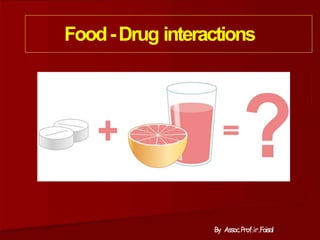
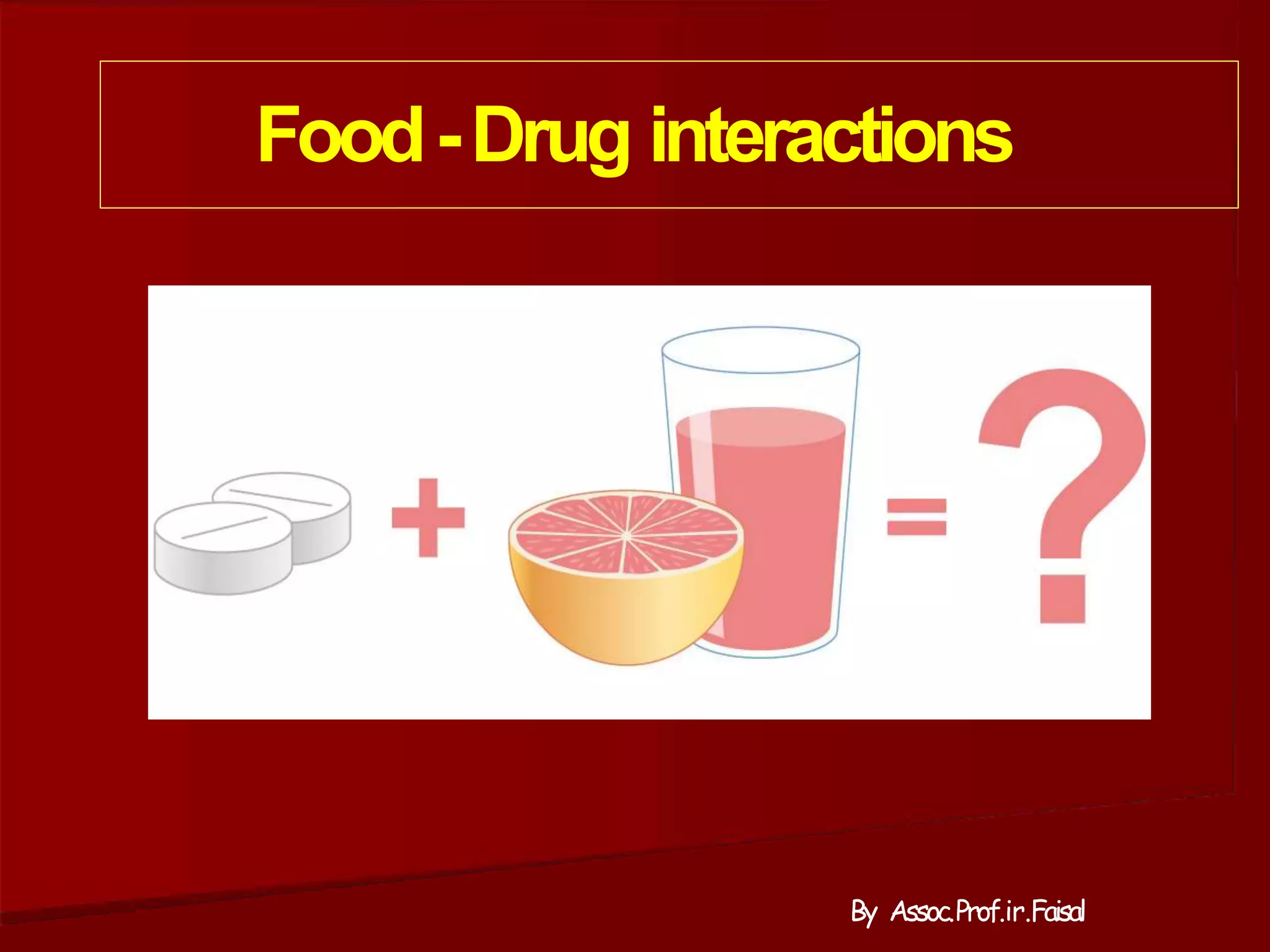
Food-Drug interactions
By Assoc.Prof.ir.Faisal
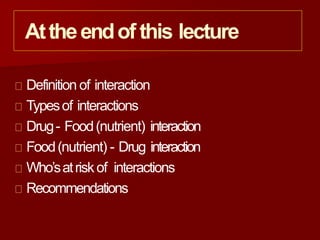
Attheendof this lecture
Definition of interaction
Typesof interactions
Drug- Food(nutrient) interaction
Food(nutrient) - Drug interaction
Who’satriskof interactions
Recommendations
 Should take medicine on an empty stomach (one
hour before eating or 2 hours after) unless advised
otherwise….. If you eat breakfast at 8 a.m.,
wait until 10 a.m. to take your pills.
As a general rule………..
 Why should we do that?
 This is because many medicines can be
affected by what you eat and when you eat it.
The presence of food in the digestive tract
can interfere with the absorption of certain
medications.
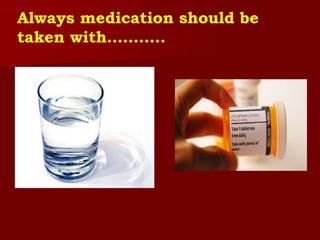
Always medication should be
taken with………..
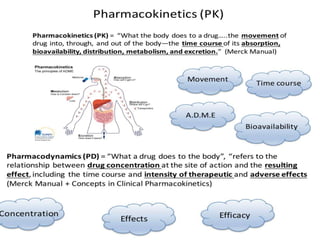
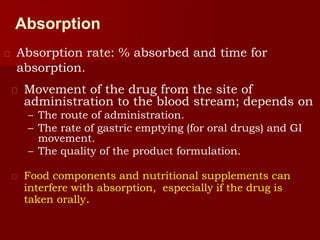
Absorption
 Absorption rate: % absorbed and time for
absorption.
 Movement of the drug from the site of
administration to the blood stream; depends on
– The route of administration.
– The rate of gastric emptying (for oral drugs) and GI
movement.
– The quality of the product formulation.
 Food components and nutritional supplements can
interfere with absorption, especially if the drug is
taken orally.
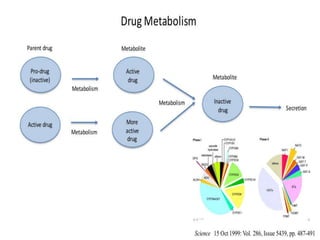
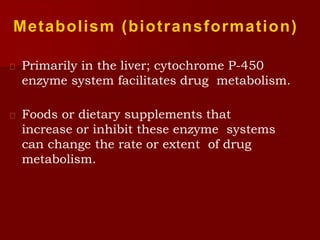
Metabolism (biotransformation)
 Primarily in the liver; cytochrome P-450
enzyme system facilitates drug metabolism.
 Foods or dietary supplements that
increase or inhibit these enzyme systems
can change the rate or extent of drug
metabolism.
Definition of interaction
Interactionhappenswhennutrientaffects theactive
materialin amedicine,sothe medicine cannot work
the way it should.
Orwhendrugaffectsnutrient metabolism.
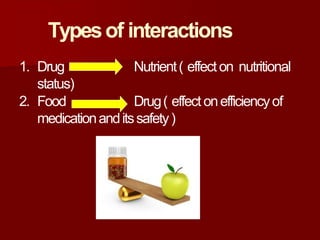
Typesof interactions
1. Drug Nutrient( effecton nutritional
status)
2. Food Drug( effect onefficiencyof
medicationanditssafety)
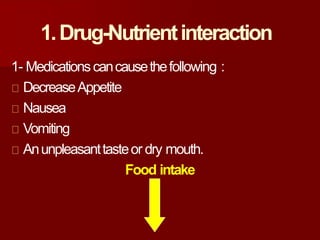
1.Drug-Nutrientinteraction
1- Medicationscancausethefollowing :
DecreaseAppetite
Nausea
Vomiting
Anunpleasanttasteor dry mouth.
Food intake
Drug-NutrientInteraction
Medications,bothprescriptionor OTC, canaffect
howthebodyuses nutrients.
For individualtakingmedicationfor alongtime,drug-
nutrient interactionsmaylead tovitamin ormineral
deficiencies.
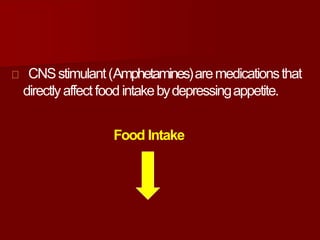
CNSstimulant(Amphetamines)aremedicationsthat
directlyaffect food intakebydepressingappetite.
Food Intake
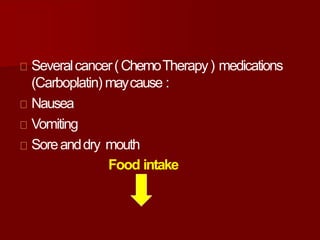
Severalcancer(ChemoTherapy) medications
(Carboplatin) maycause :
Nausea
Vomiting
Soreanddry mouth
Food intake
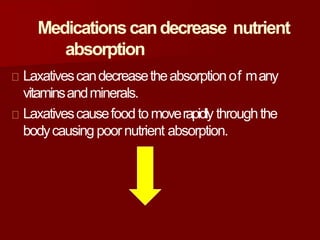
Medicationscandecrease nutrient
absorption
Laxativescandecreasetheabsorptionof many
vitaminsandminerals.
Laxativescausefoodtomoverapidly throughthe
bodycausing poornutrient absorption.
Aluminumhydroxidecontainsin some antacids
can bindtophosphorusin food.
This canpreventphosphorustofrom being
absorbedandusedbythebones causing
muscleweaknessandsevere casescancause
osteomalaciaandsevere painon walking.
Medicationscanslow down nutrient
production
VitaminKis producedbybacteriain theintestines.
Antibioticskill harmfulbacteria,buttheycanalsokill
helpful bacteriawhichis reponsiblefor vitaminK
production.
Medicationscanincreasealossof a
nutrient
Diuretics ( Lasixor Furosomide) remove excess
waterfromthebody.Some diureticsmayalso
increaselossof potassiumalongwith fluids.
Potassiumis veryimportantin proper functioning
of heartandother muscles.
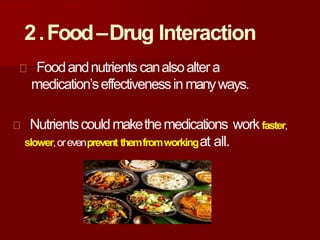
2.Food–Drug Interaction
Foodandnutrientscanalsoaltera
medication’seffectivenessin manyways.
Nutrientscouldmakethemedications workfaster,
slower,orevenprevent themfromworkingat all.
Drugsareabsorbedmorequicklyinto th
ebody
whenthestomachis empty.
Havingfoodin thestomachwill slowdowna
medication’sabsorption.
Sometimesamedicationshouldbetakenwith
food.
Foodcanincreaseor decreasetheabsorption
of a drug.
Absorbing─ thantheintendeddosemay decrease
theeffectof the drug.
Absorbing+ thantheintendeddose increases
the chance for an overdose effect….(e.g.,
toxicity)
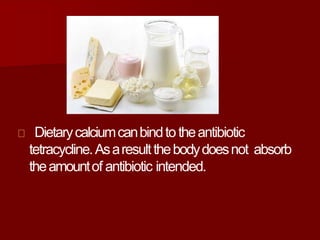
Dietarycalciumcanbindtotheantibiotic
tetracycline.Asaresultthebodydoesnot absorb
theamountof antibiotic intended.
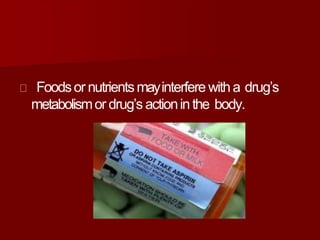
Foodsor nutrientsmayinterfere witha drug’s
metabolismor drug’s actioninthe body.
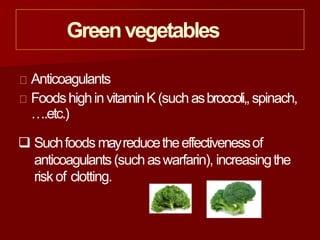
Greenvegetables
Anticoagulants
Foodshighin vitaminK(suchasbroccoli,,spinach,
….etc.)
 Suchfoods mayreducetheeffectivenessof
anticoagulants(suchaswarfarin), increasingthe
riskof clotting.
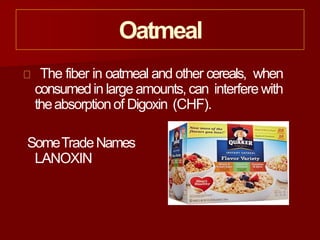
Oatmeal
The fiber in oatmeal and other cereals, when
consumedin largeamounts, can interfere with
theabsorptionof Digoxin (CHF).
SomeTradeNames
LANOXIN
Acidicdrinks,juices, andfoods may produceexcessstomach
aciditywhich may:
Destroythe medication.
Causethemedicationtodissolvein thestomachinsteadof the
intestine.
Compounds in tea called tannins can act as
chelators, binding to minerals and inhibiting the
body's ability to absorb them. Phytates,calcium
and anti-acids also block iron absorption.
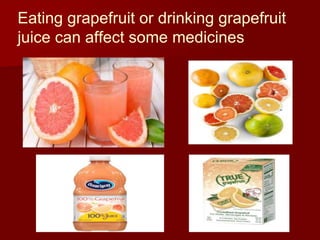
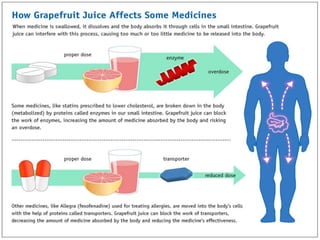
Eating grapefruit or drinking grapefruit
juice can affect some medicines
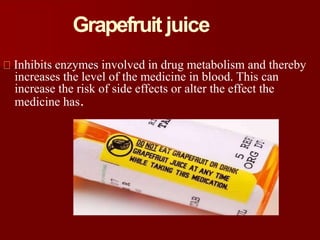
Grapefruit juice
Inhibits enzymes involved in drug metabolism and thereby
increases the level of the medicine in blood. This can
increase the risk of side effects or alter the effect the
medicine has.
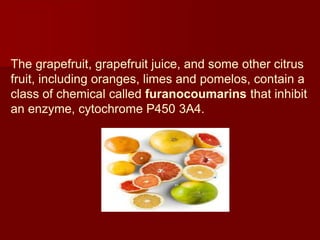
The grapefruit, grapefruit juice, and some other citrus
fruit, including oranges, limes and pomelos, contain a
class of chemical called furanocoumarins that inhibit
an enzyme, cytochrome P450 3A4.
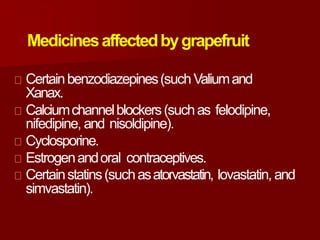
Medicinesaffectedbygrapefruit
Certainbenzodiazepines(suchValiumand
Xanax.
Calciumchannelblockers(suchas felodipine,
nifedipine, and nisoldipine).
Cyclosporine.
Estrogenandoral contraceptives.
Certainstatins(suchasatorvastatin, lovastatin, and
simvastatin).
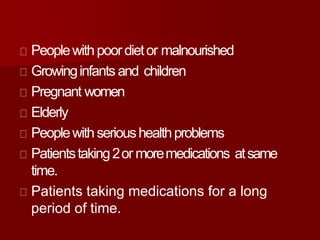
Who’satrisk?
Somepeople maybeatgreater risk o
f drug-nutrient
interactions that others. Those can include the
following:
Peoplewithpoordietor malnourished
Growinginfants and children
Pregnant women
Elderly
Peoplewithserioushealthproblems
Patientstaking2or moremedications atsame
time.
Patients taking medications for a long
period of time.
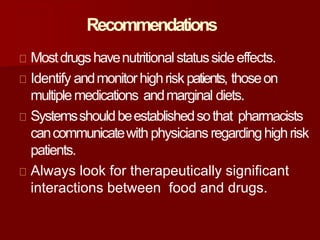
Recommendations
Mostdrugshavenutritionalstatussideeffects.
Identify andmonitorhighriskpatients, thoseon
multiplemedications andmarginal diets.
Systemsshouldbeestablishedsothat pharmacists
cancommunicatewith physicians regardinghighrisk
patients.
Always look for therapeutically significant
interactions between food and drugs.
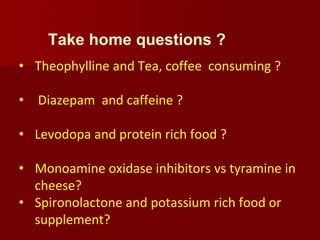
Take home questions ?
• Theophylline and Tea, coffee consuming ?
• Diazepam and caffeine ?
• Levodopa and protein rich food ?
• Monoamine oxidase inhibitors vs tyramine in
cheese?
• Spironolactone and potassium rich food or
supplement?
Thankyou

Food - Drug interactions.pptx