VISCOSITY
Viscosity
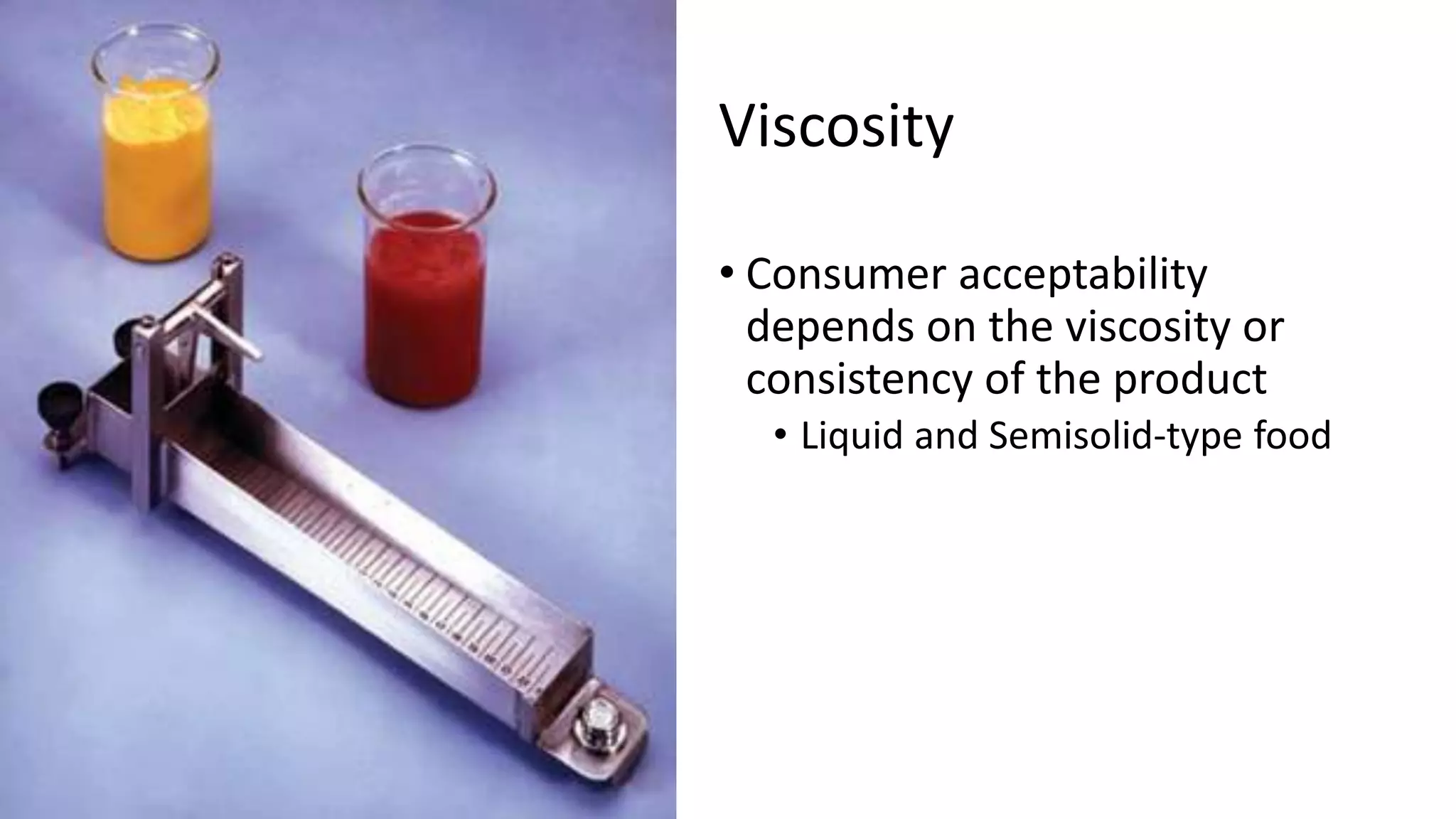
• Consumer acceptability
depends on the viscosity or
consistency of the product
• Liquid and Semisolid-type food
• Viscosity of a solution relates to its resistance to flow under an
applied force or shear stress
• Ideal solution
• The shear stress is directly proportional to the shear rate
𝑭
𝑨
= 𝜼
𝒅𝒗
𝒅𝒓
• Proportional constant (Viscosity Coefficient)
• Fluid that obey this expression are called Newtonian fluids
• Flow behavior of solutions is
greatly influenced by solute type
• High-molecular-weight soluble
polymers greatly increase viscosity
even at very low temperature
Molecular Properties
1. Size
2. Shape
3. Flexibility
4. Hydration
• Solutions of randomly coiled macromolecules have greater viscosity
compare to solutions of compact folded macromolecules
• Most macromolecular solutions do not display Newtonian behavior
• Especially at high protein concentrations
• Viscosity coefficient (η) decreases as the Shear Rate (
𝑑𝑣
𝑑𝑟
) increases
• This behavior is known as Pseudoplastic or Shear thinning
Pseudoplastic
• This behavior arises in protein solutions because of the tendency of
protein molecules to orient their major axis in the direction of the
flow.
• When shearing or flow is stopped, the viscosity may or may not
return to the original value
• Solutions of
• Fibrous proteins remains oriented and do not regain their original
viscosity
• Globular proteins rapidly regains their viscosity (Thixotropic)
• At high protein concentrations or in protein gels, where
protein-protein unteractions are numerous and strong,
proteins display plastic viscoelastic behavior
• specific amount of force, known as “yield stress,” is required to
initiate flow
• Viscosity behavior of proteins is a manifestation of complex
interactions among several variables
• Size
• Shape
• Protein-solvent Interactions
• Hydrodynamic volume
• Molecular flexibility
• When dissolved in water proteins absorbs water and swell
• Volume of the hydrated molecule (size and volume) is larger
compare to their unhydrated size or volume
• Protein–associated water induces long-range effects of the
flow behavior
• The greater the specific volume of the protein = greater
flexibility
•The viscosity of dilute protein solutions is expressed in
several ways
• Relative viscosity
• Ostwald-Fenske type capillary viscometer
• Specific viscosity
• Reduced viscosity
• Intrinsic viscosity

Food Chemistry - Viscosity

  • 1.
  • 2.
    Viscosity • Consumer acceptability dependson the viscosity or consistency of the product • Liquid and Semisolid-type food
  • 4.
    • Viscosity ofa solution relates to its resistance to flow under an applied force or shear stress • Ideal solution • The shear stress is directly proportional to the shear rate 𝑭 𝑨 = 𝜼 𝒅𝒗 𝒅𝒓 • Proportional constant (Viscosity Coefficient) • Fluid that obey this expression are called Newtonian fluids
  • 5.
    • Flow behaviorof solutions is greatly influenced by solute type • High-molecular-weight soluble polymers greatly increase viscosity even at very low temperature
  • 6.
    Molecular Properties 1. Size 2.Shape 3. Flexibility 4. Hydration
  • 7.
    • Solutions ofrandomly coiled macromolecules have greater viscosity compare to solutions of compact folded macromolecules • Most macromolecular solutions do not display Newtonian behavior • Especially at high protein concentrations • Viscosity coefficient (η) decreases as the Shear Rate ( 𝑑𝑣 𝑑𝑟 ) increases • This behavior is known as Pseudoplastic or Shear thinning
  • 8.
    Pseudoplastic • This behaviorarises in protein solutions because of the tendency of protein molecules to orient their major axis in the direction of the flow. • When shearing or flow is stopped, the viscosity may or may not return to the original value • Solutions of • Fibrous proteins remains oriented and do not regain their original viscosity • Globular proteins rapidly regains their viscosity (Thixotropic)
  • 9.
    • At highprotein concentrations or in protein gels, where protein-protein unteractions are numerous and strong, proteins display plastic viscoelastic behavior • specific amount of force, known as “yield stress,” is required to initiate flow
  • 10.
    • Viscosity behaviorof proteins is a manifestation of complex interactions among several variables • Size • Shape • Protein-solvent Interactions • Hydrodynamic volume • Molecular flexibility
  • 11.
    • When dissolvedin water proteins absorbs water and swell • Volume of the hydrated molecule (size and volume) is larger compare to their unhydrated size or volume • Protein–associated water induces long-range effects of the flow behavior • The greater the specific volume of the protein = greater flexibility
  • 12.
    •The viscosity ofdilute protein solutions is expressed in several ways • Relative viscosity • Ostwald-Fenske type capillary viscometer • Specific viscosity • Reduced viscosity • Intrinsic viscosity

Editor's Notes

  • #8 Macromolecular solution including protein solutions
  • #9 Fibrous proteins: gelatin and actomyosin Globular proteins: Soy and whey proteins
  • #11 Hydrated state